

Roughly one in twelve homes currently listed for sale across Northern England was built using a system-built or precast concrete frame method between 1965 and 1979 — and the vast majority have never undergone a specialist structural assessment. As thousands of these properties re-enter the resale market in 2026, buyers, lenders, and solicitors are increasingly confronted with a category of building that standard mortgage valuations simply cannot adequately assess. Building Surveys for 1970s Concrete Frame Properties: Defect Checklists for Rot, Cracking, and Asbestos in 2026 is no longer a niche professional topic — it is a mainstream buyer-protection issue with significant financial consequences.
This guide sets out exactly what a RICS Level 3 building survey should cover for these properties, which defects matter most, and how to interpret findings before committing to a purchase.
Key Takeaways 📋
- 1970s concrete frame homes carry unique risks that standard surveys and mortgage valuations routinely miss, including carbonation-driven cracking, hidden asbestos, and embedded timber rot.
- Mortgageability is a live concern: unrepaired precast reinforced concrete (PRC) properties are refused by most mainstream lenders unless certified remediation has been completed [1].
- A RICS Level 3 (Full Building Survey) is the minimum appropriate survey type for any concrete frame property from this era — a Level 2 is inadequate.
- Asbestos-containing materials (ACMs) were used extensively in 1970s construction and must be professionally identified before any intrusive survey work begins.
- Remediation costs can run into tens of thousands of pounds, making pre-purchase survey investment one of the highest-return decisions a buyer can make.
Why 1970s Concrete Frame Properties Demand Specialist Attention
The post-war housing boom that stretched into the 1970s produced an enormous stock of homes built using industrialised construction methods. Councils and developers turned to precast concrete panels, no-fines concrete, and large-panel system (LPS) construction to deliver housing quickly and at scale. Designs included well-documented types such as Wates, Reema hollow panel, Cornish Unit, Myton, Stent, and Tarran — each with distinct structural characteristics and failure modes [2].
These buildings are now between 45 and 55 years old. Many are approaching or have exceeded the maintenance cycles their original designers anticipated. Carbonation — the process by which atmospheric carbon dioxide reacts with calcium hydroxide in concrete, reducing its alkalinity — is the central long-term threat. Once carbonation reaches the depth of the steel reinforcement, corrosion begins. Corroding steel expands, causing the concrete cover to crack and spall. This process is largely invisible until it is well advanced [2].
💬 "The structural condition of pre-1960s PRC house types shows reinforced concrete components gradually deteriorating through carbonation and corrosion of steel reinforcement, leading to cracking — a pattern confirmed by Building Research Establishment investigations." [2]
While that research focused on pre-1960s stock, the same chemical processes apply to 1970s concrete frame construction, often at a slightly later stage of progression. Understanding building pathology — the science of how buildings deteriorate — is essential for any surveyor assessing these properties.
The Northern England Market Context in 2026
Transaction volumes for 1970s system-built homes have risen sharply in parts of Yorkshire, Greater Manchester, and the North East, driven by relative affordability compared to brick-built stock. This is creating a buyer pool that often lacks awareness of the specialist risks involved. Many first-time buyers are purchasing these properties without understanding that their chosen mortgage product may be declined at underwriting stage — after survey costs and legal fees have already been incurred [1].
Building Surveys for 1970s Concrete Frame Properties: The RICS Level 3 Protocol
For any property built using non-standard construction methods, a RICS Level 3 Full Building Survey is the minimum appropriate inspection. A Level 2 HomeBuyer Report is designed for conventional construction in reasonable condition — it is structurally inadequate for concrete frame assessment. If there is any doubt about which survey level is needed, the answer for 1970s concrete frame is always Level 3.
A Level 3 survey should include:
- Full visual inspection of all accessible concrete elements
- Crack mapping with notation of crack width, pattern, and orientation
- Carbonation depth testing (phenolphthalein indicator test) where intrusive access is permitted
- Moisture content readings across all ground-floor and below-DPC zones
- Identification of asbestos-containing materials (with referral to a licensed asbestos surveyor)
- Assessment of embedded timber within concrete panel systems
- Review of any previous repair or remediation certificates
A full building survey for a property of this type typically takes longer than a standard residential inspection. Buyers should be aware that survey duration for complex non-standard properties can run to a full day or more.
What the Survey Should NOT Omit
Some concrete frame types require cavity access or render removal to properly assess the condition of structural components. Survey practice distinguishes between types where cracking is visible externally (such as Cornish Unit, Dorran, Myton, Newland, Reema hollow panel, Stent, Tarran, and Wates) and those where the concrete condition can only be assessed by opening up (including Airey, Orlit, and Boot pier and panel types) [2]. A surveyor who does not record this distinction — and does not flag the need for further investigation — has produced an incomplete report.
The Defect Checklist: Rot, Cracking, and Asbestos in 2026

The three headline defect categories for Building Surveys for 1970s Concrete Frame Properties: Defect Checklists for Rot, Cracking, and Asbestos in 2026 are structural cracking, embedded timber rot, and asbestos-containing materials. Each requires a distinct inspection approach and carries different remediation implications.
🔍 Structural Cracking: What to Look For
Cracking in concrete frame properties is not automatically structural — but it must be assessed systematically. The following table sets out the key crack types and their significance:
| Crack Type | Typical Appearance | Likely Cause | Urgency |
|---|---|---|---|
| Hairline map cracking | Fine network across panel face | Shrinkage or carbonation onset | Monitor — low immediate risk |
| Horizontal cracking at panel joints | Linear, following mortar bed | Differential movement or settlement | Investigate — moderate risk |
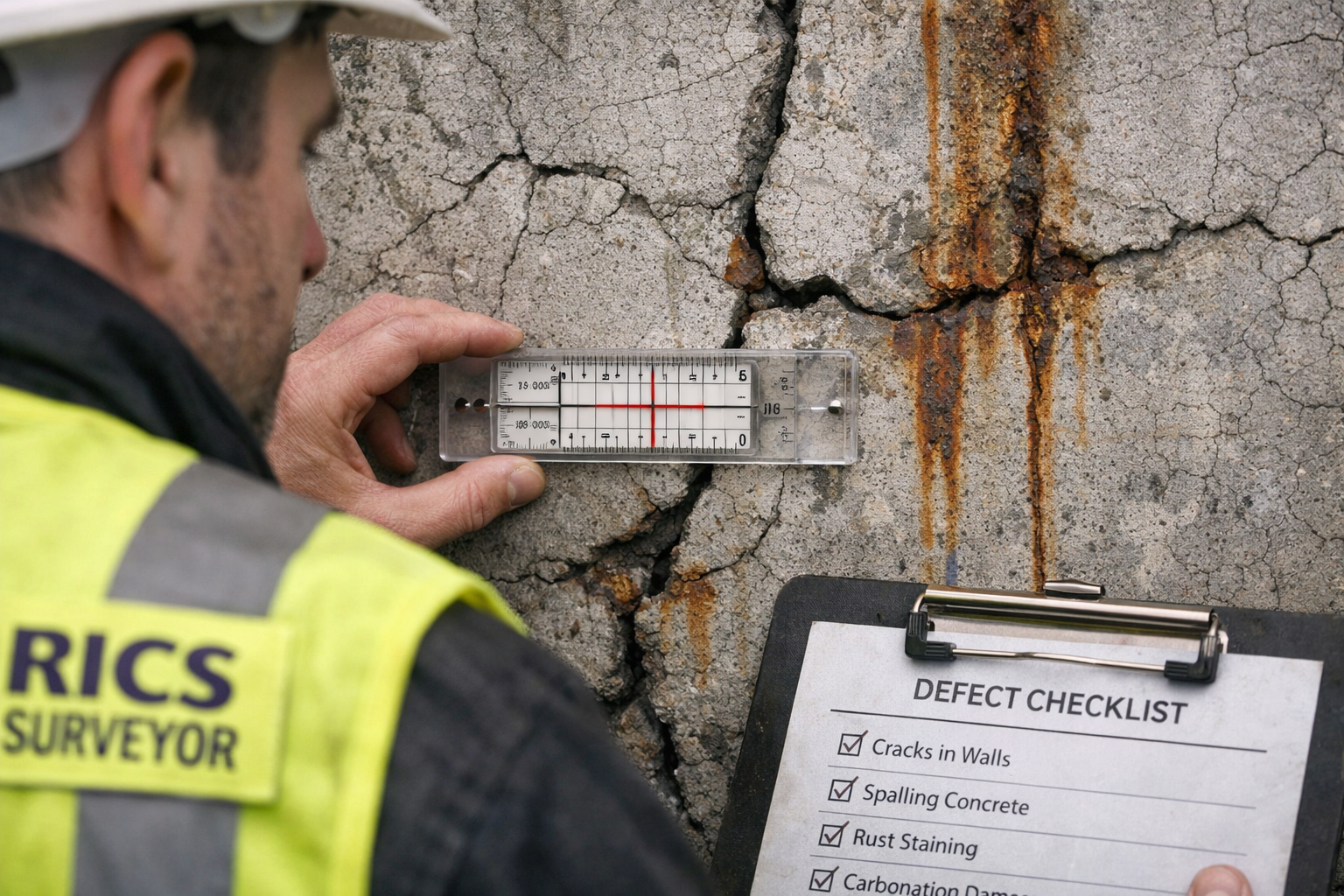
| Rust-stained cracking | Brown staining along crack line | Rebar corrosion in progress | Urgent — structural concern |
| Spalling concrete | Chunks detaching from surface | Advanced carbonation + rebar corrosion | Immediate action required |
| Diagonal cracking at corners | 45° from window/door openings | Subsidence or differential settlement | Structural engineer referral |
Rust-stained cracking is the most critical indicator. It confirms that carbonation has reached the reinforcement and active corrosion is underway. Remediation at this stage typically involves concrete repair, rebar treatment, and protective coating — costs that can range from £5,000 to £30,000+ depending on extent [6].
Surveyors should also assess stresses on structural members in commercial and residential buildings when reviewing load-bearing concrete elements — the principles of stress distribution are directly relevant to panel system assessment.
🪵 Embedded Timber Rot: The Hidden Risk
Many 1970s concrete frame systems incorporated timber elements — window frames, floor cassettes, internal partitions, and roof structures — that were cast into or built directly against concrete panels. Where moisture has penetrated panel joints or failed sealants, these timber elements are frequently found to be in an advanced state of wet rot or dry rot.
Key inspection points for embedded timber:
- ✅ Window and door frame perimeters — check for soft, discoloured, or spongy timber
- ✅ Ground floor cassette edges where concrete meets floor structure
- ✅ Roof plate and wall plate junctions in panel-to-roof connections
- ✅ Any timber built into panel chases or rebates
- ✅ Internal partition bases at ground floor level
Dry rot (Serpula lacrymans) is particularly aggressive and can spread through masonry and concrete, meaning a localised timber infection can affect a much wider area than is visually apparent. Remediation requires complete removal of affected timber, treatment of surrounding materials, and improvement of ventilation — costs can be substantial and must be factored into any purchase negotiation. For guidance on how to negotiate a house price down after survey findings, specialist advice is recommended.
⚠️ Asbestos: The Non-Negotiable Hazard
Asbestos was used extensively in UK construction throughout the 1970s. In concrete frame properties of this era, asbestos-containing materials (ACMs) are commonly found in:
- Ceiling tiles (particularly in kitchens and bathrooms)
- Floor tiles and adhesive (vinyl asbestos tiles were standard)
- Artex and textured coatings on ceilings
- Pipe lagging and boiler insulation
- Soffit boards and external panels
- Roofing sheets (particularly on garages and outbuildings)
- Insulating board around boilers and in airing cupboards
⚠️ Critical point: A building surveyor is not a licensed asbestos inspector. A RICS Level 3 survey should identify suspected ACMs and recommend a separate asbestos management survey (Type 2) or refurbishment/demolition survey (Type 3) carried out by a licensed specialist. Any intrusive survey work — including opening up of cavities or panels — must be preceded by asbestos assessment.
The Control of Asbestos Regulations 2012 places a legal duty on property owners to manage asbestos. For buyers, the presence of ACMs in a property does not automatically make it uninhabitable — encapsulated, undisturbed asbestos in good condition can be managed in situ. However, any planned renovation work changes the risk profile entirely, and remediation costs for widespread ACM removal can reach £10,000–£50,000 for a typical 1970s property [6].
Mortgageability, Remediation, and What Happens After the Survey

The Lender Problem
Mainstream mortgage lenders in 2026 remain deeply cautious about concrete frame properties. Precast reinforced concrete homes that have not undergone an approved repair scheme — such as those certified under the PRC Homes Ltd scheme or equivalent — are refused by most high-street banks [1]. This is not simply a valuation issue; it affects the fundamental mortgageability of the property.
Properties that fall into this category include:
- Unrepaired PRC homes of any listed type
- Timber-framed houses built between 1945–1970
- Properties with fully insulated cavities regardless of age [5]
For buyers relying on mortgage finance, the survey outcome directly determines whether the purchase can proceed. A building materials assessment that confirms non-standard construction without evidence of approved remediation is likely to trigger a lender decline.
Remediation Options and Costs
Where defects are identified, the survey report should outline areas requiring further investigation and provide a framework for remediation priorities. The main options are:
| Remediation Route | Description | Approximate Cost Range |
|---|---|---|
| PRC repair scheme | Full structural overhaul to approved specification, enabling mortgage | £25,000–£45,000 |
| Concrete repair and protection | Localised crack repair, rebar treatment, protective coating | £5,000–£30,000 |
| Asbestos encapsulation | Sealing ACMs in situ where in good condition | £1,000–£5,000 |
| Asbestos removal | Full licensed removal of ACMs | £10,000–£50,000+ |
| Timber rot treatment | Removal, treatment, and replacement of affected timber | £2,000–£20,000 |
These figures are indicative for 2026 and will vary significantly by region, extent of defects, and contractor. Northern England costs are generally 10–20% below the national average, but specialist concrete repair contractors are less numerous, which can affect pricing.
Using Survey Findings in Negotiation
A detailed Level 3 survey report is a powerful negotiating tool. Buyers who receive reports identifying significant defects have legitimate grounds to renegotiate the purchase price, request remediation before exchange, or withdraw entirely. The key is to obtain specialist contractor quotes before entering negotiation — a surveyor's estimate of remediation cost is a starting point, not a final figure.
💡 Pro tip: Ask the surveyor to categorise defects by urgency (immediate action, short-term, long-term monitoring) and by cost band. This structures the negotiation and prevents sellers from dismissing the report as vague.
Frequently Asked Questions
Q: Can a Level 2 survey cover a 1970s concrete frame property?
A: Technically yes, but it is strongly inadvisable. A Level 2 survey is not designed to assess non-standard construction and will not provide the depth of investigation needed. Always commission a Level 3 for concrete frame properties [3].
Q: How long do concrete frame buildings actually last?
A: Modern precast concrete structures are designed for approximately 150-year lifespans [4]. 1970s stock was built to lower specifications, but well-maintained examples with no significant carbonation or corrosion can remain structurally sound for many decades. The key variable is maintenance history.
Q: Is asbestos always a deal-breaker?
A: No. Managed asbestos in good condition is legally acceptable and common in properties of this age. It becomes a deal-breaker only if the buyer plans extensive renovation, if ACMs are in poor condition, or if removal costs are disproportionate to the property value.
Q: What is a PRC certificate and why does it matter?
A: A PRC certificate confirms that a property has been repaired to an approved structural specification, restoring its mortgageability. Without one, most lenders will decline. Buyers should verify that any certificate is genuine and relates to the specific property being purchased [1].
Conclusion: Actionable Next Steps for Buyers in 2026
The resurgence of 1970s concrete frame properties in the Northern England market makes specialist survey knowledge more important than ever. Building Surveys for 1970s Concrete Frame Properties: Defect Checklists for Rot, Cracking, and Asbestos in 2026 is not a bureaucratic exercise — it is the primary mechanism by which buyers protect themselves from purchasing a property with hidden structural, health, and financial risks.
Here is what to do next:
- Confirm construction type early — ask the estate agent or vendor for original build records or planning documents before instructing a survey.
- Commission a RICS Level 3 Full Building Survey from a chartered surveyor with documented experience in non-standard construction.
- Request an asbestos management survey as a separate instruction, to run alongside or immediately before any intrusive survey work.
- Check mortgageability with your lender before exchange — do not assume a property is mortgageable because it has been sold before.
- Use the survey report to negotiate — obtain contractor quotes for all Category 1 and Category 2 defects before making a revised offer.
- Do not proceed without a PRC certificate if the property is a listed PRC type and the vendor cannot produce one.
The cost of a thorough Level 3 survey — typically £600–£1,200 for a 1970s concrete frame property — is negligible against the potential cost of unidentified defects. In 2026, with remediation costs rising and lender scrutiny increasing, it remains the single most valuable investment a buyer of these properties can make.
References
[1] What You Should Know About Non Standard Construction Types – terracottaproperty.com
[2] The Structural Condition Of Pre 1960s Prc House Types – nonstandardhouse.com
[3] Which Survey Is Best For Older Homes – surveymatch.co.uk
[4] The Fifty Year Myth – ark.fi
[5] Houses Of Non Traditional Construction Common Property Defects 6 – peterbarry.co.uk
[6] Building Survey Defects In 1960s 1980s Housing Stock Identifying Hidden Issues Before Purchase – nottinghillsurveyors.com