

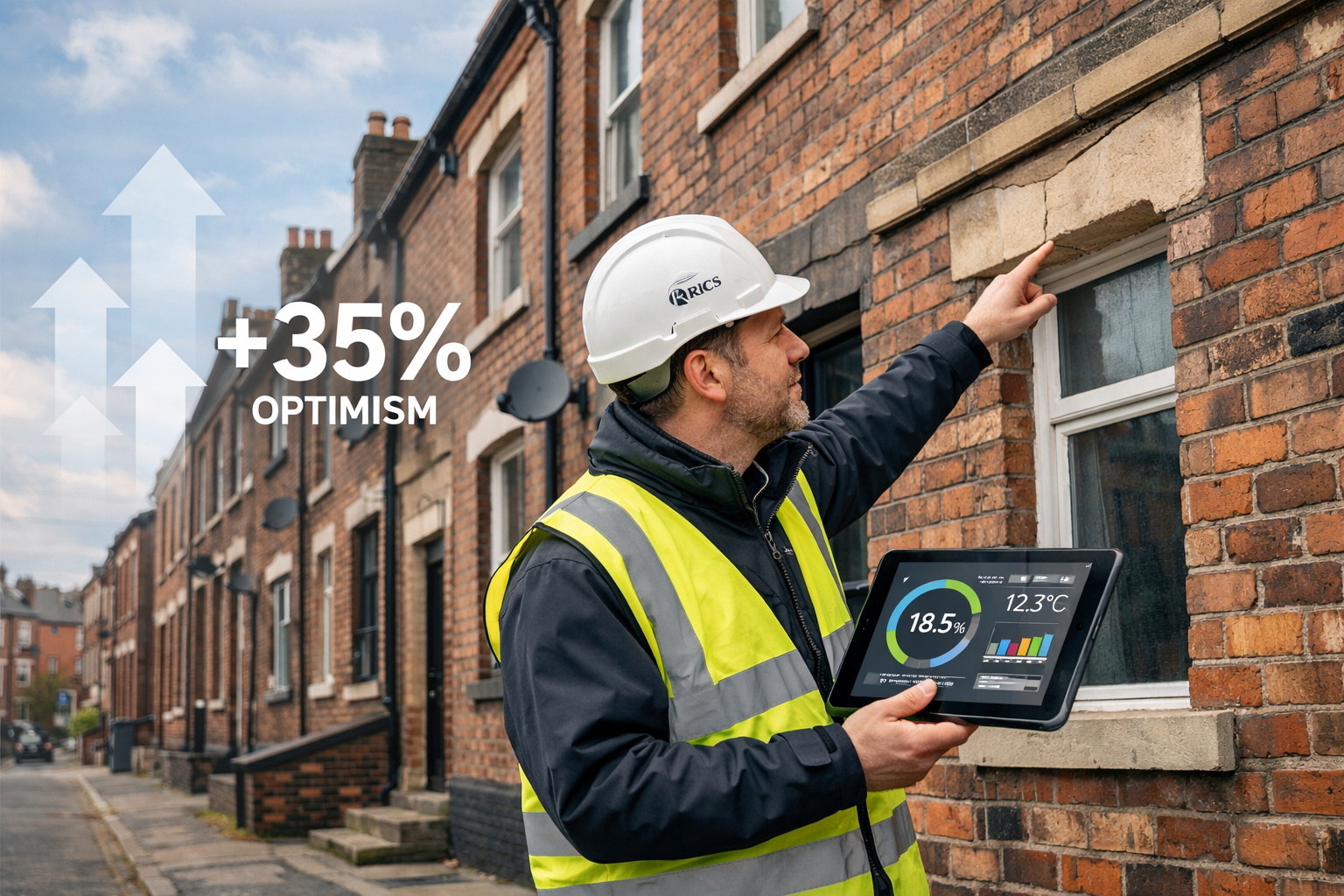
Northern England's housing market is outpacing the South at a rate not seen in over a decade — and surveyors are scrambling to keep up. With RICS January 2026 data showing a remarkable +35% net balance of optimism for sales and +43% for price expectations, the Spring 2026 housing market recovery: building survey protocols for surging northern transactions and regional divergences has become one of the most pressing topics for property professionals, buyers, and sellers alike. Understanding what this means — and how to navigate it with the right survey strategy — could be the difference between a smooth transaction and a costly mistake.
Key Takeaways
- 🏡 Northern transaction volumes are surging in spring 2026, driven by improved affordability and rising seller confidence, while London and the South East continue to lag.
- 📋 Building survey protocols must adapt to high-volume market conditions — rushed timelines increase the risk of missed defects.
- 📊 National inventory is still 13.8% below pre-pandemic baselines, meaning competition remains fierce and due diligence is more critical than ever.
- 🔍 Level 3 full building surveys are strongly recommended for older Northern stock, particularly Victorian and Edwardian terraces common in cities like Manchester, Leeds, and Liverpool.
- ⚠️ Regional divergence is real: some markets are seeing inventory surges while others contract, requiring location-specific survey and valuation strategies.
The State of the Spring 2026 Housing Market Recovery
The numbers tell a compelling story. Nationwide, home sales are forecast to rise 14% in 2026, representing a significant rebound from 2025's sluggish activity [1]. Mortgage applications surged 31% higher year-over-year in early 2026, signalling that buyers who sat on the fence are finally moving [1]. Pending sales climbed 3.9% year-over-year in March 2026 — the third consecutive month of annual gains — even as mortgage rates and economic uncertainty persisted [2].
New listings jumped 21.2% from February to March 2026, well above the historical seasonal norm of 18%, suggesting sellers are growing more confident [2]. The median listing price settled at $415,450 in March 2026, down 2.2% year-over-year but still 35.9% above pre-pandemic March 2019 levels [2].
💬 "The spring 2026 market is not a simple recovery — it is a restructuring. Buyers, sellers, and surveyors all need to recalibrate their expectations based on where they are, not where the national average sits."
Mortgage rates are expected to average around 6% in 2026, down from approximately 6.7% in 2025, providing incremental affordability relief [1]. New-home sales are projected to rise 5%, as builders continue adding supply to address persistent shortfalls [1].
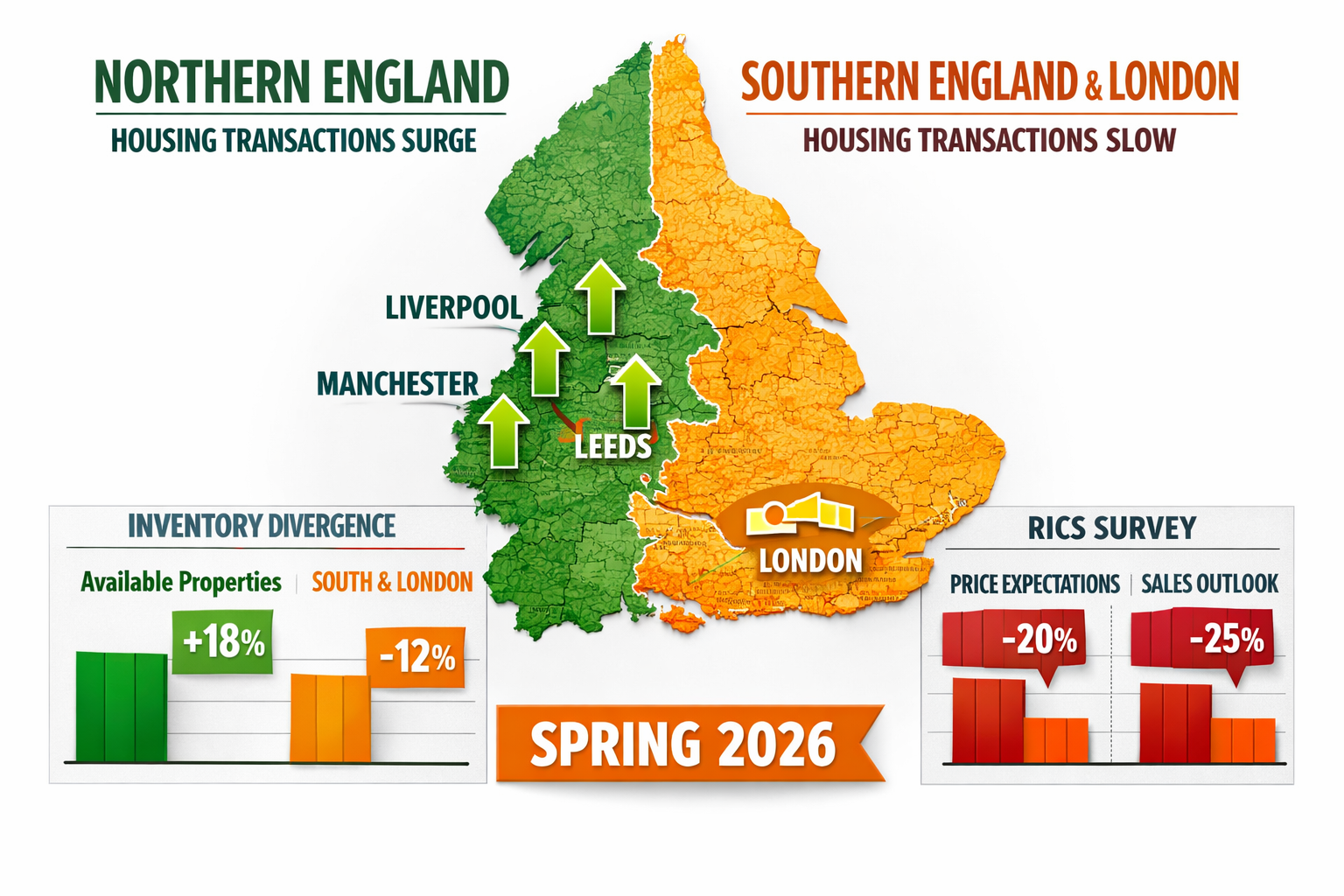
For UK buyers, the RICS January 2026 survey data mirrors this optimism. The North West, Yorkshire, and the Humber are leading the charge, with estate agents and surveyors reporting transaction queues not seen since the stamp duty holiday era.
Regional Divergences: Why Northern Markets Are Outperforming
The Spring 2026 housing market recovery is not uniform — and that is precisely the challenge for building survey protocols for surging northern transactions and regional divergences.
The North-South Split in 2026
In the US market, cities like Seattle (+42.5% active listings YoY), Louisville (+34.0%), and Indianapolis (+27.0%) are leading inventory growth [2]. Meanwhile, inventory is actually declining in markets including Orlando, Jacksonville, Hartford, San Francisco, Miami, and Chicago [2]. This pattern closely mirrors what RICS data shows in the UK: Northern cities are gaining momentum while London and parts of the South East remain constrained.
Why is the North outperforming?
| Factor | North West / Yorkshire | London / South East |
|---|---|---|
| Average property price | Lower — more accessible | High — affordability barrier |
| Price growth forecast | Strong (+43% price expectation balance) | Subdued |
| Inventory growth | Rising sharply | Flat or declining |
| First-time buyer activity | High | Suppressed |
| Investor interest | Growing | Cautious |
The upper end of the market is also performing strongly, with sales in the $750,000–$1 million range experiencing some of the largest gains nationally [1]. In UK terms, this reflects growing demand for premium Northern properties — particularly in Manchester's city fringe and Leeds' desirable suburbs — as buyers seek value compared to equivalent London stock.
National inventory remains 13.8% below the 2017–2019 pre-pandemic baseline as of March 2026, an improvement from 16.8% the previous month [2]. This tightening supply environment makes thorough property surveys not just advisable but essential.
For those considering property investment in the South, chartered surveyors in South East London can provide region-specific guidance on navigating a more constrained market.
Price Forecasts and What They Mean for Buyers
NAR forecasts a 4% median home-price gain nationally in 2026, with no danger of price declines despite localised inventory surges [1]. For UK buyers in surging Northern markets, this translates to a clear message: waiting is unlikely to produce significant price drops, but moving quickly without proper due diligence carries its own risks.
Spring 2026 Housing Market Recovery: Building Survey Protocols for Surging Northern Transactions and Regional Divergences
When transaction volumes surge, the pressure on surveyors intensifies. Timelines compress. Buyers rush. And defects get missed. The Spring 2026 housing market recovery: building survey protocols for surging northern transactions and regional divergences demands a structured, disciplined approach — especially given the age and condition of much of the housing stock in Northern England.

Choosing the Right Survey Level
The first and most critical decision is selecting the appropriate survey type. Not all properties — and not all markets — are equal.
Understanding which building survey you need is the foundation of sound due diligence. In brief:
- Level 1 (Condition Report): Suitable only for new-builds or properties in excellent condition. Rarely appropriate in Northern markets where Victorian and Edwardian stock dominates.
- Level 2 (HomeBuyer Report): Appropriate for conventional properties in reasonable condition. Covers visible defects but does not include structural calculations. Learn more about what's in a Level 2 survey.
- Level 3 (Full Building Survey): The gold standard for older, larger, or non-standard properties. Strongly recommended for terraced housing, stone-built properties, and anything pre-1920. See the full breakdown in this Level 2 vs Level 3 survey guide.
🔑 Rule of thumb for 2026 Northern markets: If the property is over 50 years old, has been extended, or sits in a high-transaction-volume area, opt for a Level 3 full building survey. The cost is modest compared to the risk of undetected structural issues.
The Surveyor's Checklist for High-Volume Northern Transactions
In a fast-moving market, surveyors and buyers alike benefit from a structured protocol. Here is a practical checklist tailored to the Spring 2026 Northern market conditions:
Pre-Instruction Phase ✅
- Confirm surveyor is RICS-accredited and locally experienced
- Verify availability — high-demand periods cause booking backlogs
- Clarify how long the building survey will take and factor into exchange timelines
- Confirm access arrangements with the seller — building surveyor access issues are common in occupied properties
On-Site Inspection Phase ✅
- Roof structure and coverings (pitched roofs are common in Northern terraces — check for common roof defects)
- Damp and moisture assessment — Northern climates increase exposure risk; understand what causes moisture in buildings
- Structural movement and cracking
- Chimney stacks and flashing
- External walls — pointing, render, and stone condition
- Windows, doors, and lintels
- Drainage and guttering
- Internal floors, ceilings, and walls
- Services: electrics, plumbing, heating
Post-Survey Phase ✅
- Review areas of further investigation flagged in the report
- Commission specialist reports where recommended (structural engineer, damp specialist)
- Use survey findings to renegotiate price or request remedial works
- Factor repair costs into mortgage and budget planning
Why Speed Should Never Compromise Thoroughness
One of the biggest risks in a surging market is the pressure to skip or abbreviate surveys to secure a property quickly. This is a false economy. A comprehensive RICS building survey is the single most effective tool a buyer has to avoid inheriting costly problems.
In Northern markets specifically, the prevalence of:
- Back-to-back terraces with shared drainage
- Stone-built properties with historic pointing failures
- Cellar conversions with inadequate waterproofing
- Extended properties with questionable structural modifications
…means that cutting corners on surveys is a risk that regularly costs buyers tens of thousands of pounds in remedial works.
Navigating the 2026 Market: Practical Guidance by Region
For Buyers in the North West and Yorkshire
These markets are moving fastest. Prioritise early survey booking — ideally within 48 hours of offer acceptance. Choose a RICS Level 3 survey for any pre-1970 property. Budget for a 2–3 week turnaround in high-demand periods.
When preparing your property for market in these regions, sellers should address visible defects proactively — buyers in competitive markets are less likely to renegotiate but more likely to withdraw if a survey reveals significant issues.
For Buyers in London and the South East
The market here is more measured. Inventory remains constrained, particularly in prime areas. Chartered surveyors in Berkshire, Buckinghamshire, and Hampshire report steady but not frenzied activity. Here, a Level 2 survey may be appropriate for modern properties, but older stock still warrants full Level 3 coverage.
For Investors and Developers
The upper-price-band outperformance noted by NAR [1] has a clear UK parallel: prime Northern city-centre apartments and suburban family homes are attracting significant investor attention. For those considering development or conversion projects, understanding building materials assessments is critical before committing to any acquisition.
Key Risks to Watch in the Spring 2026 Recovery
Despite the optimism, several risks could disrupt the recovery trajectory:
⚠️ Economic uncertainty: Realtor.com's March 2026 report noted that "tensions cloud a spring market that was just finding its footing" — geopolitical and domestic economic pressures remain real headwinds [2].
⚠️ Mortgage rate sensitivity: While rates are improving, any upward movement from the forecast 6% average could quickly dampen buyer enthusiasm [1].
⚠️ Survey bottlenecks: High transaction volumes are already stretching surveyor capacity. Delays in survey completion can jeopardise exchange and completion timelines.
⚠️ Localised overheating: In markets where inventory has surged rapidly, there is a risk of short-term price volatility as supply temporarily outpaces demand.
⚠️ Hidden defects in older stock: The Northern housing stock, while affordable, often carries deferred maintenance. A rising market can mask these issues until a thorough survey reveals them.
Conclusion: Actionable Next Steps for Spring 2026
The Spring 2026 housing market recovery: building survey protocols for surging northern transactions and regional divergences presents both significant opportunity and meaningful risk. The data is clear — transaction volumes are rising, seller confidence is growing, and Northern markets are leading the charge. But a fast market is not a forgiving market.
Here is what to do right now:
- ✅ Book your surveyor early. High-demand periods create backlogs. Do not wait until after offer acceptance to research survey options.
- ✅ Choose the right survey level. For any pre-1970 Northern property, a Level 3 full building survey is the appropriate choice. Use the complete guide to choosing the right property survey to confirm your decision.
- ✅ Use survey findings strategically. A thorough report gives buyers negotiating power and sellers the chance to address issues before they derail a sale.
- ✅ Understand regional dynamics. Whether buying in Manchester, Leeds, London, or the South East, local market conditions should drive your survey and valuation strategy.
- ✅ Do not let market excitement override due diligence. The properties that cause the most financial pain are those bought quickly, without proper inspection, in rising markets.
The Spring 2026 recovery is real — but it rewards the prepared. A rigorous building survey protocol is not a brake on progress; it is the foundation of a sound transaction.
References
[1] Housing Market Set For A 2026 Comeback Nar Predicts – nar.realtor
[2] Tensions Cloud A Spring Market That Was Just Finding Its Footing According To Realtorcom March Housing Report 302730562 – prnewswire.com