

}

Over 4.98 million leasehold dwellings exist in England alone — and the legislative ground beneath every single one of them is shifting. The publication of the Draft Commonhold and Leasehold Reform Bill on 27 January 2026, accompanied by a government consultation closing 24 April 2026, marks the most significant restructuring of residential property tenure in a generation [1][2]. For building surveyors, this is not a background legal story. It is a direct challenge to how surveys are scoped, how valuations are calculated, and how expert witness evidence is prepared.
Leasehold and Commonhold Reforms 2026: Building Surveyors' Role in Assessing Property Rights and Valuation Impact sits at the intersection of property law, structural assessment, and market valuation. Surveyors who understand the reforms deeply will serve clients better, avoid professional liability, and position themselves as indispensable advisers in a market undergoing structural change.
Key Takeaways 📋
- The Draft Commonhold and Leasehold Reform Bill (January 2026) makes commonhold mandatory for all new flats, fundamentally changing how surveyors assess tenure risk.
- Ground rent on existing leases will be capped at £250 per annum and reduced to a peppercorn after 40 years — with no landlord compensation — directly affecting investment valuations.
- Forfeiture as a landlord remedy will be abolished, removing a major risk factor that previously depressed leasehold flat values.
- The leaseholder consent threshold for converting to commonhold has been reduced from 100% to 50%, opening conversion pathways that surveyors must now factor into assessments.
- Surveyors must recalibrate valuation methodologies, survey scope, and expert witness frameworks to reflect the new legal landscape.
Understanding the 2026 Legislative Framework
What the Draft Bill Actually Says
The Draft Commonhold and Leasehold Reform Bill, published on 27 January 2026, is the culmination of years of reform pressure [1][3]. Its core provisions fall into two broad categories: changes affecting new residential developments and changes affecting existing leasehold properties.
For new developments, the Bill makes commonhold the mandatory tenure for all new flats. This covers:
- Purpose-built apartment blocks
- Flats above commercial units
- New flats created through house conversions
Developers will have no opt-out. Regardless of financial incentives or structural complexity, commonhold must be used [2][3].
For existing leaseholders, the reforms are equally significant:
| Reform Provision | Detail |
|---|---|
| Ground rent cap | £250 per annum maximum |
| Automatic peppercorn conversion | After 40 years, regardless of lease terms |
| Landlord compensation | None payable for lost ground rent income |
| Forfeiture | Abolished as a landlord remedy |
| Conversion consent threshold | Reduced from 100% to 50% of leaseholders |
💬 "The abolition of forfeiture removes one of the most feared weapons in a landlord's arsenal — and one of the most significant valuation discount factors surveyors have historically applied to leasehold flats."
No automatic changes apply to existing leasehold flats, which may continue to be bought and sold on a leasehold basis. However, provisions from the Leasehold and Freehold Reform Act 2024 — including standard-form service charge demands and accounts — will be implemented alongside the new Bill [2].
Commonhold: The Structural Shift
Under commonhold, ownership is held by a commonhold association — a company comprised of all flat owners. Each owner holds their unit as freehold, while shared areas are managed collectively [1][3].
The 2026 Bill introduces a new "Sections" framework, allowing separate management of commercial and residential parts within the same building. This is a critical development for mixed-use schemes, which previously faced near-insurmountable governance complexity under commonhold [1].
Enhanced unit holder powers are also introduced, including:
- ✅ Ability to appoint and remove directors through the First-tier Tribunal
- ✅ New frameworks for commonhold budgets and expenditure approval
- ✅ Mechanisms to challenge unreasonable costs
- ✅ Emergency borrowing provisions for urgent works
These governance rights directly affect how surveyors assess management risk in block management and residents' meeting contexts.
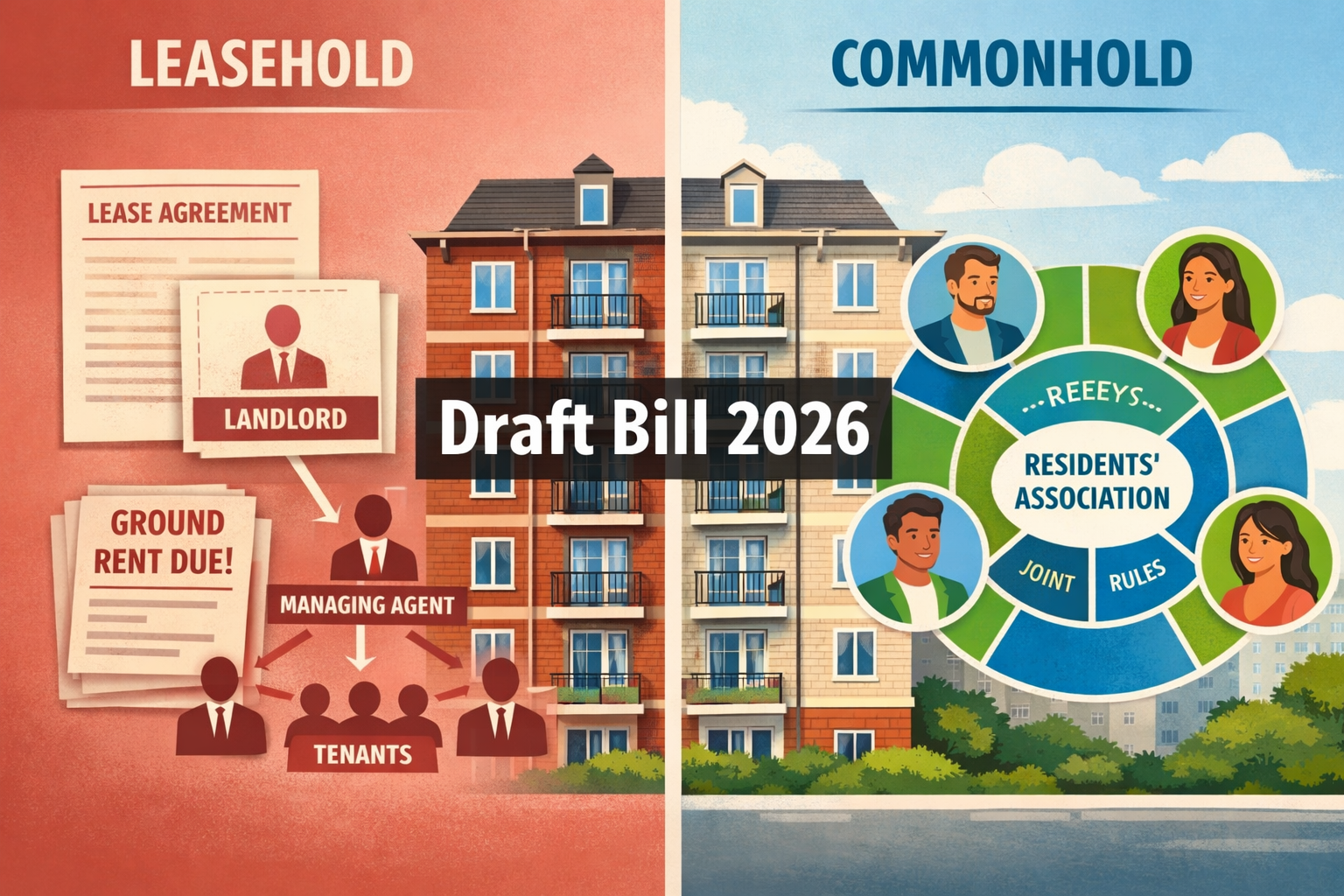
How Leasehold and Commonhold Reforms 2026 Reshape the Building Surveyor's Role
Survey Scope: What Must Now Be Assessed
The reforms expand the scope of what a competent building survey must address. Tenure type is no longer a background legal matter — it is a material factor in condition assessment and valuation advice.
When surveying a leasehold flat, surveyors must now consider:
- Remaining lease length in relation to the 40-year peppercorn conversion trigger
- Current ground rent level relative to the £250 cap
- Conversion eligibility — whether 50% leaseholder consent is achievable
- Freeholder consent and lender consent requirements for conversion
- Section 20 major works obligations under existing or transitional arrangements
- Service charge transparency under the new standardised demand framework
For surveyors conducting a Level 3 full building survey, the statutory considerations section must now explicitly address how the 2026 reforms affect the subject property's tenure, management structure, and compliance obligations.
Valuation Methodology Recalibration
The Leasehold and Freehold Reform Act 2024 already triggered significant valuation methodology recalibration, with surveyors adjusting approaches post-legislation [4]. The 2026 Bill accelerates this process further.
Key valuation adjustments surveyors must make in 2026:
🏠 Leasehold flat valuations
- Ground rent income streams previously capitalised in freehold valuations must now be modelled against the £250 cap and 40-year peppercorn conversion
- No landlord compensation means freehold investment values will fall — and this must be reflected in related party valuations
- Forfeiture abolition removes a historical discount applied to leasehold flats, potentially increasing open market values
🏢 Commonhold unit valuations
- Surveyors must develop new comparable evidence bases for commonhold units, which are currently rare in England
- Management risk assessment shifts from landlord-tenant dynamics to commonhold association governance quality
- Budget adequacy and reserve fund sufficiency become primary valuation inputs
📊 Mixed-use development valuations
- The new Sections framework requires surveyors to assess commercial and residential governance separately
- Valuations of mixed-use blocks must account for inter-section cost allocation mechanisms
For properties where inheritance tax valuations are required, the shift from ground rent income to peppercorn will materially affect freehold reversion values — a point that must be clearly addressed in formal valuation reports.
Expert Witness Responsibilities in Disputed Cases
The reforms will generate significant litigation. Disputes are expected around:
- Whether ground rent caps apply to specific lease structures
- The valuation of freehold reversions where ground rent income is reduced
- Conversion consent disputes between leaseholders and freeholders
- Service charge challenges under the new standardised framework
Building surveyors acting as expert witnesses must be able to explain the valuation impact of the reforms clearly and in terms that a tribunal or court can understand. This requires:
- Up-to-date knowledge of RICS guidance on commonhold valuation
- Ability to model pre- and post-reform valuations side by side
- Clear articulation of how forfeiture abolition and ground rent caps affect comparable evidence
💬 "A surveyor who cannot explain the valuation difference between a leasehold flat with a £500 ground rent and one subject to the new £250 cap is not equipped to serve clients in the 2026 market."
Understanding why property owners hire surveyors is evolving — expert guidance on tenure reform has become one of the most pressing reasons.
Valuation Impact: A Deeper Analysis of the Leasehold and Commonhold Reforms 2026

Ground Rent Cap: Winners and Losers
The £250 per annum ground rent cap — with automatic conversion to peppercorn after 40 years — creates clear winners and losers in the property market [1][2].
Winners:
- Leaseholders currently paying high ground rents (some paying £500–£2,000+ annually)
- Buyers of existing leasehold flats, who face reduced ongoing costs
- Mortgage lenders, who previously declined to lend on high ground rent properties
Losers:
- Freeholders with portfolios built on ground rent income streams
- Intermediate landlords, whose obligations are reduced proportionally where their own ground rent income from superior landlords decreases [1]
- Investors who purchased ground rent portfolios at valuations capitalising high income
No compensation is payable to landlords for lost ground rent income [1]. Government policy explicitly states that leaseholders will not compensate for past excess rent paid. This is a significant policy choice that surveyors must communicate clearly to investor clients.
The Forfeiture Abolition Effect
Forfeiture — the mechanism by which landlords could reclaim a property for lease breaches — has historically been a major source of anxiety for leaseholders and a discount factor in valuations. Its abolition is expected to have a positive effect on leasehold flat values, particularly in the mid-market [2].
Ground rent arrears will be excluded from enforcement entirely. Non-payment breaches will require a threshold violation — estimated at between £500 and £5,000, though not yet finalised [1].
For surveyors, this means:
- Historical comparable evidence that included forfeiture risk discounts must be treated with caution
- Adjusted valuation models are needed for post-reform market conditions
- Clients purchasing leasehold flats should be advised that this risk has been substantially removed
Conversion Pathways and Their Valuation Implications
The reduction of the leaseholder consent threshold from 100% to 50% opens up conversion to commonhold for many existing blocks [2]. However, freeholder consent and lender consent remain mandatory, meaning that leaseholders will typically need to collectively purchase the freehold before conversion can proceed.
This creates a new valuation question: what is the premium value of a converted commonhold unit versus its leasehold equivalent?
Surveyors should be aware that:
- In jurisdictions where commonhold-equivalent ownership exists (e.g., strata title in Australia, condominium in the USA), freehold flat ownership typically commands a 5–15% premium over equivalent leasehold
- The UK market will take time to develop comparable evidence
- Early adopters of commonhold conversion may see significant value uplift — but also face governance establishment costs
For clients considering right-to-buy valuations or collective enfranchisement as a precursor to commonhold conversion, the 2026 reforms change the financial calculus significantly.
Section 20 Major Works in Transition
During the transition period — before full commonhold implementation — existing leasehold blocks will continue to operate under current service charge and major works frameworks. Surveyors involved in Section 20 major works consultations must be alert to:
- The risk that works approved under leasehold frameworks may need to be revisited if conversion to commonhold occurs mid-project
- New budget and expenditure approval mechanisms under commonhold that differ from Section 20 consultation requirements
- The interaction between emergency borrowing provisions under commonhold and existing reserve fund obligations
Practical Steps for Building Surveyors in 2026
Updating Survey Reports and Checklists
Every building survey report template should be reviewed against the 2026 reforms. Key additions include:
- Tenure risk section: Explicitly address ground rent level, lease length, and conversion eligibility
- Valuation commentary: Note the impact of the £250 cap and forfeiture abolition on open market value
- Management structure assessment: Evaluate commonhold association governance quality where applicable
- Statutory compliance note: Reference the Leasehold and Freehold Reform Act 2024 and Draft Bill provisions
Surveyors choosing between survey levels should consult guidance on choosing the right property survey to ensure clients receive appropriate tenure risk coverage.
Building Professional Knowledge
RICS has been actively engaged in shaping the Draft Bill [2][8]. Surveyors should:
- Monitor RICS guidance updates on commonhold valuation methodology
- Attend CPD events focused on the 2026 reforms
- Review the government's consultation response when published post-April 2026
- Engage with specialist property lawyers when advising on conversion pathways
The dilapidations context also changes under commonhold — end-of-lease dilapidations claims will not arise for commonhold units, removing a significant area of dispute that currently generates substantial surveyor instruction.
Communicating Reform Impacts to Clients
Clients — whether buyers, sellers, investors, or lenders — need clear, jargon-free advice on what the reforms mean for their specific property. Surveyors should be prepared to explain:
- Why a flat with a £600 ground rent is now a different proposition to a buyer than it was in 2024
- How the abolition of forfeiture changes the risk profile of leasehold ownership
- What steps are required to convert an existing block to commonhold
- How commonhold association governance quality affects long-term value
Conclusion: Actionable Next Steps for Surveyors
The Leasehold and Commonhold Reforms 2026 represent the most consequential shift in English residential property tenure in living memory. For building surveyors, the message is clear: passive awareness of these changes is not enough.
Here are the immediate steps every building surveyor should take in 2026:
- ✅ Audit all survey report templates to incorporate tenure risk, ground rent cap analysis, and commonhold governance assessment sections
- ✅ Update valuation methodologies to reflect the £250 ground rent cap, peppercorn conversion trigger, and forfeiture abolition — and document the reasoning clearly in all reports
- ✅ Build a commonhold evidence base by tracking early conversions and monitoring comparable sales data as the market develops
- ✅ Engage with RICS guidance on commonhold valuation as it is published, and complete relevant CPD before advising clients on conversion
- ✅ Brief investor and lender clients proactively on the impact of ground rent cap provisions on freehold portfolio valuations — do not wait for them to ask
- ✅ Review expert witness frameworks to ensure tribunal and court reports can clearly articulate pre- and post-reform valuation differences
The surveyors who thrive in the post-reform market will be those who treat the 2026 legislation not as a compliance burden, but as a professional opportunity — a chance to deliver genuinely expert guidance at a moment when clients need it most.
References
[1] Commonhold And Leasehold Reform Steps Up A Pace – traverssmith.com
[2] Draft Commonhold Leasehold Reform Bill – ww3.rics.org
[3] Leasehold And Freehold Reform Updates 2026 Moving Towards Commonhold – hcrlaw.com
[4] Valuing Freehold Vs Leasehold Reforms In 2026 Surveyor Adjustments Post Latest Legislation Changes – nottinghillsurveyors.com
[5] Moving To Commonhold Banning Leasehold For New Flats – gov.uk
[6] The Commonhold And Leasehold Reform Bill Key Questions Answered – hoganlovells.com
[7] Draft Commonhold And Leasehold Reform Bill Command Paper – assets.publishing.service.gov.uk
[8] Rics Input Commonhold Leasehold Reform – surveyorlocal.co.uk