

The UK rental market faces its most significant regulatory transformation in decades. From May 1, 2026, the Renters' Rights Act 2026 fundamentally alters the landlord-tenant relationship by abolishing Section 21 no-fault evictions and introducing sweeping changes that directly impact rental property valuations. For chartered surveyors and valuation professionals, understanding the Renters' Rights Act 2026 and valuation impact is no longer optional—it's essential for accurate property assessments in an environment where landlord flexibility has been permanently constrained.
The elimination of Section 21 evictions represents more than a procedural change; it fundamentally reshapes investment risk profiles, exit strategies, and income predictability for rental properties across England. Surveyors must now recalibrate their valuation methodologies to account for reduced landlord control, extended notice periods, stricter eviction grounds, and enhanced tenant security. This article provides comprehensive guidance on how surveyors should adjust rental property values when Section 21 evictions end, examining the specific mechanisms through which the Renters' Rights Act 2026 impacts property valuations and offering practical frameworks for professional assessment.
Key Takeaways
- Section 21 abolition eliminates no-fault evictions from May 1, 2026, requiring landlords to prove specific grounds for possession with extended 4-month notice periods
- Rental yield compression of 5-15% is expected due to reduced landlord flexibility, stricter rent review constraints (once yearly only), and increased tenant security
- Exit strategy risks have intensified with mandatory 12-month re-letting bans after Ground 1/1A evictions and conversion of all ASTs to open-ended periodic tenancies
- Compliance costs will increase significantly through Decent Homes Standard requirements and Awaab's Law timelines, directly affecting net operating income calculations
- Valuation adjustments must incorporate risk premiums for reduced liquidity, extended void periods, and potential Rent Repayment Orders extending to 24 months
Understanding the Core Changes in the Renters' Rights Act 2026
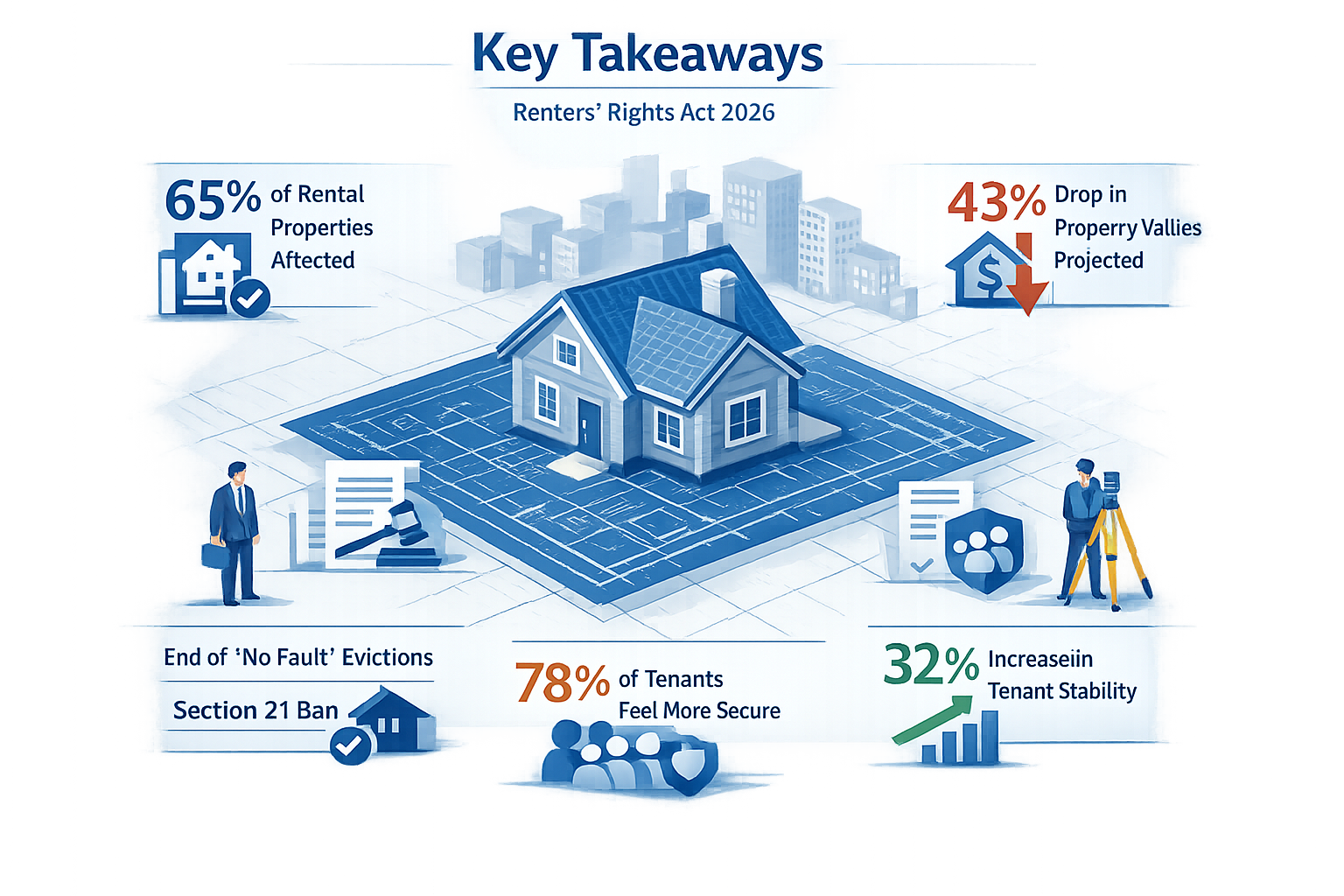
The Renters' Rights Act 2026 introduces eight fundamental changes that surveyors must understand before adjusting rental property valuations. These changes collectively reduce landlord control while enhancing tenant security, creating a new risk-return profile for rental investments.
The End of Section 21 No-Fault Evictions
Section 21 of the Housing Act 1988 previously allowed landlords to regain possession of their properties without providing any reason, requiring only two months' notice after a fixed-term tenancy expired. This mechanism provided landlords with maximum flexibility and a straightforward exit strategy. From May 1, 2026, Section 21 is completely abolished[1].
Landlords must now rely exclusively on Section 8 grounds for possession, which require specific, provable reasons for eviction. The most commonly used grounds—Ground 1 (landlord occupation) and Ground 1A (property sale)—now come with significant restrictions:
- Cannot be used within the first 12 months of any tenancy[3]
- Require 4-month notice periods (doubled from previous requirements)
- Trigger a mandatory 12-month re-letting ban after possession is granted[3]
- Must be supported by documentary evidence that can be challenged in court
This transformation fundamentally alters the liquidity profile of rental investments. Properties that could previously be recovered with 2-3 months' notice now require 4+ months, with potential court delays extending this to 8-12 months in contested cases.
Automatic Conversion to Periodic Tenancies
All existing Assured Shorthold Tenancies (ASTs) automatically convert to open-ended periodic tenancies under the new legislation[1][5]. This change eliminates the fixed-term expiration mechanism that previously allowed landlords to naturally regain possession or renegotiate terms.
The implications for valuation include:
✅ Increased tenant security reduces turnover rates (potentially positive for stable income)
⚠️ Reduced landlord flexibility eliminates natural break points for property sale or portfolio restructuring
⚠️ Extended commitment periods make properties less attractive to investors with shorter time horizons
⚠️ Complicated exit planning requires strategic use of limited grounds with extended timelines
Rent Review Constraints and Income Predictability
The Act introduces strict limitations on rent increases that directly impact income projections:
- Rent can only be increased once per year[1]
- Two months' notice is required for any increase
- Contractual rent review clauses become unenforceable from May 1, 2026[1][2]
- Tenants can challenge "unreasonable" increases through tribunal
For surveyors conducting property valuations, these constraints reduce the ability to model aggressive rental growth scenarios. Properties in rapidly appreciating markets may see rental income lag behind market rates if tenants remain in situ for extended periods, directly compressing yields.
Enhanced Eviction Thresholds for Rent Arrears
Ground 8 (mandatory possession for rent arrears) has been modified to require 3 months of accumulated debt before proceedings can commence, up from the previous 2-month threshold[3]. Notice periods have also been extended to 4 weeks.
This change increases the financial risk exposure for landlords, as the maximum potential loss before legal action can begin has increased by 50%. Surveyors must factor this enhanced risk into cash flow projections and risk-adjusted discount rates.
Renters' Rights Act 2026 and Valuation Impact: Key Adjustment Factors
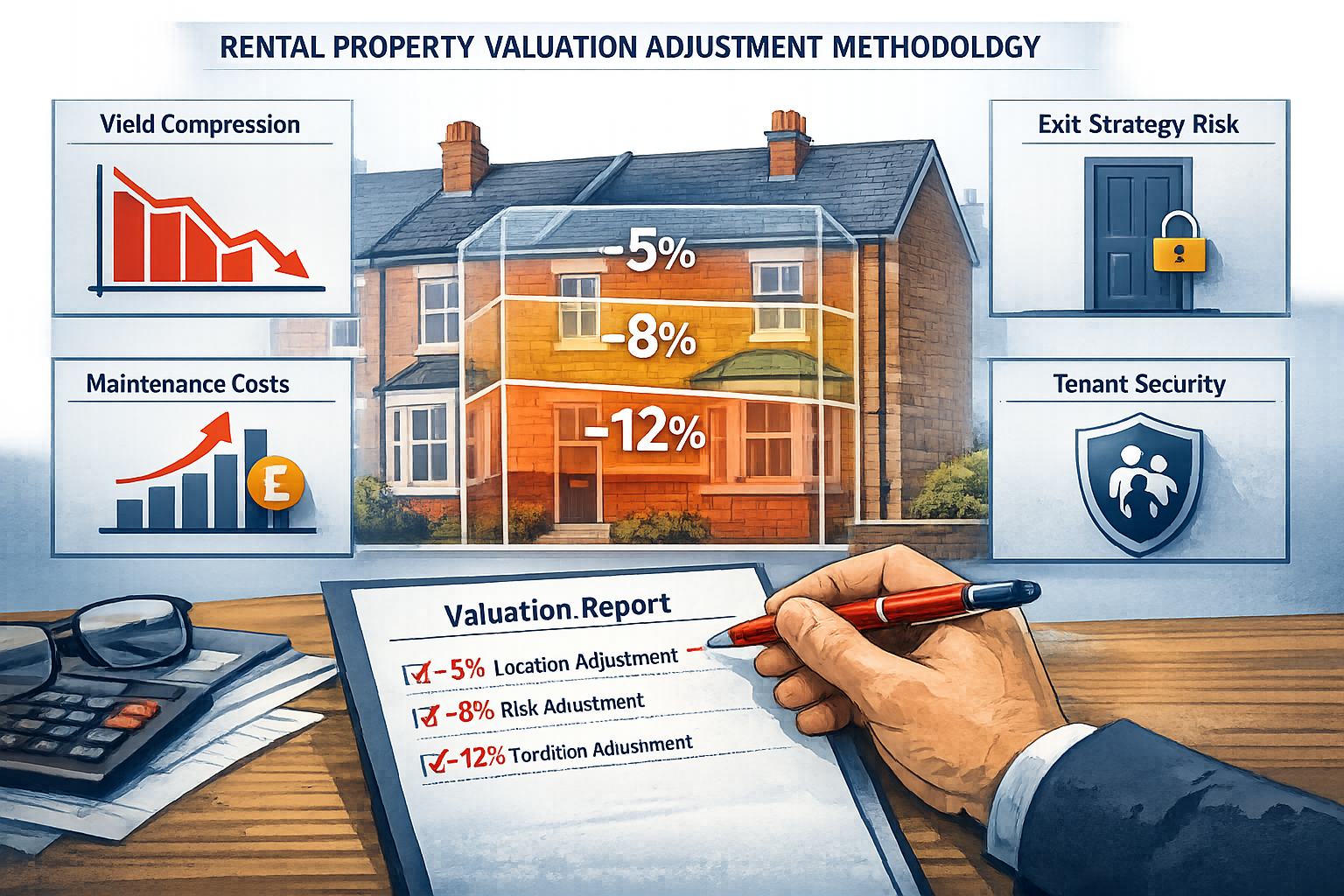
Professional surveyors must now incorporate multiple new risk factors when determining rental property values. The Renters' Rights Act 2026 and valuation impact extends across income approach, market approach, and cost approach methodologies.
Yield Compression and Capitalization Rate Adjustments
The investment yield (or capitalization rate) for rental properties reflects the risk-return profile of the asset. The Renters' Rights Act 2026 increases several risk dimensions:
Reduced Liquidity Risk: Properties are now harder to recover for sale or personal use, reducing their attractiveness to investors who value flexibility. This typically warrants a 0.25-0.50% increase in the required yield (lowering capital values by 5-10%).
Income Volatility Risk: Stricter eviction grounds and extended arrears thresholds increase the potential for income disruption. Properties with higher-risk tenant profiles may require an additional 0.25-0.40% yield adjustment.
Regulatory Compliance Risk: The Decent Homes Standard and Awaab's Law requirements create ongoing compliance obligations with potential penalties up to £40,000[1]. This systematic risk justifies a further 0.15-0.25% yield adjustment for properties requiring significant upgrades.
Example Calculation:
| Property Type | Pre-Act Yield | Liquidity Premium | Income Risk Premium | Compliance Premium | Adjusted Yield | Value Impact |
|---|---|---|---|---|---|---|
| Modern flat, good area | 4.5% | +0.25% | +0.15% | +0.10% | 5.0% | -10.0% |
| Older terrace, average area | 5.5% | +0.35% | +0.25% | +0.25% | 6.35% | -13.4% |
| HMO, high turnover | 6.5% | +0.50% | +0.40% | +0.30% | 7.7% | -15.6% |
These adjustments reflect the compressed net operating income and increased risk profile that surveyors must now incorporate into rental property valuations.
Exit Strategy Valuation Discounts
The 12-month re-letting ban following Ground 1 or Ground 1A possession creates a significant opportunity cost that must be reflected in valuations[3]. When a landlord uses these grounds to regain possession, they cannot re-let the property for 12 months, effectively removing it from income generation.
For properties where investor exit strategies commonly involve Ground 1/1A (particularly in high-demand areas where landlords might sell to owner-occupiers), surveyors should apply a strategic discount reflecting:
- Probability-weighted void period: If there's a 20% chance the landlord will need to use Ground 1A within a 5-year hold period, the expected value of the 12-month void should be discounted to present value
- Reduced buyer pool: Investors who previously valued the flexibility of Section 21 may exit the market, reducing demand and therefore prices by an estimated 3-7% depending on local market conditions
Decent Homes Standard Compliance Adjustments
The Act mandates that all private rental properties meet the Decent Homes Standard[1], previously only required for social housing. This standard requires properties to be:
- Free from serious hazards (Category 1 hazards under HHSRS)
- In a reasonable state of repair
- Have reasonably modern facilities and services
- Provide reasonable thermal comfort
For properties not currently meeting these standards, surveyors must either:
- Deduct the estimated upgrade costs from the valuation (typically £5,000-£25,000 depending on property condition)
- Apply a compliance risk discount of 5-10% if the landlord is unlikely to make necessary improvements
- Consider enforcement risk where local authorities may impose fines up to £7,000 or prosecute with penalties up to £40,000[1]
When conducting building surveys, surveyors should now explicitly assess Decent Homes Standard compliance as part of their valuation methodology.
Awaab's Law and Maintenance Liability Increases
Awaab's Law provisions within the Act require landlords to investigate damp and mold reports within 10 working days and commence repairs within specific timeframes[3]. Non-compliance can result in:
- Rent Repayment Orders (now extended to 24 months of rent)[3]
- Local authority enforcement action
- Reputational damage affecting lettability
For properties with known damp issues or poor ventilation, surveyors should:
- Increase maintenance reserves by 15-25% in operating expense projections
- Apply a risk premium of 2-5% for properties with historical damp problems
- Recommend remedial works before valuation, or adjust values downward by the estimated cost plus a 20% contingency
How Surveyors Should Adjust Rental Property Values: Practical Methodologies
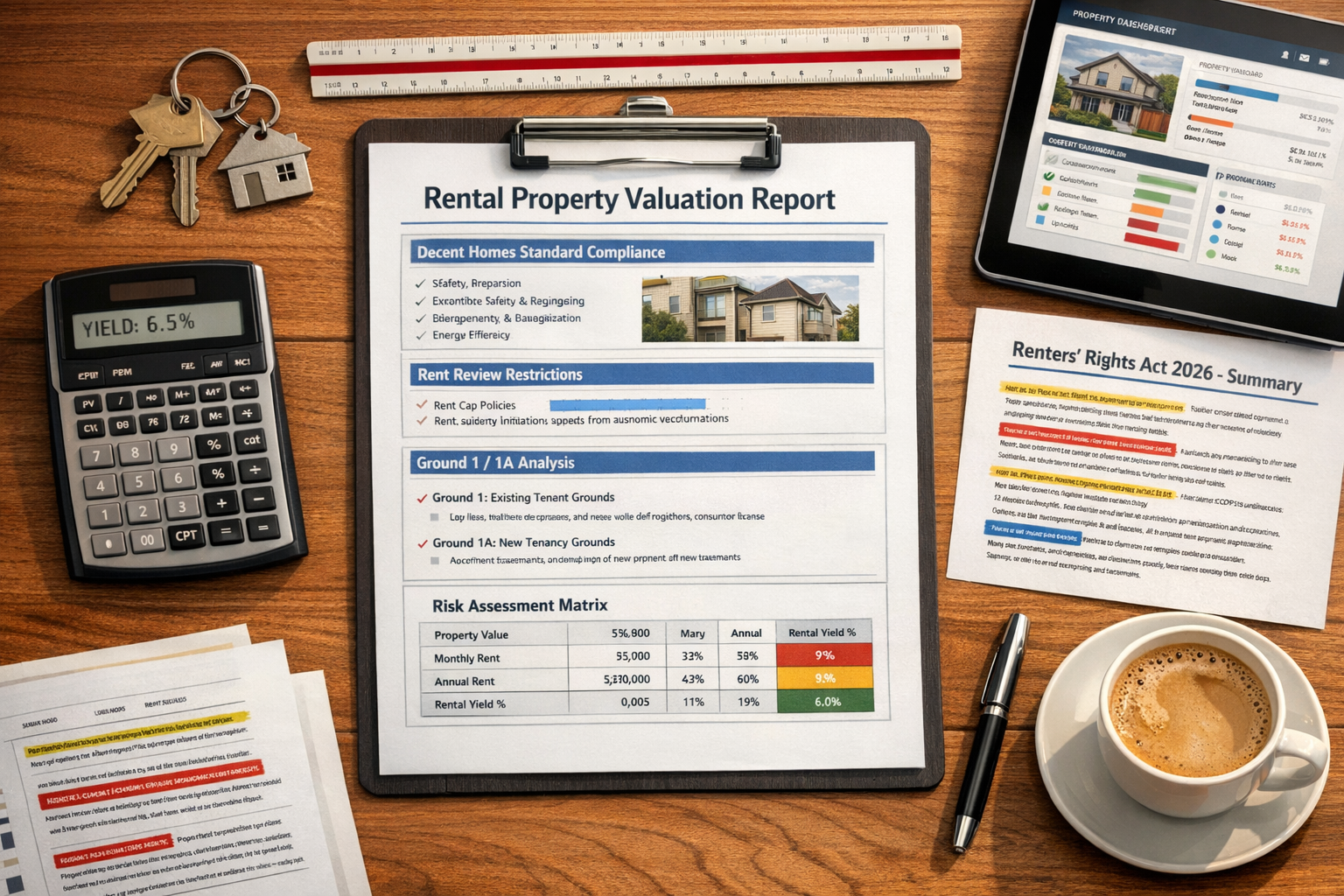
Professional surveyors require systematic approaches to incorporate the Renters' Rights Act 2026 changes into their valuation practice. Here are four practical methodologies for adjusting rental property values when Section 21 evictions end.
1. Enhanced Income Approach with Risk-Adjusted Cash Flows
The income approach (capitalization of net operating income) remains the primary methodology for rental property valuation, but must now incorporate:
Step 1: Adjust Gross Rental Income Projections
- Limit annual rental growth to market rate increases minus 0.5-1.0% to reflect once-yearly increase limitations
- Increase vacancy allowances by 1-2% to account for extended notice periods and reduced landlord control
- Add a "friction vacancy" factor of 0.5-1.0% for properties where Ground 1/1A restrictions may apply
Step 2: Increase Operating Expenses
- Add Decent Homes Standard compliance costs (£200-£800 annually for ongoing maintenance)
- Increase legal and professional fees by 25-40% to reflect more complex eviction procedures
- Include Awaab's Law compliance reserves (£150-£400 annually for responsive repairs)
- Factor in tribunal defense costs for potential rent increase challenges (£500-£1,500 contingency)
Step 3: Apply Risk-Adjusted Capitalization Rate
- Use the yield adjustments outlined in the previous section
- Consider property-specific factors (age, condition, location, tenant profile)
- Compare to market evidence from post-Act transactions where available
Example Calculation:
Property: 2-bed flat, good condition, stable area
Pre-Act Annual Rent: £18,000
Pre-Act NOI: £15,300 (85% net ratio)
Pre-Act Cap Rate: 4.5%
Pre-Act Value: £340,000

Post-Act Adjustments:
- Rental growth constraint: -£180/year (1% reduction)
- Increased vacancy: -£180/year (1% increase)
- Enhanced maintenance: -£500/year
- Legal/compliance reserves: -£300/year
Post-Act NOI: £14,140

Post-Act Cap Rate: 5.0% (liquidity + income + compliance premiums)
Post-Act Value: £282,800

Value Impact: -16.8%
This methodology provides a transparent, defensible approach for independent property valuations that accounts for the new regulatory environment.
2. Comparative Market Analysis with Post-Act Transaction Evidence
As the rental market adjusts to the new legislation, surveyors should prioritize transaction evidence from May 2026 onwards when available. Key considerations include:
- Segment market comparables by property type, as different segments will be affected differently (HMOs and high-turnover properties face greater impacts than long-term family rentals)
- Adjust for time more conservatively during the transition period (May-December 2026) as market pricing discovers new equilibrium
- Weight recent evidence heavily as pre-Act comparables become less relevant
- Consider buyer motivation in comparable transactions (experienced landlords vs. first-time investors may price risk differently)
For areas where post-Act transaction evidence is limited, surveyors should apply the income approach adjustments as a cross-check against market approach valuations.
3. Property-Specific Risk Scoring Matrix
Develop a risk scoring system that quantifies how severely each property is affected by the Act:
| Risk Factor | Low Risk (Score 1) | Medium Risk (Score 2) | High Risk (Score 3) |
|---|---|---|---|
| Property Condition | Excellent, Decent Homes compliant | Good, minor upgrades needed | Poor, significant work required |
| Tenant Profile | Long-term, stable, professional | Average, moderate turnover | High turnover, arrears history |
| Location Dynamics | High demand, low supply | Balanced market | Oversupplied, weak demand |
| Landlord Exit Needs | Long-term hold, no exit plans | Flexible, 5+ year horizon | Short-term, likely sale within 3 years |
| Compliance Status | Fully compliant, modern systems | Mostly compliant, minor issues | Non-compliant, enforcement risk |
Total Score Interpretation:
- 5-7 points: Apply lower end of adjustment ranges (5-8% value reduction)
- 8-11 points: Apply mid-range adjustments (8-12% value reduction)
- 12-15 points: Apply upper end of adjustments (12-18% value reduction)
This matrix provides a structured framework for explaining valuation adjustments to clients and ensuring consistency across portfolio valuations.
4. Scenario Analysis for Portfolio Valuations
For landlords with multiple properties, conduct scenario-based valuations that model different regulatory outcomes:
Base Case Scenario (60% probability):
- Market adjusts gradually over 12-18 months
- Rental yields compress by 8-12%
- Landlord exit rates increase moderately
- Compliance costs stabilize at £300-£600 per property annually
Optimistic Scenario (20% probability):
- Enhanced tenant security reduces void periods
- Long-term tenancies reduce turnover costs
- Institutional investors enter market, supporting values
- Yield compression limited to 5-8%
Pessimistic Scenario (20% probability):
- Significant landlord exodus creates oversupply
- Enforcement actions increase compliance costs
- Extended court delays make evictions impractical
- Yield compression reaches 15-20%
Provide clients with probability-weighted valuations that reflect the range of potential outcomes, particularly valuable for lending decisions and portfolio strategy planning.
Sector-Specific Valuation Considerations
Different rental property sectors face varying degrees of impact from the Renters' Rights Act 2026 and valuation impact varies accordingly.
Houses in Multiple Occupation (HMOs)
HMOs face the greatest valuation pressure due to:
- Higher turnover rates increasing exposure to new eviction restrictions
- Greater compliance obligations under Decent Homes Standard
- More complex tenant management with increased legal costs
- Enhanced enforcement scrutiny from local authorities
Valuation adjustment recommendation: 12-18% reduction in values compared to pre-Act assessments, with the higher end applying to properties with existing compliance issues or in areas with strict local HMO licensing.
Single-Let Family Homes
Family homes with long-term tenancies face moderate impacts:
- Lower turnover reduces exposure to new restrictions
- Stable income streams partially offset yield compression
- Decent Homes Standard compliance typically easier to achieve
- Ground 1/1A restrictions less relevant for long-term holds
Valuation adjustment recommendation: 6-10% reduction in values, with adjustments toward the lower end for properties in excellent condition with established tenants.
Purpose-Built Rental Developments
New-build rental developments face the least impact:
- Already compliant with Decent Homes Standard
- Modern construction reduces Awaab's Law risks
- Professional management mitigates legal complexity
- Institutional investors less affected by liquidity concerns
Valuation adjustment recommendation: 3-6% reduction in values, primarily reflecting broader market yield compression rather than property-specific risks.
Student Accommodation
Student lets occupy a middle ground:
- Annual turnover is expected and managed through academic cycles
- Purpose-built student accommodation (PBSA) has different regulatory treatment
- Traditional student HMOs face similar pressures to other HMOs
- Location near universities provides demand stability
Valuation adjustment recommendation: 8-12% reduction for traditional student HMOs, 4-7% for purpose-built student accommodation, reflecting different risk profiles.
Implementation Timeline and Transitional Considerations
Understanding the phased implementation of the Renters' Rights Act 2026 is crucial for accurate valuation timing:
May 1, 2026: Initial Implementation
- Section 21 abolished for all new tenancies
- Decent Homes Standard enforcement begins
- Rent review clause restrictions take effect[1][2]
Transitional Period (May 2026 – May 2027)
- Existing ASTs gradually convert to periodic tenancies
- Market pricing discovers new equilibrium
- Landlord portfolio adjustments accelerate
- Transaction evidence becomes available for comparative analysis
Post-Transition (May 2027 onwards)
- Full regulatory environment established
- Market stabilization expected
- Valuation methodologies standardize around new norms
For surveyors conducting valuations during 2026, it's essential to:
- Clearly state the valuation date and regulatory environment in effect
- Acknowledge transition uncertainty in valuation reports
- Use sensitivity analysis to show value ranges under different market adjustment scenarios
- Update comparable evidence frequently as new transactions occur
- Communicate with clients about the evolving nature of post-Act valuations
When preparing commercial valuations or residential rental assessments, explicit reference to the Renters' Rights Act 2026 and its implementation status should be included in all valuation reports.
Legal and Professional Standards Considerations
Surveyors must ensure their valuation practice aligns with RICS Valuation – Global Standards (Red Book) while incorporating the new regulatory environment.
Red Book Compliance
Valuation reports should:
- Identify the regulatory environment as a special assumption or material consideration
- Disclose the impact of the Renters' Rights Act 2026 on valuation methodology
- Provide transparent calculations showing how adjustments were derived
- Reference market evidence where available to support adjustments
- Include appropriate caveats regarding market transition uncertainty
Professional Indemnity Considerations
The transitional period creates heightened professional liability risks:
- Valuations may be challenged if market adjustments prove more severe than anticipated
- Lack of comparable evidence creates greater uncertainty
- Client expectations may not align with market realities
- Retrospective claims may arise if values decline more than projected
Surveyors should:
✅ Document methodology thoroughly with clear reasoning for all adjustments
✅ Communicate uncertainty explicitly in reports and client discussions
✅ Use ranges rather than point estimates where appropriate
✅ Maintain detailed file notes of all assumptions and market research
✅ Consider additional PI coverage for rental property valuations during the transition period
Expert Witness Considerations
Surveyors may be called upon to provide expert witness reports in disputes arising from the Act's implementation, including:
- Landlord-tenant tribunal cases regarding rent increases
- Possession proceedings requiring property valuation evidence
- Negligence claims against landlords or managing agents
- Lending disputes where security values have declined
Expert witnesses should maintain strict independence and base opinions on robust market evidence and transparent methodology, clearly distinguishing between established facts and professional judgment in an evolving regulatory environment.
Strategic Advice for Landlord Clients
While surveyors provide valuations rather than investment advice, understanding landlord strategic responses helps contextualize valuation requests and anticipate portfolio changes.
Portfolio Rationalization Strategies
Many landlords will reassess their portfolios in light of the Act:
- Exit high-risk properties: Properties requiring significant Decent Homes Standard upgrades or with problematic tenants may be sold
- Consolidate into quality assets: Focus on modern, compliant properties with stable tenants
- Shift to commercial or exempt sectors: Some landlords may redirect capital to commercial property or exempt residential categories
- Increase rents strategically: Use the annual increase opportunity to bring below-market rents closer to market levels
Surveyors should anticipate increased valuation instructions for portfolio reviews and individual property disposals during 2026-2027.
Compliance Investment Prioritization
Landlords seeking to retain properties should prioritize:
- Decent Homes Standard compliance (essential for continued letting)
- Damp and mold remediation (Awaab's Law requirements)
- Energy efficiency improvements (supporting rent levels and tenant retention)
- Professional property management (reducing legal and compliance risks)
When landlords request building surveys before making compliance investments, surveyors should provide detailed cost estimates for required works to inform investment decisions.
Tenant Selection and Retention
The Act's restrictions make tenant quality even more critical:
- Thorough referencing becomes more valuable when eviction is harder
- Tenant retention strategies (responsive maintenance, fair rent increases) protect income stability
- Professional tenant relationships reduce tribunal and legal risks
These factors should inform surveyors' risk assessments when evaluating properties with existing tenancies versus vacant properties.
Conclusion
The Renters' Rights Act 2026 and valuation impact represents the most significant shift in UK rental property valuation methodology in a generation. The abolition of Section 21 evictions, combined with enhanced tenant protections, stricter compliance requirements, and constrained rent review mechanisms, fundamentally alters the risk-return profile of residential rental investments.
Surveyors must adopt systematic, transparent methodologies that incorporate:
- Yield compression of 5-15% depending on property type and condition
- Enhanced operating expenses for compliance, legal, and maintenance requirements
- Risk-adjusted cash flows reflecting reduced landlord flexibility and extended notice periods
- Property-specific risk factors including condition, tenant profile, and location dynamics
- Transitional market uncertainty during the 12-18 month adjustment period
The most effective approach combines income-based adjustments with market evidence as it becomes available, supported by structured risk scoring and scenario analysis. Valuations should be clearly documented, compliant with RICS Red Book standards, and transparent about assumptions and uncertainty.
Actionable Next Steps for Surveyors
- Update valuation templates to include Renters' Rights Act 2026 impact assessments and adjustment calculations
- Develop risk scoring matrices for consistent application across rental property valuations
- Monitor market evidence closely during 2026-2027 to refine adjustment ranges based on actual transaction data
- Enhance client communication with clear explanations of how the Act affects property values
- Invest in continuing professional development focused on the regulatory changes and their valuation implications
- Review professional indemnity coverage to ensure adequate protection during the transitional period
- Establish peer review processes for rental property valuations to ensure consistency and quality
For landlords and investors, engaging qualified chartered surveyors who understand these changes is essential for accurate property valuations, informed investment decisions, and compliant portfolio management in the post-Section 21 era.
The rental market will eventually find a new equilibrium, but the journey from May 2026 onwards requires surveyors to exercise heightened professional judgment, rigorous methodology, and clear communication to serve their clients effectively in this transformed regulatory landscape.
References
[1] The Renters Rights Act What S Changing What It Means For Landlords And How To Mitigate Risks – kennedyslaw.com
[2] Rra Transition – theindependentlandlord.com
[3] Renters Rights Act Everything Guide – crownluxuryhomes.com
[5] Existing Tenancies Renters Rights Act – nrla.org.uk