

Buildings account for approximately 40% of global energy consumption and 33% of greenhouse gas emissions worldwide. As climate targets tighten and energy costs soar, property stakeholders can no longer afford to ignore the environmental performance of their assets. Sustainability Assessments in Building Surveys: Integrating Energy Efficiency and Carbon Footprint Analysis into Standard Survey Reports has evolved from a niche service to an essential component of comprehensive property evaluation in 2026.
The integration of sustainability metrics into building surveys represents a fundamental shift in surveying practice. Traditional surveys focused exclusively on structural integrity, defects, and maintenance requirements. Today's property buyers, investors, and owners demand detailed insights into energy performance, carbon emissions, and upgrade pathways that can reduce both environmental impact and operational costs. This transformation reflects broader market forces, regulatory pressures, and the growing recognition that environmental performance directly affects property value and marketability.
Key Takeaways
- Sustainability assessments now form a critical component of comprehensive building surveys, addressing client demands for energy performance and carbon footprint data alongside traditional structural analysis
- Energy efficiency analysis includes thermal imaging, insulation evaluation, heating system performance, and renewable energy potential assessment integrated into standard survey protocols
- Carbon footprint calculations encompass both embodied carbon in building materials and operational emissions, providing actionable upgrade recommendations
- Regulatory compliance increasingly requires detailed energy performance documentation, making integrated sustainability assessments essential for property transactions
- Financial benefits of sustainability-focused surveys include identifying cost-saving upgrade opportunities, enhancing property values, and future-proofing assets against stricter environmental regulations
Why Sustainability Assessments Matter in Modern Building Surveys
The property sector faces unprecedented pressure to decarbonize. Government mandates, including the UK's commitment to achieve net-zero emissions by 2050, have created a regulatory environment where energy performance directly impacts property viability. Buildings that fail to meet minimum energy efficiency standards face rental restrictions, reduced marketability, and potential obsolescence.
The Business Case for Integrated Assessments
Property transactions increasingly hinge on environmental performance data. Buyers want to understand:
- Current energy costs and projected expenses under various carbon pricing scenarios
- Required investments to achieve regulatory compliance or target performance levels
- Potential savings from efficiency improvements and renewable energy installations
- Carbon liability associated with continued operation without upgrades
- Future-proofing strategies that protect asset value against evolving regulations
When conducting a Level 3 full building survey, surveyors who integrate sustainability assessments provide clients with comprehensive intelligence that informs purchase decisions, renovation planning, and long-term asset management strategies. This holistic approach delivers measurably greater value than separate structural and energy assessments.
Regulatory Drivers Shaping Survey Practice
Several regulatory frameworks now mandate or incentivize detailed energy performance documentation:
📋 Energy Performance Certificates (EPCs) – Required for most property transactions, with minimum standards for rental properties
📋 Building Regulations Part L – Increasingly stringent thermal performance requirements for renovations and extensions
📋 MEES Regulations – Minimum Energy Efficiency Standards prohibiting rental of properties below EPC rating E
📋 Climate Change Act – National carbon budgets creating long-term pressure for building stock improvements
📋 Green Finance – Preferential lending rates for energy-efficient properties incentivizing upgrades
Surveyors who incorporate sustainability metrics into standard reports help clients navigate this complex regulatory landscape while identifying opportunities to leverage incentives and avoid penalties.
Core Components of Sustainability Assessments in Building Surveys: Integrating Energy Efficiency and Carbon Footprint Analysis
Effective integration requires expanding traditional survey methodologies to encompass environmental performance evaluation. This doesn't replace structural assessment but augments it with complementary analysis that addresses the full spectrum of building performance.
Energy Efficiency Analysis Techniques
Thermal Imaging and Heat Loss Identification 🌡️
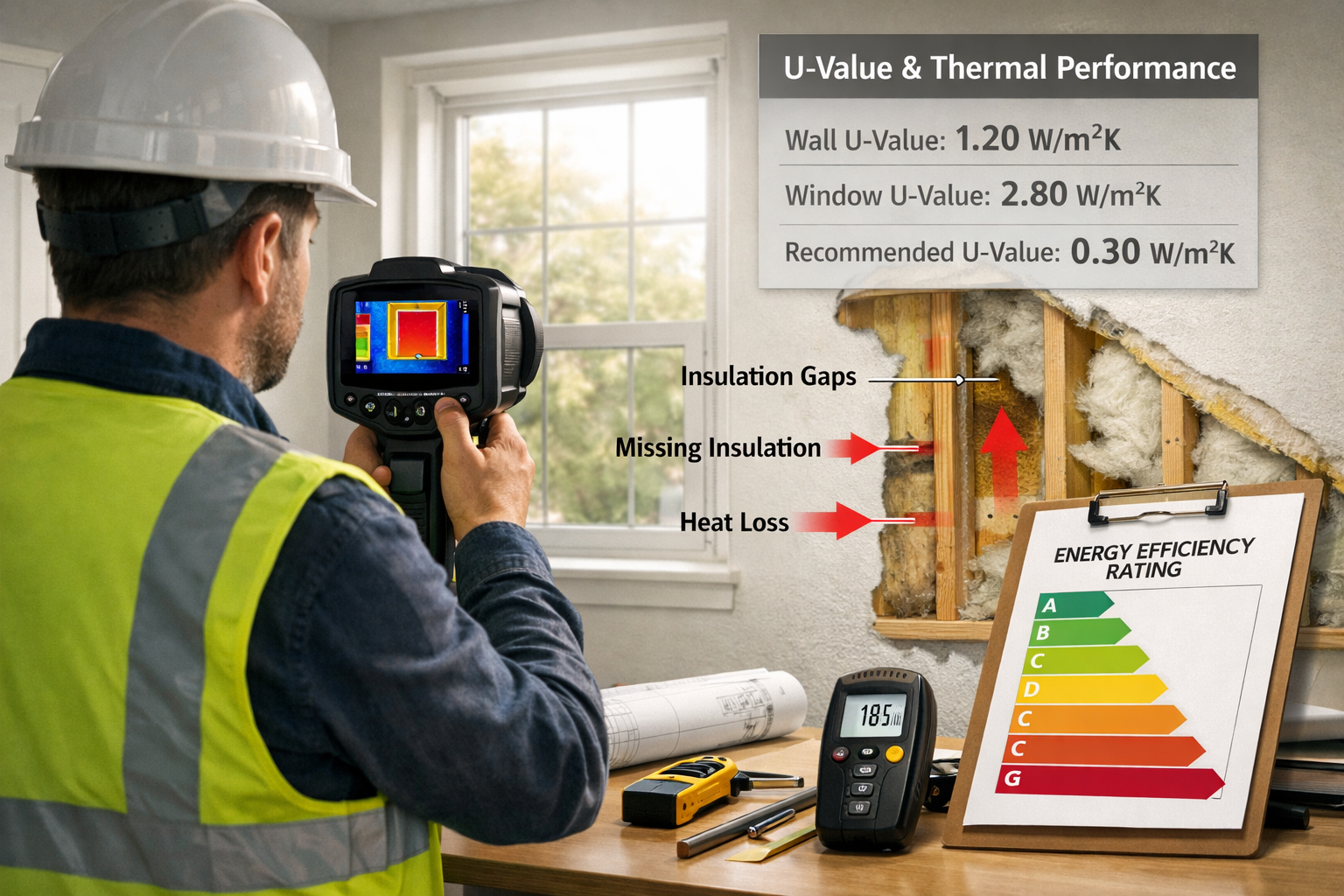
Thermal imaging cameras reveal heat loss patterns invisible to conventional inspection methods. Surveyors can identify:
- Insulation gaps in walls, roofs, and floors
- Air leakage around windows, doors, and service penetrations
- Thermal bridging through structural elements
- Heating system distribution inefficiencies
- Moisture intrusion that compromises insulation performance
This technology transforms energy assessment from theoretical calculation to visual documentation of actual performance deficiencies. When integrated into building defects surveys, thermal imaging provides actionable data that prioritizes remediation efforts based on energy impact.
Insulation Evaluation and U-Value Assessment
Comprehensive insulation analysis examines:
| Building Element | Target U-Value (W/m²K) | Typical Existing Performance | Upgrade Priority |
|---|---|---|---|
| External Walls | 0.18-0.28 | 0.45-2.10 | High |
| Roof/Loft | 0.11-0.16 | 0.25-1.50 | High |
| Ground Floor | 0.18-0.22 | 0.35-1.20 | Medium |
| Windows | 1.20-1.60 | 2.00-5.80 | High |
| Doors | 1.00-1.40 | 2.00-3.50 | Medium |
Surveyors assess current thermal performance against modern standards, calculating heat loss rates and identifying cost-effective upgrade pathways. This analysis directly informs maintenance planning and renovation priorities.
Heating, Ventilation, and Cooling System Performance
HVAC system evaluation examines:
- Boiler efficiency and age-related performance degradation
- Distribution system losses through uninsulated pipework
- Control system sophistication and zoning capabilities
- Ventilation effectiveness balancing air quality with heat retention
- Renewable heating potential including heat pump suitability
Modern surveys assess whether existing systems can deliver adequate comfort within acceptable energy budgets or require replacement with low-carbon alternatives.
Carbon Footprint Analysis Methodologies
Embodied Carbon Assessment
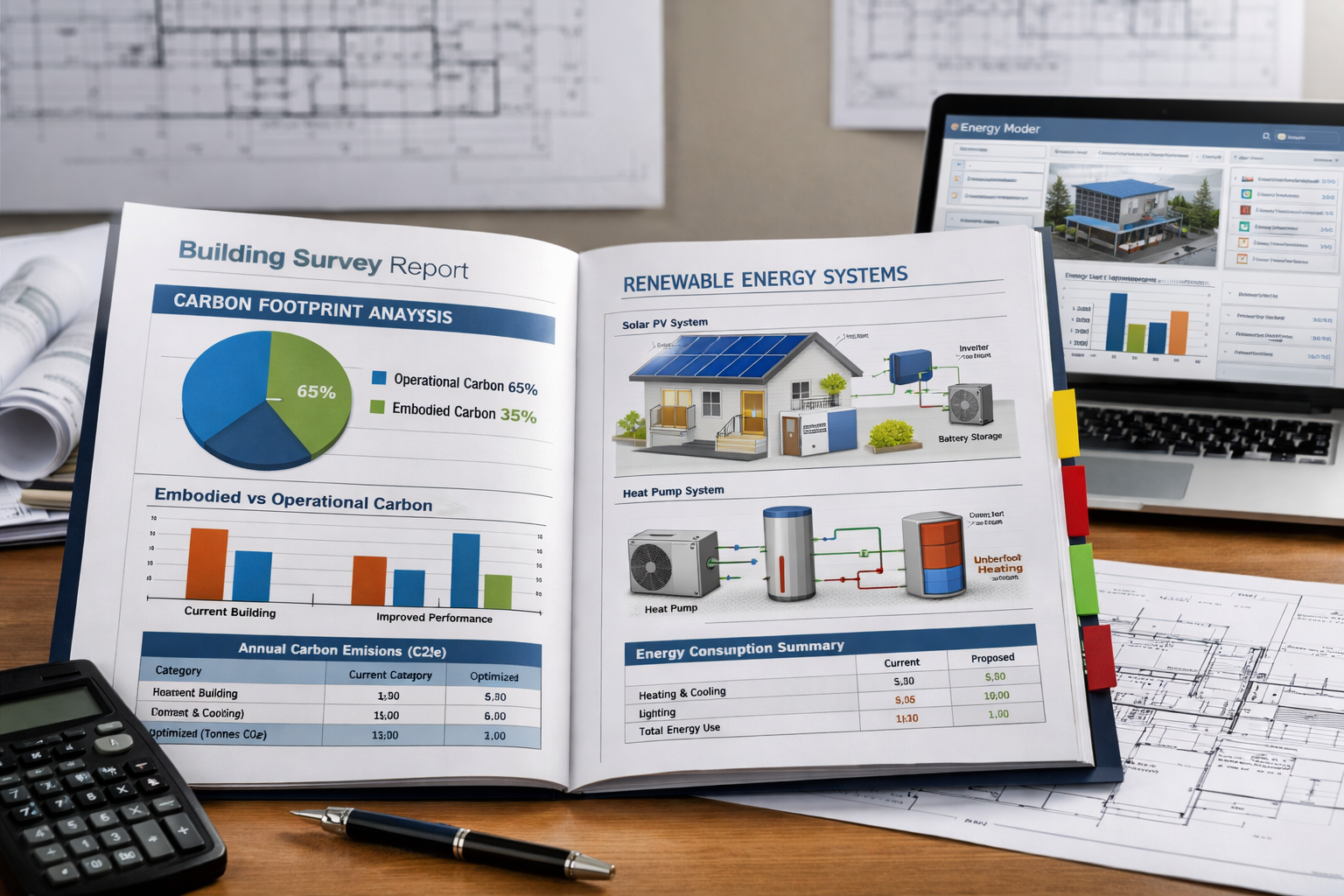
Embodied carbon represents emissions associated with material extraction, manufacturing, transportation, and construction. For existing buildings, this analysis focuses on:
- Material composition of primary structural elements
- Renovation carbon costs of various upgrade scenarios
- Circular economy opportunities for material reuse and recycling
- Low-carbon alternatives for necessary repairs and replacements
This perspective helps clients understand the full environmental impact of renovation decisions, sometimes revealing that retention and upgrade of existing fabric delivers better carbon outcomes than demolition and new construction.
Operational Carbon Calculation
Operational emissions stem from ongoing energy consumption. Comprehensive assessment includes:
✅ Baseline energy consumption from utility bills and EPC data
✅ Fuel mix analysis accounting for grid electricity carbon intensity
✅ Occupancy patterns affecting actual versus theoretical performance
✅ Seasonal variations in heating and cooling demands
✅ Projected emissions under various carbon pricing scenarios
Surveyors calculate annual carbon footprints and model reduction scenarios, providing clients with clear pathways to achieve specific emission reduction targets.
Renewable Energy Integration Potential
Assessment of renewable energy opportunities examines:
- Solar PV suitability including roof orientation, shading analysis, and structural capacity
- Solar thermal viability for domestic hot water provision
- Heat pump feasibility considering property insulation levels and heat distribution systems
- Biomass potential where appropriate fuel supply exists
- Battery storage economics for maximizing renewable energy utilization
This analysis transforms sustainability assessment from problem identification to solution development, giving clients actionable upgrade strategies with projected costs and payback periods.
Practical Integration: Sustainability Assessments in Building Surveys Workflow
Successful integration requires systematic methodology that maintains survey quality while adding environmental analysis without excessive time or cost burdens.
Pre-Survey Preparation and Data Gathering
Document Review
Before site inspection, surveyors collect:
- Current EPC certificates and historical energy performance data
- Utility bills covering at least 12 months
- Previous survey reports and maintenance records
- Planning documentation for extensions or alterations
- Building Regulations compliance certificates
- Heating system service records and specifications
This background information establishes baseline performance and identifies areas requiring detailed investigation during the physical survey.
Client Briefing and Objective Setting
Effective sustainability assessment begins with understanding client priorities:
- Immediate compliance requirements versus long-term optimization goals
- Budget constraints affecting upgrade recommendations
- Occupancy plans influencing energy modeling assumptions
- Environmental commitments driving carbon reduction targets
- Resale considerations affecting investment decisions
Clear objectives ensure survey efforts focus on delivering actionable intelligence aligned with client needs.
On-Site Assessment Protocols
Integrated Inspection Methodology
Rather than conducting separate structural and energy surveys, modern practice integrates assessment activities:
- External envelope inspection combines structural condition assessment with thermal performance evaluation
- Internal space review examines both defects and heating/ventilation effectiveness
- Services inspection evaluates mechanical systems for reliability and efficiency
- Roof space examination assesses structural integrity and insulation performance
- Thermal imaging survey identifies heat loss patterns throughout the property
This integrated approach maximizes efficiency while ensuring comprehensive coverage of both traditional and sustainability concerns. When conducting construction and condition surveys, this methodology delivers superior value by addressing the full spectrum of building performance.
Technology and Equipment Requirements
Modern sustainability-focused surveys require expanded equipment beyond traditional surveying tools:
🔧 Thermal imaging camera – Essential for heat loss visualization
🔧 Moisture meter – Critical for identifying insulation-compromising dampness
🔧 Laser distance measurer – Accurate dimensional data for energy modeling
🔧 Borescope/endoscope – Inspecting cavity wall insulation without destructive investigation
🔧 Digital manometer – Measuring air pressure differences for infiltration assessment
🔧 Lux meter – Evaluating natural daylight availability
🔧 Combustion analyzer – Testing heating appliance efficiency
Investment in appropriate technology enables surveyors to gather objective performance data rather than relying solely on visual observation and inference.
Report Structure and Presentation
Integrated Report Format
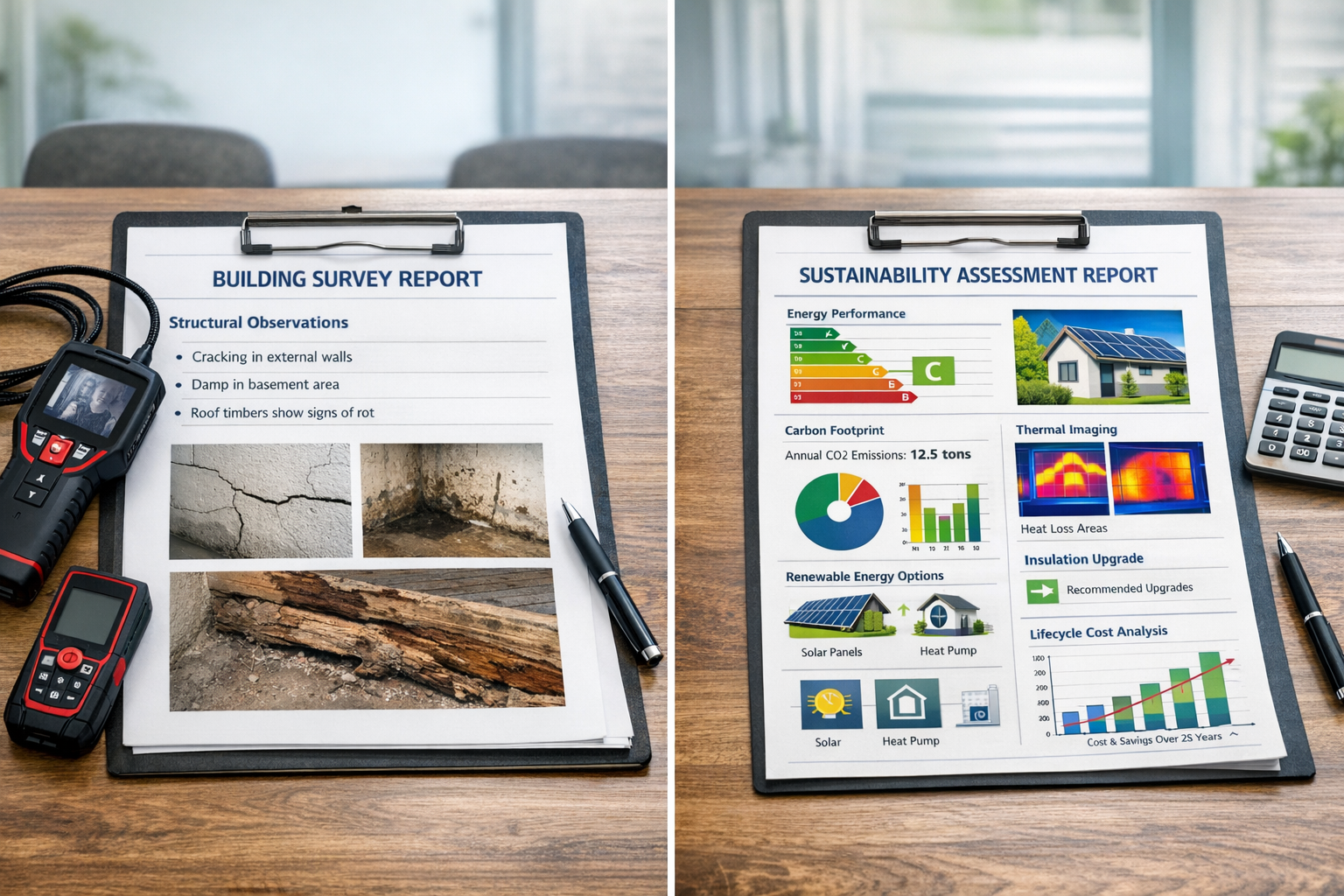
Effective reports present sustainability findings within the context of overall building condition rather than as isolated appendices. Recommended structure:
Executive Summary – Highlighting critical structural issues AND significant energy performance concerns
Property Overview – Including basic energy performance metrics alongside traditional descriptive information
External Elements – Combining condition assessment with thermal performance evaluation for walls, roof, windows, and doors
Internal Elements – Addressing both structural condition and heating/ventilation effectiveness
Services – Comprehensive mechanical and electrical system review including efficiency assessment
Energy Performance Analysis – Detailed thermal imaging results, insulation evaluation, and heat loss calculations
Carbon Footprint Assessment – Current emissions baseline and reduction scenarios
Upgrade Recommendations – Prioritized improvement strategies with cost estimates and payback calculations
Regulatory Compliance – Current status and requirements for achieving target performance levels
This structure ensures clients receive cohesive intelligence about their property rather than disconnected structural and environmental reports requiring separate interpretation.
Visual Communication Strategies
Sustainability data benefits from clear visual presentation:
- Thermal images with annotated temperature scales and problem area highlights
- Energy performance charts comparing current status to benchmarks and targets
- Carbon emission graphs showing baseline and projected reductions from various upgrades
- Cost-benefit matrices illustrating investment requirements versus savings for different improvement scenarios
- Compliance timelines mapping regulatory requirements and recommended action dates
Visual elements transform complex technical data into accessible information that supports informed decision-making.
Addressing Common Challenges in Sustainability Assessments Integration
Despite clear benefits, surveyors face practical challenges when incorporating sustainability assessments into standard practice.
Time and Cost Considerations
Efficiency Through Integration
The primary concern about sustainability assessment integration involves additional time requirements. However, effective methodology minimizes incremental effort:
- Thermal imaging during standard inspection adds 15-30 minutes for typical residential properties
- Energy data analysis using standardized calculation tools requires 30-60 minutes
- Report integration using template sections adds 45-90 minutes to documentation
Total additional time for comprehensive sustainability assessment typically ranges from 90 minutes to 3 hours depending on property complexity. This modest increase delivers substantial client value while supporting premium fee structures that reflect enhanced service delivery.
Skills and Training Requirements
Professional Development Pathways
Effective sustainability assessment requires knowledge beyond traditional surveying training:
- Building physics fundamentals including heat transfer, thermal bridging, and moisture dynamics
- Energy modeling techniques for calculating heat loss and consumption
- Renewable technology understanding covering heat pumps, solar systems, and battery storage
- Carbon accounting methodologies for embodied and operational emissions calculation
- Regulatory framework knowledge spanning EPCs, Building Regulations, and MEES
Professional bodies increasingly offer specialized training programs addressing these competencies. Surveyors should pursue continuing professional development opportunities that build sustainability assessment capabilities alongside traditional skills.
Liability and Professional Standards
Managing Risk in Expanded Scope
Incorporating sustainability assessments expands professional liability exposure. Risk management strategies include:
✅ Clear scope definition in engagement letters specifying assessment methodology and limitations
✅ Professional indemnity insurance covering energy performance advice and recommendations
✅ Appropriate disclaimers regarding energy modeling assumptions and projected savings
✅ Qualified recommendations acknowledging that actual performance depends on occupant behavior and future energy prices
✅ Specialist referral for complex renewable energy system design or advanced building physics analysis
Transparent communication about assessment scope and limitations protects both surveyor and client while maintaining professional standards.
Future Trends: Evolution of Sustainability Assessments in Building Surveys
The integration of sustainability assessments into building surveys will continue evolving as technology advances and regulatory requirements tighten.
Digital Tools and Automation
Building Information Modeling (BIM) Integration
Advanced digital tools are transforming survey practice:
- 3D laser scanning creating detailed building models supporting sophisticated energy analysis
- Automated thermal analysis using AI-powered image recognition to identify and quantify heat loss
- Cloud-based energy modeling enabling real-time calculation of upgrade scenarios during client meetings
- Digital twin technology creating virtual building replicas for ongoing performance monitoring
These technologies will make comprehensive sustainability assessment faster, more accurate, and more accessible across all property types and price points.
Whole-Life Carbon Assessment
Beyond Operational Emissions
Future sustainability assessments will increasingly address:
- Embodied carbon inventories for existing building fabric
- Renovation carbon budgets comparing environmental costs of different upgrade pathways
- Material lifecycle analysis evaluating durability, maintenance requirements, and end-of-life disposal
- Circular economy opportunities identifying reuse and recycling potential for building components
This holistic perspective recognizes that minimizing total lifecycle carbon sometimes requires different strategies than optimizing operational efficiency alone.
Regulatory Evolution and Market Transformation
Anticipating Future Requirements
Forward-looking sustainability assessments help clients prepare for emerging regulations:
- Stricter EPC requirements potentially mandating minimum C ratings for all properties by 2030
- Carbon pricing mechanisms affecting operational cost calculations
- Green mortgage preferences creating financial incentives for high-performance properties
- Climate disclosure requirements mandating carbon footprint reporting for commercial portfolios
Surveyors who understand regulatory trajectories deliver greater value by helping clients future-proof their assets against requirements that may not yet be mandatory but are clearly approaching. Understanding the consequences of failing to act on sustainability issues becomes increasingly critical for property owners.
Enhanced Valuation Integration
Environmental Performance and Property Value
The relationship between sustainability performance and property value continues strengthening:
- Green premium – High-performance properties commanding price premiums in competitive markets
- Brown discount – Poor energy performance increasingly reflected in reduced values
- Stranded asset risk – Properties failing to meet evolving standards facing marketability challenges
- Investment appeal – Environmental performance becoming key criterion for institutional investors
Sustainability assessments inform valuation by quantifying both upgrade costs and value enhancement potential, supporting more accurate property pricing that reflects environmental performance.
Best Practices for Implementing Sustainability Assessments in Building Surveys
Surveyors seeking to enhance their practice with comprehensive sustainability assessment should follow proven implementation strategies.
Service Development and Marketing
Positioning Integrated Assessments
Successful service introduction requires clear communication of value proposition:
- Client education about regulatory requirements and financial benefits of comprehensive assessment
- Case studies demonstrating cost savings and value enhancement from sustainability-focused surveys
- Tiered service offerings allowing clients to select assessment depth appropriate to their needs and budgets
- Collaborative relationships with energy consultants, renewable technology installers, and retrofit specialists
Marketing materials should emphasize that integrated sustainability assessment represents enhanced due diligence rather than optional add-on service, particularly given evolving regulatory requirements.
Quality Assurance and Continuous Improvement
Maintaining Professional Standards
Consistent quality requires systematic approaches:
📊 Standardized assessment protocols ensuring comprehensive coverage across all properties
📊 Regular equipment calibration maintaining thermal imaging and measurement accuracy
📊 Peer review processes for complex assessments or significant upgrade recommendations
📊 Client feedback collection identifying areas for service improvement
📊 Outcome tracking comparing projected versus actual performance after upgrades
Continuous improvement processes ensure sustainability assessment quality matches traditional surveying standards while adapting to evolving best practices and technological capabilities.
Collaboration and Specialist Referral
Building Professional Networks
Comprehensive sustainability assessment benefits from multidisciplinary collaboration:
- Energy consultants for detailed modeling of complex buildings
- Renewable technology specialists for system design and cost estimation
- Retrofit coordinators managing comprehensive upgrade projects
- Building Regulations specialists ensuring compliance with evolving standards
- Financial advisors structuring green financing for major improvements
Knowing when to engage specialists enhances service quality while managing professional liability for advice beyond core surveying competencies. This collaborative approach aligns with building regulation compliance testing requirements for comprehensive property assessment.
Conclusion
Sustainability Assessments in Building Surveys: Integrating Energy Efficiency and Carbon Footprint Analysis into Standard Survey Reports represents the evolution of surveying practice to meet contemporary client needs and regulatory requirements. As climate imperatives intensify and energy costs remain volatile, property stakeholders require comprehensive intelligence about both structural condition and environmental performance to make informed decisions.
The integration of sustainability assessment into standard surveying practice delivers measurable benefits for all parties. Clients receive actionable intelligence about energy performance, carbon emissions, and upgrade pathways that reduce operational costs while enhancing property value. Surveyors differentiate their services in competitive markets while building capabilities aligned with future practice requirements. The broader property sector benefits from improved building stock performance supporting national decarbonization objectives.
Taking Action: Next Steps for Surveyors and Property Owners
For Surveying Professionals:
- Invest in training – Pursue professional development in building physics, energy modeling, and carbon accounting
- Acquire appropriate technology – Thermal imaging equipment and energy analysis software enable comprehensive assessment
- Develop service offerings – Create tiered sustainability assessment packages meeting diverse client needs
- Build specialist networks – Establish referral relationships with energy consultants and renewable technology experts
- Update report templates – Integrate sustainability sections into standard survey documentation
For Property Owners and Buyers:
- Request comprehensive assessments – Specify sustainability analysis requirements when commissioning building surveys
- Review energy performance data – Examine current consumption and projected costs under various scenarios
- Evaluate upgrade recommendations – Consider both immediate compliance requirements and long-term optimization opportunities
- Explore financing options – Investigate green mortgages and improvement loans offering preferential terms
- Plan strategically – Develop phased improvement programs addressing priorities within budget constraints
The transformation of building surveys to encompass comprehensive sustainability assessment reflects fundamental shifts in property sector priorities. Environmental performance now stands alongside structural integrity as essential building characteristics requiring professional evaluation. Surveyors who embrace this evolution position themselves at the forefront of practice while delivering enhanced value that serves both client interests and broader societal objectives.
As regulatory requirements tighten and market expectations evolve, integrated sustainability assessment will transition from competitive differentiator to standard practice requirement. Forward-thinking surveyors who develop these capabilities now will lead the profession while those who delay risk obsolescence in a rapidly changing market. The question is no longer whether to integrate sustainability assessment into building surveys, but how quickly and effectively to implement comprehensive methodologies that serve client needs while maintaining professional standards.