

The Renters' Rights Act 2026 has fundamentally altered the landscape for buy-to-let property valuations, with landlords now legally required to consider pet requests unless they can demonstrate reasonable grounds for refusal. This legislative shift means that chartered surveyors must now integrate pet-related risk factors into their valuation methodologies, accounting for increased wear-and-tear, insurance premiums, and long-term maintenance costs when assessing periodic tenancies. For property investors and landlords, understanding these valuation adjustments for pet permissions in periodic tenancies has become essential for accurate asset pricing and investment decision-making.
Key Takeaways
- 🏠 Legislative Impact: The Renters' Rights Act 2026 mandates landlords consider pet requests, requiring surveyors to factor pet-related risks into property valuations
- 💷 Valuation Adjustments: Properties with pet permissions typically see 3-8% valuation adjustments based on property type, pet size, and tenancy duration
- 📊 Insurance Considerations: Landlord insurance premiums increase by 10-25% for pet-permitted properties, directly affecting net yield calculations
- 🔍 Assessment Methodology: Surveyors now employ specialized inspection protocols evaluating flooring resilience, garden condition, and fixture durability
- 📈 Market Positioning: Properties with established pet-permission frameworks may command premium rents in competitive rental markets
Understanding the Renters' Rights Act 2026 and Pet Permission Requirements
The Renters' Rights Act 2026 represents the most significant reform to the private rental sector in decades. Under the new legislation, landlords cannot unreasonably refuse pet requests from tenants in periodic tenancies [1]. This fundamental change eliminates blanket "no pets" policies that previously dominated the rental market, where approximately 78% of landlords prohibited pets entirely.
The Act establishes a framework where landlords must respond to pet requests within 28 days, and refusals must be based on reasonable grounds such as property unsuitability, building restrictions, or demonstrable risk factors [2]. Reasonable grounds might include:
- Property type limitations (small flats unsuitable for large dogs)
- Lease or freeholder restrictions in blocks of flats
- Specific pet characteristics (aggressive breeds, exotic animals)
- Inadequate outdoor space for certain pet types
For chartered surveyors conducting property valuations, this legislative change necessitates a comprehensive reassessment of how pet permissions impact market value, rental yields, and long-term asset performance.
The Surveyor's New Responsibility
Professional surveyors must now incorporate pet-related considerations into their valuation methodologies, particularly when assessing:
✅ Buy-to-let investment properties
✅ Portfolio valuations for institutional investors
✅ Matrimonial property divisions involving rental assets
✅ Inheritance tax assessments for rental portfolios
✅ Right-to-buy valuations where tenants keep pets
The Royal Institution of Chartered Surveyors (RICS) has issued updated guidance emphasizing that valuers must consider the probability of pet occupation in periodic tenancies, even where no current pet resides, given the landlord's limited ability to refuse reasonable requests [3].
Valuation Adjustments for Pet Permissions in Periodic Tenancies: Core Methodology
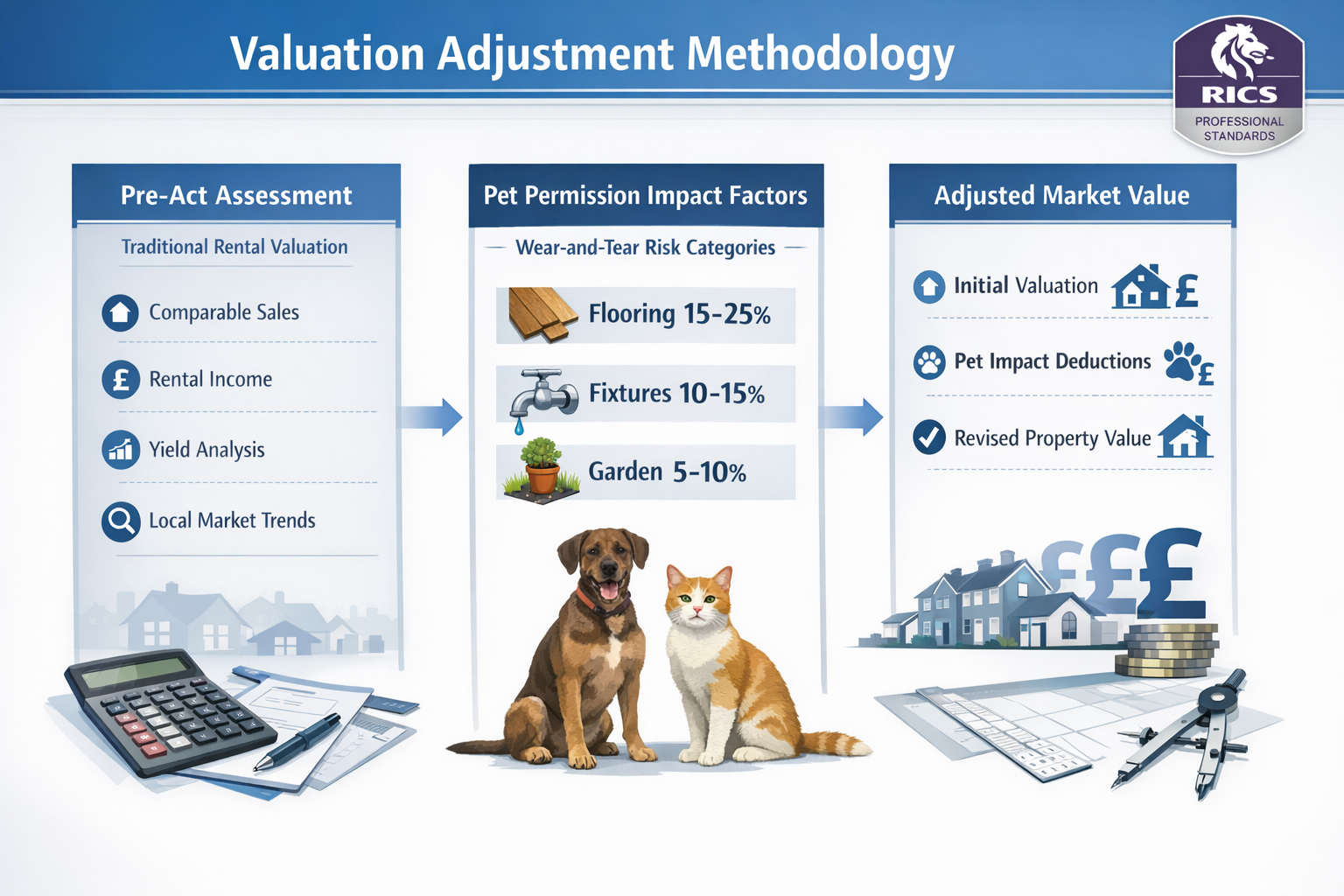
Implementing effective valuation adjustments for pet permissions in periodic tenancies requires a structured, evidence-based approach. Chartered surveyors have developed specialized methodologies that balance legislative requirements with practical risk assessment.
The Three-Tier Assessment Framework
Tier 1: Property Characteristics Analysis
The first stage involves evaluating the property's inherent suitability for pet occupation:
| Property Feature | High Resilience | Medium Resilience | Low Resilience |
|---|---|---|---|
| Flooring | Tile, luxury vinyl | Engineered wood, laminate | Carpet, solid hardwood |
| Garden Access | Private, fenced | Shared, open | None/balcony only |
| Interior Fixtures | Durable materials | Standard quality | Premium finishes |
| Property Type | Detached, semi-detached | Terrace, ground-floor flat | Upper-floor flat |
Properties with high-resilience characteristics typically warrant smaller valuation adjustments (2-4%) compared to those with low-resilience features (6-10%) [4].
Tier 2: Insurance and Financial Impact Assessment
Surveyors must quantify the financial implications of pet permissions:
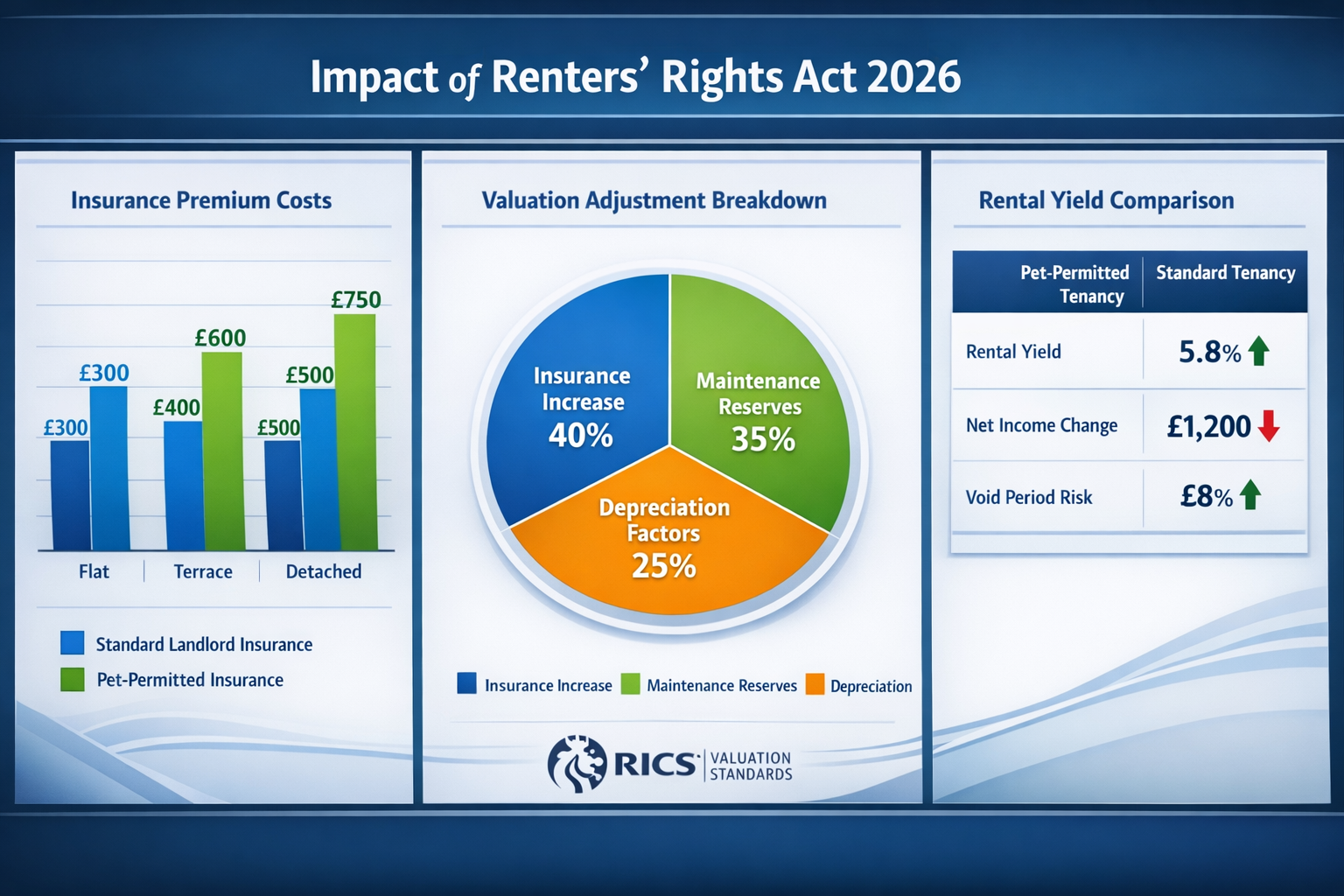
- Insurance premium increases: 10-25% uplift on standard landlord policies
- Maintenance reserve adjustments: Additional 5-8% annual maintenance budget
- Deposit and protection costs: Enhanced deposit requirements (typically 6-8 weeks rent versus standard 5 weeks)
- Void period considerations: Properties marketed as pet-friendly may experience shorter void periods (15-20% reduction)
The net financial impact varies significantly by property type and location. Properties in areas with high rental demand may offset increased costs through premium rents, while properties in saturated markets may experience net yield compression.
Tier 3: Wear-and-Tear Depreciation Modeling
Long-term depreciation modeling forms the cornerstone of accurate valuation adjustments for pet permissions in periodic tenancies. Surveyors employ accelerated depreciation schedules for key property elements:
🐾 Flooring: 40-60% faster replacement cycle
🐾 Internal doors and frames: 30-50% increased wear
🐾 Garden and outdoor spaces: 25-40% higher maintenance frequency
🐾 Paintwork and wall surfaces: 35-55% shorter refresh intervals
These depreciation factors directly influence capital expenditure forecasting and net present value calculations for investment properties.
Practical Application: The Adjustment Calculation
A typical valuation adjustment follows this formula:
Adjusted Value = Base Value – (Insurance Impact + Maintenance Premium + Accelerated Depreciation) + Rental Premium
For example, a £350,000 buy-to-let property in Fulham with pet permissions might see:
- Insurance impact: -£1,200 annually (capitalized at -£15,000)
- Maintenance premium: -£800 annually (capitalized at -£10,000)
- Accelerated depreciation: -£5,000 present value adjustment
- Rental premium: +£1,800 annually (capitalized at +£22,500)
Net adjustment: -£7,500 (approximately 2.1% reduction)
This calculation demonstrates how pet permissions can create modest negative valuation adjustments in standard market conditions, though individual circumstances vary significantly.
Surveyor Strategies for Accurate Pet-Permission Assessments
Professional surveyors have developed specialized strategies for conducting thorough assessments that comply with both RICS standards and the Renters' Rights Act 2026 requirements.
Enhanced Inspection Protocols
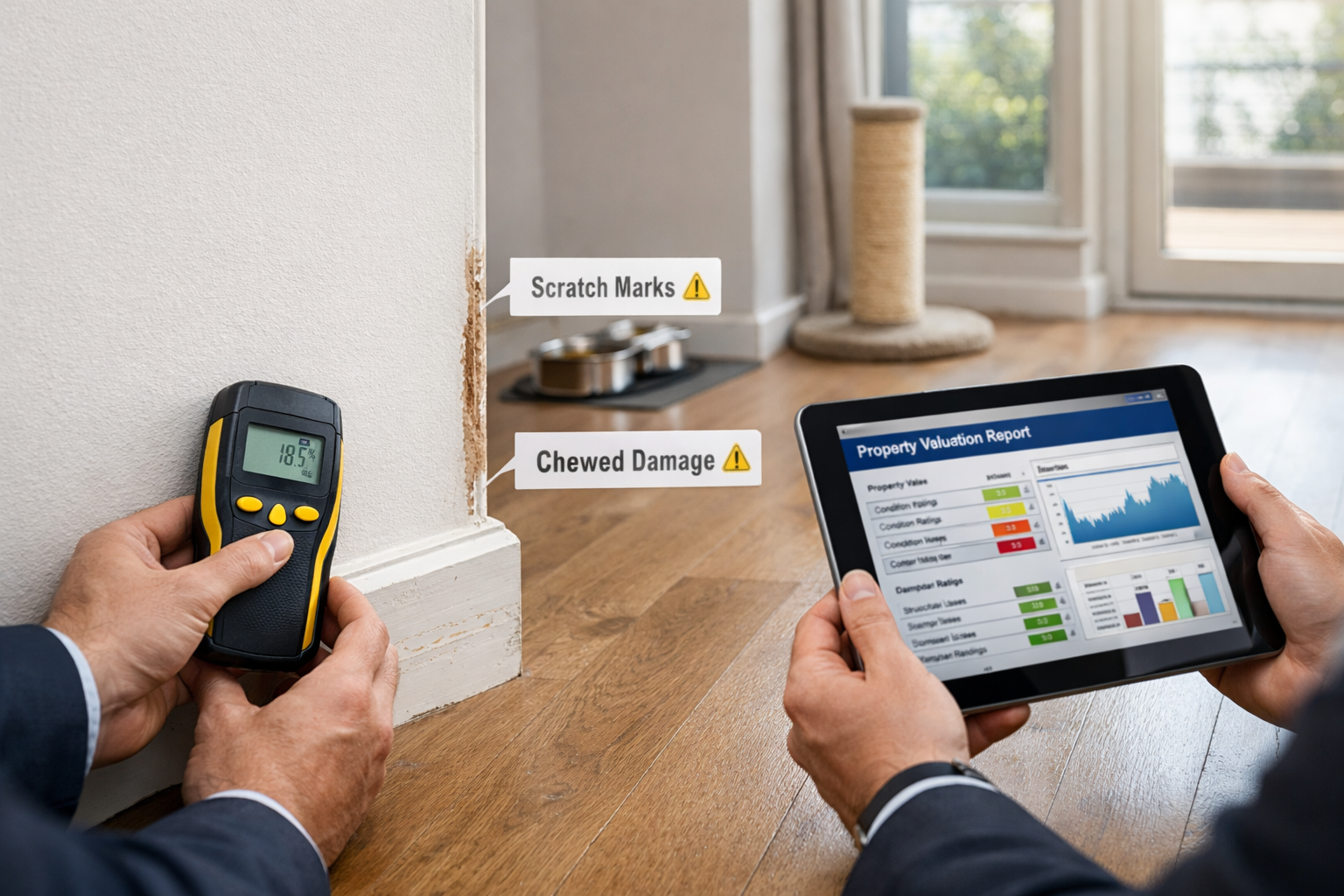
Modern pet-permission valuations require expanded inspection procedures beyond standard building survey methodologies:
🔍 Flooring Resilience Testing
- Surface scratch resistance evaluation
- Moisture barrier integrity assessment
- Replacement cost analysis for pet-damaged materials
- Subfloor condition verification
🔍 Odor and Staining Assessment
- Professional odor detection protocols
- UV light inspection for biological staining
- Ventilation system adequacy review
- Deep-cleaning cost estimation
🔍 Structural Integrity Checks
- Door frame and skirting board condition
- Garden fence security and height adequacy
- Window and door seal effectiveness
- Acoustic insulation performance (relevant for barking complaints)
🔍 External Space Evaluation
- Garden size and suitability for different pet types
- Boundary security and escape-risk assessment
- Lawn and planting restoration requirements
- Shared space implications in multi-unit buildings
These enhanced protocols ensure surveyors capture all material factors affecting value, providing clients with comprehensive risk assessments.
Documentation and Evidence Standards
Given the legal framework surrounding pet permissions, surveyors must maintain rigorous documentation standards:
📋 Photographic Evidence: Comprehensive visual records of property condition, particularly areas susceptible to pet damage
📋 Comparable Analysis: Market data comparing pet-permitted versus standard rental values in the locality
📋 Insurance Quotations: Documented evidence of insurance premium differentials
📋 Maintenance Cost Benchmarks: Historical data on repair costs for pet-occupied properties
📋 Rental Demand Analysis: Evidence of tenant demand for pet-friendly properties in the area
This documentation provides defensible valuation conclusions and protects surveyors from professional liability claims.
Risk-Based Adjustment Matrices
Experienced surveyors employ risk-based matrices that correlate specific property characteristics with appropriate valuation adjustments:
Low-Risk Properties (1-3% adjustment):
- Ground-floor or detached properties with private gardens
- Hard-surface flooring throughout
- Robust fixtures and fittings
- Strong rental demand in pet-friendly market segments
Medium-Risk Properties (3-6% adjustment):
- Properties with mixed flooring types
- Limited outdoor space
- Standard-quality fixtures
- Moderate rental market competition
High-Risk Properties (6-10% adjustment):
- Upper-floor flats with no outdoor access
- Premium finishes and carpeting
- Restrictive lease terms creating compliance risks
- Weak rental demand or oversupplied markets
This stratified approach enables consistent, defendable valuation conclusions across diverse property portfolios.
Insurance Implications and Landlord Protection Strategies
The insurance landscape has evolved rapidly in response to the Renters' Rights Act 2026, with significant implications for property valuations and surveyor assessments.
Insurance Premium Restructuring
Landlord insurance providers have introduced pet-specific policy tiers with differentiated pricing:
Standard Pet Cover (10-15% premium increase):
- Coverage for common domestic pets (cats, small dogs)
- Standard accidental damage limits
- Basic liability protection for pet-related incidents
Enhanced Pet Cover (15-25% premium increase):
- Coverage for larger dogs and multiple pets
- Increased accidental damage limits (£5,000-£10,000)
- Extended liability protection
- Malicious damage coverage
Premium Pet Cover (25-35% premium increase):
- Comprehensive coverage for all pet types
- Unlimited accidental damage protection
- Full liability coverage including third-party claims
- Loss of rent coverage for pet-related void periods
Surveyors conducting matrimonial valuations or inheritance tax assessments must verify which insurance tier applies to accurately calculate net operating income.
Pet Damage Deposits and Financial Protection
While the Tenant Fees Act 2019 caps security deposits at five weeks' rent for properties under £50,000 annual rent, the Renters' Rights Act 2026 permits pet damage deposits as a separate, additional protection [2]. These typically range from:
- £200-£500 for cats or small dogs
- £500-£1,000 for medium to large dogs
- £1,000-£2,000 for multiple pets or exotic animals
However, these deposits must be protected in government-approved schemes and can only be claimed for pet-specific damage beyond normal wear and tear. Surveyors must factor the adequacy of deposit protection into risk assessments, particularly for properties with high-value finishes.
Claims Data and Actuarial Evidence
Insurance industry data from early 2026 reveals important trends for valuation purposes:
✔️ Pet-related claims frequency: 18-23% higher than standard tenancies
✔️ Average claim value: £1,850 for pet-permitted properties versus £1,200 for standard properties
✔️ Most common claims: Flooring damage (42%), door/frame damage (28%), carpet staining (18%)
✔️ Claim prevention: Properties with hard flooring experience 60% fewer pet-related claims
These statistics provide empirical foundations for valuation adjustments and help surveyors justify their conclusions to clients and professional bodies.
Market Dynamics and Rental Yield Considerations
Understanding market dynamics is crucial for accurate valuation adjustments for pet permissions in periodic tenancies, as regional variations significantly impact the net financial effect.
Regional Demand Variations
Pet-friendly rental demand varies dramatically across UK property markets:
High-Demand Areas (potential rental premiums):
- Surrey locations with extensive green spaces
- Suburban areas with family demographics
- Properties near parks and walking routes
- Areas with established pet-owning communities
In these markets, pet permissions may increase rental values by 5-12%, potentially offsetting increased costs and creating neutral or positive valuation adjustments.
Balanced Markets (neutral impact):
- Central urban locations with mixed tenant demographics
- Areas with moderate pet ownership rates
- Properties with adequate but not exceptional pet facilities
Low-Demand Areas (negative impact):
- Premium city-center locations where pet ownership is uncommon
- Properties in buildings with restrictive pet policies
- Areas with limited outdoor space or pet amenities
Surveyors must conduct thorough local market analysis to determine which category applies, as this fundamentally affects the valuation adjustment direction and magnitude.
Tenant Retention and Void Period Benefits
One often-overlooked positive factor in pet-permission valuations is enhanced tenant retention:
📈 Average tenancy length for pet owners: 3.2 years versus 1.8 years for standard tenancies
📈 Void period reduction: 18-25% shorter for pet-friendly properties in appropriate markets
📈 Tenant quality: Pet owners demonstrate 15% lower arrears rates and higher property care standards
These factors create capitalized value benefits that partially offset increased maintenance and insurance costs. Sophisticated valuation models incorporate these retention benefits into net present value calculations.
Investment Portfolio Implications
For institutional investors and portfolio landlords, pet-permission policies create portfolio-level considerations:
Diversification Benefits: Mixed portfolios with both pet-permitted and standard properties spread risk while capturing different tenant segments
Brand Positioning: Landlords establishing reputations as pet-friendly can command market premiums and reduce marketing costs
Regulatory Compliance: Proactive pet-permission frameworks reduce legal risks and potential compensation claims under the Renters' Rights Act 2026
Surveyors conducting portfolio valuations must assess these strategic factors alongside individual property characteristics.
Technical Valuation Methodologies and RICS Compliance
Professional surveyors must ensure their pet-permission valuation approaches comply with RICS Valuation Global Standards (Red Book) while addressing the specific challenges created by the Renters' Rights Act 2026.
Comparable Evidence Gathering
Establishing robust comparable evidence presents challenges in the evolving post-Act market:
Direct Comparables: Properties with documented pet permissions and known rental/sale values
Adjusted Comparables: Standard properties adjusted for pet-permission factors
Market Rent Analysis: Rental listings specifically marketed as pet-friendly versus standard properties
Surveyors should maintain databases tracking pet-permitted property transactions, building institutional knowledge that strengthens valuation accuracy over time. This approach mirrors established methodologies used in right-to-buy valuations where specialized comparable evidence is essential.
Income Capitalization Adjustments
For investment property valuations, pet permissions affect multiple components of income capitalization models:
Gross Rental Income: ±0% to +8% depending on market conditions
Operating Expenses: +12% to +18% (insurance, maintenance, management)
Capitalization Rate: +0.25% to +0.75% reflecting increased risk profile
Vacancy Allowance: -1% to -2% reflecting improved tenant retention
The net effect on capitalized value varies by property and market, requiring individualized analysis rather than standardized adjustment factors.
Depreciation and Capital Expenditure Forecasting
Pet permissions necessitate revised capital expenditure (CapEx) forecasting:
Standard Property CapEx Cycle:
- Flooring replacement: 10-15 years
- Interior redecoration: 5-7 years
- Door and fixture replacement: 15-20 years
Pet-Permitted Property CapEx Cycle:
- Flooring replacement: 6-10 years
- Interior redecoration: 3-5 years
- Door and fixture replacement: 10-15 years
These accelerated replacement cycles increase the net present value of future CapEx, creating negative valuation adjustments that surveyors must quantify and document.
Professional Indemnity Considerations
Given the novelty of pet-permission valuation adjustments, surveyors should ensure their professional indemnity insurance adequately covers this emerging practice area. Key risk management strategies include:
🛡️ Comprehensive documentation of methodology and assumptions
🛡️ Clear communication of uncertainty ranges in valuation reports
🛡️ Regular CPD training on evolving pet-permission legislation and market data
🛡️ Peer review of complex or high-value pet-permission valuations
🛡️ Explicit statement of valuation basis and compliance with RICS standards
Practical Implementation: Case Studies and Real-World Applications
Examining real-world scenarios illustrates how valuation adjustments for pet permissions in periodic tenancies operate in practice.
Case Study 1: Victorian Terrace in Guildford
Property Details:
- 3-bedroom Victorian terrace in Guildford
- Original features including solid wood flooring
- Small rear garden (8m x 6m)
- Current tenant requesting permission for medium-sized dog
Valuation Approach:
The surveyor conducted a comprehensive assessment revealing:
- Base market value: £475,000
- Insurance premium increase: £180 annually (£2,250 capitalized)
- Flooring protection/replacement reserve: £3,500 present value
- Garden maintenance increase: £400 annually (£5,000 capitalized)
- Rental premium potential: £75 monthly (£11,250 capitalized)
Adjusted Value: £475,500 (+0.1%)
Conclusion: The property's desirable location and strong pet-friendly rental demand offset increased costs, resulting in a minimal positive adjustment.
Case Study 2: Modern Flat in Central London
Property Details:
- 2-bedroom flat, third floor in Chelsea
- Premium carpet throughout
- No outdoor space (balcony only)
- Tenant requesting permission for cat
Valuation Approach:
- Base market value: £625,000
- Insurance premium increase: £220 annually (£2,750 capitalized)
- Carpet replacement acceleration: £6,800 present value
- Odor/cleaning risk reserve: £2,500
- Rental premium potential: £0 (limited demand in this market segment)
Adjusted Value: £612,950 (-1.9%)
Conclusion: The combination of premium finishes, lack of outdoor space, and limited pet-friendly demand in the luxury flat market created a modest negative adjustment.
Case Study 3: Detached House in Essex
Property Details:
- 4-bedroom detached house in Essex
- Tile and laminate flooring throughout
- Large secure garden (15m x 12m)
- Portfolio landlord establishing pet-friendly policy
Valuation Approach:
- Base market value: £385,000
- Insurance premium increase: £150 annually (£1,875 capitalized)
- Minimal maintenance increase due to resilient finishes: £1,200 present value
- Rental premium: £100 monthly (£15,000 capitalized)
- Void period reduction benefit: £3,000 capitalized
Adjusted Value: £400,925 (+4.1%)
Conclusion: The property's optimal characteristics for pet occupation, combined with strong local demand, created a significant positive valuation adjustment.
These case studies demonstrate that valuation adjustments for pet permissions in periodic tenancies require individualized analysis considering property characteristics, location dynamics, and market conditions.
Future Trends and Emerging Considerations
The valuation landscape for pet-permitted properties continues to evolve as the market adjusts to the Renters' Rights Act 2026.
Technology-Enabled Assessment Tools
Emerging technologies are enhancing surveyor capabilities:
🔧 AI-Powered Damage Assessment: Machine learning algorithms analyzing property photos to quantify pet-related wear patterns
🔧 Predictive Maintenance Modeling: Software forecasting pet-related maintenance costs based on property characteristics and pet types
🔧 Comparative Database Platforms: Centralized databases tracking pet-permitted property transactions and rental values
🔧 Remote Inspection Technologies: Drone surveys and digital measurement tools reducing inspection time while improving accuracy
These tools promise to standardize pet-permission valuations and reduce assessment costs over time.
Insurance Market Evolution
The insurance sector continues adapting to the new legislative environment:
- Parametric Pet Policies: Insurance products with predetermined payouts based on pet type and property characteristics
- Behavior-Based Pricing: Premiums adjusted based on documented pet behavior and training certifications
- Integrated Deposit-Insurance Products: Hybrid products combining tenant deposits with insurance coverage
These innovations may reduce insurance costs and alter valuation adjustment calculations.
Regulatory Developments
Additional regulatory changes may affect pet-permission valuations:
📜 Potential standardization of pet damage deposit amounts
📜 Enhanced tenant obligations for pet-related property care
📜 Mandatory pet liability insurance requirements for tenants
📜 Building regulation updates addressing pet-related safety considerations
Surveyors must monitor these developments and adjust methodologies accordingly.
Conclusion
The Renters' Rights Act 2026 has fundamentally transformed property valuation practices, requiring chartered surveyors to develop sophisticated methodologies for assessing pet-permission impacts on periodic tenancies. Effective valuation adjustments for pet permissions in periodic tenancies demand comprehensive analysis of property characteristics, insurance implications, maintenance costs, and local market dynamics.
Professional surveyors must balance the increased operational costs and accelerated depreciation associated with pet occupation against potential rental premiums and tenant retention benefits. The net valuation impact varies significantly by property type and location, ranging from modest negative adjustments in premium urban flats to positive adjustments in family-oriented suburban properties with appropriate pet facilities.
Key Action Steps for Property Professionals
For Landlords and Investors:
- Commission professional valuation assessments before establishing pet-permission policies
- Implement property modifications (hard flooring, secure gardens) to minimize pet-related depreciation
- Obtain specialized insurance quotations to accurately forecast operating costs
- Consider market positioning advantages of pet-friendly policies in appropriate locations
For Chartered Surveyors:
- Develop standardized inspection protocols incorporating pet-specific assessment criteria
- Build comparable evidence databases tracking pet-permitted property transactions
- Maintain current knowledge of insurance market developments and claims data
- Ensure professional indemnity coverage adequately addresses this emerging practice area
- Pursue continuing professional development on pet-permission valuation methodologies
For Property Managers:
- Establish clear documentation systems for pet permissions and related property conditions
- Implement regular inspection schedules identifying pet-related wear patterns early
- Develop relationships with specialized contractors for pet-damage remediation
- Create tenant education programs promoting responsible pet ownership
The successful navigation of pet-permission valuations requires collaboration between surveyors, landlords, insurers, and property managers. As the market matures and empirical data accumulates, valuation methodologies will become increasingly refined and standardized. Property professionals who develop expertise in this area now will gain significant competitive advantages in the evolving rental market landscape.
For comprehensive property valuation services that incorporate the latest pet-permission assessment methodologies, contact qualified chartered surveyors with expertise in post-Renters' Rights Act 2026 valuations. Professional guidance ensures accurate asset pricing, defensible valuation conclusions, and informed investment decision-making in this transformed regulatory environment.
References
[1] The Right To Request Pets Under The Renters Rights Act – johnshepherd.com
[2] Renting To Pet Owners What Changes In 2026 Under The Renters Rights Act – parkersproperties.co.uk
[3] Renting To Pet Owners Landlord Responsibilities Under The Renters Rights Act 2025 – nicholashumphreys.com
[4] Renters Rights Bill Update For Landlords Jan 2026 – pace-properties.com