

The built environment accounts for nearly 40% of global carbon emissions, yet until recently, property valuations rarely factored carbon impact into financial assessments. Since July 1, 2024, the RICS Whole Life Carbon Assessment (WLCA) 2nd Edition standard has fundamentally changed this landscape, making it mandatory for all RICS members globally to integrate carbon metrics into their professional work. For chartered surveyors conducting property valuations in 2026, understanding and applying Chartered Surveyor Checklists for Whole Life Carbon in Valuations: Applying RICS 2nd Edition Standard 2026 is no longer optional—it's a professional requirement that directly impacts asset values, investment decisions, and regulatory compliance.

Key Takeaways
- Mandatory compliance: The RICS WLCA 2nd Edition became mandatory for all members on July 1, 2024, requiring carbon assessment integration across all built asset valuations [1]
- Expanded scope: The standard now applies to all built assets and infrastructure projects globally, with enhanced modules including preconstruction (A0) and employee commute (B8) assessments [2]
- Four lifecycle stages: Whole life carbon assessments must address upfront carbon (A), in-use carbon (B), end-of-life carbon (C), and beyond-boundary impacts (D) [2]
- Practical implementation: Surveyors need structured checklists to systematically capture carbon data during retrofit assessments, new builds, and property valuations
- Professional development: RICS offers comprehensive training programs in 2026 to support surveyors in mastering the 2nd Edition standard [5]
Understanding the RICS Whole Life Carbon Assessment 2nd Edition Standard
The Royal Institution of Chartered Surveyors released the second edition of its Whole Life Carbon Assessment standard following extensive stakeholder consultation that received over 1,300 responses [4]. This updated framework represents a significant evolution from the original 2017 standard, expanding its application from limited project types to encompass all built assets and infrastructure projects globally [4].
What Changed in the 2nd Edition?
The 2nd Edition introduces several critical enhancements that directly impact how chartered surveyors approach valuations:
Expanded Assessment Modules 🔍
The standard now includes refined lifecycle stages with new reporting requirements:
- Module A0: Preconstruction activities including site surveys, demolition of existing structures, and land remediation
- Module B8: Employee commute and business travel associated with building operations
- Modules D1/D2: Enhanced beyond-system-boundary assessments for reuse, recycling, and energy recovery [2]
Alignment with International Standards 🌍
The 2nd Edition aligns with the International Cost Management Standards (ICMS) 3rd Edition and incorporates the Built Environment Carbon Database (BECD), ensuring consistency across global projects [2]. This alignment is particularly important for surveyors working on international portfolios or cross-border investments.
Enhanced Guidance Areas
The updated standard provides comprehensive guidance on:
- Biogenic carbon accounting
- Retrofit and refurbishment assessments
- Circular economy principles
- Sequestration and carbon storage
- Uncertainty and sensitivity analysis [6]
The Four Core Lifecycle Stages in Whole Life Carbon Assessments
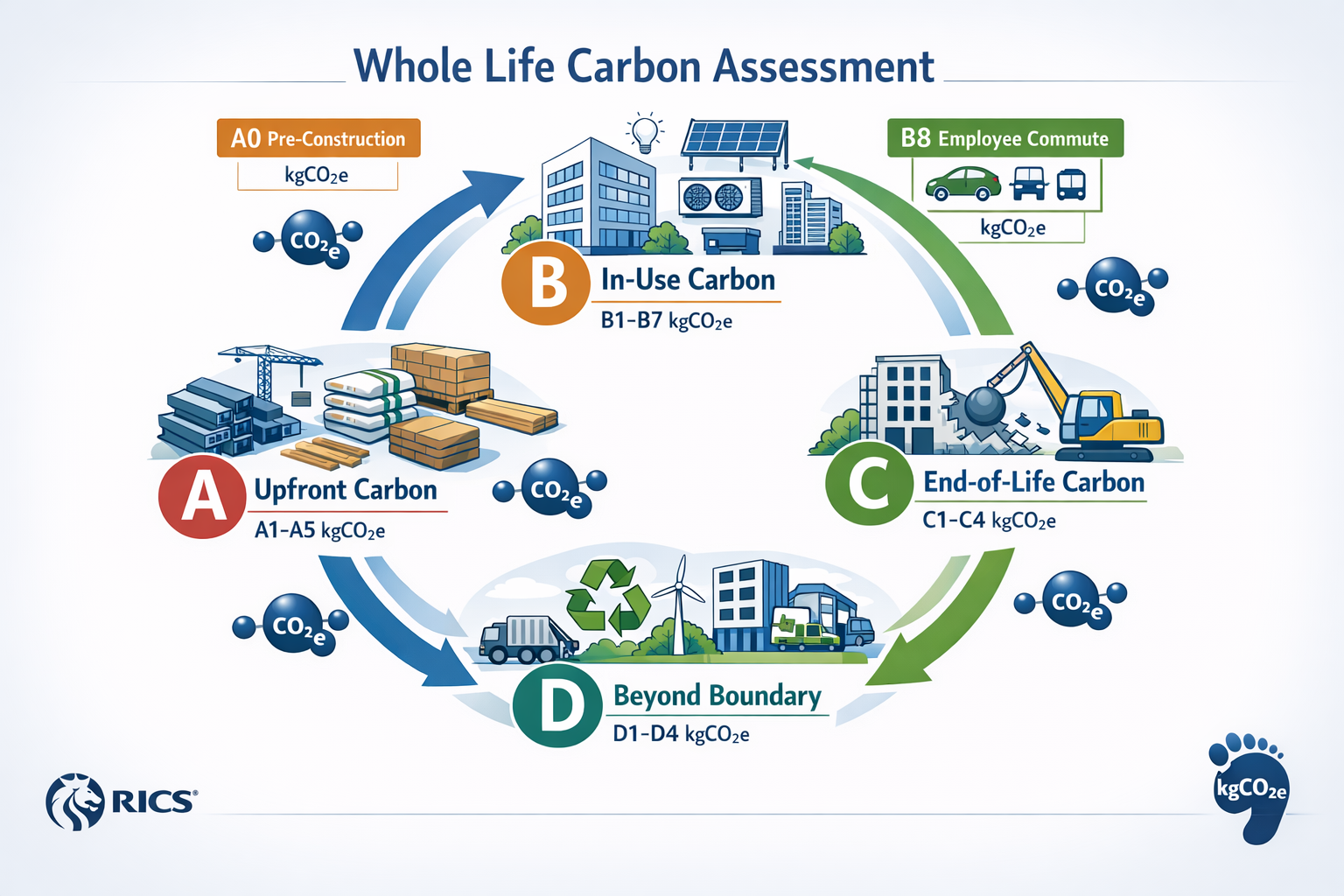
Understanding the four core lifecycle stages is essential for chartered surveyors developing comprehensive assessment checklists. Each stage contributes differently to a building's total carbon footprint and requires specific data collection approaches.
Stage A: Upfront Carbon (Product and Construction)
Stage A encompasses all carbon emissions from material extraction through construction completion. This stage typically represents 30-60% of a building's whole life carbon, making it a critical focus area [2].
Key Assessment Components:
| Module | Description | Typical Data Sources |
|---|---|---|
| A0 | Pre-construction activities | Site survey reports, demolition records |
| A1-A3 | Product stage (materials) | Environmental Product Declarations (EPDs), BECD |
| A4 | Transportation to site | Logistics records, supplier data |
| A5 | Construction process | Contractor energy use, waste records |
For building survey work, surveyors must document material specifications, quantities, and transportation distances to calculate accurate upfront carbon figures.
Stage B: In-Use Carbon (Operational Phase)
Stage B covers the operational lifespan of the building, typically 60 years for residential properties and 25-30 years for commercial assets. This stage includes:
- B1-B5: Maintenance, repair, replacement, and refurbishment activities
- B6-B7: Operational energy and water use
- B8: User-related transport (newly added in 2nd Edition) [2]
Operational carbon often dominates whole life assessments, particularly for buildings with poor energy performance. Surveyors conducting insurance reinstatement cost valuations must now factor in potential carbon reduction retrofits that affect replacement specifications.
Stage C: End-of-Life Carbon
Stage C addresses deconstruction, demolition, and waste processing. While typically representing a smaller percentage of total carbon (5-10%), this stage is increasingly important as circular economy principles gain traction [2].
Stage D: Beyond Boundary Benefits
Stage D captures benefits from reuse, recycling, and energy recovery that occur outside the building's system boundary. The 2nd Edition provides refined guidance on calculating these benefits, particularly relevant for retrofit projects that maximize material retention [6].
Chartered Surveyor Checklists for Whole Life Carbon in Valuations: Practical Implementation

Implementing the RICS 2nd Edition standard requires systematic data collection and analysis. Chartered surveyors need practical checklists tailored to different valuation scenarios.
Essential Checklist for Retrofit Assessments
When conducting valuations on existing buildings with potential retrofit interventions, surveyors should use this comprehensive checklist:
Pre-Assessment Phase ✅
- Obtain existing building energy performance certificates (EPCs)
- Review historical energy consumption data (minimum 3 years)
- Document current building fabric specifications
- Identify heritage or conservation constraints
- Establish baseline operational carbon (Stage B6-B7)
Material Assessment ✅
- Quantify existing materials to be retained
- Calculate embodied carbon in retained elements
- Assess material condition and remaining service life
- Identify opportunities for material reuse (Stage D benefits)
- Document waste management strategies for removed materials
Intervention Analysis ✅
- Calculate embodied carbon of new materials (Stage A1-A3)
- Assess transportation impacts (Stage A4)
- Estimate installation carbon (Stage A5)
- Project operational carbon savings over assessment period
- Calculate payback period for carbon investment
Circular Economy Considerations ♻️
- Document design for disassembly features
- Assess material recyclability at end-of-life
- Quantify potential Stage D benefits
- Evaluate whole building reuse potential
This systematic approach ensures compliance with the 2nd Edition standard while providing robust data for capital gains valuations that increasingly factor in carbon performance.
New Build Assessment Checklist
For new construction projects, surveyors require a different checklist focused on design optimization and material selection:
Design Stage Assessment 📐
- Review architectural specifications for low-carbon materials
- Assess structural system carbon efficiency
- Evaluate renewable energy integration (solar, heat pumps)
- Calculate Module A0 impacts (site preparation, demolition)
- Benchmark against comparable projects in BECD
Material Specification Review 🏗️
- Verify Environmental Product Declarations (EPDs) for major materials
- Assess biogenic carbon content in timber and bio-based materials
- Calculate transportation distances for key materials
- Evaluate local sourcing opportunities
- Document material substitution options and carbon impacts
Construction Planning 👷
- Review contractor carbon management plans
- Assess site energy sources and efficiency
- Evaluate waste management and recycling strategies
- Calculate construction phase emissions (Module A5)
- Document construction duration impact on carbon
Operational Projection 📊
- Model operational energy use (regulated and unregulated)
- Calculate projected Stage B6-B7 emissions over 60-year period
- Assess maintenance and replacement schedules (B1-B5)
- Include Module B8 (occupant transport) where applicable
- Establish monitoring and verification protocols
Software Tools and Digital Validation for RICS Compliance
The complexity of whole life carbon assessments necessitates specialized software tools. One Click LCA has achieved recognition as the world's first RICS-validated software for WLCA compliance, enabling surveyors to generate reports that meet the 2nd Edition standard requirements [3].
Key Software Features for Surveyors:
- Automated lifecycle stage calculations (A-D)
- Integration with EPD databases and BECD
- Scenario comparison for retrofit options
- Compliance reporting templates
- Uncertainty and sensitivity analysis tools
Surveyors should verify that any software tools used are validated against the RICS 2nd Edition standard to ensure professional compliance [3].
Integrating Carbon Metrics into Valuation Reports
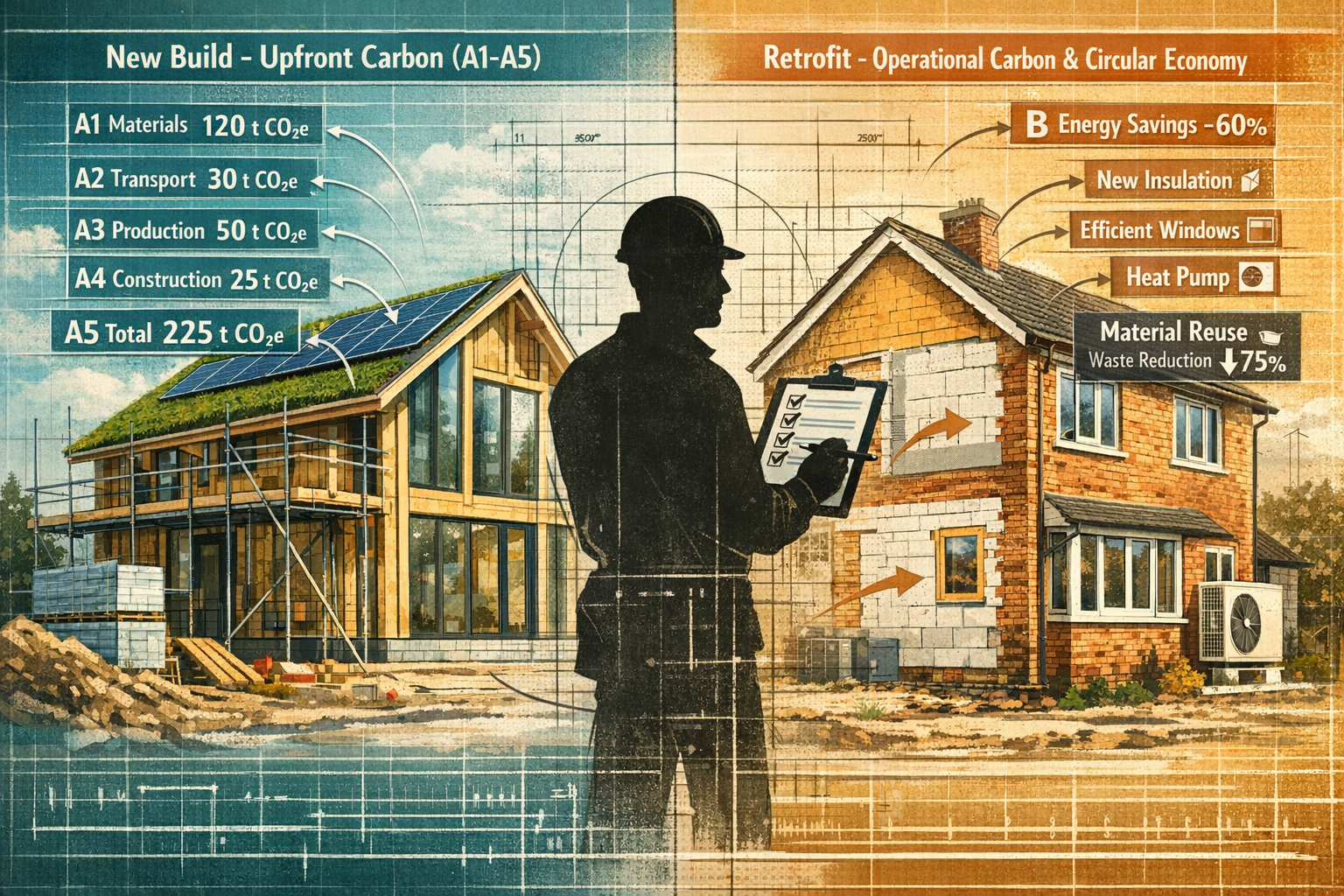
The integration of whole life carbon data into traditional valuation reports represents a significant shift in surveying practice. In 2026, clients increasingly expect carbon metrics alongside financial valuations, particularly for:
- Investment portfolios requiring ESG (Environmental, Social, Governance) reporting
- Development appraisals where planning authorities mandate carbon assessments
- Loan security valuations where lenders assess climate transition risk
- Annual tax valuations reflecting carbon-related regulatory costs
Reporting Framework for Surveyors
Executive Summary Section 📋
Include a dedicated carbon performance summary:
- Total whole life carbon (kgCO2e/m²)
- Breakdown by lifecycle stages (A, B, C, D)
- Comparison to benchmark standards
- Carbon payback period for retrofit scenarios
- Material carbon impact of key decisions
Valuation Impact Analysis 💰
Explicitly connect carbon performance to value:
- Regulatory risk assessment: Potential costs from future carbon pricing or regulations
- Operational cost implications: Energy costs tied to Stage B carbon
- Market positioning: Premium or discount based on carbon performance
- Obsolescence risk: Buildings with poor carbon performance face accelerated depreciation
Recommendations Section ✨
Provide actionable guidance:
- Priority carbon reduction interventions
- Cost-benefit analysis of retrofit options
- Compliance pathway for net zero targets
- Monitoring and verification recommendations
Training and Professional Development for 2026
RICS recognizes that implementing the 2nd Edition standard requires significant professional development. The organization offers a comprehensive Certificate in Whole Life Carbon Assessment training program specifically designed for the 2026 standard [5].
Training Program Components:
- Introduction to whole life carbon principles
- Detailed guidance on lifecycle stages A-D
- Software tools and calculation methodologies
- Case studies across building types
- Assessment boundary definition
- Reporting and compliance requirements [5]
Chartered surveyors should prioritize this training to maintain professional competency and meet client expectations. The investment in carbon assessment skills directly enhances service value and competitive positioning.
Common Challenges and Practical Solutions
Challenge 1: Data Availability
Problem: Obtaining accurate EPD data for all materials, particularly for existing buildings or imported products.
Solution: Use hierarchical data quality approaches:
- Product-specific EPDs (preferred)
- Generic EPDs from industry databases
- BECD average values with documented assumptions
- Conservative estimates with sensitivity analysis [6]
Challenge 2: Assessment Boundaries
Problem: Determining appropriate system boundaries for complex projects or portfolios.
Solution: Follow RICS guidance on boundary definition:
- Clearly document included and excluded elements
- Justify boundary decisions with reference to standard
- Maintain consistency across comparable assessments
- Record deviations from standard as required [1]
Challenge 3: Retrofit Baseline Establishment
Problem: Establishing accurate baseline carbon for existing buildings with limited historical data.
Solution: Combine multiple data sources:
- EPC assessments and Display Energy Certificates
- Utility billing data (minimum 12 months)
- Building management system records
- Occupancy and use pattern documentation
- Comparable building benchmarks
Challenge 4: Uncertainty Quantification
Problem: Communicating confidence levels in carbon assessments to clients.
Solution: Implement systematic uncertainty analysis:
- Document data quality for each input
- Perform sensitivity analysis on key variables
- Provide range estimates rather than single figures
- Clearly communicate assumptions and limitations [6]
Regional Considerations for UK Surveyors
Chartered surveyors operating across different UK regions must consider local factors affecting carbon assessments:
Grid Carbon Intensity Variations ⚡
Operational carbon calculations vary based on regional electricity grid mix. Scotland's higher renewable energy penetration results in lower operational carbon compared to regions dependent on fossil fuel generation.
Local Material Sourcing 🚛
Transportation carbon (Module A4) varies significantly based on material sourcing. Surveyors in regions with active local manufacturing (timber in Scotland, stone in Yorkshire) can demonstrate lower embodied carbon through reduced transportation distances.
Heritage and Conservation Constraints 🏛️
Areas with high concentrations of listed buildings or conservation areas face unique challenges. Surveyors working in locations like Chelsea or Guildford must balance carbon reduction with heritage preservation requirements.
Future Developments and 2026 Outlook
The regulatory landscape continues to evolve rapidly. Key developments affecting chartered surveyors in 2026 include:
Building Regulations Updates 📜
The UK government has signaled further tightening of Part L (Conservation of fuel and power) and Part Z (Whole life carbon) requirements, with embodied carbon limits expected for new buildings from 2027 onward.
Mandatory Disclosure Requirements 📢
Several jurisdictions are moving toward mandatory carbon disclosure for commercial buildings, similar to EPC requirements. This trend will increase demand for RICS-compliant assessments.
Carbon Pricing Mechanisms 💷
As carbon pricing extends across sectors, buildings with high operational carbon face increasing financial penalties. Valuations must increasingly factor in these costs as material to asset value.
Net Zero Targets 🎯
With the UK's 2050 net zero commitment and interim targets, buildings unable to demonstrate credible decarbonization pathways face significant obsolescence risk. Whole life carbon assessments provide the evidence base for decarbonization strategies.
Conclusion
The RICS Whole Life Carbon Assessment 2nd Edition standard represents a fundamental shift in how chartered surveyors approach property valuations. Since becoming mandatory in July 2024, the standard requires systematic integration of carbon metrics across all lifecycle stages—from preconstruction through end-of-life—for all built assets globally [1].
Implementing Chartered Surveyor Checklists for Whole Life Carbon in Valuations: Applying RICS 2nd Edition Standard 2026 requires:
✅ Comprehensive understanding of the four lifecycle stages (A, B, C, D)
✅ Systematic data collection using structured checklists for retrofits and new builds
✅ Integration of validated software tools for calculation and reporting
✅ Clear communication of carbon performance in valuation reports
✅ Ongoing professional development through RICS training programs
The transition to carbon-informed valuations presents both challenges and opportunities for the surveying profession. Surveyors who master these skills position themselves as essential advisors in the transition to a net-zero built environment, providing value that extends beyond traditional financial metrics to encompass environmental performance and regulatory compliance.
Next Steps for Chartered Surveyors
-
Complete RICS WLCA training: Enroll in the Certificate in Whole Life Carbon Assessment program to build foundational competency [5]
-
Develop practice checklists: Adapt the frameworks provided in this article to your specific practice areas and property types
-
Invest in validated software: Implement RICS-validated tools to streamline assessments and ensure compliance [3]
-
Build data libraries: Establish databases of EPDs, benchmark data, and local material carbon factors for your region
-
Integrate into service offerings: Update valuation service descriptions to explicitly include whole life carbon assessments
-
Engage with implementation resources: Utilize RICS implementation guides and supporting documentation for ongoing reference [6]
The future of property valuation is inextricably linked to carbon performance. Chartered surveyors who embrace this reality and develop robust assessment capabilities will lead the profession through this critical transition, delivering enhanced value to clients while contributing to the urgent goal of decarbonizing the built environment.
References
[1] Wlca Standard 2nd Edition Now In Full Effect – rics.org
[2] Understanding The Rics Whole Life Carbon Assessment Standard – tsariley.com
[3] Rics Whole Life Carbon Assessment Wlca 2nd Edition – oneclicklca.com
[4] An Overview Of Rics Second Edition Of The Whole Life Cycle Carbon Assessment Standard – buildpass.co.uk
[5] Wlcav20courseguide2026v1 – rics.org
[6] Whole Life Carbon Assessment Implementation Guides And Supporting Documents – rics.org