

Social housing landlords face a stark reality: 94% of electrical fire deaths in rental properties involve inadequate safety inspections. As Awaab's Law expands to cover electrical hazards from October 2026, expert witnesses must adapt their protocols to defend surveyor reports in increasingly complex disrepair claims. The intersection of statutory timeframes, RICS frameworks, and Level 3 building survey requirements creates unprecedented challenges for professionals navigating Expert Witness Roles in Awaab's Law Electrical Hazard Disputes: 2026 Protocols for PRS Remediation Claims.
The expansion of Awaab's Law represents a fundamental shift in how the Private Rented Sector (PRS) handles hazard remediation. Expert witnesses now require updated methodologies that align with both legal requirements and technical surveying standards to provide credible testimony in disputes.[3]
Key Takeaways
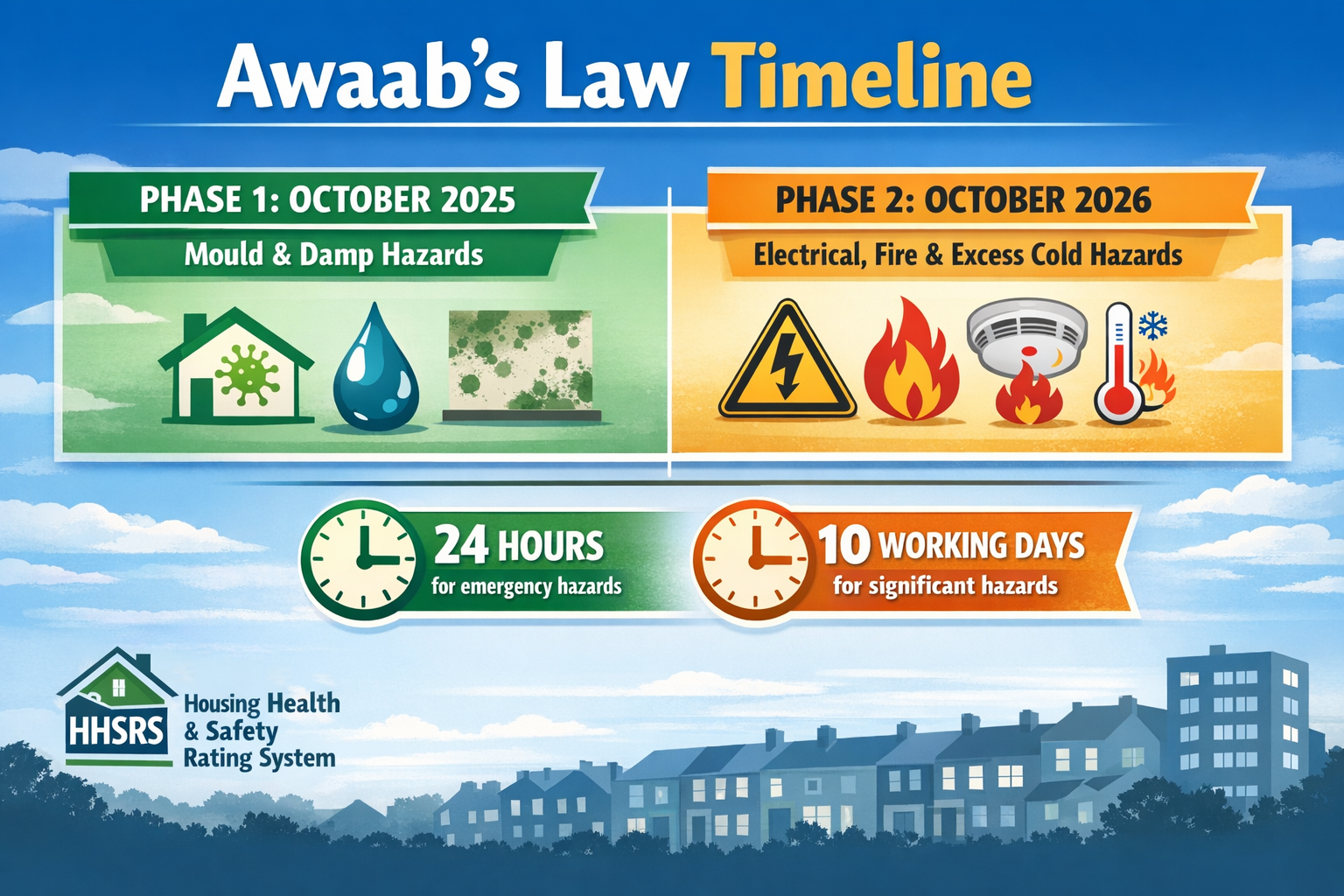
- 🔍 Phase 2 expansion in October 2026 adds electrical faults, fire hazards, and excess heat/cold to Awaab's Law coverage, requiring expert witnesses to master new assessment protocols
- ⚡ Statutory timeframes mandate 24-hour response for emergency electrical hazards and 10 working days for significant hazards, creating tight documentation requirements for expert testimony
- 📋 RICS-aligned frameworks must integrate Housing Health & Safety Rating System (HHSRS) assessments with Level 3 survey methodologies to withstand legal scrutiny
- 🛡️ Professional liability for surveyors increases substantially under the new regime, making expert witness support critical for defending inspection reports
- 📊 Evidence standards require thermal imaging, electrical testing data, and photographic documentation that meets both technical and legal admissibility criteria
Understanding Awaab's Law and Its 2026 Electrical Hazard Expansion
Awaab's Law emerged from the tragic death of two-year-old Awaab Ishak in 2020, who died from prolonged exposure to mould in his family's social housing flat. The legislation initially focused on damp and mould remediation but represents a broader commitment to tenant safety across all hazard categories.[5]
Phase 1: Current Implementation (October 2025)
The first phase of Awaab's Law, which became active in October 2025, established baseline requirements for social housing providers:
- Emergency hazards: 24-hour investigation and remediation requirement
- Significant hazards: 10 working day investigation period plus 5 working days to begin preventative work[2][5]
- Primary focus: Mould, damp, and immediate life-threatening conditions
This initial phase created the framework that expert witnesses now use when assessing landlord compliance in disrepair claims. The statutory timeframes established clear benchmarks for what constitutes reasonable response to tenant complaints.
Phase 2: October 2026 Expansion
The October 2026 expansion dramatically broadens the scope of Expert Witness Roles in Awaab's Law Electrical Hazard Disputes: 2026 Protocols for PRS Remediation Claims. Phase 2 incorporates:[3][5]
| Hazard Category | Examples | Assessment Requirements |
|---|---|---|
| Electrical Hazards | Faulty wiring, inadequate earthing, overloaded circuits | Electrical Installation Condition Report (EICR) analysis |
| Fire Safety | Defective smoke alarms, blocked escape routes, combustible materials | Fire Risk Assessment integration |
| Excess Cold | Inadequate heating, poor insulation, fuel poverty conditions | Thermal imaging and energy efficiency evaluation |
| Excess Heat | Inadequate ventilation, overheating risk in summer months | Temperature monitoring and ventilation assessment |
| Health & Hygiene | Inadequate sanitation, pest infestations, contamination | Environmental health standards application |
This expansion requires expert witnesses to develop competency across multiple technical disciplines while maintaining the rigorous documentation standards expected in building pathology assessments.
Surveyor Professional Liability Under the New Regime
The expanded scope creates substantial implications for surveyor liability. Professionals conducting property inspections must now:[3]
- Demonstrate knowledge of HHSRS assessment methodologies
- Utilize modern hazard detection technology including thermal imaging
- Document findings with sufficient detail to withstand expert cross-examination
- Understand statutory timeframes and their application to different hazard categories
- Maintain professional indemnity insurance adequate for potential claim values
Expert witnesses play a crucial role in defending surveyors who followed appropriate protocols but face allegations of negligence or inadequate inspection scope.
Expert Witness Roles in Awaab's Law Electrical Hazard Disputes: Evidence Standards and RICS Frameworks
Expert witnesses in electrical hazard disputes under Awaab's Law must navigate complex intersections between legal requirements, technical standards, and professional surveying protocols. The role extends far beyond simple fact-finding to encompass interpretation of regulatory frameworks and assessment of professional conduct.
Core Responsibilities in Construction Dispute Resolution
Expert witnesses in construction disputes serve several critical functions that apply directly to Awaab's Law cases:[1]
Technical Analysis: Experts provide detailed examination of electrical installations, identifying defects, code violations, and hazard severity. This requires competency in both current electrical regulations and historical standards applicable to older properties.
Opinion Formation: Unlike fact witnesses, experts offer professional opinions on whether landlords met their statutory obligations, whether surveyor assessments were adequate, and what remediation measures were appropriate.
Report Preparation: Written expert reports must comply with Civil Procedure Rules (CPR) Part 35 requirements, presenting findings in accessible language while maintaining technical accuracy.
Court Testimony: Experts must explain complex electrical concepts to judges and juries without technical backgrounds, defending their methodology under cross-examination.
RICS Standards for Expert Witness Practice
The Royal Institution of Chartered Surveyors (RICS) provides specific guidance for members acting as expert witnesses. In the context of Expert Witness Roles in Awaab's Law Electrical Hazard Disputes: 2026 Protocols for PRS Remediation Claims, these standards require:
✅ Independence: The expert's primary duty is to the court, not the instructing party. This proves particularly challenging when defending a fellow surveyor's work while maintaining objectivity.
✅ Competence: Experts must only accept instructions within their area of genuine expertise. Electrical hazard assessment may require collaboration with electrical engineers for complex installations.
✅ Evidence-Based Analysis: Opinions must rest on verifiable evidence, not speculation. This necessitates thorough Level 3 full building survey documentation.
✅ Transparency: Experts must disclose limitations in their assessment, areas of uncertainty, and any factors that might affect their conclusions.
Integrating HHSRS with Level 3 Survey Protocols
The Housing Health & Safety Rating System provides the statutory framework for hazard assessment in residential properties. Expert witnesses must demonstrate how surveyor findings align with HHSRS categories:
Category 1 Hazards (serious and immediate risk) include:
- Exposed live electrical conductors
- Defective electrical installations posing shock or fire risk
- Inadequate earthing creating electrocution hazard
Category 2 Hazards (less serious but still significant) include:
- Aged electrical installations approaching end of serviceable life
- Minor wiring defects requiring remediation
- Inadequate electrical capacity for modern usage
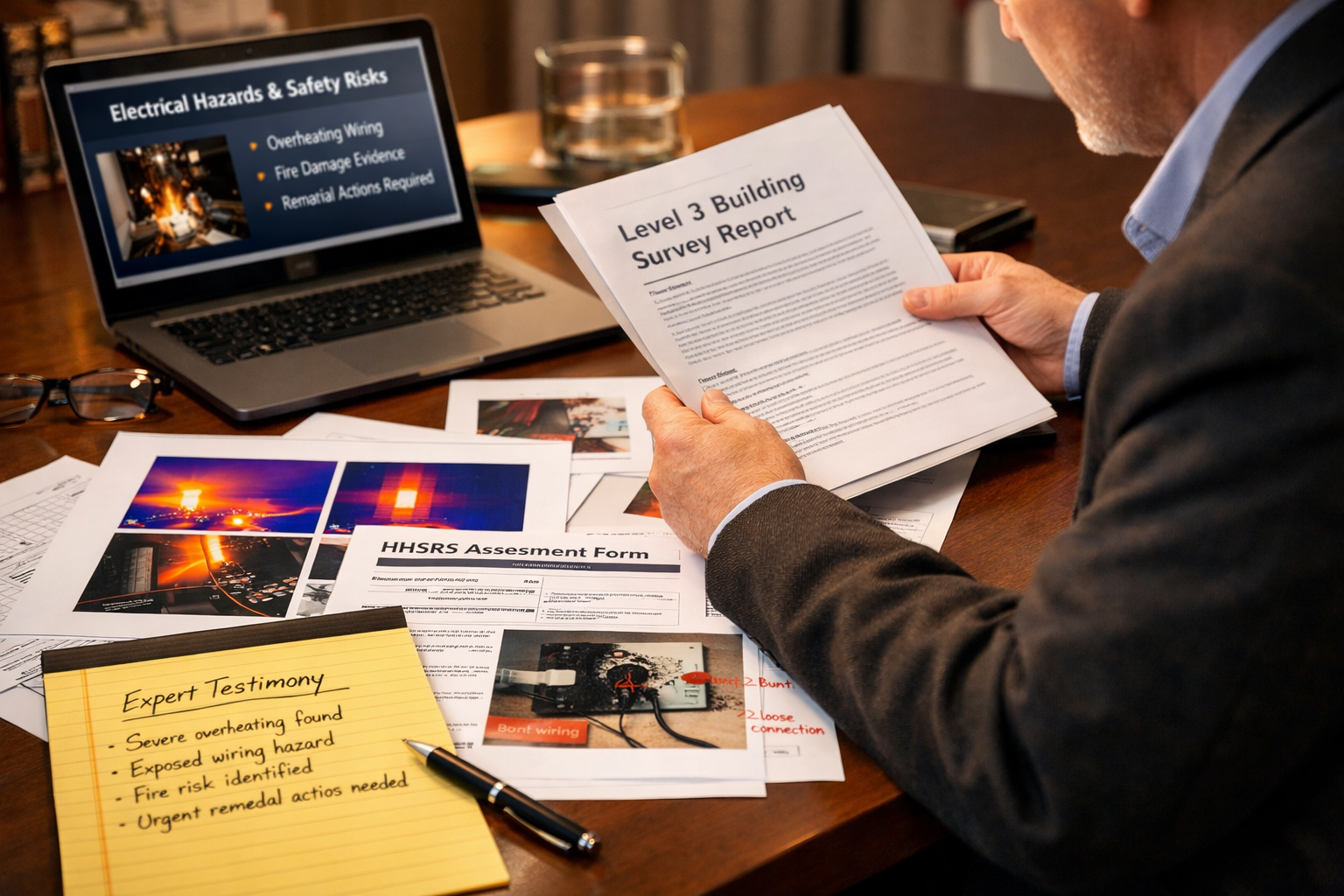
Expert witnesses must explain how building materials assessments during Level 3 surveys should identify electrical hazards, what visual inspection can reasonably detect, and when specialist electrical testing is warranted.
Documentation Requirements for Expert Testimony
Robust documentation forms the foundation of credible expert testimony. In electrical hazard disputes, this includes:
📸 Photographic Evidence: Time-stamped, high-resolution images showing:
- Overall electrical installation condition
- Specific defects or code violations
- Context showing property layout and access constraints
- Comparative images if remediation has occurred
🌡️ Thermal Imaging Data: Infrared thermography revealing:
- Overheating electrical connections
- Circuit overload conditions
- Hidden wiring defects within walls
- Distribution board hot spots indicating fault conditions
📋 Testing Records: Where electrical testing occurred:
- EICR results with specific defect codes
- Earth loop impedance measurements
- Residual Current Device (RCD) test results
- Circuit continuity verification
📝 Inspection Notes: Contemporaneous records demonstrating:
- Systematic inspection methodology
- Limitations encountered during assessment
- Recommendations for further investigation
- Communication with property occupants or managers
This documentation must meet standards for legal admissibility while providing sufficient technical detail to support expert opinions in building problems and solutions contexts.
2026 Protocols for PRS Remediation Claims: Practical Application for Expert Witnesses
The practical application of Expert Witness Roles in Awaab's Law Electrical Hazard Disputes: 2026 Protocols for PRS Remediation Claims requires systematic approaches to case assessment, evidence evaluation, and testimony preparation.
Case Assessment Framework for Electrical Hazard Disputes
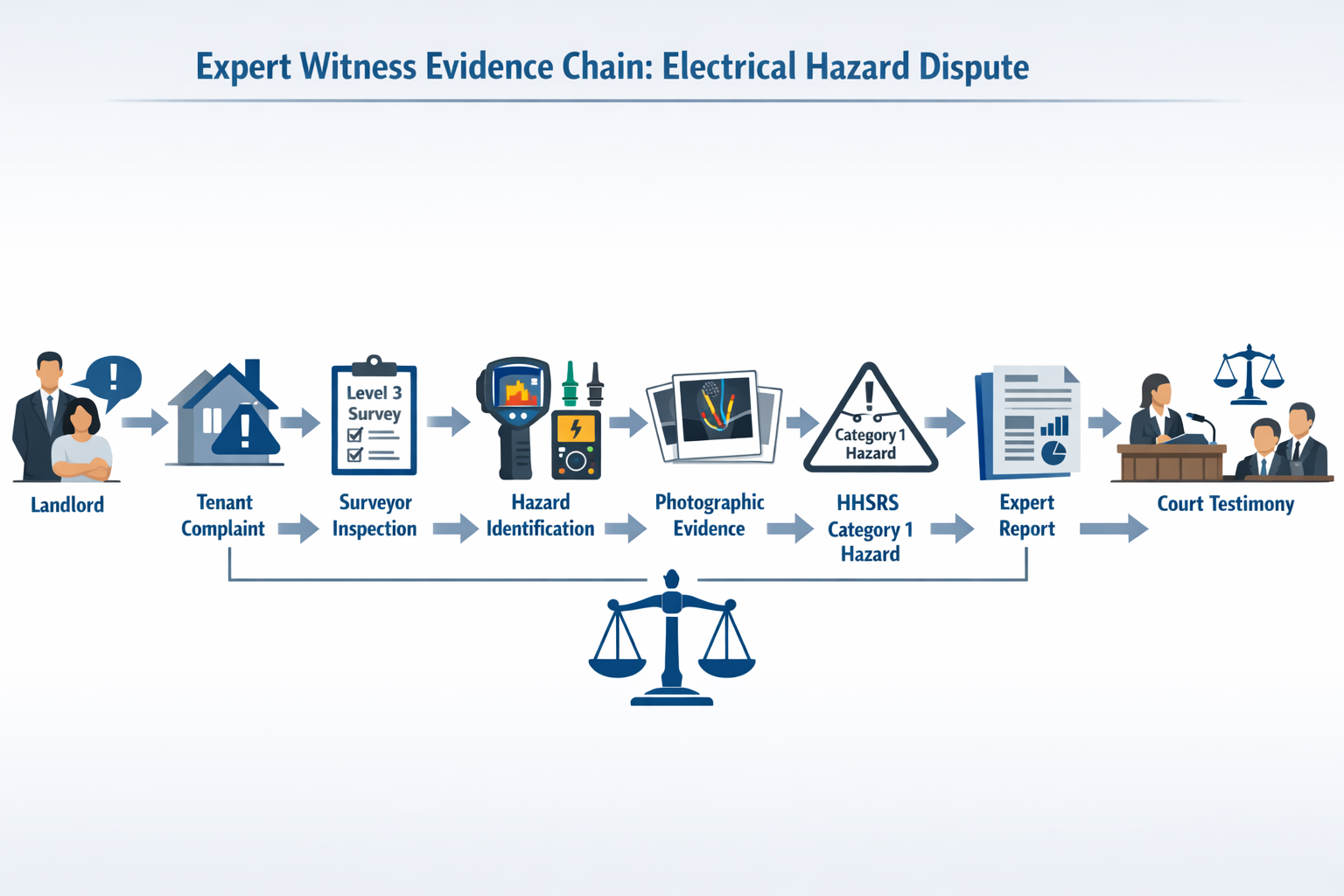
When instructed on an Awaab's Law electrical hazard case, expert witnesses should follow a structured assessment protocol:
Step 1: Timeline Reconstruction
- Establish when tenant first reported electrical concerns
- Document landlord response times against statutory 24-hour (emergency) or 10-day (significant hazard) requirements[2][5]
- Identify any inspection delays or communication failures
- Map remediation actions against required timeframes
Step 2: Hazard Classification Verification
- Review initial hazard categorization (emergency vs. significant)
- Assess whether classification was appropriate given circumstances
- Evaluate whether HHSRS methodology was correctly applied
- Determine if hazard severity changed during investigation period
Step 3: Surveyor Conduct Evaluation
- Examine scope of original inspection against professional standards
- Assess whether statutory considerations were properly addressed
- Determine if recommendations for further investigation were appropriate
- Evaluate whether limitations were adequately disclosed
Step 4: Technical Standards Application
- Compare electrical installation against current BS 7671 (18th Edition) requirements
- Consider historical standards applicable at time of installation
- Assess whether defects were reasonably discoverable during visual inspection
- Determine if specialist electrical testing was warranted
Defending Surveyor Reports in Disrepair Claims
Expert witnesses frequently defend surveyor reports against allegations of negligence or inadequate inspection. Key defense strategies include:
Demonstrating Inspection Limitations: Not all electrical hazards are visible during standard building surveys. Expert testimony should clarify:
- What visual inspection can reasonably detect (exposed wiring, damaged accessories, obvious overloading)
- What requires specialist testing (hidden wiring faults, earth continuity, RCD functionality)
- When recommendations for electrical testing were appropriate
- Industry standards for inspection scope at time of survey
Establishing Professional Standard of Care: Expert witnesses must articulate what a reasonably competent surveyor would have done in similar circumstances:
- Relevant professional guidance applicable at inspection date
- Common practice among competent practitioners
- Resource constraints affecting inspection thoroughness
- Building survey timeframes and their impact on investigation depth
Contextualizing Recommendations: Surveyors often recommend further investigation rather than definitive hazard identification. Expert witnesses should explain:
- The appropriate use of "areas requiring further investigation"
- How areas of further investigation recommendations meet professional obligations
- The distinction between surveyor observations and specialist electrical assessment
- Landlord responsibility to act on recommendations
Evidence Presentation for Maximum Impact
Effective expert testimony requires translating technical findings into accessible explanations:
Visual Aids: Prepare clear diagrams showing:
- Electrical installation layout with defect locations marked
- Comparison between compliant and defective installations
- Thermal imaging results with temperature scales
- Timeline graphics showing statutory deadline compliance
Analogies and Plain Language: Explain technical concepts using everyday comparisons:
- "The electrical installation was like a car with worn brakes—still functioning but presenting increasing risk"
- "The overloaded circuit was similar to trying to pour a gallon through a pint bottle"
- "The lack of RCD protection meant no safety net if someone touched a live wire"
Quantified Risk Assessment: Where possible, provide numerical context:
- Statistical likelihood of electrical fire from identified defects
- Comparative risk levels (e.g., "10 times higher risk than properly maintained installation")
- Industry incident rates for similar hazard conditions
Regulatory Context: Frame findings within broader regulatory landscape:
- How defects relate to construction law advice principles
- Relevant electrical safety regulations beyond Awaab's Law
- Industry best practices and guidance documents
Common Challenges in Electrical Hazard Expert Testimony
Expert witnesses face several recurring challenges in Awaab's Law cases:
⚠️ Hindsight Bias: Courts may judge surveyor conduct based on knowledge available after the fact rather than at inspection time. Experts must clearly establish what was known or reasonably knowable at the relevant date.
⚠️ Conflicting Expert Opinions: Opposing experts may reach different conclusions from the same evidence. Robust methodology documentation and clear reasoning help courts evaluate competing opinions.
⚠️ Technical Complexity: Electrical standards involve detailed technical specifications that may overwhelm non-expert audiences. Effective communication skills are as important as technical knowledge.
⚠️ Scope Creep: Instructions may evolve as cases develop. Experts must maintain clear boundaries around their expertise and avoid opining beyond their competence.
Collaboration with Electrical Engineering Specialists
Complex electrical hazard cases often require collaboration between building surveyors and electrical engineers. Expert witnesses should:[4]
- Clearly delineate respective areas of expertise
- Coordinate evidence review to avoid contradictory opinions
- Jointly prepare technical sections of reports where appropriate
- Present unified testimony on interdisciplinary issues
- Acknowledge limitations and defer to specialist expertise when appropriate
This collaborative approach strengthens overall expert evidence while maintaining individual professional responsibilities.
Future-Proofing Expert Witness Practice
As Awaab's Law continues to evolve, expert witnesses should:
📚 Maintain Continuing Professional Development: Regular training on electrical safety standards, HHSRS updates, and expert witness best practices
🔬 Invest in Technology: Thermal imaging cameras, moisture meters, and other diagnostic equipment that enhance hazard detection capabilities
📖 Document Methodology: Maintain detailed records of assessment protocols to demonstrate consistency and rigor
🤝 Build Professional Networks: Establish relationships with electrical engineers, fire safety specialists, and other experts for collaborative cases
💼 Review Insurance Coverage: Ensure professional indemnity insurance adequately covers expert witness work and potential claim values
The landscape of Expert Witness Roles in Awaab's Law Electrical Hazard Disputes: 2026 Protocols for PRS Remediation Claims will continue developing as case law accumulates and regulatory guidance evolves.
Conclusion: Navigating the New Expert Witness Landscape
The October 2026 expansion of Awaab's Law to include electrical hazards represents a watershed moment for expert witnesses, surveyors, and PRS landlords. The integration of statutory timeframes, HHSRS assessment protocols, and RICS professional standards creates a complex environment where technical competence alone is insufficient—expert witnesses must also demonstrate legal awareness, communication skills, and rigorous methodology.
Expert witnesses who successfully navigate this landscape will:
✅ Master the technical foundations of electrical hazard assessment while understanding the limitations of visual inspection versus specialist testing
✅ Develop robust documentation practices that create defensible evidence chains from initial inspection through court testimony
✅ Communicate complex concepts in accessible language that enables judges and juries to make informed decisions
✅ Maintain professional independence while providing effective support to instructing parties
✅ Collaborate effectively with specialists from other disciplines when case complexity demands interdisciplinary expertise
Actionable Next Steps for Professionals
For surveyors and potential expert witnesses preparing for the 2026 protocol implementation:
-
Undertake specialized training in HHSRS assessment methodologies and electrical hazard identification before October 2026
-
Review current inspection protocols to ensure they adequately address the expanded hazard categories under Awaab's Law
-
Invest in diagnostic equipment including thermal imaging cameras and appropriate testing devices for enhanced hazard detection
-
Establish relationships with electrical engineers and other specialists who can provide collaborative expertise on complex cases
-
Document thoroughly using systematic approaches that create clear evidence trails for potential future disputes
-
Seek mentorship from experienced expert witnesses to develop courtroom skills and understand cross-examination dynamics
-
Review professional indemnity coverage to ensure adequate protection for both surveying work and expert witness activities
The evolution of Expert Witness Roles in Awaab's Law Electrical Hazard Disputes: 2026 Protocols for PRS Remediation Claims demands proactive preparation rather than reactive adaptation. Professionals who invest now in developing the necessary competencies, methodologies, and collaborative relationships will be well-positioned to provide credible, effective expert testimony that serves justice while advancing tenant safety standards across the private rented sector.
For comprehensive support with building survey requirements or questions about expert witness services, consult with qualified RICS professionals who understand both the technical and legal dimensions of property hazard assessment.
References
[1] The Role Of Expert Witnesses In Construction Dispute Resolution – precisionschedulingconsultants.com
[2] How Does Awaabs Law Protect My Rights As A Social Housing Tenant – hja.net
[3] Awaabs Law – rpclegal.com
[4] Electrical Codes Expert Witness – seakexperts.com
[5] Awaabs Law A New Dawn For Tenant Safety – beale-law.com
[6] Awaabs Law 2026 Hazard Expansions Surveyor Protocols For Electrical Fire And Excess Heat Risks In Rentals – nottinghillsurveyors.com