

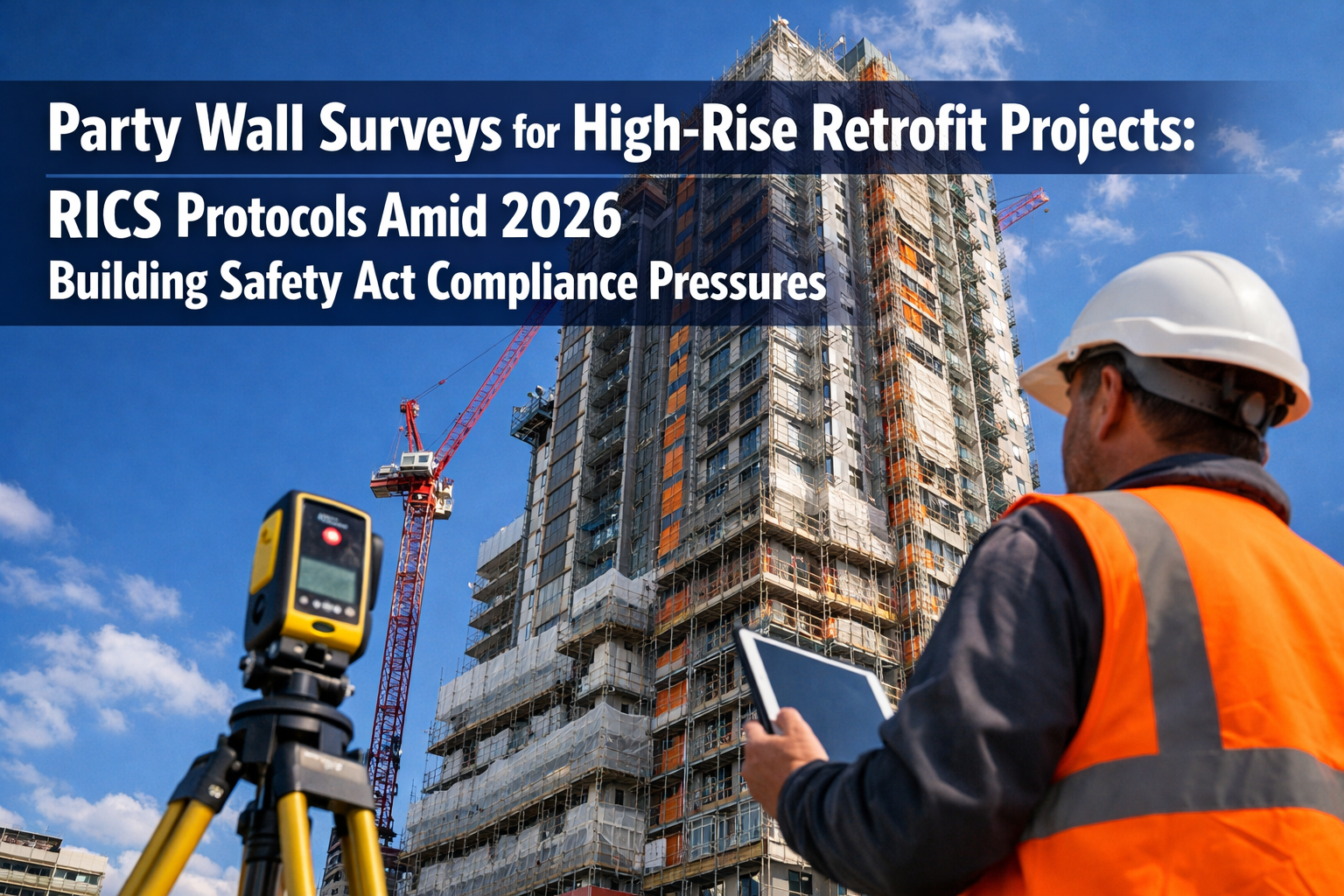
London's tower blocks are undergoing the most intensive retrofit programme in UK history. Over 3,000 high-rise buildings require urgent cladding replacement and fire safety upgrades following post-Grenfell reforms, yet many building owners face a hidden compliance minefield: Party Wall Surveys for High-Rise Retrofit Projects: RICS Protocols Amid 2026 Building Safety Act Compliance Pressures now demand unprecedented coordination between surveyors, structural engineers, and regulatory authorities. As RICS launches its consultation on the draft 8th edition of Party Wall Legislation and Procedure in 2026, surveyors must navigate complex intersections between the Party Wall etc. Act 1996, Building Safety Act requirements, and mandatory retrofit standards.[1]
The stakes have never been higher. A single missed party wall notice or inadequate vibration monitoring protocol can halt multi-million-pound retrofit projects for months, triggering contractual penalties and regulatory scrutiny. For surveyors working on Party Wall Surveys for High-Rise Retrofit Projects: RICS Protocols Amid 2026 Building Safety Act Compliance Pressures, understanding how traditional party wall procedures adapt to complex high-rise scenarios represents the difference between project success and costly disputes.
Key Takeaways
- 🏗️ RICS has launched a consultation on the 8th edition of Party Wall Legislation and Procedure in 2026, introducing enhanced guidance on regulatory conduct, fee practices, and dispute resolution specifically relevant to high-rise retrofit projects[1]
- 📋 The RICS Retrofit Standard is now mandatory for all RICS members delivering retrofit advice, requiring comprehensive risk analysis of how retrofit interventions interact with building characteristics including party wall structures[3]
- ⚖️ Building Safety Act compliance pressures are reshaping party wall survey protocols, with stricter Gateway submission scrutiny demanding more detailed structural assessments and vibration monitoring plans[7]
- 🔍 Vibration monitoring and structural safeguards have become critical components of party wall procedures for high-rise retrofits, particularly where cladding removal or structural modifications affect shared walls
- ✅ Professional competence and quality standards are under intensified focus, with RICS quality strengthening initiatives transforming surveyor practice expectations throughout 2026[6]
Understanding Party Wall Surveys in High-Rise Retrofit Contexts
The Unique Challenges of High-Rise Party Wall Scenarios
High-rise residential buildings present fundamentally different party wall challenges compared to traditional low-rise properties. In tower blocks, party walls extend vertically across multiple floors, creating complex load-bearing structures that support significant building mass. When retrofit works involve external cladding replacement, structural reinforcement, or fire safety barrier installation, the potential for party wall engagement multiplies exponentially.
Key distinctions in high-rise party wall surveys include:
- Vertical party walls spanning 10+ floors requiring comprehensive condition surveys across entire building heights
- Shared structural cores where lift shafts and stairwells constitute party structures between multiple dwelling units
- Complex ownership arrangements involving freeholders, leaseholders, and residents' management companies
- Simultaneous multi-unit impact where single retrofit interventions affect dozens of adjoining owners
The consequences of ignoring the Party Wall Act become magnified in high-rise contexts. A dispute involving a single party wall in a 20-storey building can affect 40+ residential units, creating cascading delays and exponential legal costs.
When Does the Party Wall Act Apply to Retrofit Projects?
The Party Wall etc. Act 1996 applies to retrofit works when they involve:
- Building on or astride the boundary line between properties (Section 1)
- Work to an existing party wall or party structure (Section 2)
- Excavation within 3 or 6 metres of adjoining buildings (Section 6)
For high-rise retrofits, Section 2 works represent the most common trigger. Activities that engage party wall procedures include:
✅ Cutting into party walls to install fire barriers or structural reinforcements
✅ Increasing party wall loads through additional cladding systems or balcony attachments
✅ Demolishing or rebuilding party walls as part of structural strengthening
✅ Inserting damp-proof courses or installing insulation within party wall cavities
✅ Raising party walls or adding structural elements that transfer loads through shared structures
The draft 8th edition of RICS Party Wall Legislation and Procedure provides enhanced guidance on when the Act is engaged, particularly valuable for complex retrofit scenarios where traditional party wall definitions may not clearly apply.[1]
RICS Professional Standards for Party Wall Surveyors
Professional competence requirements have intensified under RICS quality strengthening initiatives throughout 2026.[6] The RICS party wall surveyors guide establishes qualification standards that professionals must meet, particularly crucial in high-stakes retrofit projects.[5]
Essential competencies for party wall surveyors in high-rise retrofit projects:
| Competency Area | Requirements | Retrofit Application |
|---|---|---|
| Technical Knowledge | Understanding of Party Wall Act 1996, case law, RICS guidance | Interpreting Act provisions for complex high-rise scenarios |
| Building Pathology | Identifying structural defects, movement, subsidence | Assessing pre-existing conditions before retrofit interventions |
| Construction Technology | Knowledge of building methods, materials, sequencing | Understanding retrofit techniques and structural implications |
| Dispute Resolution | Negotiation, mediation, award preparation | Managing multi-party disputes in tower block contexts |
| Regulatory Compliance | Building Safety Act, Building Regulations, fire safety | Integrating party wall procedures with BSA Gateway requirements |
The updated draft guidance emphasizes professional conduct matters, including transparent fee practices and appropriate use of the Third Surveyor mechanism—particularly relevant when disputes arise in complex retrofit projects involving multiple adjoining owners.[1]
For professionals seeking to understand which building survey approaches best complement party wall assessments, comprehensive Level 3 building surveys provide the detailed structural analysis necessary for high-rise retrofit planning.
Navigating Party Wall Surveys for High-Rise Retrofit Projects: RICS Protocols Amid 2026 Building Safety Act Compliance Pressures
Integration with Building Safety Act Gateway Requirements
The Building Safety Act has fundamentally transformed how high-rise retrofit projects progress through regulatory approval. The Gateway process requires detailed structural assessments and safety case documentation that must align with party wall procedures. The RICS Building Surveying Conference 2026 emphasizes practical navigation of these BSA requirements, particularly the stricter scrutiny of Gateway submissions.[7]
Critical integration points between party wall surveys and BSA compliance:
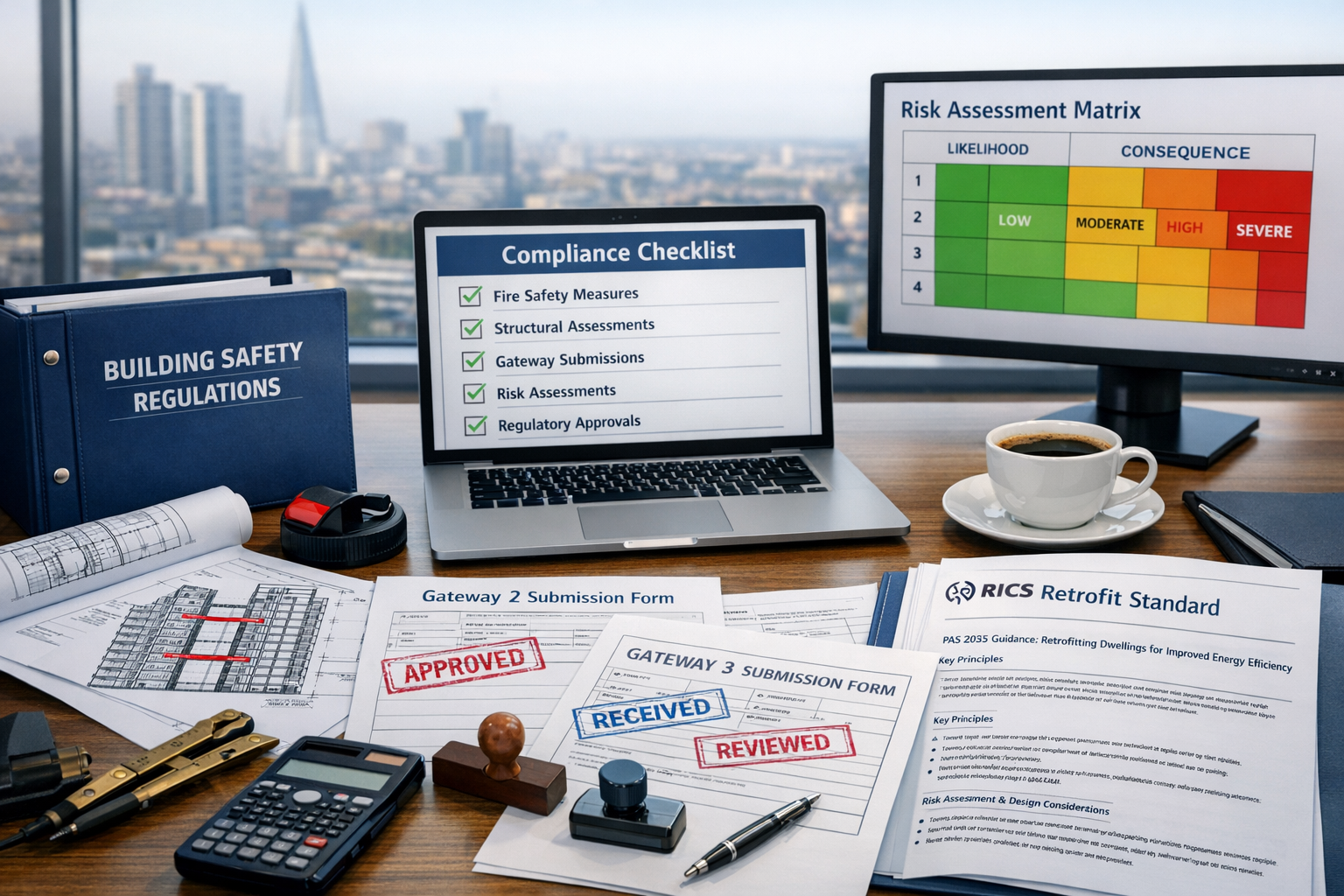
🔷 Gateway 2 (Planning Stage): Party wall notices must be served before detailed design approval, requiring early identification of all affected adjoining owners and party structures
🔷 Gateway 3 (Pre-Construction): Party wall awards must be finalized before works commence, with structural methodologies approved by both party wall surveyors and Building Safety Regulator
🔷 Ongoing Compliance: Vibration monitoring data and party wall condition reports feed into mandatory occurrence reporting under BSA requirements
🔷 Completion Documentation: Final party wall surveys demonstrating no actionable damage become part of the building's golden thread information
The building regulation compliance testing requirements now extend to party wall methodologies, demanding documented evidence that retrofit works meet both Party Wall Act obligations and BSA safety standards.
RICS Retrofit Standard: Mandatory Risk Analysis Requirements
The RICS Retrofit Standard became mandatory for all RICS members delivering retrofit-related advice in 2026, covering both commercial and residential buildings including high-rise projects.[3] This professional statement requires surveyors to conduct comprehensive risk analysis examining how retrofit options interact with building characteristics.
Specific risk analysis requirements relevant to party wall surveys:
1. Moisture Management Interactions
Retrofit insulation systems can alter moisture dynamics within party walls, creating condensation risks or interstitial moisture accumulation. Party wall surveyors must assess:
- Existing party wall construction and permeability characteristics
- Proposed insulation systems and their vapor resistance properties
- Ventilation adequacy post-retrofit
- Risk of moisture-related deterioration in shared structures
2. Thermal Bridging at Party Wall Junctions
External wall insulation (EWI) systems create thermal discontinuities where they meet party walls. Risk analysis must evaluate:
- Heat loss pathways through uninsulated party wall sections
- Condensation risk at party wall/external wall junctions
- Structural cold bridging effects on party wall stability
3. Structural Loading Changes
Cladding replacement and additional insulation systems alter party wall loading patterns. Assessment requirements include:
- Increased dead loads from new cladding systems
- Wind loading distribution changes affecting party wall structures
- Dynamic loading from construction activities during retrofit
- Long-term structural adequacy of party walls under modified loading regimes
4. Sequencing of Fabric Upgrades
The RICS Retrofit Standard mandates that fabric improvements precede heating system modifications.[3] For party wall contexts, this means:
- Party wall insulation or fire barrier installation must occur before mechanical system upgrades
- Structural strengthening of party walls must precede external envelope modifications
- Phased retrofit approaches require interim party wall condition assessments
These risk analysis requirements directly inform party wall survey scope and methodologies, ensuring that party wall schedules of condition capture baseline data necessary for evaluating retrofit-related changes.
Vibration Monitoring Protocols for High-Rise Retrofits
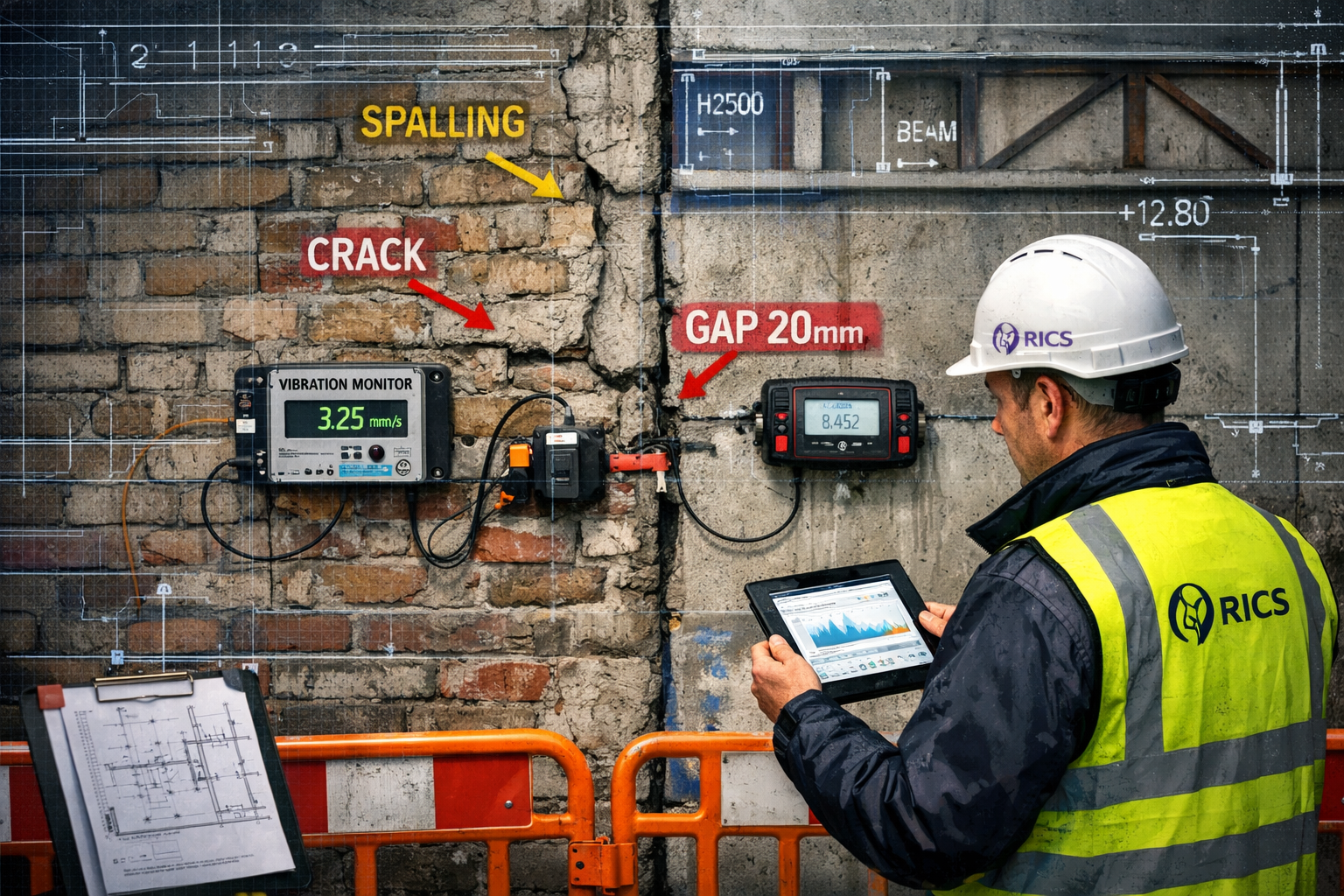
Vibration monitoring has emerged as a critical safeguard in high-rise retrofit projects, particularly where heavy equipment operates on external scaffolding or where structural modifications involve cutting, drilling, or demolition activities adjacent to party walls.
Establishing Effective Vibration Monitoring Systems:
Pre-Works Baseline Assessment
- Install vibration monitors at strategic party wall locations before works commence
- Record baseline vibration levels from normal building operations (lifts, HVAC, foot traffic)
- Document pre-existing structural movement or settlement patterns
- Establish threshold limits based on building age, construction type, and party wall condition
Continuous Monitoring During Works
- Real-time vibration monitoring with automated alert systems
- Peak particle velocity (PPV) measurements at party wall interfaces
- Frequency analysis to identify potentially damaging vibration patterns
- Daily reporting to party wall surveyors and project managers
Threshold Limits and Response Protocols
- Cosmetic damage threshold: 15mm/s PPV for residential structures
- Minor structural damage threshold: 20-50mm/s PPV depending on building condition
- Immediate work cessation triggers: Exceedance of agreed threshold limits
- Investigation protocols: Mandatory party wall inspection within 24 hours of threshold breach
Case Study: East London Tower Block Cladding Replacement (2025-2026)
A 22-storey residential tower in East London required complete cladding removal and replacement following fire safety assessments. The retrofit involved:
- Removal of 3,500m² of aluminum composite material (ACM) cladding
- Installation of new A2-rated ceramic panel system
- Structural reinforcement of balcony attachments
- Fire barrier upgrades at party wall/external wall junctions
Party Wall Challenges:
- 88 residential units with complex ownership structures
- Vertical party walls extending full building height
- Shared structural cores requiring temporary support during works
- Simultaneous impact on multiple adjoining owners
Solutions Implemented:
- Comprehensive party wall notices served to all affected leaseholders and freeholder
- Appointment of single agreed surveyor to streamline process
- Installation of 16 vibration monitoring stations at critical party wall locations
- Weekly party wall condition inspections during high-risk work phases
- Integration of party wall documentation with BSA Gateway 3 submissions
Outcomes:
- Zero actionable party wall damage claims
- Project completion within scheduled 18-month timeframe
- Successful BSA compliance certificate obtained
- Vibration monitoring data contributed to building's golden thread information
This case demonstrates how proactive party wall management, aligned with RICS protocols and BSA requirements, can facilitate complex retrofit projects while protecting adjoining owners' interests.
For projects requiring detailed structural documentation, party wall drawings provide essential visual records of existing conditions and proposed interventions.
Practical Implementation: Checklists and Actionable Protocols for Party Wall Surveys for High-Rise Retrofit Projects
Pre-Retrofit Party Wall Assessment Checklist
Before commencing any high-rise retrofit project, surveyors should complete this comprehensive assessment:
📋 Ownership and Notification Requirements
- Identify all adjoining owners (freeholders and leaseholders)
- Determine party wall locations across all building levels
- Map shared structural elements (cores, load-bearing walls, foundations)
- Establish notification timeline (minimum 2 months for Section 2 works)
- Prepare party wall notices with detailed retrofit methodology descriptions
- Serve notices via recorded delivery with proof of service
🔍 Structural Condition Documentation
- Conduct comprehensive building defects survey of all party walls
- Photograph existing cracks, movement, or deterioration
- Document pre-existing moisture issues or thermal defects
- Assess structural adequacy for proposed retrofit loading changes
- Identify any previous party wall works or modifications
- Prepare detailed schedule of condition with time-stamped evidence
⚖️ Regulatory Compliance Integration
- Review BSA Gateway requirements for project
- Align party wall timeline with Gateway submission deadlines
- Identify statutory considerations affecting party wall procedures
- Coordinate with Principal Designer and Building Safety Manager
- Ensure party wall documentation meets golden thread information standards
- Confirm insurance coverage for party wall-related risks
🛠️ Technical Methodology Planning
- Define retrofit work scope affecting party walls
- Specify structural connection details at party wall interfaces
- Plan temporary support requirements during works
- Establish vibration monitoring locations and threshold limits
- Develop construction sequencing to minimize party wall impact
- Prepare risk mitigation strategies for identified vulnerabilities
During-Works Monitoring and Management Protocol
Weekly Party Wall Inspection Routine:
Visual Inspection Components
- Systematic examination of all accessible party wall surfaces
- Photographic documentation of any new cracks or movement (with scale reference)
- Moisture meter readings at vulnerable locations
- Verification that construction activities comply with party wall award provisions
- Review of contractor compliance with agreed methodologies
Vibration Monitoring Review
- Download and analyze vibration monitoring data
- Compare recorded levels against established thresholds
- Investigate any threshold exceedances or anomalous readings
- Adjust construction methodologies if vibration patterns indicate risk
- Maintain detailed log of all monitoring data for dispute resolution purposes
Stakeholder Communication
- Provide weekly summary reports to adjoining owners
- Notify immediately of any concerns or threshold breaches
- Maintain accessible communication channels for adjoining owner queries
- Document all communications for potential dispute resolution
- Coordinate with project management teams on party wall compliance
Post-Retrofit Completion Procedures
Final Party Wall Survey Requirements:
✅ Comprehensive Condition Re-Assessment
- Complete re-survey of all party walls using identical methodology to pre-works assessment
- Direct comparison of pre- and post-works photographic evidence
- Identification of any changes attributable to retrofit works
- Assessment of whether changes constitute actionable damage
✅ Damage Assessment and Remediation
- Classification of any damage (cosmetic vs. structural)
- Specification of appropriate remedial works
- Cost estimation for repairs
- Agreement on remediation timeline and methodology
- Supervision of remedial works to satisfactory completion
✅ Award Finalization and Documentation
- Preparation of final party wall award documenting works undertaken
- Recording of any damage and agreed remediation
- Confirmation of compliance with original party wall notice provisions
- Formal sign-off by all appointed surveyors
- Distribution of award to all parties with explanation of rights
✅ BSA Golden Thread Integration
- Upload party wall documentation to building's digital information system
- Ensure party wall records accessible to Accountable Person
- Link vibration monitoring data to occurrence reporting systems
- Archive all party wall correspondence and survey records
- Provide summary report for building safety case documentation
For projects involving health and safety considerations beyond party wall matters, comprehensive safety inspection protocols should complement party wall procedures.
Common Pitfalls and How to Avoid Them
❌ Pitfall 1: Inadequate Adjoining Owner Identification
High-rise buildings often have complex ownership structures with multiple leaseholders, sub-lessees, and management companies. Failing to identify and serve all relevant parties can invalidate party wall procedures.
✅ Solution: Conduct thorough Land Registry searches, review lease structures, and consult with building management to create comprehensive adjoining owner registers before serving notices.
❌ Pitfall 2: Generic Party Wall Notices for Retrofit Works
Standard party wall notice templates often lack sufficient detail for complex retrofit methodologies, leading to disputes about work scope.
✅ Solution: Prepare bespoke notices with detailed descriptions of retrofit interventions, structural methodologies, and anticipated party wall impacts. Include technical drawings and specifications.
❌ Pitfall 3: Insufficient Pre-Works Condition Documentation
Inadequate baseline condition surveys create evidential gaps when assessing post-works damage claims.
✅ Solution: Invest in comprehensive photographic and written condition documentation, including time-stamped digital records, moisture readings, and crack width measurements at multiple locations.
❌ Pitfall 4: Failure to Integrate Party Wall Timeline with BSA Gateway Process
Party wall procedures and BSA Gateway submissions operate on different timelines, creating potential conflicts and delays.
✅ Solution: Develop integrated project timeline mapping party wall notice periods, response deadlines, and award finalization against Gateway submission requirements. Build buffer periods for potential disputes.
❌ Pitfall 5: Inadequate Vibration Monitoring During Critical Works
Relying on periodic manual inspections rather than continuous automated monitoring can miss damaging vibration events.
✅ Solution: Install automated vibration monitoring systems with real-time alert capabilities, particularly during high-risk activities like concrete cutting, demolition, or heavy equipment operation on scaffolding.
Understanding 5 common misconceptions about party wall agreements can help surveyors avoid these pitfalls and maintain professional standards throughout retrofit projects.
Enhanced RICS Guidance: What the Draft 8th Edition Means for Retrofit Surveyors
Key Updates in the 2026 Consultation Draft
RICS launched its consultation on the draft 8th edition of Party Wall Legislation and Procedure in April 2026, with the consultation period extending through May 2026.[1][2] This represents the most comprehensive update to party wall guidance in recent years, with specific relevance for surveyors navigating complex retrofit projects.
Major Enhancements in the Draft 8th Edition:
📚 Enhanced Appendices and Templates
- Revised letters of appointment with clearer terms of engagement
- Updated draft award template incorporating recent case law developments
- Expanded guidance on fee structures and billing practices
- New appendices addressing digital communication and electronic service of notices
⚖️ Strengthened Regulatory Guidance
- Enhanced guidance on professional conduct matters
- Clarification of surveyors' duties to both appointing and non-appointing owners
- Expanded discussion of conflicts of interest in complex multi-party scenarios
- Improved guidance on appropriate use of the Third Surveyor mechanism
🔧 Procedural Clarifications
- Detailed guidance on when the Party Wall Act is engaged in complex scenarios
- Enhanced explanation of notice requirements for phased or ongoing works
- Clarification of procedures when works affect multiple party walls simultaneously
- Guidance on managing party wall procedures in buildings with complex ownership structures
🤝 Public Engagement Focus
- Emphasis on clear communication with adjoining owners
- Guidance on explaining technical matters to non-professional parties
- Best practices for managing expectations and preventing disputes
- Recommendations for accessible documentation and reporting
The consultation seeks feedback from surveyors, legal professionals, and dispute resolution practitioners, recognizing that party wall practice continues to evolve in response to changing construction methods and regulatory frameworks.[1]
Implications for High-Rise Retrofit Practice
The draft 8th edition's enhanced guidance directly addresses challenges that surveyors face in high-rise retrofit contexts:
Complex Ownership Structures: The updated guidance provides clearer procedures for managing party wall processes in buildings with multiple leaseholders and management companies—precisely the scenario encountered in tower block retrofits.
Fee Practice Transparency: Enhanced guidance on fee structures helps surveyors establish clear, defensible charging arrangements for the extended timescales typical of major retrofit projects.
Third Surveyor Utilization: Improved guidance on appropriate use of the Third Surveyor mechanism is particularly valuable when disputes arise in high-stakes retrofit projects where multiple adjoining owners may have conflicting interests.
Professional Conduct Standards: Strengthened regulatory guidance aligns with broader RICS quality strengthening initiatives, raising professional expectations across all surveying disciplines.[6]
For surveyors working on retrofit projects, the draft 8th edition provides authoritative guidance that can be cited in party wall awards and dispute resolution proceedings, strengthening the professional foundation for party wall practice.
Responding to the RICS Consultation
The consultation period represents an opportunity for surveyors with retrofit experience to contribute to the development of party wall guidance. RICS specifically seeks feedback on:
- Clarity and comprehensiveness of updated guidance
- Practical applicability of revised templates and procedures
- Adequacy of regulatory and conduct guidance
- Gaps or areas requiring additional explanation
Surveyors involved in high-rise retrofit projects can provide valuable insights into how party wall procedures adapt to complex scenarios, informing the final published guidance that will shape professional practice for years to come.[4]
Conclusion: Mastering Party Wall Surveys for High-Rise Retrofit Projects in 2026
The convergence of post-Grenfell safety reforms, Building Safety Act compliance requirements, and mandatory RICS Retrofit Standards has fundamentally transformed party wall practice for high-rise projects. Party Wall Surveys for High-Rise Retrofit Projects: RICS Protocols Amid 2026 Building Safety Act Compliance Pressures demand a sophisticated integration of traditional party wall procedures with modern regulatory frameworks, structural safeguards, and comprehensive risk analysis.
Surveyors who master this integration—combining meticulous condition documentation, proactive vibration monitoring, seamless BSA Gateway coordination, and adherence to evolving RICS guidance—position themselves as indispensable professionals in the ongoing retrofit programme transforming the UK's high-rise building stock.
Actionable Next Steps for Surveying Professionals
🎯 Immediate Actions:
-
Review the Draft 8th Edition: Engage with RICS's consultation on updated party wall guidance, providing feedback based on retrofit project experience before the May 2026 deadline
-
Audit Current Procedures: Assess existing party wall survey methodologies against RICS Retrofit Standard requirements and BSA compliance expectations, identifying gaps or enhancement opportunities
-
Invest in Monitoring Technology: Evaluate vibration monitoring systems and digital condition documentation tools that enhance party wall survey accuracy and defensibility
-
Develop Integrated Templates: Create bespoke party wall notice and award templates specifically designed for high-rise retrofit scenarios, incorporating BSA Gateway coordination
-
Pursue Continuing Professional Development: Attend RICS Building Surveying Conference sessions on Building Safety Act updates and retrofit-specific party wall challenges[7]
📈 Strategic Development:
- Build relationships with structural engineers, fire safety consultants, and Building Safety Managers to facilitate integrated project delivery
- Develop expertise in thermal imaging, moisture assessment, and building pathology specific to high-rise retrofit contexts
- Establish clear fee structures and engagement terms that reflect the extended timescales and complexity of retrofit party wall work
- Create case study documentation from completed projects to demonstrate competence and inform future practice
🔗 Professional Resources:
For comprehensive support across the full spectrum of building survey and party wall requirements, professional surveying practices offer integrated services spanning building regulation compliance, statutory considerations, and sourcing specialized technical advice when retrofit projects demand multidisciplinary expertise.
The high-rise retrofit programme represents both a professional challenge and an opportunity for surveyors committed to excellence. By embracing enhanced RICS protocols, integrating Building Safety Act compliance requirements, and implementing robust structural safeguards including vibration monitoring, surveyors can deliver party wall services that protect adjoining owners' interests while facilitating the critical safety improvements that tower blocks urgently require.
The evolving landscape of Party Wall Surveys for High-Rise Retrofit Projects: RICS Protocols Amid 2026 Building Safety Act Compliance Pressures demands continuous professional development, procedural innovation, and unwavering commitment to quality standards. Surveyors who rise to this challenge will define best practice for years to come, ensuring that the UK's high-rise retrofit programme proceeds safely, efficiently, and with full protection for all stakeholders.
References
[1] Rics Launches Consultation On Updated Party Wall Practice Guidance – https://www.rics.org/news-insights/rics-launches-consultation-on-updated-party-wall-practice-guidance
[2] Rics Launches Consultation On Party Wall Guidance – https://thenegotiator.co.uk/news/regulation-law-news/rics-launches-consultation-on-party-wall-guidance/
[3] Rics Retrofit Standard Guide – https://goreport.com/rics-retrofit-standard-guide/
[4] Rics Consults On Updated Party Wall Practice Guidance – https://www.lexisnexis.co.uk/legal/news/rics-consults-on-updated-party-wall-practice-guidance
[5] Party Wall Surveys Amid 2026 Construction Boom Handling Disputes In High Demand Uk Housing Markets – https://nottinghillsurveyors.com/blog/party-wall-surveys-amid-2026-construction-boom-handling-disputes-in-high-demand-uk-housing-markets
[6] Building Survey Standards Evolution How Rics Quality Strengthening Initiatives Impact Surveyor Practice In 2026 – https://nottinghillsurveyors.com/blog/building-survey-standards-evolution-how-rics-quality-strengthening-initiatives-impact-surveyor-practice-in-2026
[7] Rics Building Surveying Conference – https://www.rics.org/training-events/conferences/rics-building-surveying-conference