

Over 60% of surveying projects currently fail to include carbon calculations and climate resilience assessments[1]. This striking statistic from the RICS Sustainability Report 2025 reveals a critical disconnect between market demand for sustainable buildings and actual professional practice. As the property sector races toward 2050 net-zero targets, chartered surveyors in 2026 face mounting pressure to integrate environmental, social, and governance (ESG) factors into everyday valuations and building assessments. The Chartered Surveyor Integration of RICS Sustainability Report 2025: Practical Tools for 2026 Valuation and Building Assessments provides a roadmap for bridging this gap through practical implementation strategies.
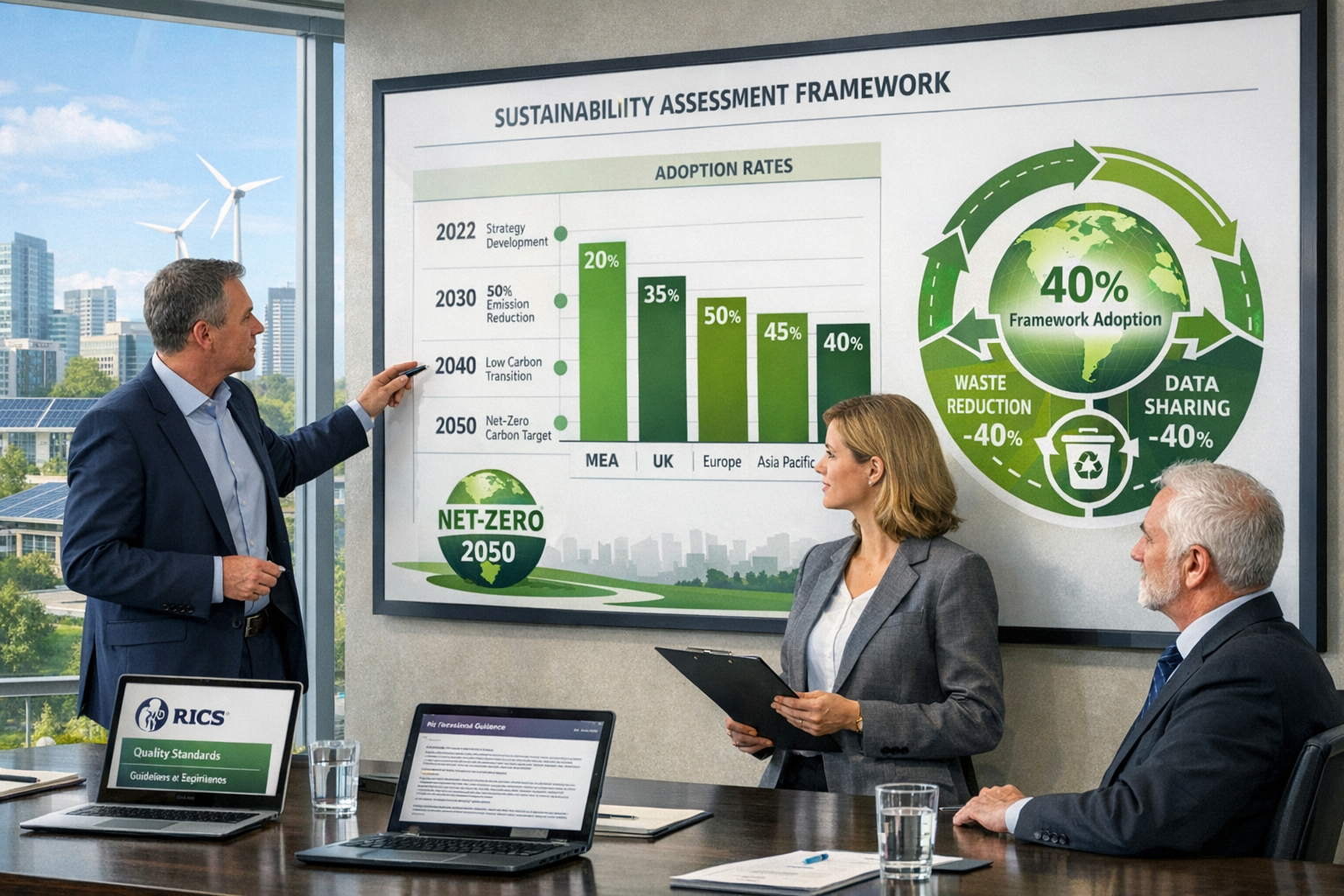
The 2025 RICS report highlights both promising trends and concerning shortfalls. While approximately 40% of professionals now track waste reduction and practice data-sharing regularly[1], the sector's overall adoption of sustainable practices remains disappointingly limited[2]. For chartered surveyors working in 2026, understanding how to apply these insights to real-world scenarios—from retrofit valuations to green premium assessments—has become essential professional competency.
Key Takeaways
- Carbon assessment remains critically underutilized, with over 60% of projects lacking proper carbon calculations despite growing market demand for sustainable buildings[1]
- Regional variations show significant opportunity, with the Middle East and Africa leading green building demand at +52%, followed by the UK at +43%[1]
- Whole Life Carbon Assessment (WLCA) framework provides chartered surveyors with standardized tools for measuring and reporting carbon emissions across project lifecycles[2]
- Green premiums in valuations require systematic approaches to quantifying sustainability features and their market value impact
- Practical barriers including high upfront costs and insufficient government incentives continue to slow widespread adoption of greener building methods[2]
Understanding the RICS Sustainability Report 2025 Framework
The RICS Sustainability Report 2025 represents a watershed moment for the surveying profession. Unlike previous iterations, this report doesn't merely highlight aspirations—it exposes the uncomfortable reality of implementation gaps while providing concrete frameworks for improvement.
Key Findings Shaping 2026 Practice
The report reveals stark geographic disparities in sustainable building demand. The Middle East and Africa region leads with an impressive +52% growth in demand for green buildings, followed by the UK at +43%, Europe at +39%, Asia Pacific at +27%, and the Americas at +11%[1]. These variations create distinct challenges and opportunities for chartered surveyors operating across different markets.
Perhaps most concerning is the adoption stagnation paradox: while market demand for sustainable buildings continues climbing, actual sector adoption of sustainable practices remains limited[2]. This disconnect creates both professional liability risks and competitive advantages for surveyors who successfully bridge the gap.
The Whole Life Carbon Assessment Standard
The RICS Whole Life Carbon Assessment (WLCA) standard emerges as the unified framework addressing measurement inconsistencies[2]. This tool provides chartered surveyors with:
- ✅ Standardized methodology for calculating embodied and operational carbon
- ✅ Consistent reporting formats enabling cross-project comparisons
- ✅ Integration pathways for existing valuation and assessment workflows
- ✅ Compliance alignment with emerging regulatory requirements
For surveyors conducting Level 3 full building surveys in 2026, incorporating WLCA principles has transitioned from optional enhancement to professional expectation.
Leading and Lagging Adoption Areas
The report identifies clear performance patterns:
| Practice Area | Adoption Rate | Status |
|---|---|---|
| Waste reduction tracking | ~40% | 🟢 Leading |
| Data-sharing practices | ~40% | 🟢 Leading |
| Carbon calculations | <50% | 🔴 Lagging |
| Climate resilience assessments | <50% | 🔴 Lagging |
This data reveals where the profession excels and where urgent improvement is needed[1]. Chartered surveyors focusing on the lagging areas can differentiate their services while advancing sector-wide progress.
Chartered Surveyor Integration of RICS Sustainability Report 2025: Carbon Benchmarking in Valuations
Integrating carbon metrics into property valuations represents one of the most significant practical challenges for chartered surveyors in 2026. Traditional valuation methodologies focused primarily on comparable sales, income potential, and physical condition. The Chartered Surveyor Integration of RICS Sustainability Report 2025: Practical Tools for 2026 Valuation and Building Assessments demands a more sophisticated approach.
Establishing Carbon Baselines
Before carbon data can influence valuations, surveyors must establish reliable baselines. This process involves:
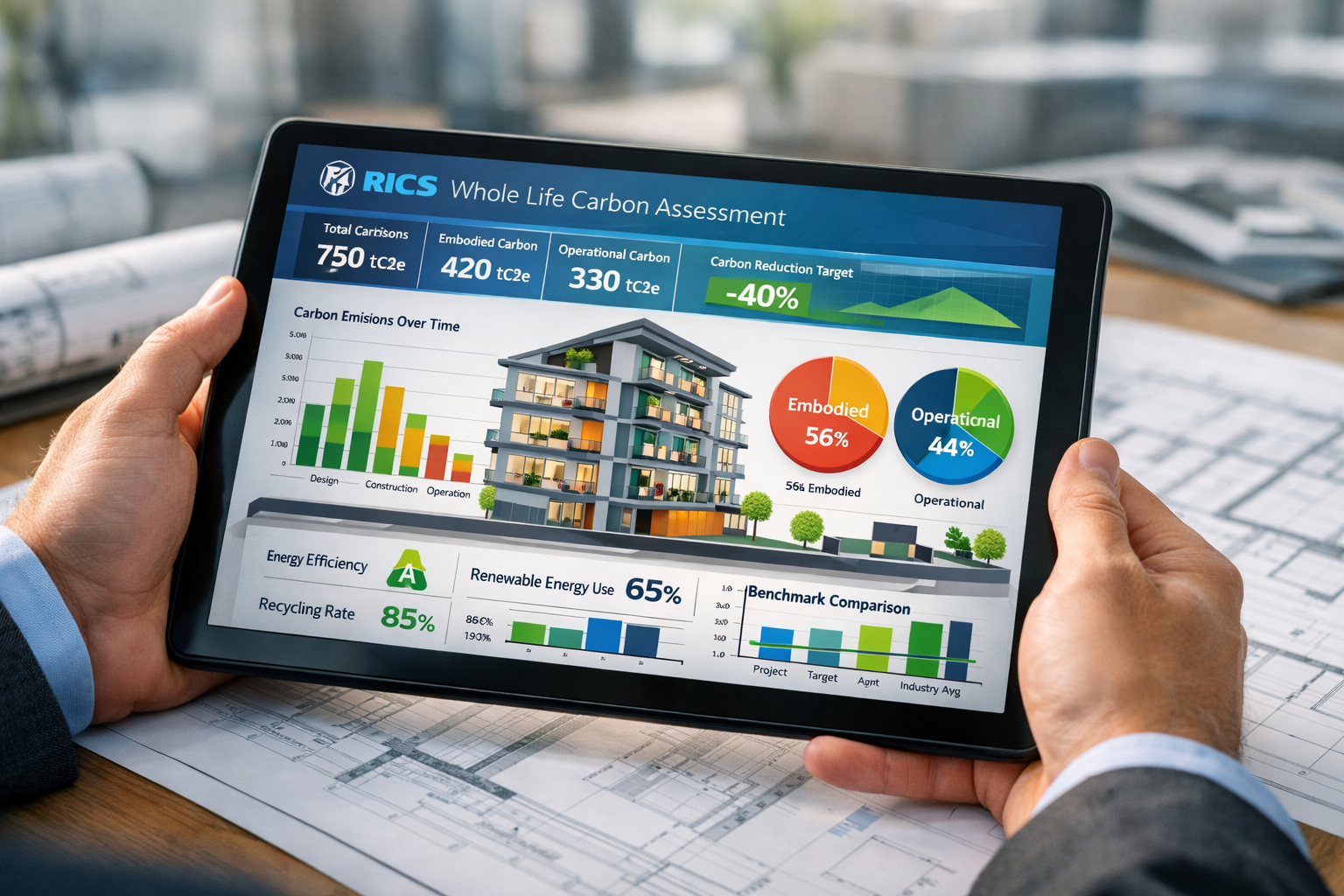
1. Embodied Carbon Assessment
Embodied carbon includes emissions from materials extraction, manufacturing, transportation, construction, and eventual demolition. For existing properties, surveyors can estimate embodied carbon using:
- Building age and construction type databases
- Material composition analysis
- Regional carbon intensity factors
- WLCA standardized calculation tools[2]
2. Operational Carbon Projection
Operational carbon stems from building energy use throughout its lifecycle. Surveyors should evaluate:
- Energy Performance Certificate (EPC) ratings
- Heating, cooling, and lighting systems efficiency
- Renewable energy integration
- Occupancy patterns and usage intensity
3. Climate Resilience Factors
Properties face varying climate risks affecting long-term value. Assessment includes:
- Flood risk and drainage adequacy
- Overheating vulnerability
- Extreme weather resilience
- Adaptation potential for future climate scenarios
Quantifying Green Premiums
Research consistently demonstrates that sustainable buildings command market premiums, but quantifying these premiums requires systematic methodology. Chartered surveyors should consider:
Energy Efficiency Premiums
Properties with superior EPC ratings (A or B) typically achieve 5-15% higher values compared to similar properties with lower ratings. When conducting capital gains valuations, this differential becomes particularly significant.
Certification Premiums
Buildings with recognized sustainability certifications (BREEAM, LEED, Passivhaus) often command additional premiums of 3-10% depending on market maturity and certification level.
Operational Cost Savings
Lower energy bills translate directly to enhanced investment value. For income-producing properties, reduced operational costs improve net operating income, directly affecting capitalization-based valuations.
Future-Proofing Value
Properties meeting or exceeding emerging regulations avoid costly retrofit requirements, preserving value that non-compliant properties will lose. This factor becomes increasingly material as 2050 net-zero targets approach[2].
Case Study: Residential Retrofit Valuation
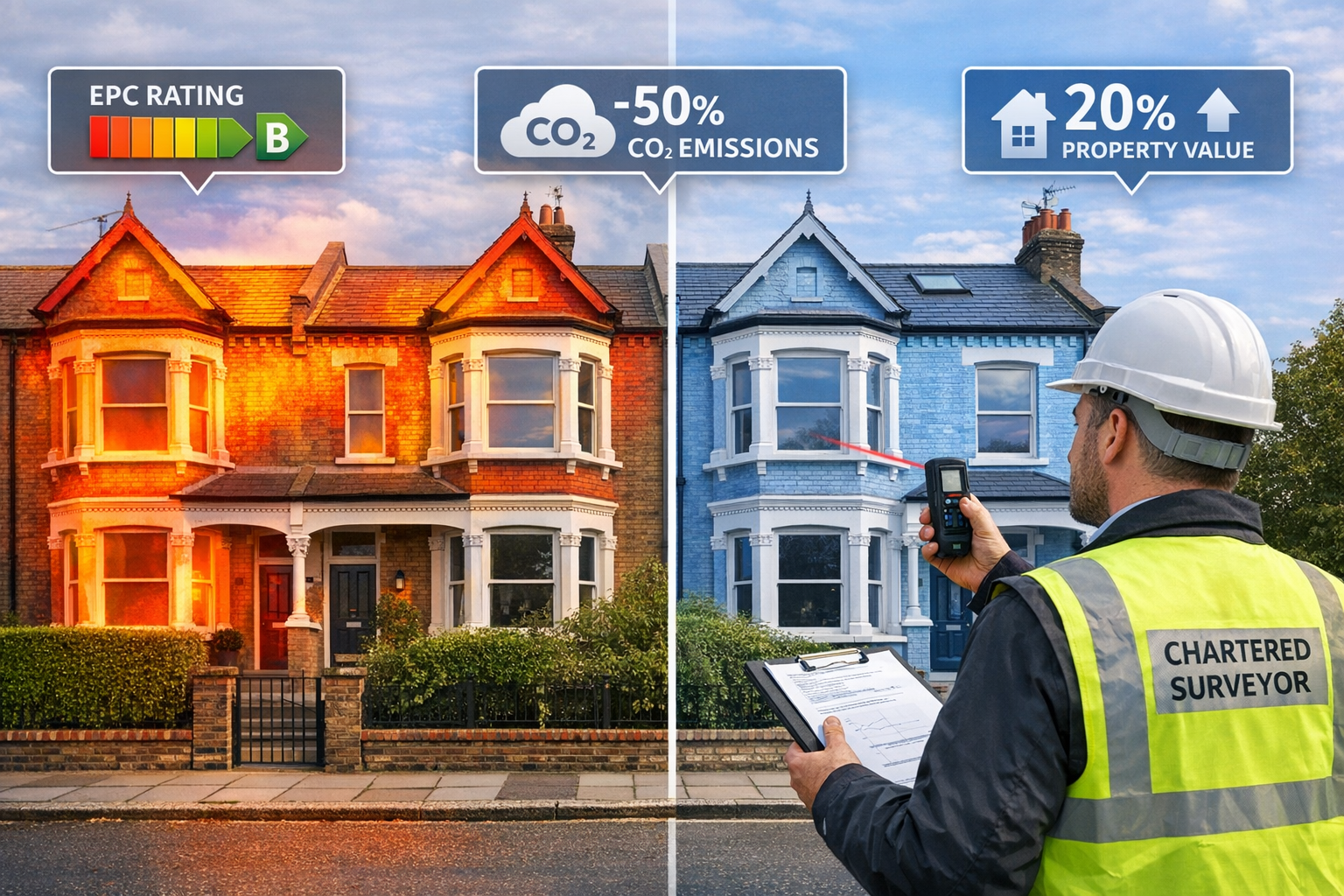
Consider a Victorian terrace in London requiring leasehold extension valuation. The surveyor must assess:
Pre-Retrofit Scenario:
- Current EPC rating: D
- Estimated annual heating costs: £2,400
- Embodied carbon: 85 kgCO2e/m²
- Operational carbon: 45 kgCO2e/m²/year
- Market value: £750,000
Post-Retrofit Scenario:
- Improved EPC rating: B
- Estimated annual heating costs: £1,200
- Operational carbon: 22 kgCO2e/m²/year
- Retrofit investment: £45,000
- Enhanced market value: £810,000
The £60,000 value increase (8% premium) exceeds the £45,000 retrofit investment, demonstrating positive return. However, the surveyor must also consider:
- Payback period on energy savings (approximately 37.5 years)
- Market appetite for sustainable features in the specific location
- Regulatory trajectory and potential future compliance costs for non-retrofitted properties
Integrating Carbon Data into Valuation Reports
Professional integration requires structured reporting. Surveyors should include dedicated sustainability sections covering:
- Carbon Performance Summary – Embodied and operational carbon metrics with benchmarking against typical buildings
- Energy Efficiency Analysis – EPC rating, improvement potential, and cost-benefit analysis
- Climate Risk Assessment – Physical climate risks and adaptation measures
- Regulatory Compliance Status – Current compliance and future regulatory trajectory
- Sustainability Value Adjustment – Quantified premium or discount applied to base valuation
This approach ensures transparency while providing clients with actionable intelligence for decision-making.
Practical Implementation: ESG Factors in Everyday Survey Work
The Chartered Surveyor Integration of RICS Sustainability Report 2025: Practical Tools for 2026 Valuation and Building Assessments extends beyond valuations into all survey activities. Chartered surveyors conducting building assessments in 2026 must embed ESG considerations throughout their workflow.
Building Survey Enhancements
Traditional building surveys focus on structural integrity, defects, and maintenance requirements. Modern practice demands expanded scope:
Environmental Assessment Components
- Thermal performance evaluation – Identifying insulation deficiencies and thermal bridging
- Moisture and ventilation analysis – Assessing condensation risks and indoor air quality
- Material sustainability review – Identifying hazardous materials and evaluating replacement options with lower embodied carbon
- Renewable energy potential – Evaluating solar, heat pump, and other renewable integration opportunities
When conducting premium drone surveys, surveyors can efficiently assess roof conditions for solar panel suitability and identify heat loss patterns through thermal imaging.
Social Considerations
- Accessibility compliance – Evaluating universal design principles and disability access
- Health and wellbeing factors – Assessing natural light, acoustic performance, and occupant comfort
- Community impact – Considering neighborhood integration and local employment in construction recommendations
Governance Elements
- Regulatory compliance – Verifying adherence to building regulations, planning conditions, and emerging sustainability requirements
- Documentation quality – Ensuring proper records exist for future retrofit planning
- Maintenance protocols – Recommending sustainable maintenance practices
Overcoming Implementation Barriers
The RICS report identifies high upfront costs and insufficient government incentives as primary barriers to sustainable building adoption[2]. Chartered surveyors can help clients navigate these challenges:
Cost-Benefit Analysis Tools
Surveyors should develop standardized models demonstrating:
- Lifecycle cost comparisons between conventional and sustainable approaches
- Energy savings projections with payback calculations
- Regulatory risk quantification for non-compliant properties
- Insurance premium variations based on climate resilience
Incentive Navigation
Staying current with available incentives enables surveyors to provide value-added guidance:
- Government grants and loan programs
- Tax incentives for energy efficiency improvements
- Enhanced capital allowances for sustainable building features
- Green mortgage products offering preferential rates
Phased Retrofit Planning
For clients facing budget constraints, surveyors can recommend prioritized, phased approaches:
Phase 1: Quick Wins (£5,000-15,000)
- Loft and cavity wall insulation
- LED lighting upgrades
- Smart heating controls
- Draught-proofing
Phase 2: Major Systems (£15,000-40,000)
- Heat pump installation
- Window and door replacement
- Solar panel installation
- Hot water system upgrades
Phase 3: Deep Retrofit (£40,000+)
- External wall insulation
- Whole-house ventilation systems
- Battery storage integration
- Advanced building management systems
Quality Standards Evolution
RICS quality strengthening initiatives are transforming building survey standards and influencing surveyor practice approaches in 2026[6]. These initiatives emphasize:
- Enhanced competency requirements for sustainability assessment
- Standardized reporting templates incorporating ESG factors
- Continuing professional development mandates for carbon literacy
- Quality assurance protocols ensuring consistent sustainability integration
Surveyors must align their practice with these evolving standards to maintain professional standing and deliver contemporary service quality. Resources like building surveyor reviews help professionals understand how these standards apply in practice.
Regional Practice Variations
The geographic demand disparities identified in the RICS report[1] require regional adaptation:
High-Growth Markets (MEA, UK)
In regions showing +43% to +52% demand growth, surveyors should:
- Position sustainability expertise as core service differentiator
- Develop specialized knowledge in local green building certifications
- Build relationships with sustainable construction specialists
- Invest in advanced assessment technologies
Moderate-Growth Markets (Europe, Asia Pacific)
With +27% to +39% growth rates, focus on:
- Selective sustainability service integration
- Client education about emerging value drivers
- Partnership development with environmental consultants
- Gradual capability building
Lower-Growth Markets (Americas)
In +11% growth regions, approach includes:
- Monitoring regulatory developments signaling future demand
- Offering sustainability assessments as optional enhancements
- Building foundational knowledge for future expansion
- Identifying early-adopter client segments
Technology Integration
Modern surveying practice increasingly relies on technology to efficiently capture and analyze sustainability data:
Digital Assessment Tools
- Thermal imaging cameras for heat loss identification
- Moisture meters for building envelope analysis
- Indoor air quality monitors
- Energy modeling software
Data Management Platforms
- Cloud-based reporting systems incorporating WLCA calculations
- Client portals providing ongoing sustainability performance tracking
- Integration with BIM (Building Information Modeling) for new construction projects
- Automated benchmarking against comparable properties
Emerging Technologies
- AI-powered defect recognition identifying energy efficiency issues
- Drone-based 3D modeling for comprehensive building analysis
- IoT sensors for real-time performance monitoring
- Blockchain-based sustainability certification verification
Sector-Wide Transformation and the Path to 2050
The RICS Sustainability Report 2025 emphasizes that current commitment and action levels must increase substantially to achieve 2050 net-zero targets[2]. Chartered surveyors occupy a strategic position to accelerate this transformation.
The UN Buildings Breakthrough Connection
RICS continues shaping global sustainability standards through participation in initiatives like the UN's Buildings Breakthrough[2]. This involvement ensures that professional standards align with international climate commitments while providing surveyors with globally recognized frameworks.
The Buildings Breakthrough aims to make near-zero emission buildings the new normal by 2030, requiring:
- Rapid scaling of sustainable construction practices
- Harmonized standards enabling international collaboration
- Financial mechanism development supporting widespread adoption
- Skills development ensuring adequate professional capacity
Chartered surveyors contribute by translating these high-level commitments into practical assessment and valuation methodologies applicable to individual projects.
Addressing the Measurement Gap
The report's finding that over 60% of projects lack adequate carbon calculations and climate resilience assessments[1] represents both challenge and opportunity. Closing this gap requires:
Professional Education Enhancement
- Mandatory carbon literacy training for all chartered surveyors
- Specialized certification programs for sustainability assessment
- Regular updates reflecting evolving best practices
- Cross-disciplinary learning with environmental scientists and engineers
Standardization Acceleration
- Widespread WLCA adoption across all project types
- Harmonized reporting formats enabling data aggregation
- Industry-wide benchmarking databases
- Quality assurance mechanisms ensuring calculation accuracy
Client Demand Cultivation
- Proactive client education about sustainability value drivers
- Transparent reporting highlighting carbon and climate considerations
- Case study development demonstrating successful implementations
- Advocacy for regulatory requirements mandating sustainability assessment
Practical Next Steps for Chartered Surveyors
Professionals seeking to align their practice with the Chartered Surveyor Integration of RICS Sustainability Report 2025: Practical Tools for 2026 Valuation and Building Assessments should consider:
Immediate Actions (Next 3 Months)
- Review the complete RICS Sustainability Report 2025 and associated guidance
- Assess current practice against report benchmarks
- Identify specific capability gaps requiring development
- Invest in basic sustainability assessment tools (thermal imaging, moisture meters)
- Update standard report templates to include sustainability sections
Short-Term Development (3-12 Months)
- Complete carbon literacy training or certification
- Develop relationships with environmental consultants for complex assessments
- Create case studies from initial sustainability-integrated projects
- Implement WLCA methodology in standard practice
- Market enhanced sustainability capabilities to existing and prospective clients
Long-Term Strategy (1-3 Years)
- Position sustainability expertise as core practice differentiator
- Develop specialized knowledge in priority sectors (residential retrofit, commercial ESG, etc.)
- Contribute to industry knowledge through publications and presentations
- Mentor junior professionals in sustainability integration
- Participate in RICS working groups shaping future standards
Collaboration and Knowledge Sharing
The report identifies data-sharing as a leading adoption area at approximately 40%[1], but significant room for improvement remains. Surveyors should actively participate in:
- Professional networks sharing sustainability assessment approaches
- Industry databases contributing project carbon data for benchmarking
- Research initiatives advancing measurement methodologies
- Client education programs building market understanding of sustainability value
Whether conducting inheritance tax valuations or insurance reinstatement cost assessments, sharing anonymized sustainability data contributes to sector-wide knowledge advancement.
Conclusion
The Chartered Surveyor Integration of RICS Sustainability Report 2025: Practical Tools for 2026 Valuation and Building Assessments represents a defining moment for the surveying profession. The stark reality that over 60% of projects currently lack adequate carbon calculations[1] contrasts sharply with growing market demand for sustainable buildings and urgent 2050 net-zero commitments[2].
Chartered surveyors in 2026 face a clear choice: lead the sustainability transformation or risk professional obsolescence. The tools exist—from the RICS Whole Life Carbon Assessment framework to emerging digital assessment technologies. The market demand is proven, with regions like the UK showing +43% growth in green building demand[1]. The barriers, while significant, are surmountable through systematic implementation of the practical approaches outlined in this article.
Successful integration requires:
✅ Embedding carbon assessment into all valuation and survey activities
✅ Quantifying green premiums using standardized methodologies
✅ Overcoming cost barriers through client education and phased approaches
✅ Investing in capability development through training and technology
✅ Contributing to sector transformation through data sharing and collaboration
The gap between current practice and 2050 requirements remains substantial, but chartered surveyors who act decisively in 2026 will not only future-proof their practices—they'll capture competitive advantage while contributing meaningfully to climate action. The RICS Sustainability Report 2025 provides the roadmap; implementation depends on individual professional commitment to transforming everyday practice.
For surveyors ready to begin this journey, the time for action is now. Start with foundational education, invest in essential tools, update reporting templates, and engage clients in conversations about sustainability value. Each property assessed, each valuation conducted, and each client advised represents an opportunity to advance both professional practice and planetary wellbeing.
References
[1] Sustainability Report 2025 – rics.org
[2] Rics Apc Hot Topics 2025 Questions Answers – resources.apcguide.com
[6] Building Survey Standards Evolution How Rics Quality Strengthening Initiatives Impact Surveyor Practice In 2026 – nottinghillsurveyors.com