

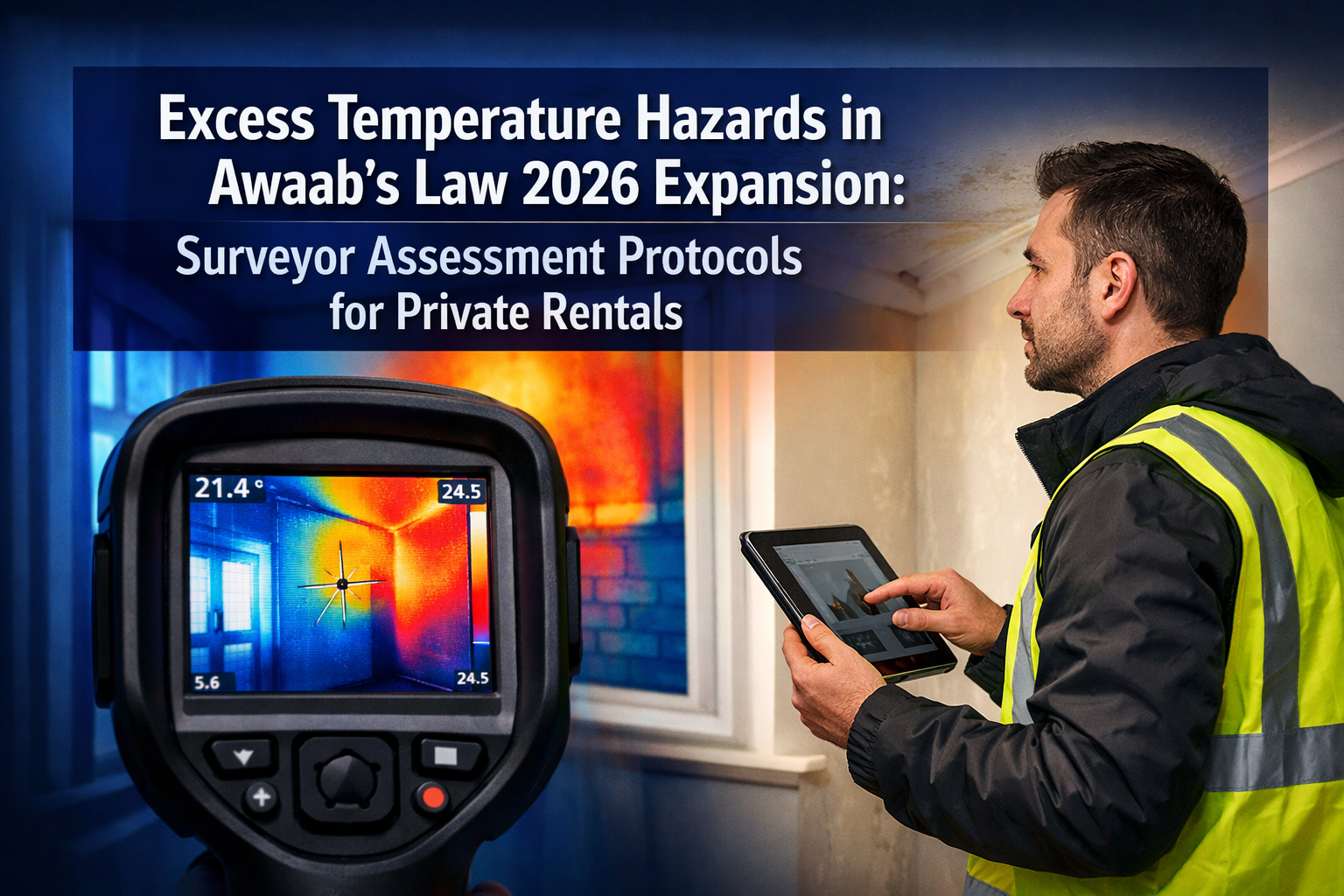
Social housing tenants reporting excess cold or heat can now trigger mandatory landlord investigations within 24 hours under Awaab's Law 2026 expansion—a seismic shift that transforms how surveyors assess thermal hazards in rental properties. While the legislation currently applies only to social housing, the ripple effects are already reshaping surveyor protocols across the private rental sector as landlords and property professionals prepare for potential future expansion.[3]
The expansion of Awaab's Law to include Excess Temperature Hazards in Awaab's Law 2026 Expansion: Surveyor Assessment Protocols for Private Rentals represents a fundamental change in how thermal comfort and safety are regulated. Originally focused on damp and mould following the tragic death of two-year-old Awaab Ishak, the law now encompasses excess cold and heat as regulated hazards requiring rapid assessment and remediation.[1][2]
Key Takeaways
- 🌡️ Excess cold and heat are now regulated hazards under Awaab's Law 2026 expansion, requiring emergency response within 24 hours for imminent risks
- 👥 Person-centered assessment replaces standardized scoring, meaning tenant vulnerabilities (age, health conditions) determine hazard severity
- ⏱️ Strict timeframes govern surveyor response: 24 hours for emergencies, 10 working days for significant hazards, with detailed written reports required
- 🏠 Private rental sector currently excluded but surveyors are adapting protocols in anticipation of future legislative expansion
- 📋 Enhanced documentation and detection tools are now essential for surveyors conducting Level 3 building surveys to identify thermal hazards
Understanding Excess Temperature Hazards in Awaab's Law 2026 Framework
What Constitutes an Excess Temperature Hazard?
Excess temperature hazards fall into two distinct categories under the 2026 expansion: excess cold and excess heat. These hazards must arise from property defects, disrepair, or lack of maintenance within the landlord's control to trigger Awaab's Law obligations.[6]
Excess cold hazards typically result from:
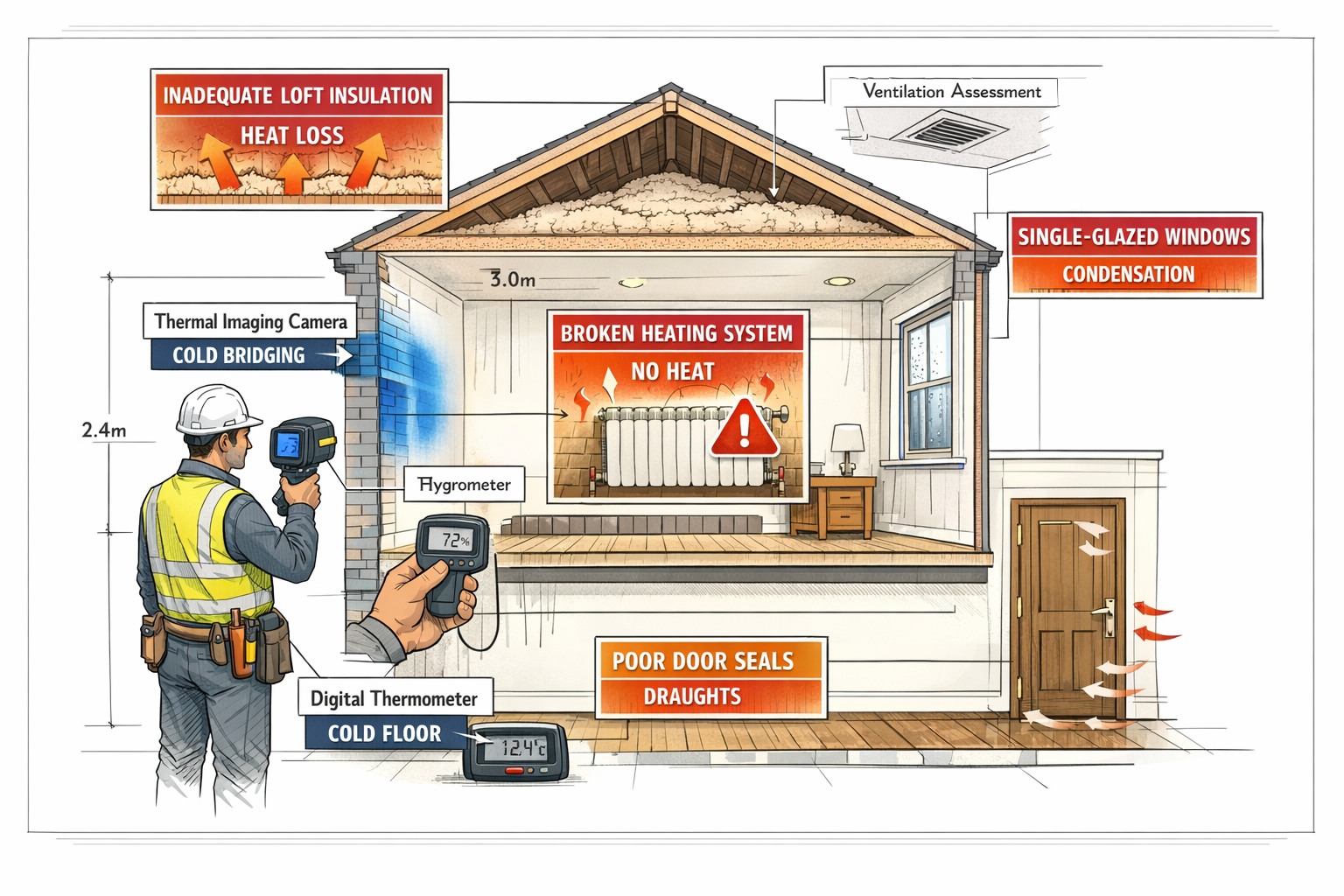
- Inadequate or deteriorating thermal insulation in walls, roofs, or floors
- Broken or inefficient heating systems
- Single-glazed or damaged windows allowing heat loss
- Gaps in door seals or structural elements creating drafts
- Failed damp proof courses causing cold bridging
Excess heat hazards commonly stem from:
- Inadequate ventilation systems preventing heat dissipation
- Lack of appropriate shading or cooling mechanisms
- Poor roof insulation trapping excessive heat
- Structural design flaws creating heat accumulation zones
- Broken or absent ventilation equipment
The critical distinction under Awaab's Law is that these conditions must pose a "significant risk of harm" to occupants, determined through person-centered assessment rather than standardized scoring alone.[6]
Person-Centered Assessment: A Paradigm Shift for Surveyors
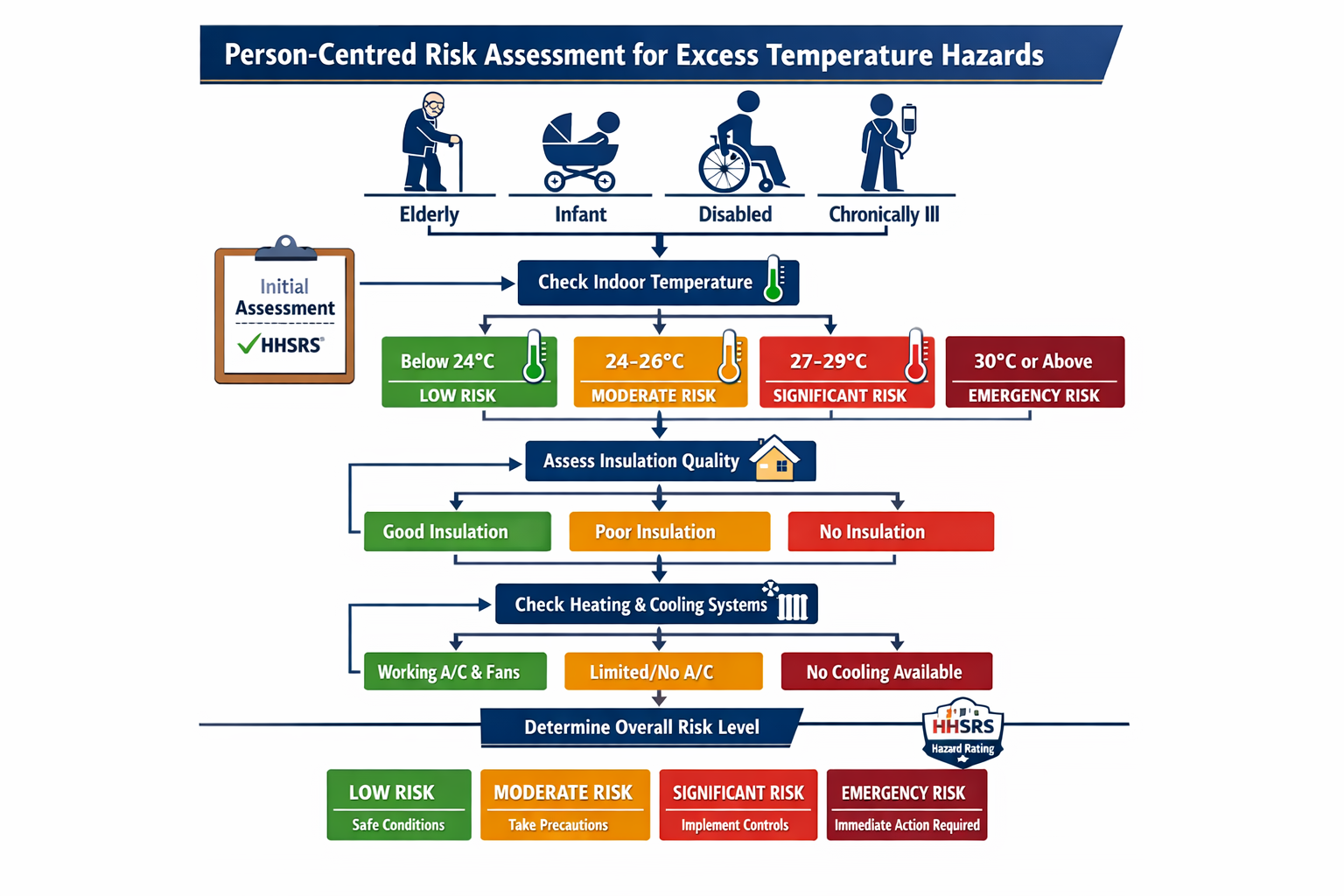
The 2026 expansion introduces a revolutionary approach to hazard assessment. Traditional Housing Health and Safety Rating System (HHSRS) scoring provided standardized risk ratings based on property conditions. However, Awaab's Law now requires surveyors to consider individual tenant vulnerabilities when determining whether a temperature hazard is significant.[6]
This means a property with identical thermal conditions might receive different hazard classifications depending on who lives there:
| Tenant Profile | Vulnerability Factors | Assessment Impact |
|---|---|---|
| Healthy adult (25-60 years) | Low vulnerability | Standard HHSRS scoring may apply |
| Elderly resident (75+ years) | Reduced thermoregulation, mobility issues | Moderate cold may become significant hazard |
| Infant or young child | Underdeveloped temperature regulation | Lower temperature thresholds trigger action |
| Chronically ill tenant | Respiratory conditions, immune compromise | Both excess cold and heat pose elevated risks |
| Disabled occupant | Limited mobility, extended home occupancy | Prolonged exposure increases hazard severity |
Surveyors conducting assessments must now gather detailed information about tenant characteristics and health conditions to accurately determine hazard significance. This requires enhanced communication skills and sensitivity when collecting personal information during inspections.[3]
Surveyor Assessment Protocols for Excess Temperature Hazards in Private Rentals
Essential Detection Tools and Methodologies
Modern surveyor assessment of Excess Temperature Hazards in Awaab's Law 2026 Expansion: Surveyor Assessment Protocols for Private Rentals requires sophisticated detection equipment beyond traditional visual inspection methods. Professional surveyors now deploy:
🌡️ Thermal Imaging Cameras
- Identify cold bridging and insulation defects
- Detect heat loss patterns around windows, doors, and structural joints
- Visualize temperature differentials across wall surfaces
- Document thermal anomalies with quantifiable data
📊 Digital Hygrometers and Thermometers
- Measure ambient temperature and relative humidity
- Record readings at multiple locations and heights
- Track temperature variations over time periods
- Establish baseline conditions for comparison
🔍 Infrared Thermometers
- Measure surface temperatures of walls, floors, and ceilings
- Identify localized cold spots indicating insulation failure
- Assess heating system effectiveness
- Document temperature gradients in different rooms
💨 Ventilation Assessment Equipment
- Measure air change rates and ventilation effectiveness
- Identify inadequate mechanical ventilation systems
- Assess natural ventilation capacity
- Detect blocked or failed ventilation pathways
When conducting building surveys with statutory considerations, surveyors must integrate these tools systematically to provide comprehensive temperature hazard assessments that meet Awaab's Law requirements.
Step-by-Step Assessment Protocol
Professional surveyors following best practices for excess temperature hazard assessment should implement this structured approach:
Phase 1: Pre-Inspection Preparation (Before Site Visit)
- Review tenant notification and complaint details
- Gather information about tenant vulnerabilities
- Research property construction type and age
- Check historical survey records if available
- Prepare appropriate detection equipment
Phase 2: Initial Visual Inspection (Day 1)
- Conduct external envelope assessment
- Identify visible insulation deficiencies
- Inspect heating system condition and operation
- Assess window and door seals
- Evaluate ventilation provisions
- Document findings with photographs
Phase 3: Technical Measurement (Day 1-2)
- Deploy thermal imaging across all habitable rooms
- Record temperature readings at multiple points
- Measure humidity levels throughout property
- Test heating system output and distribution
- Assess ventilation air change rates
- Document all measurements with timestamps
Phase 4: Vulnerability Assessment (Day 2-3)
- Interview tenants about health conditions (with consent)
- Identify vulnerable occupants
- Document occupancy patterns and room usage
- Assess tenant's ability to mitigate hazards
- Consider cumulative exposure risks
Phase 5: Hazard Classification (Day 3)
- Apply HHSRS scoring methodology
- Integrate person-centered vulnerability factors
- Determine hazard severity (emergency vs. significant)
- Identify causative defects within landlord control
- Classify hazard under Awaab's Law framework
Surveyors working in areas like Chelsea or North London should adapt protocols to account for regional property characteristics, such as older Victorian housing stock with inherent thermal inefficiencies.
Compliance Timeframes and Reporting Requirements
Emergency vs. Significant Hazard Response Protocols
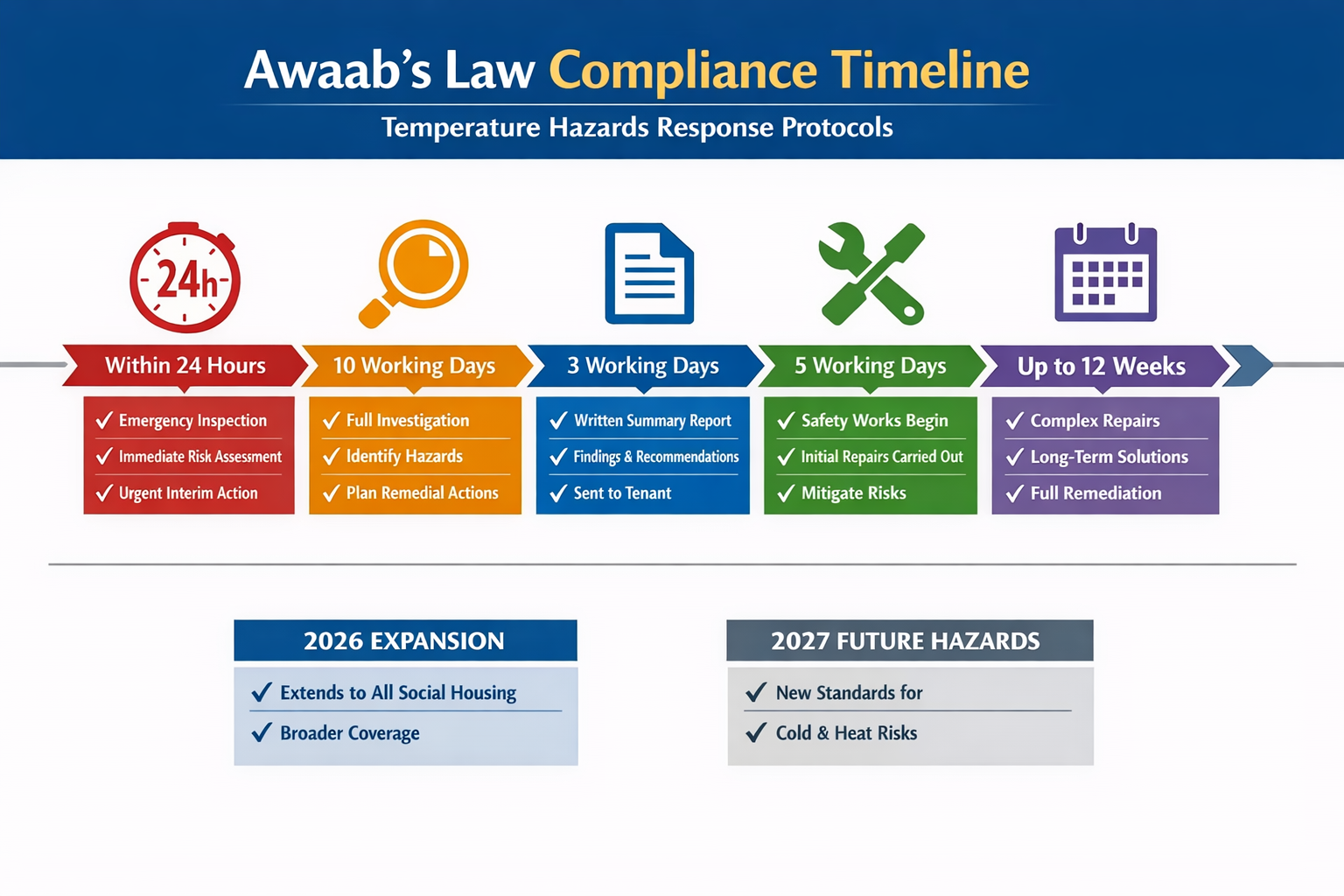
Awaab's Law establishes strict timeframes that directly impact surveyor workload and scheduling priorities. Understanding these deadlines is critical for surveyors supporting landlord compliance efforts.[5]
⚠️ Emergency Temperature Hazards (Imminent and Significant Risk)
When a temperature hazard poses immediate danger to tenant health:
- 24-hour investigation deadline: Surveyor must inspect property within 24 hours of landlord notification
- 24-hour safety works deadline: If hazard confirmed, immediate safety measures must be completed within 24 hours
- Alternative accommodation requirement: If repairs cannot be completed within 24 hours, landlord must provide suitable alternative accommodation at their expense
- Immediate reporting: Surveyor must communicate findings to landlord immediately upon completion
Emergency scenarios might include:
- Complete heating system failure during winter with vulnerable occupants
- Severe heat accumulation endangering elderly residents during heatwave
- Structural failure causing extreme cold exposure
- Ventilation system breakdown creating dangerous heat buildup
📋 Significant Temperature Hazards (Non-Emergency)
For hazards presenting significant but not imminent risk:
- 10 working days investigation deadline: Surveyor must complete property inspection within 10 working days of notification
- 3 working days written summary: Landlord must provide written summary to tenant within 3 working days after investigation concludes
- 5 working days safety works commencement: Remedial works must begin within 5 working days of investigation completion
- 12 weeks maximum for complex works: Major remediation projects (such as whole-property insulation upgrades) must commence within 12 weeks maximum[5]
This tiered approach means surveyors must prioritize emergency assessments while managing ongoing significant hazard investigations simultaneously—a significant increase in workload compared to pre-2026 requirements.[3]
Comprehensive Reporting Standards
Surveyor reports under Awaab's Law carry heightened legal weight and may be required as evidence in enforcement proceedings. Reports must include:[3]
✅ Detailed Property Description
- Construction type, age, and materials
- Heating system specifications and condition
- Insulation provisions in walls, roof, and floors
- Window and door specifications
- Ventilation system details
✅ Comprehensive Hazard Documentation
- Specific temperature measurements with locations
- Thermal imaging results with annotated images
- Humidity readings and ventilation assessments
- Identification of causative defects
- Photographic evidence of all relevant conditions
✅ Person-Centered Risk Assessment
- Tenant vulnerability factors considered
- Justification for hazard severity classification
- Explanation of how tenant characteristics influenced assessment
- Comparison to standard HHSRS scoring if applicable
✅ Remediation Recommendations
- Specific repair actions required
- Priority ranking of remedial works
- Estimated timeframes for completion
- Alternative interim measures if applicable
- Cost implications for major works
✅ Compliance Timeline Confirmation
- Clear statement of applicable deadlines
- Confirmation of hazard classification (emergency vs. significant)
- Landlord obligations under Awaab's Law
- Consequences of non-compliance
Surveyors providing expert witness reports should be particularly attentive to documentation standards, as these reports may be scrutinized in legal proceedings.
Private Rental Sector Implications and Future Expansion
Current Legislative Scope and Exclusions
As of 2026, Awaab's Law applies exclusively to social housing landlords, including local authorities and registered providers of social housing. Private rental sector landlords are not currently subject to the mandatory investigation and remediation timeframes.[3]
However, this exclusion does not mean private landlords can ignore temperature hazards. Existing legislation still applies:
- Housing Act 2004: Private landlords remain subject to HHSRS enforcement by local authorities
- Landlord and Tenant Act 1985: Obligations to maintain property structure and installations
- Homes (Fitness for Human Habitation) Act 2018: Properties must be fit for habitation throughout tenancy
The key difference is that private landlords are not bound by Awaab's Law's strict response timeframes and person-centered assessment requirements—at least not yet.
Growing Momentum for Private Sector Expansion
There are "growing calls for similar measures in the private rental sector"[3], driven by several factors:
🏘️ Housing Quality Disparities
- Private rental sector contains higher proportion of older, thermally inefficient properties
- Energy Performance Certificate (EPC) data shows many private rentals have poor thermal performance
- Vulnerable tenants in private rentals face similar risks as social housing occupants
📈 Political and Advocacy Pressure
- Housing charities and tenant advocacy groups campaigning for expansion
- Local authorities reporting temperature-related health issues in private rentals
- Parliamentary discussions about extending Awaab's Law protections
⚖️ Legal Precedent Established
- Social housing framework provides tested implementation model
- Surveyor protocols and assessment methodologies already developed
- Enforcement mechanisms proven effective
While no confirmed timeline exists for private rental sector inclusion, forward-thinking landlords and surveyors are already adapting practices to align with Awaab's Law standards. This proactive approach offers several advantages:
- Risk mitigation: Early identification prevents tenant complaints and legal action
- Competitive advantage: Higher quality properties attract and retain tenants
- Regulatory readiness: Smooth transition if legislation expands
- Tenant welfare: Demonstrates commitment to occupant health and safety
Surveyors conducting Level 3 building surveys for private rental properties should consider incorporating Awaab's Law assessment protocols as best practice, even though not legally mandated.
Enhanced Surveyor Training and Professional Development
New Competency Requirements
The expansion of Excess Temperature Hazards in Awaab's Law 2026 Expansion: Surveyor Assessment Protocols for Private Rentals demands enhanced surveyor competencies across multiple domains:
Technical Skills:
- Advanced thermal imaging interpretation
- Heating system performance assessment
- Ventilation effectiveness evaluation
- Insulation defect identification
- Building regulation compliance testing knowledge
Assessment Skills:
- Person-centered vulnerability evaluation
- HHSRS hazard scoring methodology
- Risk prioritization and classification
- Causative defect analysis
- Remediation specification development
Communication Skills:
- Sensitive tenant interviewing techniques
- Clear written reporting for legal compliance
- Effective landlord consultation
- Explanation of technical findings to non-specialists
- Testimony and evidence presentation capabilities
Regulatory Knowledge:
- Comprehensive understanding of Awaab's Law timeframes
- Housing Act 2004 and HHSRS framework
- Building Regulations thermal requirements
- Energy efficiency standards and EPC regulations
- Landlord repair obligations across tenure types
Professional surveyors should pursue continuing professional development (CPD) opportunities specifically addressing these competencies. Organizations like RICS (Royal Institution of Chartered Surveyors) are developing specialized training modules to support surveyor adaptation to Awaab's Law requirements.
Technology Integration and Innovation
Forward-thinking surveyors are integrating advanced technologies to enhance assessment accuracy and efficiency:
Real-Time Monitoring Systems
- Installation of temporary temperature and humidity sensors
- Multi-day data logging for comprehensive assessment
- Remote monitoring capabilities reducing site visit requirements
- Trend analysis identifying intermittent hazard conditions[7]
Digital Reporting Platforms
- Cloud-based report generation with standardized templates
- Automated compliance deadline tracking
- Integrated photographic and thermal imaging documentation
- Client portals for transparent communication
Predictive Analytics
- Machine learning algorithms identifying high-risk properties
- Seasonal variation modeling for temperature hazards
- Vulnerability mapping based on tenant demographics
- Prioritization tools for efficient resource allocation
Surveyors practicing in areas with diverse housing stock, such as West London or Surrey, benefit significantly from technology integration given the range of property types and construction periods requiring assessment.
Practical Remediation Strategies for Temperature Hazards
Common Defects and Solutions
Surveyors must not only identify temperature hazards but also recommend practical, cost-effective remediation strategies. Common scenarios include:
Inadequate Loft Insulation
- Assessment finding: Thermal imaging shows significant heat loss through roof
- Remediation: Install or upgrade loft insulation to minimum 270mm depth
- Timeframe: Typically completed within 5 working days for standard properties
- Cost consideration: Relatively inexpensive with high thermal improvement impact
Single-Glazed Windows
- Assessment finding: Condensation, cold surface temperatures, high heat loss
- Remediation: Replace with double-glazed units or install secondary glazing
- Timeframe: May require 12-week complex works timeline for whole-property upgrade
- Cost consideration: Significant investment but essential for thermal efficiency
Inefficient or Broken Heating Systems
- Assessment finding: Inadequate heat output, system failures, uneven distribution
- Remediation: Repair or replace boiler, upgrade radiators, install controls
- Timeframe: Emergency response if complete failure; 10-day investigation if inefficient
- Cost consideration: Variable depending on system age and extent of work required
Poor Ventilation Causing Heat Buildup
- Assessment finding: Excessive summer temperatures, inadequate air change rates
- Remediation: Install mechanical ventilation, upgrade trickle vents, add extraction fans
- Timeframe: Typically 5 working days commencement after investigation
- Cost consideration: Moderate cost with significant comfort improvement
Wall Insulation Deficiencies
- Assessment finding: Cold internal wall surfaces, thermal bridging, high heat loss
- Remediation: Install cavity wall insulation or external/internal wall insulation
- Timeframe: Complex works requiring 12-week maximum commencement timeline
- Cost consideration: Major investment, may require grant funding or phased implementation
Surveyors should consider environmental issues holistically when recommending remediation, ensuring solutions address temperature hazards without creating secondary problems like condensation or mould growth.
Interim Measures and Alternative Accommodation
When remediation cannot be completed within statutory timeframes, surveyors should advise landlords on appropriate interim measures:
Temporary Heating Solutions
- Provision of additional electric heaters (emergency cold hazards)
- Upgraded thermostat controls for better temperature management
- Temporary insulation measures (thermal curtains, draft excluders)
Ventilation Improvements
- Portable air conditioning units (emergency heat hazards)
- Temporary extraction fans
- Enhanced natural ventilation strategies
Alternative Accommodation Requirements
- Must be suitable for tenant's needs and vulnerabilities
- Should be of comparable size and location
- Landlord bears full cost during remediation period
- Tenant retains right to return to original property
Surveyors working across locations like Guildford, Epsom, or Berkshire should maintain awareness of local accommodation availability and costs when advising on alternative housing requirements.
Future Expansion: 2027 and Beyond
All HHSRS Hazards Coming into Scope
The legislative trajectory extends beyond temperature hazards. In 2027, Awaab's Law will expand to include all remaining HHSRS hazards except overcrowding, encompassing:[1][5]
- Asbestos and manufactured mineral fibers
- Biocides and chemical hazards
- Carbon monoxide and fuel combustion products
- Lead contamination
- Radiation hazards
- Uncombusted fuel gas
- Volatile organic compounds
- Crowding and space deficiencies
- Entry by intruders
- Lighting inadequacies
- Noise disturbances
- Domestic hygiene, pests, and refuse
- Food safety hazards
- Personal hygiene, sanitation, and drainage
- Water supply quality
- Falls hazards (stairs, steps, surfaces)
- Electrical hazards
- Fire safety deficiencies
- Hot surfaces and materials
- Collision and entrapment hazards
- Explosions
- Structural collapse and falling elements
This comprehensive expansion will dramatically increase surveyor assessment scope and complexity. Surveyors must prepare for multi-hazard assessments requiring diverse technical expertise and detection methodologies.
Preparing for Private Rental Sector Inclusion
While speculative, prudent surveyors and landlords should anticipate potential private rental sector inclusion by:
For Surveyors:
- Developing standardized assessment protocols aligned with Awaab's Law
- Investing in comprehensive detection equipment
- Building expertise in person-centered vulnerability assessment
- Establishing efficient reporting systems meeting legal standards
- Creating client education resources about emerging requirements
For Private Landlords:
- Commissioning proactive building surveys to identify temperature hazards before complaints arise
- Implementing preventative maintenance programs for heating and insulation systems
- Upgrading properties to meet higher thermal efficiency standards
- Documenting all maintenance and improvement works comprehensively
- Establishing clear tenant communication channels for hazard reporting
For Property Investors:
- Factoring potential compliance costs into acquisition decisions
- Prioritizing properties with good thermal performance
- Budgeting for remediation works in long-term financial planning
- Considering property development opportunities that incorporate Awaab's Law standards from design stage
The trajectory of housing regulation clearly favors enhanced tenant protections and higher property standards. Early adoption of Awaab's Law principles positions stakeholders advantageously regardless of future legislative changes.
Conclusion
The expansion of Awaab's Law to include Excess Temperature Hazards in Awaab's Law 2026 Expansion: Surveyor Assessment Protocols for Private Rentals marks a watershed moment in housing quality regulation. While currently limited to social housing, the legislation establishes rigorous standards for hazard assessment, strict remediation timeframes, and person-centered vulnerability evaluation that are reshaping surveyor practice across the sector.
Professional surveyors now require enhanced technical capabilities, sophisticated detection equipment, and comprehensive understanding of both HHSRS methodology and Awaab's Law compliance requirements. The shift from standardized scoring to person-centered assessment represents a fundamental philosophical change—recognizing that identical property conditions pose different risks depending on who lives there.
For private rental sector landlords and surveyors, the message is clear: proactive adaptation to Awaab's Law standards offers significant advantages even before legislative expansion. Early identification of temperature hazards, systematic remediation planning, and enhanced documentation practices mitigate risks while demonstrating commitment to tenant welfare.
Actionable Next Steps
For Landlords:
- Commission comprehensive Level 3 building surveys incorporating temperature hazard assessment
- Develop maintenance schedules prioritizing heating, insulation, and ventilation systems
- Establish clear tenant reporting channels for temperature-related concerns
- Budget for potential remediation works identified through proactive assessment
- Consider voluntary adoption of Awaab's Law response timeframes to demonstrate best practice
For Surveyors:
- Invest in thermal imaging equipment and advanced detection tools
- Pursue CPD training in person-centered vulnerability assessment
- Develop standardized reporting templates meeting legal compliance standards
- Build expertise in remediation specification and cost estimation
- Establish efficient scheduling systems to meet emergency response timeframes
For Tenants:
- Understand your rights regarding temperature hazards in rental properties
- Document temperature-related concerns with photographs and written records
- Report issues promptly to landlords using clear, specific descriptions
- Seek professional advice if landlords fail to respond appropriately
- Consider vulnerability factors that may increase personal risk from temperature hazards
The 2026 expansion of Awaab's Law represents more than regulatory change—it embodies a fundamental commitment to housing quality and tenant health. As the framework continues evolving toward 2027's comprehensive hazard inclusion and potential private sector expansion, stakeholders who embrace these standards position themselves at the forefront of professional practice.
For expert guidance on temperature hazard assessment and comprehensive building surveys meeting the highest professional standards, contact chartered surveyors with specialized expertise in regulatory compliance and property condition assessment.
References
[1] Preparing For Awaabs Law – beeverstruthers.co.uk
[2] Awaabs Law Timeline – glplaw.com
[3] Awaabs Law Surveyors – goreport.com
[5] Awaabs Law Is Here The Surveyors Guide For Compliance – surventrix.com
[6] Awaabs Law Guidance For Social Landlords Timeframes For Repairs In The Social Rented Sector – gov.uk
[7] Real Time Sensors In Level 3 Building Surveys Detecting Awaabs Law Hazards Before 2026 Mandates Hit Rentals – nottinghillsurveyors.com