

Carbon disputes in construction now account for over £2.4 billion in annual litigation costs across the UK property sector, with expert witnesses facing unprecedented scrutiny over their whole life carbon assessment methodologies. As regulatory frameworks tighten and green building claims come under the legal microscope, the intersection of RICS standards, PAS 2080 integration, and courtroom testimony has become a critical battleground for construction professionals.
The emergence of Expert Witness Roles in Whole Life Carbon Disputes: RICS 2026 Standards for Litigation and Reporting represents a fundamental shift in how carbon-related disagreements are resolved in the built environment. With the second edition of the RICS Whole Life Carbon Assessment (WLCA) standard taking effect in July 2024, expert witnesses must now navigate complex technical requirements while maintaining the ethical standards expected in legal proceedings[2][5].
This comprehensive guide examines the evolving landscape of carbon dispute resolution, focusing on how expert witnesses can effectively integrate PAS 2080 principles into their reports, maintain professional integrity, and prepare for the rigorous demands of courtroom testimony in 2026.
Key Takeaways
- RICS WLCA standards now provide a harmonized framework for expert witnesses addressing whole life carbon disputes, covering all lifecycle stages from A1-C4[2][5]
- PAS 2080 integration is essential for credible expert witness reports, establishing clear methodologies for carbon management in infrastructure and construction projects
- Ethical obligations require expert witnesses to maintain independence, transparency, and adherence to RICS professional conduct standards regardless of client interests
- Courtroom preparation demands comprehensive understanding of both technical carbon assessment principles and effective communication strategies for non-technical audiences
- Documentation standards in 2026 require detailed audit trails, assumption justification, and clear differentiation between embodied and operational carbon calculations
Understanding Whole Life Carbon Assessment in Legal Contexts
The RICS WLCA Framework for Dispute Resolution
The RICS Whole Life Carbon Assessment standard provides the foundational methodology for measuring and reporting carbon emissions across the entire lifecycle of buildings and infrastructure[1][2]. For expert witnesses involved in litigation, this framework offers a standardized approach that courts increasingly recognize as the benchmark for credible carbon analysis.
The standard encompasses several critical lifecycle stages:
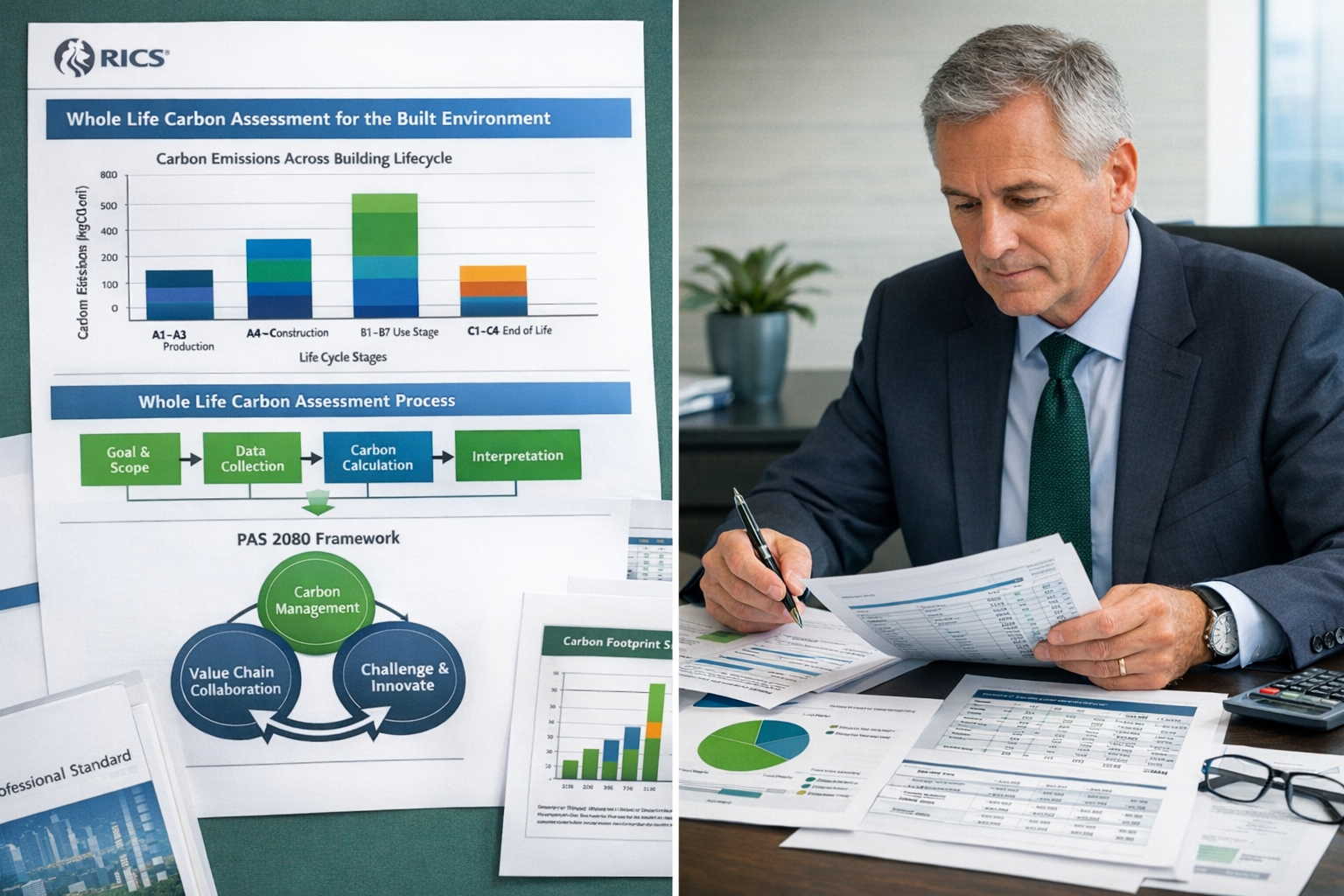
- Modules A1-A3: Product stage (raw material extraction, transport, manufacturing)
- Module A4: Construction process transport
- Module A5: Construction and installation processes
- Module B: Use stage (maintenance, repair, replacement, operational energy)
- Module C: End-of-life stage (deconstruction, transport, waste processing)
- Module D: Benefits beyond the building lifecycle
When expert witnesses prepare reports for carbon disputes, they must clearly articulate which modules are included in their assessment and justify any exclusions[2]. This transparency becomes crucial during cross-examination, where opposing counsel will scrutinize methodology choices.
Common Types of Whole Life Carbon Disputes
Carbon-related litigation in 2026 typically falls into several categories:
Green Building Claims Disputes 🏢
Developers or contractors may face legal challenges when buildings fail to meet promised carbon performance targets. Expert witnesses must evaluate whether carbon calculations were accurate, whether appropriate methodologies were used, and whether parties acted in good faith.
Contract Performance Disagreements
Construction contracts increasingly include carbon performance clauses. When disputes arise over whether contractual carbon targets were met, expert witness reports become essential for establishing baseline measurements and actual performance.
Regulatory Compliance Conflicts
As local authorities implement stricter carbon regulations, disputes emerge over compliance interpretations. Expert witnesses help courts understand technical requirements and assess whether projects meet regulatory thresholds.
Professional Negligence Claims
When carbon assessments prove inaccurate or incomplete, professional indemnity claims may follow. Expert witnesses evaluate whether professionals met the standard of care expected in their field[1].
The Role of PAS 2080 in Expert Testimony
PAS 2080:2023 (Carbon Management in Buildings and Infrastructure) provides complementary guidance that expert witnesses must integrate into their analysis. While RICS WLCA establishes measurement methodologies, PAS 2080 addresses the management processes and decision-making frameworks for carbon reduction[5].
For expert witnesses, PAS 2080 integration means:
- Evaluating whether appropriate carbon management strategies were implemented during project planning
- Assessing the adequacy of carbon reduction targets and monitoring systems
- Determining if parties followed recognized carbon management processes
- Identifying where carbon management failures contributed to disputes
The harmonization between RICS and the Institution of Civil Engineers (ICE) on carbon assessment messaging further strengthens the credibility of expert reports that reference both frameworks[5].
Expert Witness Roles in Whole Life Carbon Disputes: RICS 2026 Standards for Litigation and Reporting – Practical Application
Preparing Comprehensive Expert Witness Reports
A robust expert witness report in carbon disputes must meet both legal and technical standards. The report structure should include:
Executive Summary
A concise overview of key findings, opinions, and conclusions that non-technical readers can understand. This section often receives the most attention from judges and juries.
Qualifications and Independence Statement
Clear documentation of relevant credentials, RICS membership status, and confirmation of independence from parties involved in the dispute. Expert witnesses must explicitly state they understand their duty to the court supersedes any obligation to the instructing party.
Methodology Section
Detailed explanation of the RICS WLCA approach used, including:
- Lifecycle modules assessed (A1-C4)
- Data sources and quality assessment
- Assumptions and limitations
- Calculation methods and tools employed
- PAS 2080 management framework considerations
Technical Analysis
The core of the report where expert witnesses present their carbon assessment findings, compare against benchmarks or contractual targets, and identify discrepancies or areas of concern.
Opinions and Conclusions
Clear statements of professional opinion based on the evidence, avoiding advocacy while providing definitive conclusions where evidence supports them.
"Expert witnesses must remember their role is to assist the court, not to advocate for their client's position. Independence and objectivity are paramount." – RICS Professional Standards
Integrating RICS 2026 Standards with PAS 2080 Requirements
The integration of RICS WLCA standards with PAS 2080 carbon management principles creates a comprehensive framework for expert analysis. This dual approach addresses both the "what" (carbon measurement) and the "how" (carbon management processes).
Key Integration Points:
| RICS WLCA Component | PAS 2080 Alignment | Expert Witness Application |
|---|---|---|
| Lifecycle stages A1-C4 | Whole life value approach | Assess completeness of carbon accounting across project phases |
| Data quality requirements | Evidence-based decision making | Evaluate reliability of carbon data sources used |
| Reporting boundaries | Scope definition | Determine if appropriate boundaries were established |
| Uncertainty quantification | Risk management | Assess whether carbon risks were properly identified and managed |
| Benchmark comparisons | Performance targets | Evaluate reasonableness of carbon targets and achievement claims |
Expert witnesses should explicitly reference both standards in their reports, demonstrating how the project or dispute subject matter aligns with or deviates from recognized best practices[2][5].
Ethical Guidelines for Carbon Dispute Expert Witnesses
RICS members serving as expert witnesses must adhere to strict ethical standards that govern their conduct throughout the litigation process:
Independence and Impartiality ⚖️
Expert witnesses must maintain independence from the outcome of the case. Financial arrangements should not create incentives tied to case results. All potential conflicts of interest must be disclosed immediately.
Competence and Continuing Professional Development
Given the rapid evolution of carbon assessment methodologies, expert witnesses must demonstrate current knowledge. The RICS Certificate in Whole Life Carbon Assessment training programme provides structured education that enhances credibility[4][7].
Transparency in Methodology
All assumptions, data sources, and calculation methods must be clearly documented and available for scrutiny. Expert witnesses should anticipate challenges to their methodology and prepare comprehensive justifications.
Accurate Representation of Limitations
Carbon assessments involve inherent uncertainties. Expert witnesses must honestly communicate the limitations of their analysis rather than overstating certainty to strengthen a client's position[1].
Professional Conduct in Court
Expert witnesses must respond to questions honestly and directly, acknowledge areas outside their expertise, and correct any errors in their reports or testimony promptly.
Documentation Standards and Audit Trails
Robust documentation separates credible expert witness reports from those vulnerable to challenge. In 2026, courts expect comprehensive audit trails that allow independent verification of carbon calculations.
Essential Documentation Elements:
📊 Data Source Registry
Maintain detailed records of all data sources, including:
- Environmental Product Declarations (EPDs) used
- Carbon factor databases referenced
- Project-specific measurements and calculations
- Industry benchmarks applied
📋 Assumption Log
Document every assumption made during the assessment, with clear justification for each choice. This becomes critical when opposing experts challenge methodology decisions.
🔍 Calculation Worksheets
Preserve all intermediate calculations, not just final results. Courts may require expert witnesses to explain specific calculation steps during testimony.
📁 Version Control
Maintain clear version histories of reports, noting any revisions and the reasons for changes. This demonstrates thoroughness and prevents accusations of selective modification.
The RICS implementation guides provide templates and frameworks that expert witnesses can adapt for their documentation needs[3].
Courtroom Preparation and Testimony Best Practices
Preparing for Cross-Examination in Carbon Disputes
Cross-examination represents the most challenging aspect of expert witness testimony. Opposing counsel will attempt to undermine credibility, expose methodology weaknesses, and create doubt about conclusions. Effective preparation is essential.
Anticipate Common Challenge Areas:
Methodology Selection Challenges
Be prepared to defend why specific RICS WLCA modules were included or excluded, why particular carbon factors were chosen, and how alternative approaches might yield different results[2].
Data Quality Questions
Expect scrutiny of data sources, particularly when using generic carbon factors rather than project-specific EPDs. Have clear justifications for data quality decisions.
Assumption Interrogation
Every assumption in the carbon assessment becomes a potential target. Prepare detailed explanations for each assumption, supported by industry standards or technical literature.
Qualification Attacks
Opposing counsel may question whether the expert witness has sufficient specialized knowledge in whole life carbon assessment. RICS membership and relevant training credentials become important defensive evidence[4].
Communicating Technical Carbon Concepts to Non-Technical Audiences
Judges, juries, and attorneys often lack technical backgrounds in carbon assessment. Expert witnesses must translate complex concepts into accessible language without oversimplifying to the point of inaccuracy.
Effective Communication Strategies:
🎯 Use Analogies
Compare carbon emissions to familiar concepts. For example: "The embodied carbon in this building's concrete is equivalent to driving a car around the Earth 500 times."
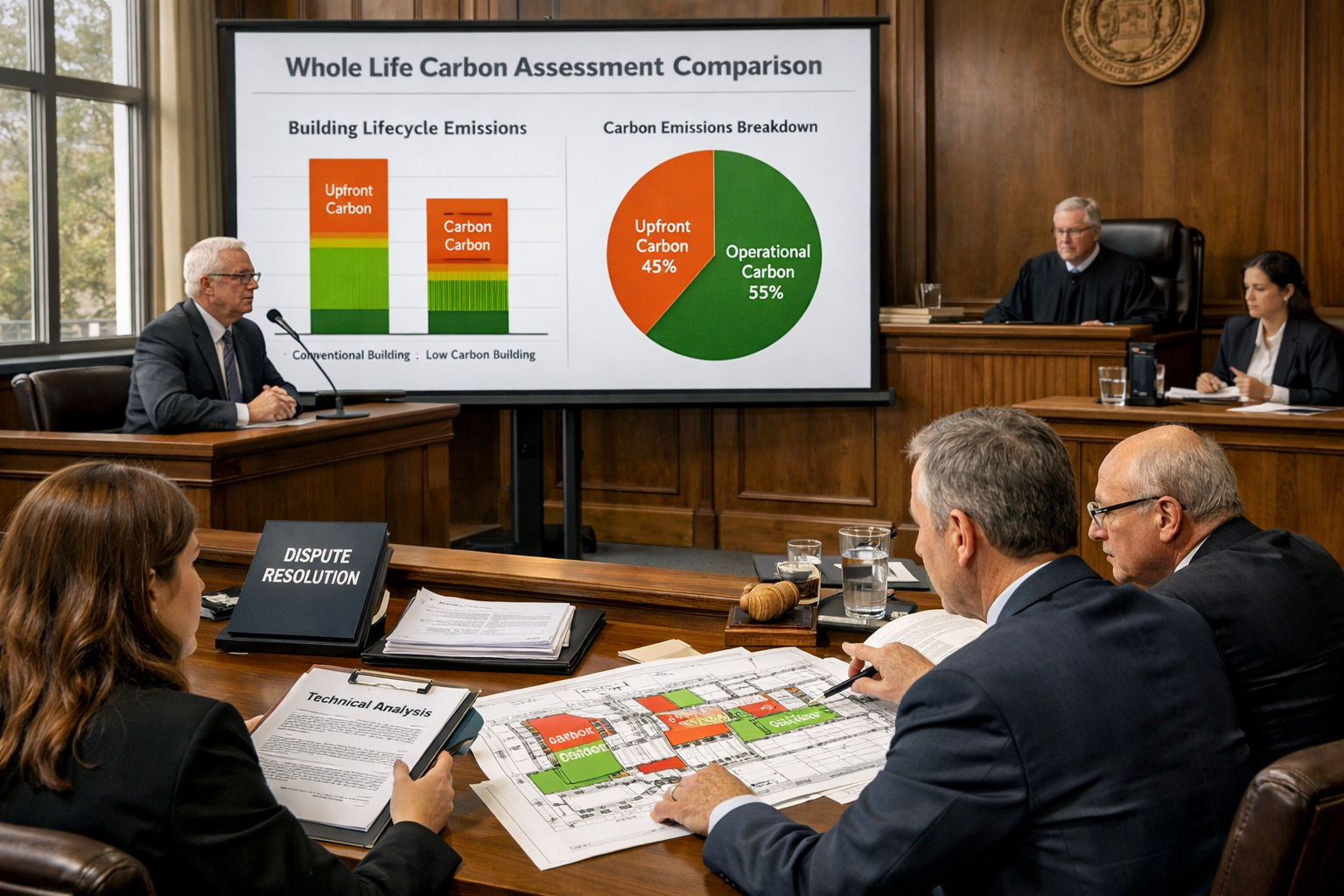
📊 Visual Aids
Prepare clear charts, graphs, and diagrams that illustrate carbon flows across lifecycle stages. Visual representations often communicate more effectively than tables of numbers.
🔢 Contextualize Numbers
Rather than stating "2,500 tonnes CO2e," explain what this means in practical terms or how it compares to relevant benchmarks.
📝 Define Technical Terms
Always define specialized terminology when first used. Don't assume familiarity with concepts like "embodied carbon," "operational carbon," or "carbon sequestration."
🗣️ Speak in Plain Language
Avoid unnecessary jargon. Replace "anthropogenic greenhouse gas emissions from the extraction and processing of raw materials" with "carbon produced when mining and manufacturing building materials."
Managing Professional Relationships During Litigation
Expert witnesses must navigate complex professional relationships while maintaining independence and ethical standards.
Relationship with Instructing Solicitors
Maintain professional boundaries. While solicitors provide case context and questions to address, they should not influence technical opinions or conclusions. Regular communication helps ensure reports address relevant legal issues without compromising independence.
Interaction with Opposing Experts
In many cases, courts encourage expert witnesses to meet and identify areas of agreement and disagreement. These "without prejudice" meetings can narrow dispute scope and clarify technical issues. Approach these interactions professionally and collaboratively.
Communication with Clients
Direct contact with the party involved in the dispute should be limited and carefully documented. All substantive communications should involve the instructing solicitor to maintain appropriate boundaries.
Post-Testimony Conduct
Expert witnesses should remain available for clarification questions but avoid discussing case details publicly or on social media, even after proceedings conclude.
Advanced Considerations for RICS Expert Witnesses in 2026
Emerging Challenges in Whole Life Carbon Litigation
The carbon dispute landscape continues to evolve rapidly, presenting new challenges for expert witnesses:
Digital Twin Integration
Building Information Modeling (BIM) and digital twins increasingly generate carbon data throughout project lifecycles. Expert witnesses must understand how to validate and interrogate digital carbon models.
Scope 3 Emissions Disputes
As carbon accounting extends to supply chain emissions, disputes over Scope 3 boundaries and calculations are becoming more common. Expert witnesses need comprehensive understanding of supply chain carbon assessment[1].
Carbon Offset Verification
When parties claim carbon neutrality through offsets, expert witnesses may need to evaluate offset quality, additionality, and permanence—areas requiring specialized knowledge beyond traditional carbon assessment.
Artificial Intelligence in Carbon Calculation
AI-powered carbon assessment tools are emerging. Expert witnesses must understand these technologies' capabilities and limitations when evaluating AI-generated carbon reports.
Continuing Professional Development Requirements
Maintaining expertise in whole life carbon assessment requires ongoing education. RICS members serving as expert witnesses should:
- Complete the RICS Certificate in Whole Life Carbon Assessment or equivalent training[4][7]
- Stay current with RICS standard updates and implementation guidance[3]
- Monitor legal precedents in carbon-related disputes
- Participate in professional forums discussing carbon assessment methodologies
- Review emerging research on embodied carbon and lifecycle assessment
The RICS commitment to delivering the future of carbon assessment in the built environment means standards and best practices will continue evolving[7]. Expert witnesses must evolve with them.
Building Credibility Through Professional Practice
Beyond technical competence, expert witness credibility stems from broader professional practice:
Maintain Active Practice
Courts value expert witnesses who actively practice in their field, not just those who testify professionally. Regular involvement in building surveys, structural assessments, and carbon assessment projects strengthens credibility.
Publish and Present
Contributing to professional publications, presenting at industry conferences, and sharing expertise through legitimate channels establishes authority in the field.
Professional Network Engagement
Active participation in RICS committees, working groups, or industry bodies demonstrates commitment to professional standards and keeps expert witnesses connected to evolving best practices.
Balanced Case Portfolio
Expert witnesses who work for both claimants and defendants across various dispute types demonstrate independence more convincingly than those who consistently represent one side.
Integration with Broader Building Assessment Services
Whole life carbon disputes rarely exist in isolation. Expert witnesses should understand how carbon assessment intersects with other building evaluation services:
- Building pathology: Material defects may affect both building performance and carbon calculations
- Environmental issues: Broader environmental concerns often accompany carbon disputes
- Dilapidations: End-of-lease disputes may include carbon performance obligations
- Planning considerations: Carbon assessment increasingly influences planning decisions
This holistic understanding allows expert witnesses to provide more comprehensive analysis and identify interconnected issues that may affect dispute resolution.

Future Directions: RICS Standards Beyond 2026
Anticipated Standard Evolution
The RICS WLCA standard will continue evolving as carbon assessment science advances and regulatory requirements tighten. Expert witnesses should anticipate:
Enhanced Data Quality Requirements
Future iterations will likely demand more rigorous data quality standards, reducing reliance on generic carbon factors in favor of project-specific EPDs and measurements[2].
Expanded Scope Coverage
Current standards focus primarily on buildings and infrastructure. Future versions may extend to broader urban development, landscape carbon, and circular economy considerations.
Integration with Digital Technologies
Standards will increasingly address how digital tools, BIM, and automated carbon calculation platforms should be used and validated[8].
International Harmonization
Efforts to align RICS standards with international frameworks (ISO, EN standards) will continue, affecting how expert witnesses approach cross-border disputes[5].
Preparing for Regulatory Changes
The UK's commitment to net-zero by 2050 ensures continued regulatory evolution. Expert witnesses must monitor:
- Building Regulations updates incorporating stricter carbon limits
- Local authority planning policies with enhanced carbon requirements
- Industry-specific regulations for sectors like social housing, commercial development, and infrastructure
- Financial disclosure requirements related to carbon performance in real estate
Staying ahead of regulatory changes allows expert witnesses to provide forward-looking analysis that considers not just current compliance but future obligations[10].
The Role of Professional Bodies in Supporting Expert Witnesses
RICS and other professional bodies continue developing resources to support expert witnesses in carbon disputes:
Practice Guidance Documents
Specialized guidance on expert witness roles in carbon disputes helps standardize approaches and establish recognized best practices[3].
Peer Review Networks
Professional networks facilitate peer review of complex carbon assessments, strengthening report quality before submission to courts.
Template Resources
Standardized templates for carbon assessment reports, assumption logs, and data registries improve consistency and completeness[3].
Expert Witness Directories
RICS maintains directories of qualified expert witnesses, helping legal professionals identify appropriately credentialed experts for carbon disputes.
Conclusion
The intersection of Expert Witness Roles in Whole Life Carbon Disputes: RICS 2026 Standards for Litigation and Reporting represents a critical evolution in construction dispute resolution. As carbon performance becomes increasingly central to building design, construction, and operation, the demand for qualified expert witnesses who can navigate both technical assessment and legal proceedings will only intensify.
Success in this specialized field requires a comprehensive skill set: deep technical knowledge of RICS WLCA methodologies, understanding of PAS 2080 carbon management principles, unwavering commitment to ethical standards, and effective communication abilities that translate complex carbon concepts for non-technical audiences.
Expert witnesses must maintain rigorous documentation practices, prepare thoroughly for cross-examination, and commit to ongoing professional development as standards and methodologies evolve. The integration of RICS standards with broader building assessment services—from structural engineering to environmental analysis—provides the holistic perspective necessary for credible expert testimony.
Actionable Next Steps
For professionals seeking to develop or enhance their expert witness capabilities in whole life carbon disputes:
-
Obtain Formal Credentials: Complete the RICS Certificate in Whole Life Carbon Assessment to establish foundational expertise[4][7]
-
Study the Standards: Thoroughly review the RICS WLCA standard, implementation guides, and PAS 2080 framework to understand methodology requirements[2][3][5]
-
Build Documentation Systems: Develop comprehensive templates and processes for maintaining audit trails, assumption logs, and data registries
-
Seek Mentorship: Connect with experienced expert witnesses who can provide guidance on courtroom procedures and testimony techniques
-
Monitor Legal Developments: Stay informed about carbon-related case law and precedents that may affect future disputes
-
Maintain Active Practice: Ensure ongoing involvement in carbon assessment projects to maintain current, practical knowledge
-
Develop Communication Skills: Practice explaining technical carbon concepts to non-technical audiences through presentations, writing, and mock testimony sessions
The growing importance of carbon performance in the built environment ensures that expert witnesses with specialized knowledge in whole life carbon assessment will play increasingly vital roles in dispute resolution. By combining technical excellence with ethical practice and effective communication, professionals can contribute meaningfully to fair and informed resolution of these complex disputes.
For organizations seeking qualified expert witness services in carbon disputes or other building-related matters, professional chartered surveying firms offer comprehensive expertise across the full spectrum of building assessment and litigation support needs.
References
[1] Understanding The Rics Whole Life Carbon Assessment Standard – https://www.tsariley.com/news/understanding-the-rics-whole-life-carbon-assessment-standard/
[2] Rics Whole Life Carbon Assessment Standard How Does It Support The Industry – https://www.bcis.co.uk/insight/rics-whole-life-carbon-assessment-standard-how-does-it-support-the-industry/
[3] Whole Life Carbon Assessment Implementation Guides And Supporting Documents – https://www.rics.org/profession-standards/rics-standards-and-guidance/sector-standards/construction-standards/whole-life-carbon-assessment/whole-life-carbon-assessment-implementation-guides-and-supporting-documents
[4] Certificate In Whole Life Carbon Assessment Training Programme – https://www.rics.org/training-events/training-courses/certificate-in-whole-life-carbon-assessment-training-programme
[5] Rics And Ice Harmonise Messaging On Carbon Assessment And Manage – https://www.rics.org/news-insights/rics-and-ice-harmonise-messaging-on-carbon-assessment-and-manage
[7] Wlca Delivering The Future Of Carbon Assessment In The Built Environment – https://www.rics.org/news-insights/wlca-delivering-the-future-of-carbon-assessment-in-the-built-environment
[8] Whole Life Carbon Assessment – https://www.rics.org/profession-standards/rics-standards-and-guidance/sector-standards/construction-standards/whole-life-carbon-assessment
[10] Rics Ceo Comments On The Publication Of The Future Homes And Building Standards – https://www.rics.org/news-insights/rics-ceo-comments-on-the-publication-of-the-future-homes-and-building-standards