

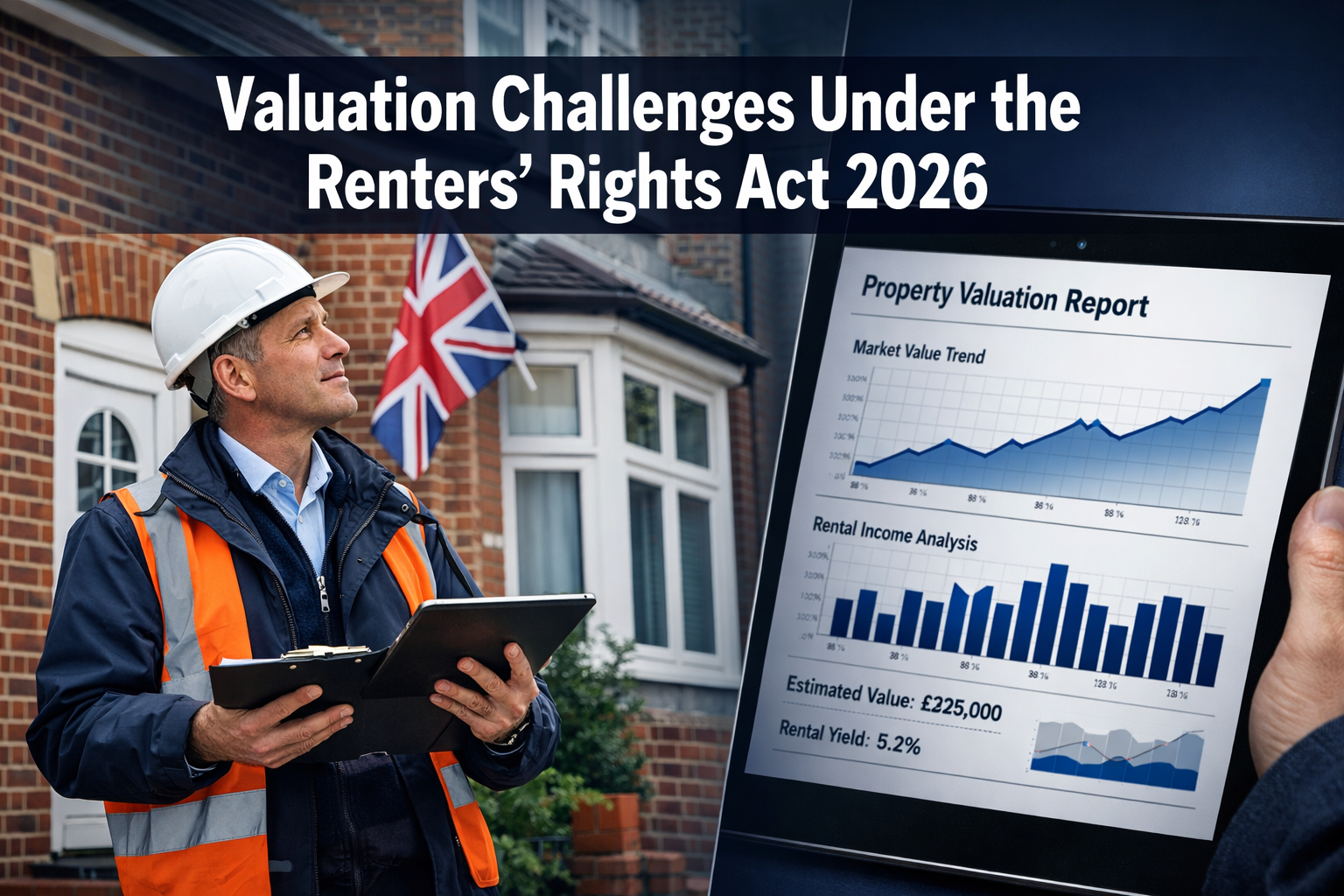
The Renters' Rights Act 2026 received Royal Assent on October 27, 2025, fundamentally reshaping how surveyors value rental properties across England. With 11 million private renters and 2.3 million landlords affected, property valuers now face unprecedented challenges in assessing investment returns under radically different income assumptions, tenant mobility patterns, and landlord risk profiles[1]. The elimination of Section 21 'no fault' evictions and the introduction of rent review caps mean that traditional valuation methodologies—built on decades of Assured Shorthold Tenancy (AST) data—must be completely recalibrated.
This comprehensive guide examines the Valuation Challenges Under the Renters' Rights Act 2026: How Surveyors Assess Properties with New Tenant Protections and Rent Controls, providing property professionals with actionable insights into navigating this transformative legislative landscape.
Key Takeaways
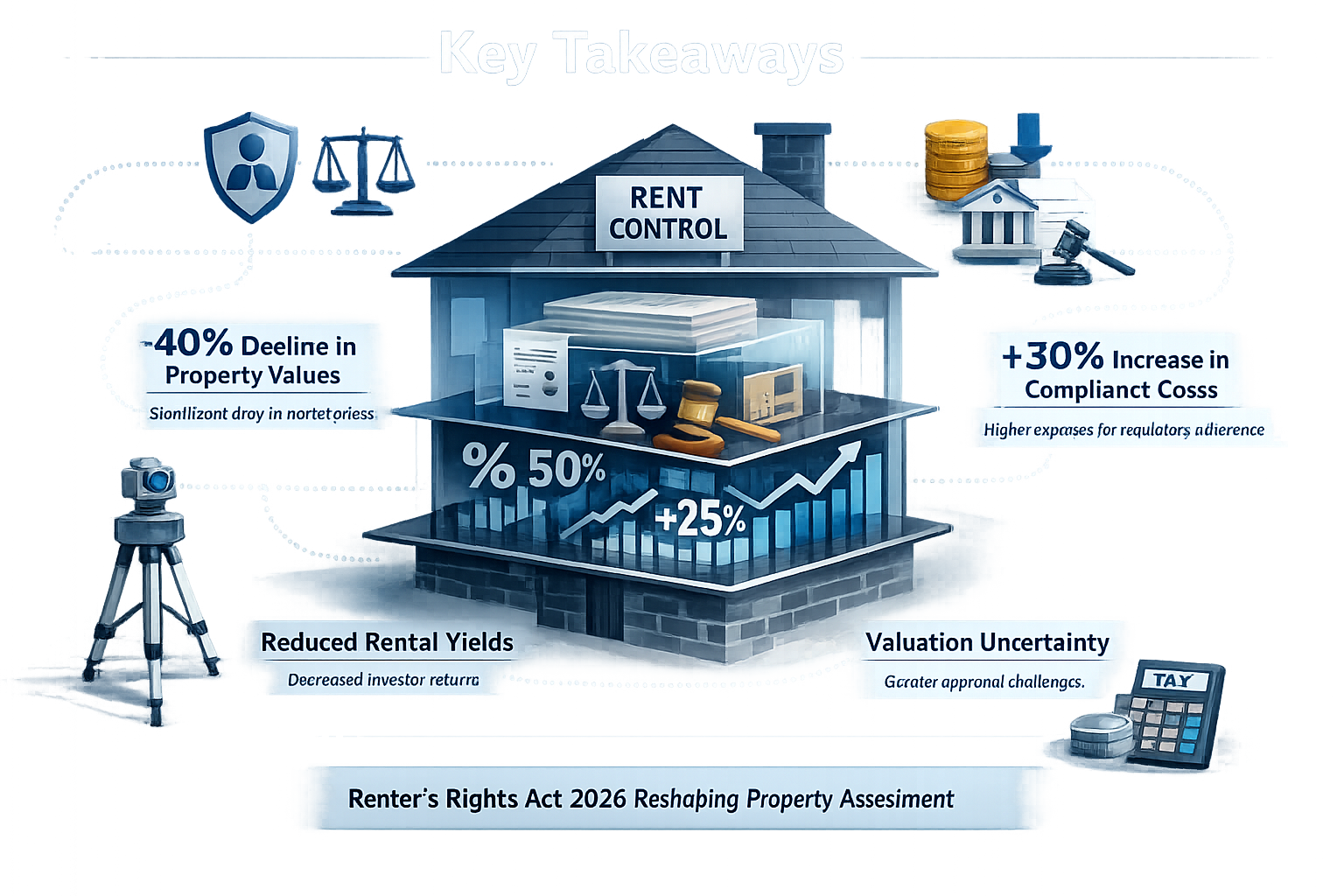
- 🏠 Periodic tenancies replace fixed-term ASTs, eliminating income predictability that valuers previously relied upon for investment property assessments
- 📊 Rent control measures limit increases to once annually after the first 12 months, fundamentally altering income projection models
- ⚖️ RICS maintains vacant possession assumptions remain valid but requires case-by-case professional judgment based on available Section 8 repossession grounds[1]
- 🔄 Historic comparable evidence from pre-2026 AST properties may no longer provide reliable valuation benchmarks due to structural tenure changes[2]
- 💼 Mixed-use properties face amplified valuation stress as tenants gain easier exit options when disturbed by commercial activities below[2]
Understanding the Fundamental Tenure Structure Shift
From Fixed-Term ASTs to Periodic Tenancies
The Valuation Challenges Under the Renters' Rights Act 2026 begin with the most fundamental change: the complete replacement of both new and existing ASTs with open-ended periodic monthly tenancies that have no minimum term[1]. This transformation eliminates the contractual certainty that fixed-term agreements provided to property investors and their valuers.
Under the previous system, landlords could rely on:
- Predictable income streams for the duration of fixed terms (typically 6-12 months)
- Defined void periods occurring at known lease expiry dates
- Comparable evidence from similar properties with similar tenure structures
The new periodic tenancy framework introduces several valuation complications:
| Valuation Factor | Pre-2026 AST System | Post-2026 Periodic System |
|---|---|---|
| Tenant Notice Period | Tied to fixed term end | 2 months at any time[1] |
| Income Predictability | High (contract duration) | Low (continuous exit risk) |
| Void Forecasting | Scheduled intervals | Unpredictable timing |
| Comparable Evidence | Abundant historical data | Limited transition data[2] |
| Landlord Recovery | Section 21 available | Section 8 grounds only[1] |
Impact on Investment Yield Calculations
Professional surveyors conducting property valuations must now account for increased income volatility when calculating net present values and investment yields. The shift toward periodic tenancies introduces commercial-style risk pricing into residential portfolios[2].
Key valuation adjustments surveyors are implementing include:
✅ Higher void assumptions (15-20% vs. previous 8-12%)
✅ Increased turnover cost provisions for more frequent tenant changes
✅ Risk-adjusted discount rates reflecting income uncertainty
✅ Enhanced due diligence on property condition and compliance standards
Rent Control Measures and Income Projection Challenges
The 12-Month Rent Freeze and Annual Increase Restrictions
One of the most significant Valuation Challenges Under the Renters' Rights Act 2026 stems from the new rent control framework. The Act prohibits any rent increases during the first 12 months of a tenancy, with only one annual increase permitted thereafter, subject to market value restrictions[1].
This creates several valuation complications:
For new rental properties entering the market:
- Initial rent setting becomes critical (no adjustment possible for 12 months)
- Surveyors must assess whether asking rents reflect 12-month forward market conditions
- Risk of under-pricing cannot be corrected quickly
For existing tenanted properties:
- Income growth assumptions must be capped at annual intervals
- Market rent reviews become less flexible than commercial property equivalents
- Tenant retention incentives may suppress achievable rent increases
Income Modelling vs. Direct Comparison Methodology
The fragmentation of comparable evidence is forcing surveyors to reconsider their primary valuation approaches[2]. Traditional direct comparison methods—which rely on recent sales of similar properties with similar tenancy arrangements—face significant challenges when:
- Historic comparables reflect AST income patterns that no longer apply
- Mixed-use properties lack sufficient transaction evidence
- Market participants haven't established consensus pricing for new tenure risks
Many surveyors are shifting toward enhanced income modelling approaches that incorporate:
- Scenario analysis (best case, base case, worst case tenant turnover)
- Sensitivity testing on void periods and rent collection rates
- Discounted cash flow models that explicitly account for periodic tenancy risks
- Yield adjustments based on property-specific risk factors
When conducting annual tax valuations or SIPP pension valuations, surveyors must now provide substantially more detailed commentary on their income assumptions and methodology choices.
Market Rent Determination Under New Constraints
Determining "market rent" under the Renters' Rights Act 2026 requires surveyors to consider:
- Comparable properties with similar tenant protection profiles
- Tenant demand elasticity in response to reduced mobility barriers
- Landlord supply responses (some exiting market, reducing available stock)
- Regional variations in enforcement and tenant behavior patterns
"The sector is entering a period of significant uncertainty rather than immediate consensus, with fundamental questions unresolved about tenant behavior adaptation, institutional versus small landlord responses, and speed of market equilibrium establishment."[2]
RICS Guidance and the Vacant Possession Assumption Debate
Professional Standards for Valuation Under New Legislation
The Royal Institution of Chartered Surveyors (RICS) has provided critical guidance on the Valuation Challenges Under the Renters' Rights Act 2026, particularly regarding the controversial vacant possession assumption.
RICS Position:
- The use of vacant possession assumptions remains reasonable based on Section 8 grounds for repossession that continue to be available to landlords[1]
- However, valuers must apply case-by-case assessment and exercise professional judgment
- Surveyors require appropriate experience and skill to assess market impact on a property-by-property basis[1]
This guidance provides important clarity but also places significant responsibility on individual valuers to justify their assumptions.
Section 8 Grounds and Repossession Reliability
While Section 21 'no fault' evictions have been eliminated, landlords retain access to Section 8 grounds for repossession, including:
- Mandatory grounds (rent arrears exceeding specified thresholds)
- Discretionary grounds (persistent rent delays, property damage, nuisance)
- Landlord occupation needs (own occupation, family member occupation)
The reliability of these grounds for valuation purposes depends on:
| Ground Type | Reliability for Valuation | Considerations |
|---|---|---|
| Rent Arrears (Mandatory) | High | Clear thresholds, court enforcement |
| Property Damage | Medium | Requires evidence, court discretion |
| Landlord Occupation | Medium | Notice periods, genuine need test |
| Anti-Social Behavior | Low-Medium | Evidence burden, tenant defenses |
Surveyors must assess whether the specific property and tenant profile support a realistic vacant possession assumption or whether adjustments are necessary.
Property-Specific Risk Assessment
When conducting Level 3 full building surveys or comprehensive valuations, surveyors should evaluate:
Physical property factors:
- Condition and compliance with Decent Homes Standards
- Building materials assessments affecting tenant appeal
- Maintenance requirements that could trigger tenant complaints
Tenant profile considerations:
- Length of current tenancy (established vs. new tenants)
- Payment history and relationship with landlord
- Demographic factors affecting mobility likelihood
Location and market factors:
- Local rental demand strength
- Competition from purpose-built rental developments
- Regional enforcement patterns for tenant protections
Mixed-Use Properties and Amplified Valuation Stress

The Compounded Challenge for Flats Above Commercial Units
Perhaps nowhere are the Valuation Challenges Under the Renters' Rights Act 2026 more acute than with mixed-use properties—particularly residential flats positioned above commercial premises[2].
These properties face compounded valuation pressure because:
- Tenants can exit more easily if disturbed by commercial activity below (noise, extraction systems, food preparation odors)
- Pre-existing narrow tenant pools become even more restricted
- Lender treatment was already cautious and may become more conservative
- Yield softening occurs as investors demand greater uncertainty buffers[2]
Specific Commercial Use Impacts
Different commercial uses create varying degrees of valuation risk:
High-Risk Commercial Uses:
- 🍕 Restaurants and takeaways (extraction noise, food odors, late hours)
- 🎵 Bars and entertainment venues (noise, anti-social behavior)
- 🏭 Light industrial (operational noise, delivery disruptions)
Medium-Risk Commercial Uses:
- 🏪 Retail shops (customer traffic, delivery times)
- ☕ Cafes (moderate noise, daytime hours)
- 💼 Offices (limited evening/weekend disturbance)
Lower-Risk Commercial Uses:
- 📚 Professional services (quiet operations)
- 🏦 Financial services (minimal disturbance)
Surveyors must now explicitly quantify the additional risk premium associated with each commercial use type when valuing the residential component above.
Comparable Evidence Gaps for Mixed-Use
The challenge of finding reliable comparable evidence for mixed-use properties has intensified[2]. Surveyors face:
- Limited transaction volumes in mixed-use categories
- Inconsistent tenure arrangements across historical comparables
- Varying commercial use impacts that aren't directly comparable
- Lender valuation approaches that differ significantly between institutions
Many surveyors are adopting component valuation approaches that separately assess:
- Commercial unit value (ground floor)
- Residential unit value (upper floors) with risk adjustments
- Integration premium or discount based on configuration
Understanding how block management differs from property management becomes particularly relevant for mixed-use buildings with multiple residential units.
Lender Responses and Loan-to-Value Considerations
Current Monitoring Phase
Major mortgage lenders have not yet formally changed lending criteria but are closely monitoring market developments following the Act's implementation[2]. This creates uncertainty for both surveyors and property investors.
Key unknowns that lenders are evaluating include:
- Whether to reduce loan-to-value ratios for higher-risk income sectors
- Whether to require enhanced valuation commentary on turnover and void assumptions
- How to differentiate risk pricing between property types and locations
- What additional covenants to impose on landlord borrowers
Enhanced Valuation Commentary Requirements
Even without formal policy changes, lenders are increasingly requesting more detailed valuation reports that address:
✅ Specific Section 8 grounds applicable to the property
✅ Tenant profile assessment and turnover risk evaluation
✅ Income volatility scenarios with sensitivity analysis
✅ Comparable evidence justification and methodology explanation
✅ Compliance status with Decent Homes Standards and other regulations
Surveyors conducting valuations for lending purposes should anticipate these requirements and provide comprehensive documentation.
Portfolio Valuation Strategies
For landlords with multiple property portfolios, the Renters' Rights Act 2026 creates differentiated risk profiles across holdings. Surveyors should consider:
Portfolio segmentation by risk category:
- Core holdings (low-risk, high-demand locations, good condition)
- Value-add opportunities (properties requiring compliance upgrades)
- Disposition candidates (high-risk mixed-use or secondary locations)
Regular rental unit inspections become more critical for maintaining valuation support and demonstrating compliance.
Compliance Costs and the Decent Homes Standard
Enhanced Due Diligence Requirements
The Valuation Challenges Under the Renters' Rights Act 2026 extend beyond tenure structure to include increased compliance burdens that affect property values[1].
Key compliance requirements impacting valuations:
- Decent Homes Standards (energy efficiency, repair standards, facilities)
- Deposit Protection Scheme adherence and documentation
- Electrical safety certificates (every 5 years)
- Gas safety certificates (annual)
- Energy Performance Certificates (minimum ratings)
Capital Expenditure Implications
Surveyors must assess whether properties meet current standards and quantify the capital expenditure required for compliance. This involves:
- Building defects surveys to identify compliance gaps
- Budgeting for repairs and restoration to meet Decent Homes Standards
- Energy efficiency upgrade cost estimates
- Ongoing maintenance reserve calculations
Valuation adjustment formula:
Adjusted Value = Market Value (compliant property) - Compliance Capex - Disruption Costs
Properties requiring significant compliance work may see substantial value reductions, particularly if work requires tenant vacation or extended void periods.
Pet Policies and Property Condition
The Act's provisions regarding pet ownership rights create additional considerations:
- Potential for increased wear and tear
- Higher turnover costs for property refurbishment
- Possible insurance premium increases
- Need for more frequent property inspections
Surveyors should factor these considerations into maintenance cost assumptions and void period calculations.
Market Recalibration and Future Outlook

The Transition Period Uncertainty
The property market is currently experiencing a significant recalibration period as participants adapt to the new legislative framework[2]. Several fundamental questions remain unresolved:
Tenant behavior adaptation:
- Will tenants exercise their increased mobility rights extensively?
- How will tenant retention rates change across different property types?
- What rent premium will tenants pay for higher-quality, compliant properties?
Landlord responses:
- Will small landlords exit the market in significant numbers?
- How will institutional investors adjust their acquisition criteria?
- What operational changes will landlords implement to reduce turnover?
Market equilibrium timing:
- How quickly will rental supply adjust to new demand patterns?
- When will sufficient transaction evidence emerge for reliable comparables?
- How will regional markets develop different characteristics?
Institutional vs. Small Landlord Divergence
The Valuation Challenges Under the Renters' Rights Act 2026 may affect different landlord categories very differently:
Institutional landlords:
- Better positioned to absorb compliance costs
- Professional management reduces turnover risks
- Access to capital for property upgrades
- Portfolio diversification mitigates individual property risks
Small landlords (1-3 properties):
- Higher proportional compliance cost burden
- Limited resources for extended void periods
- Less sophisticated tenant screening and retention
- May face pressure to sell to institutional buyers
This divergence could lead to market consolidation and valuation premiums for properties with institutional-grade specifications and management.
Regional Market Variations
Surveyors must consider geographic factors when assessing valuation impacts:
| Region Type | Tenant Mobility Risk | Supply Response | Valuation Impact |
|---|---|---|---|
| High-Demand Urban | Lower (limited alternatives) | Stable | Moderate |
| Secondary Cities | Medium | Some landlord exits | Significant |
| Rural/Remote | Higher (seeking urban moves) | Landlord exits likely | Severe |
| Student Markets | Lower (academic cycles) | Purpose-built growth | Low-Moderate |
Location-specific analysis becomes even more critical when conducting valuations across different markets. Understanding local area characteristics helps surveyors make informed adjustments.
Practical Valuation Methodology Recommendations
Step-by-Step Valuation Approach
Surveyors addressing the Valuation Challenges Under the Renters' Rights Act 2026 should adopt a systematic methodology:
1. Property Classification
- Categorize by type (single-let, HMO, mixed-use)
- Assess compliance status with Decent Homes Standards
- Identify specific risk factors (commercial uses, condition issues)
2. Tenure Analysis
- Review current tenancy arrangements
- Evaluate Section 8 grounds applicability
- Assess realistic vacant possession assumptions
3. Income Assessment
- Establish current market rent (considering 12-month freeze implications)
- Project annual increase potential (market constraints)
- Calculate void period assumptions (15-20% for higher-risk properties)
- Estimate turnover costs (letting fees, refurbishment, marketing)
4. Comparable Evidence Review
- Identify post-Act transaction comparables where available
- Adjust pre-Act comparables for tenure structure changes
- Document methodology for comparable selection and adjustment
5. Risk-Adjusted Valuation
- Apply appropriate yield (reflecting income volatility)
- Conduct sensitivity analysis on key assumptions
- Provide valuation range rather than single-point estimate
6. Compliance Assessment
- Quantify capital expenditure for standards compliance
- Adjust valuation for required works
- Consider timing and disruption implications
Documentation and Professional Judgment
Given the evolving nature of the market and RICS's emphasis on case-by-case professional judgment[1], surveyors should:
📋 Provide detailed written rationale for all key assumptions
📋 Document comparable evidence with explicit adjustments
📋 Explain yield selection and risk premium justification
📋 Include scenario analysis showing valuation sensitivity
📋 Disclose uncertainty where market evidence is limited
This enhanced documentation protects professional liability and provides transparency for clients and lenders.
Ongoing Market Monitoring
Surveyors should establish systematic market monitoring processes:
- Track rental transaction volumes and pricing trends
- Monitor landlord supply responses (portfolio sales, market exits)
- Observe tenant behavior patterns (turnover rates, notice periods)
- Review lender policy changes and lending criteria adjustments
- Update valuation assumptions quarterly as market data emerges
Conclusion
The Valuation Challenges Under the Renters' Rights Act 2026: How Surveyors Assess Properties with New Tenant Protections and Rent Controls represent the most significant transformation of residential property valuation methodology in decades. The shift from fixed-term ASTs to periodic tenancies, combined with rent control measures and enhanced tenant protections, fundamentally alters the risk-return profile of rental property investments.
Key imperatives for surveyors:
✅ Abandon reliance on historic AST comparables without appropriate adjustments for tenure structure changes
✅ Adopt enhanced income modelling approaches that explicitly account for increased tenant mobility and income volatility
✅ Apply rigorous property-specific risk assessment rather than assuming uniform market impacts
✅ Provide comprehensive documentation of methodology, assumptions, and professional judgment
✅ Maintain continuous market monitoring as the sector establishes new equilibrium pricing
Mixed-use properties, secondary locations, and non-compliant properties face the most significant valuation pressure and require particularly careful analysis. Meanwhile, high-quality properties in strong rental markets with institutional-grade specifications may experience relatively modest impacts.
Next Steps for Property Professionals
For surveyors:
- Review and update valuation templates to incorporate new risk factors
- Pursue continuing professional development on the Act's implications
- Establish peer review processes for complex valuations during the transition period
- Engage with RICS guidance updates as market consensus develops
For landlords and investors:
- Commission comprehensive property valuations to understand portfolio impacts
- Prioritize compliance upgrades to maintain value and tenant appeal
- Consider portfolio optimization strategies based on differentiated risk profiles
- Engage professional surveyors with specific experience in post-Act valuations
For lenders:
- Develop clear guidance for enhanced valuation commentary requirements
- Establish risk-differentiated lending criteria based on property characteristics
- Monitor portfolio performance data to calibrate appropriate loan-to-value ratios
- Collaborate with valuation professionals to establish best practice approaches
The market recalibration period will likely extend through 2026 and beyond as participants adapt to the new framework. Surveyors who develop robust methodologies, maintain rigorous professional standards, and provide transparent documentation will be best positioned to navigate these challenges successfully.
References
[1] Consideration Of Implications Of Renters Rights Act On Valuation – https://www.rics.org/news-insights/consideration-of-implications-of-renters-rights-act-on-valuation
[2] Renters Rights Bill Future Of Valuations – https://www.terracottaproperty.com/blog/renters-rights-bill-future-of-valuations