

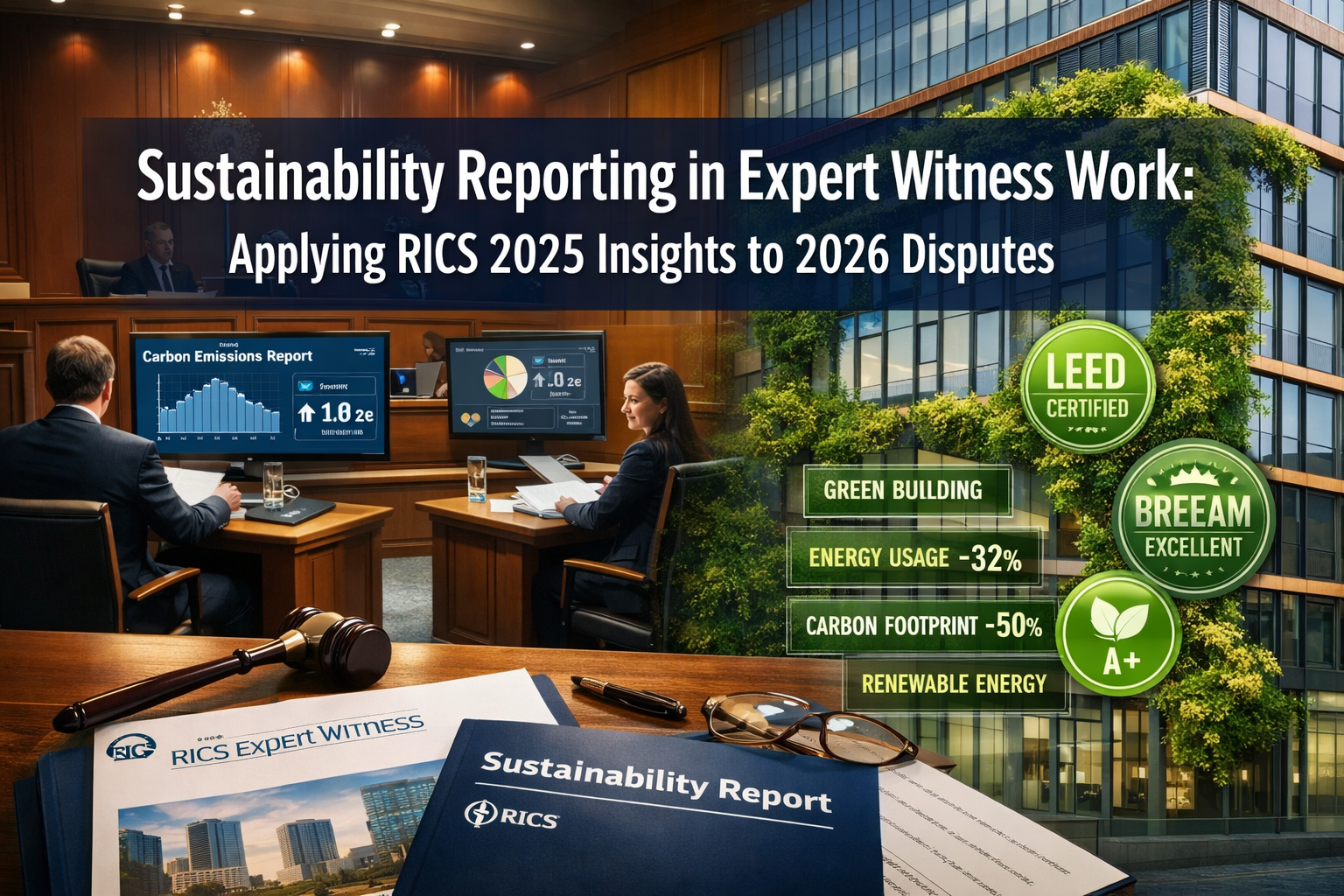
Nearly half of construction professionals—46% to be exact—don't measure carbon emissions across their projects, according to RICS's 2025 Sustainability Report.[3] This alarming statistic isn't just an environmental concern; it represents a critical vulnerability in expert witness testimony as sustainability disputes surge in 2026. When surveyors step into the witness box to provide evidence on property valuations, party wall awards, or construction disputes, the absence of robust carbon data can undermine entire cases. Sustainability Reporting in Expert Witness Work: Applying RICS 2025 Insights to 2026 Disputes has become essential as regulatory frameworks tighten and courts demand verifiable environmental evidence.
The Royal Institution of Chartered Surveyors (RICS) launched its first major update to expert witness standards since 2014, explicitly integrating environmental, social, and governance (ESG) factors into surveyor expert evidence globally.[1] This transformation arrives precisely when the EU Corporate Sustainability Reporting Directive (CSRD) moves into delivery phase and the UK transitions toward more robust ESG reporting regimes. For expert witnesses, these converging developments create both challenges and opportunities in 2026.
Key Takeaways
- RICS 2025 standards now mandate ESG integration in expert witness reports, requiring surveyors to address carbon metrics, climate resilience, and sustainability claims in property disputes
- 46% of construction professionals fail to measure carbon emissions, creating significant evidentiary gaps that expert witnesses must navigate when providing testimony on environmental performance
- New regulatory frameworks including the EU Green Claims Directive (effective September 2026) and UK Sustainability Reporting Standards directly impact expert witness standards for environmental evidence
- Skills deficits in embodied carbon assessment affect 30% of professionals, highlighting the need for enhanced competency in sustainability reporting for credible expert testimony
- Conflict of interest disclosure requirements have been strengthened, with clearer legal consequences for non-compliance in sustainability-related disputes
Understanding the RICS 2025 Expert Witness Framework
The updated RICS expert witness standard represents years of collaborative development with technical experts, addressing modern practice challenges that didn't exist when the previous version was published in 2014.[1] The framework establishes clear, practical guidance for how environmental, social, and governance factors should be reflected in surveyor expert evidence across all jurisdictions.
Core ESG Integration Requirements
Expert witnesses must now demonstrate competency in assessing and reporting on sustainability metrics relevant to their testimony. This includes:
- Carbon performance data for property valuations and development disputes
- Climate resilience assessments for long-term asset viability
- Green claims verification to support or challenge environmental marketing statements
- Regulatory compliance evidence tied to emerging sustainability frameworks
The standard emphasizes that ESG considerations are no longer optional enhancements but fundamental components of professional expert witness practice. When providing evidence on commercial valuations or property development disputes, expert witnesses must address sustainability factors that materially affect asset value and performance.
Digital Evidence and AI Provisions
Recognizing technological advancement, the 2025 standard includes provisions for AI use and digital evidence presentation.[1] Expert witnesses can now leverage:
✅ AI-assisted carbon calculation tools for embodied and operational emissions analysis
✅ Digital building performance monitoring data as evidence
✅ Automated compliance checking systems for sustainability standards
✅ Blockchain-verified sustainability certifications
However, the standard requires full transparency about AI tool usage, including disclosure of algorithms, data sources, and potential biases in automated analysis. Expert witnesses remain personally responsible for all evidence presented, regardless of technological assistance employed.
Enhanced Conflict of Interest Disclosure
The updated framework establishes clearer requirements for identifying and disclosing conflicts of interest, with explicit explanation of legal consequences for non-compliance.[1] In sustainability disputes, conflicts may arise from:
- Previous consulting relationships with parties involved in green certification
- Financial interests in competing sustainability technologies
- Prior advocacy positions on environmental standards
- Relationships with ESG rating agencies or verification bodies
Expert witnesses must conduct thorough conflict screening before accepting appointments in sustainability-related disputes, maintaining detailed documentation of the disclosure process.
Sustainability Reporting in Expert Witness Work: Key Metrics and Standards for 2026
The landscape of sustainability reporting has evolved dramatically, with multiple regulatory frameworks converging in 2026 to create unprecedented demands on expert witness testimony. Understanding these metrics and standards is crucial for providing credible, defensible evidence in property and construction disputes.
The Carbon Measurement Challenge
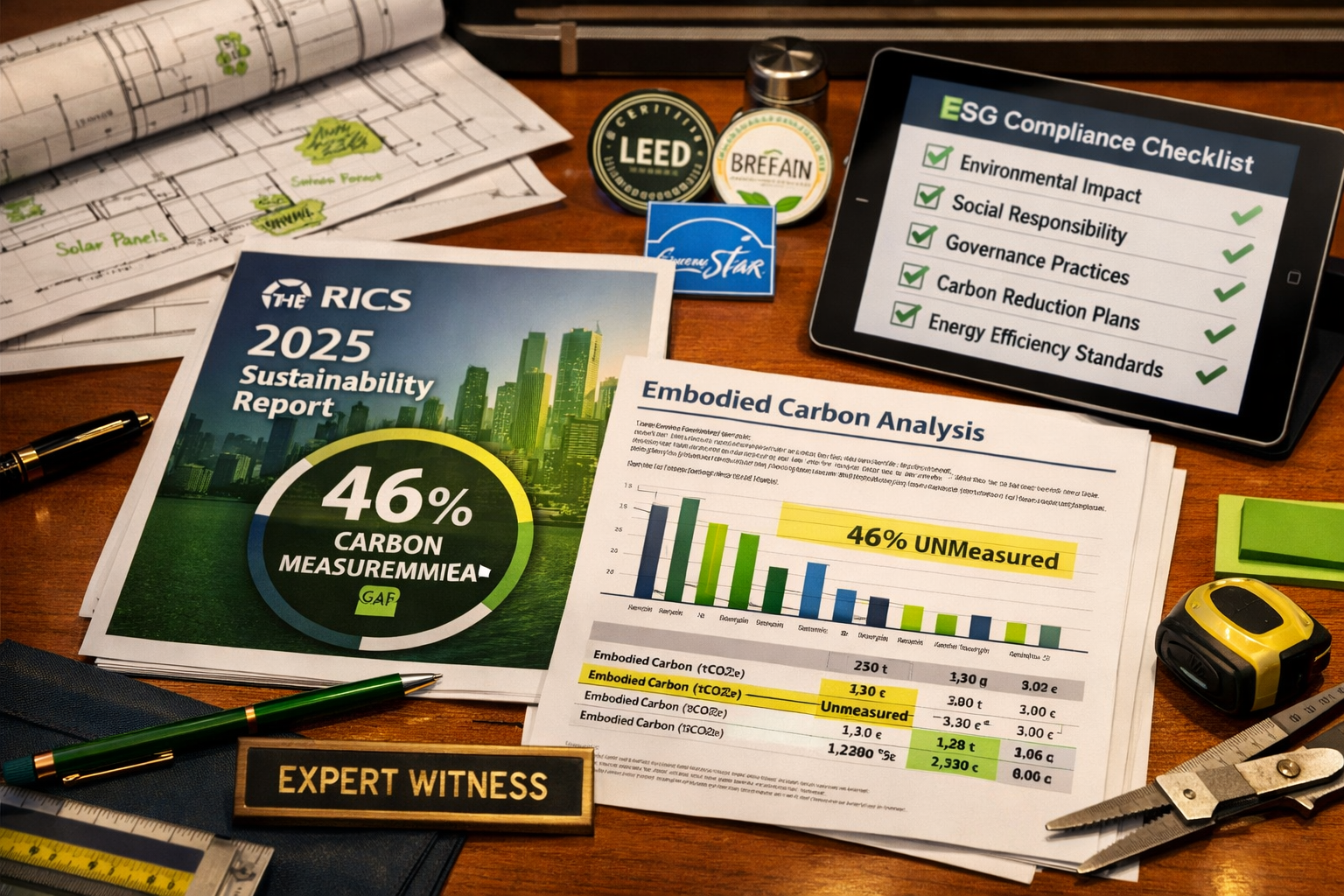
The RICS 2025 Sustainability Report reveals troubling gaps in carbon measurement practices that directly impact expert witness credibility.[3] With 46% of construction professionals not measuring carbon emissions—an increase from 34% in 2024—expert witnesses face significant challenges when disputes involve carbon performance claims.
Embodied Carbon vs. Operational Carbon
Expert witnesses must distinguish between:
| Carbon Type | Definition | Measurement Challenges |
|---|---|---|
| Embodied Carbon | Emissions from materials, manufacturing, transport, construction | 30% of professionals lack assessment skills[3] |
| Operational Carbon | Emissions from building energy use during occupation | Inconsistent monitoring across 60%+ of projects[3] |
| Whole Life Carbon | Combined embodied + operational over building lifespan | Limited standardized methodologies |
When providing expert testimony on condition surveys or building performance disputes, witnesses must clearly articulate which carbon metrics are relevant and available, acknowledging data limitations that may affect conclusions.
Climate Resilience Assessment Standards
Climate resilience assessments remain underutilized, with 60% or more of construction professionals reporting these evaluations in less than half of projects or not at all.[3] This creates vulnerability in disputes involving:
- Long-term property valuations where climate risk affects asset value
- Insurance claims related to extreme weather events
- Development disputes concerning flood risk or heat stress
- Dilapidations where climate factors accelerate deterioration
Expert witnesses must establish baseline resilience standards appropriate to property type, location, and expected lifespan, drawing on emerging frameworks like the Task Force on Climate-related Financial Disclosures (TCFD) recommendations.
EU and UK Regulatory Frameworks
EU Corporate Sustainability Reporting Directive (CSRD)
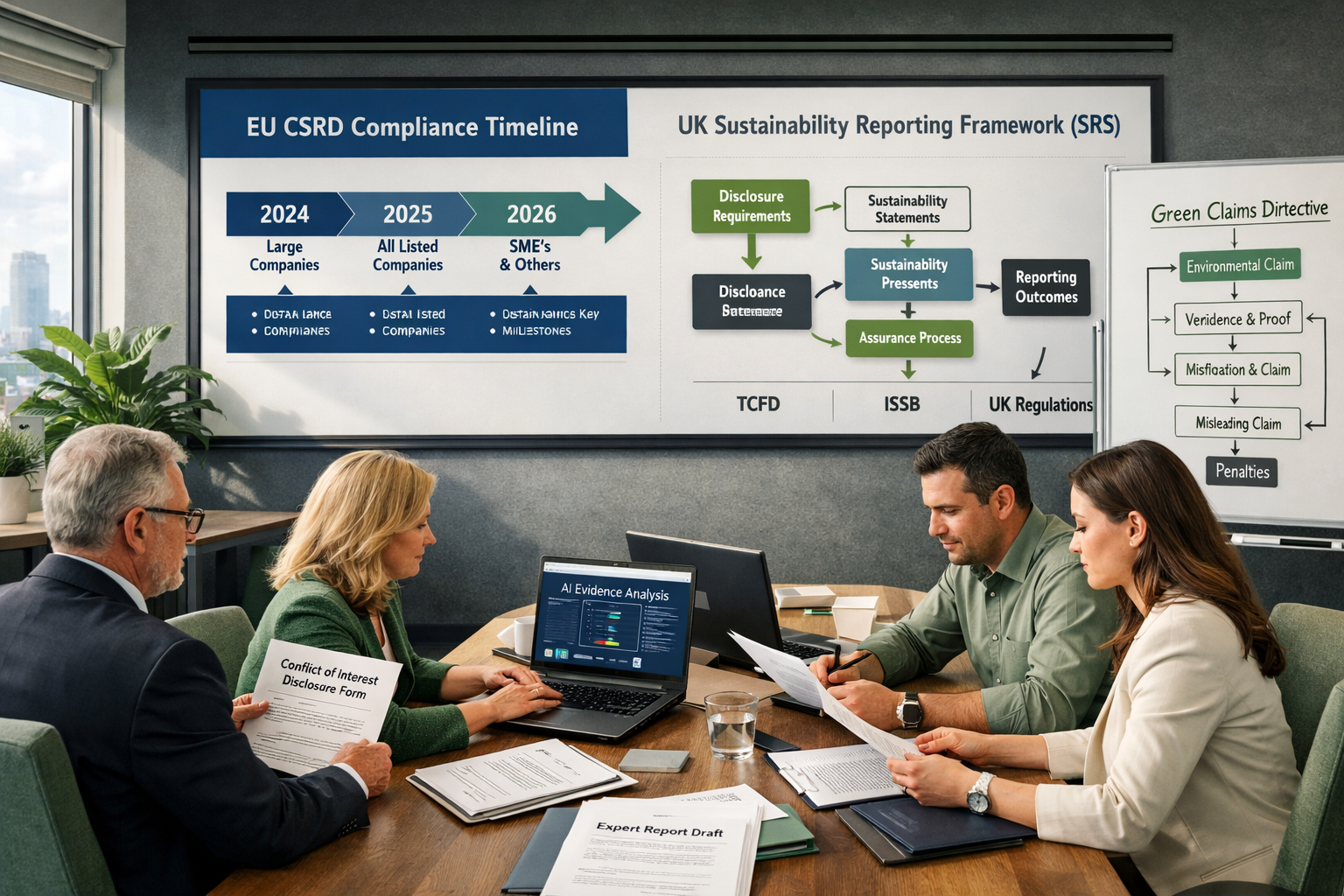
The CSRD enters delivery phase in 2026, with first reports published and assurance expectations rising quickly.[2] Expert witnesses may be called to assess:
- Accuracy and completeness of corporate sustainability disclosures
- Materiality assessments for environmental impacts
- Scenario analysis and resilience planning adequacy
- Governance structures for sustainability oversight
EU Green Claims Directive (Effective September 2026)
The EU Empowering Consumers for the Green Transition Directive bans generic environmental claims and requires substantiation and third-party verification for assertions like "carbon neutral" or "eco-friendly."[2] Expert witnesses must evaluate:
🔍 Claim substantiation – Is there verifiable data supporting environmental assertions?
🔍 Offset legitimacy – Do carbon offset claims meet additionality and permanence standards?
🔍 Comparative accuracy – Are environmental comparisons fair and scientifically valid?
🔍 Verification quality – Has independent third-party assessment been properly conducted?
UK Sustainability Reporting Standards (UK SRS)
The UK transitions toward more robust ESG reporting centered on UK SRS, with expectations for scenario analysis, resilience assessment, and clear governance links.[2] Expert witnesses working on UK disputes must understand these evolving standards and their implications for property valuations and development assessments.
Housing Health and Safety Considerations
RICS members acting as expert witnesses in housing disrepair claims should note Awaab's Law, effective October 2025, alongside the Housing Health and Safety Rating System (HHSRS).[1] These standards create new benchmarks for assessing housing conditions in disputes involving community housing projects and residential property management.
Expert testimony must address how sustainability factors—including ventilation, moisture control, and thermal performance—intersect with health and safety obligations under current law.
Applying RICS 2025 Insights to 2026 Disputes: Practical Implementation
Translating sustainability reporting standards into effective expert witness practice requires systematic approaches to evidence gathering, analysis, and presentation. The convergence of regulatory frameworks in 2026 demands practical strategies for addressing sustainability factors in property disputes.
Evidence Collection and Documentation
Building a Robust Sustainability Evidence Base
Expert witnesses must establish comprehensive documentation protocols that capture sustainability performance data throughout the evidence collection process. This includes:
- Primary data collection – Direct measurement of carbon emissions, energy performance, and resource consumption
- Documentary evidence – Sustainability certifications, compliance reports, and environmental impact assessments
- Comparative benchmarking – Industry standards and peer performance data for context
- Verification records – Third-party audit trails and certification documentation
When conducting building surveys or measured building surveys, expert witnesses should integrate sustainability data collection as standard practice, not as an afterthought when disputes arise.
Addressing the Skills Gap
The 30% skills deficit in embodied carbon assessment represents a significant professional development challenge.[3] Expert witnesses must:
Enhance Technical Competency
- Complete specialized training in carbon calculation methodologies
- Understand lifecycle assessment (LCA) principles and tools
- Master relevant software platforms for sustainability analysis
- Stay current with evolving regulatory requirements
Collaborate with Specialists
For complex sustainability disputes, expert witnesses may need to work alongside:
- Environmental engineers for detailed carbon modeling
- Climate scientists for resilience assessments
- ESG auditors for compliance verification
- Legal specialists in environmental regulation
This collaborative approach strengthens evidence quality while maintaining clear accountability for expert opinions provided.
Structuring Sustainability-Enhanced Expert Reports
Expert witness reports addressing sustainability factors should follow a clear structure that integrates ESG considerations throughout, not as isolated sections. Effective reports include:
Executive Summary with Sustainability Context
Begin with clear statements about how sustainability factors affect the dispute, including materiality assessment and regulatory context relevant to the case.
Methodology Section with ESG Framework
Explicitly describe sustainability assessment methodologies, data sources, calculation standards, and limitations. Transparency about measurement approaches is crucial for credibility.
Analysis Section with Integrated Sustainability Metrics
Rather than treating sustainability as separate from traditional valuation or condition assessment, integrate environmental performance throughout the analysis. For example:
"The property valuation reflects a 12% discount due to inadequate thermal performance and absence of renewable energy systems, consistent with market evidence showing reduced buyer appetite for properties requiring significant sustainability upgrades to meet 2026 regulatory standards."
Conclusions with Sustainability Implications
Clearly articulate how sustainability factors affect ultimate conclusions, including quantified impacts where possible and qualitative assessments where quantification is not feasible.
Managing Green Claims Litigation Risk
Regulators, customers, and courts increasingly scrutinize sustainability claims, with vague or poorly substantiated statements representing material legal and reputational risk.[2] Expert witnesses must apply rigorous standards when evaluating environmental assertions:
The Green Claims Assessment Framework
| Assessment Criterion | Expert Witness Evaluation |
|---|---|
| Specificity | Are claims precise and measurable, or vague and aspirational? |
| Substantiation | Is there verifiable data supporting the claim? |
| Comparability | Are comparative claims fair and scientifically valid? |
| Verification | Has independent third-party assessment occurred? |
| Materiality | Does the claim address significant environmental impacts? |
When disputes involve property development with sustainability marketing claims, expert witnesses must evaluate whether environmental assertions meet the heightened standards imposed by September 2026 regulatory requirements.
Conflict Management in Sustainability Disputes
The enhanced conflict of interest disclosure requirements in the RICS 2025 standard demand proactive conflict management.[1] Best practices include:
✅ Comprehensive conflict screening before accepting appointments
✅ Written disclosure of all potential conflicts to instructing parties
✅ Independence documentation demonstrating freedom from bias
✅ Ongoing monitoring for conflicts emerging during engagement
✅ Withdrawal protocols if unmanageable conflicts arise
For expert witnesses working across multiple sustainability-related matters, maintaining detailed records of prior engagements and positions taken is essential for demonstrating consistency and independence.
Integrating AI and Digital Tools Responsibly
The RICS 2025 standard's provisions for AI use create opportunities for enhanced analysis while requiring careful transparency.[1] When employing AI-assisted tools for sustainability assessment:
Disclosure Requirements
- Identify specific AI tools and algorithms used
- Explain data sources and training datasets
- Acknowledge limitations and potential biases
- Maintain human oversight and professional judgment
Quality Assurance
Expert witnesses remain personally responsible for all evidence presented, regardless of technological assistance. Implement validation protocols that:
- Cross-check AI outputs against manual calculations
- Test sensitivity to input assumptions
- Verify results against industry benchmarks
- Document quality assurance procedures
Case Study Applications
Scenario 1: Party Wall Award with Embodied Carbon Dispute
A party wall dispute involves disagreement over construction methods, with one party claiming the proposed approach has excessive embodied carbon. The expert witness must:
- Calculate embodied carbon for alternative construction methods
- Assess materiality of carbon differences to property values
- Evaluate reasonableness of carbon reduction requests
- Consider regulatory compliance requirements effective in 2026
Scenario 2: Commercial Property Valuation with Green Claims Challenge
A commercial property valuation dispute centers on sustainability certifications claimed by the seller but challenged by the buyer. Expert witness responsibilities include:
- Verifying authenticity and validity of sustainability certifications
- Assessing market impact of environmental performance on value
- Evaluating compliance with EU Green Claims Directive requirements
- Determining appropriate valuation adjustments for sustainability factors
Scenario 3: Development Dispute Involving Climate Resilience
A development dispute involves allegations of inadequate climate resilience planning. The expert witness must:
- Assess climate risk exposure using current scientific projections
- Evaluate adequacy of resilience measures against industry standards
- Determine financial implications of climate vulnerability
- Consider regulatory requirements under UK SRS framework
These scenarios demonstrate how Sustainability Reporting in Expert Witness Work: Applying RICS 2025 Insights to 2026 Disputes requires integration of environmental factors throughout traditional surveying and valuation practice.
Conclusion
The integration of sustainability reporting into expert witness work represents a fundamental shift in professional practice, driven by converging regulatory frameworks and heightened scrutiny of environmental claims in 2026. The RICS 2025 expert witness standard provides essential guidance for navigating this transformation, establishing clear expectations for ESG factor integration, digital evidence use, and enhanced conflict disclosure.
The alarming 46% gap in carbon measurement among construction professionals creates both challenges and opportunities for expert witnesses. Those who develop robust competencies in sustainability assessment, master emerging regulatory frameworks, and implement rigorous evidence collection protocols will provide more credible, defensible testimony in an increasingly complex dispute landscape.
Actionable Next Steps for Expert Witnesses:
- Complete specialized training in carbon calculation methodologies and sustainability assessment frameworks relevant to your practice areas
- Review and update conflict of interest screening procedures to address sustainability-related potential conflicts
- Integrate sustainability data collection into standard survey and valuation protocols, not as separate add-ons
- Establish AI tool disclosure protocols that ensure transparency while leveraging technological capabilities
- Monitor regulatory developments including EU Green Claims Directive implementation and UK SRS evolution
- Build collaborative networks with environmental specialists who can support complex sustainability analyses
- Document methodologies thoroughly, creating clear audit trails for sustainability assessments that withstand cross-examination
The convergence of the EU CSRD, UK SRS, and Green Claims Directive in 2026 creates unprecedented demands on expert witness practice. Surveyors who proactively embrace sustainability reporting standards will not only meet regulatory requirements but also provide superior value to clients navigating increasingly complex property and construction disputes.
For expert witnesses seeking to enhance their sustainability competencies, consider exploring resources on community housing projects and sustainability and staying current with evolving health and safety inspection standards that intersect with environmental performance requirements.
The future of expert witness work lies in seamlessly integrating sustainability considerations throughout professional practice—not as specialized niche expertise, but as fundamental competency expected of all chartered surveyors providing expert evidence in 2026 and beyond.
References
[1] RICS Launches Global Consultation On Updated Expert Witness Standard – rics.org
[2] Ten ESG And Sustainability Trends For 2026 – ricardo.com
[3] Sustainability Report 2025 – rics.org