

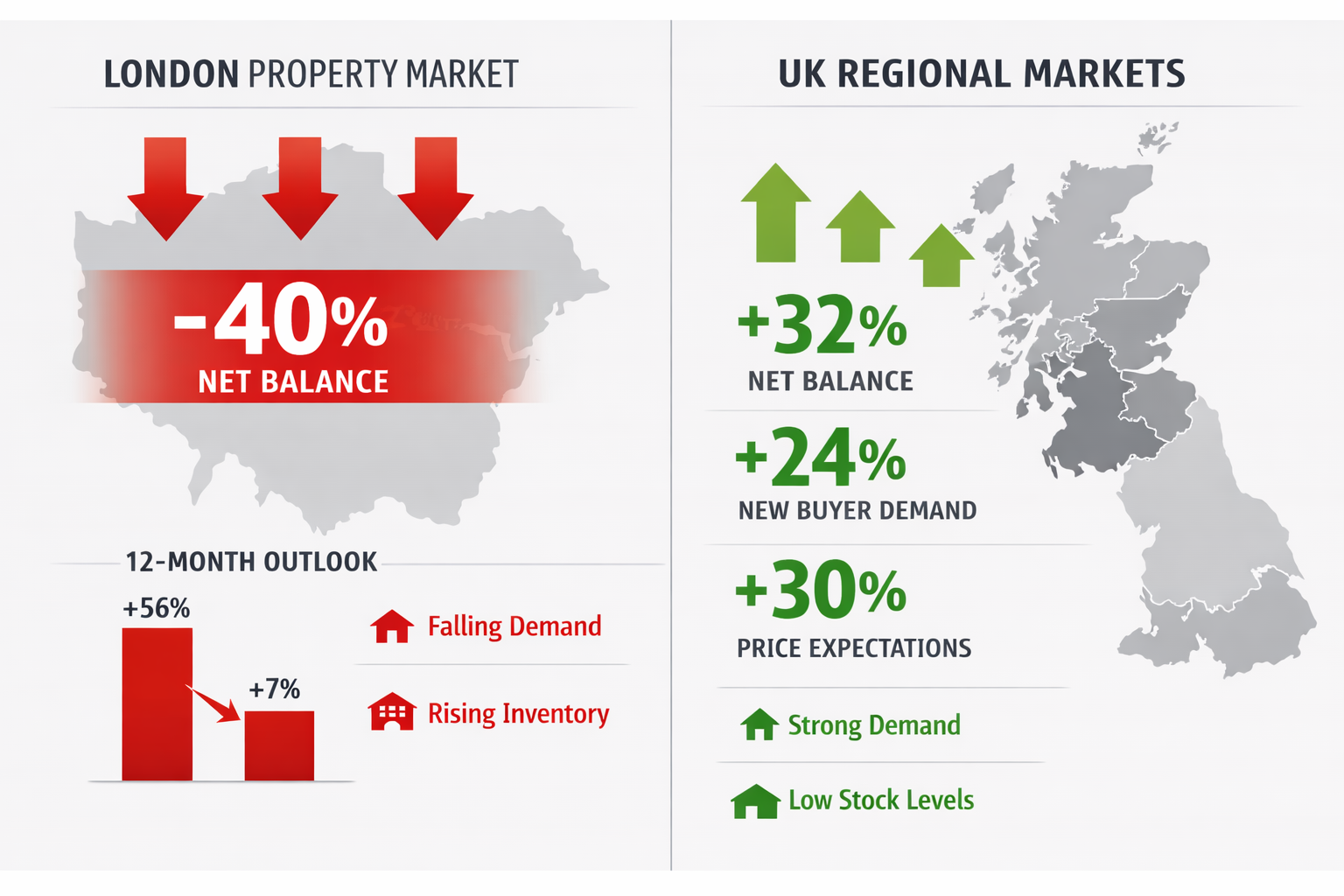
London's property market sentiment has plummeted to a -40% net balance in February 2026, with 40% more chartered surveyors reporting price decreases than increases—a figure that dramatically outpaces pressure in every other UK region.[1] This sharp deterioration in London Price Cooling 2026: Chartered Surveyor Valuation Strategies Amid Sharp Sentiment Drop represents one of the most significant regional divergences in recent memory, forcing professional valuers to recalibrate their methodologies amid unprecedented uncertainty.
The data reveals an even more troubling trend: 12-month price expectations for London collapsed from +56% in January to just +7% by February 2026, while the broader UK market maintained expectations at +33%.[1] This 49-percentage-point swing in confidence within a single month signals not merely a cooling, but a fundamental reassessment of London's property outlook that demands sophisticated valuation responses from chartered surveyors navigating this volatile landscape.

Key Takeaways
- London sentiment crashed to -40% net balance in February 2026, with 12-month expectations plunging from +56% to +7% in just one month—the sharpest regional decline in the UK[1]
- Valuation methodologies require immediate adjustment to account for rapid sentiment shifts, with chartered surveyors emphasizing comparable sales recency and market condition adjustments
- Regional disparities have reached historic levels, with Northern Ireland, Scotland, and the North West showing firm price trends while London, the South East, and East Anglia face substantial downward pressure[1]
- Transaction activity remains subdued with new buyer enquiries at -26% and agreed sales at -12%, creating valuation challenges due to limited comparable evidence[1]
- Professional valuers must balance short-term volatility against maintained positive long-term outlooks, requiring nuanced approaches to property valuations across different instruction types
Understanding the February 2026 London Market Collapse
The Scale of Sentiment Deterioration
The February 2026 RICS Residential Survey data paints a stark picture of London's property market health. The -40% net balance for current price trends means that surveyors across the capital are witnessing widespread downward pressure on valuations.[1] This figure represents the difference between those reporting price increases and those reporting decreases—when 40% more professionals see prices falling than rising, the market signal is unambiguous.
What makes this particularly concerning is the velocity of the sentiment shift. London's 12-month price expectations stood at a robust +56% in January 2026, suggesting surveyors anticipated significant appreciation over the coming year.[1] By February, this optimism had evaporated, leaving expectations at a meager +7%—still technically positive, but barely so. This 49-point collapse in forward-looking confidence occurred against a backdrop of:
- Renewed macroeconomic uncertainty 📉
- Persistent concerns about elevated mortgage rates
- Geopolitical tensions affecting energy prices
- Diverging regional market dynamics[1]
For chartered surveyors in London, this rapid sentiment deterioration creates immediate practical challenges. Valuations conducted in January using comparable sales from late 2025 suddenly appeared optimistic by February standards. The market had shifted beneath surveyors' feet.
Comparative Regional Analysis
London's struggles become even more pronounced when viewed against other UK regions. The South East recorded a -24% net balance, while East Anglia posted -26%—both negative, but substantially better than London's -40%.[1] Meanwhile, Northern Ireland, Scotland, and the North West demonstrated firm price trends, with active transaction volumes and rising house prices creating an entirely different valuation environment.[2]
| Region | Price Balance (Feb 2026) | Market Characteristics |
|---|---|---|
| London | -40% | Sharp cooling, collapsed expectations |
| South East | -24% | Moderate downward pressure |
| East Anglia | -26% | Significant regional weakness |
| Northern Ireland | Positive | Strong momentum, active transactions |
| Scotland | Positive | Firm price trends, buyer confidence |
| North West | Positive | Rising prices, healthy activity |
Source: RICS UK Residential Survey February 2026[1]
This "stark regional disparity" creates a complex landscape for national surveying firms and requires location-specific valuation strategies.[5] A methodology appropriate for chartered surveyors in South West London may need substantial modification for properties in Edinburgh or Manchester, where market fundamentals remain robust.
Transaction Activity and Market Liquidity
The London Price Cooling 2026: Chartered Surveyor Valuation Strategies Amid Sharp Sentiment Drop extends beyond sentiment to actual market activity. New buyer enquiries deteriorated to -26% net balance in February, down from -15% in January, indicating reduced market engagement.[1] When fewer buyers are actively searching, the pool of potential purchasers for any given property shrinks, applying downward pressure on achievable prices.
Agreed sales posted a -12% net balance, with near-term sales expectations at -2%.[1] This subdued transaction environment creates a critical challenge for valuers: limited comparable evidence. When properties aren't selling, establishing accurate market values becomes increasingly difficult. Surveyors must rely on:
- Older comparable sales requiring time adjustments ⏰
- Off-market intelligence from industry networks
- Asking price reductions as proxy indicators
- Cross-regional comparisons with appropriate location adjustments
The supply side showed relative stability, with new instructions at +2% net balance—neither rising nor falling materially.[1] This suggests sellers aren't flooding the market, but neither are they withdrawing properties en masse. The result is a market in uncomfortable equilibrium: sufficient supply meeting insufficient demand at current price levels.
Chartered Surveyor Valuation Methodologies for Cooling Markets
Comparable Sales Analysis in Volatile Conditions
The cornerstone of residential property valuation—comparable sales analysis—requires significant adaptation during the London Price Cooling 2026: Chartered Surveyor Valuation Strategies Amid Sharp Sentiment Drop. Traditional approaches typically consider sales within the previous 3-6 months as reliable comparables. However, when sentiment shifts as dramatically as it did between January and February 2026, even recent sales may not reflect current market conditions.
Professional surveyors are implementing several key adjustments:
- Recency weighting: Prioritizing the most recent transactions (within 4-6 weeks) and applying downward adjustments to older comparables to reflect deteriorating sentiment
- Transaction stage verification: Distinguishing between agreed sales, exchanged contracts, and completed transactions—with greater weight given to more recent agreement dates
- Asking price trend analysis: Monitoring asking price reductions as a leading indicator of vendor expectations adjusting to market realities
- Days-on-market metrics: Incorporating time-to-sale data to assess whether comparable properties sold quickly (suggesting the price was below market) or slowly (suggesting it was at or above market)
For matrimonial valuations and inheritance tax valuations, where accuracy and defensibility are paramount, these methodological refinements become especially critical. HMRC and family courts expect valuations to reflect market conditions at the specific valuation date, not outdated sentiment from months prior.
Market Conditions Adjustments and Sentiment Factors
Beyond individual comparable analysis, professional valuers must apply market conditions adjustments that account for broader sentiment shifts. The RICS Valuation Standards (Red Book) require surveyors to consider "special assumptions" and market context when forming opinions of value.[3]
In the February 2026 London market, this means explicitly acknowledging:
- Directional market movement: The market is cooling, not stable or rising
- Buyer negotiating power: Reduced demand gives purchasers leverage to negotiate below asking prices
- Mortgage availability: Concerns about sustained higher rates affect buyer capacity
- Economic uncertainty: Geopolitical factors and energy price volatility dampen confidence[1]
Practically, this might translate to applying a 2-5% downward adjustment to comparable sales from 3-6 months prior, depending on the specific sub-market and property type. Prime central London properties might experience different adjustment factors than suburban family homes in Putney or Battersea.
Valuation Approaches for Different Instruction Types
The purpose of a valuation significantly influences the appropriate methodology and risk tolerance in the London Price Cooling 2026: Chartered Surveyor Valuation Strategies Amid Sharp Sentiment Drop environment:
Mortgage Lending Valuations 🏦
Lenders require conservative valuations that protect their security interest. In a cooling market, surveyors typically adopt a cautious stance, potentially valuing at or slightly below recent comparable sales to ensure the loan-to-value ratio provides adequate cushion against further price declines.
Purchase Valuations
Buyers commissioning independent valuations want to ensure they're not overpaying. Surveyors can provide valuable context about how to negotiate house prices down after a survey by highlighting the cooling market conditions and comparable evidence supporting lower offers.
Tax-Related Valuations
Capital gains tax valuations and annual tax valuations require objective market value opinions at specific dates. These cannot be artificially conservative or optimistic—they must reflect the actual market conditions prevailing at the valuation date, supported by robust comparable evidence and transparent methodology.
Insurance Reinstatement Valuations
Interestingly, insurance reinstatement cost valuations remain largely insulated from market sentiment shifts, as they reflect building costs rather than market values. However, even here, economic uncertainty affecting construction material prices requires attention.
The Role of Professional Judgment
Despite sophisticated methodologies and data analysis, professional judgment remains central to accurate valuation in volatile markets. The RICS emphasizes that surveyors must exercise skill, diligence, and judgment based on their knowledge and experience.[3]
In the February 2026 London context, this means:
- Recognizing micro-market variations: Not all London neighborhoods are experiencing identical cooling
- Understanding property-specific factors: Unique characteristics may insulate or expose individual properties to market trends
- Balancing short-term volatility against longer-term fundamentals: The +7% 12-month expectation suggests surveyors still anticipate eventual recovery[1]
- Communicating uncertainty transparently: Valuation reports should acknowledge market volatility and the limitations of comparable evidence
Experienced chartered surveyors across London understand that valuation is as much art as science, particularly when market conditions shift rapidly. The February 2026 data demands humility about the precision of any single valuation figure and the importance of clearly explaining the methodology and assumptions underlying each opinion of value.
Strategic Implications for Property Stakeholders

Buyer Opportunities in the Cooling Market
The London Price Cooling 2026: Chartered Surveyor Valuation Strategies Amid Sharp Sentiment Drop creates distinct opportunities for informed buyers. With buyer enquiries down to -26% and agreed sales at -12%, competition for properties has decreased substantially.[1] This shift in market dynamics means:
Enhanced Negotiating Position 💪
Buyers can leverage professional valuation evidence to negotiate more aggressively. When a chartered surveyor's report indicates the market has cooled 5-10% since the property was listed, sellers face objective evidence that their asking price may be outdated. Strategic buyers are commissioning independent valuations before making offers, using the professional opinion as negotiating leverage.
Reduced Bidding Wars
The frenetic multiple-offer scenarios that characterized London's market in previous years have largely evaporated. Properties are spending longer on the market, giving buyers time to conduct thorough due diligence, including comprehensive building surveys that identify defects providing further negotiating grounds.
Access to Better Properties
With fewer active buyers, properties that would have attracted intense competition in stronger market conditions are now accessible to a broader range of purchasers. Well-informed buyers working with experienced surveyors can identify genuine value in a market where seller expectations haven't yet fully adjusted to the new reality.
Seller Considerations and Pricing Strategies
For sellers, the February 2026 market requires realistic pricing from the outset. Properties listed at inflated prices simply aren't attracting viewings, let alone offers. The data shows that surveyors across London are witnessing downward price pressure—sellers who ignore this reality risk their properties becoming "stale" listings that languish unsold.[1]
Effective seller strategies include:
- Commissioning a pre-sale valuation: Understanding the realistic market value before listing prevents overpricing and the subsequent need for embarrassing price reductions
- Pricing competitively from day one: Properties priced at or slightly below valuation generate immediate interest and can still achieve good prices through negotiation
- Highlighting value-adds: In a buyer's market, emphasizing recent improvements, energy efficiency, or unique features becomes more important
- Being prepared to negotiate: The days of receiving asking price or above are temporarily over for most London properties
Sellers should also consider the opportunity cost of waiting. While some may hope to "wait out" the cooling period, the -40% net balance suggests this isn't a brief blip but a sustained market adjustment.[1] Properties held off-market continue to incur holding costs while values potentially decline further.
Lender Risk Management and Valuation Instructions
Mortgage lenders are responding to the London Price Cooling 2026: Chartered Surveyor Valuation Strategies Amid Sharp Sentiment Drop by tightening valuation requirements and scrutinizing surveyor opinions more carefully. The dramatic shift in sentiment raises concerns about loan security, particularly for high loan-to-value mortgages.
Lenders are increasingly:
- Requiring more detailed comparable evidence in valuation reports
- Questioning valuations that appear optimistic relative to recent sales
- Applying additional scrutiny to properties in areas showing the steepest declines
- Reducing maximum LTV ratios for London properties to maintain adequate security margins
For surveyors conducting mortgage valuations, this means more conservative approaches are not only prudent but expected. A valuation that proves optimistic by 5-10% within months of completion creates professional liability risk and damages the surveyor's reputation with lender clients.
Commercial Property and Investment Considerations
While residential property dominates the February 2026 headlines, commercial property valuations face related challenges. London's commercial market often correlates with residential sentiment, as both reflect underlying economic confidence and activity levels.
Investment property owners must consider:
- Rental market dynamics: Interestingly, the lettings market shows different characteristics, with landlord instruction shortages at -27% while tenant demand remains at +2%[1]
- Yield implications: As property values potentially decline while rents remain stable or increase, gross yields improve for new investors
- Portfolio rebalancing: The stark regional disparities suggest opportunities to shift investment focus toward stronger regional markets
The lettings data reveals an important nuance: 20% of surveyors expect rent increases over the coming three months, despite the sales market cooling.[1] This divergence between sales and rental markets creates interesting opportunities for buy-to-let investors who can acquire properties at reduced prices while benefiting from stable or rising rental income.
Future Outlook and Professional Adaptation
Interpreting the +7% Long-Term Expectation
Despite the dramatic short-term cooling, London surveyors maintain a +7% 12-month price expectation—still positive, albeit barely.[1] This suggests professional valuers believe the current downturn represents a correction rather than the beginning of a sustained crash. Several factors support this cautiously optimistic long-term view:
Fundamental Supply Constraints 🏗️
London's chronic housing shortage hasn't disappeared. With new instructions at only +2%, the supply pipeline remains constrained.[1] Once buyer confidence returns and mortgage rates stabilize, this supply-demand imbalance should support price recovery.
Economic Resilience
Despite geopolitical uncertainty and energy price concerns, the UK economy has demonstrated resilience. Employment remains relatively strong, and wage growth continues, providing fundamental support for housing demand.
Historical Pattern Recognition
Experienced surveyors have witnessed previous market corrections that proved temporary. The 2008-2009 financial crisis, the 2016 Brexit referendum uncertainty, and the 2020 pandemic all created short-term disruptions followed by recovery. The +7% expectation suggests professionals view February 2026 through this historical lens.
However, the 49-point collapse in expectations within a single month demonstrates how quickly sentiment can shift.[1] Surveyors must remain vigilant and prepared to adjust their long-term outlook if conditions deteriorate further or if positive catalysts emerge that accelerate recovery.
Adapting Professional Practice for Volatility
The London Price Cooling 2026: Chartered Surveyor Valuation Strategies Amid Sharp Sentiment Drop demands professional adaptation across multiple dimensions:
Enhanced Market Intelligence Systems 📊
Surveyors are investing in more sophisticated market monitoring, including:
- Real-time transaction tracking databases
- Sentiment analysis from multiple sources
- Micro-market heat mapping
- Predictive analytics incorporating economic indicators
Transparent Communication
Valuation reports increasingly include detailed market context sections explaining the volatile conditions, the limitations of comparable evidence, and the assumptions underlying the valuation opinion. This transparency protects both clients and surveyors by ensuring all parties understand the uncertainty inherent in the current market.
Continuing Professional Development
The RICS and other professional bodies are emphasizing training in valuation during volatile market conditions, helping surveyors refine their methodologies and judgment in challenging environments.
Client Education
Professional surveyors are taking time to educate clients about market realities, helping buyers understand negotiating opportunities and sellers recognize the need for realistic pricing. This advisory role extends beyond simply providing a valuation figure to offering strategic guidance.
Regional Diversification and Expertise
The stark contrast between London's -40% net balance and the positive trends in Northern Ireland, Scotland, and the North West highlights the importance of regional expertise and diversification.[1][2] Surveying firms with national coverage are leveraging their regional knowledge to provide clients with comparative context and investment opportunities.
For example, a client considering property investment might benefit from understanding that while London faces headwinds, other UK regions offer stronger fundamentals. Similarly, surveyors valuing portfolios across multiple regions must apply location-specific methodologies rather than uniform national approaches.
This regional divergence also creates opportunities for surveyors to specialize in specific geographic markets, developing deep local knowledge that enables more accurate valuations and better client advice. Firms operating in Watford, Essex, or Berkshire may find their markets behaving differently than central London, requiring tailored approaches.
Technology Integration in Valuation Practice
Modern surveying increasingly incorporates technology solutions that enhance accuracy and efficiency, particularly valuable during volatile market conditions:
- Automated Valuation Models (AVMs): While not replacing professional judgment, AVMs provide useful data points and trend analysis
- Geographic Information Systems (GIS): Mapping tools help identify micro-market variations and comparable property locations
- Drone surveys: Premium drone surveys enable comprehensive property assessment without physical access challenges
- Digital reporting platforms: Cloud-based systems facilitate faster report delivery and easier comparable evidence documentation
However, technology remains a tool to support, not replace, professional expertise. The nuanced judgment required to interpret the February 2026 market conditions and apply appropriate adjustments cannot be fully automated. The most effective surveying practices combine technological efficiency with human expertise and local market knowledge.
Conclusion
The London Price Cooling 2026: Chartered Surveyor Valuation Strategies Amid Sharp Sentiment Drop represents one of the most significant regional market adjustments in recent UK property history. With sentiment crashing to -40% net balance and 12-month expectations plummeting from +56% to +7% in a single month, chartered surveyors face unprecedented challenges in delivering accurate, defensible valuations.[1]
Key conclusions for property stakeholders:
✅ For Buyers: The cooling market creates genuine opportunities for those who act strategically, commission professional valuations, and negotiate confidently based on objective evidence
✅ For Sellers: Realistic pricing informed by current market conditions is essential—overpricing leads to extended marketing periods and potentially lower ultimate sale prices
✅ For Surveyors: Methodological rigor, transparent communication, and professional judgment are more important than ever when comparable evidence is limited and market direction uncertain
✅ For Investors: The divergence between London's cooling sales market and its stable lettings market, combined with strong regional markets elsewhere in the UK, creates selective opportunities
The maintained positive long-term expectation of +7%, despite severe short-term pressure, suggests professional surveyors view this as a correction rather than a collapse.[1] However, the velocity of sentiment deterioration demands vigilance and flexibility as conditions continue to evolve throughout 2026.
Actionable Next Steps
If you're buying property in London:
- Commission an independent professional valuation before making offers
- Use objective market evidence to negotiate confidently
- Consider comprehensive building surveys to identify additional negotiating points
- Act decisively when you find the right property—good value won't last forever
If you're selling property in London:
- Obtain a realistic pre-sale valuation from an experienced chartered surveyor
- Price competitively from the outset to generate immediate interest
- Be prepared to negotiate and demonstrate flexibility
- Consider the opportunity cost of waiting for market conditions to improve
If you require specialist valuations:
Whether for matrimonial purposes, inheritance tax, capital gains, or other purposes, ensure your surveyor demonstrates clear understanding of current market conditions and applies appropriate methodologies for the volatile 2026 environment.
The London property market has entered a challenging phase, but with professional guidance, transparent information, and realistic expectations, stakeholders can navigate these conditions successfully and position themselves for the eventual recovery that experienced surveyors continue to anticipate.
References
[1] Uk Residential Survey February 2026 – https://www.rics.org/news-insights/uk-residential-survey-february-2026
[2] Watch – https://www.youtube.com/watch?v=U8d5WC6Q0ng
[3] Valuation Adjustments For Londons February 2026 Price Slump Rics Techniques For 40 Net Balances – https://nottinghillsurveyors.com/blog/valuation-adjustments-for-londons-february-2026-price-slump-rics-techniques-for-40-net-balances
[4] Building Surveys In A Cooling Then Recovering Market How 2026 Price Stability Changes What Buyers Should Prioritise – https://nottinghillsurveyors.com/blog/building-surveys-in-a-cooling-then-recovering-market-how-2026-price-stability-changes-what-buyers-should-prioritise
[5] Building Survey Market Sentiment In Early 2026 Navigating Regional Price Divergence And Buyer Uncertainty – https://nottinghillsurveyors.com/blog/building-survey-market-sentiment-in-early-2026-navigating-regional-price-divergence-and-buyer-uncertainty