

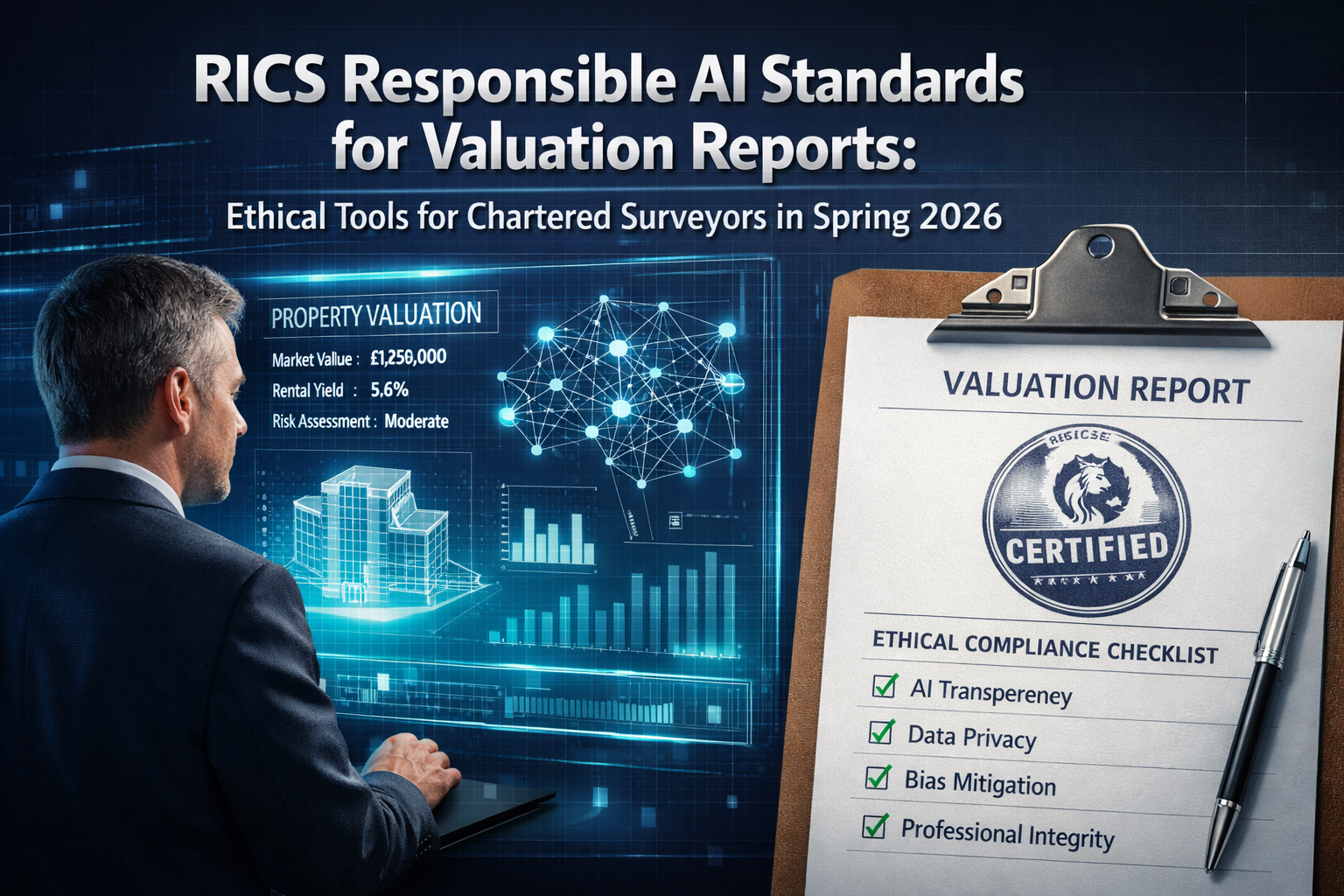
Chartered surveyors across the UK face a watershed moment: as of March 9, 2026, artificial intelligence tools integrated into valuation reports must comply with the world's first mandatory professional standard governing AI use in surveying practice[1][2]. This isn't voluntary guidance—it's a binding requirement that fundamentally reshapes how commercial valuations and property assessments are conducted, documented, and defended.
The RICS Responsible AI Standards for Valuation Reports: Ethical Tools for Chartered Surveyors in Spring 2026 represents more than regulatory compliance. It establishes the framework through which professional judgment, client transparency, and technological innovation coexist—particularly critical when valuation accuracy determines party wall settlements, expert witness testimony, and insurance reinstatement cost valuations worth millions.
Key Takeaways
- Mandatory compliance begins March 9, 2026 for all RICS members and regulated firms globally, establishing binding requirements rather than optional guidance[1][2]
- Four foundational pillars structure the standard: Governance & Risk Management, Professional Judgement & Oversight, Transparency & Client Communication, and Responsible AI Development[2]
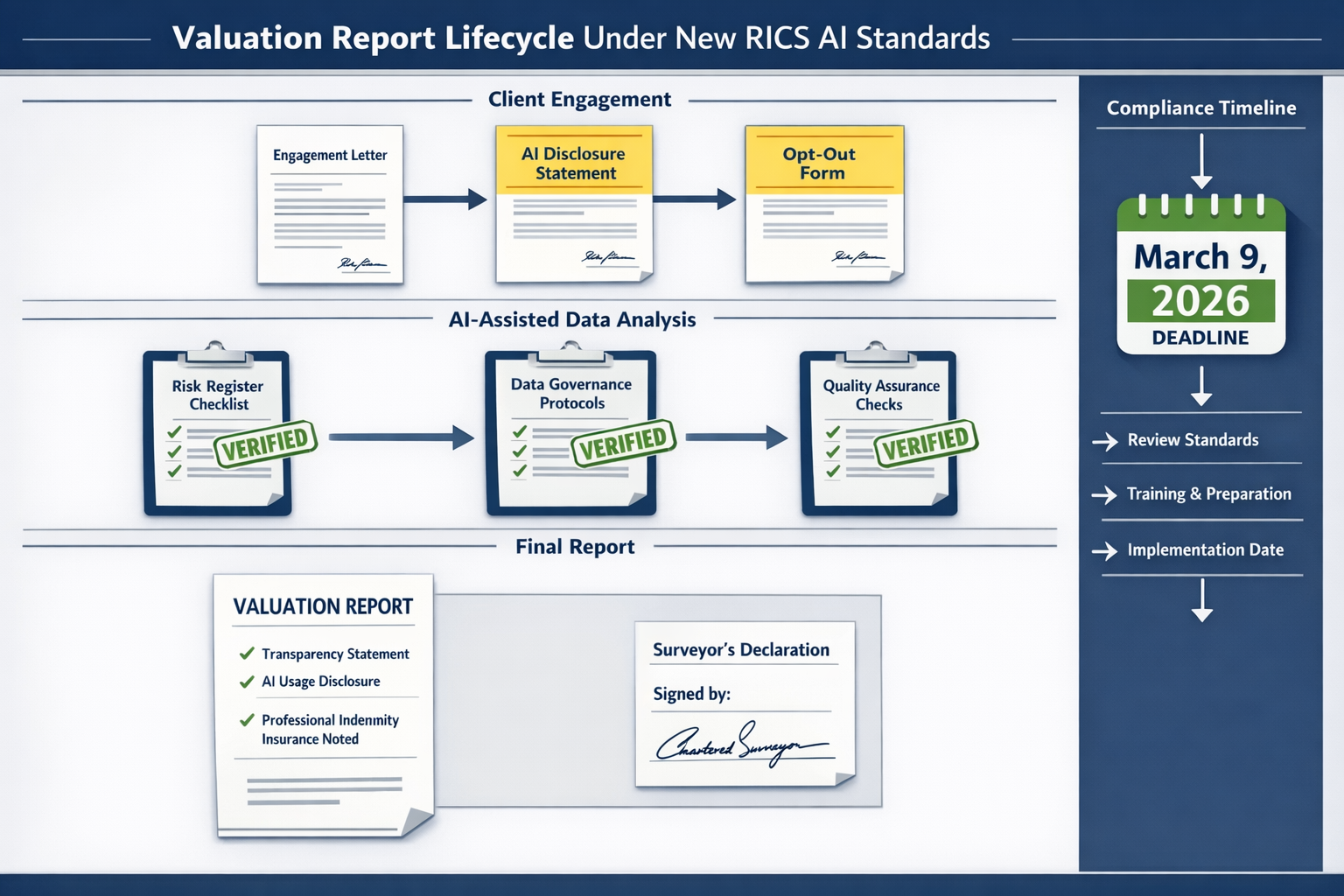
- Written client disclosure becomes mandatory—surveyors must inform clients in writing when and how AI tools influence valuation reports, with explicit opt-out provisions[1][3]
- Professional accountability remains non-transferable—AI assists practice but never replaces the surveyor's ultimate responsibility for professional advice[2]
- Terms of engagement require immediate updates to specify AI usage scope, insurance coverage, quality assurance processes, and redress mechanisms[3]
Understanding the RICS Responsible AI Standards for Valuation Reports: Ethical Tools for Chartered Surveyors in Spring 2026
The Royal Institution of Chartered Surveyors has established the first global professional standard governing artificial intelligence integration across valuation, construction, infrastructure, and land services sectors[1]. This landmark regulation affects every RICS member and regulated firm worldwide, fundamentally altering how technology intersects with professional practice.
What Makes This Standard Mandatory, Not Advisory
Unlike previous RICS guidance documents, the Responsible AI Standards carry binding force. Non-compliance potentially affects eligibility for major projects and professional standing[1][4]. This distinction matters profoundly for firms conducting valuations that inform lending decisions, litigation settlements, or statutory requirements.
The standard applies across multiple surveying contexts:
- Residential and commercial property valuations
- Party wall assessments and expert witness reports
- Insurance reinstatement cost calculations
- Construction project feasibility studies
- Infrastructure asset management
- Land registry and boundary determinations
RICS Acting President Elect Maureen Ehrenberg emphasized that the standard ensures "surveyors remain at the forefront of innovation while protecting clients, data, and public trust"[1][3]. This balance between technological advancement and professional integrity defines the standard's core philosophy.
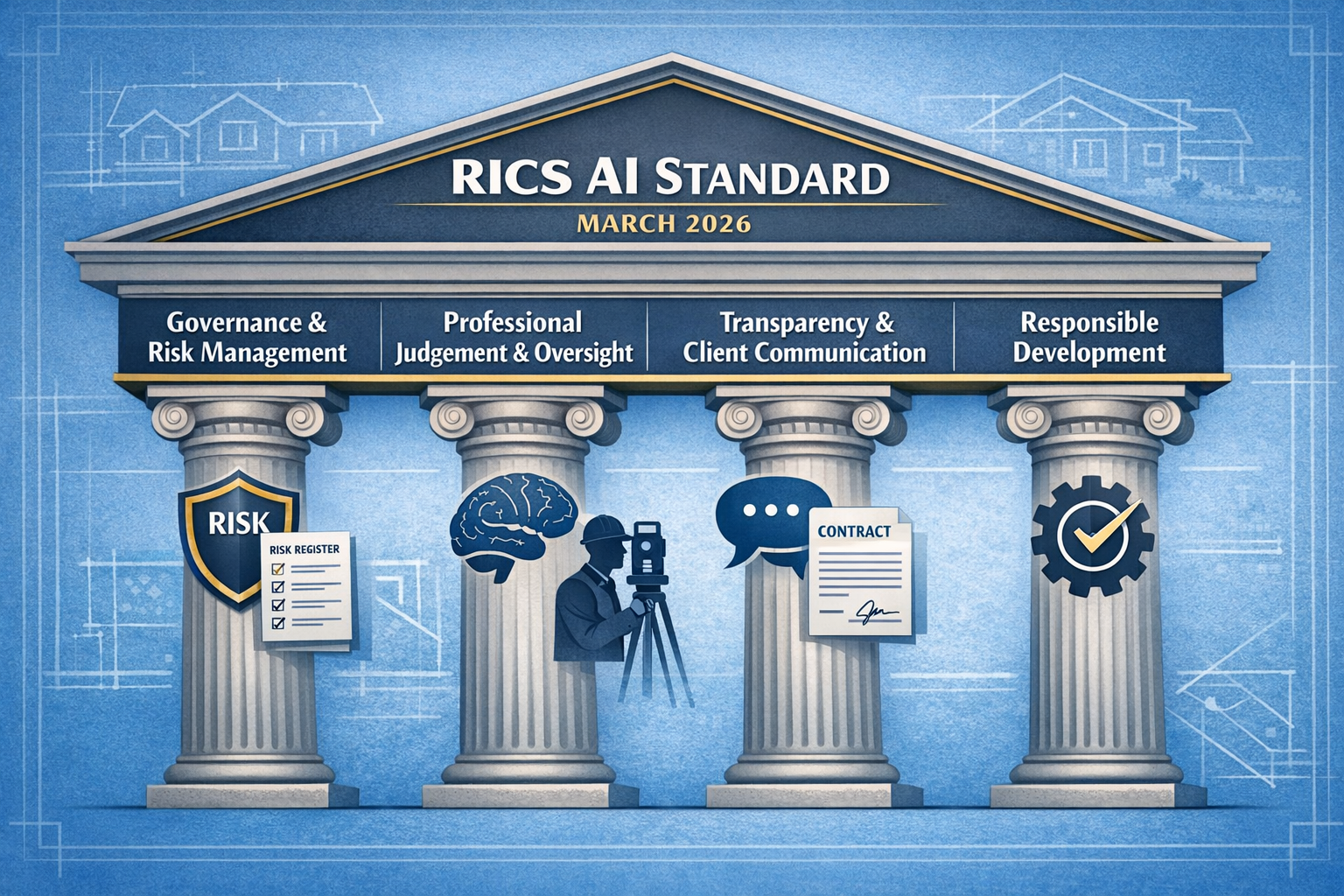
The Four Foundational Pillars of RICS Responsible AI Standards for Valuation Reports
The standard organizes requirements into four interconnected pillars that structure both compliance obligations and best practice expectations[2].
Pillar 1: Governance & Risk Management 🛡️
Firms must implement comprehensive governance frameworks before deploying AI systems in professional practice. This pillar mandates:
Risk Register Requirements:
- Documented assessment of each AI system's capabilities and limitations
- Identification of potential failure modes specific to valuation contexts
- Regular review cycles with dated entries and responsible parties
- Integration with existing professional indemnity insurance protocols
Due Diligence Procedures:
- Vendor assessment protocols examining algorithm training data sources
- Validation testing against known valuation scenarios
- Documentation of system selection rationale
- Ongoing monitoring of AI system performance metrics
The governance pillar recognizes that AI systems deployed in party wall assessments carry different risk profiles than those used in preliminary desktop valuations. A system that adequately estimates market values for standard residential properties may prove unsuitable for specialized assets like listed buildings or properties with complex structural issues.
Pillar 2: Professional Judgement & Oversight 🧠
This pillar embeds the principle that "AI assists professional practice; it does not replace it"[2]. Surveyors remain fully accountable for all professional advice regardless of technological tools employed.
Professional Scepticism Mandate:
The standard requires RICS members to assess AI output reliability using their knowledge, skills, experience, and professional scepticism—terminology already established in valuation standards like the Red Book[3]. This means:
- Questioning AI-generated valuations that deviate from local market knowledge
- Verifying comparable property selections against professional judgment
- Identifying when AI systems extrapolate beyond their training data
- Documenting instances where professional override supersedes algorithmic recommendations
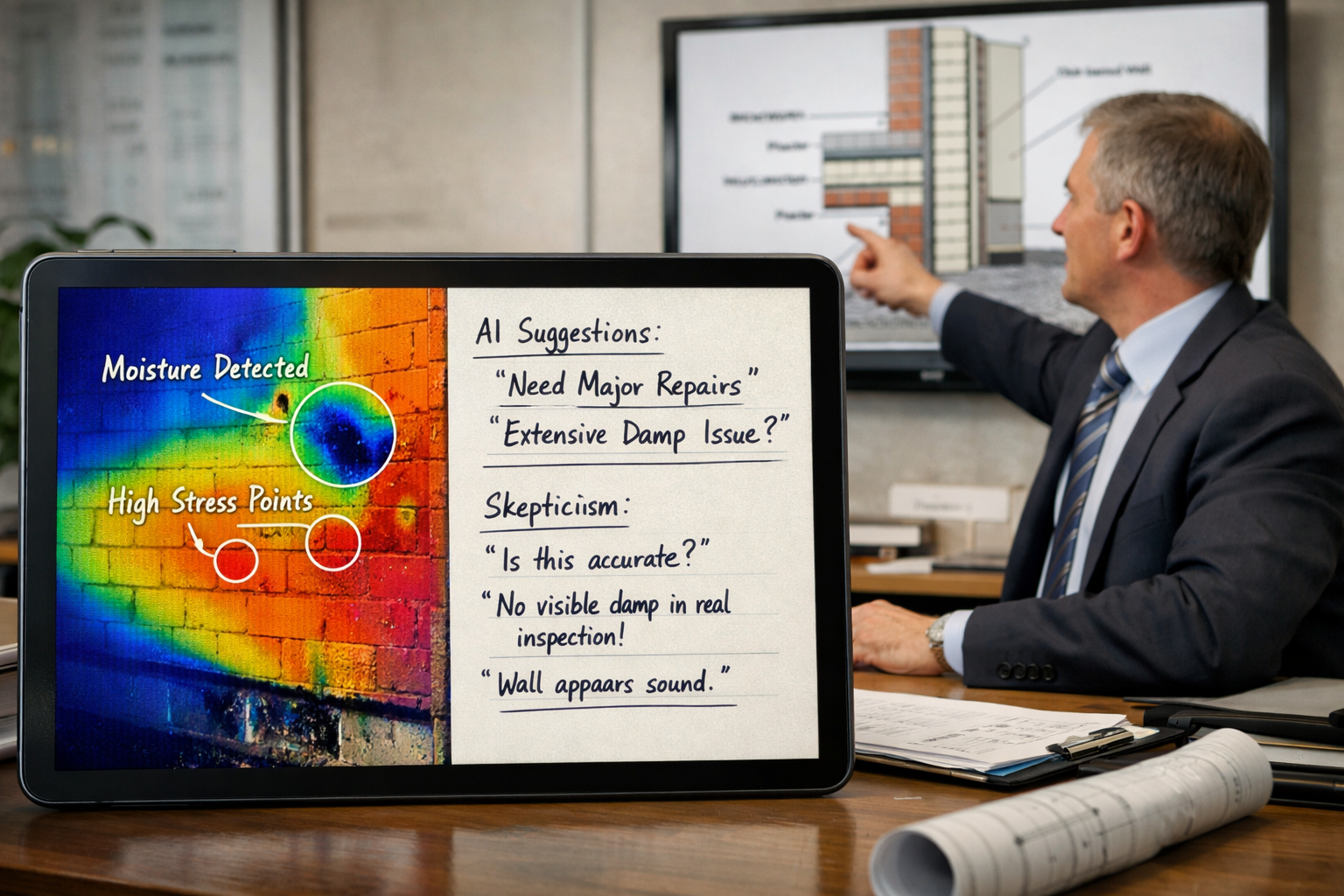
Case Study: Party Wall Assessment Accuracy
Consider a party wall surveyor using AI-powered structural analysis software to assess potential damage risks from proposed excavation works. The AI system processes soil composition data, foundation depths, and historical subsidence records to generate risk scores.
Under the new standard, the surveyor cannot simply accept the AI output. They must:
- Physically inspect the party wall structure
- Verify soil data against site-specific conditions
- Apply professional judgment regarding construction methodology impacts
- Document any discrepancies between AI recommendations and professional assessment
- Take ultimate responsibility for advice provided to both property owners
This layered approach maintains professional accountability while leveraging AI's data processing capabilities.
Pillar 3: Transparency & Client Communication 📋
The transparency pillar introduces mandatory written disclosure requirements that fundamentally change client engagement processes.
Terms of Engagement Updates:
All regulated firms adopting AI must revise client agreements to specify[3]:
| Required Element | Documentation Requirement |
|---|---|
| AI Usage Scope | Specific description of which valuation tasks involve AI assistance |
| Insurance Coverage | Confirmation that professional indemnity insurance covers AI-assisted work |
| Quality Assurance | Internal review processes ensuring AI output accuracy |
| Redress Mechanisms | Procedures for addressing AI-related errors or disputes |
| Opt-Out Options | Client's right to request traditional non-AI valuation methods |
This transparency extends beyond initial engagement. Valuation reports themselves must disclose AI involvement, creating an audit trail that proves invaluable in expert witness scenarios.
Expert Witness Implications:
When chartered surveyors provide expert witness testimony in property disputes, courts increasingly scrutinize methodology. The RICS standard strengthens expert credibility by:
- Demonstrating systematic quality assurance processes
- Providing clear documentation of professional oversight
- Establishing that AI served as a tool rather than decision-maker
- Creating defensible records of how conclusions were reached
For firms conducting commercial valuations that may later face legal challenge, this documented transparency proves essential.
Pillar 4: Responsible Development of AI 🔧
The fourth pillar addresses how AI systems are developed, trained, and validated for surveying applications. While this pillar primarily targets technology vendors and firms developing proprietary AI tools, it establishes expectations that all surveyors should understand when evaluating AI systems.
Key Development Principles:
- Training data representativeness: AI systems must be trained on datasets that reflect the diversity of properties and market conditions they'll encounter in practice
- Bias identification and mitigation: Developers must actively test for and address algorithmic biases that could systematically over- or under-value certain property types
- Explainability requirements: AI systems should provide reasoning for their outputs rather than functioning as "black boxes"
- Version control and documentation: Clear records of system updates, algorithm changes, and performance benchmarks
Implementing RICS Responsible AI Standards for Valuation Reports in Practice
Compliance requires systematic changes across firm operations, from initial AI system selection through ongoing quality assurance.
Step 1: Conduct AI System Audit
Firms must inventory all AI tools currently used in valuation practice, including:
- Automated valuation models (AVMs)
- Comparable property selection algorithms
- Property condition assessment software
- Market trend analysis tools
- Risk assessment calculators
For each system, document:
- ✅ Vendor information and system specifications
- ✅ Training data sources and update frequency
- ✅ Validation testing results
- ✅ Current usage contexts and limitations
- ✅ Integration points with professional judgment
Step 2: Develop Risk Registers
Create comprehensive risk registers that identify potential failure modes specific to your practice areas. For insurance reinstatement cost valuations, relevant risks might include:
- AI underestimating specialist construction costs for heritage features
- Algorithmic failure to account for regional material price variations
- System inability to assess non-standard construction methods
- Data staleness in rapidly changing material markets
Each identified risk requires documented mitigation strategies and monitoring procedures.
Step 3: Update Terms of Engagement
Revise client engagement letters to incorporate mandatory transparency disclosures. Sample language might include:
"In conducting this valuation, we may utilize AI-assisted tools for comparable property analysis and market trend assessment. All AI outputs are subject to professional review and verification by our qualified chartered surveyors. Our professional indemnity insurance covers AI-assisted work. You have the right to request a traditional valuation methodology without AI assistance."
Step 4: Establish Quality Assurance Protocols
Implement systematic review processes ensuring AI outputs receive appropriate professional scrutiny. Effective protocols include:
Threshold-Based Review:
- Automatic senior surveyor review when AI valuations deviate more than 10% from initial professional estimates
- Mandatory site visits for properties where AI confidence scores fall below established thresholds
- Secondary valuation methods for high-value or complex properties
Documentation Standards:
- Written explanations when professional judgment overrides AI recommendations
- Explicit statements of assumptions embedded in AI analysis
- Recorded concerns about AI output reliability in specific cases
Step 5: Train Staff on Professional Scepticism
The standard's emphasis on professional scepticism requires cultural change within firms. Training programs should develop surveyors' ability to:
- Recognize when AI systems operate outside their validated parameters
- Identify implausible comparable property selections
- Question valuations that conflict with local market knowledge
- Document reasoning when accepting or rejecting AI recommendations
Case Studies: Responsible AI Use in Specialized Valuation Contexts
Case Study 1: Party Wall Valuation Accuracy
A chartered surveyor in Battersea receives instructions to assess potential diminution in value to a Victorian terrace property due to proposed basement excavation in the adjoining property. The surveyor uses AI-powered structural analysis software to model foundation stress and settlement risk.
AI System Output:
The software generates a 15% diminution estimate based on comparable party wall dispute settlements and structural modeling.
Professional Scepticism Application:
The surveyor notes that:
- The property has existing underpinning from previous works (not reflected in AI training data)
- Local soil conditions differ from AI model assumptions
- The proposed construction methodology includes protective measures the AI didn't account for
Compliant Approach:
The surveyor documents AI analysis as supporting evidence but conducts independent structural assessment, consults historical records, and applies professional judgment to conclude a 7% diminution is more appropriate. The valuation report explicitly states:
"AI-assisted structural modeling was utilized as one input in this assessment. However, the final valuation conclusion reflects professional judgment considering site-specific factors including existing underpinning, verified soil conditions, and proposed construction methodology. The responsible chartered surveyor has personally inspected the property and takes full professional responsibility for this valuation."
Case Study 2: Expert Witness Testimony in Commercial Dispute
A chartered surveyor provides expert witness testimony in a commercial lease dilapidations dispute. The surveyor used AI tools to estimate repair costs for a commercial property in Hammersmith.
Challenge from Opposing Counsel:
The opposing expert questions the reliability of AI-generated cost estimates, suggesting algorithmic bias systematically inflates repair valuations.
RICS Standard Compliance Strengthens Position:
The surveyor demonstrates:
- Comprehensive risk register documenting AI system validation testing
- Written quality assurance protocols showing professional review of all AI outputs
- Documented instances where professional judgment overrode AI recommendations
- Clear audit trail of how AI served as analytical tool rather than decision-maker
- Client disclosure confirming transparency about AI usage
The court finds the evidence credible specifically because the RICS standard compliance demonstrates systematic professional oversight rather than uncritical reliance on technology.
Industry Impact: How RICS Responsible AI Standards for Valuation Reports Transform Surveying Practice
The March 2026 implementation deadline creates immediate operational requirements across the surveying profession.
Impact on Firm Operations
Small Practices:
Smaller firms may initially view compliance as burdensome, but the standard provides competitive advantage by:
- Demonstrating professional rigor to clients and lenders
- Creating defensible documentation for professional indemnity claims
- Establishing quality assurance systems that improve overall practice standards
Large Multi-Disciplinary Firms:
Larger organizations face complexity coordinating AI governance across multiple practice areas. Benefits include:
- Standardized approaches to technology adoption
- Enhanced risk management frameworks
- Improved client confidence in technology-enabled service delivery
Impact on Professional Development
The standard necessitates competency development in AI literacy. Surveyors must now understand:
- How machine learning algorithms function at conceptual level
- What training data means for AI system reliability
- How to identify algorithmic bias in valuation contexts
- When AI systems operate beyond validated parameters
Professional development programs, including those for open roles in surveying firms, increasingly incorporate AI literacy alongside traditional technical skills.
Impact on Client Relationships
Transparency requirements fundamentally change client communication. Sophisticated clients increasingly ask:
- "What AI systems do you use in valuations?"
- "How do you ensure AI outputs are accurate?"
- "What happens if AI makes an error?"
- "Can I opt out of AI-assisted valuation?"
Surveyors who proactively address these questions build trust and differentiate their services. The RICS standard provides the framework for confident, transparent responses.
Preparing for Compliance: Practical Steps Before March 2026
Immediate Actions (Before March 9, 2026)
Week 1-2: Assessment Phase
- ✅ Inventory all AI tools currently used in practice
- ✅ Review existing terms of engagement for compliance gaps
- ✅ Assess current professional indemnity insurance coverage for AI-assisted work
Week 3-4: Policy Development
- ✅ Draft AI governance policy aligned with four pillars
- ✅ Create risk register templates for different valuation types
- ✅ Develop client disclosure language for terms of engagement
Week 5-6: Implementation
- ✅ Update all standard engagement letter templates
- ✅ Establish quality assurance protocols for AI output review
- ✅ Schedule staff training on professional scepticism requirements
Week 7-8: Testing & Refinement
- ✅ Pilot new procedures on sample valuation projects
- ✅ Gather staff feedback on workflow integration
- ✅ Refine documentation templates based on practical experience
Long-Term Compliance Maintenance
Compliance isn't a one-time achievement but an ongoing commitment requiring:
Quarterly Reviews:
- Update risk registers based on new AI system deployments
- Review AI system performance metrics against established benchmarks
- Assess any client feedback or concerns about AI usage
Annual Assessments:
- Comprehensive audit of AI governance framework effectiveness
- Staff competency evaluation in AI literacy and professional scepticism
- Terms of engagement review ensuring continued compliance
Continuous Improvement:
- Monitor RICS guidance updates and industry best practices
- Participate in professional forums discussing AI implementation challenges
- Share lessons learned within firm and broader professional community
The Future of Valuation Practice Under RICS AI Standards
The RICS Responsible AI Standards for Valuation Reports: Ethical Tools for Chartered Surveyors in Spring 2026 represents the beginning of a transformation, not its conclusion.
Emerging Trends
Increased AI Sophistication:
As AI systems become more capable, the professional judgment pillar becomes increasingly critical. Surveyors must develop deeper technical literacy to effectively oversee more complex algorithmic processes.
Regulatory Alignment:
Other professional bodies globally are watching the RICS standard closely. Expect similar requirements to emerge in other jurisdictions, potentially creating international consistency in AI governance for property professionals.
Client Expectations Evolution:
As AI transparency becomes standard practice, clients will increasingly expect detailed explanations of how technology influences professional advice. This transparency ultimately strengthens professional relationships.
Integration with Other Standards:
The AI standard complements existing RICS requirements including Red Book valuation standards and professional conduct obligations. Future updates will likely create tighter integration across the professional standards framework.
Conclusion
The RICS Responsible AI Standards for Valuation Reports: Ethical Tools for Chartered Surveyors in Spring 2026 establishes a comprehensive framework balancing technological innovation with professional accountability. By mandating governance structures, professional oversight, client transparency, and responsible AI development, the standard protects clients, maintains public trust, and positions chartered surveyors as leaders in ethical technology adoption.
Compliance requires immediate action across firm operations—from updating terms of engagement to establishing risk registers and quality assurance protocols. However, the investment yields substantial returns: enhanced professional credibility, defensible expert witness testimony, stronger client relationships, and competitive differentiation in an increasingly technology-enabled marketplace.
The fundamental principle remains unchanged: AI assists professional practice; it does not replace it[2]. Chartered surveyors retain ultimate responsibility for professional advice, with technology serving as a powerful tool amplifying human expertise rather than substituting for it.
Next Steps for Your Practice
- Conduct an immediate AI system audit inventorying all technology tools used in valuation practice
- Review and update terms of engagement to incorporate mandatory transparency disclosures before March 9, 2026
- Develop comprehensive risk registers specific to your practice areas and AI systems
- Implement quality assurance protocols ensuring professional review of all AI outputs
- Schedule staff training on professional scepticism and AI literacy requirements
- Establish ongoing compliance monitoring through quarterly reviews and annual assessments
For firms seeking guidance on implementing these standards across valuation services, professional support ensures compliance while maintaining service quality and client confidence.
The March 2026 deadline approaches rapidly. Firms that proactively embrace the RICS Responsible AI Standards position themselves as trusted advisors navigating the intersection of professional expertise and technological innovation—exactly where the future of chartered surveying practice resides.
References
[1] Rics Launches Landmark Global Standard On Responsible Use Of Ai In Surveying – rics.org
[2] Rics First Ever Standard On Responsible Ai Use Now In Effect – rics.org
[3] pbctoday.co.uk – pbctoday.co.uk
[4] Rics Sets Ai Rules Construction S Revolutionary March Deadline – projectflux.ai