

The UK government confirmed on 28 January 2026 that the Decent Homes Standard will extend to private rentals, creating unprecedented compliance obligations for an estimated 4.6 million privately rented properties across England.[1] This regulatory shift transforms building surveyor responsibilities and exposes landlords to maximum fines of £40,000 for non-compliance, marking the most significant change to private rented sector (PRS) standards in decades. Understanding the Decent Homes Standard in Private Rentals: Building Surveyor Protocols for 2026 PRS Compliance and Landlord Liability has become essential for property professionals navigating this new enforcement landscape.
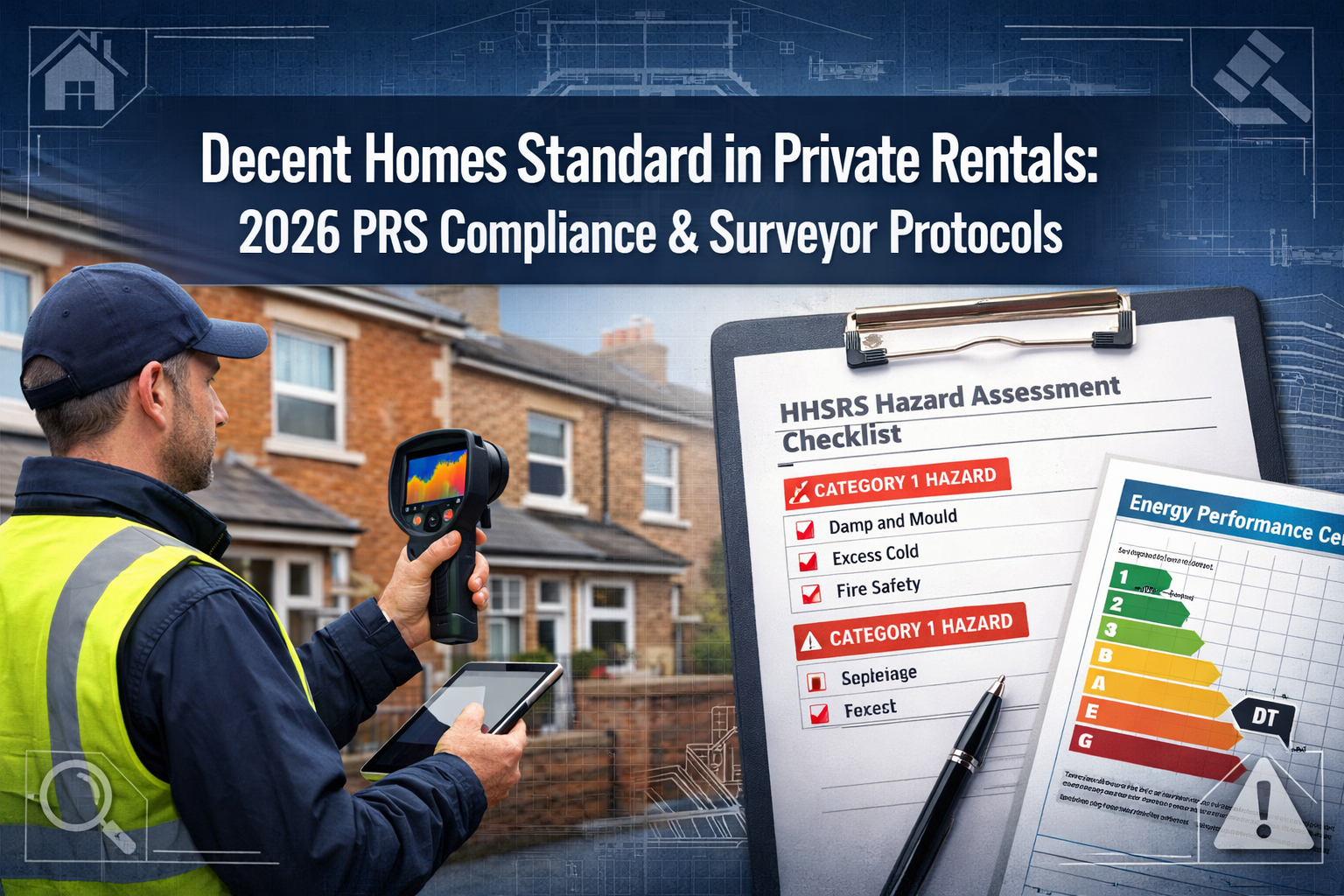
The phased implementation begins 1 May 2026 with the Renters' Rights Act, requiring full compliance by 2035 for all private rental properties.[5] Building surveyors now face heightened professional liability when assessing rental properties, as their evaluations directly determine whether landlords meet the five mandatory criteria that define a "decent" home under the new framework.
Key Takeaways
✅ Five mandatory criteria must be met: no Category 1 hazards (HHSRS), reasonable repair state, adequate facilities, thermal comfort (EPC C by 2030), and specific damp/mould standards[1]
✅ Building surveyors bear increased liability for accurate HHSRS assessments, with landlords facing £40,000 maximum fines and potential banning orders for non-compliance[3]
✅ Phased enforcement timeline runs from May 2026 through 2035, with EPC C thermal requirements mandatory by October 2030[5]
✅ Local authorities gain expanded powers to inspect properties and enforce standards through both criminal and civil penalties[4]
✅ Property Portal registration will become legally required, creating transparent compliance records accessible to tenants and enforcement officers[4]
Understanding the Five Criteria of Decent Homes Standard in Private Rentals
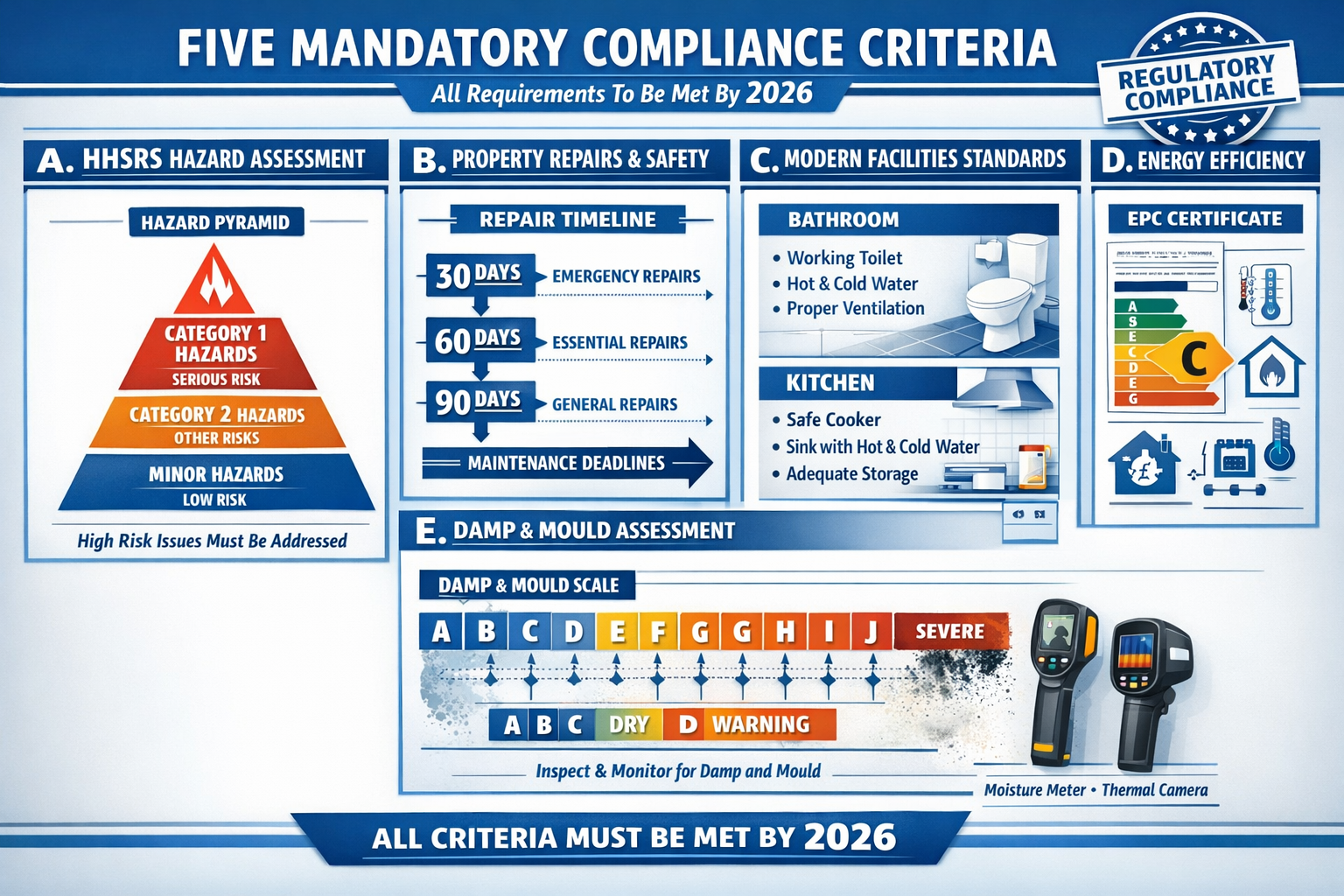
The Decent Homes Standard in Private Rentals: Building Surveyor Protocols for 2026 PRS Compliance and Landlord Liability framework establishes five distinct compliance criteria that building surveyors must systematically evaluate during property assessments.
Criterion A: Category 1 Hazards Under HHSRS
Properties must be free from Category 1 hazards as defined by the Housing Health and Safety Rating System (HHSRS).[1] This represents no substantive change from existing obligations under Section 9A of the Landlord and Tenant Act 1985, but enforcement will intensify significantly.
Building surveyors must conduct comprehensive HHSRS hazard assessments across 29 potential hazard categories, including:
- Damp and mould growth 🏚️
- Excess cold
- Falls on stairs and level surfaces
- Electrical hazards
- Fire safety deficiencies
- Entry by intruders
- Structural collapse risks
The assessment methodology requires surveyors to evaluate both the likelihood and severity of harm, with Category 1 hazards representing serious and immediate risks requiring urgent remediation.
Criterion B: Reasonable State of Repair
Properties must maintain a reasonable state of repair considering their age, character, and prospective lifespan.[1] This criterion demands professional judgment from building surveyors evaluating:
| Building Element | Repair Standards | Surveyor Assessment Protocol |
|---|---|---|
| External walls | Weather-tight, structurally sound | Visual inspection, moisture readings, structural integrity checks |
| Roof structure | No significant defects, adequate drainage | Accessible areas inspection, drone surveys for complex roofs |
| Windows & doors | Functional, secure, weather-sealed | Operation testing, draught detection, security assessment |
| Heating systems | Operational, safe, whole-home coverage | Functional testing, safety certification review |
| Plumbing & drainage | Leak-free, adequate water pressure | Flow testing, visible pipe inspection, drainage assessment |
Surveyors conducting Level 3 full building surveys must document repair deficiencies with photographic evidence and cost estimates for remediation works.
Criterion C: Adequate Facilities and Services
The standard mandates modern facilities including:[1]
- ✅ Kitchen with adequate space and layout
- ✅ Kitchen sink with hot and cold water supply
- ✅ Adequate food storage and preparation areas
- ✅ Bathroom with bath or shower
- ✅ Toilet (may be in bathroom or separate)
- ✅ Basin with hot and cold water
Building surveyors must verify that facilities meet contemporary standards, not merely basic functionality. This includes assessing ventilation adequacy in bathrooms and kitchens to prevent condensation-related issues.
Criterion D: Reasonable Thermal Comfort
This criterion introduces the most significant new requirement: whole-home heating capability.[1] Unlike social housing standards that require heating in only two rooms, private rentals must provide heating throughout the entire property.
By 1 October 2030, all privately rented homes must achieve an EPC C rating or equivalent under reformed Minimum Energy Efficiency Standards (MEES), unless a valid exemption is registered.[2] Building surveyors must:
- Verify current EPC ratings and validity dates
- Assess heating system capacity and distribution
- Identify insulation deficiencies
- Calculate estimated upgrade costs to reach EPC C
- Document valid exemption grounds where applicable
Understanding building materials assessments becomes critical for evaluating thermal performance and insulation effectiveness.
Criterion E: Damp and Mould Standards
Criterion E represents a new specific standard addressing the UK's persistent damp and mould crisis in rental properties. A property fails this criterion if damp and mould hazards are assessed in bands A through H on the HHSRS scale (where A represents the most dangerous hazards and J the safest).[1]
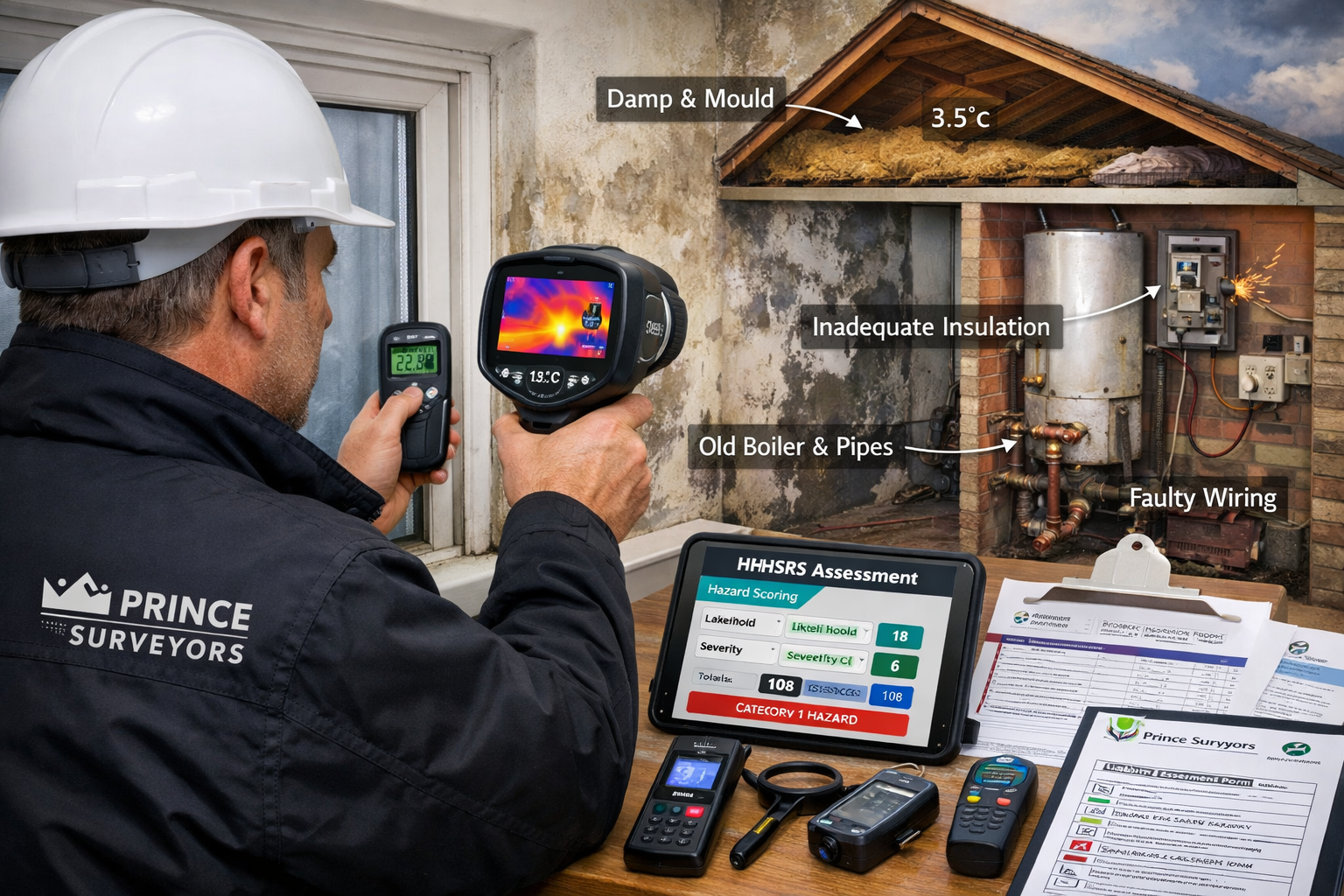
Building surveyors must employ specialized diagnostic equipment:
- 🔍 Moisture meters for quantitative dampness readings
- 🌡️ Thermal imaging cameras to identify cold spots and insulation failures
- 💨 Hygrometers to measure relative humidity levels
- 🔬 Visual mould identification and extent mapping
This criterion acknowledges that damp and mould represent distinct hazards requiring specific assessment protocols beyond general Category 1 hazard evaluations.
Building Surveyor Protocols for 2026 PRS Compliance Assessments
The Decent Homes Standard in Private Rentals: Building Surveyor Protocols for 2026 PRS Compliance and Landlord Liability framework demands systematic inspection methodologies that balance thoroughness with practical efficiency.
Pre-Inspection Documentation Review
Professional surveyors should establish comprehensive documentation protocols before site visits:
Essential Pre-Inspection Documents:
- Current Energy Performance Certificate (EPC)
- Previous HHSRS assessments (if available)
- Gas Safety Certificate (annual requirement)
- Electrical Installation Condition Report (EICR)
- Building Regulation compliance certificates
- Planning permissions for alterations
- Previous survey reports
- Tenant complaint history
Reviewing these documents allows surveyors to identify known issues and focus inspection efforts on high-risk areas. Understanding building survey timeframes helps establish realistic assessment schedules.
Systematic HHSRS Assessment Protocol
Building surveyors must adopt structured approaches to HHSRS evaluations:
Room-by-Room Assessment Checklist:
- External inspection – structural integrity, drainage, damp penetration risks
- Roof space – insulation, ventilation, structural condition, water ingress
- Living areas – heating provision, electrical safety, window condition, fire safety
- Kitchen – facilities adequacy, ventilation, gas/electrical safety, water supply
- Bathrooms – facilities, ventilation, water supply, mould growth, heating
- Bedrooms – heating, window safety, electrical outlets, damp indicators
- Circulation spaces – stairs safety, lighting, trip hazards, fire escape routes
- Services – boiler condition, electrical distribution, plumbing integrity
Surveyors should document findings using standardized forms that map directly to the five Decent Homes criteria, creating clear audit trails for compliance verification.
Diagnostic Equipment Requirements
Professional compliance assessments require investment in specialized diagnostic tools:
| Equipment | Purpose | Compliance Application |
|---|---|---|
| Thermal imaging camera | Identify heat loss, insulation gaps, hidden damp | Criterion D (thermal comfort) and E (damp/mould) |
| Moisture meter | Quantify dampness levels in building materials | Criterion E (damp/mould) and A (HHSRS hazards) |
| Gas detector | Identify carbon monoxide and gas leaks | Criterion A (Category 1 hazards – gas safety) |
| Electrical testing equipment | Verify electrical safety and earthing | Criterion A (Category 1 hazards – electrical) |
| Laser distance measurer | Accurate room dimensions and ceiling heights | Criterion C (adequate facilities and space) |
| Digital camera | Comprehensive photographic evidence | All criteria documentation |
| Borescope camera | Inspect concealed spaces and cavities | Criteria A and B (hidden defects) |
Many surveyors now utilize drone surveys for comprehensive roof inspections without access risks.
Reporting Standards for Landlord Compliance
Survey reports must clearly articulate compliance status against each criterion:
Essential Report Components:
✍️ Executive summary – Overall compliance status with clear pass/fail determination
✍️ Criterion-by-criterion analysis – Detailed findings mapped to A, B, C, D, and E requirements
✍️ HHSRS hazard schedule – All identified hazards with category classifications and risk scores
✍️ Photographic evidence – Comprehensive visual documentation of defects and hazards
✍️ Remediation recommendations – Prioritized repair schedule with estimated costs
✍️ Compliance timeline – Realistic schedule for achieving full Decent Homes compliance
✍️ Professional liability disclaimer – Clear scope limitations and access restrictions
Surveyors should reference what questions to ask during building surveys to ensure comprehensive information gathering.
Frequency of Compliance Assessments
While the Decent Homes Standard doesn't mandate specific re-inspection intervals, best practice suggests:
- Initial compliance assessment – Before new tenancies commence
- Annual reviews – Light-touch inspections focusing on tenant-reported issues
- Full re-assessment – Every 3-5 years or following significant works
- Triggered inspections – After tenant complaints or local authority notices
Landlords should reference guidance on how often rental units should be inspected to establish appropriate monitoring schedules.
Landlord Liability Under Decent Homes Standard in Private Rentals
The enforcement framework for Decent Homes Standard in Private Rentals: Building Surveyor Protocols for 2026 PRS Compliance and Landlord Liability creates substantial financial and operational risks for non-compliant property owners.

Financial Penalties and Enforcement Powers
Local authorities possess extensive enforcement capabilities under the new framework:
Penalty Structure:[3]
| Offence Severity | Maximum Fine | Additional Consequences |
|---|---|---|
| Minor non-compliance | £7,000 civil penalty | Improvement notice, compliance deadline |
| Serious Category 1 hazards | £30,000 per hazard | Prohibition order, emergency remedial works |
| Persistent non-compliance | £40,000 maximum | Banning orders, rent repayment orders |
| Criminal conviction | Unlimited fine | Criminal record, rental license revocation |
Failure to comply with the Decent Homes Standard constitutes both a criminal offence and grounds for civil penalties, providing local councils with flexible enforcement options.[4]
Banning Orders and Rental Prohibitions
Landlords who commit serious or repeated offences face banning orders that prohibit them from:
- 🚫 Letting properties
- 🚫 Engaging in property management
- 🚫 Holding positions in property management companies
- 🚫 Being involved in property-related businesses
Banning orders typically last 12 months minimum but can extend to several years for egregious violations.[3] These orders are publicly recorded and accessible through the proposed Property Portal system.
Rent Repayment Orders
Tenants living in non-compliant properties can apply for Rent Repayment Orders (RROs) requiring landlords to refund rent paid during periods of non-compliance. Tribunals can order repayment of up to 12 months' rent where landlords have failed to meet Decent Homes Standards.[3]
Property Portal Registration Requirements
The government has committed to legislating for a mandatory digital Property Portal where private landlords must:[4]
- Register all rental properties with detailed information
- Demonstrate regulatory compliance across all standards
- Maintain current certificates (gas safety, EICR, EPC)
- Update compliance status following inspections
- Provide transparency for tenant verification
Tenants will be able to review compliance information before entering tenancies, creating market pressure for maintaining high standards beyond mere legal compliance.
Professional Indemnity Implications for Surveyors
Building surveyors face heightened professional liability exposure when conducting Decent Homes compliance assessments. Professional indemnity insurance policies must provide adequate coverage for:
- Negligent HHSRS assessments – Failing to identify Category 1 hazards
- Incorrect compliance certifications – Certifying properties that fail standards
- Inadequate inspection scope – Missing defects due to insufficient investigation
- Reporting errors – Misrepresenting compliance status in survey reports
Surveyors should maintain detailed inspection records, photographic evidence, and clear documentation of access limitations to defend against potential claims. Many professionals now include specific Decent Homes Standard compliance clauses in their terms of engagement.
Landlord Risk Mitigation Strategies
Property owners can reduce liability exposure through proactive compliance management:
Risk Reduction Framework:
- Commission comprehensive building surveys – Engage qualified surveyors for thorough assessments before issues escalate
- Establish preventive maintenance schedules – Address minor defects before they become Category 1 hazards
- Maintain detailed compliance records – Document all inspections, repairs, and certificates systematically
- Respond promptly to tenant reports – Treat damp, mould, and heating complaints as urgent compliance issues
- Budget for thermal upgrades – Plan capital expenditure to achieve EPC C by 2030 deadline
- Consider portfolio rationalization – Evaluate whether older, non-compliant properties justify upgrade costs
Understanding building regulation compliance testing helps landlords verify that improvement works meet required standards.
Implementation Timeline and Transition Planning
The phased rollout of the Decent Homes Standard creates distinct compliance milestones that landlords and surveyors must navigate:
Key Compliance Dates
1 May 2026 – Renters' Rights Act implementation begins, introducing the Decent Homes Standard framework alongside ending no-fault evictions[5]
1 October 2030 – EPC C rating becomes mandatory for all privately rented properties (Criterion D thermal comfort requirement)[2]
2035 – Full compliance with all five Decent Homes criteria required for 100% of private rental properties[5]
Transition Period Strategies
Landlords should develop multi-year compliance roadmaps that prioritize:
Year 1 (2026-2027): Assessment Phase
- Commission comprehensive building surveys on all portfolio properties
- Identify Category 1 hazards requiring immediate remediation
- Obtain current EPCs and calculate thermal upgrade requirements
- Register properties on the Property Portal when launched
Years 2-4 (2027-2030): Thermal Upgrade Phase
- Prioritize properties furthest from EPC C rating
- Implement insulation improvements (loft, cavity wall, solid wall)
- Upgrade heating systems to efficient whole-home solutions
- Install energy-efficient windows and doors where needed
Years 5-9 (2030-2035): Final Compliance Phase
- Address remaining repair and facility deficiencies
- Complete damp and mould remediation works
- Ensure all properties meet all five criteria
- Maintain ongoing compliance through regular inspections
Portfolio-Level Compliance Planning
Landlords with multiple properties should adopt systematic approaches:
- Categorize properties by compliance distance (compliant, minor works needed, major works needed, uneconomical to upgrade)
- Prioritize investments based on rental income, property value, and upgrade costs
- Consider disposals where upgrade costs exceed property values or expected returns
- Leverage financing through green mortgages and energy efficiency loan schemes
- Engage specialist advisors including building surveyors, energy assessors, and property tax consultants
Professional Standards and Continuing Education
Building surveyors must enhance their competencies to deliver credible Decent Homes compliance assessments:
Required Technical Knowledge
Surveyors should develop expertise across:
- HHSRS methodology – Comprehensive understanding of all 29 hazard categories and scoring systems
- Energy performance assessment – EPC rating factors, thermal modeling, and upgrade pathways
- Damp and mould diagnosis – Condensation vs. penetrating vs. rising damp identification
- Building pathology – Understanding defect causes and appropriate remediation strategies
- Regulatory frameworks – Housing Act 2004, Building Regulations, MEES requirements
Professional Qualifications and Accreditations
Relevant professional credentials include:
- 🎓 RICS (Royal Institution of Chartered Surveyors) – Chartered Building Surveyor status
- 🎓 CIOB (Chartered Institute of Building) – Building surveying qualifications
- 🎓 RPSA (Residential Property Surveyors Association) – Specialist residential expertise
- 🎓 CABE (Chartered Association of Building Engineers) – Building engineering knowledge
- 🎓 HHSRS training certification – Specialist hazard assessment training
Many surveyors pursue additional training in thermal imaging, moisture investigation, and energy assessment to enhance their Decent Homes compliance capabilities.
Quality Assurance and Peer Review
Professional surveying practices should implement:
- Standardized assessment protocols – Consistent methodologies across all surveyors
- Report template systems – Structured formats ensuring comprehensive coverage
- Peer review processes – Second surveyor review of complex or borderline assessments
- Continuing professional development – Regular training on regulatory updates and technical advances
- Professional indemnity insurance – Adequate coverage levels for compliance assessment work
Conclusion
The Decent Homes Standard in Private Rentals: Building Surveyor Protocols for 2026 PRS Compliance and Landlord Liability framework represents a fundamental transformation of the private rented sector regulatory landscape. With implementation beginning 1 May 2026 and full compliance required by 2035, landlords and building surveyors face an extended transition period demanding strategic planning and substantial investment.
The five mandatory criteria—Category 1 hazard elimination, reasonable repair, adequate facilities, thermal comfort, and damp/mould standards—create comprehensive obligations that extend well beyond previous regulatory requirements. Maximum penalties of £40,000, combined with banning orders and rent repayment orders, establish genuine deterrents against non-compliance.
Building surveyors occupy a critical position in this new framework, as their professional assessments determine compliance status and guide remediation priorities. The heightened liability exposure demands enhanced technical competencies, specialized diagnostic equipment, and rigorous reporting standards.
Actionable Next Steps
For Landlords:
- Commission comprehensive building surveys on all rental properties immediately
- Develop multi-year compliance roadmaps with realistic budgets and timelines
- Prioritize thermal upgrades to meet the 2030 EPC C deadline
- Establish preventive maintenance schedules to avoid Category 1 hazards
- Maintain detailed compliance documentation for Property Portal registration
For Building Surveyors:
- Invest in specialized diagnostic equipment (thermal cameras, moisture meters)
- Pursue HHSRS training and certification programs
- Develop standardized Decent Homes compliance assessment protocols
- Review professional indemnity insurance coverage levels
- Create comprehensive reporting templates addressing all five criteria
For Property Professionals:
- Monitor Property Portal implementation timelines and registration requirements
- Stay informed on local authority enforcement approaches and priorities
- Engage with industry bodies advocating for practical compliance guidance
- Consider specialist certifications in energy assessment and damp investigation
- Build relationships with qualified building surveyors experienced in compliance work
The Decent Homes Standard creates both challenges and opportunities for the private rented sector. Landlords who approach compliance proactively will differentiate their properties in an increasingly quality-conscious rental market, while those who delay face escalating enforcement risks and potential portfolio viability issues. Building surveyors who develop robust compliance assessment capabilities will find sustained demand for their specialized expertise throughout the transition period and beyond.
References
[1] theindependentlandlord – theindependentlandlord.com
[2] What Is The Decent Homes Standard – blog.goodlord.co
[3] The New Decent Homes Standard What Landlords And Tenants Need To Know – gowlingwlg.com
[4] A Decent Homes Standard In The Private Rented Sector Consultation – gov.uk
[5] A Guide To The Governments Decent Homes Standard – cia-landlords.co.uk