

From May 1, 2026, Section 21 "no-fault" evictions cease to exist in England, fundamentally transforming how landlords regain possession of rental properties.[1] This seismic shift under the Renters' Rights Act 2026 places surveyors at the center of landlord-tenant disputes, requiring expert evidence on property conditions, repair standards, and structural defects to support Section 8 possession claims. Understanding the Renters' Rights Act 2026: What Surveyors Need to Know About Section 8 Grounds, Ombudsman Disputes, and Professional Liability has never been more critical for property professionals navigating this new legal landscape.

The abolition of Section 21 means landlords must now specify valid legal grounds for eviction under Section 8, backed by compelling evidence that often requires professional surveyor input.[5] With three new mandatory grounds introduced, stricter notice periods, and enhanced tenant protections, surveyors face increased scrutiny of their assessments, heightened professional liability exposure, and expanded roles in ombudsman dispute resolution processes.
Key Takeaways
✅ Section 8 becomes the only eviction route from May 1, 2026, requiring surveyors to provide expert evidence on property conditions, structural issues, and repair standards to support possession claims
✅ Three new mandatory grounds (1A for property sale, 1B for redevelopment, 8A for persistent arrears) create additional documentation requirements and professional liability considerations for surveying professionals
✅ Ombudsman dispute processes now routinely involve surveyor evidence on damp, mould, disrepair, and property condition, making accurate assessments critical to avoiding professional negligence claims
✅ Professional indemnity insurance requirements have intensified as surveyors face potential liability for incorrect condition assessments that affect possession proceedings or tenant compensation claims
✅ Enhanced notice periods and stricter thresholds (including 3-month arrears requirement for Ground 8) mean surveyor reports must meet higher evidential standards for court proceedings
Understanding Section 8 Grounds Under the Renters' Rights Act 2026
Section 8 notices require landlords to specify one or more legal grounds for seeking possession, fundamentally different from the previous Section 21 "no-fault" approach.[1] These grounds fall into two categories: mandatory grounds (where courts must grant possession if conditions are met) and discretionary grounds (where judges assess reasonableness).[5]
Mandatory vs. Discretionary Grounds
Mandatory grounds provide landlords with guaranteed possession if specific criteria are satisfied. The court has no discretion to refuse the order based on tenant circumstances. Key mandatory grounds include:
- Ground 8: Serious rent arrears (now requiring 3 months' arrears, increased from 2 months)[4]
- Ground 1: Landlord or family member intends to occupy (now requires 12-month minimum tenancy)[4]
- Ground 1A: Property sale (new ground with 4 months' notice)[5]
- Ground 1B: Redevelopment requiring vacant possession (new ground)[5]
- Ground 8A: Persistent rent arrears (new ground – arrears on 3+ occasions in preceding 3 years)[5]
Discretionary grounds allow courts to consider whether possession is reasonable given all circumstances. These include:
- Ground 14: Anti-social behaviour or nuisance
- Ground 10: Some rent arrears (less than 3 months)
- Ground 11: Persistent delay in paying rent
- Ground 12: Breach of tenancy agreement
New Grounds Introduced in 2026
The Renters' Rights Act 2026 introduces three significant new mandatory grounds that reshape possession proceedings:
| Ground | Purpose | Notice Period | Key Requirements |
|---|---|---|---|
| Ground 1A | Property sale | 4 months | Cannot re-let for 12 months; £40,000 fine for misuse[5] |
| Ground 1B | Redevelopment | 4 months | Requires planning permission or building regulations approval |
| Ground 8A | Persistent arrears | 4 weeks | Arrears on 3+ separate occasions within 3 years[5] |
Ground 1A specifically addresses landlord sales, requiring 4 months' notice and prohibiting re-letting for 12 months following possession.[5] Misuse carries penalties up to £40,000, creating significant enforcement risks for landlords who falsely claim sale intentions.
Ground 1B facilitates redevelopment projects requiring vacant possession, though landlords must demonstrate genuine redevelopment plans with appropriate permissions.
Ground 8A targets tenants with persistent payment issues even when current arrears don't meet the 3-month threshold for Ground 8.[5]
Modified Existing Grounds
Several existing grounds have been substantially amended:
Ground 1 (landlord occupation) now requires landlords to wait 12 months minimum before serving notice, preventing immediate possession claims on new tenancies.[4] Notice periods extend to 4 months (increased from 2 months), giving tenants more time to find alternative accommodation.
Ground 8 (serious rent arrears) threshold increases from 2 months to 3 months' rent.[4] Notice periods extend from 2 weeks to 4 weeks, and arrears must exist both at notice service and at the court hearing date.[5] Additional protections apply where arrears result from housing benefit delays.[4]
Ground 7 (death of tenant) now requires possession proceedings to begin within 24 months of death with a 2-month notice period.[3]
Ground 7A (severe anti-social behaviour) requires immediate notice for tenant convictions of criminal offences, breaches of criminal behaviour orders, or noise nuisance convictions.[3]
Ground 7B (no right to rent) applies when tenants lack immigration status to occupy, requiring only 2 weeks' notice.[1]
Four new supported accommodation grounds (5E, 5F, 5G) address housing provided for homelessness duties and care support provision, with 4-week notice periods.[3]
Renters' Rights Act 2026: What Surveyors Need to Know About Section 8 Grounds and Evidence Requirements
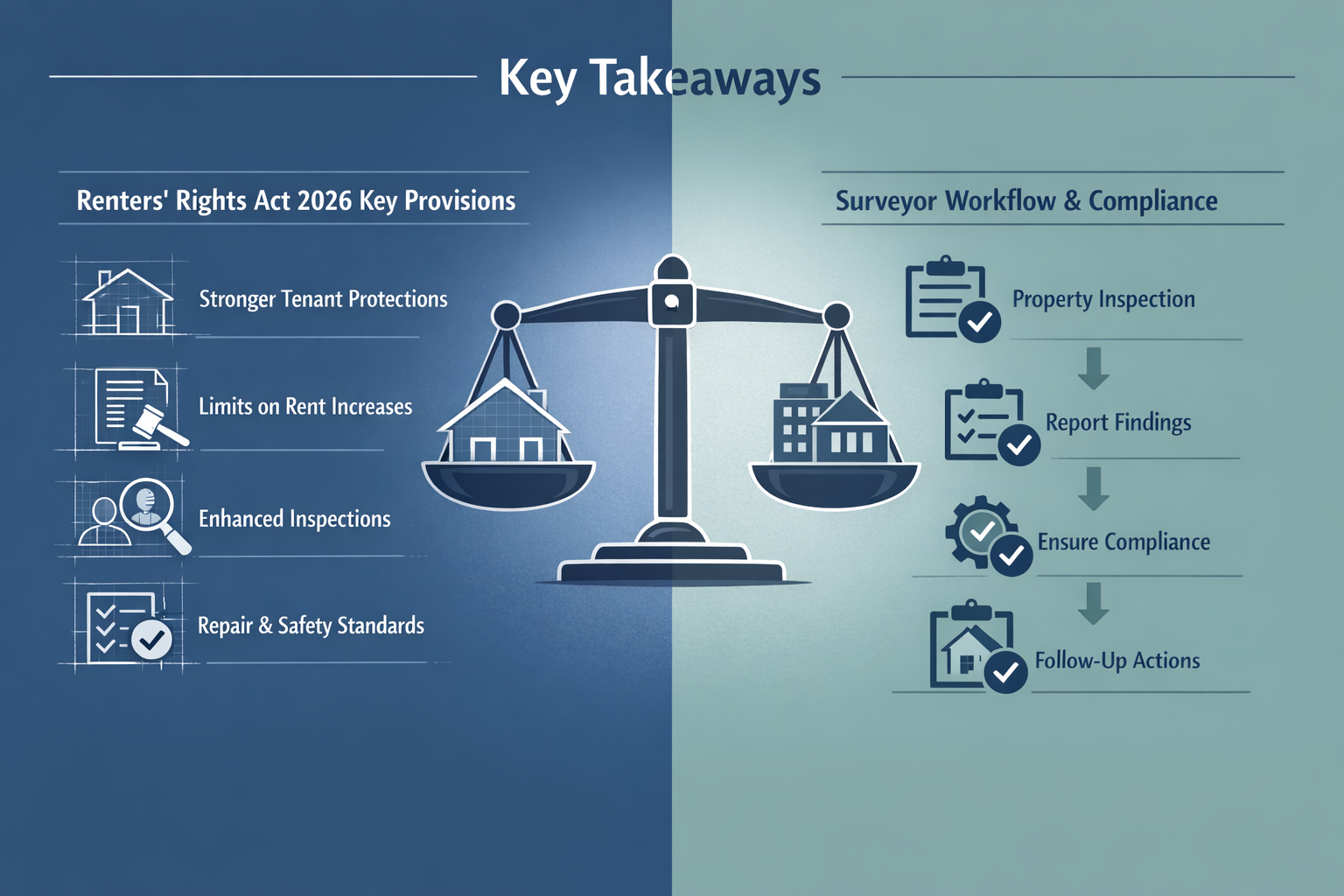
Surveyors play a pivotal role in Section 8 possession proceedings, particularly for grounds relating to property condition, redevelopment plans, and landlord obligations. The Renters' Rights Act 2026: What Surveyors Need to Know About Section 8 Grounds, Ombudsman Disputes, and Professional Liability centers on providing court-admissible evidence that withstands legal scrutiny.
Surveyor Evidence for Mandatory Grounds
Ground 1B (redevelopment) requires comprehensive surveyor input to demonstrate:
- Structural assessments confirming redevelopment necessity
- Building condition reports justifying major works
- Planning and building regulations compliance documentation
- Evidence that works cannot be completed with tenant in situ
- Cost estimates and project timelines
Surveyors conducting building defects surveys must provide detailed documentation showing why vacant possession is essential for proposed works. Courts scrutinize these claims carefully to prevent abuse of redevelopment grounds.
Ground 1A (property sale) may require surveyor evidence when:
- Buyers request vacant possession based on property condition
- Structural issues affect marketability with sitting tenants
- Lender requirements necessitate vacant possession
- Pre-sale remediation works require property access
Discretionary Grounds Requiring Technical Evidence
Ground 14 (anti-social behaviour) increasingly involves surveyor evidence on:
- Noise transmission assessments in multi-unit properties
- Damage to property caused by tenant behavior
- Structural alterations made without permission
- Environmental health hazards created by tenant actions
Ground 12 (breach of tenancy agreement) often requires surveyor documentation of:
- Unauthorized alterations or structural changes
- Property damage beyond normal wear and tear
- Garden or external area neglect affecting property value
- Failure to maintain heating systems causing property damage
Surveyors must distinguish between normal wear and tear and tenant-caused damage with photographic evidence, detailed condition descriptions, and professional opinions on causation. When conducting a Level 3 full building survey, clear documentation of existing conditions protects both landlords and tenants in subsequent disputes.
Property Condition Standards and Landlord Obligations
The Renters' Rights Act 2026 strengthens landlord repair obligations, making surveyor assessments critical for determining compliance. Landlords cannot use Section 8 grounds while in breach of repair obligations that materially affect tenant enjoyment.
Surveyors must assess:
🏠 Structural integrity: Foundations, walls, roofs, chimneys, and load-bearing elements
💧 Damp and moisture: Rising damp, penetrating damp, condensation, and mould growth
🔧 Mechanical systems: Heating, plumbing, electrical installations, and ventilation
🪟 Windows and doors: Functionality, security, weather-tightness, and safety
🏗️ External elements: Guttering, downpipes, external walls, and drainage systems
Understanding what questions should be asked during a building survey helps surveyors gather comprehensive evidence for possession proceedings.
Documentation Standards for Court Proceedings
Courts require surveyor evidence to meet specific standards:
Photographic evidence must include:
- Date and time stamps
- Clear location identification
- Multiple angles showing context
- Scale references for defects
- Before and after comparisons where relevant
Written reports must contain:
- Professional qualifications and experience
- Inspection methodology and limitations
- Objective condition descriptions
- Professional opinions clearly distinguished from facts
- Compliance with RICS standards and guidance
Expert witness statements require:
- Declaration of understanding expert duties to the court
- Confirmation of independence from instructing party
- Clear reasoning supporting conclusions
- Acknowledgment of report limitations
- References to relevant technical standards
Surveyors providing evidence for possession proceedings should ensure reports align with statutory considerations affecting rental properties.
Ombudsman Disputes and Surveyor Involvement in the Renters' Rights Act 2026 Framework
The Renters' Rights Act 2026 mandates private landlord membership in approved ombudsman schemes, creating a formal dispute resolution pathway before court proceedings.[8] This requirement fundamentally changes how surveyor evidence is used in landlord-tenant conflicts, with ombudsmen routinely requesting independent condition assessments.
The Property Ombudsman Scheme and Surveyor Evidence
Ombudsman schemes handle complaints about:
- Property condition and disrepair
- Landlord failure to carry out repairs
- Damp, mould, and condensation issues
- Deposit deduction disputes
- Service charge disputes in multi-unit properties
Surveyors provide critical evidence by:
✅ Conducting independent condition assessments showing property state at tenancy start and end
✅ Evaluating repair standards against landlord obligations and industry benchmarks
✅ Assessing damp and mould causation distinguishing structural issues from lifestyle factors
✅ Determining repair costs for damage beyond normal wear and tear
✅ Reviewing service charge reasonableness for service charge management in multi-unit buildings
Damp and Mould Assessments
Following the 2020 Homes (Fitness for Human Habitation) Act and subsequent guidance, damp and mould cases represent a significant portion of ombudsman complaints. The Renters' Rights Act 2026 reinforces landlord obligations to address these issues promptly.
Surveyors must:
- Identify moisture sources: Rising damp, penetrating damp, condensation, or plumbing leaks
- Assess ventilation adequacy: Natural and mechanical ventilation systems
- Evaluate heating provision: Adequate heating to prevent condensation
- Determine causation: Structural defects vs. tenant lifestyle factors
- Recommend remediation: Proportionate solutions addressing root causes
A comprehensive construction and condition survey provides the detailed evidence ombudsmen require to determine liability and appropriate compensation.
Ombudsman Decision-Making Process
The typical ombudsman process involves:
Week 1-2: Tenant submits complaint with supporting evidence
Week 3-4: Landlord responds with counter-evidence and surveyor reports
Week 5-6: Ombudsman reviews evidence and may request additional surveyor input
Week 7-8: Decision issued with compensation awards if appropriate
Ombudsmen consider:
- Whether landlord breached obligations
- Impact on tenant (health, enjoyment, financial loss)
- Landlord's response to reported issues
- Reasonableness of repair timescales
- Adequacy of compensation offered
Compensation awards range from £100 for minor inconvenience to £10,000+ for serious disrepair affecting health and safety. Surveyor evidence directly influences award levels by establishing:
- Severity and duration of disrepair
- Impact on property habitability
- Reasonableness of tenant expectations
- Appropriate remediation costs
Professional Standards for Ombudsman Evidence
Surveyors providing ombudsman evidence must maintain:
Independence: Clear separation from landlord/tenant financial interests
Objectivity: Evidence-based conclusions without advocacy for either party
Competence: Appropriate qualifications and experience for the specific issue
Clarity: Reports accessible to non-technical ombudsman case handlers
Timeliness: Prompt report delivery within ombudsman timescales
RICS members must follow RICS Practice Statement and Guidance Note on Surveyors Acting as Expert Witnesses, even in ombudsman proceedings that don't reach court.
Common Ombudsman Dispute Scenarios
Scenario 1: Deposit Deduction Disputes
Landlords claim property damage; tenants dispute extent and causation. Surveyors provide:
- Pre-tenancy condition reports
- End-of-tenancy condition assessments
- Damage vs. wear and tear analysis
- Reasonable repair cost estimates
Scenario 2: Repair Obligation Disputes
Tenants report disrepair; landlords claim issues are tenant-caused or outside obligations. Surveyors determine:
- Whether defects fall within landlord repair obligations
- Causation of defects (structural vs. tenant actions)
- Appropriate remediation approaches
- Reasonable timescales for repairs
Scenario 3: Damp and Mould Complaints
Tenants suffer health impacts from damp/mould; landlords claim lifestyle causation. Surveyors establish:
- Primary moisture sources
- Structural defects contributing to dampness
- Adequacy of ventilation and heating
- Proportionate remediation requirements
Understanding how block managers provide good service helps surveyors working on multi-unit properties navigate complex service charge and maintenance disputes.
Professional Liability Considerations for Surveyors Under the Renters' Rights Act 2026
The Renters' Rights Act 2026: What Surveyors Need to Know About Section 8 Grounds, Ombudsman Disputes, and Professional Liability includes understanding heightened liability exposure as surveyor evidence becomes central to possession proceedings and dispute resolution.
Negligence Claims and Professional Indemnity Insurance
Surveyors face potential negligence claims from:
Landlords when:
- Incorrect condition assessments lead to failed possession claims
- Inadequate evidence results in ombudsman decisions against landlords
- Missed defects prevent successful Ground 1B (redevelopment) applications
- Underestimated repair costs affect financial planning
Tenants when:
- Inaccurate reports support unjustified possession proceedings
- Failure to identify serious defects affects health and safety
- Incorrect causation analysis leads to unfair deposit deductions
- Inadequate damp/mould assessments result in continued exposure
Professional indemnity insurance requirements have intensified. RICS-regulated firms must maintain:
- Minimum £250,000 cover for sole practitioners
- Minimum £500,000 for partnerships
- Run-off cover for 6 years after ceasing practice
- Coverage adequate for largest single claim exposure
Surveyors working on high-value properties or complex possession cases should consider enhanced PI cover reflecting increased claim values under the new regime.
Duty of Care and Standard of Skill
Surveyors owe a duty of care to:
- Instructing clients (landlords or tenants commissioning reports)
- Third parties relying on reports (courts, ombudsmen, lenders)
- Occupants affected by assessments (in some circumstances)
The required standard is that of a reasonably competent surveyor with appropriate qualifications and experience for the specific instruction. Courts assess whether the surveyor:
✓ Conducted adequate inspection given property type and instruction
✓ Applied appropriate methodology and technical standards
✓ Reached conclusions a competent surveyor would reach
✓ Communicated findings clearly with appropriate caveats
✓ Disclosed limitations affecting assessment reliability
Common Liability Pitfalls
Inadequate inspection scope: Failing to inspect all accessible areas or missing critical defects due to rushed inspections
Causation errors: Incorrectly attributing damp to tenant lifestyle when structural defects exist, or vice versa
Overstating certainty: Making definitive conclusions about concealed defects without appropriate investigation
Bias toward instructing party: Allowing landlord/tenant relationship to compromise objectivity
Inadequate documentation: Insufficient photographic evidence or vague condition descriptions
Failure to update knowledge: Not understanding current repair standards, building regulations, or legal requirements
Scope creep: Addressing issues beyond instruction without appropriate disclaimers
Risk Management Strategies
Surveyors can minimize liability exposure through:
📋 Clear terms of engagement: Written instructions specifying scope, limitations, and intended use
📸 Comprehensive documentation: Extensive photographs with detailed written descriptions
🎓 Continuing professional development: Regular training on building pathology, legal changes, and technical standards
🔍 Appropriate investigation: Using moisture meters, thermal imaging, and other diagnostic tools
⚖️ Objective reporting: Clear separation of facts, opinions, and limitations
🤝 Professional collaboration: Consulting specialists for complex issues (structural engineers, damp specialists)
💼 Adequate insurance: PI cover reflecting claim exposure and regular policy review
Understanding how long building surveys take helps surveyors allocate sufficient time for thorough inspections that withstand legal scrutiny.
Expert Witness Obligations
When providing evidence for possession proceedings or ombudsman disputes, surveyors must:
Understand expert duties: Primary duty to the court/ombudsman, not the instructing party
Maintain independence: Avoid advocacy and present balanced evidence
Stay within expertise: Only offer opinions within professional competence
Disclose limitations: Clearly state report constraints and areas not inspected
Provide reasoning: Explain methodology and logic supporting conclusions
Update evidence: Inform instructing party of changed opinions before proceedings
Failure to meet expert witness standards can result in:
- Evidence being disregarded or given reduced weight
- Wasted costs orders against instructing party
- Professional disciplinary proceedings
- Reputational damage affecting future instructions
RICS Professional Standards
RICS members must comply with:
- Rules of Conduct for Members (effective 2022)
- Rules of Conduct for Firms (effective 2022)
- RICS Valuation – Global Standards (Red Book)
- RICS Home Survey Standard (for residential surveys)
- Practice Statement and Guidance Note on Surveyors Acting as Expert Witnesses
Key obligations include:
- Acting with integrity: Honest, transparent practice
- Maintaining competence: Appropriate qualifications and CPD
- Providing good quality service: Meeting client needs professionally
- Treating others with respect: Professional behavior toward all parties
- Taking responsibility: Accountability for work quality
RICS can impose sanctions including:
- Formal cautions
- Consent orders with conditions
- Fines up to £50,000
- Expulsion from membership
Surveyors should also consider party wall rights when assessing properties affected by neighboring development, as these intersect with Ground 1B redevelopment claims.
Practical Guidance for Surveyors Navigating the New Landscape
Pre-Instruction Considerations
Before accepting instructions related to possession proceedings or tenant disputes:
✅ Verify competence: Ensure appropriate experience for the specific property type and issues
✅ Check conflicts: Identify any conflicts of interest affecting independence
✅ Clarify scope: Agree precise instruction scope, methodology, and deliverables
✅ Confirm use: Understand how the report will be used (court, ombudsman, negotiation)
✅ Agree fees: Establish fixed or capped fees covering potential court attendance
✅ Review insurance: Confirm PI cover adequacy for the instruction
Inspection Best Practices
Preparation:
- Review tenancy agreements and repair obligations
- Obtain previous condition reports and correspondence
- Prepare appropriate diagnostic equipment
- Allow sufficient time for thorough inspection
During inspection:
- Photograph all areas systematically
- Use moisture meters for suspected damp areas
- Note heating and ventilation provision
- Document access limitations
- Interview occupants about defect history
Post-inspection:
- Analyze findings against repair standards
- Research causation for complex defects
- Prepare draft report promptly while details fresh
- Review conclusions for objectivity and balance
Report Writing for Legal Proceedings
Effective reports for possession proceedings and ombudsman disputes include:
Executive summary: Key findings and conclusions (1-2 pages)
Property description: Location, type, age, construction, accommodation
Inspection scope: Date, duration, areas inspected, limitations
Condition assessment: Systematic room-by-room findings with photographs
Defect analysis: Causation, severity, urgency, and remediation requirements
Cost estimates: Reasonable repair costs with breakdown
Conclusions: Clear opinions on key issues (repair obligations, causation, standards)
Appendices: Photographs, floor plans, technical references
Working with Legal Representatives
Solicitors instructing surveyors for possession cases expect:
📞 Responsive communication: Prompt responses to queries and instruction clarifications
📅 Realistic timescales: Accurate estimates for report delivery and availability for court
💷 Transparent costs: Clear fee structures including court attendance rates
📊 Court-ready evidence: Reports meeting CPR Part 35 requirements
🎯 Focused opinions: Addressing specific legal issues without unnecessary detail
Understanding the broader context of new property management laws helps surveyors appreciate how the Renters' Rights Act 2026 fits within evolving landlord-tenant regulation.
Conclusion
The Renters' Rights Act 2026: What Surveyors Need to Know About Section 8 Grounds, Ombudsman Disputes, and Professional Liability represents a fundamental shift in how property professionals support landlord-tenant relationships. With Section 21 abolished from May 1, 2026, surveyors have become essential participants in possession proceedings, providing the technical evidence courts and ombudsmen require to determine whether Section 8 grounds are satisfied.
The introduction of three new mandatory grounds—particularly Ground 1A (property sale) and Ground 1B (redevelopment)—creates additional documentation requirements and liability exposure for surveyors. Stricter thresholds for existing grounds, including the increase to 3 months' arrears for Ground 8, demand higher evidential standards in surveyor reports.
Mandatory ombudsman membership for landlords means surveyors increasingly provide evidence in dispute resolution processes, requiring independence, objectivity, and clarity in condition assessments. Professional liability considerations have intensified, with surveyors facing potential negligence claims from both landlords and tenants when reports influence possession outcomes or compensation awards.
Actionable Next Steps for Surveyors
🎓 Update knowledge: Complete CPD on Renters' Rights Act 2026 provisions, Section 8 grounds, and ombudsman processes
📋 Review procedures: Update inspection protocols, report templates, and terms of engagement for possession-related work
💼 Check insurance: Verify PI cover adequacy and consider enhanced limits for possession case exposure
🤝 Build relationships: Develop connections with solicitors specializing in landlord-tenant law
📚 Maintain standards: Ensure compliance with RICS professional standards and expert witness obligations
🔍 Enhance documentation: Invest in diagnostic equipment and photographic capabilities for court-quality evidence
The surveyors who thrive under the Renters' Rights Act 2026 will be those who recognize their expanded role in the landlord-tenant ecosystem, maintain rigorous professional standards, and provide the objective, evidence-based assessments that courts and ombudsmen require. Whether conducting a Level 2 or Level 3 property survey or providing expert evidence in possession proceedings, professional competence and independence remain the foundation of surveyor value in 2026's transformed rental sector.
References
[1] Section 8 Notice – https://blog.openrent.co.uk/section-8-notice/
[2] Section 8 Notice Grounds For Possession Explained 2026 Guide – https://landlordknowledge.co.uk/section-8-notice-grounds-for-possession-explained-2026-guide/
[3] Rrb Grounds Table – https://theindependentlandlord.com/rrb-grounds-table/
[4] New Section 8 Grounds For Possession Whats Changing Under The Renters Rights Act – https://www.talbotslaw.co.uk/site/new-section-8-grounds-for-possession-whats-changing-under-the-renters-rights-act/
[5] Section 8 Notices – https://www.augustapp.com/blog/section-8-notices
[6] Section 8 Possession Grounds 2026 Complete Guide To The Only Eviction Route – https://www.elliotleigh.com/post/section-8-possession-grounds-2026-complete-guide-to-the-only-eviction-route/
[7] Understanding Mandatory Grounds 1 And 1a Under The Renters Rights Act – https://www.guildofletting.com/blog/understanding-mandatory-grounds-1-and-1a-under-the-renters-rights-act
[8] The Renters Rights Act Information Sheet 2026 – https://assets.publishing.service.gov.uk/media/69bc04b8f7b1c24d8e23ce60/The_Renters__Rights_Act_Information_Sheet_2026.pdf