

Data center construction shows no signs of slowing down in 2026, with infrastructure spending creating unprecedented demand for professional building surveys across multiple sectors[2]. As the construction industry experiences targeted growth in specific segments, chartered surveyors face a critical challenge: scaling operations to meet surging demand while upholding the rigorous quality standards that protect clients and maintain professional credibility.
Building Surveys in the 2026 Recovery Boom: Managing Increased Volumes While Maintaining Quality Standards represents more than just an operational challenge—it defines the future viability of surveying practices. The multifamily construction market shows early recovery signs, infrastructure projects maintain momentum through Q3 2026, and technological advances in survey equipment create both opportunities and pressures[2][4]. Surveyors must now implement strategic approaches that balance efficiency with thoroughness, leveraging technology without compromising the detailed analysis that distinguishes professional building surveys from superficial property inspections.
Key Takeaways
- Volume management requires systematic workflow optimization using digital tools, standardized templates, and strategic team allocation to handle increased survey requests efficiently
- Technology integration accelerates data collection through drone surveys, thermal imaging, and laser scanning while maintaining comprehensive Level 3 building survey standards
- Quality assurance protocols become non-negotiable during high-volume periods, requiring peer review systems, standardized checklists, and continuous professional development
- Strategic client communication manages expectations around turnaround times while educating property buyers on the value of thorough survey investigations
- Resource planning must anticipate sector-specific demand from data centers, infrastructure projects, and recovering multifamily markets to allocate surveyor capacity effectively
Understanding the 2026 Construction Recovery Landscape
The construction sector in 2026 presents a nuanced picture rather than uniform growth across all segments. Data center construction remains the dominant driver of activity, fueled by relentless cloud computing and artificial intelligence demands[2]. This specialized sector generates substantial surveying requirements for site assessments, existing building evaluations for conversion projects, and condition surveys for facility expansion.
Infrastructure construction spending maintains strength through much of 2026, supported by authorization under the Infrastructure Investment and Jobs Act that extends until late Q3[2]. This sustained funding creates consistent demand for building surveys related to:
- Highway service buildings and maintenance facilities 🛣️
- Water treatment plants and pumping stations 💧
- Public transportation infrastructure
- Municipal buildings and community facilities
Meanwhile, the multifamily construction market demonstrates early recovery signs with improved project flow and stabilizing costs[4]. Developers cautiously returning to apartment and condominium projects require comprehensive surveys for site acquisition, existing building assessments, and due diligence investigations.
However, contractors overall maintain "dampened" expectations for 2026, expressing concerns about broader economic conditions, potential recession risks, and materials cost volatility[3]. This creates an uneven demand landscape where surveyors must strategically position their services.
Sector-Specific Survey Demands
| Construction Sector | Survey Volume Trend | Primary Survey Types Required | Timeline Pressures |
|---|---|---|---|
| Data Centers | ⬆️ Very High | Site condition, structural capacity, environmental | Extremely tight |
| Infrastructure | ⬆️ High | Existing facilities, right-of-way buildings | Moderate |
| Multifamily | ↗️ Moderate Growth | Pre-acquisition, conversion feasibility | Standard |
| Commercial Office | ➡️ Flat | Dilapidations, condition assessments | Variable |
| Residential Sales | ↗️ Steady Recovery | Full building surveys, homebuyer reports | Client-driven |
This differentiated landscape requires surveyors to develop flexible capacity management strategies that can pivot between sectors while maintaining consistent quality standards across all survey types.
Workflow Optimization Strategies for Building Surveys in the 2026 Recovery Boom
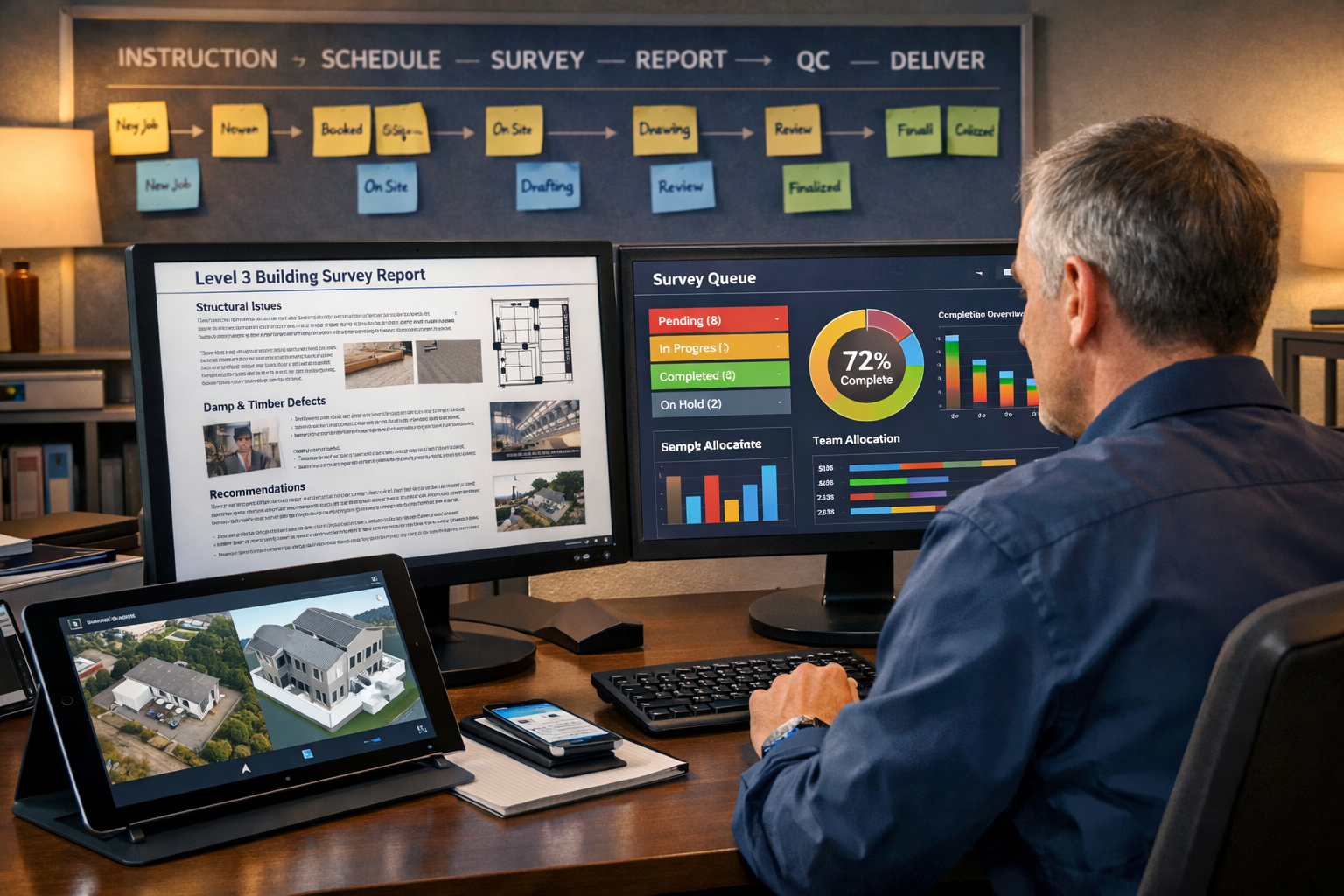
Successfully managing increased volumes while maintaining quality standards demands systematic workflow transformation rather than simply working longer hours. Strategic workflow optimization begins with standardization of repeatable processes while preserving the customized analysis that each property requires.
Digital Template Systems
Modern surveying practices leverage comprehensive digital templates that accelerate report production without sacrificing thoroughness. These templates should include:
- Pre-populated section frameworks for common building elements (foundations, roofing, services, drainage)
- Standardized defect descriptions with severity classifications that surveyors customize to specific observations
- Integrated photo annotation tools that link images directly to relevant report sections
- Automated cross-referencing systems that ensure areas of further investigation are properly flagged throughout the report
The key distinction: templates provide structure and consistency, not pre-written conclusions. Each property receives individualized analysis within an efficient framework.
Strategic Team Allocation
High-performing surveying practices implement tiered team structures that optimize expertise deployment:
Senior Chartered Surveyors focus on complex properties, unusual construction types, listed buildings and conservation areas, and quality assurance reviews. Their expertise addresses the most challenging aspects of Building Surveys in the 2026 Recovery Boom: Managing Increased Volumes While Maintaining Quality Standards.
Mid-level Surveyors handle standard residential surveys, modern construction properties, and routine commercial assessments, with senior oversight on complex findings.
Graduate Surveyors support data collection, preliminary research, photographic documentation, and report drafting under supervision, accelerating overall throughput.
This structure multiplies capacity while ensuring appropriate expertise addresses each property's specific challenges.
Batching and Scheduling Optimization
Strategic scheduling transforms surveyor productivity. Effective approaches include:
- Geographic batching that clusters surveys in similar locations, reducing travel time by 30-40%
- Property type batching that allows surveyors to maintain mental focus on similar construction challenges
- Staggered report delivery schedules that prevent bottlenecks in the review and finalization stages
- Buffer time allocation for unexpected complications or building problems requiring detailed investigation
One leading practice: conducting site inspections Monday through Thursday, reserving Fridays for report writing, peer reviews, and client consultations. This rhythm prevents the common trap of accumulated site visits with delayed report production.
Technology Integration for Building Surveys in the 2026 Recovery Boom
The 2026 land survey equipment boom features significant advances in total stations, GPS/GNSS systems, and laser scanners designed for urban development applications[5]. While these tools primarily serve land surveying, building surveyors benefit from parallel technological advances that accelerate data collection without compromising analytical rigor.
Drone Survey Technology
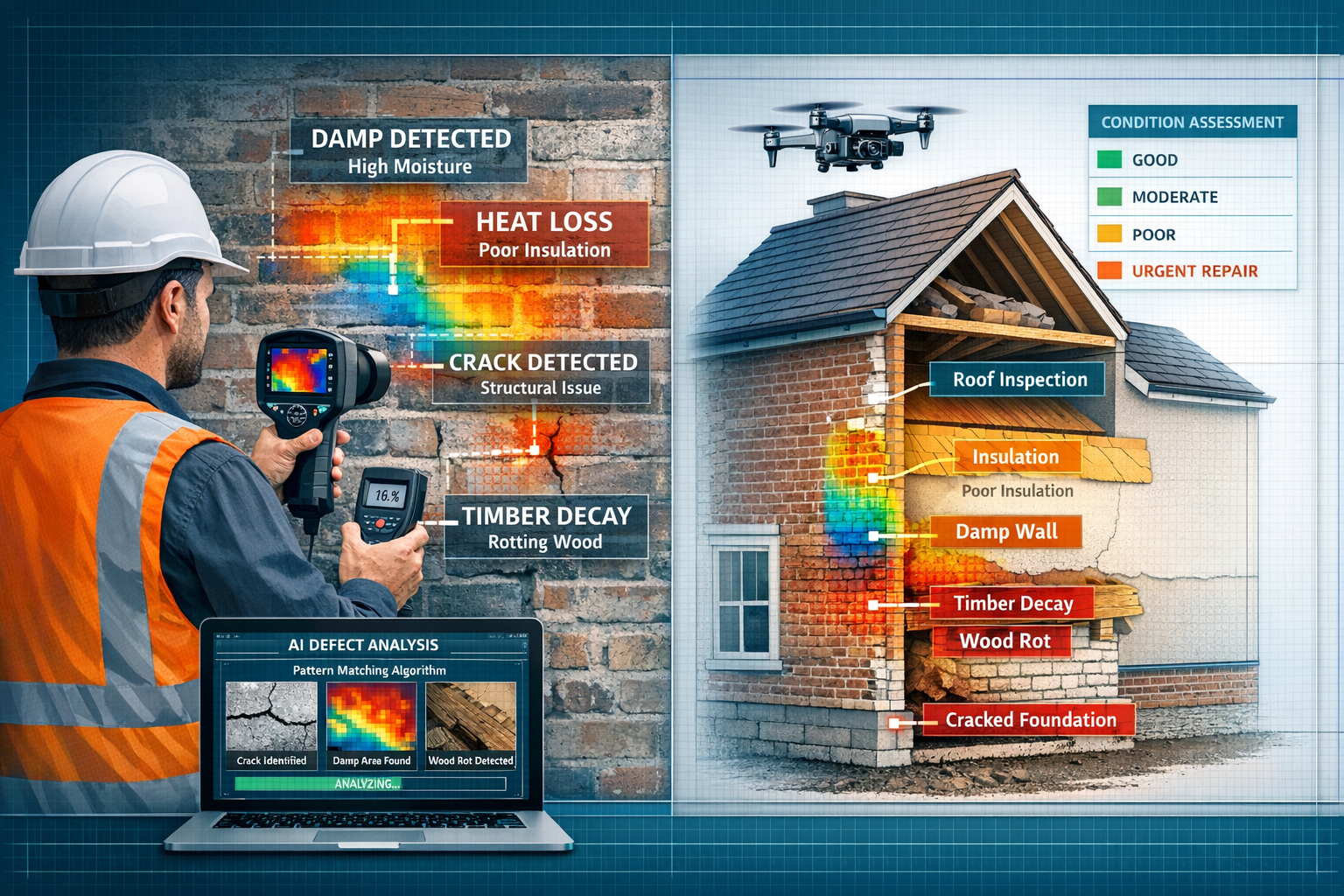
Premium drone surveys have evolved from specialized tools to standard equipment for efficient building assessment. Modern applications include:
- High-resolution roof condition documentation eliminating dangerous ladder access for initial assessment
- Thermal imaging overlays identifying heat loss, moisture penetration, and insulation deficiencies
- Photogrammetry-based 3D modeling creating detailed elevation records for complex buildings
- Chimney and high-level detail capture providing close-up imagery of otherwise inaccessible elements
The efficiency gain: comprehensive roof and high-level surveys completed in 20-30 minutes versus 2-3 hours using traditional access methods, with superior documentation quality and enhanced surveyor safety.
Mobile Data Capture Systems
Tablet-based inspection software transforms on-site efficiency by enabling:
- Real-time report drafting with observations recorded directly into structured templates during site inspection
- Instant photo integration with automatic geotagging and report section assignment
- Voice-to-text functionality allowing surveyors to dictate detailed observations while maintaining visual focus on building elements
- Offline capability ensuring functionality in properties without mobile connectivity
This technology reduces post-inspection report compilation time by 40-50%, accelerating delivery while observations remain fresh in the surveyor's mind.
Advanced Diagnostic Equipment
Modern building surveyors deploy sophisticated diagnostic tools that enhance assessment accuracy:
Thermal imaging cameras identify moisture intrusion, insulation gaps, and hidden structural issues invisible to visual inspection. These tools prove particularly valuable for environmental issues assessment and energy efficiency evaluation.
Moisture meters with deep-wall probes quantify dampness levels rather than relying solely on visual indicators, providing objective data for condition assessment.
Borescope inspection cameras enable non-destructive investigation of wall cavities, roof spaces, and underfloor areas, expanding the scope of thorough examination without invasive opening-up works.
Laser distance measurers and digital levels accelerate dimensional verification and levelness assessment with greater accuracy than traditional methods.
Digital Report Production Systems
Cloud-based report production platforms enable collaborative workflows where multiple team members contribute to comprehensive surveys:
- Simultaneous section drafting with different surveyors addressing specific building elements
- Automated quality checks flagging incomplete sections, missing cross-references, or inconsistent terminology
- Template libraries ensuring consistent formatting and professional presentation across all reports
- Client portal integration enabling secure report delivery and streamlined communication
The critical distinction: technology accelerates process efficiency while the surveyor's professional judgment, experience, and analytical skills remain central to quality outcomes. Tools enhance capability; they don't replace expertise.
Quality Assurance Protocols During High-Volume Periods
Building Surveys in the 2026 Recovery Boom: Managing Increased Volumes While Maintaining Quality Standards demands uncompromising commitment to quality assurance even when operational pressures intensify. Quality failures damage professional reputation far more severely than delayed delivery, making robust QA systems non-negotiable.

Mandatory Peer Review Systems
High-performing practices implement structured peer review protocols:
Technical review by a senior surveyor examines every report for completeness, accuracy, and appropriate recommendations. This review specifically verifies:
- All major building elements receive adequate attention
- Maintenance recommendations align with identified defects
- Cost estimates reflect current market conditions
- Areas requiring specialist investigation are clearly identified
- Conclusions logically follow from observations
Editorial review ensures professional presentation, clear communication, and client accessibility. Reports must communicate complex technical issues in language property buyers understand without oversimplification.
Spot-check site verification involves senior surveyors occasionally accompanying junior colleagues on inspections, providing real-time mentoring and quality calibration.
Standardized Inspection Checklists
Comprehensive checklists prevent omissions during site inspections while allowing flexibility for property-specific issues. Effective checklists include:
- Systematic building element coverage from foundations through roof structure
- Services assessment protocols for heating, electrical, plumbing, and drainage systems
- External grounds evaluation including boundaries, outbuildings, and site drainage
- Regulatory compliance verification for building control, planning permissions, and safety standards
- Documentation requirements ensuring adequate photographic evidence for all significant observations
These checklists function as quality guardrails, not restrictive scripts. Experienced surveyors adapt their inspection approach to each property's unique characteristics while ensuring nothing significant goes unnoticed.
Continuous Professional Development
Maintaining quality standards during volume increases requires ongoing skill development:
Technical training keeps surveyors current on modern construction methods, building materials, and defect recognition. The construction industry evolves continuously; surveyor knowledge must keep pace.
Report writing workshops refine communication skills, ensuring complex technical findings translate into actionable client guidance.
Technology proficiency training maximizes the value of diagnostic equipment and digital tools, preventing sophisticated equipment from becoming underutilized investments.
Case study reviews examine challenging properties, unusual defects, and complex situations, building collective expertise across the surveying team.
Client Communication Standards
Quality extends beyond technical accuracy to encompass client experience. Professional practices establish communication protocols including:
- Clear turnaround time commitments with realistic delivery schedules rather than overpromising
- Interim updates for complex surveys requiring extended investigation
- Accessible follow-up consultation allowing clients to discuss findings and recommendations
- Educational approach helping property buyers understand which building survey they need for their specific circumstances
Understanding that most clients lack technical construction knowledge, surveyors must translate findings into practical implications for property purchase decisions and ownership responsibilities.
Resource Planning and Capacity Management
Strategic resource planning enables practices to capitalize on the 2026 recovery boom without overextending capabilities or compromising standards. Sustainable growth requires deliberate capacity development rather than reactive scrambling to meet demand spikes.
Forecasting Sector-Specific Demand
Analyzing construction trends helps anticipate surveying demand patterns:
- Monitor planning applications in service areas to predict residential survey requirements 3-6 months ahead
- Track commercial development announcements signaling future demand for pre-acquisition and condition surveys
- Maintain relationships with developers and contractors providing early visibility into project pipelines
- Analyze seasonal patterns in property transactions to optimize staffing levels
This intelligence enables proactive recruitment, training investments, and strategic partnerships before demand peaks overwhelm capacity.
Flexible Capacity Models
Modern practices employ varied staffing approaches to manage volume fluctuations:
Core permanent team provides stable capacity for baseline demand and maintains quality culture and standards.
Associate surveyors with established relationships provide surge capacity during peak periods while maintaining quality consistency through familiarity with practice standards.
Graduate training programs develop future capacity while providing immediate support for data collection, research, and preliminary analysis under supervision.
Strategic partnerships with complementary practices enable mutual support during capacity constraints or specialized expertise requirements.
Technology Investment Priorities
Limited resources require strategic technology investment decisions. Priority areas for practices managing increased volumes include:
- Mobile inspection platforms delivering immediate productivity gains through on-site report drafting
- Drone equipment and pilot training expanding high-level inspection capability
- Cloud-based collaboration systems enabling team coordination and remote work flexibility
- Advanced diagnostic equipment enhancing assessment accuracy and client value
Technology investments should demonstrate clear ROI through time savings, quality enhancement, or expanded service capability rather than pursuing novelty for its own sake.
Managing Client Expectations
Transparent communication prevents disappointment and maintains professional relationships during high-demand periods:
- Realistic scheduling that acknowledges current workload rather than accepting every instruction regardless of capacity
- Tiered service options offering expedited delivery for premium fees or standard timelines at regular rates
- Clear scope definitions ensuring clients understand what Level 3 full building surveys include versus more limited inspections
- Proactive updates if unexpected complications extend delivery timelines
Clients appreciate honesty about availability and timelines far more than accepted instructions followed by delays and excuses.
Balancing Speed and Thoroughness
The fundamental tension in Building Surveys in the 2026 Recovery Boom: Managing Increased Volumes While Maintaining Quality Standards centers on balancing efficiency with comprehensive investigation. Speed without thoroughness produces liability risks and client dissatisfaction; thoroughness without efficiency creates unsustainable business models.
Time Allocation Standards
Establishing appropriate time allocations for different property types ensures adequate investigation without unnecessary inefficiency:
- Standard modern residential (up to 2,000 sq ft): 2.5-3.5 hours on-site inspection
- Larger modern residential (2,000-4,000 sq ft): 3.5-5 hours on-site
- Period properties requiring detailed investigation: 4-6 hours on-site
- Complex properties with significant defects: Extended time as required
These standards provide planning frameworks while acknowledging that individual properties may require more or less time based on specific circumstances. The surveyor's professional judgment determines appropriate investigation depth.
Knowing When to Slow Down
Experienced surveyors recognize situations demanding extended investigation regardless of scheduling pressures:
- Structural movement indicators requiring detailed crack mapping and pattern analysis
- Suspected concealed defects where limited opening-up or specialist investigation becomes necessary
- Complex building alterations where building control compliance and structural adequacy require careful evaluation
- Significant moisture penetration demanding thorough investigation of causes and extent
Professional integrity requires acknowledging when properties exceed standard survey scope and adjusting timelines accordingly. Clients benefit far more from delayed but thorough reports than rushed assessments missing critical issues.
Risk-Based Investigation Approach
Efficient surveyors employ risk-based investigation prioritization:
High-risk elements receive detailed attention regardless of apparent condition:
- Structural integrity (foundations, load-bearing walls, roof structure)
- Water penetration vulnerability (roofing, drainage, damp-proofing)
- Safety-critical systems (electrical installations, gas services, structural stability)
Moderate-risk elements receive appropriate investigation proportionate to age and condition:
- Building services (heating, plumbing, ventilation)
- Non-structural elements (internal finishes, joinery, fittings)
- External works (boundaries, paving, outbuildings)
Lower-risk elements receive visual assessment with recommendations for routine maintenance:
- Decorative condition
- Minor cosmetic defects
- Routine wear and tear
This approach ensures critical issues receive thorough investigation while avoiding disproportionate time on minor matters.
Leveraging Specialist Support
Building Surveys in the 2026 Recovery Boom: Managing Increased Volumes While Maintaining Quality Standards often requires recognizing when specialist expertise enhances survey quality and manages professional liability.
When to Recommend Specialist Investigations
Professional surveyors identify situations requiring specialist input:
- Structural engineers for significant cracking, movement, or structural alterations requiring load calculations
- Electrical specialists for outdated wiring systems, commercial installations, or safety concerns
- Drainage specialists for complex drainage issues, suspected defects, or commercial systems
- Environmental consultants for contamination concerns, asbestos presence, or hazardous materials
- Arboricultural consultants for tree-related subsidence risks or protected specimens
Recommending appropriate specialists demonstrates professional competence rather than limitation. Clients appreciate surveyors who recognize the boundaries of generalist expertise and guide them toward comprehensive property understanding.
Building Strategic Referral Networks
Establishing relationships with reliable specialists streamlines the recommendation process:
- Pre-vetted specialist contacts with proven competence and professional standards
- Coordinated investigation timing enabling specialists to access properties efficiently
- Collaborative reporting where specialist findings integrate with building survey recommendations
- Reciprocal referrals creating mutually beneficial professional relationships
These networks enhance service quality while providing specialists with consistent instruction flow, creating win-win professional relationships.
Future-Proofing Survey Practices
The 2026 recovery boom represents both immediate opportunity and long-term strategic inflection point. Forward-thinking practices use current volume increases to build sustainable competitive advantages.
Investing in Team Development
Structured training programs transform junior surveyors into competent professionals faster, multiplying capacity while maintaining standards. Effective programs include:
- Supervised inspection experience with graduated responsibility
- Formal technical training in construction technology and defect recognition
- Report writing mentorship with detailed feedback
- Professional qualification support for APC candidates
Practices that invest in development during busy periods build loyalty and retain talent, avoiding the costly cycle of recruitment and turnover.
Building Digital Infrastructure
Technology investments made during the 2026 boom create lasting efficiency advantages:
- Comprehensive digital libraries of defect photography, technical details, and reference materials
- Knowledge management systems capturing institutional expertise and best practices
- Client relationship management platforms streamlining communication and instruction processing
- Data analytics capabilities tracking performance metrics and identifying improvement opportunities
These systems compound value over time, creating increasingly efficient operations as data accumulates and processes refine.
Developing Niche Expertise
The differentiated 2026 construction landscape creates opportunities for specialized positioning:
- Data center and technology facility expertise serving the booming sector with specialized knowledge
- Period property specialists addressing the complex challenges of historic buildings
- Sustainable building assessment as energy efficiency and environmental performance gain importance
- Commercial and investment property focus serving developer and investor clients
Specialization enables premium positioning while building deep expertise that generalist competitors cannot easily replicate.
Conclusion
Building Surveys in the 2026 Recovery Boom: Managing Increased Volumes While Maintaining Quality Standards represents a defining challenge for professional surveying practices. The construction sector's uneven recovery—with data centers and infrastructure driving growth while broader markets show cautious optimism—creates both opportunity and operational complexity[2][3][4].
Success requires systematic approaches across multiple dimensions: workflow optimization through digital templates and strategic team allocation, technology integration leveraging drones and mobile inspection platforms, uncompromising quality assurance with peer review and standardized protocols, and strategic resource planning that anticipates sector-specific demand patterns.
The fundamental principle remains clear: technology and process efficiency enable surveyors to work smarter, but professional judgment, technical expertise, and thorough investigation remain irreplaceable. Practices that maintain this balance—accelerating repeatable processes while preserving analytical rigor—will thrive during the 2026 recovery and beyond.
Actionable Next Steps
For surveying practices navigating the 2026 recovery boom:
- Audit current workflows to identify bottlenecks and inefficiencies limiting capacity
- Invest in mobile inspection technology delivering immediate productivity gains
- Implement mandatory peer review systems if not already established
- Develop strategic specialist networks for reliable referral relationships
- Create realistic capacity forecasts based on sector-specific construction trends
- Establish clear quality standards that remain non-negotiable regardless of volume pressures
- Build team capability through structured training and professional development
The practices that emerge strongest from the 2026 recovery boom will be those that viewed increased demand not merely as short-term revenue opportunity but as catalyst for building sustainable operational excellence. Quality and efficiency need not conflict—properly implemented, they reinforce each other, creating practices that deliver exceptional client value at sustainable scale.
Understanding the difference between survey levels and matching appropriate investigation depth to property characteristics remains fundamental to efficient resource allocation. The 2026 recovery boom rewards practices that combine technological sophistication with traditional surveying rigor, meeting increased demand without compromising the thorough investigation that protects clients and upholds professional standards.
References
[1] The Church Construction Boom Why New Builds Are Surging Amid Widespread Closures In 2026 – https://www.churchesforsale.com/the-church-construction-boom-why-new-builds-are-surging-amid-widespread-closures-in-2026/
[2] constructiondive – https://www.constructiondive.com/news/5-construction-trends-2026/808904/
[3] 2026 Construction Industry Outlook – http://news.agc.org/economics/2026-construction-industry-outlook/
[4] Developers See Early Signs Of Recovery In Multifamily Construction Market – https://www.globest.com/2026/04/03/developers-see-early-signs-of-recovery-in-multifamily-construction-market/
[5] Navigating The 2026 Land Survey Equipment Boom Total Stations Gps And Laser Scanners Reviewed – https://nottinghillsurveyors.com/blog/navigating-the-2026-land-survey-equipment-boom-total-stations-gps-and-laser-scanners-reviewed