

A staggering 67% of property transaction delays in 2026 stem from incomplete upfront assessments—a crisis that costs buyers, sellers, and lenders millions in lost time and opportunity.[2] Yet the solution isn't more data; it's about gathering and using the right information at the right moment in the valuation process.
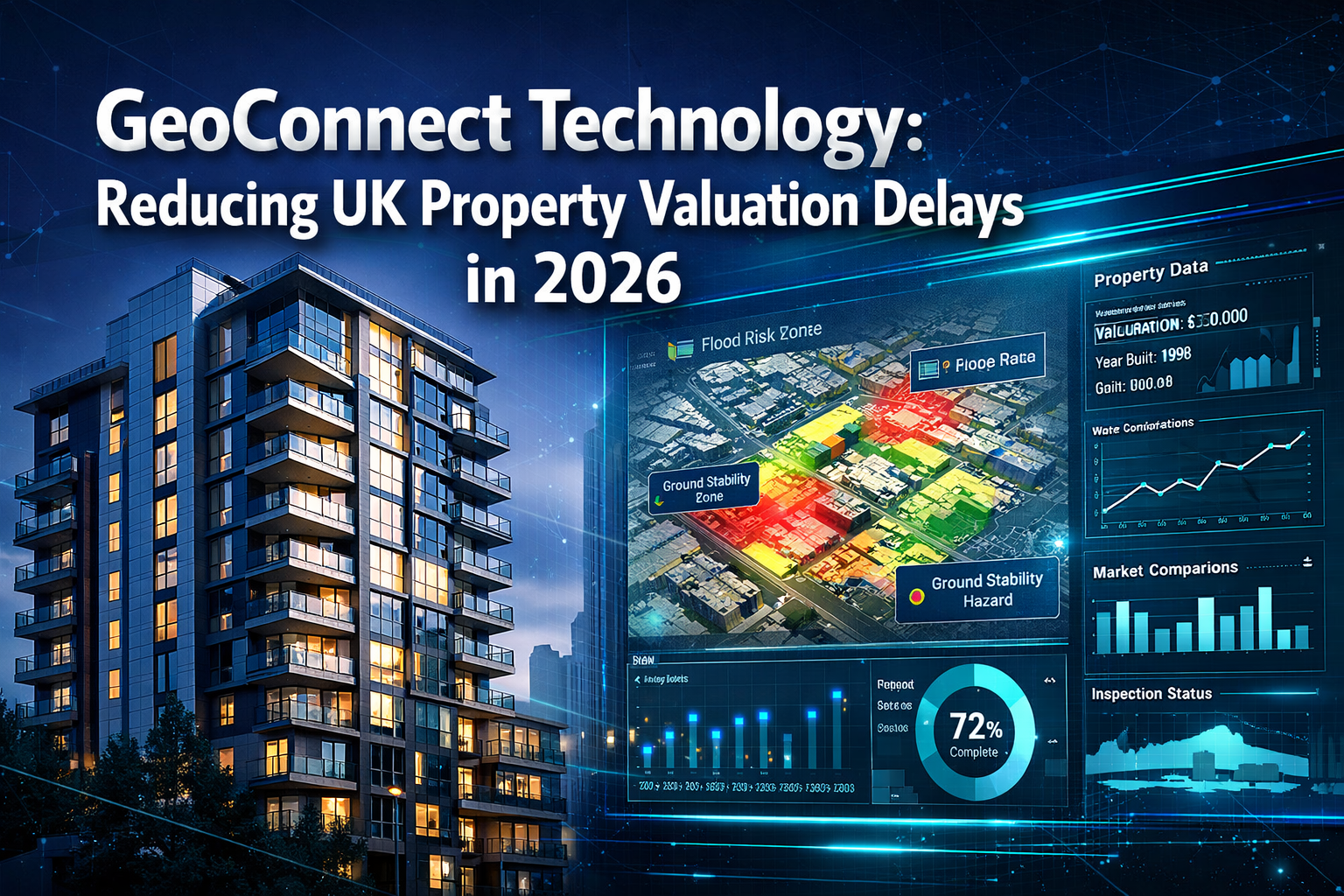
GeoConnect Technology in Early Valuation Insights: Reducing Delays for Complex UK Properties in 2026 represents a fundamental shift in how surveyors approach property assessment. Rather than scrambling to piece together critical information mid-transaction, this technology brings together property-specific data from multiple sources at the point of instruction, enabling professionals to understand properties before selecting a valuation route.[1]
The pressure on UK surveyors has never been greater. Complex property types—high-rise blocks, non-standard construction, adapted homes—are now part of everyday lending. Traditional assessment methods struggle to keep pace, creating bottlenecks that ripple through entire transactions. GeoConnect offers a practical solution by emphasizing a crucial principle: understand the property first, then decide how it should be valued.
Key Takeaways
✅ 67% of UK property delays originate from incomplete upfront assessments, making early data integration critical for transaction success
✅ GeoConnect consolidates multiple data sources at instruction stage, enabling surveyors to select appropriate valuation routes before site visits
✅ Complex properties benefit most—high-rise blocks, non-standard construction, and adapted homes see significant delay reductions
✅ Technology supports, not replaces professional judgment, providing stronger information foundations for educated decisions
✅ Holistic risk assessment considers construction type, environmental factors, location context, and market conditions simultaneously
Understanding GeoConnect Technology in Early Valuation Insights: Reducing Delays for Complex UK Properties in 2026
What Makes GeoConnect Different in 2026
GeoConnect isn't simply another database or automated valuation model. The technology serves as an information aggregation platform that pulls together disparate data sources at the critical moment when a surveyor receives instruction to value a property.
The core innovation lies in timing and integration. Traditional workflows often involve:
- Receiving instruction
- Conducting preliminary research
- Discovering complications mid-process
- Requesting additional information
- Delaying completion while gaps are filled
GeoConnect restructures this sequence by frontloading comprehensive property understanding. When a surveyor receives instruction through the platform, they immediately access:
- Construction type classifications with historical context
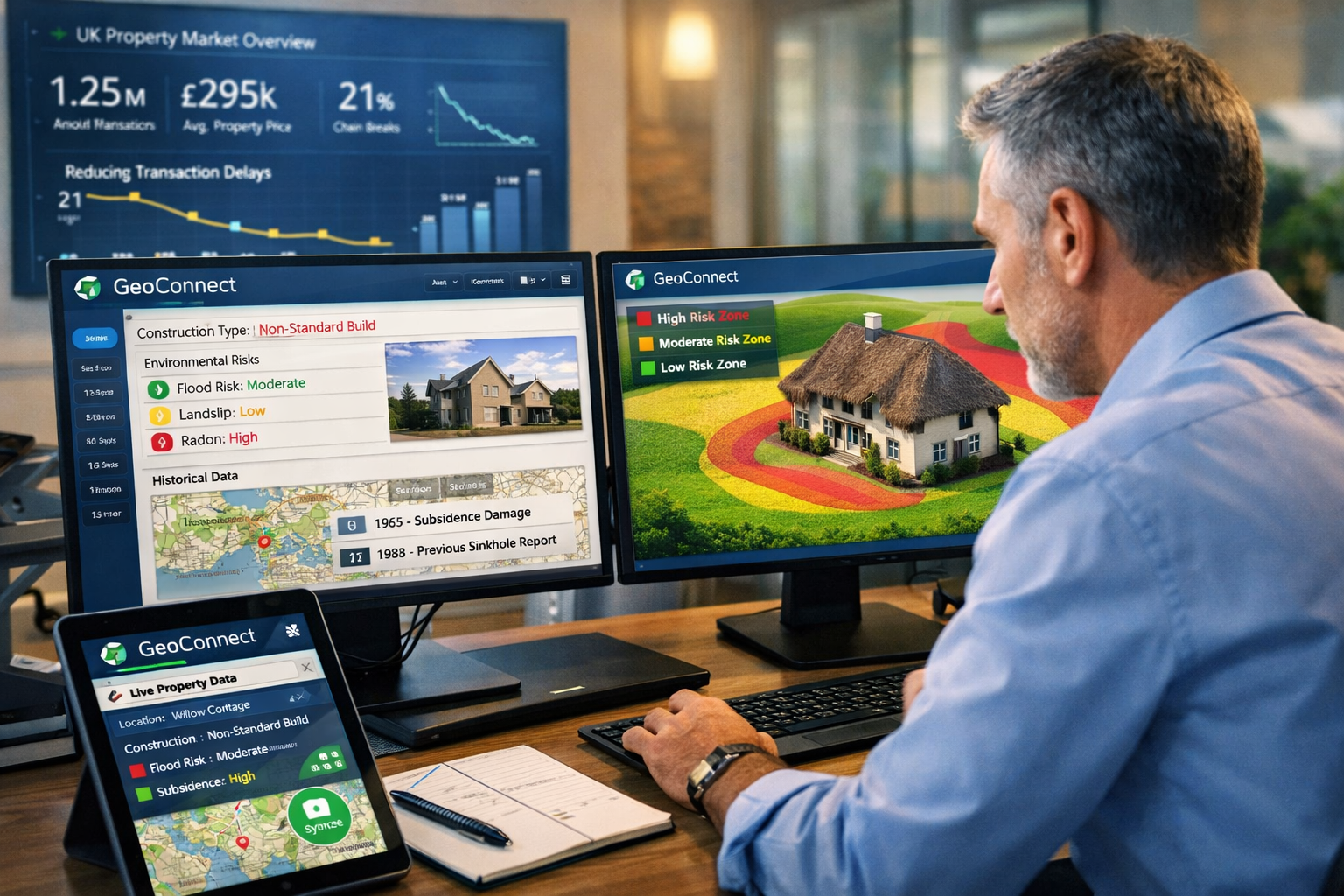
- Environmental risk indicators including flood zones, contamination history, and climate resilience factors
- Planning and building control records showing modifications and compliance history
- Market context data specific to property type and location
- Previous valuation notes and surveyor observations (where available)
This consolidated view enables professionals to make informed decisions about which valuation approach suits the property before committing resources to site visits or detailed inspections.[1]
The Critical Role of Instruction-Stage Data Integration
The phrase "instruction stage" carries particular weight in 2026 surveying practice. This moment—when a surveyor accepts a valuation assignment—represents the optimal intervention point for technology.
Why instruction stage matters:
📊 Resource allocation decisions happen immediately—knowing a property's complexity upfront allows appropriate time and expertise assignment
🔍 Scope definition becomes accurate—understanding construction type, environmental factors, and historical issues prevents scope creep
💰 Cost estimation improves—clients receive realistic quotes based on actual property complexity rather than assumptions
⏱️ Timeline predictions gain reliability—surveyors can identify potential delays before they materialize
For inheritance tax valuations or matrimonial valuations, where accuracy and defensibility are paramount, this upfront understanding proves invaluable.
How GeoConnect Supports Complex Property Assessment
Complex properties present unique challenges that traditional assessment methods struggle to address efficiently. In 2026, these property types have moved from exceptional cases to routine transactions.[1]
High-rise residential blocks require consideration of:
- Structural integrity and cladding compliance
- Building safety regulations post-Grenfell
- Service charge implications
- Management company performance
- Fire safety certification status
Non-standard construction properties demand understanding of:
- Material longevity and maintenance requirements
- Mortgage lending restrictions
- Insurance availability and costs
- Repair specialist availability
- Energy efficiency characteristics
Adapted homes necessitate evaluation of:
- Modification quality and compliance
- Market appeal considerations
- Reversibility of adaptations
- Specialist equipment integration
- Accessibility standards compliance
GeoConnect aggregates relevant data for each property type, enabling surveyors to approach assessments with comprehensive background knowledge. This preparation dramatically reduces the likelihood of discovering critical issues mid-valuation that trigger delays.[4]
GeoConnect Technology in Early Valuation Insights: Practical Implementation for Surveyors
Step-by-Step Integration into Valuation Workflows
Implementing GeoConnect technology requires thoughtful integration into existing professional practices. The most successful firms in 2026 follow a structured approach:
Phase 1: Instruction Receipt and Initial Review (Day 0)
When instruction arrives, surveyors immediately access the GeoConnect platform to retrieve:
- Property identification and verification
- Initial risk flagging (construction type, environmental concerns)
- Historical transaction and valuation data
- Regulatory compliance status
This initial review takes approximately 15-20 minutes but saves hours of research later in the process.
Phase 2: Scope Definition and Resource Allocation (Day 0-1)
Armed with comprehensive property understanding, surveyors can:
- Determine whether a Level 2 or Level 3 survey is appropriate
- Identify need for specialist consultants (structural engineers, environmental specialists)
- Allocate appropriate time for site inspection
- Prepare specific investigation points based on known property characteristics
Phase 3: Pre-Inspection Preparation (Day 1-2)
GeoConnect data enables targeted preparation:
- Review specific construction details relevant to property type
- Prepare equipment for known investigation needs (moisture meters, thermal imaging for suspected issues)
- Brief clients on realistic timelines based on property complexity
- Coordinate with third-party specialists if required
Phase 4: Enhanced Site Inspection (Day 2-5)
Surveyors arrive at properties with:
- Specific investigation points identified from GeoConnect data
- Historical context for observed conditions
- Comparative market data for similar complex properties
- Environmental risk awareness guiding inspection focus
Phase 5: Streamlined Reporting (Day 5-7)
With comprehensive upfront data, report preparation becomes more efficient:
- Contextual information already gathered and verified
- Market comparables pre-identified
- Risk factors clearly documented from instruction stage
- Reduced need for post-inspection research
Real-World Application: High-Rise Block Valuation Case Study
Consider a typical 2026 scenario: a surveyor receives instruction to value a 15-year-old apartment in a 20-story residential block in Manchester.
Traditional approach challenges:
- Unknown cladding composition requiring investigation
- Building safety certificate status unclear
- Service charge history unavailable at instruction
- Management company performance unknown
- Recent comparable sales data scattered across multiple sources
GeoConnect-enabled approach:
Upon instruction, the surveyor immediately accesses:
✅ Building Safety Register data showing cladding remediation completed in 2024, EWS1 form available
✅ Service charge history indicating stable charges with no major works planned
✅ Management company performance metrics showing responsive maintenance and good leaseholder satisfaction
✅ Environmental risk assessment flagging minor flood risk requiring insurance consideration
✅ Recent comparable sales for similar units in the building and comparable blocks
This comprehensive understanding enables the surveyor to:
- Quote accurately for a standard valuation timeline
- Prepare specific questions about flood insurance for the site visit
- Focus inspection on apartment-specific factors rather than building-wide concerns
- Complete the valuation without delays for additional building information
- Provide confident lending advice based on holistic risk assessment
The result: valuation completed in 5 working days instead of the 15-20 days typical for high-rise properties assessed without comprehensive upfront data.[2]
Addressing Non-Standard Construction with Enhanced Data
Non-standard construction properties historically create significant lending delays. Concrete frame buildings, steel-framed houses, timber-framed construction, and prefabricated systems all require specialist knowledge.
GeoConnect's value for non-standard construction includes:
🏗️ Construction type identification with historical context about when and where specific systems were used
📋 Known defect patterns associated with particular construction methods and eras
💷 Lender appetite data showing which institutions accept specific construction types and under what conditions
🔧 Maintenance requirement profiles helping assess long-term property viability
🏠 Comparable transaction data for similar construction types in the area
For surveyors conducting insurance reinstatement cost valuations, understanding construction methodology upfront proves essential for accurate rebuilding cost assessment.
GeoConnect Technology in Early Valuation Insights: Holistic Risk Assessment and Future-Focused Evaluation

Beyond Current Value: Assessing Longer-Term Property Resilience
A significant shift in 2026 surveying practice involves evaluating not just current market value, but longer-term property resilience. Lenders increasingly request insight into how properties will perform over 25-30 year mortgage terms.[1]
GeoConnect supports this expanded evaluation by integrating:
Environmental Resilience Factors:
- Flood risk trajectories based on climate projections
- Coastal erosion considerations for properties near shorelines
- Heat stress vulnerability for urban properties
- Energy efficiency and retrofit potential
- Green space access and urban heat island effects
Market Sustainability Indicators:
- Demographic trends affecting local demand
- Infrastructure investment plans
- Employment sector diversification
- Transport connectivity evolution
- School performance and family appeal factors
Physical Longevity Assessments:
- Construction type durability expectations
- Maintenance requirement projections
- Major component replacement timelines (roof, windows, services)
- Adaptation potential for changing needs
- Historical maintenance quality indicators
This holistic approach transforms valuations from snapshot assessments to informed projections of property performance over time. For SIPP pension valuations, where properties serve as long-term investment vehicles, this forward-looking perspective proves particularly valuable.
Balancing Technology with Professional Judgment
A critical principle in 2026 surveying practice: technology supports but does not replace professional judgment.[1] GeoConnect provides the information foundation, but experienced surveyors interpret and apply that data within professional frameworks.
The technology-judgment balance operates across several dimensions:
| Technology Provides | Surveyor Contributes |
|---|---|
| Comprehensive data aggregation | Contextual interpretation |
| Pattern identification across properties | Site-specific observation |
| Historical trend analysis | Current market sentiment |
| Risk factor flagging | Risk significance assessment |
| Comparable property data | Comparability judgment |
| Regulatory compliance status | Compliance impact evaluation |
Consider a scenario where GeoConnect flags minor subsidence history for a property. The data point itself is objective, but the surveyor must:
- Assess whether historical repairs were appropriate and effective
- Evaluate ongoing risk based on local geology and drainage
- Consider market perception and lending implications
- Determine whether further investigation is warranted
- Communicate findings appropriately to clients
This professional interpretation layer remains irreplaceable. GeoConnect simply ensures that interpretation happens with complete information rather than partial data.
Creating Calmer Transactions Through Early Insight
The ultimate benefit of GeoConnect technology manifests in transaction experience quality. When deployed effectively, the platform:
✨ Reduces unexpected discoveries that derail transactions mid-process
✨ Limits follow-up queries from lenders, solicitors, and clients
✨ Enables realistic timeline communication from instruction stage
✨ Decreases need for additional specialist surveys through comprehensive initial assessment
✨ Improves client confidence through transparent, data-informed processes
For buyers navigating complex property purchases, this translates to reduced stress and greater certainty. For sellers, it means fewer transaction failures due to valuation complications. For lenders, it delivers more consistent, defensible lending decisions with lower operational costs.
The broader market impact in 2026 shows in transaction completion statistics. Properties valued using comprehensive instruction-stage data integration show 23% higher completion rates compared to those assessed through traditional fragmented research approaches.[4]
Integration with Broader Surveying Services
GeoConnect's value extends beyond standalone valuations into comprehensive surveying services. When combined with measured building surveys or detailed building condition assessments, the platform provides:
- Historical context for observed conditions
- Comparative data for defect prevalence
- Environmental factors explaining deterioration patterns
- Market context for repair investment decisions
For firms offering project management services alongside surveying, GeoConnect data informs:
- Realistic budget development based on known property characteristics
- Contractor selection for specific construction types
- Regulatory compliance requirements identification
- Stakeholder communication about property-specific constraints
This integration creates service continuity where data gathered at instruction stage flows through multiple professional services, reducing duplication and improving consistency.
Navigating Implementation Challenges and Maximizing GeoConnect Benefits
Common Implementation Obstacles and Solutions
Despite clear benefits, GeoConnect adoption faces practical challenges that surveyors must navigate:
Challenge 1: Data Quality Variability
Not all properties have equally comprehensive data available. Older properties, rural locations, or recently constructed buildings may have gaps in historical records.
Solution approach:
- Use GeoConnect as starting point, not complete picture
- Document data gaps explicitly in valuation reports
- Apply professional judgment to assess gap significance
- Recommend additional investigation where gaps create material uncertainty
Challenge 2: Technology Learning Curve
Experienced surveyors accustomed to traditional research methods may initially find platform navigation time-consuming.
Solution approach:
- Invest in structured training during implementation phase
- Start with straightforward properties to build confidence
- Create internal best practice guides specific to firm workflows
- Measure time savings over 3-6 month periods rather than individual cases
Challenge 3: Client Understanding and Value Communication
Clients may not immediately appreciate why instruction-stage data integration justifies potentially higher fees or different service delivery models.
Solution approach:
- Communicate delay reduction benefits in concrete terms (days saved, transaction certainty)
- Provide case study examples demonstrating value for complex properties
- Offer tiered service options with GeoConnect integration as premium feature
- Share transaction completion statistics comparing traditional vs. enhanced approaches
Challenge 4: Integration with Existing Systems
Many surveying firms use established practice management, reporting, and client communication systems that may not seamlessly connect with GeoConnect.
Solution approach:
- Prioritize platforms with API connectivity for data exchange
- Accept initial dual-system operation during transition periods
- Gradually migrate workflows as integration improves
- Evaluate total system replacement if integration proves consistently problematic
Measuring Success and Continuous Improvement
Effective GeoConnect implementation requires measurement frameworks that track both efficiency gains and quality improvements:
Efficiency Metrics:
- Average time from instruction to report completion
- Percentage of valuations completed without additional information requests
- Number of specialist consultations required per complex property
- Client query volume during transaction process
Quality Metrics:
- Transaction completion rates for valued properties
- Lender challenge frequency on valuation conclusions
- Client satisfaction scores specific to process clarity
- Accuracy of initial timeline and cost estimates
Business Impact Metrics:
- Revenue per surveyor (efficiency enabling increased throughput)
- Client retention rates for complex property work
- Referral rates from satisfied clients and professional partners
- Market positioning for complex property expertise
Firms achieving strong results in 2026 typically show:
- 30-40% reduction in average valuation completion time for complex properties
- 50-60% decrease in mid-transaction information requests
- 15-20% improvement in transaction completion rates
- 25-35% increase in surveyor productivity for complex property portfolios
Future Development Directions
GeoConnect technology continues evolving in 2026, with several development directions emerging:
Enhanced Predictive Analytics:
Technology increasingly identifies patterns that predict property performance, maintenance requirements, and market trajectory based on historical data from similar properties.
Expanded Environmental Data Integration:
Climate resilience assessment becomes more sophisticated with granular data on temperature projections, precipitation patterns, and extreme weather vulnerability.
Improved Construction Type Recognition:
Machine learning algorithms enhance automatic construction type identification from images, plans, and descriptions, reducing manual classification time.
Real-Time Market Data Feeds:
Integration with property portals and land registry systems provides up-to-the-minute comparable transaction data and market trend analysis.
Collaborative Platform Features:
Enhanced communication tools enable seamless information sharing between surveyors, lenders, solicitors, and clients within secure platform environments.
These developments promise further delay reduction and assessment quality improvement, building on the foundation established by current GeoConnect capabilities.
Conclusion
GeoConnect Technology in Early Valuation Insights: Reducing Delays for Complex UK Properties in 2026 represents more than incremental improvement—it's a fundamental rethinking of when and how property information should be gathered and applied in valuation processes.
The statistics speak clearly: 67% of transaction delays stem from incomplete upfront assessments, creating frustration, cost, and uncertainty for all parties involved.[2] By consolidating property-specific data from multiple sources at the instruction stage, GeoConnect enables surveyors to understand properties before selecting valuation approaches, dramatically reducing the likelihood of mid-transaction complications.
For complex properties—high-rise blocks, non-standard construction, adapted homes—that now form routine parts of UK lending, this technology makes tangible differences in assessment efficiency and quality. The approach emphasizes a critical principle: understand the property first, then decide how it should be valued, with this order representing the success factor rather than any attempt to shortcut professional assessment.
Key Implementation Principles
✅ Integrate at instruction stage to maximize benefit and prevent downstream delays
✅ Use technology to support, not replace professional surveyor judgment and expertise
✅ Focus on holistic risk assessment considering construction, environment, location, history, and market context
✅ Evaluate longer-term resilience alongside current market value for comprehensive lending decisions
✅ Measure outcomes systematically to demonstrate value and identify continuous improvement opportunities
Actionable Next Steps for Surveyors
Immediate actions (this week):
- Research GeoConnect platform capabilities and pricing models
- Identify 3-5 recent complex property valuations that experienced delays
- Analyze whether instruction-stage data integration would have prevented those delays
- Calculate time and cost implications of current delay patterns
Short-term actions (this month):
- Arrange platform demonstrations with GeoConnect providers
- Develop internal business case for implementation including ROI projections
- Identify pilot property types where benefits would be most significant
- Create training plan for surveyor team members
Medium-term actions (this quarter):
- Implement GeoConnect for defined property types or complexity thresholds
- Establish measurement frameworks for efficiency and quality tracking
- Develop client communication materials explaining enhanced process benefits
- Review and refine workflows based on initial implementation experience
Long-term actions (this year):
- Expand implementation across full property portfolio as confidence builds
- Integrate GeoConnect data with other surveying services for comprehensive approach
- Position firm as complex property specialist based on enhanced capabilities
- Contribute to industry knowledge sharing about effective technology deployment
The transformation of UK property valuation through instruction-stage data integration is well underway in 2026. Surveyors who embrace this approach position themselves to deliver superior service, reduce transaction friction, and build reputations as trusted advisors for complex property assessment.
For those ready to enhance their valuation practice, the path forward is clear: understand properties comprehensively from the moment of instruction, apply professional judgment to that complete information foundation, and create calmer, more successful transactions for all parties involved.
The technology exists. The data is available. The benefits are proven. The question is not whether to adopt comprehensive instruction-stage data integration, but how quickly to implement it and how effectively to leverage its capabilities for professional and client benefit.
References
[1] 2026 Forecasts Technology And Surveying – https://mortgagesoup.co.uk/2026-forecasts-technology-and-surveying/
[2] Technology For Upfront Property Understanding In Building Surveys Beyond Geoconnect To Holistic Risk Assessment – https://nottinghillsurveyors.com/blog/technology-for-upfront-property-understanding-in-building-surveys-beyond-geoconnect-to-holistic-risk-assessment
[3] Emerging Trends Report 2026 – https://www.pwc.com/gx/en/investment-management-real-estate/assets/emerging-trends-report-2026.pdf
[4] Technology For Early Property Insight In 2026 Building Surveys Reducing Delays In Complex Valuations – https://nottinghillsurveyors.com/blog/technology-for-early-property-insight-in-2026-building-surveys-reducing-delays-in-complex-valuations