

{"cover":"Professional landscape format (1536×1024) hero image featuring bold text overlay 'Third Party Mechanisms in Party Wall Deadlocks: RICS Guidance for 2026 High-Volume Projects' in extra large 72pt white sans-serif font with dark shadow and semi-transparent navy overlay box, positioned center-upper third. Background shows three professional surveyors in business attire reviewing architectural plans and dispute documents at modern conference table with London construction skyline visible through floor-to-ceiling windows, neutral tones with RICS blue and gold accents, high contrast, editorial magazine cover quality, professional authority aesthetic","content":["Detailed landscape format (1536×1024) image showing professional meeting room scene with two appointed party wall surveyors seated across from each other at polished wooden table, architectural drawings and Party Wall Act 1996 documents spread between them, one surveyor pointing to specific clause while other reviews notes, neutral third surveyor standing at head of table with gavel symbol, modern office setting with London cityscape background, warm professional lighting, RICS certification visible on wall, composition emphasizes mediation and dispute resolution, editorial quality with blue and grey professional color palette","Comprehensive landscape format (1536×1024) infographic-style image displaying party wall dispute resolution timeline flowchart from left to right, showing stages: initial disagreement (red warning icon), surveyor appointment (two professional figures), third surveyor selection (neutral mediator icon), determination period (14-day calendar graphic), final award (legal document with stamp), and cost breakdown bar chart at bottom showing fee structures in pounds sterling, clean modern design with icons and connecting arrows, professional blue and gold RICS color scheme, high-volume project statistics overlaid, data visualization aesthetic","Striking landscape format (1536×1024) image of modern UK construction site with terraced housing development showing shared party walls between properties, construction workers and surveyor with hard hat reviewing plans in foreground, scaffolding and building materials visible, digital overlay showing transparent dispute resolution framework diagram with connected nodes, 2026 construction boom context with cranes in background, professional photography style with architectural focus, warm natural lighting, emphasis on efficient project delivery and dispute avoidance, contemporary urban development aesthetic"]
Construction disputes under the Party Wall etc. Act 1996 cost UK building owners an average of £3,500-£8,000 when third surveyors become necessary—yet 2026's housing market recovery is driving unprecedented volumes of party wall work, making efficient dispute resolution mechanisms more critical than ever. Understanding Third Party Mechanisms in Party Wall Deadlocks: RICS Guidance for 2026 High-Volume Projects can mean the difference between project delays costing tens of thousands and swift, legally binding resolutions that keep developments on track.
The construction sector's rebound in 2026 has created a perfect storm: increased building activity, tighter timelines, and higher stakes for both building and adjoining owners. When appointed surveyors cannot reach agreement, the statutory requirement to appoint a third surveyor becomes unavoidable. This comprehensive guide examines how RICS guidance shapes third party mechanisms, outlines appointment procedures, breaks down fee structures, and provides actionable strategies for avoiding costly deadlocks in today's high-volume project environment.
Key Takeaways
- Statutory requirement: Third surveyor appointment is mandatory under the Party Wall etc. Act 1996 when two appointed surveyors cannot agree, with determinations being final and legally binding on all parties
- Cost implications: Third surveyor fees typically range from £1,500-£5,000+ and come in addition to existing surveyor costs, representing the most expensive phase of party wall disputes
- Limited scope: Third surveyors rule only on specific points of disagreement submitted by appointed surveyors, not the entire dispute, with 14-day appeal windows to County Court
- RICS 2023 standards: The 7th edition professional standard emphasizes ethical conduct alongside statutory obligations, with enhanced CPD requirements effective January 2026
- Prevention strategies: Appointing experienced, RICS-qualified surveyors from the outset and maintaining clear communication significantly reduces the likelihood of third surveyor involvement
Understanding Third Party Mechanisms in Party Wall Deadlocks: RICS Guidance for 2026 High-Volume Projects
The Party Wall etc. Act 1996 establishes a clear framework for resolving disputes between building owners undertaking construction work and their neighbors. When the two appointed surveyors—one representing each party—reach an impasse on any matter, the legislation mandates a specific escalation mechanism. This third party mechanism serves as the final arbiter in party wall deadlocks, providing legally binding determinations that cannot be ignored by either party.[1]
The Statutory Framework
Under Section 10 of the Act, when two appointed surveyors cannot agree on any matter, they must immediately select and appoint a third surveyor. This requirement is not optional—it represents a statutory obligation that activates automatically upon deadlock.[5] The third surveyor mechanism exists to prevent construction projects from stalling indefinitely due to surveyor disagreements.
The third surveyor is not chosen by either the building owner or adjoining owner. Instead, the two appointed surveyors must jointly nominate and appoint this neutral specialist. This selection process ensures impartiality and prevents either party from gaining an unfair advantage in the dispute resolution process.[2]
Key Characteristics of Third Surveyor Determinations
Several critical features distinguish third surveyor involvement from standard party wall procedures:
🎯 Limited Scope: The third surveyor addresses only the specific point of disagreement submitted by the two appointed surveyors, not the entire dispute or all aspects of the party wall matter.[2]
⚖️ Final and Binding: The third surveyor's ruling on the disputed point is legally final and binding on all parties and both original surveyors, and must be incorporated into the final Party Wall Award.[2]
📋 Quasi-Judicial Function: Third surveyors operate in a quasi-judicial capacity, making determinations based on evidence, statutory requirements, and professional expertise—though they do not enjoy judicial immunity.[1]
⏱️ Appeal Mechanism: Parties may lodge an appeal with a County Court under Section 10(17) of the Act within 14 days of the determination being served, though appeals are rare, highly technical, and expensive.[2]
For building owners managing party wall matters, understanding these mechanisms helps set realistic expectations about timelines and costs when disputes arise.
RICS Professional Standards for Third Party Mechanisms in 2026
The Royal Institution of Chartered Surveyors (RICS) provides comprehensive guidance that shapes how party wall professionals approach third surveyor appointments and dispute resolution. The RICS Party Wall Legislation and Procedure standard, reissued in May 2023 as the 7th edition, replaced the previous guidance note with a professional standard that carries greater weight.[3]
Enhanced Professional Conduct Requirements
The 2023 RICS standard emphasizes that members must meet professional and ethical behaviour expectations commensurate with their membership, alongside their duty to conform to the Act. These obligations are complementary rather than mutually exclusive.[1][3]
Key professional conduct requirements include:
| Requirement | Description | Impact on Third Surveyor Appointments |
|---|---|---|
| Competence | Surveyors must only accept appointments where they possess adequate knowledge and expertise | Reduces likelihood of deadlocks caused by inexperience |
| Independence | Must maintain impartiality and avoid conflicts of interest | Critical for third surveyor selection and neutrality |
| Transparency | Clear communication about fees, processes, and timelines | Helps parties understand third surveyor cost implications |
| Accountability | RICS members can face disciplinary action for incompetence or bad faith | Provides recourse beyond statutory appeals |
The quasi-judicial function of party wall surveyors does not bestow judicial immunity. RICS members can face professional consequences for allegations of incompetence or bad faith, even when acting in their statutory capacity.[1]
2026 CPD Framework Updates
Effective January 2026, RICS implemented a revised Continuing Professional Development (CPD) framework with enhanced quality review. The organization now audits a higher proportion of member CPD records, focusing on quality and relevance of activities rather than simple hour accumulation.[4]
For party wall surveyors, this means:
- ✅ Greater emphasis on party wall-specific training and case study analysis
- ✅ Documentation of learning outcomes from complex third surveyor cases
- ✅ Demonstration of up-to-date knowledge of RICS standards and statutory requirements
- ✅ Evidence of ethical decision-making in dispute resolution scenarios
These enhanced requirements aim to elevate professional standards across the sector, particularly important given the increased volume of party wall work in 2026's construction recovery. Understanding common misconceptions about party wall agreements helps surveyors maintain high standards of client communication.
Ethical Considerations in High-Volume Environments
The 2026 construction boom creates unique pressures for party wall surveyors. High project volumes can tempt professionals to rush assessments or take shortcuts. RICS guidance explicitly addresses these pressures, requiring members to:
🔍 Maintain thoroughness: Even under time pressure, surveyors must conduct adequate investigations and provide properly reasoned determinations
💬 Communicate clearly: Parties must understand the implications of third surveyor involvement before deadlock occurs
💰 Provide transparent fee estimates: Building owners deserve clear cost projections, including potential third surveyor expenses
⚖️ Prioritize dispute avoidance: Appointed surveyors should exhaust all reasonable efforts to reach agreement before triggering third surveyor mechanisms
The cost of party wall agreements becomes significantly more burdensome when third surveyors become necessary, making prevention a priority for all parties.
Appointment Procedures and Selection Criteria for Third Surveyors
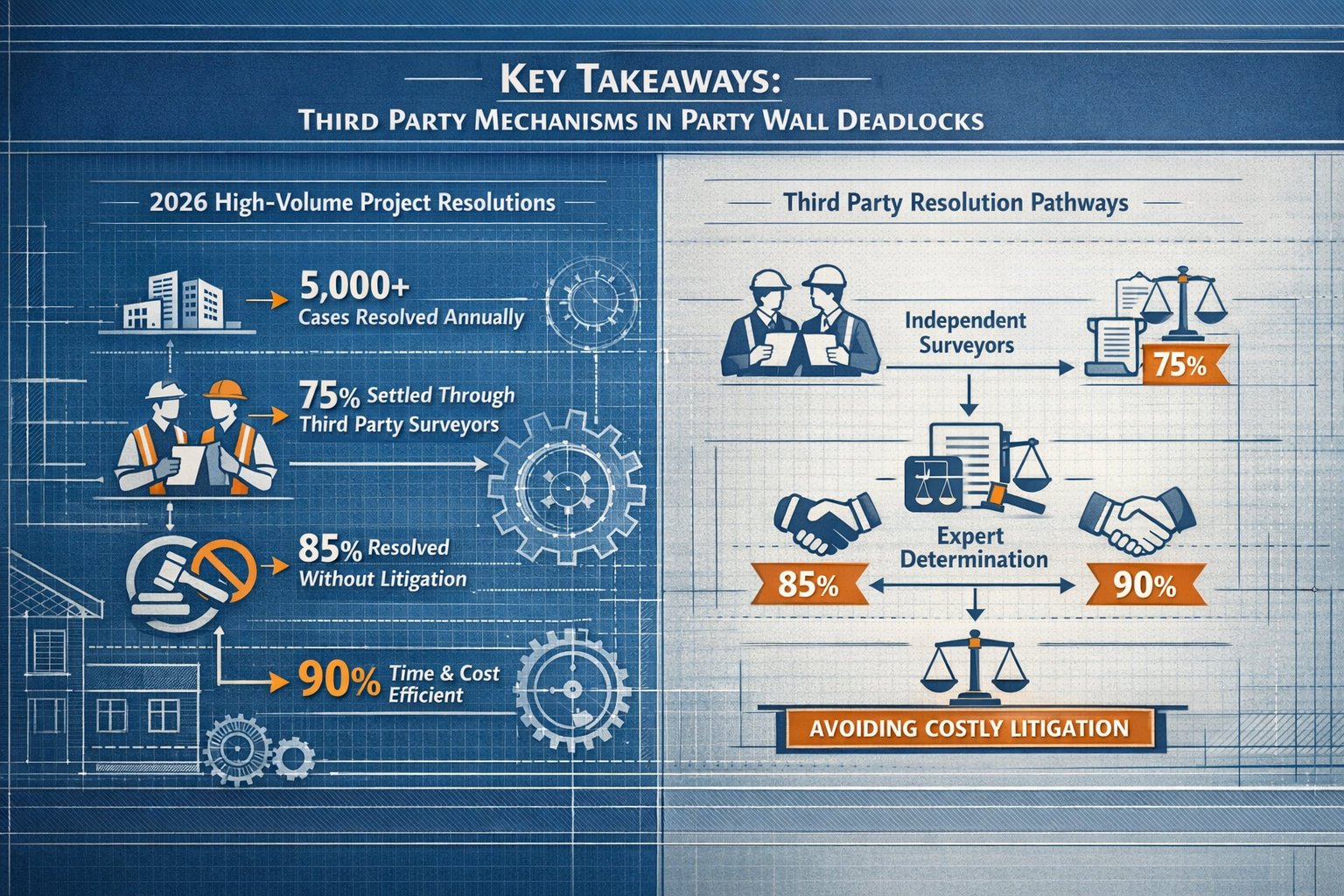
The process of appointing a third surveyor follows specific statutory requirements, but practical considerations significantly impact outcomes. Understanding these procedures helps building owners and their representatives navigate deadlocks efficiently while minimizing delays and costs.
The Joint Appointment Process
When two appointed surveyors reach deadlock, they must jointly select and appoint a third surveyor. This process typically unfolds in several stages:
1️⃣ Recognition of Deadlock: Either appointed surveyor may declare that agreement cannot be reached on a specific matter. This declaration triggers the statutory requirement for third surveyor appointment.[2]
2️⃣ Candidate Identification: The two appointed surveyors must collaborate to identify suitable candidates. Despite their disagreement on the substantive issue, they must work together on this procedural matter.
3️⃣ Neutral Selection: The selected third surveyor must be acceptable to both appointed surveyors. Neither the building owner nor adjoining owner has direct input into this selection, ensuring neutrality.[2]
4️⃣ Formal Appointment: Once agreed, the third surveyor is formally appointed in writing, with clear terms of reference outlining the specific point(s) requiring determination.
5️⃣ Fee Agreement: Before commencing work, the third surveyor establishes fee arrangements. These costs are typically borne by the building owner as part of overall party wall expenses, though the third surveyor may require upfront payment or security.
Essential Qualifications and Experience
Not every party wall surveyor is suitable for third surveyor appointments. The role requires specific qualifications and experience:
📚 Statutory Knowledge: Deep understanding of the Party Wall etc. Act 1996, relevant case law, and statutory interpretation principles
🏗️ Technical Expertise: Comprehensive knowledge of construction methods, structural engineering principles, and building pathology
⚖️ Dispute Resolution Experience: Proven track record in making quasi-judicial determinations and producing reasoned decisions
🎓 Professional Credentials: RICS membership (typically MRICS or FRICS) with specialization in party wall matters
📝 Report Writing Skills: Ability to produce clear, legally robust determinations that withstand scrutiny
🤝 Impartiality: No previous relationship with either party, appointed surveyor, or the properties in question
When checking engineers for party wall work, similar due diligence applies to third surveyor selection, though the stakes are higher given the binding nature of their determinations.
Geographic and Availability Considerations
In 2026's high-volume construction environment, third surveyor availability has become a practical constraint. The pool of suitably qualified and experienced professionals is limited, particularly in high-demand areas like London and the South East.
Regional Variations: Major urban centers have deeper pools of qualified third surveyors, while rural areas may require appointments from distant locations, increasing costs and timelines.
Workload Pressures: Experienced third surveyors often have full appointment books. Securing their services may require waiting periods of 2-4 weeks or longer during peak construction seasons.
Fee Implications: High-demand third surveyors command premium fees, particularly for complex disputes involving structural concerns or high-value properties.
Virtual Proceedings: Post-pandemic, many third surveyors conduct inspections and hearings partially remotely, potentially expanding the geographic pool of candidates while reducing travel costs.
For projects in specific regions, working with chartered surveyors in Surrey or chartered surveyors in London who understand local third surveyor availability can streamline the appointment process.
The Determination Process
Once appointed, the third surveyor follows a structured process to reach their determination:
Stage 1: Terms of Reference (1-3 days)
- Review the specific point(s) of disagreement submitted by appointed surveyors
- Clarify scope and boundaries of the determination required
- Establish timelines and procedural framework
Stage 2: Evidence Gathering (1-2 weeks)
- Review submissions from both appointed surveyors
- Conduct site inspections if necessary
- Request additional information or technical reports
- May consult with specialists on complex technical matters
Stage 3: Analysis and Deliberation (1-2 weeks)
- Evaluate evidence against statutory requirements
- Consider relevant case law and RICS guidance
- Assess technical feasibility and reasonableness of competing positions
- Draft preliminary findings
Stage 4: Determination (3-5 days)
- Produce written determination with clear reasoning
- Serve determination on both appointed surveyors
- Determination becomes binding immediately upon service
- 14-day appeal period begins
Total typical timeline: 3-6 weeks from appointment to final determination, though complex cases may extend longer.
Fee Structures and Cost Management in Third Party Mechanisms
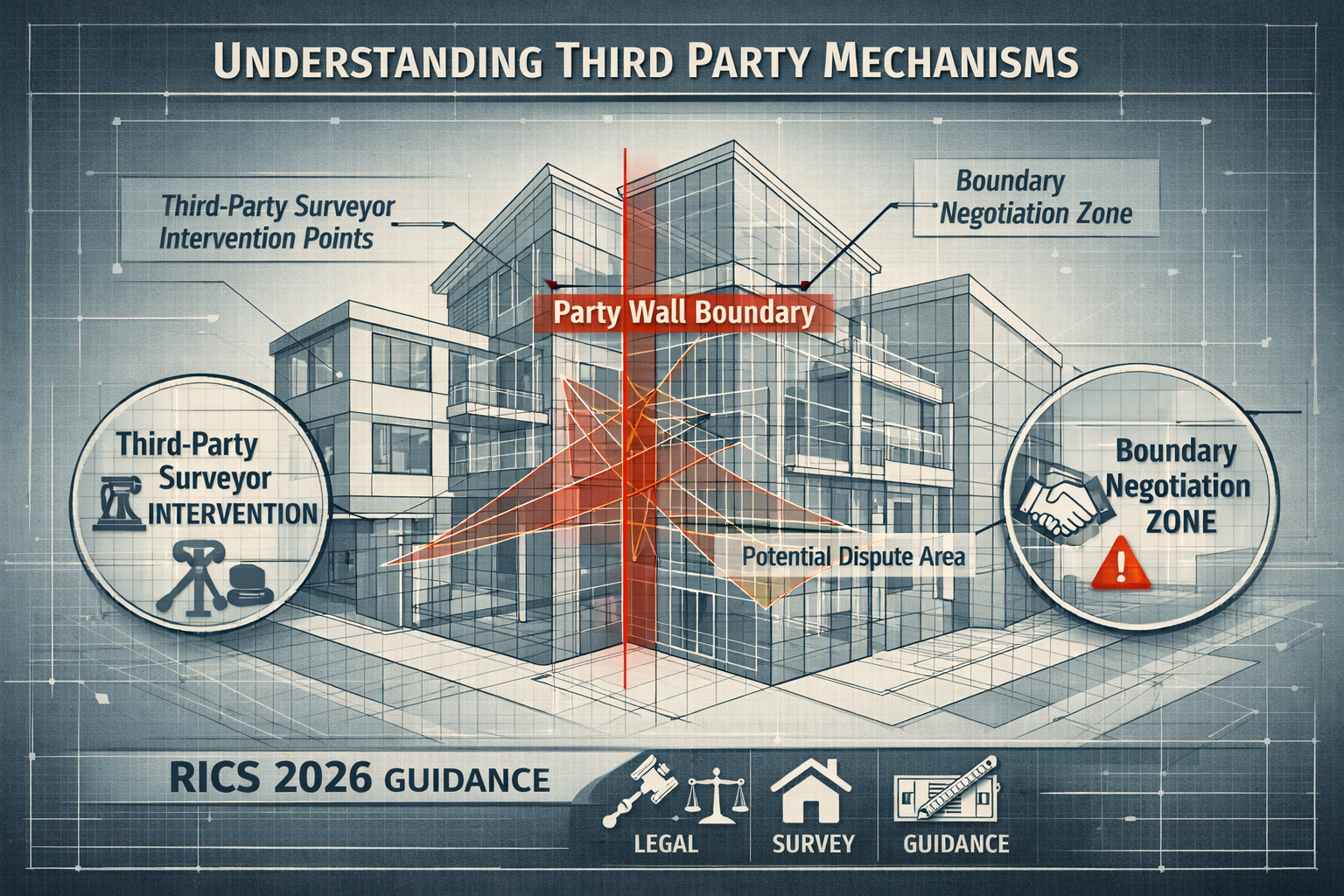
The financial implications of third surveyor involvement represent one of the most significant concerns for building owners. Understanding fee structures and implementing cost management strategies can help mitigate the substantial expenses associated with party wall deadlocks.
Typical Third Surveyor Fee Ranges
Third surveyor fees vary considerably based on dispute complexity, property value, and the specific issues requiring determination. Based on 2026 market rates:
Basic Determinations: £1,500-£3,000
- Straightforward disagreements on single issues
- Limited site inspection requirements
- Clear-cut statutory interpretation
- Minimal technical complexity
Standard Determinations: £3,000-£5,000
- Multiple points of disagreement
- Moderate technical complexity
- Detailed site inspections required
- Review of structural calculations or engineering reports
Complex Determinations: £5,000-£10,000+
- High-value properties or commercial developments
- Significant structural concerns
- Multiple technical specialists required
- Extensive evidence review and analysis
- Detailed written reasoning required
These fees come in addition to the costs already incurred with the two appointed surveyors, making third surveyor involvement the most expensive phase of party wall disputes.[2]
Fee Structure Components
Third surveyor fees typically include several components:
💼 Professional Time: Hourly rates ranging from £150-£300+ depending on surveyor experience and reputation
📋 Site Inspections: Additional charges for property visits, typically £500-£1,500 per inspection
🔬 Technical Consultations: Fees for consulting structural engineers, architects, or other specialists
📄 Report Preparation: Time allocated for drafting detailed determinations with legal reasoning
🚗 Expenses: Travel costs, particularly for surveyors traveling from distant locations
⚖️ Administrative Costs: Document management, correspondence, and procedural administration
Payment Responsibility and Timing
Under the Party Wall etc. Act 1996, the building owner typically bears responsibility for all party wall costs, including third surveyor fees. However, payment structures vary:
Upfront Retainer Model: Third surveyor requires deposit (often 50-75% of estimated fees) before commencing work, with final balance due upon determination delivery.
Staged Payment Model: Fees billed at key milestones (appointment, site inspection, determination delivery), spreading costs across the process timeline.
Final Invoice Model: All fees invoiced upon completion, though less common due to payment risk concerns.
Security Deposit: Some third surveyors require appointed surveyors to lodge security deposits before beginning work, protecting against non-payment.
Building owners should budget for third surveyor costs as a contingency when planning projects requiring party wall services, typically allocating 2-3x the standard party wall surveyor fees as a reserve.
Cost Management Strategies
Several strategies can help minimize third surveyor costs or avoid them entirely:
✅ Appoint Experienced Surveyors Initially: Investing in highly qualified, experienced appointed surveyors from the outset significantly reduces deadlock likelihood. The incremental cost of premium surveyors is far less than third surveyor fees.
✅ Encourage Early Communication: Building owners should facilitate direct dialogue between appointed surveyors early in the process, addressing potential disagreements before positions harden.
✅ Define Scope Clearly: Clear, detailed party wall notices and scopes of work reduce ambiguity that can lead to surveyor disagreements.
✅ Consider Mediation: Before triggering third surveyor appointment, appointed surveyors might engage in informal mediation or seek guidance from RICS dispute resolution services.
✅ Limit Points of Disagreement: If deadlock becomes unavoidable, appointed surveyors should narrowly define the specific points requiring third surveyor determination, limiting scope and therefore cost.
✅ Agree on Efficient Procedures: Appointed surveyors can agree with the third surveyor on streamlined procedures, such as joint site inspections or written submissions rather than formal hearings.
✅ Maintain Professional Relationships: Surveyors who regularly work together in local markets are more likely to reach compromise, avoiding third surveyor involvement.
For building owners managing multiple properties or development portfolios, engaging project management services can provide oversight that identifies and addresses party wall issues before they escalate to costly deadlocks.
Insurance and Risk Allocation
Professional indemnity insurance plays a crucial role in third surveyor scenarios:
Surveyor Coverage: Appointed surveyors should maintain adequate professional indemnity insurance covering potential claims arising from their determinations or advice. Third surveyors similarly require robust coverage.
Building Owner Protection: While building owners typically pay party wall costs, they may have recourse against appointed surveyors who act negligently or in bad faith, making insurance verification important.
Policy Limits: Verify that surveyor insurance policies have sufficient limits for the property values and project scales involved. High-value developments may require enhanced coverage.
Claims Scenarios: Understanding when insurance might respond—such as surveyor negligence leading to unnecessary third surveyor involvement—helps parties assess risk allocation.
Timelines and Project Impact in 2026 High-Volume Environments
The 2026 construction recovery has created intense pressure on project timelines. Understanding how third party mechanisms affect project schedules helps building owners and developers plan realistically and implement strategies to minimize delays.
Standard Third Surveyor Timelines
From deadlock recognition to final determination, third surveyor involvement typically adds 6-12 weeks to party wall processes:
Week 1-2: Appointment Phase
- Appointed surveyors recognize deadlock
- Identify and agree on third surveyor candidate
- Formal appointment and terms of reference
- Fee agreement and retainer payment
Week 3-5: Evidence and Investigation
- Submissions from appointed surveyors
- Site inspections and property access
- Technical report review
- Additional information requests
Week 6-10: Analysis and Determination
- Evidence evaluation and legal analysis
- Draft determination preparation
- Final determination production
- Service on appointed surveyors
Week 11-12: Appeal Period
- 14-day window for County Court appeals
- Determination becomes final if no appeal filed
- Incorporation into Party Wall Award
Complex cases involving structural engineering disputes, high-value properties, or multiple points of disagreement can extend these timelines to 12-16 weeks or longer.
Cumulative Project Delays
Third surveyor involvement creates cumulative delays beyond the determination timeline itself:
Pre-Deadlock Period: 2-4 weeks of appointed surveyor negotiations before deadlock is formally declared
Post-Determination Period: 1-2 weeks for appointed surveyors to incorporate determination into final Party Wall Award
Construction Mobilization: Additional time required to remobilize contractors and trades after extended delays
Total Potential Delay: 9-22 weeks from initial surveyor disagreement to construction commencement
For time-sensitive developments in 2026's competitive market, these delays can have significant financial consequences:
- 🏗️ Contractor Standby Costs: Daily charges for contractors unable to proceed
- 📈 Market Risk: Property values or construction costs may shift during delays
- 💰 Financing Costs: Extended interest payments on development loans
- 📅 Opportunity Costs: Delayed revenue from sales or rentals
- 🤝 Relationship Damage: Strained relations with neighbors and contractors
Strategies for Timeline Management
Several approaches can help minimize project impact when third surveyor involvement becomes necessary:
Parallel Processing: Where possible, continue with non-affected construction elements while third surveyor determination proceeds, though this requires careful risk assessment.
Expedited Procedures: Appointed surveyors and third surveyor can agree to compressed timelines for straightforward disputes, potentially reducing determination period to 3-4 weeks.
Provisional Measures: In some cases, parties may agree to provisional protective measures allowing limited work to proceed pending final determination.
Clear Communication: Keeping contractors, lenders, and other stakeholders informed about third surveyor timelines helps manage expectations and maintain relationships.
Contingency Planning: Building buffer periods into project schedules for potential party wall delays, particularly for projects in densely built areas with multiple adjoining owners.
Understanding the responsibilities of construction project managers includes anticipating and mitigating party wall risks that could derail project timelines.
Alternative Dispute Resolution Considerations
While third surveyor appointment is statutorily required upon deadlock, parties might consider whether alternative approaches could resolve disagreements more efficiently:
RICS Dispute Resolution Service: Before formal deadlock, appointed surveyors might seek guidance from RICS dispute resolution services, potentially avoiding third surveyor necessity.
Expert Determination Agreements: Parties might agree to binding expert determination outside the statutory framework, though this requires consent from both building and adjoining owners.
Mediation: Non-binding mediation between appointed surveyors can sometimes break deadlocks, particularly where personality conflicts rather than technical disagreements drive the impasse.
Technical Consultation: Joint appointment of a technical specialist (structural engineer, architect) to provide guidance on specific technical matters, helping appointed surveyors reach agreement.
These alternatives work only when all parties cooperate and appointed surveyors remain willing to seek compromise. Once formal deadlock is declared, statutory third surveyor appointment becomes mandatory.
Avoiding Injunctions Through Effective Third Party Mechanisms
One of the most severe consequences of party wall disputes is the potential for injunctions that completely halt construction work. Understanding how effective use of third party mechanisms helps avoid injunctions is crucial for building owners in 2026's high-stakes development environment.
The Injunction Risk
Adjoining owners who believe their rights are being violated can seek injunctions from the County Court to stop construction work. Grounds for injunction applications include:
⚠️ Failure to Follow Statutory Procedures: Building owner proceeding without proper party wall notices or awards
⚠️ Breach of Award Terms: Construction work exceeding scope or methods specified in Party Wall Award
⚠️ Inadequate Protection: Failure to implement protective measures required by the award
⚠️ Dispute Over Award Validity: Challenges to whether the award properly addresses statutory requirements
⚠️ Damage or Risk: Evidence of actual damage or imminent risk to adjoining property
Injunctions represent the nuclear option in party wall disputes, with devastating consequences:
- 🛑 Immediate Work Stoppage: All construction must cease immediately
- 💸 Massive Financial Impact: Daily costs can reach thousands of pounds
- ⚖️ Legal Expenses: Court proceedings add £10,000-£50,000+ in legal costs
- 📰 Reputational Damage: Public court disputes harm developer reputation
- 🏗️ Contractor Claims: Stopped contractors may pursue delay claims
How Third Surveyor Mechanisms Prevent Injunctions
The statutory third surveyor process provides a critical safety valve that helps avoid injunction applications:
✅ Legitimate Dispute Resolution: When appointed surveyors cannot agree, the third surveyor mechanism demonstrates that parties are following proper statutory procedures rather than acting arbitrarily.
✅ Binding Determinations: Third surveyor determinations are final and binding, providing legal certainty that reduces grounds for court intervention.
✅ Professional Oversight: The quasi-judicial nature of third surveyor determinations provides assurance that disputes are being resolved by qualified professionals rather than through adversarial litigation.
✅ Timely Resolution: While third surveyor involvement adds weeks to timelines, it provides faster resolution than court proceedings, which can take months or years.
✅ Cost Proportionality: Third surveyor fees, while substantial, are far less than litigation costs, making this route more proportionate for most disputes.
Best Practices for Injunction Avoidance
Building owners can implement several practices to minimize injunction risk while utilizing third party mechanisms effectively:
1. Maintain Statutory Compliance
- Serve proper party wall notices with adequate detail
- Respond promptly to adjoining owner concerns
- Appoint qualified surveyors immediately upon dissent
- Follow all procedural requirements meticulously
2. Communicate Proactively
- Keep adjoining owners informed about project timelines
- Address concerns before they escalate
- Provide regular updates during third surveyor processes
- Demonstrate good faith throughout
3. Implement Protective Measures
- Begin condition surveys before work commences
- Install monitoring equipment as recommended
- Follow construction methods specified in awards
- Document compliance with award terms
4. Respect the Process
- Do not commence work before awards are finalized
- If third surveyor involvement is necessary, wait for determination
- Incorporate third surveyor determinations fully into final awards
- Allow appeal periods to expire before proceeding
5. Engage Professional Support
- Work with experienced party wall surveyors who understand injunction risks
- Consider legal advice for high-risk or high-value projects
- Engage project managers who can coordinate compliance
- Maintain professional indemnity insurance
For complex developments, particularly community housing projects involving multiple stakeholders, professional project oversight becomes essential for managing party wall risks effectively.
When Injunctions Occur Despite Third Surveyor Involvement
In rare cases, adjoining owners may seek injunctions even when third surveyor mechanisms are being properly utilized. Common scenarios include:
Procedural Challenges: Adjoining owner argues that third surveyor appointment was improper or that the determination exceeds statutory authority.
Urgency Claims: Adjoining owner presents evidence of immediate risk requiring emergency court intervention before third surveyor can complete determination.
Parallel Disputes: Injunction application relates to matters outside the specific point under third surveyor consideration.
Bad Faith Allegations: Claims that building owner or appointed surveyor is acting in bad faith despite engaging third surveyor process.
If faced with injunction proceedings, building owners should:
- 🏛️ Seek immediate legal representation experienced in party wall litigation
- 📋 Document all compliance with statutory procedures and third surveyor processes
- 🤝 Consider settlement negotiations to avoid full court proceedings
- ⚖️ Prepare evidence demonstrating good faith engagement with dispute resolution
- 💰 Assess cost-benefit of defending versus settling, given litigation expenses
Practical Case Studies: Third Party Mechanisms in 2026 Projects
Examining real-world applications of third party mechanisms in party wall deadlocks provides valuable insights for building owners and professionals navigating 2026's high-volume construction environment.
Case Study 1: Rear Extension Deadlock in South London
Project: Two-story rear extension on Victorian terraced property
Dispute: Appointed surveyors disagreed on foundation depth requirements. Building owner's surveyor proposed 1.2m depth; adjoining owner's surveyor insisted on 1.8m depth due to concerns about underpinning implications.
Third Surveyor Process:
- Appointment completed within 10 days
- Site inspection and soil investigation review conducted
- Determination issued after 4 weeks
- Ruling: 1.5m depth required with specific construction methodology
Outcome:
- ✅ Construction proceeded without injunction risk
- ✅ Total delay: 6 weeks from deadlock to determination
- ✅ Additional cost: £2,800 in third surveyor fees
- ✅ Avoided potential litigation costs of £15,000+
Lessons: Early soil investigation and clear technical specifications in initial notices could have prevented deadlock. However, once disagreement arose, prompt third surveyor appointment minimized project impact.
Case Study 2: Commercial Development in Central London
Project: Five-story mixed-use development with basement excavation affecting six adjoining properties
Dispute: Multiple points of disagreement including temporary works design, monitoring protocols, and access arrangements for condition surveys
Third Surveyor Process:
- Complex appointment involving multiple adjoining owners
- Third surveyor required structural engineering consultation
- Determination process extended to 10 weeks
- Multiple site visits and technical report reviews
Outcome:
- ✅ Comprehensive determination addressed all disputed points
- ✅ Final Party Wall Award incorporated determination
- ✅ Additional cost: £12,500 in third surveyor fees
- ⚠️ Total delay: 14 weeks from initial disagreement to construction commencement
Lessons: High-value commercial projects require experienced surveyors from the outset. The complexity and multiple adjoining owners made third surveyor involvement more likely, highlighting the importance of contingency planning in project timelines and budgets.
Case Study 3: Loft Conversion in West London
Project: Loft conversion requiring steel beam installation through party wall
Dispute: Disagreement over whether proposed steel specification provided adequate fire protection and structural support
Third Surveyor Process:
- Appointed surveyors initially attempted informal technical consultation
- Structural engineer provided independent opinion
- Appointed surveyors reached agreement without formal third surveyor determination
Outcome:
- ✅ Avoided third surveyor costs entirely
- ✅ Minimal delay: 2 weeks for technical consultation
- ✅ Additional cost: £800 for structural engineer opinion (shared between appointed surveyors)
- ✅ Maintained positive working relationship between surveyors
Lessons: This case demonstrates the value of appointed surveyors exploring alternatives before declaring formal deadlock. Joint technical consultation can resolve disagreements more efficiently than third surveyor appointment, though this requires professional cooperation and flexibility.
Case Study 4: Basement Excavation Dispute
Project: Single-story basement excavation beneath existing property
Dispute: Appointed surveyors disagreed on temporary works requirements and monitoring frequency during excavation
Third Surveyor Process:
- Deadlock declared after 3 weeks of unsuccessful negotiation
- Third surveyor appointment delayed due to candidate availability
- Determination required detailed temporary works review
- Process extended to 8 weeks
Outcome:
- ✅ Determination provided clear construction methodology
- ⚠️ Delay resulted in contractor demobilization and remobilization
- ⚠️ Additional costs: £4,200 third surveyor fees + £8,500 contractor standby costs
- ✅ Work ultimately completed without damage or further disputes
Lessons: Third surveyor availability can significantly impact timelines. Building owners should factor potential delays into construction schedules, particularly during peak building seasons. The contractor standby costs exceeded third surveyor fees, highlighting the broader financial impact of deadlocks.
Conclusion
Third Party Mechanisms in Party Wall Deadlocks: RICS Guidance for 2026 High-Volume Projects represents a critical knowledge area for building owners, developers, and construction professionals navigating today's competitive property market. The statutory requirement for third surveyor appointment when appointed surveyors cannot agree provides essential dispute resolution machinery, but comes with significant cost and timeline implications that demand careful management.
The 2026 construction recovery has intensified pressures on party wall processes, making efficient dispute resolution more important than ever. Understanding that third surveyor determinations are final and binding, limited in scope to specific points of disagreement, and typically cost £1,500-£10,000+ helps building owners budget appropriately and set realistic project timelines.
RICS guidance, particularly the 2023 7th edition professional standard and enhanced 2026 CPD requirements, emphasizes professional conduct alongside statutory compliance. This dual focus aims to elevate standards across the sector, reducing the likelihood of deadlocks caused by inexperience or poor professional practices.
Actionable Next Steps
For building owners planning construction projects in 2026:
📋 Step 1: Engage experienced, RICS-qualified party wall surveyors from project inception, investing in quality appointments that reduce deadlock risk.
💰 Step 2: Budget contingency funds of 2-3x standard party wall costs to cover potential third surveyor involvement, typically £5,000-£15,000 for residential projects.
📅 Step 3: Build 8-12 week buffer periods into project timelines for potential party wall delays, particularly for projects in densely built areas.
📝 Step 4: Ensure party wall notices include comprehensive technical details and clear construction methodologies, reducing ambiguity that can lead to surveyor disagreements.
🤝 Step 5: Maintain open communication with adjoining owners throughout the process, addressing concerns proactively before they escalate to formal disputes.
⚖️ Step 6: If deadlock occurs, support prompt third surveyor appointment rather than prolonged negotiation, as delays compound project costs.
🔍 Step 7: Review surveyor professional indemnity insurance and verify RICS membership status before appointments, ensuring adequate protection and professional accountability.
For professionals working in party wall matters, staying current with RICS guidance, maintaining robust CPD records under the enhanced 2026 framework, and developing expertise in dispute resolution mechanisms positions practitioners to serve clients effectively in high-volume environments.
The third surveyor mechanism, while expensive and time-consuming, provides essential legal certainty that helps avoid the far more costly alternative of injunction proceedings and litigation. By understanding these processes, planning appropriately, and engaging qualified professionals, building owners can navigate party wall deadlocks efficiently while maintaining positive neighbor relations and keeping projects on track in 2026's dynamic construction market.
References
[1] Jan 22 Party Wall Legislation And Procedure 7th Edition – https://www.rics.org/content/dam/ricsglobal/documents/standards/jan_22_party_wall_legislation_and_procedure_7th_edition.pdf
[2] Appointing The Third Surveyor When Disagreements Arise And Why This Costly Step Is Necessary – https://www.partywallslimited.com/blog/appointing-the-third-surveyor-when-disagreements-arise-and-why-this-costly-step-is-necessary
[3] Party Wall Legislation And Procedure – https://www.rics.org/profession-standards/rics-standards-and-guidance/sector-standards/building-surveying-standards/party-wall-legislation-and-procedure
[4] Revised Cpd Framework Effective 2026 New App – https://www.rics.org/news-insights/revised-cpd-framework-effective-2026-new-app
[5] Party Wall Surveys Amid 2026 Construction Boom Handling Disputes In High Demand Uk Housing Markets – https://nottinghillsurveyors.com/blog/party-wall-surveys-amid-2026-construction-boom-handling-disputes-in-high-demand-uk-housing-markets