

Three-quarters of European Union residential buildings currently fail to meet emerging energy performance standards—a statistic that has fundamentally transformed how lenders assess property valuations in 2026.[4] As regulatory frameworks tighten and climate resilience becomes a core underwriting criterion, chartered surveyors now face unprecedented pressure to deliver comprehensive assessments that extend far beyond traditional structural evaluations. The Valuation Resilience Factors in 2026 Lending: Surveyor Insights on Energy Standards and Future-Proofing landscape demands a sophisticated understanding of energy performance certificates (EPCs), long-term maintenance projections, and technological assessment tools that can identify risks in non-standard constructions before they impact lending decisions.
This shift represents more than regulatory compliance—it reflects a fundamental recalibration of property value itself. Lenders increasingly recognize that energy efficiency directly correlates with investment performance, loan security, and long-term asset viability. Properties demonstrating superior energy standards command premium valuations, while inefficient stock faces growing stigma and reduced marketability.[4]
Key Takeaways
- Energy performance polarization is creating significant valuation gaps, with A-rated properties outperforming G-rated stock by substantial margins in lending assessments
- Lenders now mandate comprehensive long-term assessments including EPC ratings, maintenance forecasts, and retrofit potential as standard conditions precedent to funding
- Technology-enabled surveying provides early identification of risks in non-standard constructions through thermal imaging, drone surveys, and digital assessment platforms
- RICS-aligned evaluation frameworks establish standardized checklists that integrate energy standards, climate resilience, and future-proofing requirements into valuation methodology
- Grid readiness and renewable infrastructure compatibility have become essential valuation factors alongside traditional structural considerations
Understanding Valuation Resilience Factors in 2026 Lending Standards
The lending landscape in 2026 operates under fundamentally different parameters than even two years prior. Valuation resilience now encompasses a property's ability to maintain or increase value despite evolving regulatory requirements, climate risks, and energy performance mandates. This concept extends beyond simple market comparables to include forward-looking assessments of compliance costs, retrofit potential, and operational efficiency.
The Regulatory Framework Driving Change
The revised Energy Performance of Buildings Directive (EPBD) has established minimum energy standards that directly impact lending decisions across the UK and EU markets. Properties failing to meet these thresholds face restricted access to mortgage finance, reduced loan-to-value ratios, and higher interest rates reflecting increased risk profiles.[4]
Starting in 2027, the EU Emissions Trading System II compliance deadline creates additional urgency for property owners to reduce emissions or face offsetting costs—expenses that lenders now factor into their risk calculations.[4] This regulatory pressure has transformed energy efficiency from a "nice-to-have" feature into a fundamental determinant of property value and lending viability.
Energy Performance Polarization
Evidence from 2026 market data reveals significant divergence in investment performance between energy-efficient and inefficient properties. This polarization accelerates as regulatory standards tighten, creating a two-tier market where:
✅ High-performing properties (EPC ratings A-C) benefit from:
- Enhanced valuations reflecting lower operational costs
- Preferential lending terms and competitive interest rates
- Strong tenant demand and reduced void periods
- Future-proof compliance positioning
❌ Low-performing properties (EPC ratings E-G) face:
- Valuation discounts reflecting retrofit requirements
- Restricted lending availability and higher rates
- Declining tenant interest and marketability concerns
- Substantial capital expenditure to achieve compliance
Professional valuations must now quantify these factors with precision, providing lenders with clear risk assessments and cost projections.
Grid Readiness as a Lending Condition
In 2026, grid connection terms and readiness assessments are routinely treated as key conditions precedent to funding for properties with renewable energy infrastructure or electric vehicle charging capabilities.[5] This requirement reflects the growing importance of energy infrastructure integration in property valuations.
Surveyors must evaluate:
- Existing electrical capacity and upgrade requirements
- Distribution network operator (DNO) connection agreements
- Smart meter compatibility and energy management systems
- Renewable energy generation potential and storage capacity
Technology-Enabled Assessment for Non-Standard Constructions
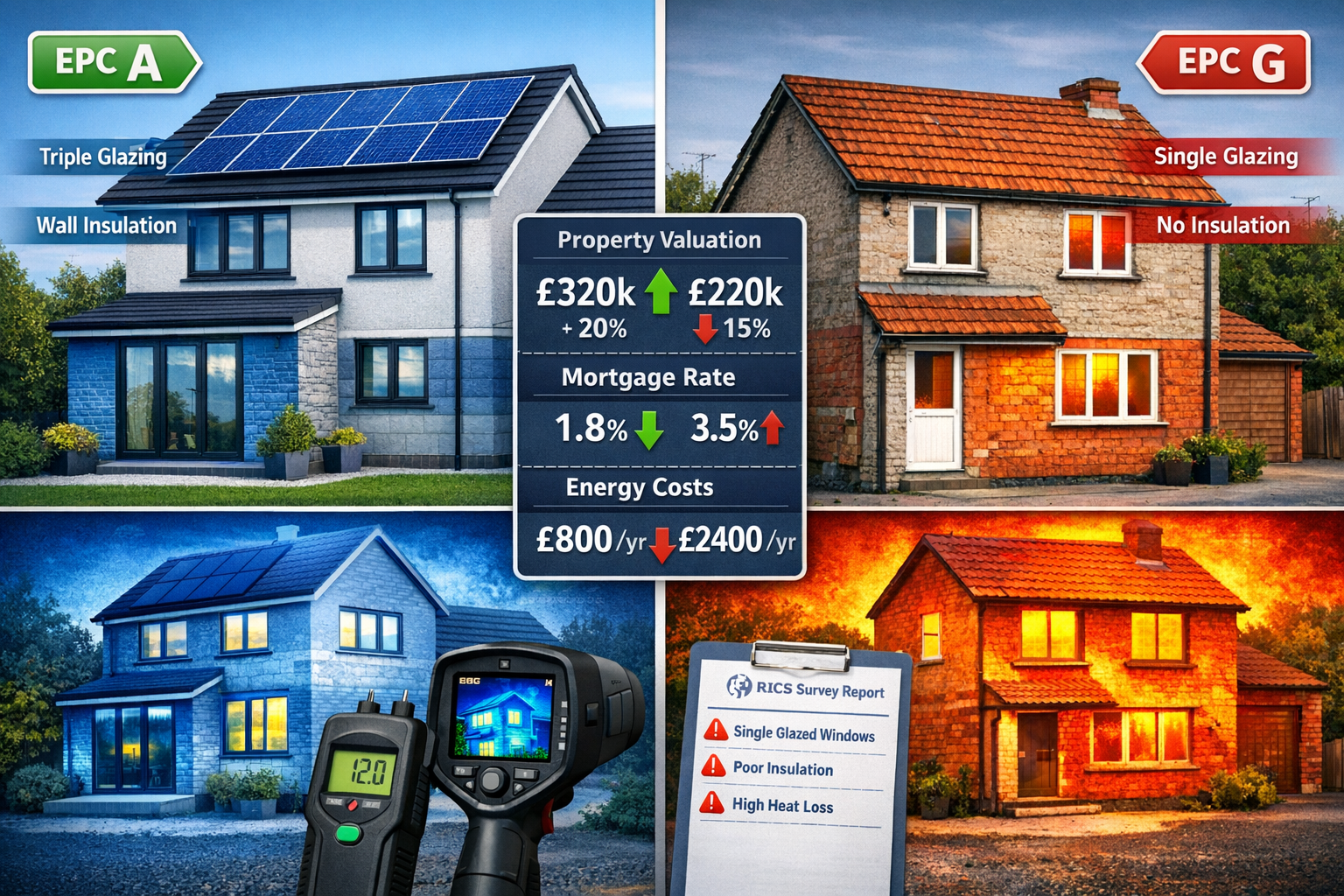
Non-standard construction properties—including timber frame, steel frame, concrete systems, and innovative modern methods of construction—present unique challenges for valuation resilience assessments. Traditional visual inspections often prove insufficient to identify hidden defects, insulation failures, or structural concerns that impact both immediate lending decisions and long-term value retention.
Digital Assessment Platforms
Modern surveying technology enables early identification of risks that would remain undetected through conventional methods. These tools provide lenders with confidence in their security valuations while protecting borrowers from unforeseen remediation costs.
Thermal Imaging Technology 📸
Infrared thermography reveals:
- Heat loss patterns indicating insulation deficiencies
- Moisture ingress behind wall cladding
- Thermal bridging at structural junctions
- Air leakage pathways affecting energy performance
This data directly informs EPC projections and retrofit cost estimates, essential components of valuation resilience factors in 2026 lending decisions.
Drone Survey Capabilities 🚁
Unmanned aerial vehicles provide:
- Comprehensive roof condition assessments without scaffolding
- Solar panel installation feasibility analysis
- Chimney and high-level detail inspection
- Photographic evidence for remote lender review
Drone technology proves particularly valuable for Level 3 full building surveys where detailed roof assessments are essential.
Moisture Detection Systems 💧
Advanced moisture meters and hygrometers identify:
- Hidden water penetration in cavity walls
- Condensation risks in poorly ventilated spaces
- Damp-related deterioration in timber elements
- Mould growth potential affecting indoor air quality
These findings directly impact property valuations, as moisture-related defects often require substantial remediation investment and indicate broader building performance issues.
Integration with RICS Standards
The Royal Institution of Chartered Surveyors (RICS) has updated professional standards to incorporate energy performance and climate resilience into valuation methodology. The Red Book Global Standards now explicitly require surveyors to consider sustainability factors when they materially affect value.[4]
This integration ensures that technology-enabled assessments align with professional standards, providing lenders with defensible valuations that meet regulatory requirements and industry best practices. Chartered surveyors delivering RICS building surveys must demonstrate competence in both traditional structural assessment and modern energy performance evaluation.
RICS-Aligned Checklists for Energy Standards and Future-Proofing

Standardized evaluation frameworks provide consistency and comprehensiveness in valuation resilience assessments. The following RICS-aligned checklists integrate energy standards, maintenance projections, and future-proofing requirements into a cohesive methodology that serves both lender risk management and borrower transparency needs.
Energy Performance Assessment Checklist
Current Energy Efficiency ⚡
- Obtain valid EPC certificate (maximum 10 years old)
- Verify current energy rating (A-G scale)
- Review energy consumption data (kWh/m² annually)
- Assess heating system type, age, and efficiency rating
- Evaluate insulation levels (walls, roof, floors)
- Inspect glazing specifications (single, double, triple)
- Document renewable energy installations (solar PV, heat pumps)
- Identify smart home energy management systems
Compliance and Regulatory Position 📋
- Confirm compliance with current minimum energy standards
- Assess gap to 2027 EPBD requirements
- Calculate estimated retrofit costs to achieve target rating
- Review planning constraints affecting energy improvements
- Verify building regulations compliance for recent works
- Check conservation area or listed building restrictions
Improvement Potential 📈
- Identify cost-effective energy efficiency measures
- Assess solar panel installation feasibility
- Evaluate heat pump conversion potential
- Consider external wall insulation options
- Review window replacement opportunities
- Estimate payback periods for major improvements
Long-Term Maintenance Projection Framework
Lenders in 2026 require detailed maintenance forecasts extending across typical mortgage terms (25-30 years). This forward-looking approach identifies capital expenditure requirements that impact property affordability and value retention.
| Component | Expected Lifespan | Replacement Cost Impact | Valuation Adjustment |
|---|---|---|---|
| Boiler/Heating System | 12-15 years | £3,000-£12,000 | Moderate |
| Roof Covering | 40-60 years | £8,000-£25,000 | Significant |
| Windows/Doors | 20-30 years | £5,000-£15,000 | Moderate |
| Solar PV System | 25-30 years | £4,000-£8,000 | Low-Moderate |
| External Decoration | 5-7 years | £2,000-£5,000 | Minor |
| Electrical Rewiring | 30-40 years | £3,500-£6,000 | Moderate |
Professional surveyors must provide realistic cost projections based on current market rates, with appropriate contingencies for inflation and specification upgrades required to meet future standards. This information enables lenders to assess whether borrowers can reasonably afford both mortgage payments and essential property maintenance.
Climate Resilience and Adaptation Checklist
Flood Risk Assessment 🌊
- Review Environment Agency flood zone mapping
- Assess historical flooding incidents
- Evaluate flood defense infrastructure
- Inspect property-level flood protection measures
- Consider climate change projections for flood risk
- Verify flood insurance availability and cost
Overheating and Heat Stress ☀️
- Assess building orientation and solar gain
- Evaluate ventilation adequacy for summer conditions
- Review cooling system provision or potential
- Consider climate projections for temperature extremes
- Inspect shading devices and thermal mass
Storm and Weather Resilience 💨
- Evaluate roof fixing adequacy for high winds
- Assess chimney and high-level element security
- Review drainage capacity for intense rainfall
- Inspect external cladding and render condition
- Consider tree proximity and root damage risk
The FORTIFIED standard, established by the Insurance Institute for Business & Home Safety, provides measurable resilience benchmarks including stronger materials, water sealing, hardened windows, and engineering enhancements.[1] Properties meeting these standards demonstrate superior risk profiles that translate into favorable lending terms.
Future-Proofing Evaluation Criteria
Infrastructure Readiness 🔌
- Assess electrical capacity for EV charging (minimum 7kW)
- Evaluate smart meter installation and compatibility
- Review broadband/fiber connectivity for smart home systems
- Consider battery storage installation potential
- Assess grid export capability for renewable generation
Adaptation Potential 🔧
- Evaluate structural capacity for solar panel installation
- Assess space availability for heat pump equipment
- Review loft insulation upgrade feasibility
- Consider cavity wall insulation potential
- Assess basement or loft conversion opportunities
Regulatory Trajectory Alignment 📊
- Project compliance costs for 2030 energy targets
- Assess alignment with net-zero pathway requirements
- Consider emerging standards (e.g., embodied carbon)
- Evaluate adaptation to circular economy principles
- Review potential for green mortgage product eligibility
Lender Requirements for Long-Term Value Protection
Financial institutions have fundamentally revised their underwriting criteria to emphasize long-term value protection over short-term market conditions. This strategic shift reflects lessons learned from previous market cycles and growing recognition that energy efficiency and climate resilience directly impact loan performance.
Stricter Underwriting Standards
Energy storage and renewable infrastructure lenders are implementing heightened due diligence protocols with independent engineer reviews focusing on battery capacity degradation, thermal runaway safety issues, and equipment warranty terms.[2] While these requirements primarily apply to commercial energy projects, similar principles now extend to residential lending where properties incorporate renewable generation or storage systems.
Lenders routinely require:
Independent Technical Assessment 🔍
- Third-party verification of EPC ratings and improvement recommendations
- Structural engineer certification for renewable energy installations
- Electrical safety certificates for solar PV and battery storage systems
- Specialist reports for non-standard construction types
Performance Guarantees and Warranties 📜
- Manufacturer warranties for major energy efficiency installations
- Installer guarantees meeting industry standards (e.g., MCS certification)
- Insurance-backed warranties for retrofit works
- Maintenance contracts for complex systems (heat pumps, solar)
Supply Chain Due Diligence 🔗
Following executive orders imposing tariffs since January 2025, lenders conduct heightened due diligence on supply contracts to assess risks from increased costs in renewable energy and energy storage supply chains.[2] This scrutiny extends to residential properties where recent installations may face warranty claims or replacement parts availability issues.
Valuation Adjustments and Risk Pricing
Properties demonstrating superior energy performance and climate resilience benefit from preferential lending terms including:
- Higher loan-to-value ratios (up to 95% vs. 85% for poor performers)
- Reduced interest rate margins (0.25-0.50% discount)
- Extended mortgage terms reflecting confidence in long-term value
- Green mortgage incentives including cashback and fee waivers
Conversely, properties with poor energy ratings or significant climate risks face:
- Valuation discounts (5-15% below comparable efficient properties)
- Reduced LTV caps (maximum 75-80%)
- Interest rate premiums reflecting increased risk
- Mandatory retention amounts for essential remediation works
Professional property valuations must clearly articulate these factors, providing lenders with transparent risk assessments and borrowers with realistic expectations about lending terms.
Investment Performance and Market Dynamics
The renewable energy infrastructure market has experienced significant recalibration in 2026, with core renewable infrastructure returns approaching 10% and Core+ strategies exceeding 10%.[3] This shift to a buyer's market with adjusted return expectations creates attractive entry points for long-term investors while simultaneously raising the bar for project viability and lending standards.
Capital Supply-Demand Gap
Higher interest rates and reduced capital availability have created a capital supply-demand gap in energy transition infrastructure.[3] This dynamic affects residential property markets indirectly, as:
- Institutional capital seeks stable, inflation-protected returns in proven energy-efficient property portfolios
- Development finance prioritizes projects meeting highest energy standards
- Refinancing opportunities favor properties with demonstrated performance
- Portfolio landlords face pressure to upgrade or divest poor-performing stock
Inflation Linkage and Portfolio Diversification
Energy transition infrastructure offers strong inflation linkage through operational cost savings that increase in value as energy prices rise.[3] This characteristic makes energy-efficient properties particularly attractive to long-term investors and pension funds seeking inflation-protected returns.
Surveyors must quantify these benefits in valuation reports, demonstrating:
Operational Cost Advantages 💰
- Annual energy cost savings vs. comparable properties
- Projected savings over mortgage term with inflation assumptions
- Reduced maintenance costs for modern efficient systems
- Lower insurance premiums for climate-resilient properties
Tenant Demand Premium 👥
- Reduced void periods for energy-efficient rental properties
- Rental premium potential (5-10% for A-rated properties)
- Stronger tenant retention and satisfaction
- Compliance with minimum energy efficiency standards (MEES)
Practical Implementation for Surveyors and Lenders
Implementing comprehensive valuation resilience factors in 2026 lending requires coordination between surveyors, lenders, borrowers, and other stakeholders. The following practical guidance supports effective integration of energy standards and future-proofing into routine valuation practice.
Surveyor Best Practices
Pre-Inspection Preparation 📝
- Request EPC certificate and previous survey reports in advance
- Review planning history and building control records
- Check flood risk mapping and environmental databases
- Prepare technology tools (thermal camera, moisture meter, drone)
- Confirm lender-specific requirements and reporting templates
On-Site Assessment Protocol 🏠
- Conduct systematic room-by-room inspection documenting energy features
- Use thermal imaging to identify insulation deficiencies and air leakage
- Photograph key energy installations (boiler, solar panels, insulation)
- Measure and record room dimensions for energy modeling
- Interview occupants about energy costs and system performance
- Assess accessibility for future improvement works
Reporting and Recommendations 📄
- Provide clear EPC rating and compliance status
- Quantify retrofit costs for specific improvement scenarios
- Include thermal images and annotated photographs
- Estimate long-term maintenance requirements with cost projections
- Highlight climate risks and recommended adaptation measures
- Offer prioritized improvement recommendations with payback periods
Lender Integration Strategies
Financial institutions should establish standardized protocols for incorporating energy performance into lending decisions:
Underwriting Framework 🏦
- Define minimum EPC ratings for different loan products
- Establish valuation adjustment matrices based on energy performance
- Create retention policies for properties requiring energy improvements
- Develop green mortgage incentive structures
- Set climate risk acceptance criteria and exclusions
Borrower Communication 💬
- Provide clear guidance on energy performance requirements
- Offer resources for understanding EPC ratings and improvements
- Explain how energy efficiency affects lending terms
- Share information about available grants and incentives
- Support borrowers in planning cost-effective upgrades
Portfolio Monitoring 📊
- Track energy performance distribution across mortgage book
- Monitor compliance with evolving regulatory standards
- Assess climate risk exposure by geography and property type
- Review loan performance correlation with energy ratings
- Adjust lending criteria based on market evidence
Case Study: Valuation Resilience in Practice
A recent building survey of an Edwardian cottage demonstrates practical application of valuation resilience factors. The property featured:
- Original single-glazed sash windows with significant heat loss
- Uninsulated solid walls typical of period construction
- Aging gas boiler nearing end of expected lifespan
- No renewable energy installations
- EPC rating of E with potential to achieve C
The surveyor's comprehensive assessment included:
- Thermal imaging survey revealing 30% heat loss through walls and windows
- Retrofit cost analysis projecting £18,000 for external wall insulation, window upgrades, and heat pump installation
- Energy cost modeling demonstrating £1,200 annual savings post-improvement
- Maintenance projection identifying £8,000 essential works over five years
- Climate risk assessment noting moderate flood risk requiring £3,000 mitigation
The lender used this information to:
- Apply a 10% valuation discount reflecting improvement requirements
- Offer 85% LTV with mandatory £15,000 retention for energy works
- Provide green mortgage incentive of 0.35% rate reduction upon completion
- Require flood insurance as lending condition
This approach protected both lender and borrower interests while incentivizing property improvement aligned with 2026 standards.
Emerging Technologies and Future Developments
The surveying profession continues to evolve with technological innovation enhancing assessment capabilities:
Artificial Intelligence and Machine Learning 🤖
- Automated defect detection from photographic surveys
- Predictive maintenance modeling based on building characteristics
- Energy performance optimization recommendations
- Comparative market analysis incorporating sustainability factors
Building Information Modeling (BIM) 🏗️
- Digital twin creation for existing properties
- Retrofit scenario modeling and visualization
- Lifecycle cost analysis and carbon accounting
- Integration with smart building management systems
Remote and Hybrid Inspection Models 💻
- Video-guided remote surveys for initial assessments
- Hybrid approaches combining remote and physical inspection
- Continuous monitoring through IoT sensors
- Real-time data integration for portfolio management
These developments promise to enhance valuation resilience factors in 2026 lending by providing richer data, more accurate projections, and better-informed decision-making.
Regulatory Outlook and Strategic Positioning
Looking beyond 2026, the regulatory trajectory points toward increasingly stringent energy performance requirements and expanded climate resilience mandates. Properties and lending practices that anticipate these changes will maintain competitive advantage and value resilience.
Anticipated Regulatory Developments
2027-2030 Timeline 📅
- EU Emissions Trading System II compliance enforcement begins
- UK government consultation on minimum EPC C requirement for all properties
- Enhanced building regulations incorporating embodied carbon limits
- Mandatory climate risk disclosure for all property transactions
- Integration of nature-based solutions into planning requirements
Strategic Positioning for Surveyors 🎯
- Develop specialized expertise in energy assessment and retrofit planning
- Invest in advanced assessment technology and training
- Build relationships with energy consultants and retrofit specialists
- Stay current with evolving standards and best practices
- Offer value-added services beyond basic compliance reporting
Strategic Positioning for Lenders 🎯
- Develop sophisticated green mortgage product ranges
- Build internal expertise in energy performance risk assessment
- Partner with retrofit finance providers for integrated solutions
- Engage proactively with regulators on emerging requirements
- Position portfolios for transition to net-zero aligned lending
Conclusion
The valuation resilience factors in 2026 lending landscape represents a fundamental transformation in how property value is assessed, understood, and protected. Energy performance standards, long-term maintenance projections, climate resilience, and future-proofing potential have evolved from peripheral considerations to core determinants of lending decisions and property valuations.
Chartered surveyors play a pivotal role in this transformation, providing the technical expertise and independent assessment that enables lenders to make informed decisions while protecting borrower interests. The integration of advanced technology—from thermal imaging to drone surveys to digital assessment platforms—enhances the profession's capability to identify risks early and quantify improvement opportunities accurately.
For lenders, embracing comprehensive energy and resilience assessments offers multiple benefits: reduced loan default risk, improved portfolio performance, regulatory compliance, and competitive positioning in the growing green finance market. Properties demonstrating superior energy efficiency and climate adaptation consistently outperform inefficient stock across multiple metrics.
Actionable Next Steps
For Property Owners and Buyers 🏡
- Obtain current EPC certificate and understand improvement recommendations
- Commission comprehensive Level 3 building survey including energy assessment
- Develop costed improvement plan with realistic timelines
- Explore green mortgage products and available grants
- Prioritize improvements with best payback and value protection
For Surveyors 📐
- Invest in thermal imaging and moisture detection equipment
- Complete continuing professional development on energy assessment
- Develop standardized reporting templates incorporating RICS requirements
- Build networks with energy consultants and retrofit specialists
- Market expertise in valuation resilience to lender clients
For Lenders 🏦
- Review and update underwriting criteria to incorporate energy performance
- Develop green mortgage product suite with competitive incentives
- Establish partnerships with approved surveyor panels
- Create borrower education resources on energy efficiency
- Monitor portfolio exposure to climate and energy transition risks
For Industry Stakeholders 🤝
- Advocate for clear, consistent regulatory frameworks
- Support development of standardized assessment methodologies
- Invest in workforce training and capacity building
- Promote successful case studies and best practices
- Collaborate on research and data sharing initiatives
The convergence of regulatory pressure, technological capability, and market demand creates unprecedented opportunity for those who embrace comprehensive valuation resilience assessment. Properties that meet 2026 standards will maintain value and marketability, while those that lag face growing disadvantage. By implementing the frameworks, checklists, and best practices outlined in this article, surveyors and lenders can navigate this transformation successfully, protecting value and supporting the essential transition to sustainable, resilient property stock.
For expert guidance on property valuations incorporating energy performance and future-proofing assessments, contact our team of chartered surveyors for professional advice tailored to your specific requirements.
References
[1] When Insurance And Policy Align Resilience Scales – https://rmi.org/when-insurance-and-policy-align-resilience-scales/
[2] Project Financing Trends For Global Energy Storage Projects In 2026 And Beyond – https://www.morganlewis.com/pubs/2026/03/project-financing-trends-for-global-energy-storage-projects-in-2026-and-beyond
[3] Outlook 2026 Decoupling Driving Resilient Opportunities – https://www.schroders.com/en-hk/hk/individual/insights/outlook-2026-decoupling-driving-resilient-opportunities/
[4] Real Estate How Resilience Yields Opportunities In 2026 – https://www.aberdeeninvestments.com/en-gb/professional/insights-and-research/real-estate-how-resilience-yields-opportunities-in-2026
[5] Financing The Energy Transition How Deals Are Getting Done In 2026 – https://www.multilaw.com/multilaw-connect/MCONNECT/multilaw-connect-resources/Financing_the_Energy_Transition_How_Deals_Are_Getting_Done_in_2026.aspx