

The abolition of Section 21 no-fault evictions will fundamentally alter how landlords coordinate party wall works with tenants who now hold indefinite occupancy rights. With the Renters' Rights Act 2025 taking effect from 1 May 2026, property owners planning extensions, loft conversions, or basement excavations face a critical question: how do you serve party wall notices and manage surveyor access when tenants can no longer be removed through fixed-term expiry? Understanding the Renters' Rights Act 2026 Impact on Party Wall Surveys: Managing Notifications in Periodic Tenancies and Landlord Databases becomes essential for avoiding costly delays, disputes, and compliance failures.
This comprehensive guide examines how the new legislative framework intersects with the Party Wall etc. Act 1996, creating unprecedented challenges for landlords undertaking structural works while navigating mandatory database registration, ombudsman requirements, and enhanced tenant protections.

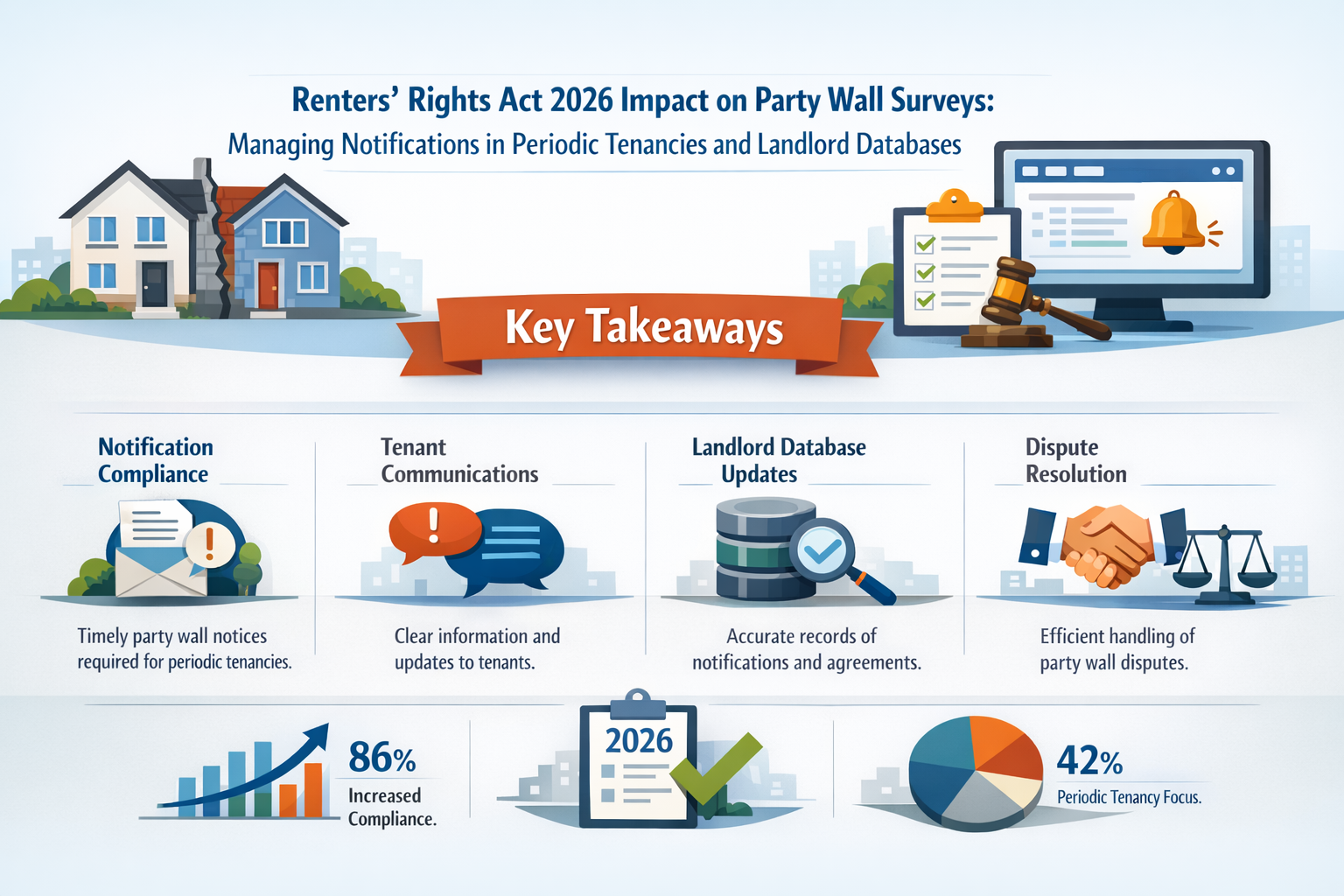
Key Takeaways
- All fixed-term tenancies automatically convert to open-ended periodic tenancies from 1 May 2026, eliminating landlords' ability to time party wall works around tenancy expiry dates
- Party wall notice periods (2 months for most works, 1 month for excavations) now overlap with mandatory tenant notification requirements under the new Act, requiring coordinated communication strategies
- Landlords must register with the Rental Database and join an Ombudsman Scheme by late 2026, with non-compliance resulting in fines up to £7,000 and potential barriers to serving valid party wall notices
- The Decent Homes Standard extension creates dual compliance obligations where party wall works must satisfy both structural safety requirements and new habitability standards
- Tenant cooperation becomes critical for surveyor access and schedule of condition surveys, as indefinite tenancy rights strengthen occupiers' negotiating positions during building works
Understanding the Renters' Rights Act 2026 Framework and Timeline
Phase 1: Immediate Changes from 1 May 2026
The Renters' Rights Act 2025 introduces a phased implementation schedule that directly impacts property development planning. Phase 1 takes effect on 1 May 2026, bringing immediate and irreversible changes to all private tenancies across England and Wales.[2]
The most significant change for property owners planning structural works is the automatic conversion of all existing fixed-term Assured Shorthold Tenancies (ASTs) to open-ended periodic tenancies.[2] This conversion happens by operation of law—landlords cannot prevent it, and tenants gain indefinite occupancy rights subject only to specific grounds for possession.
Previously, landlords could strategically time major building works around tenancy expiry dates, either completing works between tenants or serving Section 21 notices to regain possession before commencing disruptive construction projects. This planning flexibility disappears entirely under the new regime.
Key Phase 1 provisions affecting party wall works:
- ✅ Section 21 no-fault evictions abolished – landlords cannot remove tenants to facilitate building works
- ✅ Rent reviews limited to once annually with two months' notice required[2]
- ✅ Enhanced grounds for possession require specific circumstances (property sale, landlord moving in, serious rent arrears)
- ✅ Mandatory Information Sheet must be provided to all tenants by 31 May 2026[5]
Phase 2: Database and Ombudsman Requirements (Late 2026)
From late 2026, Phase 2 introduces mandatory registration and oversight mechanisms that create additional compliance layers for landlords undertaking party wall works.[2]
Private landlords must:
- Register with the national Rental Database (annual fee required)
- Join an approved Ombudsman Scheme for dispute resolution
- Maintain up-to-date property and tenancy information on the database
- Demonstrate compliance with all statutory obligations before certain legal processes
These requirements have direct implications for party wall procedures. A landlord who fails to register may face challenges enforcing party wall awards or pursuing possession proceedings if building works necessitate temporary tenant relocation. Non-compliance with database registration carries fines up to £7,000—the same penalty structure that applies to party wall breaches.[2]
Phase 3: Decent Homes Standard Extension
The final phase extends the Decent Homes Standard to private landlords, creating a comprehensive habitability framework that intersects with party wall obligations.[2] Local authorities gain enforcement powers including:
- 📋 Fines up to £7,000 for initial non-compliance
- 📋 Fines up to £40,000 or prosecution for failure to comply with enforcement action
- 📋 Prohibition orders preventing property occupation until works completed
For landlords planning party wall works, this creates a dual compliance requirement: structural works must satisfy both the Party Wall etc. Act 1996 procedural requirements and the substantive Decent Homes Standard quality thresholds.
Renters' Rights Act 2026 Impact on Party Wall Surveys: Notice Timing and Tenant Coordination
Revised Notice Strategies Under Periodic Tenancies
The Party Wall etc. Act 1996 establishes clear notice periods that remain unchanged by the Renters' Rights Act:[1]
- 2 months' notice for works to existing party walls or building on the boundary line
- 1 month's notice for excavation works within 3-6 meters of neighboring structures
However, the context in which these notices operate has fundamentally changed. Previously, landlords could serve party wall notices knowing that tenants would vacate at fixed-term expiry, allowing works to proceed with vacant possession. Under periodic tenancies with indefinite duration, landlords must now:
- Coordinate party wall notices with ongoing tenant occupation
- Secure tenant cooperation for surveyor access throughout the process
- Plan works around tenant rights to quiet enjoyment and habitability
- Maintain compliance with rent review restrictions (only once annually)[2]
Understanding when you need a party wall surveyor becomes more critical when tenancy timelines no longer provide natural breaks in occupation.
Tenant Notification Requirements and Information Sheets
The Renters' Rights Act mandates that landlords provide a comprehensive Information Sheet to all tenants by 31 May 2026.[5] This document must explain:
- Tenant rights under the new legislative framework
- Grounds for possession and eviction procedures
- Rent review processes and limitations
- Complaint and dispute resolution mechanisms
- Ombudsman contact information
For landlords planning party wall works, this creates a dual notification obligation:
| Requirement | Timeline | Content | Penalty for Non-Compliance |
|---|---|---|---|
| Renters' Rights Information Sheet | By 31 May 2026 | Statutory tenant rights and procedures | Fine up to £7,000[5] |
| Party Wall Notice | 2 months before works (1 month for excavations) | Specific works details, surveyor appointment rights | Invalid notice, work stoppage, damages |
Best practice requires integrating these communications to avoid confusion and demonstrate good faith cooperation with tenants. A landlord who fails to provide the Information Sheet may find tenants less cooperative with party wall procedures, potentially claiming the landlord's overall non-compliance undermines the validity of construction-related notices.
Surveyor Access and Schedule of Condition Challenges
Party wall procedures typically require multiple property inspections:
- Initial inspection to assess existing conditions
- Schedule of condition preparation documenting pre-works state
- Monitoring visits during construction
- Post-completion inspection to verify no damage occurred
Under fixed-term tenancies, landlords could schedule these inspections during void periods or include access clauses in tenancy agreements. Periodic tenancies with enhanced tenant protections make access coordination more complex.
Tenants retain the right to quiet enjoyment, and while landlords maintain statutory access rights for repairs and inspections, party wall surveyor visits serve the building owner's interests rather than tenant safety or property maintenance. This creates potential friction points.
Recommended access protocols:
✅ Provide minimum 24 hours' written notice for all surveyor visits
✅ Offer flexible scheduling accommodating tenant work schedules
✅ Explain the purpose and duration of each inspection clearly
✅ Document all access requests and responses for dispute resolution
✅ Consider tenant compensation for significant disruption (not legally required but builds cooperation)
Professional party wall schedule of condition documentation becomes even more critical when tenant relationships extend indefinitely, as any future damage claims may arise years after works completion.
Dispute Resolution Under Dual Frameworks
When party wall disputes arise, landlords now navigate two parallel dispute resolution systems:
Traditional Party Wall Dispute Resolution:
- Appointment of agreed surveyor or separate surveyors for each party
- Preparation of party wall award with binding determinations
- Appeal to county court within 14 days of award service
- Typical costs: £150-£200 per hour for surveyors, approximately £1,000 for complete award[1]
Renters' Rights Ombudsman Process:
- Mandatory membership in approved Ombudsman Scheme (Phase 2)[2]
- Tenant complaints about works disruption, access disputes, or habitability concerns
- Ombudsman investigation and binding determinations
- Potential compensation orders to tenants
A tenant who objects to party wall works may simultaneously:
- Refuse consent to the party wall notice, triggering surveyor appointment
- File a complaint with the Ombudsman claiming excessive disruption
- Raise concerns about Decent Homes Standard compliance during works
Landlords must manage these parallel processes carefully to avoid contradictory determinations or compliance failures in one system undermining their position in the other. For guidance on managing complex party wall situations, review our top 9 questions about party wall surveys.
Managing Landlord Database Registration and Party Wall Documentation

Database Registration Requirements and Implications
The mandatory Rental Database registration (Phase 2, late 2026) creates a centralized record of all private landlords and their properties.[2] While specific database requirements await secondary legislation, the framework will likely require:
- Property address and ownership details
- Current tenancy information (tenant names, start dates, rent amounts)
- Compliance certificates (gas safety, electrical safety, energy performance)
- Enforcement action history (fines, prohibition orders, prosecutions)
- Ombudsman membership details
For landlords planning party wall works, database registration creates both opportunities and risks:
Opportunities:
- ✅ Demonstrates professionalism and compliance to tenants and neighbors
- ✅ Provides centralized record of property improvements and structural works
- ✅ May facilitate faster processing of building control applications
- ✅ Creates audit trail of proper procedures followed
Risks:
- ⚠️ Party wall disputes or complaints recorded on permanent database
- ⚠️ Non-compliance with any requirement may trigger database flags
- ⚠️ Enforcement authorities can easily identify landlords with multiple properties
- ⚠️ Database information may be publicly searchable (details pending)
Best practice: Update database records before commencing party wall procedures to demonstrate current compliance status. If the database includes a section for planned works or current building projects, proactively disclosing party wall procedures may prevent tenant complaints about inadequate notice.
Documentation Requirements for Compliance
The intersection of party wall procedures and Renters' Rights Act compliance creates extensive documentation obligations:
Essential Records to Maintain:
- Renters' Rights Information Sheet – proof of service to all tenants by 31 May 2026[5]
- Party wall notices – copies of all notices served with proof of service
- Surveyor appointment letters – documenting proper appointment procedures
- Party wall awards – final determinations with all schedules and conditions
- Schedule of condition reports – comprehensive pre-works documentation
- Access request records – all surveyor visit notifications and tenant responses
- Ombudsman membership certificate – proof of Phase 2 compliance
- Database registration confirmation – proof of landlord registration
- Tenant communications log – all correspondence regarding works and disruption
- Completion certificates – building control approval and final inspections
This documentation serves multiple purposes:
- Demonstrates compliance if enforcement action taken
- Provides evidence in party wall disputes or Ombudsman complaints
- Supports database reporting requirements
- Protects against future damage claims from tenants or neighbors
Consider engaging professionals who understand party wall agreement essentials to ensure documentation meets both traditional party wall standards and new regulatory requirements.
Cost Implications and Budget Planning
The Renters' Rights Act 2026 Impact on Party Wall Surveys: Managing Notifications in Periodic Tenancies and Landlord Databases extends beyond procedural complexity to significant cost implications:
Traditional Party Wall Costs:
- Surveyor fees: £150-£200 per hour[1]
- Complete party wall award: approximately £1,000[1]
- Schedule of condition: £500-£1,500 depending on property size
- Monitoring visits: £200-£400 per visit
Additional Renters' Rights Act Costs:
- Database registration: annual fee (amount TBD)
- Ombudsman membership: annual fee (typically £100-£300 based on other schemes)
- Information Sheet preparation and service: £50-£200 for professional assistance
- Enhanced tenant communication: additional surveyor time for coordination
- Potential compensation: if Ombudsman orders payment for excessive disruption
Contingency costs for delays:
- Extended surveyor engagement if tenant access delays schedule of condition
- Additional rent periods if works delayed by compliance issues
- Legal fees if disputes escalate to county court or Ombudsman formal proceedings
For comprehensive cost planning, review our guide on party wall surveyor costs and factor in the additional compliance layers introduced by the Renters' Rights Act.
Strategic Timing for Development Projects
With fixed-term tenancies eliminated, landlords must adopt new strategic approaches to timing major development works:
Option 1: Coordinate with Tenant Lifecycle Events
- Plan works when tenants indicate intention to vacate
- Offer relocation assistance or temporary accommodation
- Structure rent reductions to incentivize cooperation during works
Option 2: Pursue Possession on Specific Grounds
- Ground 1: Landlord intends to occupy property (requires 2 months' notice)
- Ground 1A: Landlord intends to sell property (requires 2 months' notice)
- Coordinate possession with party wall notice periods for seamless transition
Option 3: Works with Tenant in Situ
- Extensive pre-works consultation and planning
- Phased construction to minimize disruption
- Enhanced schedule of condition to protect all parties
- Clear compensation framework for significant disruption
Each approach requires careful coordination of party wall procedures with tenancy management, ensuring notices align and documentation demonstrates compliance with both frameworks.
Practical Guidance: Step-by-Step Compliance Process
Pre-Works Compliance Checklist
Before serving party wall notices for any structural works, complete this compliance verification:
Renters' Rights Act Compliance:
- Information Sheet served to all tenants (by 31 May 2026 deadline)[5]
- Database registration completed (Phase 2 requirement)[2]
- Ombudsman membership active (Phase 2 requirement)[2]
- Current rent review compliance verified (annual limit observed)[2]
- No outstanding tenant complaints or Ombudsman investigations
- Property meets Decent Homes Standard (Phase 3 requirement)[2]
Party Wall Procedure Preparation:
- Architectural drawings prepared showing works scope
- Neighboring properties identified (within 3-6m for excavations)[1]
- Party wall surveyor consulted on notice requirements
- Timeline established with appropriate notice periods
- Budget allocated for surveyor fees and potential awards
- Tenant communication strategy developed
Only after completing these preliminary steps should you proceed with formal party wall notice service.
Integrated Notice Service Strategy
Serve party wall notices using an integrated approach that acknowledges both frameworks:
Sample Communication Timeline:
Week 1: Initial tenant consultation
- Explain planned works in accessible language
- Provide preliminary timeline and disruption estimate
- Invite questions and concerns
- Reference Information Sheet rights and Ombudsman process
Week 2: Formal party wall notice service
- Serve notice to adjoining owners (neighbors)
- Serve copy to tenants for information (not legally required but demonstrates transparency)
- Provide surveyor contact information
- Explain next steps in party wall process
Week 4: Follow-up and access coordination
- Confirm tenant understanding of process
- Schedule initial surveyor inspection
- Address any concerns raised
- Document all communications
Week 8: Pre-works final preparation
- Complete schedule of condition with tenant present if possible
- Finalize party wall award
- Confirm works start date
- Provide emergency contact information
This integrated approach demonstrates good faith compliance with tenant protection requirements while maintaining proper party wall procedures.
Managing Disputes and Ombudsman Complaints
When disputes arise, respond systematically:
Party Wall Dispute Response:
- Document the specific objection or concern
- Engage surveyors promptly (within 10 days of notice response)
- Facilitate surveyor access and information provision
- Review draft award carefully before finalization
- Consider mediation if significant disagreement persists
Ombudsman Complaint Response:
- Acknowledge complaint within required timeframe
- Provide comprehensive documentation of compliance
- Demonstrate reasonable efforts to minimize disruption
- Show adherence to party wall procedures and tenant rights
- Propose resolution if complaint has merit
For complex disputes involving both frameworks, consider engaging specialists in party wall disputes who understand the intersection with tenancy law.
Technology Solutions for Compliance Management
Several technology solutions can help landlords manage the increased complexity:
Digital Tools:
- 📱 Property management software with compliance tracking modules
- 📱 Document management systems for centralized record storage
- 📱 Tenant communication portals for transparent notice service
- 📱 Calendar integration for deadline tracking (notice periods, database renewal, Information Sheet updates)
- 📱 Surveyor coordination platforms for scheduling and report sharing
Key Features to Prioritize:
- Automated deadline reminders for statutory notice periods
- Template libraries for compliant communications
- Audit trails showing when documents served and acknowledged
- Integration with database reporting requirements
- Secure tenant access for viewing works information
Technology cannot replace professional judgment, but it can prevent administrative failures that undermine otherwise compliant procedures.
Future Considerations and Legislative Evolution
Anticipated Secondary Legislation
The Renters' Rights Act 2025 framework relies on extensive secondary legislation to implement specific requirements. Landlords should monitor developments in:
- Database registration procedures – specific information requirements, fee structures, update frequencies
- Ombudsman scheme standards – approved schemes, membership criteria, complaint processes
- Decent Homes Standard details – specific technical requirements, inspection protocols, enforcement priorities
- Information Sheet updates – revised content as procedures evolve
These details will directly impact how party wall procedures integrate with the broader compliance framework. Subscribe to updates from professional bodies and regulatory authorities to stay informed.
Impact on Property Development Economics
The Renters' Rights Act 2026 Impact on Party Wall Surveys: Managing Notifications in Periodic Tenancies and Landlord Databases may fundamentally alter the economics of property development in the rental sector:
Potential Market Effects:
- Reduced appetite for complex structural works on tenanted properties
- Increased premium for vacant possession properties
- Higher development costs factored into rent calculations
- Consolidation toward professional landlords with compliance infrastructure
- Innovation in tenant-friendly construction methodologies
Property owners should conduct financial modeling that incorporates:
- Extended project timelines due to tenant coordination requirements
- Higher professional fees for integrated compliance management
- Contingency budgets for dispute resolution in both frameworks
- Ongoing database and Ombudsman membership costs
Best Practices for Professional Landlords
Professional landlords who embrace the new framework can differentiate themselves through:
✨ Proactive compliance – exceeding minimum requirements to demonstrate commitment
✨ Transparent communication – clear, accessible information about works and tenant rights
✨ Professional partnerships – working with surveyors who understand both frameworks
✨ Technology adoption – using digital tools to streamline compliance
✨ Tenant relationships – building cooperation through fair treatment and reasonable accommodation
These practices not only ensure compliance but also reduce dispute risk and maintain property value through successful completion of enhancement works.
Conclusion
The Renters' Rights Act 2026 Impact on Party Wall Surveys: Managing Notifications in Periodic Tenancies and Landlord Databases represents a fundamental shift in how structural development works proceed on rental properties. The abolition of Section 21 no-fault evictions and transition to indefinite periodic tenancies eliminates traditional timing strategies, requiring landlords to coordinate party wall procedures with ongoing tenant occupation and enhanced protection rights.
Key implementation priorities:
- Ensure Information Sheet compliance by the 31 May 2026 deadline to establish good faith with tenants[5]
- Prepare for database registration and Ombudsman membership before Phase 2 implementation in late 2026[2]
- Integrate party wall notice procedures with tenant communication strategies that acknowledge enhanced rights
- Invest in professional surveyor expertise that understands both the Party Wall etc. Act 1996 and Renters' Rights Act requirements
- Maintain comprehensive documentation demonstrating compliance with all overlapping frameworks
- Budget appropriately for increased costs and potential delays from coordination requirements
The intersection of these legislative frameworks creates complexity, but also opportunity for professional landlords who embrace best practices. Properties with successful structural enhancements completed under the new regime will demonstrate both physical improvement and regulatory compliance—valuable attributes in an increasingly regulated rental market.
Next Steps:
- Audit current tenancies to identify which will convert to periodic tenancies on 1 May 2026
- Review planned development projects to assess party wall notice timing under new constraints
- Consult with qualified party wall surveyors about integrated compliance strategies
- Establish relationships with Ombudsman schemes and prepare for database registration
- Develop tenant communication protocols that balance party wall requirements with enhanced tenant rights
For expert assistance navigating the Renters' Rights Act 2026 Impact on Party Wall Surveys: Managing Notifications in Periodic Tenancies and Landlord Databases, consult with chartered surveyors who specialize in both party wall procedures and residential tenancy compliance. Professional guidance can prevent costly mistakes and ensure your development projects proceed smoothly within the new regulatory framework.
References
[1] Party Wall Agreement – hoa.org.uk
[2] The Renters Rights Act What S Changing What It Means For Landlords And How To Mitigate Risks – kennedyslaw.com
[5] The Renters Rights Act Information Sheet 2026 What You Need To Know – mondaq.com
How Prince Surveyors can help: explore our party wall surveyors or learn about our party wall surveyor costs.