

A two-year-old child died from prolonged exposure to black mould in social housing in 2020. That tragedy became the catalyst for Awaab's Law—legislation that now mandates strict investigation and repair timeframes for hazardous housing conditions.[1] While Phase 1 took effect for social housing in October 2025, the Awaab's Law Extensions 2026: Expert Witness Protocols for Surveyors in Private Rented Sector Hazard Disputes will transform how chartered surveyors prepare evidence for the private rented sector when Phase 3 rolls out in late 2026.
The extension brings private landlords under identical obligations as social housing providers, creating unprecedented demand for RICS-aligned expert witness testimony in tribunal and ombudsman cases. Surveyors must now master evidence protocols covering not just damp and mould, but expanded hazards including excess cold, fire safety breaches, and electrical risks—all with forensic precision that withstands legal scrutiny.
Key Takeaways
- Phase 3 extends to private rentals in late 2026, requiring landlords to investigate hazards within 10 working days and complete repairs according to statutory timeframes[1]
- Expert witness protocols must address five core hazard categories: damp and mould, excess cold, fire safety, electrical risks, and structural defects with RICS-compliant documentation
- Emergency hazards demand 24-hour response, while significant issues require investigation within 10 working days and remediation within specified periods[1]
- Tribunal-ready evidence requires systematic documentation: timestamped photographs, calibrated instrument readings, root cause analysis, and compliance certificates
- Surveyors face enhanced liability as local councils gain stronger enforcement powers including improvement notices, civil penalties, and landlord banning orders[1]
Understanding the Awaab's Law Extensions 2026 Framework for Private Rentals
The Awaab's Law Extensions 2026: Expert Witness Protocols for Surveyors in Private Rented Sector Hazard Disputes represent a fundamental shift in rental property regulation. Unlike previous housing standards that focused primarily on structural adequacy, this framework introduces legally binding response timeframes that create clear liability thresholds for landlords and their professional advisors.[2]
Statutory Response Timeframes and Hazard Categories
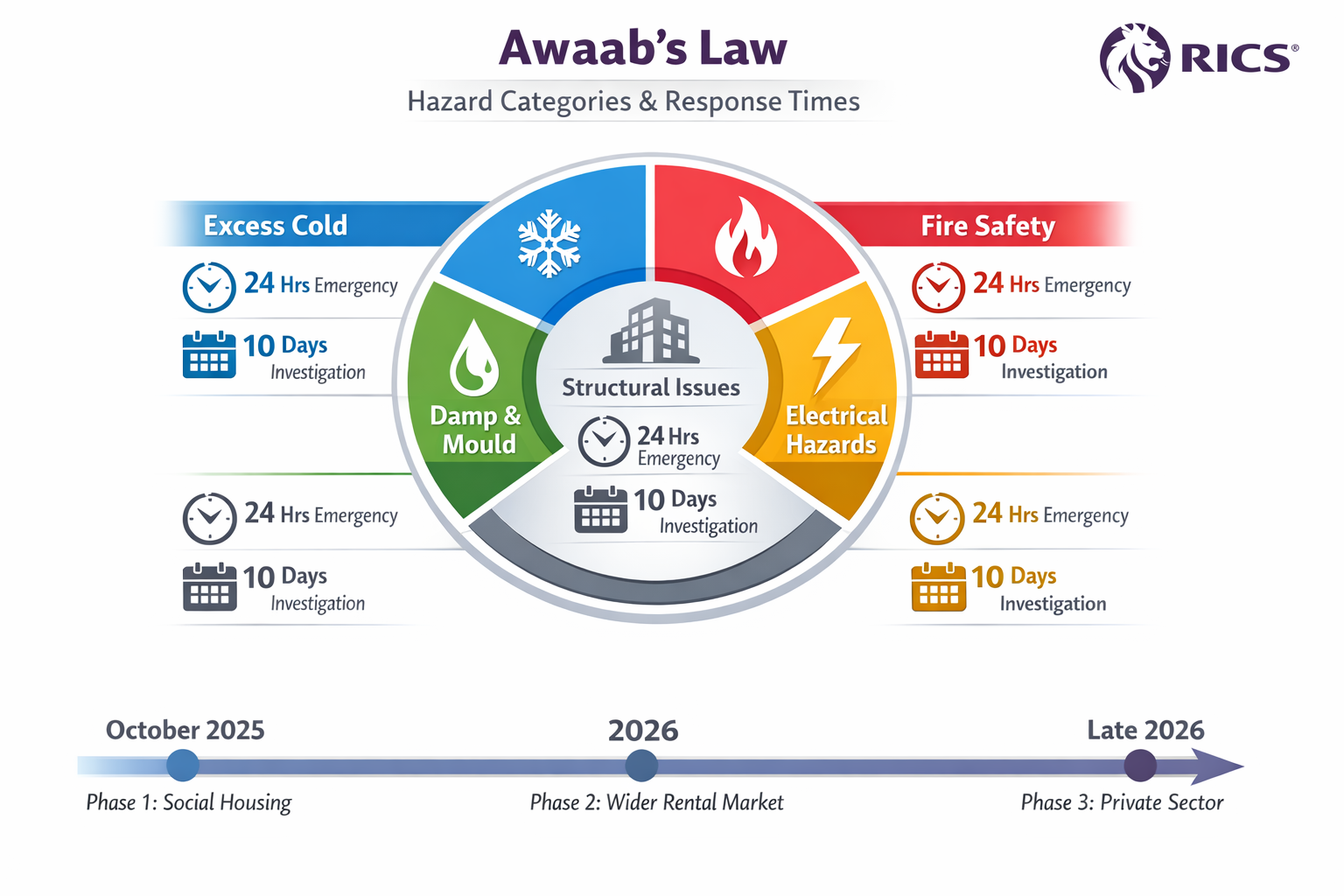
The legislation establishes a three-tier response system that surveyors must understand when preparing expert evidence:
Emergency Hazards (24-Hour Response) ⚠️
- Gas leaks and carbon monoxide risks
- Severe electrical faults posing immediate danger
- Complete heating system failure during winter months
- Structural collapse or imminent collapse risk
- Severe water ingress causing immediate habitability loss
Significant Hazards (10 Working Days Investigation) 📋
- Widespread damp and mould growth
- Inadequate heating causing excess cold conditions
- Fire safety breaches including blocked escape routes
- Electrical installation defects requiring remediation
- Roof leaks and persistent water penetration
Standard Repairs (Timeframes Vary by Severity) 🔧
Properties must be made safe within five working days after investigation for significant hazards, with full remediation following root cause analysis.[1]
The Five Core Hazard Categories Under Awaab's Law Extensions 2026
Professional surveyors providing expert witness testimonies in rental disputes must develop specialized protocols for each hazard category:
| Hazard Category | Key Assessment Criteria | Required Evidence Standards |
|---|---|---|
| Damp & Mould | Moisture meter readings, ventilation adequacy, thermal bridging | Calibrated hygrometer data, photographic progression, laboratory analysis |
| Excess Cold | Heating system capacity, insulation performance, thermal efficiency | EPC ratings, thermal imaging, temperature logging over 7+ days |
| Fire Safety | Escape route adequacy, detection systems, fire door integrity | Compliance certificates, BS 9999 assessment, compartmentation testing |
| Electrical Risks | Installation condition, earth bonding, circuit protection | EICR reports, voltage testing, thermal scanning of consumer units |
| Structural Issues | Load-bearing capacity, subsidence, dangerous defects | Structural calculations, crack monitoring, foundation investigation |
RICS-Aligned Evidence Preparation Protocols for Tribunal Cases
When disputes escalate to tribunal or ombudsman proceedings, surveyors acting as expert witnesses must provide evidence that meets civil procedure rules and professional standards. The Awaab's Law Extensions 2026: Expert Witness Protocols for Surveyors in Private Rented Sector Hazard Disputes demand a systematic approach to evidence collection and presentation.[3]
Documentation Requirements for Expert Witness Reports
Initial Complaint Documentation 📝
Expert witnesses must establish a clear timeline from the tenant's first report. This includes:
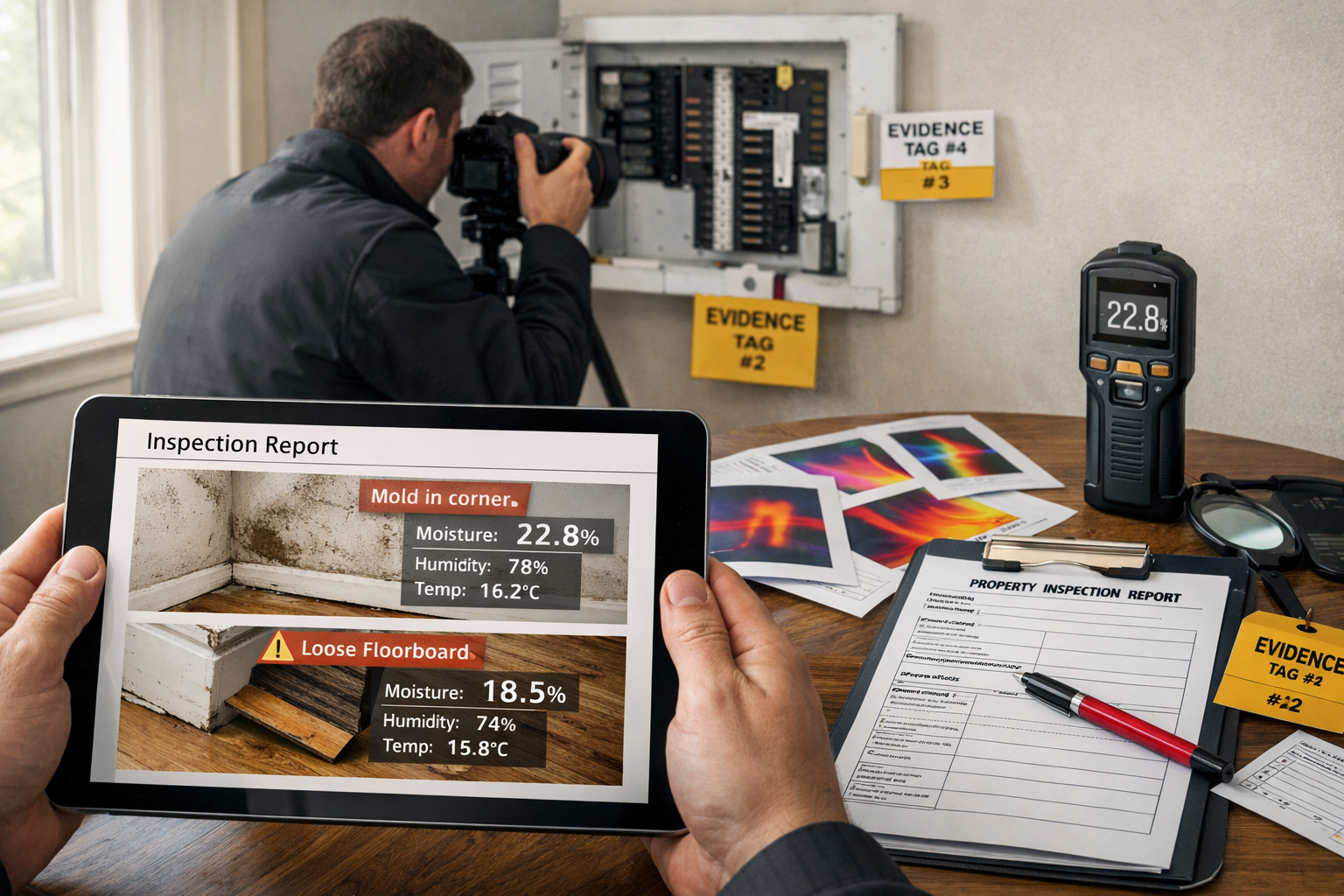
- Timestamped photographs showing hazard progression
- Written correspondence between tenant and landlord
- Maintenance request records with response dates
- Previous inspection reports or surveys
- Tenant health records (where relevant and consented)
Surveyors should obtain complete documentation chains to demonstrate whether landlords met the 10-working-day investigation requirement or 24-hour emergency response obligation.[1]
Instrumental Evidence Collection 🔬
Professional-grade equipment and calibration certificates are essential for tribunal-admissible evidence:
- Moisture Meters: Protimeter or Tramex devices with current calibration certificates, recording both surface and subsurface readings at multiple locations
- Thermal Imaging Cameras: FLIR or similar systems documenting heat loss, thermal bridging, and moisture patterns with temperature scales visible
- Hygrometers: Relative humidity measurements taken at multiple times over 48-72 hours minimum
- Electrical Testing Equipment: Multifunction testers providing insulation resistance, earth loop impedance, and RCD trip times
- Gas Analyzers: Carbon monoxide detectors with digital readouts and data logging capability
All instrument readings must include metadata: date, time, location, ambient conditions, and operator credentials.
Root Cause Analysis vs. Surface Treatment
A critical distinction in Awaab's Law Extensions 2026: Expert Witness Protocols for Surveyors in Private Rented Sector Hazard Disputes is demonstrating whether landlords investigated underlying causes or merely addressed symptoms.[1]
Inadequate Response Examples ❌
- Painting over mould without addressing moisture source
- Providing portable heaters without repairing central heating
- Surface repairs to electrical outlets without full circuit testing
- Temporary ventilation without addressing condensation causes
Compliant Investigation Examples ✅
- Thermal imaging to identify cold bridging causing condensation
- Drainage surveys to locate external water ingress sources
- Full electrical installation condition reports (EICR)
- Ventilation capacity calculations and air change rate testing
- Structural engineer assessment of subsidence or settlement
Expert witnesses must present evidence showing whether the landlord's investigation was proportionate to the hazard severity and whether remediation addressed root causes.
Photographic Evidence Standards
Courts and tribunals require systematic photographic documentation that meets forensic standards:
Technical Requirements 📸
- High-resolution images (minimum 12 megapixels)
- EXIF data preserved showing date, time, and camera settings
- Scale references (measuring tape or reference object) in frame
- Multiple angles and distances for each defect
- Before, during, and after remediation sequences
Compositional Requirements
- Wide shots establishing room context and location
- Medium shots showing defect extent and surrounding conditions
- Close-ups documenting specific failures or hazards
- Detail shots of manufacturer labels, model numbers, installation dates
Professional surveyors conducting building surveys for compliance purposes should maintain consistent photographic protocols across all inspections.
Preparing Expert Witness Testimony for Ombudsman and Tribunal Proceedings
The Awaab's Law Extensions 2026: Expert Witness Protocols for Surveyors in Private Rented Sector Hazard Disputes require surveyors to present evidence that balances technical precision with accessibility for non-specialist decision-makers.[3]
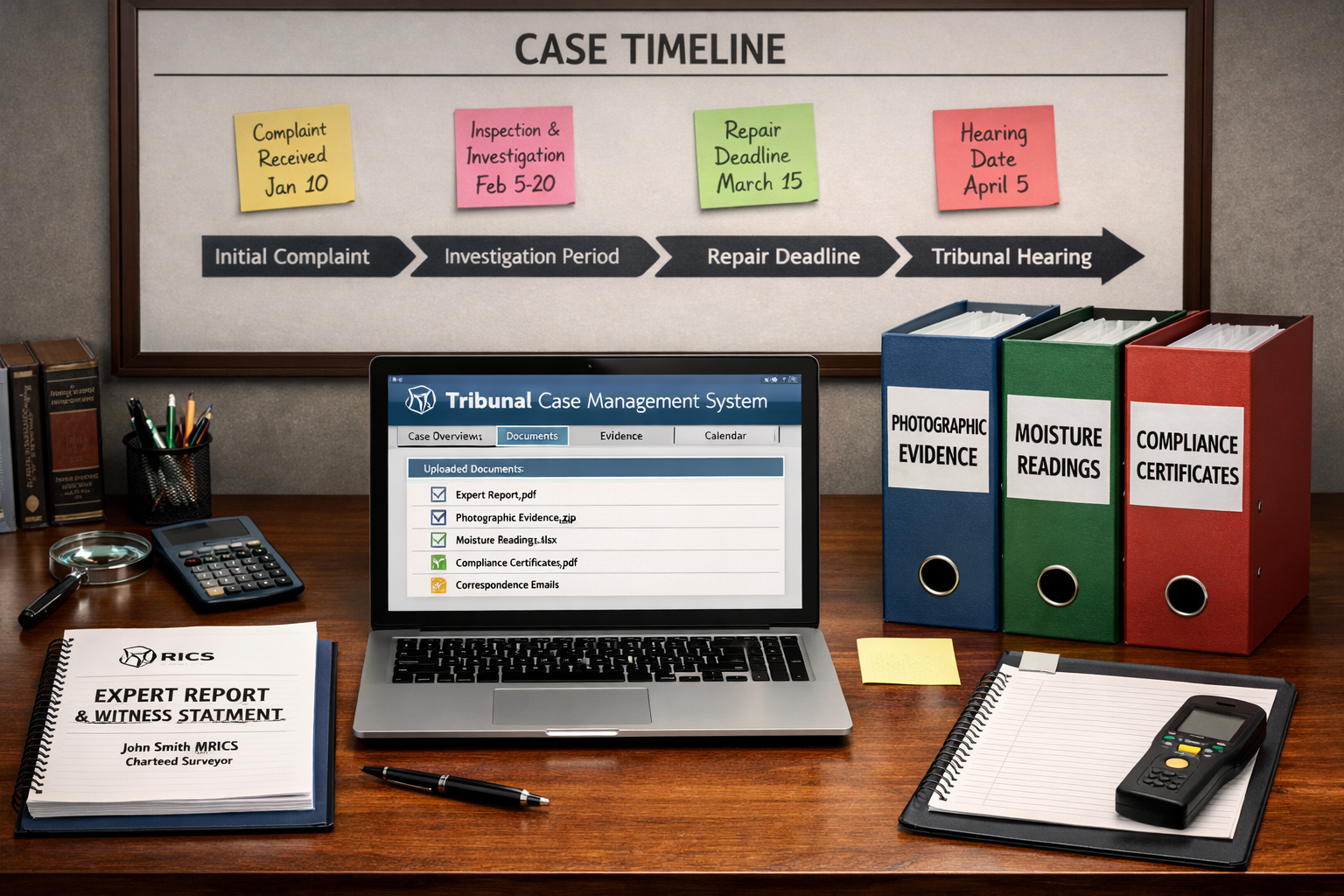
Expert Report Structure and Content
Executive Summary Section 📄
- Clear statement of instructions received
- Summary of key findings in plain language
- Opinion on whether landlord met statutory obligations
- Recommended remediation measures and costs
Methodology Section
- Inspection dates, times, and duration
- Personnel present during inspection
- Equipment used with calibration details
- Standards and guidance documents referenced (RICS, BRE, BS standards)
- Limitations or constraints on inspection scope
Findings Section with Hazard-Specific Analysis
For each hazard category identified, expert witnesses should provide:
Damp and Mould Analysis 💧
- Moisture content readings with location mapping
- Mould species identification (where laboratory analysis conducted)
- Ventilation adequacy assessment against Building Regulations Part F
- Thermal performance evaluation identifying cold bridging
- Occupant behavior factors (balanced assessment)
Excess Cold Assessment 🥶
- Heating system capacity calculations
- Insulation performance evaluation
- Temperature monitoring data over representative period
- Energy Performance Certificate (EPC) rating analysis
- Comparison against Decent Homes Standard thermal comfort criteria
Fire Safety Evaluation 🔥
- Means of escape adequacy assessment
- Fire detection and alarm system compliance
- Fire door integrity and self-closing mechanism function
- Compartmentation and fire stopping condition
- Emergency lighting provision and testing records
Electrical Safety Assessment ⚡
- EICR findings with classification of defects (C1, C2, C3)
- Circuit protection adequacy
- Earth bonding compliance
- Consumer unit condition and type (plastic vs. metal)
- Portable appliance testing records (where relevant)
Structural Defects Documentation 🏗️
- Crack monitoring data showing progression or stability
- Foundation condition assessment
- Load-bearing element integrity
- Subsidence or settlement evidence
- Dangerous structural conditions requiring immediate action
Cross-Examination Preparation
Expert witnesses must anticipate challenges to their evidence and methodology:
Common Challenge Areas ⚖️
- Instrument calibration and accuracy
- Professional qualifications and experience
- Inspection scope limitations
- Alternative causation theories
- Cost estimates for remediation works
Surveyors should prepare detailed responses addressing:
- Relevant RICS qualifications and CPD records
- Professional indemnity insurance coverage
- Previous expert witness experience
- Published guidance followed in assessment
- Peer review or second opinions obtained
Understanding construction law principles helps surveyors anticipate legal arguments and frame evidence appropriately.
Documentation Retention and Disclosure
Mandatory Retention Periods 🗄️
- All inspection notes and draft reports: 6 years minimum
- Photographic evidence with metadata: permanent retention
- Instrument calibration certificates: duration of case plus 2 years
- Correspondence with instructing parties: permanent retention
- Laboratory reports and specialist assessments: permanent retention
Expert witnesses must disclose all relevant evidence to both parties, including findings that may not support their client's position. Professional duty to the tribunal supersedes client loyalty.
Enforcement Powers and Surveyor Liability Under Phase 3
The Awaab's Law Extensions 2026: Expert Witness Protocols for Surveyors in Private Rented Sector Hazard Disputes introduce enhanced local authority enforcement powers that increase professional liability for surveyors providing compliance advice.[1]
Local Authority Inspection and Enforcement Powers
Enhanced Entry Rights 🚪
Local councils gain statutory powers to:
- Enter private rental properties for compliance inspections
- Require landlords to provide access within specified timeframes
- Conduct follow-up inspections to verify remediation completion
- Interview tenants and inspect documentation records
Enforcement Action Hierarchy 📊
-
Improvement Notices: Formal notices specifying required works with completion deadlines (typically 28-90 days depending on hazard severity)
-
Civil Penalties: Financial penalties up to £30,000 for serious breaches, with amounts determined by offense severity, landlord's previous record, and harm caused
-
Prosecution: Criminal prosecution for the most serious violations, particularly where tenant health has been significantly compromised
-
Banning Orders: Prohibition from letting properties for landlords with persistent compliance failures, lasting 12 months to indefinite periods
-
Rent Repayment Orders: Tenants may claim rent repayment for periods where properties failed to meet standards
Professional Liability for Surveyors
Chartered surveyors providing compliance advice or property inspection services face increased liability exposure:
Negligent Advice Claims ⚠️
- Failure to identify Category 1 hazards during surveys
- Inadequate investigation of reported hazards
- Incorrect assessment of compliance with Decent Homes Standard
- Missed statutory deadlines for investigation or remediation
- Insufficient documentation of inspection findings
Professional Indemnity Considerations
Surveyors should ensure PI insurance covers:
- Expert witness work with minimum £1 million per claim
- Compliance advisory services related to Awaab's Law
- Retrospective cover for work completed before Phase 3 implementation
- Defense costs for regulatory investigations
- Disciplinary proceedings by RICS
Grace Periods and Transition Arrangements
The Government is expected to implement transition provisions when Phase 3 takes effect in late 2026, similar to previous housing reforms.[1]
Anticipated Grace Period Provisions 📅
- 6-12 month transition period for landlords to conduct compliance assessments
- Phased enforcement prioritizing the most serious hazards
- Guidance period where improvement notices precede penalties
- Landlord education programs and compliance toolkits
However, emergency hazards will require immediate 24-hour response from day one of Phase 3 implementation, with no grace period for life-threatening conditions.[1]
Surveyors should advise landlord clients to conduct proactive compliance audits well before late 2026 to identify and remediate issues before statutory deadlines apply.
Practical Compliance Strategies for Private Landlords and Their Surveyors
Professional surveyors can add significant value by helping private landlords prepare for the Awaab's Law Extensions 2026: Expert Witness Protocols for Surveyors in Private Rented Sector Hazard Disputes through proactive compliance programs.
Pre-Phase 3 Compliance Audits
Systematic Property Assessment Protocol 🔍
-
Desktop Review Phase
- Review existing EPCs, gas safety certificates, and EICRs
- Analyze tenant complaint history and maintenance records
- Identify properties with previous damp, mould, or heating issues
- Prioritize high-risk properties for detailed inspection
-
Physical Inspection Phase
- Conduct comprehensive surveys addressing all five hazard categories
- Use thermal imaging to identify hidden defects
- Test heating systems under load conditions
- Assess ventilation adequacy and air change rates
- Document current condition with photographic evidence
-
Risk Prioritization Phase
- Categorize findings by hazard severity (emergency, significant, standard)
- Estimate remediation costs and timeframes
- Develop phased compliance improvement plans
- Identify properties requiring specialist assessments
Surveyors offering building survey services can develop specialized Awaab's Law compliance packages for landlord clients.
Documentation Systems for Compliance Demonstration
Essential Record-Keeping Requirements 📋
Landlords must maintain comprehensive documentation to demonstrate compliance:
- Tenant Communication Log: All reports of hazards with dates, times, and response actions
- Inspection Records: Professional survey reports with photographic evidence
- Remediation Documentation: Contractor invoices, completion certificates, warranty documents
- Testing Certificates: Gas safety, electrical testing, fire alarm servicing, emergency lighting
- Maintenance Schedules: Planned preventive maintenance programs with completion records
Digital document management systems with cloud backup ensure records remain accessible for enforcement investigations or tribunal proceedings.
Preventive Maintenance Programs
Proactive Hazard Prevention 🛠️
Rather than reactive responses to tenant complaints, surveyors should recommend preventive programs:
Damp and Mould Prevention
- Annual ventilation system servicing and filter replacement
- Gutter and downpipe clearance twice yearly
- External pointing and render maintenance on 5-year cycles
- Condensation risk assessments before winter months
- Tenant education on ventilation and heating practices
Heating System Reliability
- Annual boiler servicing before heating season
- Heating system capacity reviews for property modifications
- Thermostatic radiator valve functionality testing
- Insulation upgrades to reduce heat loss
- Smart heating controls for improved efficiency
Electrical Safety Maintenance
- EICR testing every 5 years (or change of tenancy)
- Consumer unit upgrades to current standards
- Surge protection installation
- Portable appliance testing for landlord-provided items
- Emergency lighting testing in HMOs
Fire Safety Compliance
- Smoke and carbon monoxide alarm testing quarterly
- Fire door maintenance and adjustment annually
- Emergency escape route inspections
- Fire risk assessments reviewed every 2 years
- Compartmentation integrity checks
Understanding common building problems and solutions helps surveyors develop comprehensive preventive maintenance specifications.
Cost-Benefit Analysis of Proactive Compliance
Financial Implications 💰
While proactive compliance requires upfront investment, the alternative costs are significantly higher:
Proactive Compliance Costs (Typical 2-Bed Rental)
- Comprehensive compliance survey: £800-1,200
- Thermal imaging assessment: £300-500
- EICR testing: £200-350
- Annual preventive maintenance: £400-600
- Documentation system setup: £200-400
- Total Annual Investment: £1,900-3,050
Reactive Compliance Costs (Typical Enforcement Scenario)
- Emergency remediation works: £3,000-8,000
- Civil penalty for breach: £5,000-30,000
- Legal representation costs: £2,000-5,000
- Rent repayment orders: £6,000-15,000 (6-12 months rent)
- Void period during works: £1,500-3,000
- Reputational damage and tenant turnover: incalculable
- Total Reactive Costs: £17,500-61,000+
The financial case for proactive compliance is overwhelming, even before considering tenant welfare and professional reputation factors.
Specialist Assessment Requirements for Complex Hazards
Certain hazard scenarios require specialist expertise beyond general surveying competence. The Awaab's Law Extensions 2026: Expert Witness Protocols for Surveyors in Private Rented Sector Hazard Disputes recognize that complex cases demand multidisciplinary assessment.[1]
When to Instruct Specialist Consultants
Structural Engineering Input 🏗️
Instruct structural engineers when:
- Subsidence or settlement is suspected
- Load-bearing elements show distress
- Major alterations have compromised structural integrity
- Foundation movement is evident
- Historic buildings require specialist assessment
Professional structural engineering services provide calculations and assessments that general surveyors cannot offer.
Environmental Health Specialists 🧪
Engage environmental health consultants for:
- Mould species identification and toxicity assessment
- Air quality testing for spores and allergens
- Asbestos identification and management
- Radon gas testing and mitigation
- Chemical contamination assessment
Electrical Engineering Consultants ⚡
Specialist electrical engineers provide:
- Complex three-phase installation assessment
- Commercial property electrical compliance
- Fire alarm system design and specification
- Emergency lighting calculations
- Renewable energy integration assessment
Mechanical Engineering Expertise 🔧
Mechanical engineers assess:
- Commercial heating and ventilation systems
- Heat pump installations and performance
- Legionella risk in water systems
- Mechanical ventilation with heat recovery (MVHR)
- Building management system integration
Coordinating Multidisciplinary Evidence
When multiple specialists contribute to expert witness evidence, the coordinating surveyor must:
Evidence Integration Responsibilities 📊
- Ensure all specialists receive identical instructions
- Coordinate site access and inspection scheduling
- Prevent evidence conflicts or contradictions
- Synthesize findings into coherent expert report
- Identify where specialist opinions diverge and explain implications
Joint Expert Meetings
In complex tribunal cases, experts may participate in "without prejudice" meetings to:
- Identify areas of agreement and disagreement
- Narrow issues requiring tribunal determination
- Clarify technical points for lay decision-makers
- Produce joint statements summarizing positions
Technology and Innovation in Hazard Assessment
Modern surveying technology significantly enhances evidence quality for Awaab's Law Extensions 2026: Expert Witness Protocols for Surveyors in Private Rented Sector Hazard Disputes.
Advanced Diagnostic Equipment
Thermal Imaging Applications 🌡️
- Identifying thermal bridging and insulation defects
- Locating hidden moisture penetration
- Detecting underfloor heating faults
- Visualizing air leakage paths
- Documenting heating system performance
Moisture Detection Technology 💧
- Capacitance meters for non-invasive moisture detection
- Radio frequency meters for deep-wall moisture mapping
- Infrared moisture detection
- Humidity data loggers for long-term monitoring
- Condensation risk calculators
Indoor Air Quality Monitoring 🌬️
- Particulate matter sensors (PM2.5, PM10)
- Volatile organic compound (VOC) detectors
- Carbon dioxide level monitoring
- Temperature and humidity data logging
- Mould spore air sampling equipment
Digital Documentation and Reporting
Cloud-Based Inspection Platforms ☁️
- Real-time data capture during inspections
- Automatic timestamp and geolocation tagging
- Standardized reporting templates ensuring consistency
- Client portal access for immediate report delivery
- Secure document retention meeting disclosure requirements
Drone Survey Technology 🚁
For properties where access is difficult or dangerous, premium drone surveys provide:
- High-resolution roof condition assessment
- Chimney stack and flashing inspection
- Gutter and rainwater goods documentation
- Render and external wall condition survey
- Safe inspection of high-level elements
Building Information Modeling (BIM) for Evidence Presentation
Advanced practitioners use BIM technology to:
- Create 3D models showing defect locations
- Animate moisture penetration pathways
- Visualize proposed remediation strategies
- Demonstrate compliance with Building Regulations
- Produce compelling tribunal presentation materials
Conclusion: Preparing for the Private Sector Extension
The Awaab's Law Extensions 2026: Expert Witness Protocols for Surveyors in Private Rented Sector Hazard Disputes represent the most significant shift in rental property regulation in decades. When Phase 3 takes effect in late 2026, approximately 4.6 million private rental properties in England will come under statutory investigation and repair timeframes that create clear liability for landlords and their professional advisors.[2]
Chartered surveyors must develop specialized competencies across five core hazard categories—damp and mould, excess cold, fire safety, electrical risks, and structural defects—with evidence preparation protocols that meet RICS standards and withstand tribunal scrutiny. The 24-hour emergency response requirement and 10-working-day investigation deadline leave no room for delays or inadequate assessments.[1]
Actionable Next Steps for Surveyors
Immediate Actions (2026) 📋
- Review and update professional indemnity insurance to cover Awaab's Law expert witness work
- Complete CPD training on the five hazard categories and statutory response timeframes
- Invest in calibrated diagnostic equipment with current certification
- Develop standardized documentation protocols for tribunal-admissible evidence
- Create Awaab's Law compliance audit service offerings for landlord clients
Medium-Term Development (2026-2027) 🎯
- Build relationships with specialist consultants for multidisciplinary assessments
- Develop case law knowledge as early tribunal decisions establish precedents
- Create template expert witness reports addressing each hazard category
- Establish quality assurance processes for evidence preparation
- Monitor enforcement patterns and local authority priorities
Long-Term Strategic Positioning 🚀
- Position as recognized expert in rental sector compliance
- Publish thought leadership on emerging hazard assessment techniques
- Provide training to other surveyors on expert witness protocols
- Develop technology-enhanced assessment methodologies
- Build reputation through successful tribunal outcomes
The extension of Awaab's Law to the private rented sector will generate substantial demand for qualified expert witnesses who can navigate the intersection of technical surveying, legal procedure, and tenant welfare. Surveyors who master these protocols now will establish themselves as essential advisors in a transformed regulatory landscape.
For landlords and property professionals seeking proactive compliance support, engaging chartered surveyors with comprehensive building survey expertise provides the foundation for meeting statutory obligations while protecting tenant health and safety.
The legacy of Awaab Ishak demands that housing professionals rise to meet these enhanced standards. The protocols outlined in this article provide the framework for surveyors to contribute meaningfully to that essential mission.
References
[1] Decent Home Standards And Awaabs Law For Private Landlords – https://brittontime.com/insights/guides/decent-home-standards-and-awaabs-law-for-private-landlords/
[2] Awaabs Law Private Rented Sector Extension – https://awaabs-law.com/awaabs-law-private-rented-sector-extension
[3] Expert Witness Testimonies In 2026 Rental Regulation Disputes Preparing For Awaabs Law And Tenant Demand Surges – https://nottinghillsurveyors.com/blog/expert-witness-testimonies-in-2026-rental-regulation-disputes-preparing-for-awaabs-law-and-tenant-demand-surges