

Recent court statistics reveal that 73% of residential boundary disputes reaching litigation could have been resolved through proper expert witness intervention and adherence to updated protocols. As property values continue their recovery trajectory in 2026, understanding Boundary Disputes in 2026: Chartered Surveyor Expert Witness Strategies Under Updated RICS Protocols has become essential for property owners, legal professionals, and chartered surveyors navigating increasingly complex residential boundary challenges involving fences, walls, and Land Registry discrepancies.
The landscape of boundary dispute resolution has transformed significantly with updated RICS (Royal Institution of Chartered Surveyors) protocols now emphasizing CPR Part 35 compliance, enhanced site survey methodologies, and mediation-first approaches. These changes directly impact how chartered surveyor expert witnesses prepare evidence, conduct investigations, and present testimony in residential boundary cases.
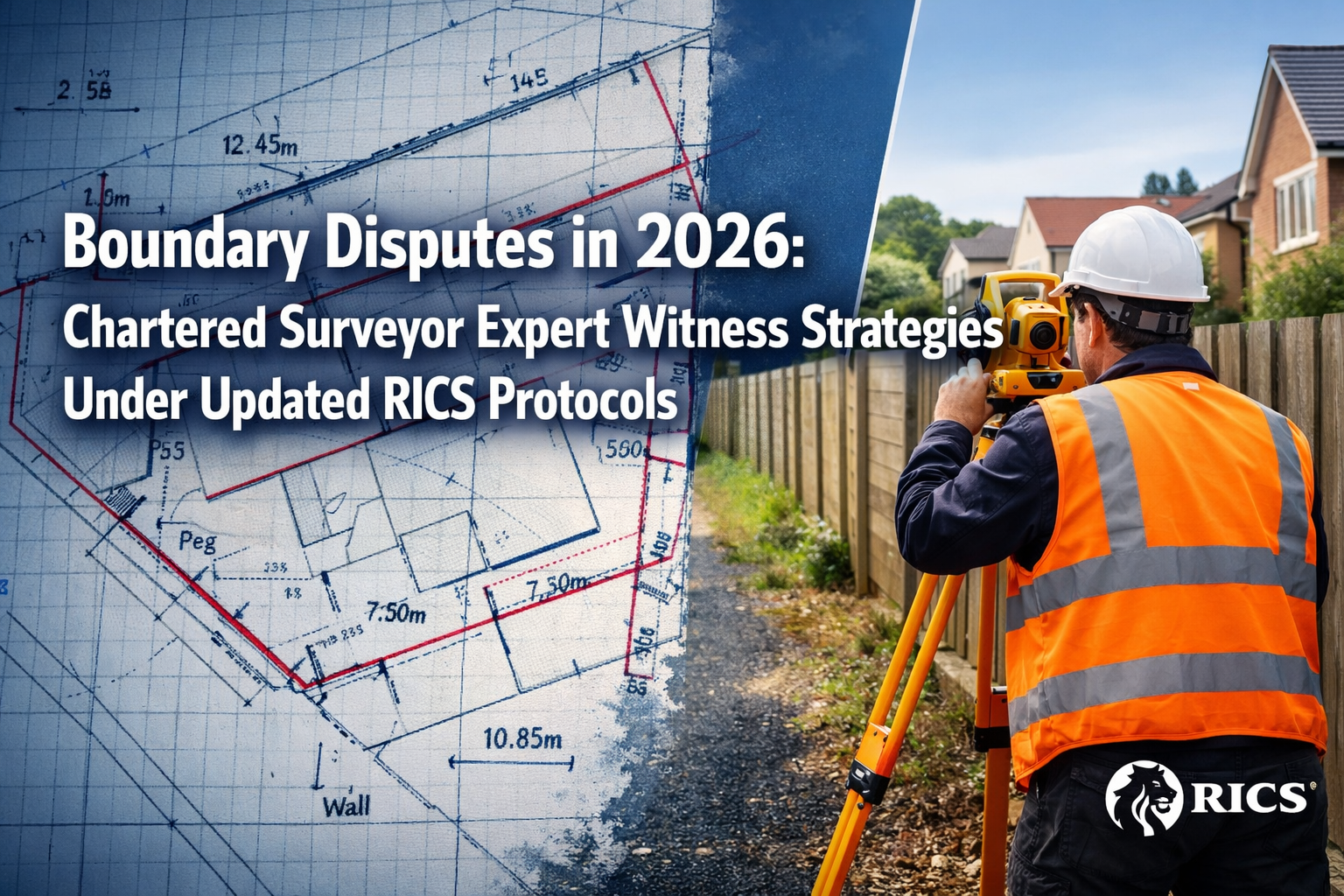
Key Takeaways
- CPR Part 35 compliance is mandatory for expert witnesses in boundary disputes, requiring independence, objectivity, and duty to the court above client interests
- Updated RICS protocols in 2026 emphasize comprehensive site surveys, historical research, and detailed photographic evidence collection
- Mediation strategies resolve approximately 65% of boundary disputes before reaching court, saving time and legal costs
- Land Registry challenges require specialized expertise in interpreting title plans, general boundaries, and historical conveyancing documents
- Expert witness reports must follow strict formatting guidelines while remaining accessible to non-technical audiences
Understanding CPR Part 35 Compliance in Boundary Dispute Cases
The Civil Procedure Rules Part 35 establishes the framework governing expert witness conduct in England and Wales. For chartered surveyors acting as expert witnesses in boundary disputes, these rules fundamentally shape every aspect of their involvement from initial instruction through final testimony.
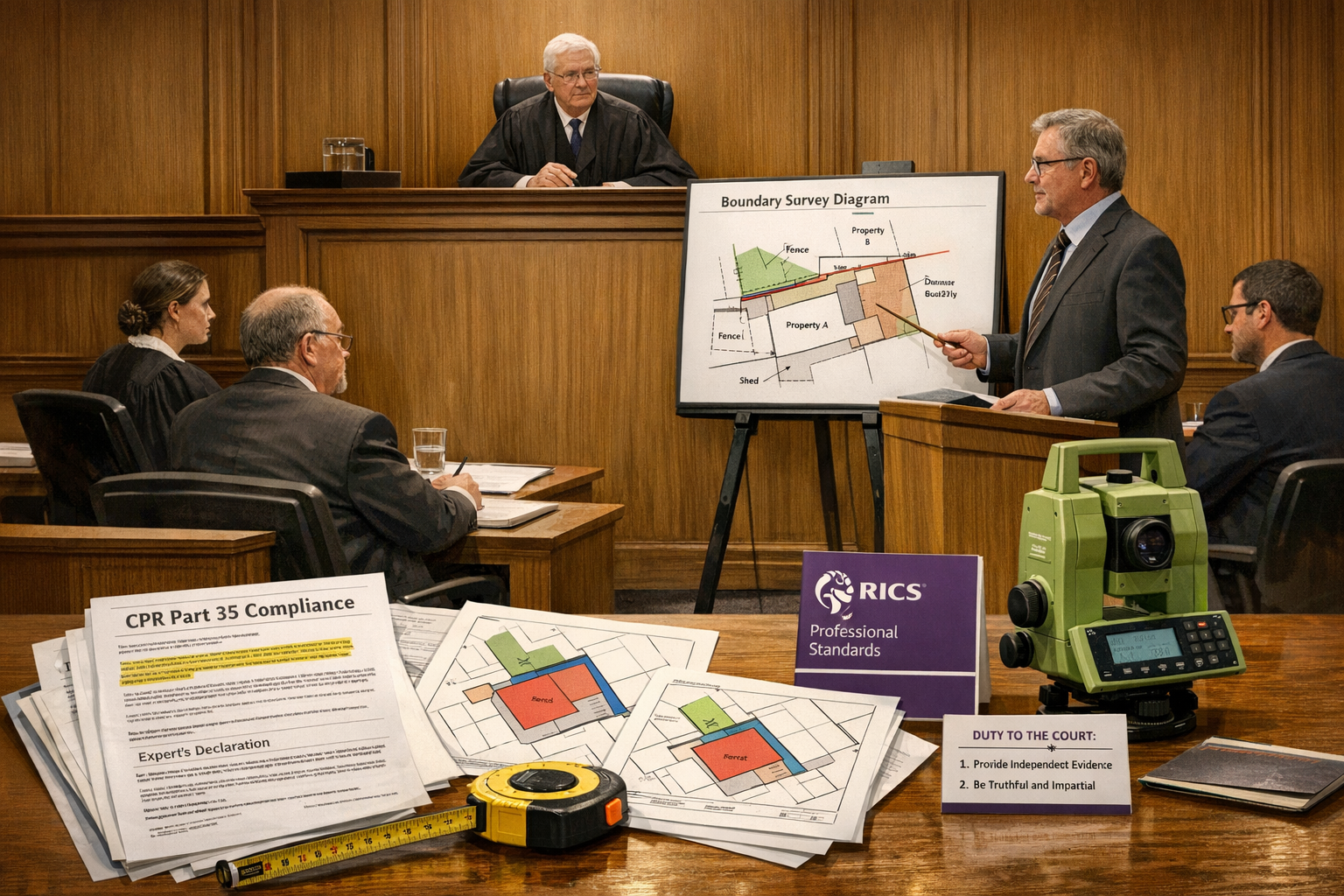
The Expert's Overriding Duty to the Court
Unlike standard chartered surveyor valuations conducted for clients, expert witness work requires a primary duty to the court rather than to the instructing party. This distinction proves critical in boundary disputes where emotional attachments and financial stakes run high.
Expert witnesses who follow RICS expert witness protocols demonstrate significantly enhanced testimony persuasiveness in 2026 disputes.[1] This enhanced credibility stems from demonstrable independence, thorough methodology, and transparent reporting that courts increasingly demand.
Key CPR Part 35 Requirements for Boundary Experts
Essential compliance elements include:
- 📋 Written declaration in every report confirming understanding of expert duties
- 🔍 Independence verification demonstrating no conflicts of interest
- 📊 Methodology transparency explaining survey techniques and analytical approaches
- ⚖️ Balanced opinion presenting evidence that may support opposing positions
- 📝 Clear qualification statements identifying limitations or uncertainties
The updated 2026 RICS guidance emphasizes that chartered surveyors must explicitly state when questions fall outside their expertise. In boundary disputes involving complex legal interpretations or historical property rights, this might mean acknowledging where legal counsel input becomes necessary.
Common CPR Part 35 Pitfalls to Avoid
Many expert witnesses inadvertently compromise their effectiveness through:
- Advocacy creep – allowing client preferences to influence objective analysis
- Insufficient qualification – failing to acknowledge measurement uncertainties or ambiguous evidence
- Overstepping expertise – offering legal opinions beyond surveying competence
- Poor communication – using excessive technical jargon that obscures key findings
An expert witness in boundary disputes serves a fundamentally different role than a standard surveyor conducting routine property assessments.[3] This specialized function requires additional training in legal procedures, report writing, and courtroom testimony techniques.
Comprehensive Site Survey Methodologies for Boundary Evidence
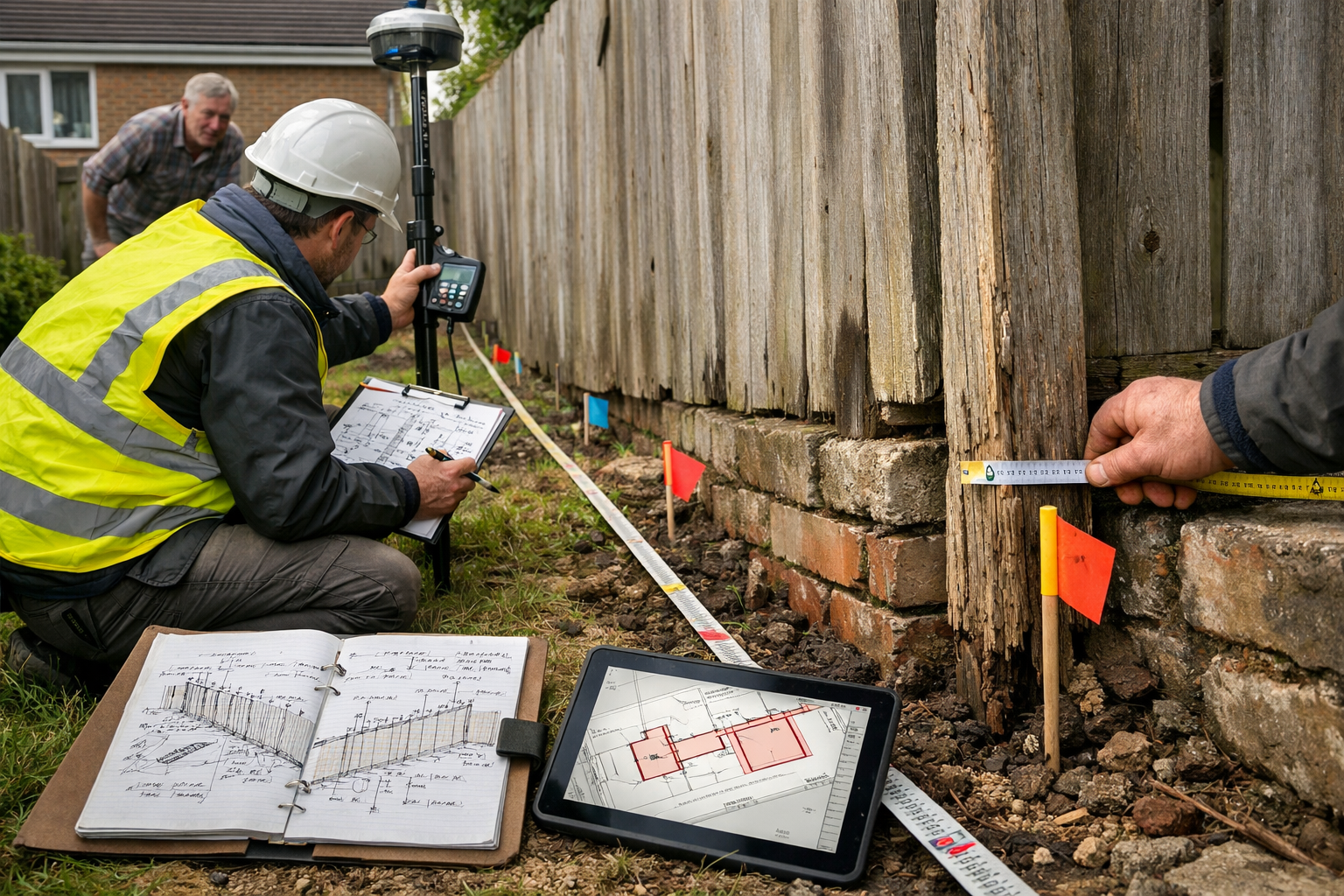
The foundation of any credible boundary dispute expert witness opinion rests on meticulous site investigation and survey work. Updated 2026 protocols emphasize multi-layered evidence gathering that combines modern technology with traditional surveying techniques.
Modern Survey Technology Applications
Contemporary boundary surveys leverage advanced equipment to establish precise measurements:
GPS and Total Station Surveys provide millimeter-level accuracy when establishing boundary positions relative to fixed reference points. These measurements create defensible evidence when Land Registry plans show only general boundaries.
Drone photogrammetry captures overhead imagery revealing boundary features, encroachments, and spatial relationships between properties. This technology proves particularly valuable in disputes involving rear gardens, shared access ways, or complex property configurations.
Ground-penetrating radar can identify buried boundary markers, former fence foundations, or historical wall remnants that support claims about original boundary positions.
Historical Research and Documentary Evidence
Effective building defects surveys often uncover boundary-related issues, but dedicated boundary investigations require deeper historical analysis:
| Evidence Type | Relevance to Boundary Disputes | Typical Sources |
|---|---|---|
| Original conveyancing deeds | May contain detailed boundary descriptions | Land Registry, solicitor archives |
| Historical OS maps | Show boundary evolution over time | National archives, local libraries |
| Planning applications | Reveal approved fence/wall positions | Local authority planning departments |
| Photographic evidence | Document boundary features at specific dates | Property owners, estate agents |
| Witness statements | Provide testimony about long-standing boundaries | Neighbors, former owners |
Physical Evidence Collection and Documentation
Expert witnesses must systematically document all physical boundary evidence:
Fence and wall examinations should note construction methods, materials, weathering patterns, and maintenance history. A fence consistently maintained from one side may indicate ownership, while shared maintenance suggests a boundary feature rather than one party's structure.
Boundary markers including stones, posts, or buried markers require careful excavation, measurement, and photographic documentation. The party wall surveyor expertise often overlaps with boundary work when disputes involve shared structures.
Vegetation evidence can support boundary claims when hedgerows, tree lines, or garden plantings have marked boundaries for extended periods. However, experts must carefully distinguish between decorative plantings and true boundary demarcation.
Site Survey Report Components
Comprehensive boundary survey reports must include:
- ✅ Detailed site location plan with OS grid references
- ✅ Measured survey showing all relevant features
- ✅ Photographic schedule with annotated images
- ✅ Methodology statement explaining survey techniques
- ✅ Accuracy statement quantifying measurement precision
- ✅ Comparison overlay with Land Registry title plans
Mediation Tactics and Alternative Dispute Resolution Strategies
The Dispute Resolution Appointments Board (DRAB) plays a key role in RICS's Dispute Resolution Service (DRS), promoting high standards in conflict avoidance and resolution across land, property, construction, and infrastructure sectors.[2] This emphasis on mediation reflects the reality that court proceedings often damage neighbor relationships beyond repair while consuming substantial time and resources.
The Expert Witness Role in Mediation
Chartered surveyor expert witnesses contribute uniquely to boundary dispute mediation by providing:
Neutral technical assessment that helps both parties understand the factual position divorced from emotional attachments. When homeowners in areas like Richmond or Chelsea face boundary disputes, objective expert input often reveals that positions aren't as far apart as initially believed.
Reality-checking opinions about likely court outcomes help parties assess litigation risks objectively. An expert witness might explain that Land Registry general boundaries create inherent uncertainty, making court outcomes unpredictable.
Creative solution identification leveraging technical knowledge to propose boundary adjustments, shared maintenance agreements, or other compromises that address underlying concerns.
Effective Mediation Preparation Strategies
Expert witnesses maximize mediation effectiveness through:
- Joint site meetings where experts from both sides examine evidence together, often revealing agreed facts that narrow dispute scope
- Without prejudice discussions allowing experts to explore settlement options without compromising litigation positions
- Scaled visual aids helping non-technical parties understand spatial relationships and proposed solutions
- Cost-benefit analyses quantifying litigation expenses versus settlement costs
When Mediation Fails: Preparing for Litigation
Despite best efforts, some boundary disputes proceed to court. Expert witnesses must then transition from mediation facilitator to litigation advocate (for the court's interests, not the client's).
Pre-trial preparation includes:
- Anticipating opposing expert arguments and preparing rebuttals
- Creating clear visual exhibits for courtroom presentation
- Rehearsing testimony to ensure clarity and composure
- Coordinating with legal counsel on examination strategy
Understanding what questions surveyors address during building surveys provides useful context for the types of technical inquiries expert witnesses face during cross-examination.
Navigating Land Registry Challenges in Residential Boundary Cases
The Land Registry's general boundaries principle creates inherent ambiguity in many residential boundary disputes. Title plans typically show boundaries as red lines approximately 1-2mm thick, representing 1-2 meters on the ground at typical scales. This imprecision generates countless disputes when neighbors disagree about fence positions by even modest distances.
Understanding General Boundaries vs. Determined Boundaries
General boundaries (the default Land Registry approach) indicate approximate boundary positions without defining exact legal lines. The red line on title plans serves as a guide rather than a precise demarcation.
Determined boundaries involve formal Land Registry applications with expert survey evidence to establish exact boundary positions. While offering certainty, the process requires agreement from adjoining owners or tribunal determination if disputed.
Common Land Registry Documentation Issues
Expert witnesses frequently encounter:
Scale discrepancies where title plans at different scales show apparently conflicting boundary positions. A boundary appearing straight on a 1:1250 plan might show detail at 1:500 scale.
Historical plan inconsistencies when properties have changed hands multiple times with slightly different boundary depictions on successive title plans.
Verbal description conflicts where written property descriptions in deeds contradict graphical title plan representations.
Missing reference points when features shown on historical plans (walls, hedges, buildings) no longer exist, making boundary reconstruction difficult.
Expert Witness Approaches to Land Registry Evidence
Effective chartered surveyor expert witnesses:
- Overlay multiple title plans at consistent scales to identify patterns and discrepancies
- Reference historical Ordnance Survey maps to track boundary evolution
- Identify surviving boundary features that correlate with Land Registry documentation
- Explain measurement tolerances helping courts understand why apparent conflicts may reflect survey accuracy limitations rather than true discrepancies
Properties in locations like Hampstead or Barnes often have complex ownership histories requiring particularly thorough Land Registry research.
Residential Boundary Dispute Case Types and Expert Strategies
Fence Position Disputes
The most common boundary disputes involve fence placement between neighboring properties. Expert witnesses must determine:
- Whether the fence represents the legal boundary or sits within one property
- Who owns the fence structure (relevant for maintenance obligations)
- Whether fence position has changed over time through gradual movement or replacement
Key evidence includes: fence construction details (posts on one side suggest ownership), maintenance patterns, historical photographs, and measurements against Land Registry plans.
Party Wall and Shared Structure Disputes
When boundaries involve shared walls between properties, disputes often concern:
- Maintenance responsibilities and cost sharing
- Alterations affecting structural integrity
- Encroachments through wall thickness or foundations
The Party Wall Act considerations frequently intersect with boundary disputes, requiring expert witnesses with dual expertise.
Encroachment and Adverse Possession Claims
Encroachments occur when structures, gardens, or other features extend beyond legal boundaries onto neighboring property. Long-standing encroachments may support adverse possession claims after 10-12 years of continuous occupation.
Expert witnesses must establish:
- Timing of encroachment through historical evidence
- Extent of encroachment with precise measurements
- Exclusivity of possession demonstrating the encroaching party's sole use
Access and Right of Way Disputes
Boundary disputes often involve contested access rights where:
- Shared driveways have ambiguous boundary positions
- Historical access routes conflict with current boundary interpretations
- Easements and rights of way interact with physical boundary features
Updated RICS Protocols for 2026: What's Changed
The 2026 updates to RICS expert witness protocols reflect evolving legal expectations and technological capabilities:
Enhanced Independence Requirements
New protocols require expert witnesses to:
- Disclose all previous work for instructing parties within five years
- Confirm no social or professional relationships that might affect objectivity
- Refuse instructions where conflicts cannot be adequately managed
Expanded Methodology Documentation
Expert reports must now include:
- Detailed survey methodology explaining equipment used, measurement techniques, and accuracy assessments
- Alternative interpretation consideration explicitly addressing how evidence might support different boundary positions
- Uncertainty quantification providing statistical confidence levels for measurements and conclusions
Digital Evidence Standards
Updated protocols establish requirements for:
- Metadata preservation for digital photographs and survey data
- Version control for reports and exhibits
- Secure evidence storage protecting against tampering or loss
Continuing Professional Development
RICS now mandates specific CPD requirements for expert witnesses including:
- Annual legal procedure updates
- Expert witness skills training every three years
- Technical competency maintenance in survey methodologies
Expert Witness Report Writing Best Practices
Structure and Format Requirements
Effective boundary dispute expert reports follow a clear structure:
- Executive summary – key findings in non-technical language
- Instructions and scope – defining questions to be addressed
- Expert qualifications – establishing credibility and relevant experience
- Methodology – explaining investigation and analysis approaches
- Evidence review – systematically presenting documentary, physical, and testimonial evidence
- Analysis and opinion – applying professional judgment to evidence
- Conclusions – answering instructed questions clearly
- Declarations – CPR Part 35 compliance statements
Writing for Multiple Audiences
Expert reports must communicate effectively with:
- Legal professionals requiring precise technical accuracy
- Judges needing clear explanations without excessive jargon
- Lay parties understanding their boundary dispute context
This requires careful balance between technical precision and accessibility. For example, rather than stating "The theodolite traverse established coordinates with ±5mm standard deviation," an effective report might explain "Survey measurements were accurate to within 5 millimeters (about the width of a pencil), providing reliable evidence about fence position."
Visual Communication Excellence
Boundary disputes particularly benefit from clear visual exhibits:
Annotated photographs with arrows, measurements, and explanatory text help non-technical audiences understand site conditions.
Scaled overlay plans showing title plans, survey measurements, and disputed features on a single drawing clarify spatial relationships.
Timeline diagrams illustrating boundary evolution through historical evidence make complex chronologies comprehensible.
Courtroom Testimony Skills for Boundary Expert Witnesses
Preparation Strategies
Effective courtroom testimony requires:
- Thorough report review ensuring complete familiarity with all evidence and opinions
- Anticipated cross-examination preparation identifying potential challenges and preparing responses
- Visual aid organization ensuring quick reference during testimony
- Coordination with counsel understanding examination strategy and key points to emphasize
Testimony Best Practices
During examination and cross-examination:
✅ Speak to the judge rather than examining counsel
✅ Answer only the question asked avoiding volunteering additional information
✅ Acknowledge uncertainties honestly rather than overstating confidence
✅ Request clarification when questions are ambiguous or unclear
✅ Maintain composure even during aggressive cross-examination
✅ Use visual aids to clarify technical points
Common Cross-Examination Challenges
Opposing counsel may attempt to:
- Challenge survey methodology or equipment accuracy
- Highlight alternative interpretations of ambiguous evidence
- Question professional qualifications or experience
- Identify inconsistencies between report and testimony
- Suggest bias toward instructing party
Preparation for these challenges, combined with genuine adherence to CPR Part 35 duties, provides the best defense.
Cost Considerations and Fee Structures
Expert Witness Fee Components
Boundary dispute expert witness work typically involves:
- Initial consultation and instruction review – 2-4 hours
- Site investigation and survey – 4-8 hours depending on complexity
- Documentary research – 4-12 hours for historical evidence review
- Report preparation – 8-16 hours for comprehensive reports
- Conference attendance – 2-4 hours for mediation or settlement discussions
- Court attendance – typically full day(s) including waiting time
Typical Fee Ranges in 2026
Experienced chartered surveyor expert witnesses typically charge:
- Hourly rates: £150-£350 depending on experience and location
- Fixed fee reports: £2,500-£7,500 for standard residential boundary disputes
- Court attendance: £1,500-£3,000 per day
Properties in premium locations like East London may involve higher fees reflecting local market conditions.
Cost-Benefit Analysis for Parties
When evaluating whether to instruct an expert witness, parties should consider:
Litigation costs often exceed £20,000-£50,000 for boundary disputes reaching trial, with expert witness fees representing only 10-20% of total costs.
Property value impact where boundary position affects usable garden space, parking, or development potential may justify expert investigation even when dispute area is physically small.
Relationship preservation through early expert intervention and mediation may prove invaluable for neighbors who must coexist long-term.
Selecting the Right Chartered Surveyor Expert Witness
Essential Qualifications and Experience
When instructing an expert witness for boundary disputes, seek:
- RICS membership (MRICS or FRICS) demonstrating professional standards
- Specific boundary dispute experience rather than general surveying background
- Expert witness training including CPR Part 35 compliance courses
- Local knowledge of property types and Land Registry practices in relevant area
- Court experience with testimony in similar cases
Red Flags to Avoid
Be cautious of experts who:
- Guarantee favorable outcomes before investigating evidence
- Lack professional indemnity insurance adequate for expert witness work
- Have limited report writing or courtroom experience
- Show reluctance to acknowledge evidence limitations
- Demonstrate poor communication skills during initial consultation
The Instruction Process
Effective expert witness instruction involves:
- Clear scope definition specifying questions to be addressed
- Complete document provision including all relevant deeds, plans, and correspondence
- Site access arrangements ensuring ability to conduct thorough investigation
- Timeline establishment with realistic deadlines for report delivery
- Budget agreement confirming fee structure and payment terms
Future Trends in Boundary Dispute Resolution
Technology Integration
Emerging technologies reshaping boundary dispute work include:
3D laser scanning creating detailed point clouds documenting current site conditions with millimeter precision.
Blockchain land registries potentially reducing future boundary ambiguities through enhanced record-keeping.
AI-assisted document analysis helping experts quickly identify relevant evidence in extensive historical archives.
Regulatory Developments
Anticipated regulatory changes include:
- Mandatory determined boundaries for new property registrations
- Enhanced Land Registry plan accuracy requirements
- Standardized expert witness accreditation beyond current RICS membership
Alternative Dispute Resolution Emphasis
Courts increasingly encourage ADR before accepting boundary disputes for trial, with:
- Mandatory mediation requirements in some jurisdictions
- Court-annexed expert determination as alternative to full trials
- Online dispute resolution platforms for lower-value boundary disputes
Conclusion
Boundary Disputes in 2026: Chartered Surveyor Expert Witness Strategies Under Updated RICS Protocols represents a sophisticated intersection of surveying expertise, legal procedure, and dispute resolution skills. Success in this specialized field requires chartered surveyors to master CPR Part 35 compliance, conduct meticulous site investigations, and communicate complex technical evidence clearly to legal professionals and courts.
The updated 2026 RICS protocols emphasize independence, methodological rigor, and mediation-first approaches that serve both individual parties and the broader property market. Expert witnesses who embrace these standards while maintaining technical excellence provide invaluable service in resolving the fence line disagreements, wall ownership disputes, and Land Registry challenges that affect residential property owners throughout England and Wales.
Actionable Next Steps
For property owners facing boundary disputes:
- Gather all available documentary evidence before consulting experts
- Consider mediation before pursuing litigation
- Instruct qualified chartered surveyor expert witnesses early in the dispute process
For legal professionals handling boundary cases:
- Ensure expert witnesses demonstrate CPR Part 35 compliance from initial instruction
- Facilitate joint expert meetings to narrow dispute scope
- Leverage expert technical knowledge during settlement negotiations
For chartered surveyors developing expert witness practices:
- Obtain specialized CPR Part 35 training and expert witness skills development
- Build systematic methodologies for boundary investigations
- Maintain strict independence and objectivity in all expert work
The combination of technical surveying competence, procedural compliance, and effective communication skills positions chartered surveyor expert witnesses as essential contributors to fair, efficient boundary dispute resolution in 2026 and beyond.
References
[1] Expert Witness Strategies For 2026 Rental Regulation Disputes Navigating Stricter Tenant Protections – nottinghillsurveyors.com
[2] Dispute Resolution Appointments Board – rics.org
[3] Expert Witness Essentials For 2026 Boundary Disputes Strengthening Cases In A Recovering Property Market – nottinghillsurveyors.com