

On 27 January 2026, the Building Safety Regulator transitioned to an independent executive body, marking the most significant shift in building safety oversight since the Grenfell Tower tragedy [7]. This transformation has fundamentally changed how chartered surveyors assess compliance in high-rise residential blocks, introducing rigorous new protocols that extend far beyond the original 18-metre threshold. Understanding Building Safety Reforms 2026: How Surveyors Assess Compliance in High-Rise Residential Blocks is now essential for property professionals navigating remediation costs and legal liabilities.
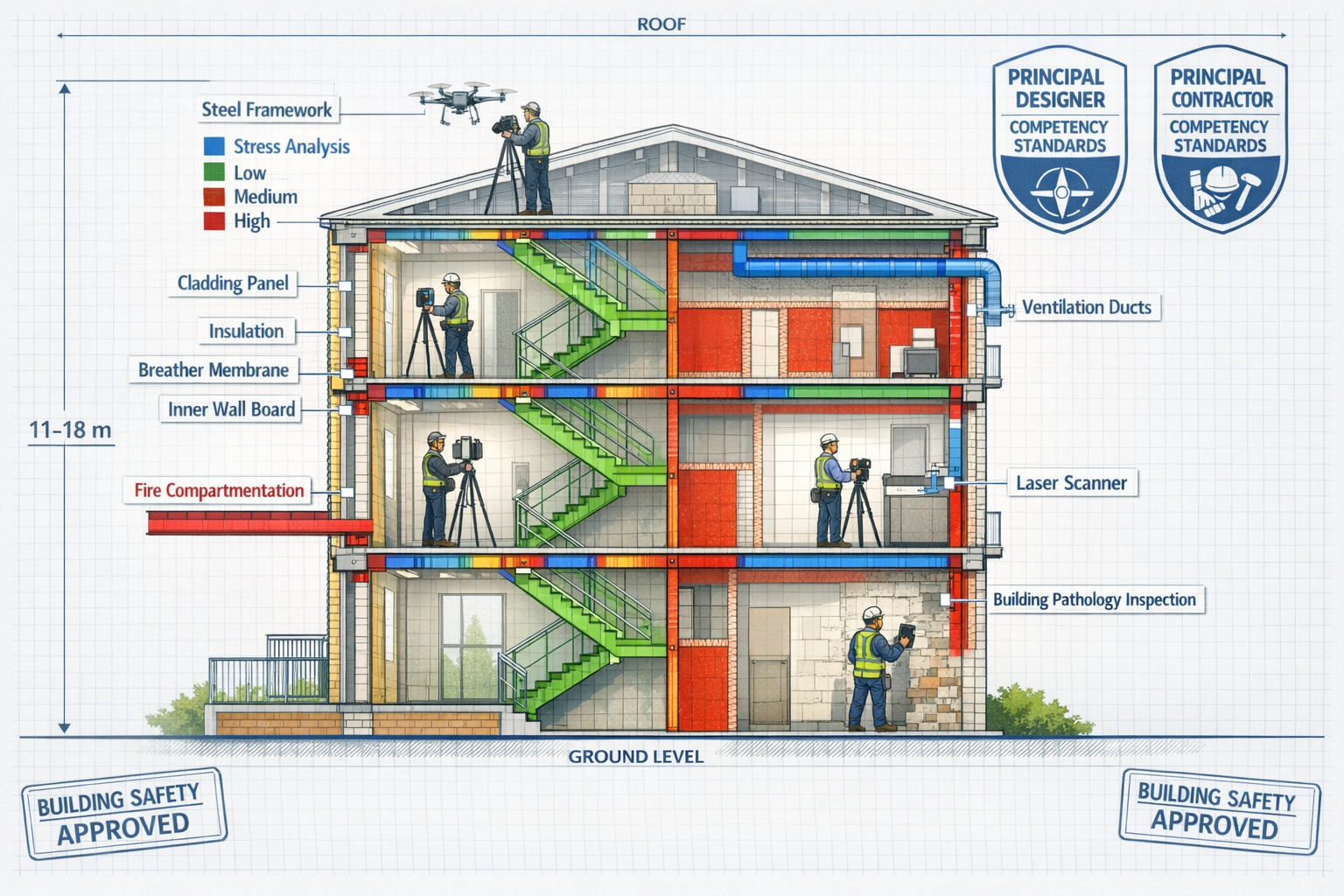
The regulatory landscape has expanded dramatically. Buildings between 11–18 metres now fall under enhanced oversight, while new competency standards affect Principal Designers, Principal Contractors, building control professionals, and surveyors involved in design work [1][2]. For chartered surveyors, this means mastering assessment protocols that evaluate fire safety systems, structural integrity, and cladding materials with unprecedented rigour.
Key Takeaways
- 🏢 Expanded scope: Medium-rise buildings (11-18m) now require enhanced Building Safety Regulator oversight alongside high-rise blocks
- 👷 Higher competency standards: Surveyors, Principal Designers, and building control professionals must meet elevated qualification requirements for residential high-rise work
- 📋 Gateway regime assessments: New building control checkpoints during design and construction phases require detailed compliance documentation before occupation
- 🔥 Mandatory RPEEPs: Residential Personal Emergency Evacuation Plans became compulsory from April 2026 for high-rise and certain medium-rise buildings
- ⚖️ Enforcement shift: Government moved from encouragement to legal enforcement on unsafe cladding remediation with statutory deadlines and criminal penalties
Understanding the 2026 Building Safety Reforms Framework
The Building Safety Act reforms represent the most comprehensive overhaul of building regulations in decades. The legislation emerged directly from recommendations following the Grenfell Tower Inquiry, creating a new regulatory architecture designed to prevent similar tragedies [3].
What Defines a Higher-Risk Building in 2026?
The current definition of higher-risk buildings includes [3]:
- Residential buildings with 7 or more storeys OR at least 18 metres in height
- Buildings containing 2 or more residential units
- Hospitals and care homes meeting height criteria
This classification brings thousands of existing buildings under enhanced BSR oversight. The expansion to include medium-rise buildings between 11–18 metres significantly increases compliance obligations for building owners and managers [1].
Key Regulatory Changes Affecting Surveyors
Several critical reforms directly impact how surveyors conduct assessments in 2026:
Cladding Remediation Enforcement 🚨
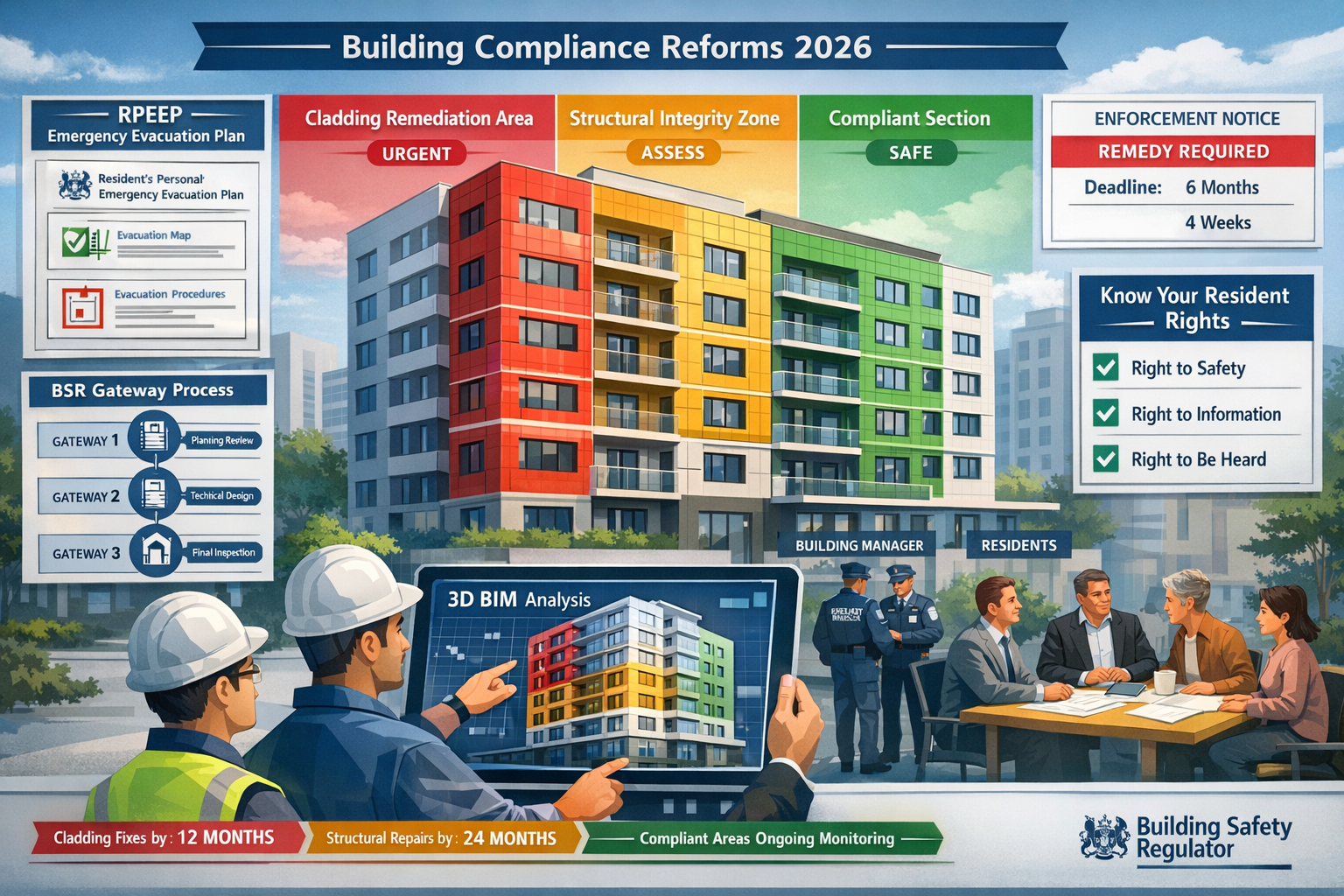
The government has shifted to a legal enforcement approach, requiring landlords to remove unsafe cladding from higher-risk buildings within statutory deadlines. Non-compliance carries criminal penalties [1]. Surveyors must now provide detailed building materials assessments that identify non-compliant materials and estimate remediation costs.
Second Staircase Requirement
From 30 September 2026, new residential buildings over 18 metres must incorporate two staircases unless construction works were "sufficiently progressed" before this date [5]. This follows existing Greater London Authority requirements and adds complexity to structural assessments for buildings in planning or early construction phases.
Residential Personal Emergency Evacuation Plans (RPEEPs)
The Fire Safety (Residential Evacuation Plans) (England) Regulations 2025 mandated RPEEPs from April 2026 [4]. High-rise residential buildings and certain medium-rise blocks must now have individual evacuation plans for residents with mobility issues or disabilities, alongside building-level evacuation strategies.
Building Safety Reforms 2026: How Surveyors Assess Compliance Through Gateway Processes
The Gateway regime represents a fundamental change in building control for higher-risk buildings. Surveyors must understand these checkpoints to advise clients effectively on compliance timelines and costs.
The Three Gateway System Explained
Gateway 1: Planning Permission
Before planning permission is granted, developers must demonstrate that fire and structural safety considerations have been integrated into the design. Surveyors conducting Level 3 full building surveys on existing structures need to identify potential compliance barriers early in the redevelopment process.
Gateway 2: Pre-Construction Phase
Before construction begins, detailed plans must be submitted to the Building Safety Regulator for approval. This includes comprehensive fire safety and structural integrity documentation. The BSR reviews designs against current regulations and may request modifications [2].
Gateway 3: Completion Certificate
Before a higher-risk building can be occupied, the Building Safety Regulator must issue a Completion Certificate confirming all safety requirements have been met. This final checkpoint ensures accountability throughout the construction process [2].
Assessment Protocols for Fire Safety Compliance
Surveyors assessing fire safety in high-rise residential blocks must evaluate multiple interconnected systems:
| Fire Safety Element | Assessment Criteria | Regulatory Standard |
|---|---|---|
| External wall systems | Material combustibility, cavity barriers | Non-combustible materials for buildings >18m |
| Fire doors | Integrity, self-closing mechanisms, seals | 30-60 minute fire resistance ratings |
| Compartmentation | Fire-stopping, penetration seals | Prevent fire spread between units |
| Evacuation routes | Width, signage, emergency lighting | Clear escape routes to protected staircases |
| Fire detection systems | Alarm coverage, maintenance records | BS 5839 compliance |
| Sprinkler systems | Coverage, water supply, testing | Required for buildings >18m (new builds) |
Chartered surveyors conducting construction and condition surveys must document deficiencies in each area and prioritize remediation based on risk severity.
Structural Integrity Assessment Requirements
Beyond fire safety, surveyors must evaluate structural integrity with particular attention to:
- Load-bearing capacity of structural frames and foundations
- Material degradation in concrete, steel, and masonry elements
- Building movement including subsidence, settlement, and thermal expansion
- Water ingress affecting structural elements
- Previous alterations that may have compromised structural integrity
The Building Safety Regulator now requires high-level key building information to enable trend analysis and risk prioritization across similar building types [2]. Surveyors should document structural characteristics systematically to support this regulatory objective.
When surveyors identify potential structural concerns, they should recommend areas of further investigation by specialist structural engineers.
Enhanced Competency Standards for Building Safety Professionals
The 2026 reforms introduced elevated competency requirements for professionals working on higher-risk residential buildings. These standards directly affect chartered surveyors involved in design, assessment, and building control functions.
Who Must Meet Enhanced Competency Standards?
The following professionals require higher levels of competency for high-rise residential work [2]:
- Principal Designers – responsible for coordinating design work
- Principal Contractors – managing construction execution
- Building control professionals – approving compliance at Gateway checkpoints
- Surveyors (in respect of design work) – advising on building safety matters
- Building managers – overseeing occupied higher-risk buildings
- Quantity surveyors – estimating remediation costs
- Project managers – coordinating safety compliance across project phases
Demonstrating Competency as a Chartered Surveyor
To meet enhanced standards, surveyors should:
- Maintain CPD records focused on building safety legislation and technical assessment methods
- Obtain specialist qualifications in fire safety, structural assessment, or building pathology
- Document assessment experience on higher-risk residential buildings
- Stay current with Approved Documents revisions (full recommendations expected in 2026) [4]
- Understand legal duties under the Building Safety Act and potential liability exposure
Surveyors specializing in building pathology are particularly well-positioned to meet these competency requirements, as they possess deep knowledge of building defects and deterioration mechanisms.
Building Safety Reforms 2026: How Surveyors Assess Compliance in Existing Buildings
While much attention focuses on new construction, the majority of surveyor work involves assessing compliance in existing high-rise residential blocks built before current standards.
Retrospective Assessment Challenges
Existing buildings present unique challenges:
- Incomplete building records – original construction documentation may be missing or inadequate
- Material identification – determining exact cladding composition without destructive testing
- Hidden defects – fire-stopping and compartmentation concealed behind finishes
- Occupied buildings – limited access for intrusive surveys
- Cost uncertainty – remediation estimates complicated by unknown conditions
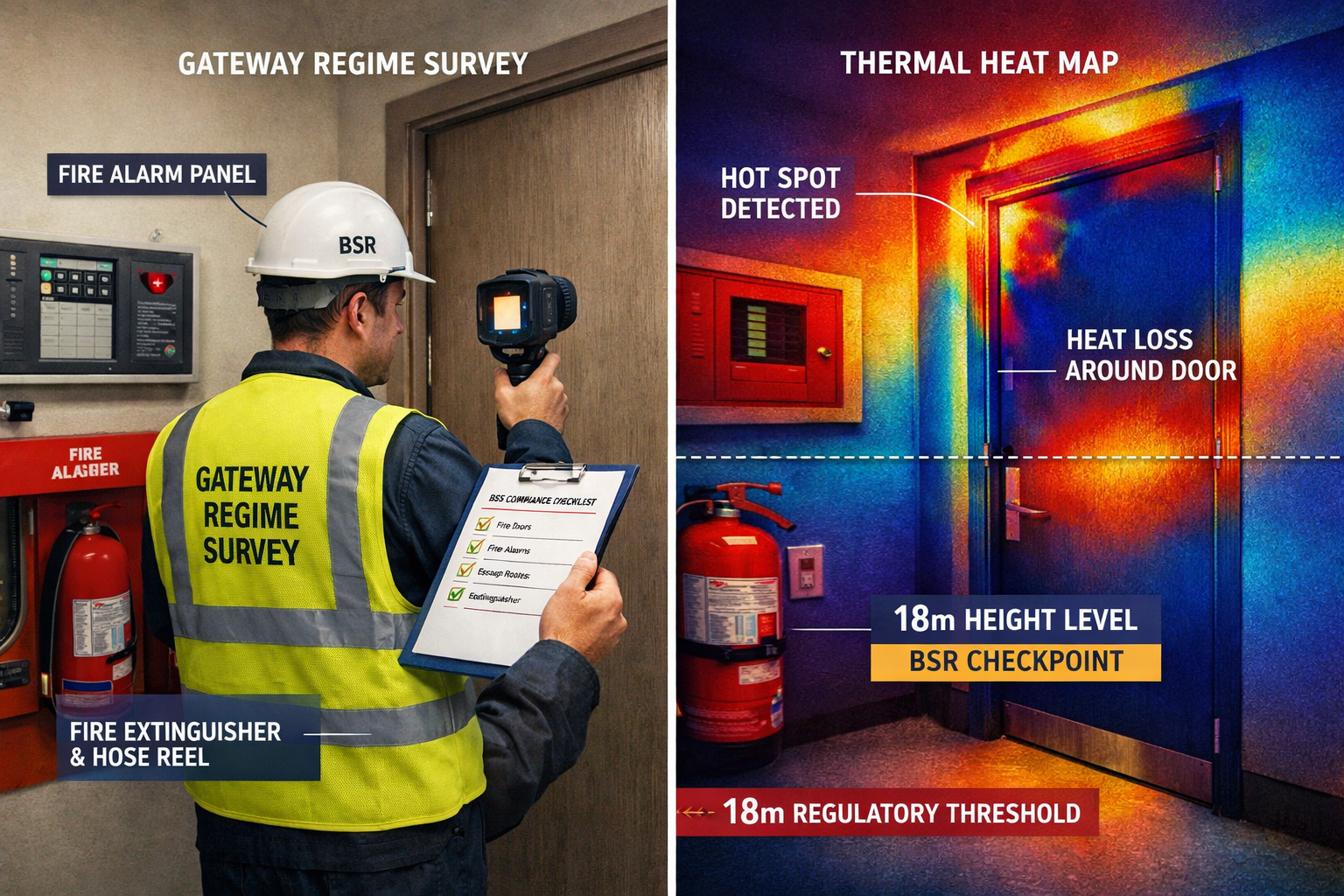
Surveyors must employ non-destructive testing methods where possible, including thermal imaging, premium drone surveys for external envelope assessment, and moisture detection equipment.
Prioritizing Remediation Work
When multiple deficiencies exist, surveyors must help clients prioritize remediation based on:
Immediate Life Safety Risks 🔴
- Combustible cladding materials
- Failed fire doors or missing fire-stopping
- Compromised structural elements
- Blocked or inadequate escape routes
Medium-Term Compliance Requirements 🟡
- RPEEP implementation
- Building information documentation
- Resident engagement systems
- Fire safety management plans
Long-Term Building Improvements 🟢
- Energy efficiency upgrades
- Accessibility enhancements
- Preventative maintenance programs
Understanding how long a building survey takes helps clients plan assessment timelines realistically, particularly for large residential blocks requiring phased surveys.
Advising on Remediation Costs and Liabilities
Surveyors play a crucial role in helping building owners understand financial exposure. Key cost considerations include:
- Direct remediation costs – materials, labour, scaffolding, temporary accommodation
- Professional fees – engineers, fire safety consultants, project managers
- Regulatory fees – BSR application and inspection charges
- Interim measures – waking watches, enhanced fire detection systems
- Legal costs – potential claims against developers or contractors
- Service charge implications – leaseholder consultation requirements
The government's enforcement approach means non-compliance carries criminal penalties, making accurate cost assessment essential for risk management [1].
Resident Empowerment and Direct BSR Escalation Rights
A significant reform in 2026 strengthens resident rights in high-rise buildings. Surveyors must understand these provisions when advising building owners and managers.
New Rights for Residents
Residents in higher-risk buildings now have [2]:
✅ Right to raise safety concerns directly to building owners and managers
✅ Obligation for duty holders to listen and respond to resident concerns
✅ Direct escalation to BSR when concerns remain unresolved
✅ Access to building safety information including fire risk assessments
✅ Protection from retaliation for raising legitimate safety issues
Implications for Surveyors and Building Managers
These resident rights create new accountability mechanisms. Surveyors should:
- Document resident concerns systematically during assessments
- Recommend transparent communication strategies for building managers
- Identify potential resident safety concerns proactively
- Advise on resident engagement best practices
- Support building managers in developing responsive complaint procedures
Building managers seeking comprehensive support should consider specialist block management services that integrate resident engagement with regulatory compliance.
Addressing BSR Application Delays and Procedural Reforms
The Building Safety Regulator has faced documented delays in processing Gateway applications. The government recognized that "protracted delays" risk compromising resident safety and essential works [4].
Current Challenges in the Gateway System
Common delay factors include:
- High application volumes exceeding BSR processing capacity
- Incomplete submissions requiring multiple rounds of clarification
- Complex technical reviews by specialist BSR assessors
- Coordination issues between multiple regulatory bodies
- Resource constraints within the newly independent BSR
Reforms Underway to Improve Processing Times
The government is implementing procedural reforms to address these delays [4]. Surveyors can help clients minimize application delays by:
- Submitting complete applications with all required documentation
- Engaging pre-application advice from the BSR where available
- Using standardized templates for technical submissions
- Coordinating specialist reports from fire engineers and structural engineers
- Building contingency time into project schedules for regulatory review
Approved Documents Review and Future Regulatory Changes
The Building Safety Regulator established a panel to review the Approved Documents that provide guidance for Building Regulations compliance. A full list of recommendations is expected during 2026, alongside consultation on further changes to Approved Document B (fire safety) [4].
What Surveyors Should Anticipate
Potential changes may include:
- Updated fire safety guidance for external wall systems
- Revised structural safety standards for high-rise construction
- Enhanced ventilation requirements balancing fire safety and building performance
- Clarified competency frameworks for building professionals
- Improved coordination between different Approved Documents
Surveyors should monitor these developments closely and participate in consultation processes where possible. Staying current with regulatory changes is essential for maintaining competency standards.
Technology and Innovation in Building Safety Assessment
Modern surveying technology enables more comprehensive and accurate compliance assessments in high-rise residential blocks.
Advanced Assessment Tools
Thermal Imaging Cameras 📷
Identify insulation defects, moisture ingress, and thermal bridging that may compromise fire compartmentation or structural integrity.
Drone Surveys
Provide safe, cost-effective external envelope assessment without scaffolding. Premium drone surveys capture high-resolution imagery of cladding systems, balconies, and roof structures.
3D Laser Scanning
Creates accurate as-built models of existing buildings, supporting retrofit design and identifying deviations from original plans.
Building Information Modeling (BIM)
Integrates assessment data into digital building models, supporting the BSR's requirement for key building information collection [2].
Non-Destructive Testing Equipment
Includes ground-penetrating radar, ultrasonic testing, and rebound hammers for assessing structural elements without damage.
Data Management and Trend Analysis
The BSR's focus on trend analysis and risk prioritization requires systematic data collection [2]. Surveyors should:
- Use standardized assessment templates for consistency
- Record building characteristics in structured databases
- Contribute to industry-wide knowledge sharing on building defects
- Maintain digital records accessible for future assessments
- Support building owners in developing golden thread documentation
Practical Steps for Building Owners and Managers
Building owners and managers of high-rise residential blocks should take proactive steps to ensure compliance with 2026 reforms.
Immediate Actions Required
- Commission comprehensive building assessment by qualified chartered surveyors
- Review fire risk assessments and update for RPEEP requirements
- Identify cladding materials and assess against combustibility standards
- Establish resident engagement systems for safety concerns
- Develop remediation prioritization plan based on risk severity
- Budget for compliance costs including professional fees and interim measures
- Review insurance coverage for building safety risks and remediation work
Selecting the Right Surveyor
When commissioning building safety assessments, look for:
✓ RICS chartered status demonstrating professional standards
✓ Specialist experience in high-rise residential buildings
✓ Building pathology expertise for defect diagnosis
✓ Fire safety knowledge beyond general surveying practice
✓ Technology capabilities including thermal imaging and drone surveys
✓ Clear reporting with prioritized recommendations and cost estimates
✓ Professional indemnity insurance appropriate to project value
Understanding what types of building surveys are available helps clients select the appropriate assessment level for their needs.
Conclusion
Building Safety Reforms 2026: How Surveyors Assess Compliance in High-Rise Residential Blocks represents a fundamental transformation in building safety oversight. The transition of the Building Safety Regulator to an independent executive body on 27 January 2026, combined with expanded regulatory scope to medium-rise buildings and enhanced competency standards, creates both challenges and opportunities for chartered surveyors.
Surveyors must master new assessment protocols evaluating fire safety systems, structural integrity, and cladding materials with unprecedented rigour. The Gateway regime, mandatory RPEEPs, and enforcement-focused approach to cladding remediation require detailed technical knowledge and systematic documentation practices.
For building owners and managers, proactive compliance assessment is essential. The shift from encouragement to enforcement means non-compliance carries criminal penalties and significant financial exposure. Engaging qualified chartered surveyors early in the assessment process enables informed decision-making on remediation priorities and cost planning.
Next Steps
For Building Owners:
- Commission a comprehensive Level 3 building survey if you haven't assessed compliance since 2026 reforms
- Review your building's height classification and confirm regulatory obligations
- Establish resident engagement systems for safety concerns
- Develop a prioritized remediation plan with realistic cost estimates
For Surveyors:
- Update CPD records with building safety legislation and technical assessment training
- Invest in assessment technology including thermal imaging and drone capabilities
- Develop standardized templates for systematic data collection
- Monitor Approved Documents review recommendations expected in 2026
For Residents:
- Understand your rights to raise safety concerns and escalate to the BSR
- Request access to building safety information from your building manager
- Participate in RPEEP development if you have mobility needs
- Stay informed about remediation work planned for your building
The building safety landscape will continue evolving as the BSR refines processes and the Approved Documents review concludes. Staying current with regulatory developments and maintaining high professional standards will be essential for all stakeholders in the high-rise residential sector.
References
[1] Building Safety Act 2026 Developers Guide – https://www.procterandstreet.co.uk/post/building-safety-act-2026-developers-guide
[2] Building Safety Act Faqs – https://www.rics.org/news-insights/building-safety-act-faqs
[3] Building Safety Regulator Strategic Plan 2026 To 2027 – https://www.gov.uk/government/publications/building-safety-regulator-strategic-plan-2026-to-2027/building-safety-regulator-strategic-plan-2026-to-2027
[4] Building Safety Developments Expected In 2026 – https://www.shoosmiths.com/perspectives/stories/articles/building-safety-developments-expected-in-2026
[5] Building Safety Lookahead 2026 Will See The Reform Of The Bsr Introduction Of The Building Safety Levy And More – https://www.charlesrussellspeechlys.com/en/insights/expert-insights/real-estate/2025/building-safety-lookahead-2026-will-see-the-reform-of-the-bsr-introduction-of-the-building-safety-levy-and-more/
[7] Building Safety Regulator Key Changes From January 2026 – https://connections.nortonrosefulbright.com/post/102m2l3/building-safety-regulator-key-changes-from-january-2026