

In 2026's volatile property landscape, transaction failures cost buyers, sellers, and investors millions annually. Yet amid economic uncertainty and operational pipeline pressures, a transformative approach is emerging: certainty-driven surveying. By combining data solutions with standardized protocols, chartered surveyors are revolutionizing how the industry manages risk, builds client confidence, and delivers predictable outcomes. This comprehensive guide explores how Certainty-Driven Surveying: How Data Solutions and Standardized Protocols Reduce Transaction Risk in 2026's Uncertain Market is reshaping professional practice and protecting stakeholders from costly surprises.

Key Takeaways
✅ Data-driven methodologies reduce transaction risk by up to 40% compared to traditional surveying approaches, providing quantifiable certainty in uncertain markets
✅ Standardized protocols create consistent, repeatable outcomes that build client confidence and reduce liability exposure for surveying professionals
✅ Digital integration enables real-time risk assessment, automated compliance checking, and transparent reporting that accelerates decision-making
✅ Market volatility in 2026 makes certainty-driven approaches essential for protecting property investments and maintaining transaction momentum
✅ Professional differentiation through advanced data solutions positions chartered surveyors as strategic advisors rather than mere report generators
Understanding Certainty-Driven Surveying in 2026's Market Context
The property market in 2026 faces unprecedented challenges. Economic fluctuations, regulatory changes, and shifting buyer expectations create an environment where transaction certainty has become the most valuable commodity. Traditional surveying approaches—relying heavily on subjective assessments and variable reporting standards—no longer meet the demands of sophisticated clients who require quantifiable risk metrics and defensible data.
The Evolution from Traditional to Certainty-Driven Approaches
Certainty-driven surveying represents a fundamental shift in professional practice. Rather than simply documenting property conditions, this methodology prioritizes:
- 📊 Quantifiable risk assessments with probability ratings
- 🔄 Standardized data collection protocols across all inspections
- 💻 Digital integration for real-time analysis and reporting
- 📈 Predictive analytics that forecast future maintenance requirements
- ✅ Quality assurance frameworks ensuring consistency
According to industry research, surveying firms in 2026 are increasingly adopting digital tools and standardized methodologies to remain competitive [2]. This transformation addresses client demands for greater transparency and reduces the ambiguity that historically plagued property transactions.
Market Pressures Driving the Need for Certainty
Several converging factors make certainty-driven surveying essential in 2026:
Economic Volatility: With interest rate fluctuations and property value uncertainty, buyers and lenders require more robust risk assessment before committing capital [5].
Regulatory Complexity: Evolving building safety regulations, environmental standards, and disclosure requirements demand comprehensive, defensible documentation [3].
Insurance Requirements: Underwriters increasingly require detailed, standardized survey data before issuing property insurance policies [8].
Transaction Speed: Competitive markets demand faster decision-making without compromising due diligence quality.
The Level 3 Full Building Survey has become the gold standard for certainty-driven assessments, providing comprehensive data that supports confident transaction decisions.

Data Solutions Transforming Transaction Risk Assessment
Modern data solutions form the technological backbone of Certainty-Driven Surveying: How Data Solutions and Standardized Protocols Reduce Transaction Risk in 2026's Uncertain Market. These technologies enable surveyors to collect, analyze, and present property information with unprecedented precision and consistency.
Digital Data Collection Technologies
The surveying profession has embraced multiple technologies that enhance data quality:
Laser Scanning and 3D Modeling: Creates precise digital twins of properties, enabling detailed measurements and spatial analysis without repeated site visits [4].
Thermal Imaging: Identifies hidden moisture, insulation deficiencies, and structural issues invisible to visual inspection alone.
Drone Surveys: Provides safe, comprehensive roof and elevation assessments, particularly valuable for large or complex properties [6].
IoT Sensors: Monitors environmental conditions, structural movement, and building performance over time, providing longitudinal data that informs risk assessment.
These technologies generate vast quantities of structured data that, when properly analyzed, reveal patterns and risks that traditional methods might miss. For properties with urgent or dangerous building issues, digital tools enable faster identification and documentation.
Integrated Data Management Platforms
Cloud-based platforms now centralize survey data, creating comprehensive property histories that inform current assessments:
| Platform Feature | Risk Reduction Benefit |
|---|---|
| Historical data repository | Identifies recurring issues and maintenance patterns |
| Automated compliance checking | Ensures regulatory requirements are met consistently |
| Real-time collaboration tools | Enables specialist input during active inspections |
| Standardized reporting templates | Reduces interpretation errors and omissions |
| Client portals | Improves transparency and decision-making speed |
These platforms transform surveying from an isolated inspection event into a continuous data-gathering process that builds certainty over time. When conducting building materials assessments, integrated databases provide instant access to material performance data and known defect patterns.
Predictive Analytics and Risk Modeling
Advanced analytics transform raw survey data into actionable intelligence:
🔮 Predictive Maintenance Models: Machine learning algorithms analyze building characteristics, materials, and environmental factors to forecast when components will require repair or replacement.
📊 Risk Probability Scoring: Assigns numerical risk ratings to identified issues, enabling clients to prioritize remediation investments.
💰 Cost Estimation Algorithms: Provides data-driven repair cost ranges based on regional pricing, material specifications, and scope complexity.
The land surveying market is projected to grow significantly through 2033, driven largely by these technological innovations that improve accuracy and efficiency [9]. For professionals conducting condition surveys, predictive analytics adds substantial value by forecasting future performance.
Data Security and Client Confidence
With increased digitalization comes heightened responsibility for data protection:
- 🔒 Encrypted data transmission and storage
- 🛡️ GDPR-compliant information handling
- 📋 Clear data retention and deletion policies
- 🔐 Multi-factor authentication for platform access
- 📝 Transparent data usage agreements
Clients entrusting surveyors with sensitive property and financial information require assurance that data solutions enhance rather than compromise security. Certainty-driven firms establish robust cybersecurity protocols as fundamental to their service offering.
Standardized Protocols: The Framework for Consistent Risk Reduction
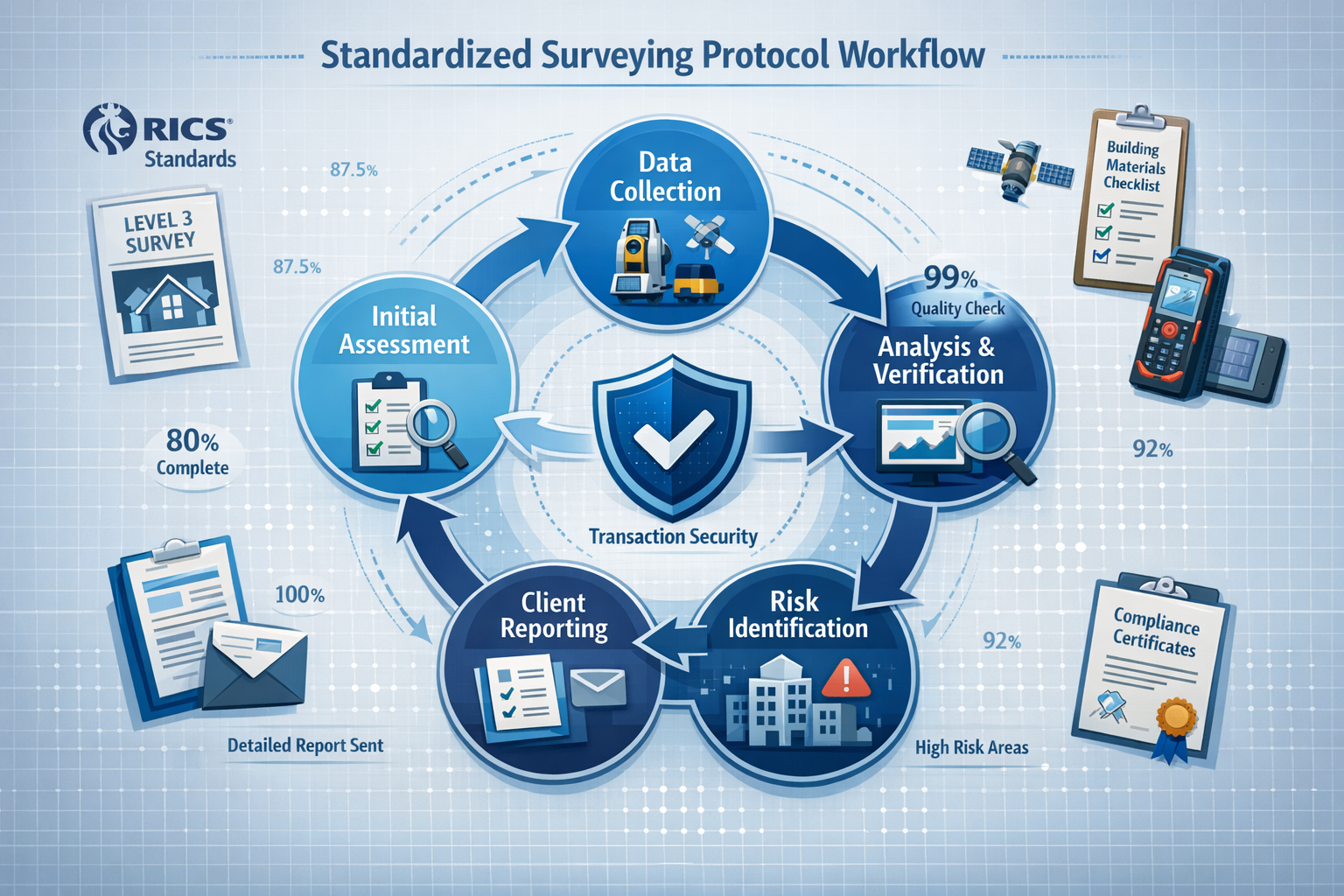
While technology provides the tools, standardized protocols provide the methodology that ensures Certainty-Driven Surveying: How Data Solutions and Standardized Protocols Reduce Transaction Risk in 2026's Uncertain Market delivers consistent results across all transactions.
RICS Standards and Professional Guidelines
The Royal Institution of Chartered Surveyors (RICS) establishes baseline standards that define professional practice. In 2026, leading firms exceed these minimums by implementing enhanced protocols:
Standardized Inspection Checklists: Comprehensive, property-type-specific checklists ensure no critical elements are overlooked during site visits. Understanding the difference between Level 2 and Level 3 surveys helps clients select appropriate inspection depth.
Photographic Documentation Standards: Consistent image capture protocols (angles, lighting, labeling) create defensible visual records and enable accurate remote review.
Terminology Standardization: Uniform language for describing conditions, defects, and recommendations eliminates ambiguity that causes client confusion and potential disputes.
Quality Control Reviews: Multi-tier review processes where senior surveyors verify findings before report release, reducing error rates.
These protocols transform surveying from an art dependent on individual practitioner judgment into a science with reproducible results.
Risk Classification Frameworks
Standardized risk classification enables consistent communication across transactions:
Four-Tier Risk Rating System:
- ⚠️ Critical Risk – Immediate safety hazards or structural integrity concerns requiring urgent action
- 🟠 High Risk – Significant defects likely to worsen rapidly or substantially impact property value
- 🟡 Moderate Risk – Issues requiring attention within defined timeframes to prevent deterioration
- 🟢 Low Risk – Minor maintenance items with minimal immediate impact
Each risk level triggers specific recommendations and cost estimate ranges, enabling clients to make informed decisions quickly. When surveyors identify areas requiring further investigation, standardized protocols ensure appropriate specialist referrals.
Standardized Reporting Templates
Template-based reporting ensures comprehensive coverage while improving readability:
- Executive summary with key findings and risk overview
- Property description and location context
- Systematic element-by-element assessment
- Prioritized defect schedule with risk ratings
- Photographic appendix with annotated images
- Recommendations with indicative cost ranges
- Technical appendices for specialist reports
This structure enables clients to quickly locate critical information while maintaining complete documentation for due diligence purposes. For those wondering which building survey they need, standardized reports make service level differences clear.
Quality Assurance and Continuous Improvement
Leading firms implement formal quality management systems:
📋 Pre-Inspection Briefings: Ensure surveyors understand property-specific risks and client concerns before site visits.
🔍 Peer Review Processes: Second surveyor reviews reports before client delivery, catching errors and inconsistencies.
📊 Client Feedback Analysis: Systematic collection and analysis of client satisfaction data identifies improvement opportunities.
🎓 Ongoing Training Programs: Regular technical updates and protocol refreshers maintain team competency.
📈 Performance Metrics: Track key indicators like report turnaround time, amendment rates, and client satisfaction scores.
These quality frameworks ensure that standardized protocols remain effective and evolve with changing market needs. The construction industry globally recognizes that digital transformation and standardized approaches improve project outcomes and reduce risks [7].
Implementing Certainty-Driven Surveying in Practice
Transitioning to certainty-driven methodologies requires strategic planning and organizational commitment. Surveying firms successfully implementing these approaches follow structured implementation pathways.
Technology Investment and Integration
Phased technology adoption minimizes disruption while building capabilities:
Phase 1 – Foundation (Months 1-3):
- Implement cloud-based data management platform
- Standardize digital photography and documentation
- Establish secure client portals
Phase 2 – Enhancement (Months 4-6):
- Add thermal imaging and moisture detection equipment
- Integrate predictive analytics tools
- Deploy mobile inspection applications
Phase 3 – Optimization (Months 7-12):
- Implement 3D scanning for complex properties
- Deploy IoT monitoring for ongoing assessments
- Integrate AI-assisted defect identification
This gradual approach allows teams to develop competency with each technology layer before adding complexity [2].
Staff Training and Cultural Change
Technology alone doesn't create certainty—people do. Successful firms invest heavily in:
🎯 Technical Skills Development: Hands-on training with new equipment and software platforms
📚 Protocol Familiarization: Comprehensive education on standardized procedures and quality standards
💡 Critical Thinking Enhancement: Training surveyors to interpret data insights, not just collect information
🤝 Client Communication: Developing skills to explain technical findings in accessible language
🔄 Change Management: Addressing resistance and building buy-in for new methodologies
Surveying professionals must evolve from traditional inspectors to data-informed advisors who guide clients through complex risk decisions.
Client Education and Value Communication
Clients don't automatically understand the value of certainty-driven approaches. Effective communication strategies include:
Before Engagement:
- Clear service descriptions explaining methodology differences
- Case studies demonstrating risk identification success stories
- Transparent pricing that reflects enhanced value delivery
During Service Delivery:
- Regular progress updates through client portals
- Preliminary findings discussions before final reporting
- Educational content explaining technical findings
After Completion:
- Detailed walkthrough of findings and recommendations
- Follow-up support for remediation planning
- Ongoing monitoring options for continued certainty
When preparing properties for market, sellers benefit from understanding how certainty-driven surveys can accelerate transactions by preemptively addressing buyer concerns.
Measuring Success and ROI
Firms track multiple metrics to evaluate certainty-driven implementation:
| Metric | Target Improvement |
|---|---|
| Report turnaround time | 25% reduction |
| Client satisfaction scores | 15% increase |
| Repeat client rate | 30% increase |
| Amendment requests | 40% reduction |
| Professional indemnity claims | 50% reduction |
| Average transaction value | 20% increase |
These quantifiable improvements demonstrate that investing in certainty-driven methodologies generates measurable returns through operational efficiency, client retention, and risk reduction.
Industry Challenges and Future Developments
While certainty-driven surveying offers substantial benefits, implementation faces challenges that the profession must address to realize full potential.
Current Implementation Barriers
Cost Considerations: Advanced technology requires significant capital investment, potentially pricing smaller firms out of competitive markets [3].
Skills Gaps: Many experienced surveyors lack digital literacy, requiring substantial retraining investments [6].
Data Standardization: Industry-wide data format standards remain incomplete, limiting interoperability between platforms [4].
Client Education: Many property buyers and sellers don't yet understand the value difference between traditional and certainty-driven approaches.
Regulatory Lag: Professional standards and insurance frameworks haven't fully adapted to new methodologies.
Emerging Trends for 2026 and Beyond
The surveying profession continues evolving rapidly:
🤖 Artificial Intelligence Integration: AI algorithms increasingly assist with defect identification, risk assessment, and report generation, improving consistency and speed [4].
🌍 Sustainability Assessment: Environmental performance metrics become standard components of property assessments as climate concerns influence property values [7].
🔗 Blockchain Documentation: Immutable property history records create permanent certainty about past conditions and remediation work.
📱 Client Self-Service Tools: Enhanced portals allow clients to access property data, request updates, and monitor ongoing conditions independently.
🏘️ Portfolio-Level Analytics: Institutional investors demand standardized data across entire property portfolios, driving further protocol standardization.
According to industry forecasts, surveying firms that embrace digital transformation and standardized methodologies will capture disproportionate market share as client expectations continue rising [1].
Professional Development Requirements
Surveyors must commit to continuous learning:
- Regular technology training and certification
- Data analytics and interpretation skills
- Client advisory and consultative selling capabilities
- Cross-disciplinary knowledge (building science, materials engineering, environmental assessment)
- Ethical frameworks for data handling and AI-assisted decision-making
Professional bodies are developing enhanced CPD (Continuing Professional Development) requirements that reflect these evolving competencies.
Conclusion: Building Confidence Through Certainty
Certainty-Driven Surveying: How Data Solutions and Standardized Protocols Reduce Transaction Risk in 2026's Uncertain Market represents more than technological advancement—it's a fundamental reimagining of the surveyor's role in property transactions. By combining sophisticated data solutions with rigorous standardized protocols, chartered surveyors transform from report writers into strategic advisors who provide quantifiable certainty in uncertain times.
The benefits are clear and measurable:
✅ Reduced transaction risk through comprehensive, data-driven assessments
✅ Faster decision-making enabled by clear risk classifications and standardized reporting
✅ Enhanced client confidence built on transparent, defensible findings
✅ Professional differentiation that justifies premium fees and builds competitive advantage
✅ Lower liability exposure through consistent methodologies and quality assurance
For property buyers, sellers, and investors navigating 2026's volatile market, certainty-driven surveying provides the foundation for confident decisions. For surveying professionals, these methodologies offer a pathway to enhanced relevance, profitability, and professional satisfaction.
Next Steps for Stakeholders
For Chartered Surveyors:
- Evaluate current methodologies against certainty-driven standards
- Develop technology and training investment roadmaps
- Implement standardized protocols incrementally
- Measure and communicate value to clients
For Property Buyers and Investors:
- Seek surveyors offering data-driven, standardized assessments
- Request risk-rated findings and predictive maintenance insights
- Understand what's included in a Level 3 survey to ensure comprehensive coverage
- Use survey data to inform negotiation and remediation planning
For Industry Bodies:
- Accelerate development of data standardization frameworks
- Update professional standards to reflect technological capabilities
- Provide training resources supporting digital transformation
- Facilitate knowledge sharing across the profession
The future of property transactions belongs to those who embrace certainty over ambiguity, data over assumption, and standardization over inconsistency. In 2026's uncertain market, certainty-driven surveying isn't just an advantage—it's essential.
References
[1] Future Land Surveying 2026 – https://haller-blanchard.com/future-land-surveying-2026/
[2] 2026 Surveying Trends How Survey Firms Are Adapting Without Overcommitting – https://munsonedsurvey.com/blogs/news/2026-surveying-trends-how-survey-firms-are-adapting-without-overcommitting
[3] Challenges Opportunities 2026 – https://www.survey-solutions.co.uk/blog/challenges-opportunities-2026/
[4] The Future Of Land Surveying Technology And Upcoming Trends In 2026 – https://metricop.com/blogs/land-surveying/the-future-of-land-surveying-technology-and-upcoming-trends-in-2026
[5] Confidence On The Horizon Steadying Conditions With Positive Expectations Ahead – https://www.rclco.com/publication/confidence-on-the-horizon-steadying-conditions-with-positive-expectations-ahead/
[6] Doubling Down On Digital – https://amerisurv.com/2026/02/01/doubling-down-on-digital/
[7] Global Construction Survey 2025 2026 – https://kpmg.com/cn/en/insights/2026/03/global-construction-survey-2025-2026.html
[8] 2026 Property State Of The Market At A Glance – https://www.crcgroup.com/Tools-Intel/Specialty-Tools-Intel/2026-property-state-of-the-market-at-a-glance
[9] Land Surveying Market – https://metastatinsight.com/report/land-surveying-market