

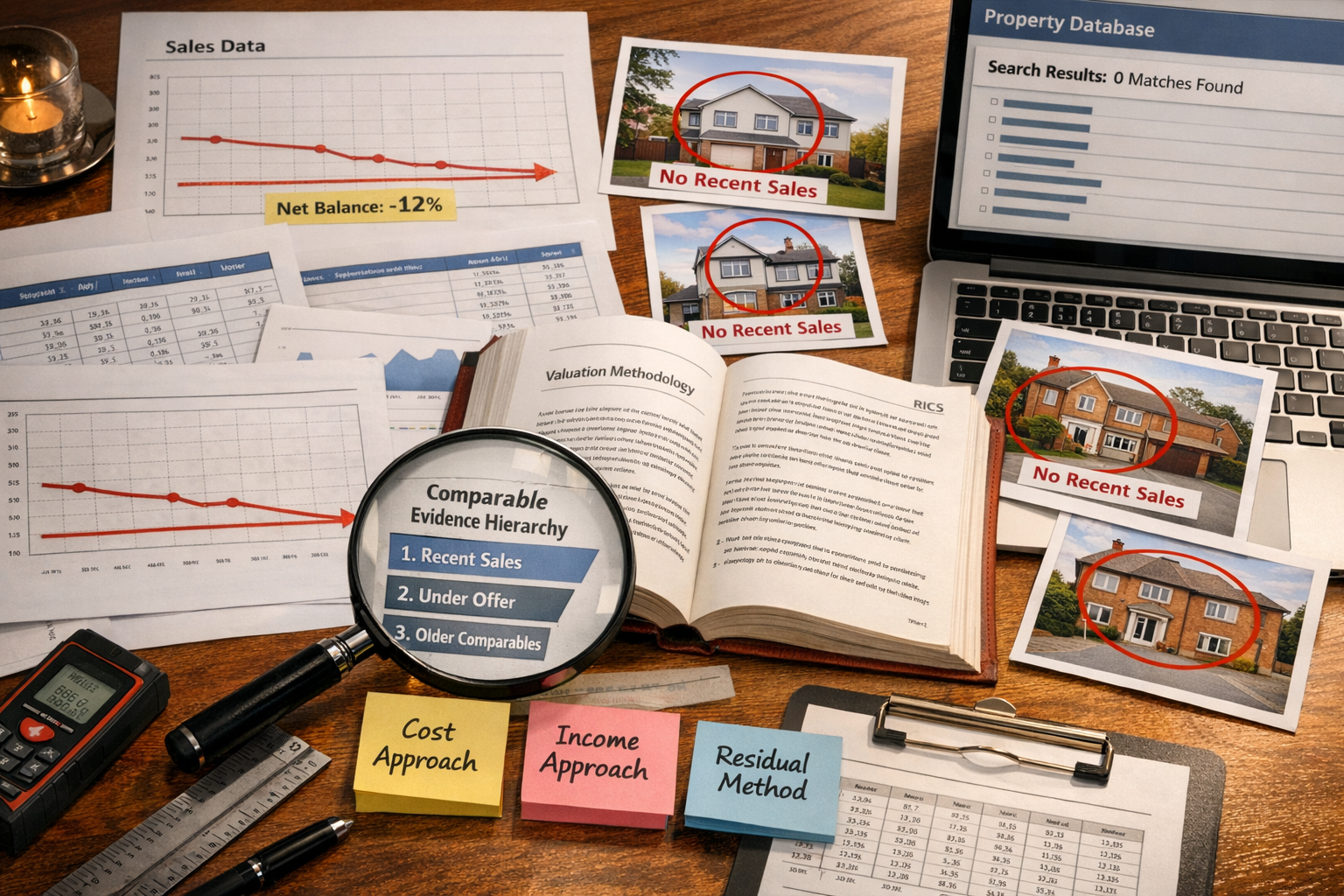
February 2026 has brought a sobering reality to property professionals across the UK: agreed sales have dropped to a -12% net balance, creating one of the most challenging environments for property valuation in recent memory. When transaction volumes dry up and comparable evidence becomes scarce, building surveyors must adapt their techniques and expand their methodological toolkit to deliver reliable valuations that stand up to scrutiny.
The current market conditions present a unique challenge for professionals undertaking property valuations and building surveys. Understanding Valuation Evidence in Subdued Markets: Building Surveyor Techniques When Agreed Sales Remain Flat and Comparable Evidence Is Scarce has become essential for maintaining professional standards when traditional comparable sales data proves insufficient.
Key Takeaways
- 📉 February 2026 shows agreed sales at -12% net balance, creating significant challenges for traditional comparable-based valuation methods
- 🔍 Alternative valuation methodologies become essential when comparable evidence is scarce, including cost approach, income capitalization, and residual methods
- 📊 Evidence hierarchy frameworks help surveyors prioritize available data sources and justify valuation conclusions in subdued markets
- ⚖️ Time and location adjustments require greater scrutiny when using older or geographically distant comparables
- ✅ Professional judgment and transparency in reporting assumptions become critical to maintaining credibility during market uncertainty
Understanding the Current Market Challenge
The property market in 2026 has entered a period of significant stagnation. With agreed sales showing a negative 12% net balance in February, surveyors face an unprecedented scarcity of recent, reliable comparable transactions. This situation creates multiple complications for professionals attempting to value properties using traditional methods.
Why Comparable Evidence Matters
Comparable evidence—recent sales of similar properties in similar locations—forms the cornerstone of most residential property valuations. The market approach relies on the principle that buyers and sellers establish value through their transactions. When these transactions become rare, the foundation of this methodology weakens considerably.
Traditional comparable-based valuations typically require:
- Recent transactions (ideally within 3-6 months)
- Similar property characteristics (size, type, condition)
- Comparable locations (same neighborhood or similar areas)
- Arm's length sales (not distressed or between related parties)
- Sufficient quantity (minimum 3-5 comparables for reliability)
When the market slows dramatically, finding comparables that meet all these criteria becomes increasingly difficult, forcing surveyors to adapt their approach.
The Impact of Flat Markets on Valuation Confidence
Subdued markets create several specific challenges:
- Stale data concerns: Comparables from 6-12 months ago may not reflect current market sentiment
- Reduced transaction volume: Fewer sales mean less data to analyze and verify trends
- Buyer uncertainty: Potential purchasers question whether asking prices reflect true market value
- Lender caution: Mortgage providers become more conservative in their lending criteria
- Increased scrutiny: Valuations face greater challenge from clients, lenders, and legal advisors
According to recent industry analysis, surveyors must employ tactical approaches when modest price growth forecasts suggest only 2.5% annual uplift, requiring greater precision in methodology selection.[1]
Valuation Evidence in Subdued Markets: Alternative Methodologies
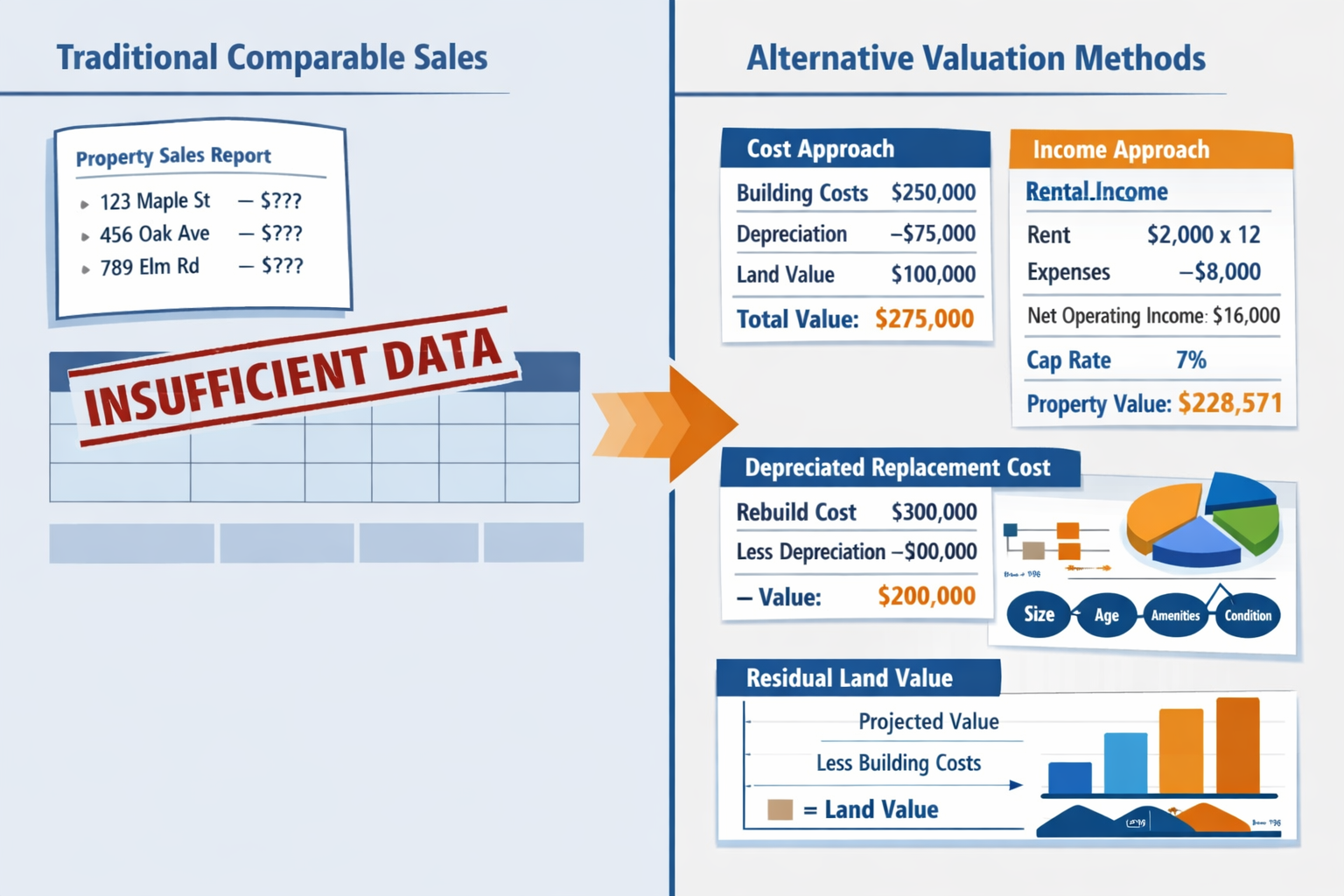
When traditional comparable evidence proves insufficient, building surveyors must turn to alternative valuation approaches. Understanding when and how to apply these methods represents a critical skill for professionals navigating Valuation Evidence in Subdued Markets: Building Surveyor Techniques When Agreed Sales Remain Flat and Comparable Evidence Is Scarce.
The Cost Approach (Depreciated Replacement Cost)
The cost approach estimates value by calculating what it would cost to replace the property, then adjusting for depreciation and obsolescence. This method becomes particularly valuable when comparable sales data is scarce.
Key components include:
- Land value: Assessed separately through land sales or residual methods
- Replacement cost new: Current construction costs for an equivalent building
- Physical depreciation: Wear and tear based on age and condition
- Functional obsolescence: Design features that reduce utility or appeal
- External obsolescence: Location or market factors affecting value
For building surveyors conducting Level 3 full building surveys, detailed knowledge of construction costs and building pathology provides a natural advantage when applying this methodology.
Practical application example:
| Component | Calculation | Amount |
|---|---|---|
| Land value | Recent land sale analysis | £150,000 |
| Building replacement cost | 150 m² × £1,800/m² | £270,000 |
| Physical depreciation | -20% (age/condition) | -£54,000 |
| Functional obsolescence | -5% (layout issues) | -£13,500 |
| Total estimated value | £352,500 |
The Income Approach (Investment Method)
For properties with income-generating potential, the income capitalization approach provides an alternative valuation framework. This method calculates value based on the property's ability to generate future income.
Core calculation:
Value = Net Operating Income ÷ Capitalization Rate
This approach requires:
- ✅ Market rent analysis: Current rental rates for comparable properties
- ✅ Vacancy and collection loss estimates: Realistic assumptions about occupancy
- ✅ Operating expense projections: Management, maintenance, insurance, taxes
- ✅ Capitalization rate selection: Derived from market yields and risk assessment
The income approach proves particularly useful for:
- Multi-unit residential properties
- Commercial premises with residential components
- Properties in areas with active rental markets
- Investment properties where sales comparables are limited
The Residual Method
The residual method works backward from the completed development value, subtracting all costs and profit to arrive at the current site value. While primarily used for development sites, this approach can inform valuations of properties with significant refurbishment potential.
Basic formula:
Site Value = Gross Development Value – (Construction Costs + Professional Fees + Finance Costs + Developer's Profit)
This methodology becomes relevant when valuing properties with urgent or dangerous building issues that require substantial remediation before achieving market value.
Hedonic Pricing Models
Hedonic pricing uses statistical analysis to break down property value into individual characteristics, allowing surveyors to estimate value based on specific attributes rather than whole-property comparables.
Property characteristics analyzed include:
- 🏠 Physical attributes: Size, bedrooms, bathrooms, garage
- 📍 Location factors: School quality, transport links, amenities
- 🏗️ Construction quality: Materials, age, condition
- 🌳 Environmental features: Garden size, views, noise levels
This approach requires substantial data and statistical expertise but can produce reliable valuations when traditional comparables are scarce.
Building Surveyor Techniques for Managing Scarce Comparable Evidence
Professional surveyors must develop systematic approaches to handle situations where Valuation Evidence in Subdued Markets: Building Surveyor Techniques When Agreed Sales Remain Flat and Comparable Evidence Is Scarce becomes the operational reality.
Expanding Geographic Search Parameters
When local comparables prove insufficient, surveyors must carefully expand their search radius while maintaining validity:
Geographic expansion strategy:
- Primary zone (0-0.5 miles): Ideal comparables, minimal adjustment needed
- Secondary zone (0.5-1.5 miles): Acceptable with location adjustments
- Tertiary zone (1.5-3 miles): Usable if similar neighborhood characteristics
- Regional comparables (3+ miles): Require substantial adjustment and justification
Each geographic expansion requires documented location adjustments accounting for:
- Neighborhood desirability differences
- School catchment variations
- Transport accessibility changes
- Local amenity availability
- Environmental factors (noise, pollution, views)
Time Adjustments for Older Comparables
When recent sales are unavailable, surveyors must use older transactions with appropriate time adjustments. This requires careful market analysis and transparent methodology.
Time adjustment framework:
| Market Condition | Adjustment Method | Typical Range |
|---|---|---|
| Stable/flat market | Minimal adjustment (0-1% per quarter) | 0-2% annually |
| Modest growth | Conservative uplift (0.5-1% per quarter) | 2-4% annually |
| Declining market | Negative adjustment (-0.5-2% per quarter) | -2-8% annually |
| Volatile market | Detailed monthly analysis required | Varies significantly |
In the current environment with 2.5% annual uplift forecasts, time adjustments must reflect this modest growth while acknowledging market uncertainty.[1]
Evidence Hierarchy and Quality Assessment
Establishing a clear evidence hierarchy helps surveyors prioritize available data and justify their conclusions when facing limited comparables.
Recommended evidence hierarchy:
Tier 1 – Strongest Evidence:
- ⭐ Recent arm's length sales (0-3 months, <0.5 miles)
- ⭐ Direct comparable properties (similar size, type, condition)
- ⭐ Verified transaction prices (not just asking prices)
Tier 2 – Good Evidence:
- 📋 Recent sales (3-6 months, 0.5-1.5 miles)
- 📋 Similar properties requiring modest adjustments
- 📋 Multiple listing service data with good detail
Tier 3 – Acceptable Evidence:
- 📝 Sales 6-12 months old with time adjustments
- 📝 Properties requiring significant characteristic adjustments
- 📝 Expanded geographic area comparables
Tier 4 – Supporting Evidence:
- 📄 Asking prices (heavily discounted reliability)
- 📄 Withdrawn listings (market resistance indicators)
- 📄 Rental evidence for income approach verification
Cross-Verification Using Multiple Approaches
Professional best practice in subdued markets involves triangulation—using multiple valuation methods to cross-verify conclusions:
Example triangulation approach:
- Primary method: Comparable sales (adjusted for time/location)
- Secondary method: Cost approach (replacement cost less depreciation)
- Tertiary method: Income approach (if rental potential exists)
When all three methods produce values within a reasonable range (typically ±10%), confidence in the valuation increases significantly. Substantial divergence requires investigation and explanation.
Enhanced Property Inspection and Documentation
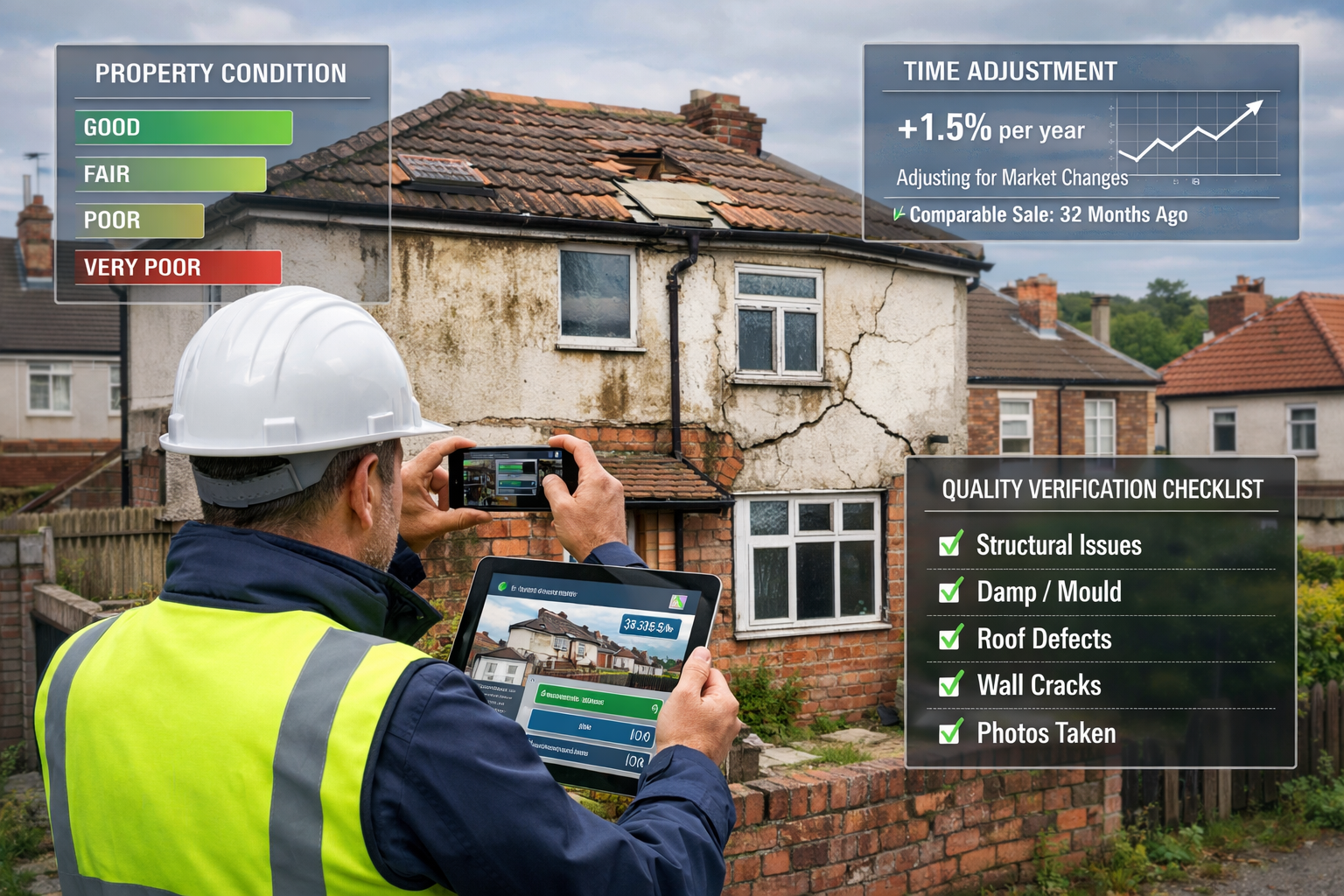
When comparable evidence is weak, the quality of the building survey and property inspection becomes even more critical. Detailed documentation of property condition, defects, and characteristics provides essential support for valuation adjustments.
Key documentation elements include:
- 📸 Comprehensive photography: All elevations, rooms, defects, and features
- 📐 Accurate measurements: Verified floor areas and room dimensions
- 🔍 Detailed condition assessment: Using standardized rating systems
- 📋 Specification analysis: Construction quality, materials, finishes
- ⚠️ Defect quantification: Cost estimates for repairs and improvements
This thorough approach supports both the valuation process and provides clients with actionable information for negotiating house prices based on survey findings.
Leveraging Professional Networks and Market Intelligence
Experienced surveyors develop extensive professional networks that provide valuable market intelligence beyond formal comparable data:
Network intelligence sources:
- 🤝 Estate agent relationships: Current market sentiment and buyer behavior
- 🏦 Mortgage lender contacts: Lending criteria changes and valuation challenges
- ⚖️ Legal professional connections: Transaction completion rates and renegotiations
- 👷 Construction professionals: Current build costs and renovation expenses
- 📊 Fellow surveyors: Shared market observations and methodology discussions
This qualitative intelligence helps surveyors understand market dynamics that pure transaction data might not reveal, particularly important when managing expectations around valuation stability.[2]
Transparent Reporting and Assumption Disclosure
When employing alternative methodologies or making significant adjustments due to limited comparables, transparent reporting becomes essential for maintaining professional credibility.
Critical reporting elements:
- Methodology explanation: Clear statement of approach and rationale
- Assumption disclosure: All key assumptions explicitly stated
- Limitation acknowledgment: Honest assessment of evidence quality
- Adjustment justification: Detailed explanation of all significant adjustments
- Confidence statement: Professional opinion on valuation reliability
- Alternative scenarios: Range of values under different assumptions
This transparency protects both the surveyor and the client, ensuring all parties understand the basis and limitations of the valuation in challenging market conditions.
Professional Standards and Regulatory Considerations
Building surveyors must maintain strict adherence to professional standards even when market conditions make valuation challenging. The RICS Red Book (RICS Valuation – Global Standards) provides the framework for professional valuation practice.
Key Red Book Requirements in Subdued Markets
Valuation Practice Statements (VPS) particularly relevant include:
- VPS 3: Valuation reports must clearly state the approach, reasoning, and any special assumptions
- VPS 4: Bases of value must be appropriate to the purpose (market value, investment value, etc.)
- UK National Supplement: Additional requirements for UK valuations including market conditions commentary
Special Assumptions and Departures
When comparable evidence is scarce, surveyors may need to employ special assumptions—assumptions that differ from actual circumstances but are necessary for the valuation purpose.
Common special assumptions in subdued markets:
- Assuming completion of repairs not yet undertaken
- Assuming planning permission not yet granted
- Assuming market conditions at a specific date different from valuation date
- Assuming sale on a specified marketing period
All special assumptions must be:
- ✅ Clearly stated in the report
- ✅ Reasonable and realistic
- ✅ Agreed with the client in advance
- ✅ Appropriate to the valuation purpose
Professional Indemnity Considerations
Valuations in challenging markets carry increased professional risk. Surveyors should:
- Ensure adequate professional indemnity insurance coverage
- Document all methodology decisions and rationale
- Maintain detailed working papers supporting conclusions
- Consider seeking additional specialist advice for complex situations
- Stay current with continuing professional development on valuation techniques
Practical Case Study: Valuing an Edwardian Property in a Flat Market
Consider a practical scenario: valuing an Edwardian cottage in February 2026 with minimal recent comparable sales.
Property characteristics:
- 3-bedroom Edwardian semi-detached cottage
- 110 m² floor area
- Requires modernization (kitchen, bathroom)
- Some structural concerns (roof, damp)
- Desirable location but limited recent sales
Available evidence:
- Only 2 comparable sales in past 6 months (insufficient)
- 5 sales from 9-15 months ago (require time adjustment)
- 3 properties currently marketed (asking price data only)
- Active rental market (income approach possible)
Surveyor's approach:
-
Primary method – Adjusted comparables:
- Use 5 older sales with +2% time adjustment (conservative given 2.5% annual forecast)
- Apply condition adjustments (-8% for modernization needs)
- Location adjustments (±2% based on specific street appeal)
- Indicated value range: £385,000-£405,000
-
Secondary method – Cost approach:
- Land value: £180,000 (based on limited land sales)
- Replacement cost: 110 m² × £1,700/m² = £187,000
- Depreciation: -25% (age, condition, obsolescence) = -£46,750
- Indicated value: £320,250 (lower due to modernization needs)
-
Tertiary method – Income approach:
- Market rent: £1,800/month (£21,600/year)
- Less: 10% expenses = £19,440 net
- Capitalization rate: 5% (market yield)
- Indicated value: £388,800
Conclusion:
The comparable and income approaches show strong agreement (£385,000-£405,000 and £388,800), while the cost approach indicates lower value due to deferred maintenance. The surveyor reconciles to £395,000 with detailed explanation of methodology, adjustments, and the weight given to each approach.
Technology and Data Solutions for Evidence-Scarce Markets
Modern technology offers tools to help surveyors navigate challenging valuation environments:
Property Data Platforms
- Land Registry data: Historical transaction records and price trends
- Rightmove/Zoopla analytics: Asking price trends and time-on-market data
- EIG/TwentyCi: Comprehensive property intelligence and market analytics
- CoStar/Focus: Commercial property data (for mixed-use properties)
Automated Valuation Models (AVMs)
While not suitable as primary valuation methods for regulated purposes, AVMs can provide:
- Quick market value estimates for initial assessment
- Validation checks against manual valuations
- Market trend identification
- Comparable property identification
Important limitations:
- ⚠️ Less reliable in flat or declining markets
- ⚠️ Cannot account for property-specific condition issues
- ⚠️ Require human professional judgment overlay
- ⚠️ Not acceptable for mortgage lending valuations
Digital Survey Tools
Modern surveying technology enhances evidence gathering:
- 📱 Digital measurement tools: Laser measures, floor plan apps
- 📷 360° photography: Comprehensive visual documentation
- 🗺️ GIS mapping: Location analysis and comparable identification
- ☁️ Cloud-based reporting: Efficient documentation and collaboration
Conclusion
Valuation Evidence in Subdued Markets: Building Surveyor Techniques When Agreed Sales Remain Flat and Comparable Evidence Is Scarce represents one of the most challenging aspects of professional surveying practice in 2026. With agreed sales showing a -12% net balance in February, surveyors must expand their methodological toolkit beyond traditional comparable sales analysis.
Success in these conditions requires:
🎯 Methodological flexibility – Competence in alternative valuation approaches including cost, income, and residual methods
📊 Enhanced analysis – Sophisticated time and location adjustments when using limited comparable evidence
🔍 Rigorous documentation – Detailed property inspection and condition assessment to support valuation conclusions
💼 Professional transparency – Clear reporting of methodology, assumptions, and limitations
📚 Continuous learning – Staying current with market conditions, regulatory requirements, and professional standards
Actionable Next Steps
For building surveyors facing challenging market conditions:
-
Review your methodology toolkit – Ensure competence in all three primary valuation approaches (market, cost, income)
-
Strengthen professional networks – Develop relationships with estate agents, lenders, and fellow surveyors for market intelligence
-
Invest in technology – Adopt digital tools for property data analysis, measurement, and documentation
-
Enhance reporting practices – Implement transparent reporting templates that clearly explain methodology and limitations
-
Pursue continuing education – Attend RICS courses on valuation in challenging markets and alternative methodologies
-
Consider specialist support – Don't hesitate to seek additional expert advice for complex situations
The subdued market conditions of 2026 demand professional excellence, methodological rigor, and transparent communication. Surveyors who master these techniques will not only navigate current challenges successfully but will emerge as trusted advisors capable of delivering reliable valuations regardless of market conditions.
Understanding the consequences of failing to act on proper valuation methodology becomes even more critical in uncertain markets, where both professional reputation and client interests depend on sound, defensible valuation conclusions.
References
[1] Valuation Accuracy Under Modest Price Growth Surveyor Tactics For 2 5 Annual Uplift Forecasts In 2026 – nottinghillsurveyors.com
[2] Managing Expectations In 2026 Why Valuation Stability Depends On Perception Not Just Performance – ir-impact.com