

Wales is emerging as a regional leader in the UK housing recovery, defying national trends with robust buyer demand signals that are reshaping how surveyors approach property valuations in 2026. While much of the UK residential market continues to grapple with subdued transaction volumes and cautious pricing sentiment, Valuation Strategies for Wales Housing Recovery: RICS Tools Capturing Q1 2026 Demand Signals reveal a markedly different picture—one where professional valuers must adapt their methodologies to capture accelerating regional dynamics rather than relying on stale national averages.
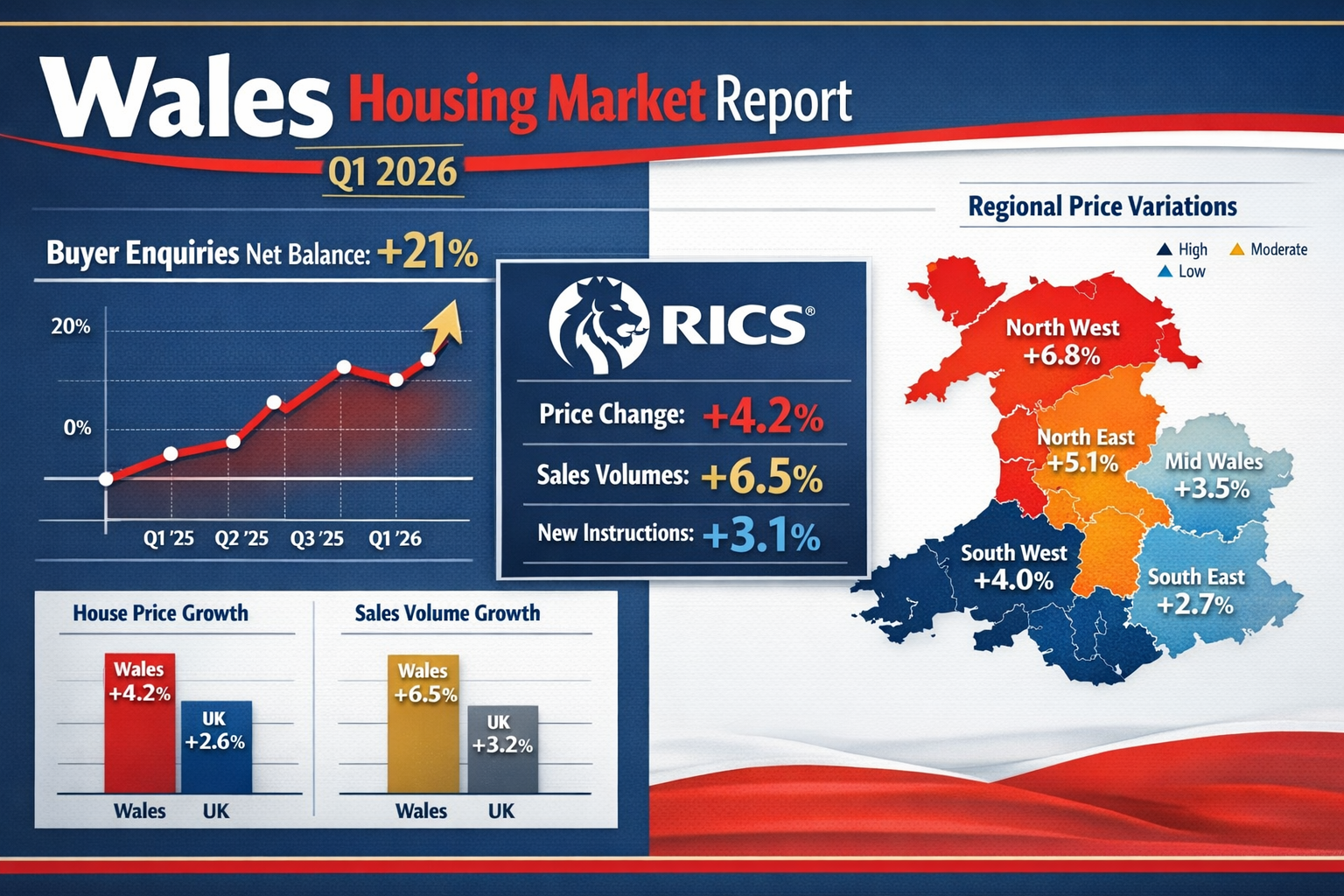
The latest RICS data shows Wales recording a net balance of 21% of surveyors expecting increased home sales in Q1 2026—one of the most encouraging regional indicators across the entire UK [1]. This divergence from the broader market creates both opportunities and challenges for chartered surveyors, lenders, and property professionals who must now deploy region-specific valuation techniques that accurately reflect local demand signals, supply constraints, and price momentum.
Key Takeaways
✅ Wales leads regional recovery: RICS surveyors report a net balance of +21% expecting increased home sales in Q1 2026, significantly outperforming national metrics [1]
✅ Valuation methodologies must adapt: Traditional UK-wide comparables and national price indices fail to capture Wales-specific demand acceleration, requiring localized RICS-compliant approaches
✅ Dual-timeline outlook: Near-term caution (net balance -18% for three-month price expectations) contrasts with positive twelve-month outlook (+33% net balance), demanding nuanced valuation strategies [2]
✅ Supply stabilization supports accuracy: New property instructions at +2% net balance provide more predictable comparable data for valuation purposes [2]
✅ Rental valuations show resilience: Landlord rental expectations at +20% net balance offer alternative investment valuation perspectives amid constrained supply [2]
Understanding the Wales Housing Recovery Context in Q1 2026
Regional Divergence from National Trends
The UK residential property market in early 2026 presents a tale of two markets. Nationally, agreed sales remain subdued at a net balance of -12%, and headline house prices show flat to marginally negative trends at -12% net balance in February 2026 [2]. These figures paint a picture of continued weakness in transaction completion rates and modest downward valuation pressure across much of England.
Wales, however, is charting a distinctly different course. The Welsh property market is experiencing unprecedented attention in 2026, with multiple RICS-aligned protocols and surveys focused specifically on Wales-specific valuation challenges and recovery indicators [3]. This regional outperformance stems from several converging factors:
- Affordability advantages compared to southern England markets
- Migration patterns from higher-cost regions seeking value
- Infrastructure investment supporting economic confidence
- Interest rate expectations that favor mortgage-dependent buyers
- Supply-demand imbalances creating localized price support
For valuation professionals, this divergence means that national price indices and UK-wide comparable sales data increasingly fail to reflect true market value in Welsh properties. Surveyors must instead deploy granular, locality-specific analysis that captures the unique demand signals emerging across Welsh regions.
The RICS Framework for Regional Valuation Accuracy
The Royal Institution of Chartered Surveyors provides the professional standards framework that ensures valuation consistency and reliability across varying market conditions. In the context of Wales's Q1 2026 recovery, RICS guidance emphasizes several core principles:
🔍 Market Evidence Hierarchy: Valuers must prioritize recent, directly comparable transactions within the specific Welsh locality over older or geographically distant sales data.
📊 Demand Signal Integration: The +21% net balance of surveyors expecting increased sales represents forward-looking market intelligence that should inform valuation judgments, particularly for development appraisals and investment valuations [1].
⚖️ Professional Judgment: RICS Red Book standards require valuers to exercise informed judgment when market conditions diverge from historical patterns—precisely the situation facing Wales in early 2026.
🏘️ Localized Comparable Selection: The regional nature of housing market performance means that comparable evidence must be drawn from increasingly narrow geographic boundaries to maintain relevance [5].
Professional property valuations require adherence to these RICS standards while remaining responsive to rapidly evolving market conditions.
Core Valuation Strategies for Wales Housing Recovery: RICS Tools Capturing Q1 2026 Demand Signals

Strategy 1: Comparative Market Analysis with Regional Weighting
Traditional comparative market analysis (CMA) relies on identifying similar properties that have recently sold, then adjusting for differences in size, condition, location, and features. In the Wales Q1 2026 context, this approach requires critical modifications:
Temporal Recency Weighting: Given the rapid shift in buyer sentiment, comparables from Q4 2025 may understate current market values. Valuers should prioritize transactions from January-March 2026, even if this means expanding geographic search parameters slightly.
Regional Performance Multipliers: When Wales-specific comparables are limited, adjusting comparable sales from other regions requires explicit recognition of the +21% demand differential. A property in a region showing flat or negative demand signals cannot serve as a direct comparable without substantial adjustment.
Supply Constraint Adjustments: The new instructions gauge at +2% net balance suggests stable but not abundant supply [2]. Properties in submarkets with tighter supply deserve upward valuation adjustments relative to areas with more abundant listings.
Understanding what surveyors look at during property valuations provides essential context for how these regional factors influence final valuation figures.
Strategy 2: Forward-Looking Demand Signal Integration
One of the most significant challenges in Valuation Strategies for Wales Housing Recovery: RICS Tools Capturing Q1 2026 Demand Signals is reconciling near-term caution with longer-term optimism. RICS data reveals this tension clearly:
- Near-term expectations: Net balance of -18% for three-month price outlook [2]
- Twelve-month expectations: Net balance of +33% anticipating price increases [2]
This dual-timeline outlook requires valuers to carefully consider valuation purpose and time horizon:
| Valuation Purpose | Recommended Approach | Rationale |
|---|---|---|
| Mortgage lending | Conservative, emphasize near-term caution | Lender risk management prioritizes downside protection |
| Investment appraisal | Balanced, incorporate 12-month outlook | Investment decisions require medium-term value perspective |
| Development viability | Optimistic, weight Wales-specific +21% demand | Development timelines align with positive 12-month outlook |
| Probate/taxation | Current market value, minimal forward projection | Statutory requirements demand present-day valuation |
For annual tax valuations and similar statutory purposes, RICS standards require current market value without speculation, even when forward indicators are positive.
Strategy 3: Rental Market Cross-Validation
The resilience of Wales's rental market provides valuable cross-validation data for capital valuations. RICS February 2026 data shows landlord rental valuations at a net balance of +20% expecting rental price rises over the coming three months, supported by constrained supply at -27% net balance for landlord instructions [2].
This rental strength offers several valuation insights:
Investment Yield Calibration: Strong rental growth expectations support higher capital valuations for buy-to-let properties, as investor demand responds to improved yield prospects.
Affordability Pressure Indicators: Rising rents relative to purchase prices may accelerate first-time buyer urgency, supporting sales market demand—the mechanism likely driving Wales's +21% sales expectation figure.
Supply-Demand Validation: The severe constraint in rental supply (-27% net balance) corroborates the broader supply tightness affecting sales valuations [2].
Valuers can use rental market data to stress-test capital valuation conclusions, particularly when comparable sales evidence is limited. A property showing strong rental demand and constrained competing supply should command valuation confidence even if recent sales comparables are sparse.
Advanced RICS Tools for Capturing Q1 2026 Wales Demand Signals
Automated Valuation Models (AVMs) with Regional Calibration
Automated Valuation Models have become increasingly sophisticated, leveraging machine learning algorithms to process vast datasets of property characteristics, transaction history, and market conditions. However, AVMs trained on national data systematically underperform in regionally divergent markets like Wales in Q1 2026.
Best practice for Wales valuations in 2026 includes:
🎯 Regional Training Data: Ensure AVM algorithms are trained specifically on Welsh transaction data, with recent Q1 2026 sales weighted heavily to capture current momentum.
🔄 Hybrid Approaches: Combine AVM outputs with professional surveyor judgment, using the automated model as a starting point that receives manual adjustment for Wales-specific factors.
📈 Demand Signal Overlays: Integrate RICS survey data (such as the +21% sales expectation metric) as an explicit input variable, allowing the model to adjust for forward-looking sentiment.
⚠️ Confidence Interval Reporting: Given market volatility, report AVM valuations with explicit confidence ranges rather than single-point estimates, acknowledging uncertainty while capturing likely value ranges.
For complex properties or those requiring detailed analysis, a comprehensive Level 3 building survey may be necessary to inform accurate valuation.
RICS Comparable Evidence Database Strategies
RICS members have access to various comparable evidence databases, but effective use requires strategic filtering in the Wales Q1 2026 context:
Geographic Radius Optimization: Start with a tight geographic radius (0.5-1 mile in urban areas, 3-5 miles in rural Wales) and expand only if insufficient comparables exist. Each expansion requires explicit adjustment for location differences.
Temporal Filters: Prioritize comparables from the past 90 days. For properties in rapidly appreciating Welsh submarkets, even six-month-old comparables may understate current values.
Property Type Precision: Given supply constraints, avoid over-reliance on "similar" property types. A three-bedroom semi-detached property is not directly comparable to a three-bedroom terraced house without adjustment, even in the same postcode.
Transaction Type Verification: Distinguish between arm's-length market transactions and distressed sales, family transfers, or other non-market transactions that may not reflect true market value.
Interest Rate Sensitivity Analysis
The February 2026 RICS update notes that "the sense that interest rates may fall faster than previously anticipated is contributing to less negative feedback" in residential surveys [5]. This interest rate sensitivity creates both opportunity and risk for valuations:
Scenario Modeling: For investment and development valuations, model multiple interest rate scenarios:
- Base case: Rates follow current market expectations
- Optimistic case: Faster rate cuts materialize, boosting buyer affordability and demand
- Pessimistic case: Rate cuts delayed or reversed, dampening demand recovery
Affordability Calculations: Explicitly calculate how interest rate changes affect typical buyer mortgage affordability in the specific Welsh locality, then adjust valuation conclusions accordingly.
Comparable Transaction Context: When analyzing comparable sales, note the prevailing interest rate environment at the time of transaction. A sale completed in Q4 2025 under higher rate expectations may understate Q1 2026 value if buyer sentiment has improved due to rate cut expectations.
Supply Pipeline Analysis
The stabilization of new property instructions at +2% net balance provides a more predictable supply environment [2], but valuers must look beyond this headline figure:
Planning Permission Monitoring: Track planning applications and approvals in the specific Welsh locality. Areas with constrained development pipelines justify higher valuations due to limited future supply competition.
New Build Competition: Assess proximity and pricing of new build developments. In Wales's recovery market, new builds may set price ceilings if they offer modern specifications at competitive prices.
Conversion and Renovation Activity: Monitor HMO conversions, subdivision of larger properties, and renovation projects that effectively increase supply without appearing in new build statistics.
For properties involved in community housing projects, additional considerations around social value and long-term sustainability may influence valuation approaches.
Practical Implementation: Valuation Strategies for Wales Housing Recovery in Action
Case Study Framework: Urban vs. Rural Wales Valuations
Urban Wales Scenario (Cardiff/Swansea):
A three-bedroom terraced property in a Cardiff suburb requires valuation for mortgage purposes in March 2026. Comparable sales from Q4 2025 suggest £285,000, but RICS data shows strong demand recovery.
Valuation Approach:
- Identify Q1 2026 comparables within 1-mile radius (three properties found, range £290,000-£305,000)
- Apply +21% demand signal as qualitative adjustment factor (not mechanical price increase)
- Consider near-term caution (-18% three-month outlook) appropriate for mortgage lending purpose
- Final valuation: £295,000, reflecting current market value with modest upward adjustment from Q4 2025 levels, supported by comparable evidence and demand signals
Rural Wales Scenario (Pembrokeshire):
A four-bedroom detached property in rural Pembrokeshire requires valuation for estate planning purposes in February 2026. Limited recent comparables available.
Valuation Approach:
- Expand geographic radius to 5 miles, identifying two comparables from past six months
- Adjust for temporal difference using Wales-specific demand indicators
- Cross-reference with rental market strength (+20% rental expectation) to validate capital value
- Apply professional judgment regarding supply constraints in rural areas
- Final valuation: Emphasize value range rather than single point, acknowledging comparable scarcity while incorporating positive Wales demand signals
Red Flags and Valuation Cautions
Despite Wales's positive Q1 2026 outlook, several caution flags warrant conservative valuation approaches:
⚠️ Over-reliance on sentiment data: The +21% sales expectation reflects surveyor sentiment, not completed transactions. Actual sales completion rates remain subdued nationally at -12% [2].
⚠️ Localized market variations: Wales is not monolithic. Coastal areas, valleys communities, and border regions show different demand patterns requiring granular analysis.
⚠️ Mortgage availability constraints: Positive buyer sentiment requires translation into actual mortgage approvals. Lender risk appetite remains a constraining factor.
⚠️ Economic uncertainty: Broader UK economic conditions, employment trends, and consumer confidence all influence housing demand beyond regional factors.
Professional valuers must balance optimism about Wales's recovery with RICS-mandated prudence, ensuring valuations remain defensible even if near-term market conditions disappoint relative to current expectations.
Documentation and Audit Trail Requirements
RICS standards require comprehensive documentation of valuation assumptions, particularly when departing from national trends or historical patterns. For Valuation Strategies for Wales Housing Recovery: RICS Tools Capturing Q1 2026 Demand Signals, documentation should include:
📋 Comparable Evidence Schedule: Complete details of all comparable transactions considered, including those rejected and reasons for rejection.
📋 Regional Data Integration: Explicit reference to RICS survey data, including the +21% Wales sales expectation figure and how it influenced valuation judgment [1].
📋 Adjustment Rationale: Clear explanation of all adjustments made to comparable evidence, with quantification where possible and qualitative reasoning where not.
📋 Market Conditions Commentary: Narrative description of Q1 2026 Wales market conditions, distinguishing regional performance from national trends.
📋 Assumption and Special Assumption Disclosure: Clear statement of any assumptions (e.g., regarding future interest rate movements) underlying the valuation.
This documentation protects both the valuer and the client, ensuring the valuation can be understood and defended months or years later if market conditions evolve differently than anticipated.
Sector-Specific Valuation Considerations for Wales Q1 2026
Residential Development Appraisals
Development viability appraisals require particularly careful consideration of Valuation Strategies for Wales Housing Recovery: RICS Tools Capturing Q1 2026 Demand Signals because they inherently involve forward-looking projections:
Sales Rate Assumptions: The +21% sales expectation supports more optimistic absorption rate assumptions for Welsh developments compared to UK averages [1]. However, prudent appraisals should still model conservative scenarios.
Price Growth Trajectories: The twelve-month outlook at +33% net balance suggests price appreciation potential [2], but development appraisals should avoid aggressive appreciation assumptions that could render schemes unviable if growth disappoints.
Construction Cost Inflation: Balance optimistic revenue projections against potential cost pressures, ensuring development viability doesn't rely solely on price growth.
For developments requiring funding for land acquisition, lenders will scrutinize these assumptions carefully, requiring robust justification of Wales-specific optimism.
Buy-to-Let Investment Valuations
The rental market's resilience (landlord expectations at +20% net balance) creates favorable conditions for buy-to-let valuations [2]:
Yield Compression Potential: Strong rental growth combined with capital value stability or growth can compress yields, supporting higher investment valuations.
Tenant Demand Validation: The -27% net balance for landlord instructions indicates severe supply constraints, validating strong tenant demand assumptions [2].
Regulatory Considerations: Welsh-specific rental regulations and licensing requirements must be factored into investment valuations, potentially constraining values relative to England.
Exit Strategy Assumptions: Investment valuations should consider both rental income streams and capital appreciation potential, with Wales's Q1 2026 demand signals supporting optimistic exit value assumptions on appropriate timelines.
For SIPP pension valuations involving Welsh buy-to-let properties, trustees require particular confidence in valuation robustness given fiduciary responsibilities.
Heritage and Non-Standard Properties
Wales's rich architectural heritage means many valuations involve properties that challenge standard comparable-based approaches:
Limited Comparable Universe: Listed buildings, period properties, and rural estates often lack directly comparable recent transactions, requiring greater reliance on professional judgment.
Demand Signal Interpretation: The +21% sales expectation may not apply uniformly to heritage properties, which attract specialized buyer pools less sensitive to general market sentiment [1].
Condition and Defect Considerations: Detailed understanding of building pathology becomes critical for accurate valuation of older Welsh properties.
Conservation and Planning Constraints: Listed building status and conservation area restrictions affect both value and marketability, requiring explicit consideration in valuation reports.
Looking Forward: Sustaining Valuation Accuracy Through Market Evolution
Monitoring Key Indicators Beyond Q1 2026
Valuation Strategies for Wales Housing Recovery: RICS Tools Capturing Q1 2026 Demand Signals must evolve as market conditions change. Valuers should establish systematic monitoring of:
📊 Monthly RICS Survey Data: Track whether Wales continues to outperform national metrics or if regional divergence narrows.
📊 Mortgage Approval Volumes: Sentiment must translate into actual lending activity to sustain price growth.
📊 Employment and Economic Indicators: Regional economic performance underpins housing demand over medium-term horizons.
📊 Supply Pipeline Development: Monitor whether the +2% new instructions balance shifts toward greater supply, which could moderate price pressures [2].
📊 Interest Rate Trajectory: Actual Bank of England policy decisions versus market expectations will significantly influence buyer affordability and demand.
Professional Development and RICS Compliance
The rapidly evolving Wales market in 2026 demands ongoing professional development for valuers:
🎓 Regional Market Intelligence: Attend Wales-specific property market briefings and engage with local market participants to maintain current knowledge.
🎓 RICS Red Book Updates: Stay current with any RICS guidance updates addressing regional market divergence or valuation methodology in recovering markets.
🎓 Technology Adoption: Embrace emerging valuation technologies, including enhanced AVMs and data analytics tools, while maintaining professional skepticism about automated outputs.
🎓 Peer Review and Quality Assurance: Implement peer review processes for complex or high-value Wales valuations, ensuring multiple professional perspectives inform final conclusions.
Building Client Confidence Through Transparency
In a market characterized by regional divergence and evolving demand signals, transparent communication with clients becomes essential:
✅ Explain Regional Context: Ensure clients understand why Wales valuations may diverge from national trends and media headlines about UK property market weakness.
✅ Quantify Uncertainty: Where appropriate, provide valuation ranges rather than single-point estimates, acknowledging market volatility while offering professional judgment on most likely value.
✅ Document Assumptions Clearly: Make all assumptions explicit in valuation reports, allowing clients to assess sensitivity to changing market conditions.
✅ Provide Forward Guidance: While maintaining RICS compliance regarding speculation, offer clients context about market trajectory based on current demand signals like the +21% sales expectation [1].
Conclusion
Valuation Strategies for Wales Housing Recovery: RICS Tools Capturing Q1 2026 Demand Signals represent a critical evolution in professional property valuation practice, responding to unprecedented regional market divergence. Wales's position as a recovery leader—with RICS surveyors reporting a net balance of +21% expecting increased home sales—demands that valuers move beyond national averages and generic methodologies to embrace granular, locality-specific analysis.
The key principles for successful Wales valuations in 2026 include:
🏆 Prioritize recent, regionally-specific comparable evidence over older or geographically distant sales data
🏆 Integrate forward-looking demand signals from RICS surveys while maintaining appropriate caution for valuation purpose and time horizon
🏆 Cross-validate capital valuations using rental market strength and supply constraint indicators
🏆 Document assumptions comprehensively to ensure valuation defensibility as market conditions evolve
🏆 Balance optimism about Wales's recovery with RICS-mandated professional prudence and risk awareness
The dual-timeline outlook—near-term caution contrasting with positive twelve-month expectations—requires particular sophistication in valuation judgment. Valuers must carefully consider whether their specific valuation purpose aligns with conservative near-term perspectives or can appropriately incorporate longer-term recovery optimism.
Actionable Next Steps
For property professionals seeking to implement these strategies:
- Audit your comparable evidence sources to ensure Wales-specific, recent transaction data forms the foundation of valuations
- Subscribe to RICS monthly survey updates to track whether regional divergence persists or narrows
- Develop scenario-based valuation frameworks that model different interest rate and demand trajectories
- Enhance documentation practices to explicitly reference Wales-specific demand signals in valuation reports
- Engage with local market participants to supplement statistical data with qualitative market intelligence
For property buyers and investors, these insights suggest:
- Recognize regional variation when interpreting national property market commentary
- Seek RICS-qualified valuers with specific Wales market expertise for purchase decisions
- Consider medium-term outlook when evaluating Wales property investments, given positive twelve-month expectations
- Request detailed valuation reports that explain regional context and comparable evidence selection
The Wales housing recovery in Q1 2026 demonstrates that property markets remain fundamentally local, even in an era of national data and automated valuation tools. Professional surveyors who master Valuation Strategies for Wales Housing Recovery: RICS Tools Capturing Q1 2026 Demand Signals will deliver superior value to clients while maintaining the rigorous standards that define RICS professional practice.
As the market continues to evolve through 2026 and beyond, the principles established here—regional specificity, demand signal integration, transparent documentation, and balanced professional judgment—will remain essential to accurate, defensible property valuation across all market conditions.
References
[1] Party Wall Surveys For Wales Housing Boom Rics Compliance Amid Accelerating Regional Demand In Q1 2026 – nottinghillsurveyors.com
[2] Uk Residential Market Survey February 2026 – rics.org
[3] Building Survey Protocols For Wales Housing Boom Rics Standards Amid 2026 Regional Price Surge – nottinghillsurveyors.com
[5] Uk Economy Property Update February 2026 – rics.org