

The construction sector stands at a pivotal crossroads in 2026. After weathering a prolonged period of uncertainty, early indicators suggest the industry is transitioning from subdued activity toward cautious recovery. For expert witnesses engaged in construction disputes, understanding these nuanced market signals has never been more critical. Expert Witness Protocols for Construction Monitor Recovery Signals: Assessing Subdued Activity Transitions in 2026 provides essential guidance for professionals who must interpret forward-looking data, validate delay claims, and assess market-driven project deferrals in an evolving economic landscape.
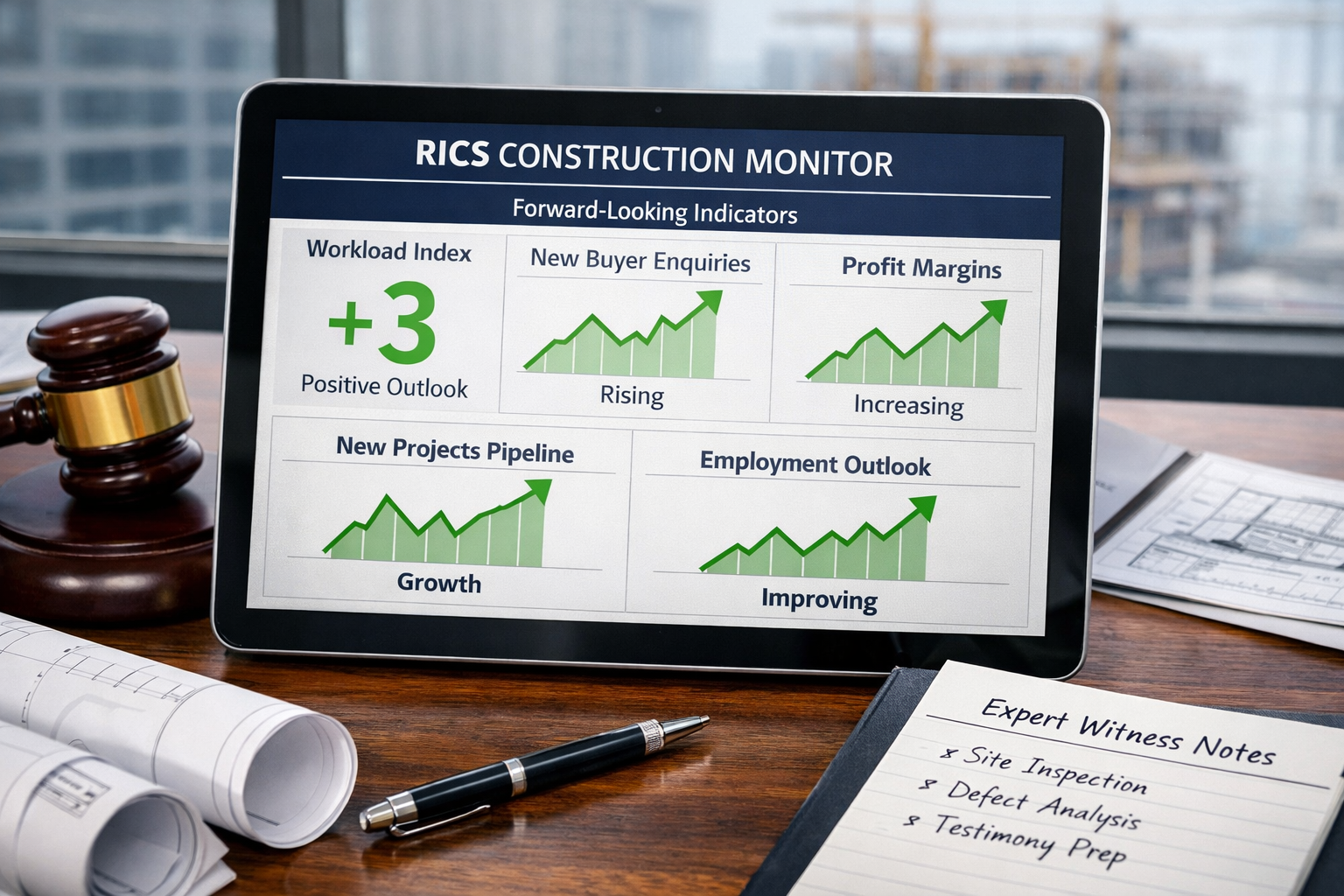
The Royal Institute of British Architects (RIBA) Workload Index recorded a positive balance of +3 in January 2026—the first positive reading after four consecutive months of decline[1]. Meanwhile, tender price inflation forecasts have been revised upward to 3.0% from 2.5%, reflecting renewed cost resilience[1]. These signals, combined with declining contractor backlogs and shifting project pipelines, create a complex evidential environment that demands rigorous analytical protocols from expert witnesses.
Key Takeaways
- 📊 RIBA Workload Index turned positive (+3) in January 2026, marking the first optimistic signal after four months of negative balances and indicating tentative market recovery
- 📉 Contractor backlog fell to 8.1 months in November 2025, the lowest level since February 2024, signaling increased competitive pressure and capacity availability
- 🏗️ Deferral patterns dominate over project abandonment, with schemes being pushed into late 2026 rather than cancelled outright—a critical distinction for delay analysis
- ⚖️ Expert witnesses must differentiate between market-driven delays and contractual breaches, using RICS Construction Monitor forward indicators as objective benchmarks
- 🎯 Building Safety Act Gateway 2 approval timelines are shortening, creating opportunities for residential and mixed-use projects to emerge from regulatory parking
Understanding the 2026 Construction Market Context
The construction industry entered 2026 carrying significant baggage from previous years. UK construction activity remained broadly flat in Q4 2025, with mixed signals creating uncertainty for project stakeholders[3]. However, forward-looking indicators now point toward modest recovery, fundamentally changing the landscape for dispute resolution and expert witness analysis.
The Shift from Decline to Tentative Recovery
For expert witnesses evaluating construction disputes in 2026, understanding the timing and nature of this transition is paramount. The sector experienced:
- Four consecutive months of negative RIBA Workload Index balances through December 2025
- Contractor backlog declining to its lowest point in four years by January 2026[2]
- Planning activity falling significantly despite total project starts increasing[2]
These seemingly contradictory indicators reflect a market in transition rather than terminal decline. Expert witnesses must recognize that deferral patterns dominate over abandonment—many schemes are being pushed into late 2026 rather than scrapped entirely[1]. This distinction carries profound implications for delay claims, force majeure arguments, and assessment of reasonable contractor responses to market conditions.
Sector-Specific Performance Variations
Not all construction sectors are experiencing recovery uniformly. Data center construction dominates the pipeline, with contractors engaged in this work recording 11.0 months of backlog versus just 7.8 months for non-data center projects[5]. Similarly, water, energy, and utilities programs are sustaining activity even as other sectors struggle[1].
Expert witnesses analyzing construction project manager responsibilities must account for these sector-specific variations when assessing whether delays were reasonable or avoidable. A residential developer facing Gateway 2 bottlenecks operates in a fundamentally different environment than a data center contractor with robust forward work.
Expert Witness Protocols for Construction Monitor Recovery Signals: Interpreting Forward Indicators
The RICS UK Construction Monitor provides expert witnesses with objective, industry-wide benchmarks for assessing market conditions. In 2026, these forward-looking indicators have become essential tools for distinguishing legitimate market-driven delays from contractual breaches.
RICS Workload Index as Evidential Benchmark
The RIBA Workload Index reaching +3 in January 2026 represents more than a statistical curiosity[1]. For expert witnesses, this threshold crossing provides:
- Temporal marker for market sentiment shift: Projects deferred in late 2025 may have been reasonable responses to negative indicators
- Baseline for assessing contractor decisions: Firms that maintained aggressive growth during the negative period faced different risks than those who adopted cautious strategies
- Context for pricing disputes: Tender price inflation forecasts revised upward to 3.0% reflect renewed confidence that affects cost escalation claims[1]
Expert witnesses should document the specific workload index readings relevant to the dispute timeline. A project delayed in October 2025 (during negative index territory) carries different implications than one delayed in February 2026 (after positive indicators emerged).
Productivity Metrics and Delay Analysis
The UK productivity net balance improved to +18% over the past 12 months, with forward expectations rising to +34%[3]. These metrics provide expert witnesses with objective benchmarks for assessing whether productivity shortfalls claimed by contractors align with industry-wide trends.
When evaluating delay claims, expert witnesses should:
- Compare project-specific productivity data against RICS industry benchmarks
- Assess whether claimed inefficiencies exceed sector-wide performance variations
- Evaluate management responses to productivity challenges in light of industry best practices
- Consider firm size effects: Medium and large practices remain optimistic while smaller practices show caution[1]
For disputes involving construction law advice, these productivity metrics provide crucial context for determining whether delays were excusable under contract terms.
Backlog Indicators and Capacity Assessment
The ABC Construction Backlog falling to 8.1 months in November 2025—the lowest since February 2024—signals fundamental shifts in contractor capacity and competitive dynamics[7]. Expert witnesses must understand what this means for various dispute scenarios:
For delay claims: Reduced backlog suggests contractors had greater capacity to accelerate works or deploy additional resources. Claims that contractors were "fully committed" to other projects require more rigorous scrutiny in this environment.
For pricing disputes: The backlog decline indicates rising competitive pressure for 2026 work[7]. Contractors may have bid more aggressively, affecting the reasonableness of claimed rates and the availability of alternative suppliers.
For termination disputes: Only 13% of contractors expect sales to decrease over the next six months—the smallest share since February 2022[5]. This optimism affects assessments of whether contractor financial distress was genuinely unforeseeable or resulted from poor management.
Assessing Subdued Activity Transitions in Expert Witness Analysis
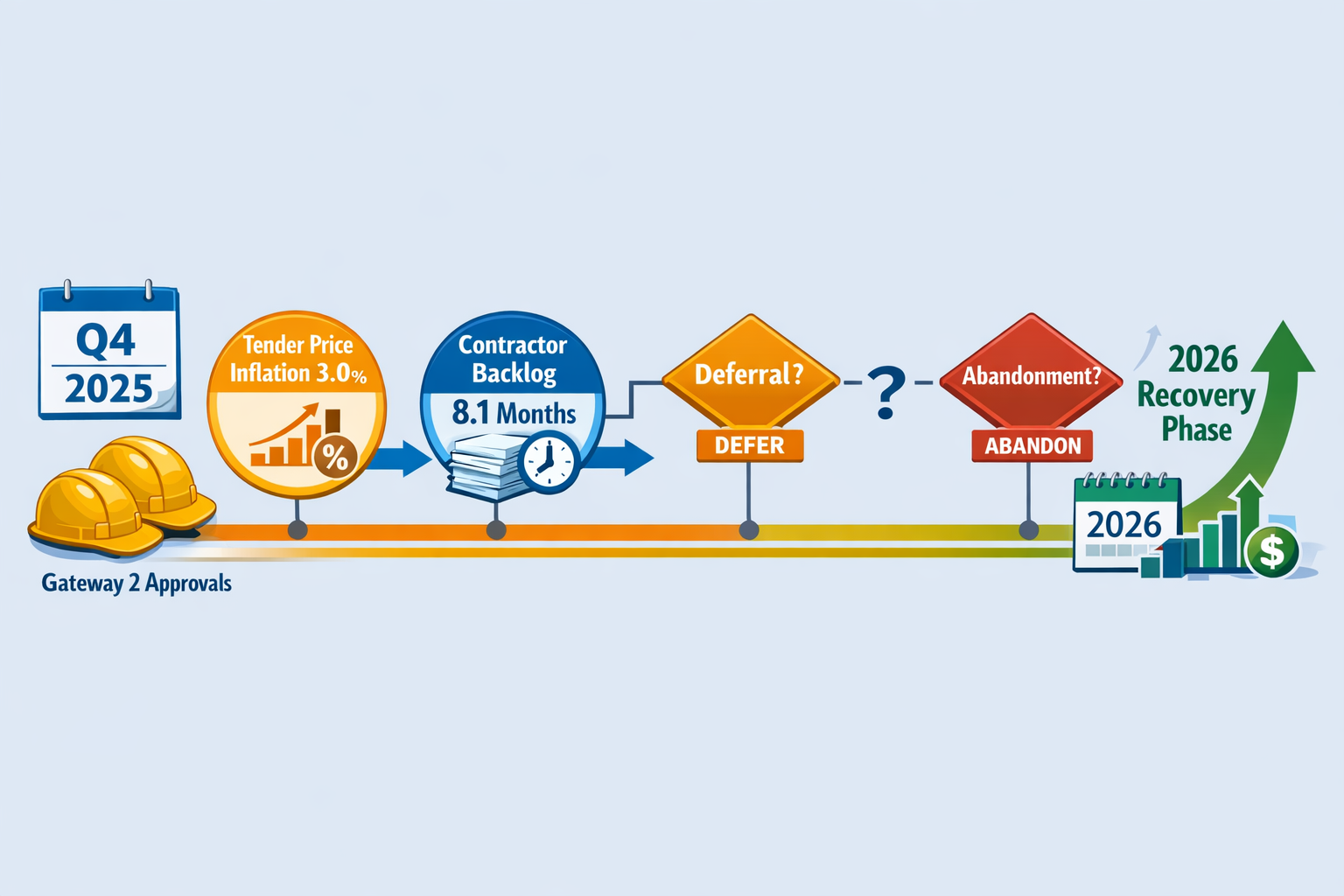
Expert witnesses evaluating construction disputes in 2026 must develop protocols for distinguishing between three distinct market phases: subdued activity (Q4 2025), transition period (Q1 2026), and modest recovery (mid-2026 onward). Each phase carries different implications for delay analysis, cost claims, and assessment of reasonable party conduct.
Deferral Versus Abandonment Analysis
The industry pattern of deferral dominating over abandonment creates unique challenges for expert witness analysis[1]. Unlike outright project cancellations, deferrals create ambiguous situations where:
- Force majeure claims may be partially valid but time-limited
- Supply chain disruptions reflect strategic supplier decisions rather than absolute unavailability
- Financing delays may result from lender caution rather than market impossibility
Expert witnesses should develop a deferral assessment protocol that includes:
- Documentary evidence of deferral decision-making: Board minutes, lender correspondence, and strategic planning documents that reveal whether deferral was necessary or opportunistic
- Comparison against sector benchmarks: Were similar projects in the same sector deferred at similar rates?
- Timeline analysis: Did the deferral occur during the negative indicator period (reasonable) or after positive signals emerged (potentially strategic)?
- Alternative action assessment: What mitigation measures were available but not pursued?
For projects involving party wall disputes or party wall schedule of condition issues, deferral timing can significantly impact neighboring property obligations and damage causation analysis.
Building Safety Act Gateway 2 Impact Assessment
Residential and mixed-use projects are re-emerging from parking as Building Safety Act Gateway 2 approval timelines shorten[1]. This regulatory bottleneck created legitimate delays throughout 2024-2025, but expert witnesses must now assess whether continued delays remain justified in 2026.
Protocol for Gateway 2 delay analysis:
- Submission timing: When was the Gateway 2 application actually submitted relative to regulatory guidance timelines?
- Response quality: Did the application require multiple resubmissions due to incomplete information?
- Regulatory correspondence: Does the documentary record show proactive engagement or passive waiting?
- Comparative timelines: How do approval timelines for the disputed project compare to similar schemes submitted in the same period?
The shortening of approval timelines in 2026 means that delays attributed to Gateway 2 processes require increasingly rigorous justification. Expert witnesses should obtain actual approval timeline data from Building Control Bodies to establish appropriate benchmarks.
Tier-Based Contractor Performance Standards
Tier 1 contractors maintain well-utilized status with pricing discipline, while Tier 2 firms face more variable conditions in viability-sensitive sectors[1]. Expert witnesses must adjust performance expectations based on contractor tier:
| Contractor Tier | Expected Backlog | Pricing Discipline | Resource Flexibility | Risk Tolerance |
|---|---|---|---|---|
| Tier 1 | 9-12 months | High | Moderate | Low |
| Tier 2 | 6-9 months | Variable | High | Moderate |
| Tier 3 | 3-6 months | Low | Very High | High |
When assessing whether a contractor's response to market conditions was reasonable, expert witnesses should consider tier-appropriate benchmarks. A Tier 1 contractor claiming inability to resource a project faces higher scrutiny than a Tier 3 firm with limited capacity reserves.
Sector-Specific Recovery Signals and Dispute Implications
The 2026 recovery is not uniform across construction sectors. Expert witnesses must understand sector-specific dynamics when assessing delay claims, pricing disputes, and performance obligations.
Data Center Construction Boom
Contractors working on data center projects record 11.0 months of backlog compared to 7.8 months for other work[5]. This disparity creates several dispute implications:
- Resource allocation conflicts: Did contractors prioritize data center work over contractual obligations in other sectors?
- Labor and material availability: Claims of unavailability require scrutiny when data center projects successfully procured the same resources
- Pricing benchmarks: Data center pricing may not reflect broader market conditions for residential or commercial work
Residential and Mixed-Use Recovery
The emergence of residential and mixed-use projects from Gateway 2 parking creates a surge in late 2026 project starts[1]. Expert witnesses evaluating disputes in this sector should consider:
- Timing of contractor commitments: Were resources committed before or after the recovery signal?
- Supply chain readiness: Did suppliers maintain capacity during the subdued period or require ramp-up time?
- Subcontractor availability: The backlog decline suggests greater subcontractor availability than in previous years[2]
For property-related disputes involving building survey requirements or level 3 building surveys, understanding sector-specific recovery timing is essential for assessing damage causation and loss quantification.
Infrastructure and Utilities Resilience
Water, energy, and utilities programs are sustaining activity even during the broader market downturn[1]. This resilience affects expert witness analysis in several ways:
- Benchmark availability: Ongoing projects provide contemporaneous cost and productivity data
- Supply chain validation: Claims of material unavailability are harder to sustain when infrastructure projects successfully procured similar items
- Labor market assessment: Skilled trades working on infrastructure projects were available for mobilization to other sectors
Developing Robust Expert Witness Protocols
Expert witnesses must develop systematic protocols for analyzing construction disputes in the context of subdued activity transitions. The following framework provides a structured approach:
Phase 1: Market Context Establishment
Objective: Establish the specific market conditions prevailing during the dispute period.
Data sources:
- RIBA Workload Index readings for relevant months
- RICS Construction Monitor forward indicators
- ABC Construction Backlog data
- Tender price inflation forecasts
- Sector-specific activity reports
Deliverable: Timeline showing market indicator trends with key threshold crossings highlighted (e.g., return to positive workload index).
Phase 2: Sector-Specific Benchmarking
Objective: Identify performance benchmarks appropriate to the project sector and contractor tier.
Analysis requirements:
- Productivity metrics for comparable projects
- Backlog levels for similar contractors
- Pricing trends in the specific sector
- Regulatory timeline data (where applicable)
Deliverable: Benchmark comparison table showing project performance against sector norms.
Phase 3: Causation Analysis
Objective: Distinguish between market-driven impacts and party-specific failures.
Key questions:
- Were delays consistent with sector-wide deferral patterns?
- Did the party take reasonable mitigation measures?
- Were alternative courses of action available?
- Did the party's decisions align with forward indicators?
Deliverable: Causation matrix separating market factors from contractual breaches.
Phase 4: Quantum Assessment
Objective: Quantify losses attributable to proven breaches, excluding market-driven impacts.
Methodology:
- Apply sector-specific cost indices
- Adjust for productivity variations
- Account for market-driven price movements
- Separate avoidable from unavoidable delays
Deliverable: Loss quantification with clear attribution to specific causes.
Practical Considerations for Expert Witnesses in 2026
Beyond analytical protocols, expert witnesses must navigate practical challenges unique to the 2026 recovery environment.
Documentary Evidence Standards
The transition from subdued activity to recovery requires contemporaneous documentation of decision-making. Expert witnesses should expect to review:
- Board minutes and strategic planning documents showing how parties responded to market signals
- Lender correspondence revealing financing constraints and conditions
- Supply chain communications demonstrating procurement efforts and supplier responses
- Regulatory submissions and responses for Gateway 2 and other approval processes
- Resource allocation records showing contractor deployment decisions
The absence of such documentation may itself be evidence of poor management or opportunistic behavior rather than genuine market-driven necessity.
Cross-Examination Preparation
Expert witnesses can expect rigorous cross-examination on their interpretation of recovery signals. Key areas of challenge include:
- Timing precision: When exactly did market conditions shift from subdued to recovery?
- Sector applicability: Do general market indicators apply to the specific project sector?
- Hindsight bias: Did the expert improperly apply knowledge of later developments to earlier decisions?
- Alternative interpretations: Could reasonable experts reach different conclusions from the same data?
Robust protocols and clear documentation of analytical methodology provide the best defense against such challenges. Expert witnesses should maintain detailed working papers showing how they reached their conclusions and what alternative interpretations they considered and rejected.
Coordination with Legal Teams
The complexity of market indicator analysis requires close coordination between expert witnesses and legal teams. Expert witnesses should:
- Educate legal teams on the significance of specific market indicators and threshold crossings
- Identify documentary gaps early in the process so legal teams can pursue additional disclosure
- Align expert opinions with legal theories of causation and breach
- Prepare joint statements with opposing experts that narrow areas of disagreement
For matters involving construction project management, coordination between technical experts and legal advisors is particularly critical given the multifaceted nature of delay and disruption claims.
Emerging Trends Affecting Expert Witness Practice
Several emerging trends in 2026 will shape expert witness practice in construction disputes:
Increased Scrutiny of Deferral Claims
As the recovery strengthens, courts and arbitrators will likely apply heightened scrutiny to deferral-based delay claims. Expert witnesses should anticipate:
- Demands for quantitative proof that deferral was commercially necessary
- Comparative analysis requirements showing how similar projects proceeded
- Mitigation obligation emphasis requiring proof that parties explored alternatives
- Temporal precision in defining when deferral became reasonable and when it ceased to be justified
Data-Driven Dispute Resolution
The availability of robust industry-wide data from RICS, RIBA, and ABC creates opportunities for more objective, data-driven dispute resolution. Expert witnesses who can effectively leverage these datasets will provide greater value to clients and tribunals.
Regulatory Impact Quantification
The Building Safety Act's ongoing implementation requires expert witnesses to develop sophisticated protocols for quantifying regulatory delay impacts. This includes:
- Establishing baseline approval timelines
- Identifying avoidable versus unavoidable regulatory delays
- Assessing the adequacy of application materials
- Evaluating proactive versus reactive regulatory engagement
Multi-Disciplinary Expert Teams
The complexity of 2026 construction disputes increasingly requires multi-disciplinary expert teams combining:
- Construction programming and delay experts
- Quantum and cost experts
- Market and economic experts
- Regulatory and compliance specialists
Expert witnesses must develop protocols for coordinating across disciplines and presenting cohesive, integrated opinions.
Conclusion: Navigating the Recovery Transition
Expert Witness Protocols for Construction Monitor Recovery Signals: Assessing Subdued Activity Transitions in 2026 requires sophisticated understanding of market dynamics, rigorous analytical methodology, and clear communication of complex concepts. The construction industry's shift from subdued activity toward modest recovery creates both challenges and opportunities for expert witnesses engaged in dispute resolution.
The key to effective expert witness practice in this environment lies in:
✅ Establishing objective market benchmarks using RICS, RIBA, and ABC data to ground opinions in industry-wide trends rather than subjective assessments
✅ Distinguishing deferral from abandonment and recognizing that project delays in 2026 carry different implications than those in earlier periods
✅ Accounting for sector-specific variations rather than applying general market trends uniformly across all construction types
✅ Developing robust protocols for causation analysis that separate market-driven impacts from contractual breaches
✅ Maintaining rigorous documentation of analytical methodology to withstand cross-examination and support credible expert opinions
Actionable Next Steps
For expert witnesses preparing to assess construction disputes in the 2026 recovery environment:
-
Compile a comprehensive market indicator database covering Q4 2025 through mid-2026, including RIBA Workload Index, RICS Construction Monitor data, and ABC backlog figures
-
Develop sector-specific benchmarks for the construction types most relevant to your practice, including productivity metrics, backlog levels, and pricing trends
-
Create standardized protocols for deferral analysis, Gateway 2 delay assessment, and tier-based contractor performance evaluation
-
Establish relationships with data providers to ensure access to the most current industry statistics and forward indicators
-
Invest in continuing education on Building Safety Act implications, market analysis techniques, and emerging dispute resolution methodologies
-
Review and update expert report templates to incorporate market context sections and forward indicator analysis
-
Engage with legal teams early in dispute processes to ensure alignment between technical analysis and legal strategy
The construction industry's transition from subdued activity to recovery in 2026 presents unique challenges for expert witnesses. Those who develop robust protocols for analyzing recovery signals, distinguishing market-driven impacts from contractual breaches, and presenting data-driven opinions will provide invaluable guidance to clients and tribunals navigating this complex landscape.
By grounding expert opinions in objective industry data, maintaining rigorous analytical standards, and clearly communicating the implications of market transitions, expert witnesses can fulfill their essential role in fair and efficient construction dispute resolution. The protocols outlined in this guide provide a framework for achieving these goals in the dynamic market environment of 2026.
For additional guidance on construction-related matters, explore resources on construction project management and specialized services including construction law advice.
References
[1] Signs Of A Building Recovery As Pipeline Begins To Stir – https://www.constructionenquirer.com/2026/02/20/signs-of-a-building-recovery-as-pipeline-begins-to-stir/
[2] Construction Sector Shows Mixed Signals At Start Of 2026 – https://www.indexbox.io/blog/construction-sector-shows-mixed-signals-at-start-of-2026/
[3] Rics Construction Productivity Report 2026 – https://www.rics.org/news-insights/rics-construction-productivity-report-2026
[5] Construction Backlog Indicator Remains Elevated – https://www.abc.org/News-Media/News-Releases/construction-backlog-indicator-remains-elevated
[7] 62229 Abc Backlog Pullback In November Signals Rising Competitive Pressure For 2026 Work – https://www.enr.com/articles/62229-abc-backlog-pullback-in-november-signals-rising-competitive-pressure-for-2026-work