

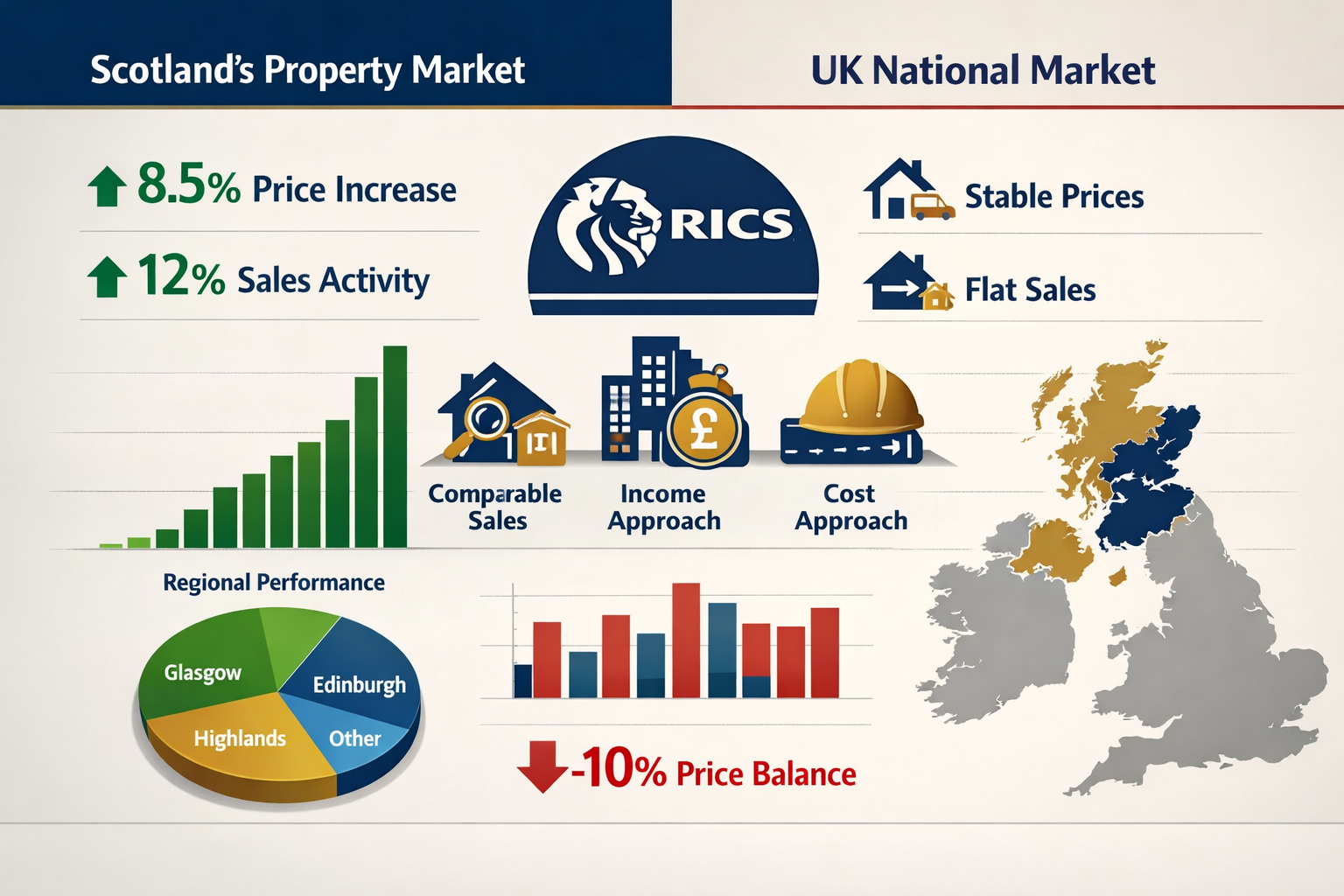
As the UK property market navigates a complex landscape in 2026, a striking divergence has emerged between regional performance metrics. While national price balances show a -10% stabilisation trend, Northern Ireland and Scotland are demonstrating remarkable resilience with strong upward price trajectories that challenge conventional market wisdom. For chartered surveyors and property professionals, understanding the Valuation Accuracy in Northern Ireland and Scotland Leads: RICS Techniques for Outpacing National Stabilisation has become essential for delivering precise, defensible valuations in these top-performing Celtic regions.
The contrast between these regional powerhouses and broader UK trends presents both opportunities and challenges for valuation professionals. RICS-accredited surveyors working in these markets must adapt their methodologies to account for unique local factors, evolving economic conditions, and the specific characteristics that drive value in Scottish and Northern Irish property markets.
Key Takeaways
- 🏴 Scotland and Northern Ireland are outperforming national trends with positive price trajectories while the UK shows -10% price balance stabilisation in 2026
- 📊 RICS has published targeted guidance including the Scotland Manifesto 2026 addressing skills shortages and infrastructure challenges affecting valuation accuracy [3]
- 🔍 Enhanced valuation techniques including localised comparable analysis and regional economic factor integration are essential for Celtic market accuracy
- ⚖️ Skills shortage crisis threatens valuation capacity with Scotland requiring 10,000+ additional construction sector jobs by 2028 [3]
- 📋 Modernised land registration processes in Northern Ireland are improving data accuracy and electronic communication for valuers [1]
Understanding Regional Market Divergence in 2026
The UK property market in 2026 presents a fascinating case study in regional variation. While national headlines focus on market stabilisation and price corrections, the reality on the ground in Scotland and Northern Ireland tells a different story entirely.
The National Context: Stabilisation and Correction
Across much of England and Wales, property markets have entered a stabilisation phase characterised by modest price adjustments. The -10% price balance reflects a market recalibrating after years of rapid growth, with buyers and sellers finding new equilibrium points. This national trend, however, masks significant regional variations that demand nuanced valuation approaches.
For surveyors conducting commercial valuations or residential assessments, relying solely on national indicators can lead to significant valuation errors when applied to Scottish or Northern Irish properties.
Celtic Regions: A Different Trajectory
Northern Ireland and Scotland have maintained strong upward price trajectories throughout 2026, driven by several interconnected factors:
- Economic resilience in key sectors including technology, renewable energy, and financial services
- Housing supply constraints creating sustained demand pressure
- Infrastructure investment supporting regional development and accessibility
- Demographic shifts with internal UK migration patterns favouring these regions
- Affordability advantages compared to southern England markets

These factors create a valuation environment where standard national benchmarks simply don't apply. Chartered surveyors must develop region-specific expertise to deliver accurate assessments that reflect local market realities.
RICS Standards and Regional Valuation Frameworks
The Royal Institution of Chartered Surveyors has recognised the importance of regional expertise through targeted guidance and advocacy initiatives. Understanding these frameworks is essential for Valuation Accuracy in Northern Ireland and Scotland Leads: RICS Techniques for Outpacing National Stabilisation.
The RICS Scotland Manifesto 2026
RICS published its comprehensive Scotland Manifesto 2026 ahead of the Scottish Budget and election, establishing clear priorities for the surveying profession. The manifesto addresses three critical pillars: supporting economic growth, advancing net zero objectives, and building resilient places [3].
For valuation professionals, the manifesto highlights several key considerations:
| Priority Area | Valuation Impact | Professional Response |
|---|---|---|
| Skills Shortage | Reduced valuation capacity and expertise gaps | Enhanced training and CPD requirements |
| Housing Supply | Supply constraints affecting price dynamics | Careful comparable selection and adjustment |
| Infrastructure Development | Value impacts from connectivity improvements | Future-proofing valuations with development plans |
| Net Zero Transition | Energy efficiency premiums and retrofit costs | EPC integration and sustainability assessments |
The manifesto identifies that Skills Development Scotland estimates the construction sector will require at least 10,000 additional jobs by 2028 to meet future demand, with particular shortages of surveyors already constraining housing supply and infrastructure projects [3].
Northern Ireland Land Registration Modernisation
RICS has actively contributed to the Land & Property Services consultation on modernising land registration processes in Northern Ireland. The organisation welcomed proposals that facilitate electronic communication while maintaining safeguards around auditability and register accuracy [1].
For surveyors, these modernisation efforts translate to:
- Enhanced data accessibility for comparable evidence gathering
- Improved title verification reducing valuation risk
- Streamlined transaction processes supporting market efficiency
- Better audit trails for professional liability protection
When preparing homebuyers reports or conducting detailed valuations, access to accurate, up-to-date land registration information is fundamental to professional practice.
Advanced RICS Techniques for Celtic Market Valuation
Achieving Valuation Accuracy in Northern Ireland and Scotland Leads: RICS Techniques for Outpacing National Stabilisation requires mastery of several advanced methodologies specifically adapted to regional conditions.
Localised Comparable Analysis
The foundation of accurate valuation in divergent markets is rigorous comparable analysis that accounts for local market dynamics:
Geographic Specificity: Comparables must be drawn from tightly defined geographic areas reflecting the subject property's actual market. A comparable from Glasgow may have limited relevance for an Edinburgh property, despite both being in Scotland.
Temporal Adjustments: In rapidly appreciating markets, time adjustments become critical. Comparables from six months ago may require significant upward adjustment to reflect current market conditions.
Quality and Condition Matching: The Celtic regions show particular sensitivity to property condition and modernisation. Energy efficiency improvements command measurable premiums that must be quantified in adjustments.
Transaction Type Verification: Distinguishing between arms-length transactions, family transfers, and distressed sales is essential for reliable comparable evidence.
Regional Economic Factor Integration
Valuation professionals must integrate region-specific economic indicators into their assessments:
- Employment trends in key regional industries
- Wage growth patterns affecting affordability and demand
- Population migration data showing demographic shifts
- Regional infrastructure investment timelines and impacts
- Local planning policy changes affecting supply
Understanding what to do if your home valuation is less than an offer becomes particularly relevant when regional markets diverge from national trends, as buyers and sellers may reference different market indicators.
Enhanced Market Analysis Methodologies
RICS professionals working in Scotland and Northern Ireland should employ several enhanced techniques:
Segmented Market Analysis: Breaking down the market by property type, price band, and location to identify specific trends within the broader regional pattern.
Supply-Demand Modelling: Quantifying the relationship between available stock and buyer demand to forecast short-term price movements.
Cross-Border Comparisons: Understanding how Scottish and Northern Irish markets relate to each other and to nearby English regions provides context for valuation decisions.
Development Viability Assessment: Evaluating new development economics to understand replacement cost dynamics and supply pipeline impacts.
Practical Application: Valuation Strategies for Top-Performing Regions
Implementing these techniques requires systematic approaches that balance professional standards with regional market realities.
Pre-Valuation Research Protocol
Before conducting any valuation in Scotland or Northern Ireland, surveyors should:
- Review recent regional market reports from RICS, estate agents, and property data providers
- Analyse local authority planning data for supply pipeline intelligence
- Consult regional economic forecasts from development agencies and chambers of commerce
- Verify land registry data and recent transaction patterns
- Assess infrastructure development plans that may impact values
This research foundation ensures valuations are grounded in current regional realities rather than outdated national assumptions.
Inspection and Assessment Considerations
During property inspections, Celtic region specialists should pay particular attention to:
Energy Efficiency: Scotland's ambitious net zero targets create strong demand for energy-efficient properties. EPC ratings directly impact value, with premiums for higher ratings exceeding national averages.
Modernisation Quality: The quality of recent improvements matters significantly in these competitive markets. Professional, building-regulation-compliant work commands premiums that DIY or substandard work cannot.
Local Amenity Access: Proximity to employment centres, transport links, and quality schools shows heightened importance in Scottish and Northern Irish markets where supply constraints limit buyer choice.
Property Condition: In supply-constrained markets, even properties requiring work attract competitive interest. Understanding the relationship between condition and value requires nuanced local knowledge.

Valuation Report Construction
Reports must clearly articulate the regional context and methodology:
"Valuation accuracy in divergent regional markets demands transparent explanation of methodology, comparable selection rationale, and explicit discussion of regional factors influencing the assessment."
Effective reports should include:
- Executive summary highlighting regional market context
- Detailed comparable analysis with explicit adjustment explanations
- Regional market commentary supporting valuation conclusions
- Risk factors specific to the local market
- Assumptions and limitations clearly stated
For capital gains tax valuations or other statutory purposes, this documentation becomes essential for defending professional opinions.
Addressing the Skills Shortage Challenge
The skills shortage identified in the RICS Scotland Manifesto 2026 presents both challenges and opportunities for valuation professionals.
Impact on Valuation Capacity
The shortage of qualified surveyors in Scotland and Northern Ireland creates several pressures:
- Extended turnaround times for valuation instructions
- Reduced competition potentially affecting fee structures
- Quality concerns as less experienced professionals handle complex instructions
- Geographic coverage gaps in rural and remote areas
For clients, understanding how long a building survey takes becomes increasingly important when planning transactions in these capacity-constrained markets.
Professional Development Priorities
Surveyors seeking to develop expertise in Celtic markets should focus on:
Regional Market CPD: Attending Scotland and Northern Ireland-specific training events, webinars, and market briefings.
Local Networking: Building relationships with regional estate agents, solicitors, and other property professionals who understand local market nuances.
Data Source Development: Establishing access to regional property databases, planning portals, and market intelligence sources.
Regulatory Knowledge: Understanding Scottish and Northern Irish property law, planning systems, and regulatory frameworks that differ from English practice.
Collaborative Practice Models
The skills shortage encourages innovative practice approaches:
- Regional specialist partnerships between firms
- Mentoring programmes pairing experienced regional specialists with developing professionals
- Knowledge-sharing platforms for comparable evidence and market intelligence
- Technology adoption to enhance efficiency and capacity
Technology and Data in Regional Valuation
Modern valuation practice increasingly relies on technology to enhance accuracy and efficiency, particularly important in markets showing divergence from national trends.
Valuation Software and Tools
Sophisticated valuation software enables:
- Automated comparable searching across multiple data sources
- Statistical analysis of market trends and price movements
- Adjustment calculations with transparent methodology
- Report generation with consistent formatting and compliance
Using land value calculators and similar tools can provide useful benchmarks, though professional judgment remains essential in interpreting results for regional markets.
Data Sources for Celtic Markets
Key data sources for Scotland and Northern Ireland include:
| Data Source | Coverage | Key Applications |
|---|---|---|
| Registers of Scotland | Scottish property transactions | Comparable evidence, market trends |
| Land & Property Services NI | Northern Ireland transactions | Price data, ownership verification |
| RICS Market Surveys | Regional sentiment indicators | Market direction, confidence levels |
| Local authority planning portals | Development pipeline data | Supply analysis, infrastructure impacts |
| Energy Performance Certificate registers | EPC ratings and trends | Energy efficiency premiums |
Artificial Intelligence and Machine Learning
Emerging AI technologies offer potential for enhanced valuation accuracy:
- Predictive modelling of regional price movements
- Automated comparable selection with quality scoring
- Natural language processing of market reports and news
- Image analysis for property condition assessment
However, professional judgment remains irreplaceable in interpreting regional market dynamics and applying appropriate adjustments.
Risk Management in Divergent Markets
Valuing properties in markets that diverge significantly from national trends creates specific professional risks that require careful management.
Professional Indemnity Considerations
Surveyors should ensure their professional indemnity insurance:
- Covers regional practice without geographic exclusions
- Provides adequate limits for property values in the region
- Includes retroactive cover for evolving market conditions
- Covers specialist valuation types undertaken in the region
Documentation and Audit Trails
Robust documentation protects against professional liability:
- Comparable selection rationale clearly recorded
- Adjustment methodology transparently explained
- Market research sources cited and dated
- Assumptions and limitations explicitly stated
- Client instructions confirmed in writing
Quality Assurance Processes
Firms operating in Scotland and Northern Ireland should implement:
- Peer review of valuations by regional specialists
- Regular calibration exercises comparing valuations to subsequent transactions
- Continuing professional development focused on regional markets
- Client feedback mechanisms to identify concerns early
Future Outlook: Sustaining Valuation Excellence
As 2026 progresses, several trends will shape valuation practice in Scotland and Northern Ireland.
Market Evolution Scenarios
Potential market developments include:
Continued Divergence: Scotland and Northern Ireland maintain strong performance while other UK regions stabilise, requiring ongoing regional specialisation.
Convergence: National market recovery brings regions back into alignment, reducing the need for specialised regional approaches.
Further Fragmentation: Additional regional variations emerge, creating even more complex valuation landscapes.
Regulatory and Standards Development
RICS continues to evolve its standards and guidance:
- Enhanced regional guidance addressing specific Celtic market characteristics
- Technology standards for valuation software and data usage
- Sustainability integration reflecting net zero commitments
- Skills development frameworks addressing capacity challenges
Professional Practice Evolution
Forward-thinking valuation practices will:
- Invest in regional expertise through recruitment and training
- Adopt advanced technology to enhance efficiency and accuracy
- Develop collaborative networks for knowledge sharing
- Engage with policy development through RICS and other professional bodies
For professionals considering whether funding for land development is viable in these regions, accurate valuation becomes the foundation for sound investment decisions.
Conclusion
The Valuation Accuracy in Northern Ireland and Scotland Leads: RICS Techniques for Outpacing National Stabilisation represents a critical competency for chartered surveyors in 2026. As these Celtic regions continue demonstrating strong upward price trajectories against a backdrop of national -10% price balance stabilisation, the ability to deliver precise, defensible valuations has never been more important.
Success in these markets requires a multifaceted approach combining:
✅ Deep regional market knowledge grounded in local economic, demographic, and supply factors
✅ Rigorous comparable analysis with appropriate geographic and temporal adjustments
✅ Integration of RICS guidance including the Scotland Manifesto 2026 priorities and modernised land registration frameworks
✅ Advanced technology adoption while maintaining essential professional judgment
✅ Robust risk management through documentation, quality assurance, and appropriate insurance
✅ Ongoing professional development addressing regional specialisation and capacity challenges
Actionable Next Steps
For surveyors seeking to enhance their regional valuation capabilities:
- Review the RICS Scotland Manifesto 2026 to understand strategic priorities affecting the profession [3]
- Develop regional data sources including local transaction databases and market intelligence contacts
- Invest in continuing professional development focused on Celtic market characteristics
- Establish quality assurance processes for regional valuations
- Build collaborative networks with other regional specialists
- Monitor land registration modernisation in Northern Ireland for practice improvements [1]
- Integrate sustainability considerations reflecting regional net zero commitments
The divergence between Scottish and Northern Irish markets and broader UK trends creates both challenges and opportunities for valuation professionals. Those who invest in developing regional expertise, adopt advanced methodologies, and maintain rigorous professional standards will be best positioned to deliver the accurate, reliable valuations these dynamic markets demand.
As the UK property landscape continues to evolve, the ability to navigate regional variations with confidence and precision will increasingly define valuation excellence in the profession.
References
[1] Uk Influence And Advocacy Update January 2026 – rics.org
[3] Rics Scotland Manifesto 2026 Surveying Scotland – rics.org
[4] Regional Valuation Divergences In 2026 Recovery Rics Tactics For North South Price Shifts In Building Surveys – nottinghillsurveyors.com