

{"cover":"Professional landscape format (1536×1024) magazine cover hero image featuring bold white text overlay 'Building Survey Protocols for Wales Housing Recovery: Q1 2026 Demand Surge' in extra large 72pt modern sans-serif font with dark shadow effect, positioned center-upper third. Background shows dramatic Welsh housing landscape with traditional stone cottages in foreground, modern residential development in middle ground, and rolling green Welsh hills under dynamic cloudy sky. Overlay includes subtle Welsh dragon watermark, professional surveyor with tablet and drone in lower corner. Color palette: deep slate blue, emerald green, white, gold accents. High contrast, editorial quality, architectural photography style with professional composition following rule of thirds, sharp focus, magazine-worthy aesthetic","content":["Detailed landscape format (1536×1024) editorial image showing professional building surveyor conducting comprehensive Level 3 inspection inside traditional Welsh stone property. Scene captures surveyor using thermal imaging camera to check damp issues on interior stone wall, with visible moisture meter readings, inspection checklist on tablet, and cross-section diagram overlay highlighting flood risk assessment protocols. Welsh property features exposed stone walls, timber beams, period windows. Foreground shows surveying equipment including laser measure, moisture detector. Background reveals inspection notes and regional risk assessment charts. Natural lighting through windows, professional documentary style, architectural detail focus, technical precision aesthetic","Detailed landscape format (1536×1024) infographic-style visualization showing Wales housing market data for Q1 2026. Split-screen composition: left side displays upward trending graph with 21% net balance increase in home sales expectations, 22% price increase predictions, bar charts showing 8,700 annual housing need target. Right side shows detailed regional map of Wales with color-coded flood risk zones, coastal areas, valley regions marked with survey protocol icons. Includes data visualization elements: percentage badges, arrow indicators, housing unit icons, surveyor checkpoint symbols. Professional color scheme: navy blue, Welsh red, white, data visualization green and amber. Clean modern infographic design, editorial quality, business report aesthetic","Detailed landscape format (1536×1024) professional scene showing modern surveying technology deployment in Welsh housing context. Foreground features advanced drone hovering over residential property capturing aerial inspection footage, with operator holding controller displaying live thermal imaging feed. Middle ground shows traditional Welsh terraced housing row with mix of renovated and survey-flagged properties. Background includes surveyor team with digital tablets reviewing building defect protocols, portable equipment cases open showing moisture meters, structural assessment tools. Screen overlays display digital survey reports, risk assessment checklists, Q1 2026 timeline markers. Golden hour lighting, professional architectural photography style, technology-meets-tradition composition, high detail editorial quality"]"}
The Welsh housing market stands at a pivotal moment. After years of uncertainty, 21% of RICS surveyors now expect increased home sales in Q1 2026[1], marking a dramatic shift in market sentiment. This surge in buyer confidence, coupled with competitive mortgage rates and an urgent need for 8,700 additional homes annually[3], creates unprecedented opportunities—but only for those prepared with robust building survey protocols tailored to Wales' unique challenges.
Building Survey Protocols for Wales Housing Recovery: Capturing Q1 2026 Demand Surge Opportunities requires more than standard inspection checklists. With Wales facing distinct regional risks including flood-prone valleys, coastal erosion zones, and aging stone-built properties, surveyors must deploy specialized assessment frameworks that address both immediate market demands and long-term structural integrity concerns.

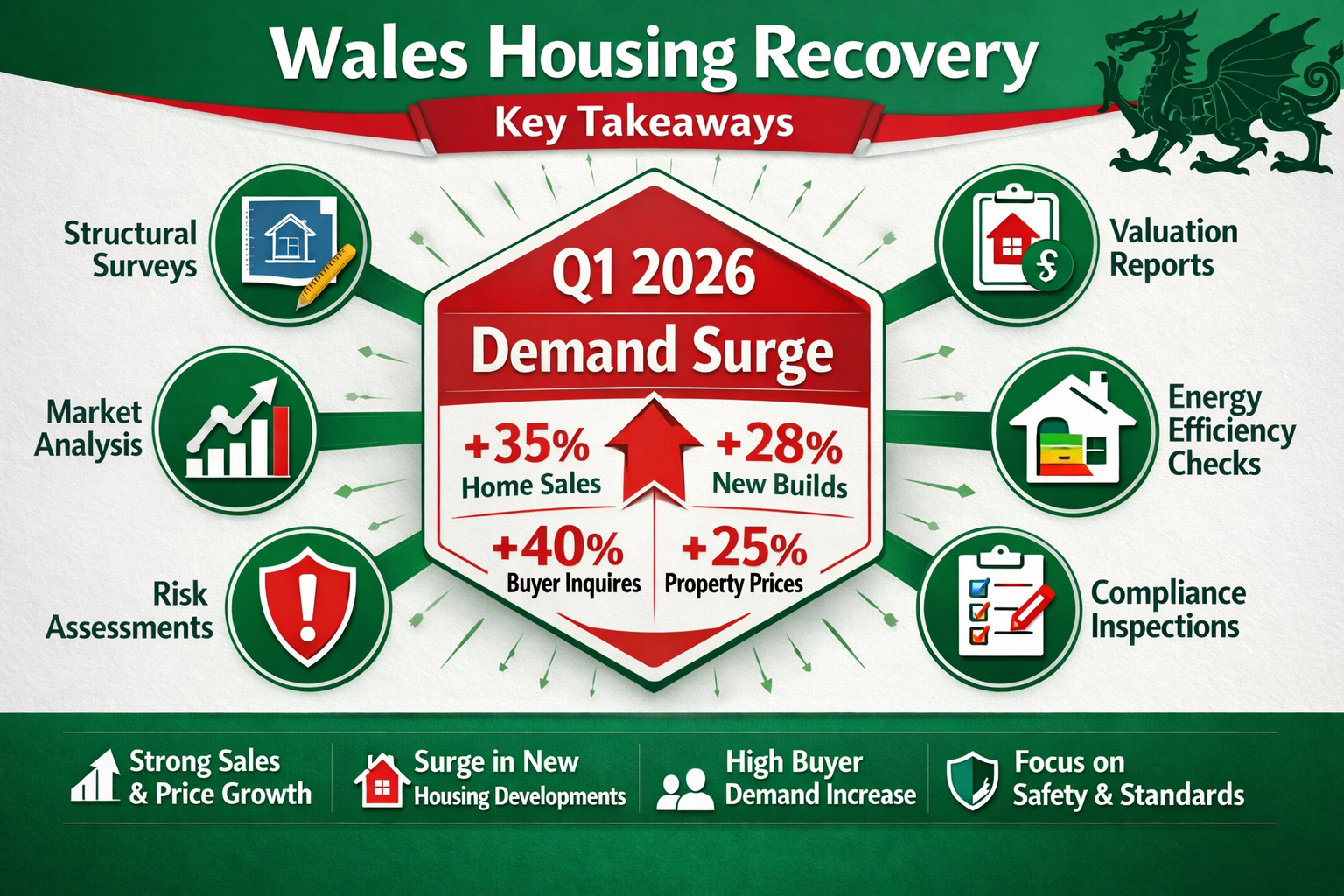
Key Takeaways
- Market momentum is accelerating: 21% net balance of surveyors predict increased sales in Q1 2026, with 22% expecting price rises[1]
- Wales needs 8,700 additional homes annually through 2030, creating massive demand for comprehensive building surveys[3]
- Regional risk protocols are essential: Flood zones, coastal properties, and traditional stone construction require tailored Level 3 survey approaches
- First-time buyers are driving recovery: Competitive mortgage rates fuel bottom-up market growth, demanding efficient survey turnaround times
- Technology integration is critical: Drone surveys and thermal imaging enable faster, more comprehensive assessments for Q1 2026 surge
Understanding the Q1 2026 Wales Housing Market Surge
The Numbers Behind the Recovery
The Welsh housing market has shifted from cautious optimism to genuine momentum. According to the latest RICS Residential Market Survey, 22% net balance of surveyors predict price increases in Q1 2026[1], a significant change from the relatively flat price picture that characterized late 2025. This positive sentiment extends beyond the immediate quarter, with 25% of surveyors expecting higher sales activity by year-end 2026[1].
The average Welsh property price currently stands at approximately £215,000[6], positioning Wales as an attractive market for first-time buyers and investors alike. However, this recovery isn't uniform across all segments. Industry experts describe it as a "bottom-up" recovery[5], with challenges persisting at the upper end while first-time buyer and lower-price segments drive activity.
What's Driving Buyer Confidence?
Several factors converge to create this Q1 2026 opportunity:
- 🏦 Competitive mortgage rates making homeownership more accessible than renting
- 📈 Improved buyer enquiry levels following momentum from late 2025
- 🏘️ Increased seller instructions creating more market inventory
- 💰 Modest but steady price growth forecasts (single-digit increases rather than sharp rebounds)
- 🎯 Government housing targets creating urgency around new development
Kelvin Francis, Director at Peter Alan in Cardiff, notes that buyers are "looking to purchase rather than rent," supporting the sales momentum observed in early 2026[1]. This shift in consumer behavior creates immediate demand for thorough, efficient building survey services that can keep pace with accelerated transaction timelines.
The Unmet Housing Need Crisis
Behind these market statistics lies a sobering reality: 9,400 households currently have unmet housing need in Wales[8], representing a 64% increase since 2019 estimates. This includes families in temporary accommodation, overcrowded conditions, and concealed households unable to form independent homes.
The Welsh Government's Chief Statistician estimates that between 7,800 and 9,300 additional homes are needed annually over the next five years[3], with a central estimate of 8,700 homes. The breakdown reveals:
| Housing Type | Annual Need | Percentage |
|---|---|---|
| Market Housing | 5,655 homes | 65% |
| Affordable Housing | 3,045 homes | 35% |
| Total Annual Need | 8,700 homes | 100% |
Despite delivering 3,900 affordable homes in 2024-25 (a 10% increase from the prior year), Wales must achieve 4,936 affordable homes in 2025-26—a 27% increase—to meet revised targets[2]. This gap between delivery and need underscores the critical importance of efficient building survey protocols that don't become bottlenecks in the housing supply chain.
Building Survey Protocols for Wales Housing Recovery: Regional Risk Assessment Frameworks
Tailoring Protocols to Welsh Property Characteristics
Building Survey Protocols for Wales Housing Recovery: Capturing Q1 2026 Demand Surge Opportunities demands recognition that Welsh properties present unique challenges distinct from the broader UK market. Traditional stone construction, valley locations with flood history, coastal exposure, and heritage considerations require specialized assessment approaches.
A comprehensive Level 3 full building survey for Welsh properties should incorporate these regional risk factors:
Flood Risk Assessment Protocols
Wales has experienced significant flooding events in recent years, making flood risk evaluation essential for valley and riverside properties. Survey protocols must include:
- Historical flood data review for the specific postcode and surrounding area
- Natural Resources Wales flood map consultation and risk zone classification
- Ground floor construction assessment including DPC (damp proof course) integrity
- Drainage system evaluation for capacity and maintenance status
- External ground level analysis relative to property thresholds
- Evidence of previous flood damage including staining, structural movement, or remediation work
Properties in flood-prone areas require enhanced moisture testing protocols and recommendations for flood resilience measures. This specialized approach helps buyers make informed decisions while identifying properties requiring additional building defects surveys focused on water ingress issues.
Traditional Stone Construction Protocols
Many Welsh properties feature traditional stone construction with solid walls, lime mortar, and minimal damp proofing. Survey protocols must address:
- 🏗️ Wall construction analysis distinguishing between solid stone, rubble-filled cavity, or later modifications
- 💧 Breathability assessment ensuring inappropriate cement renders haven't trapped moisture
- 🧱 Pointing condition evaluating lime mortar deterioration and repointing needs
- 🌡️ Thermal performance and realistic insulation options for solid wall construction
- 🔍 Rising damp vs. penetrating damp differentiation using moisture meters and visual inspection
Traditional stone properties require surveyors with specific expertise in heritage construction methods. Standard modern building assumptions often don't apply, making specialist knowledge critical for accurate condition assessment.
Coastal Property Protocols
Welsh coastal properties face unique environmental challenges requiring enhanced survey attention:
- Salt exposure assessment evaluating render, masonry, and metalwork deterioration
- Wind exposure analysis checking roof covering security and weather-tightness
- Coastal erosion risk particularly relevant for cliff-top or beach-adjacent properties
- Corrosion inspection of metal components including gutters, downpipes, and structural elements
- Window and door seal integrity under extreme weather conditions
Technology-Enhanced Survey Protocols
Building Survey Protocols for Wales Housing Recovery: Capturing Q1 2026 Demand Surge Opportunities benefits significantly from technology integration that improves assessment speed and accuracy without compromising thoroughness.
Drone Survey Integration
Premium drone surveys offer particular advantages for Welsh properties:
- Roof inspection without scaffolding or access equipment on difficult terrain
- Chimney stack assessment particularly valuable for traditional properties with multiple stacks
- Valley gutter inspection identifying hidden deterioration in complex roof configurations
- Elevation photography capturing overall condition and context
- Thermal imaging from aerial perspective identifying heat loss patterns
Drone technology proves especially valuable for properties in challenging locations—hillside cottages, coastal homes, or rural farmhouses where traditional access presents difficulties. This capability enables surveyors to maintain comprehensive assessment standards while accelerating inspection timelines to match Q1 2026 market velocity.
Thermal Imaging Protocols
Thermal imaging cameras identify issues invisible to visual inspection:
- Hidden moisture detection behind finishes and within wall cavities
- Insulation deficiency mapping showing thermal bridging and missing insulation
- Air leakage identification revealing drafts and weather-tightness failures
- Heating system performance assessment showing radiator and pipe distribution
- Structural thermal bridging at junctions and penetrations
For Welsh stone properties, thermal imaging proves particularly valuable in distinguishing between surface condensation, penetrating damp, and rising damp—issues that can be difficult to differentiate through visual inspection alone.
Streamlined Reporting for Market Velocity
The Q1 2026 demand surge requires survey reports that balance comprehensiveness with accessibility. Buyers need clear, actionable information delivered quickly to maintain transaction momentum.
Essential reporting elements include:
- ✅ Executive summary with traffic light condition ratings
- 📊 Priority-ranked defect list distinguishing urgent, medium, and long-term issues
- 💷 Cost indication bands for major repair items
- 🎯 Regional risk highlights specific to Welsh property challenges
- 📸 Annotated photography clearly showing identified defects
- 📋 Maintenance recommendations for ongoing property care
Reports should explicitly address urgent or dangerous building issues requiring immediate attention, ensuring buyers understand priority actions. Where complex issues require specialist investigation, clear recommendations for sourcing extra advice from structural engineers, damp specialists, or other experts should be provided.

Implementing Efficient Survey Workflows for Q1 2026 Demand
Scheduling and Capacity Planning
Capturing Q1 2026 opportunities requires strategic capacity planning that anticipates demand surges while maintaining quality standards. Survey practices should implement:
Demand forecasting based on market indicators:
- Monitor RICS survey data for regional sentiment shifts
- Track mortgage approval statistics as leading indicators
- Establish relationships with estate agents for pipeline visibility
- Analyze seasonal patterns specific to Welsh market dynamics
Flexible resource allocation:
- Cross-train surveyors on Welsh-specific protocols
- Establish associate surveyor networks for surge capacity
- Implement technology solutions that reduce inspection time
- Develop standardized but comprehensive checklists for efficiency
Priority scheduling systems:
- Fast-track protocols for time-sensitive transactions
- Clear communication of realistic turnaround times
- Urgent inspection options with appropriate pricing
- Batch scheduling for geographic efficiency
Quality Assurance in High-Volume Periods
Market surges create pressure to accelerate work, but compromising survey quality creates professional liability risks and undermines client trust. Robust quality assurance protocols should include:
- Standardized inspection checklists ensuring no elements are overlooked during busy periods
- Peer review systems for complex or high-value properties
- Report template quality controls maintaining consistency and completeness
- Client feedback mechanisms identifying areas for improvement
- Professional indemnity insurance adequate for practice volume and property values
Understanding building surveyor access requirements helps avoid inspection delays that compound scheduling pressures. Clear communication with clients and estate agents about access needs, inspection duration, and any limitations ensures smooth workflow even during peak demand periods.
Pricing Strategies for Market Recovery
The Q1 2026 surge presents both opportunity and pricing complexity. Survey practices must balance competitive positioning with sustainable profitability while reflecting the specialized expertise required for Welsh properties.
Pricing considerations include:
- Base survey fees reflecting property size, age, and complexity
- Regional risk premiums for flood zones, coastal locations, or heritage properties
- Technology enhancements such as drone surveys or thermal imaging
- Urgency premiums for expedited turnaround requirements
- Volume discounts for developers or bulk instructions
Understanding the cost of measured building surveys and related services helps practices position their offerings competitively while ensuring adequate compensation for specialized Welsh property expertise.
Building Strategic Partnerships
Capturing Building Survey Protocols for Wales Housing Recovery: Capturing Q1 2026 Demand Surge Opportunities benefits from strategic partnerships that expand service capabilities and referral networks:
Estate agent relationships:
- Regular market updates and insights sharing
- Preferred surveyor arrangements for their clients
- Co-marketing opportunities highlighting survey importance
- Feedback loops improving service delivery
Mortgage broker connections:
- Understanding lender-specific survey requirements
- Streamlined communication for valuation coordination
- Education about survey types and recommendations
- Referral arrangements for borrower clients
Specialist consultant networks:
- Structural engineers for complex defect investigation
- Damp and timber specialists for detailed assessments
- Heritage consultants for listed building expertise
- Environmental consultants for contamination or flood risk
Developer and housing association relationships:
- New build snagging inspection services
- Portfolio property assessments
- Community housing project support
- Ongoing maintenance survey programs
These partnerships create referral networks that generate consistent instruction flow while positioning survey practices as comprehensive property advisory resources rather than transactional service providers.
Regional Focus: Applying Protocols Across Welsh Markets
Cardiff and South Wales Urban Markets
Cardiff and surrounding urban areas drive significant transaction volume in the Q1 2026 recovery. These markets feature:
- Victorian and Edwardian terraces requiring assessment of typical period property issues
- Modern apartment developments with potential building safety and cladding considerations
- Converted properties needing evaluation of conversion quality and building regulation compliance
- New build estates requiring snagging inspection and NHBC warranty review
Survey protocols for urban South Wales properties should emphasize party wall conditions, shared services, parking and access rights, and local authority planning considerations. Understanding Edwardian cottage characteristics proves valuable given the prevalence of this property type.
North Wales Coastal and Rural Properties
North Wales presents distinct survey challenges:
- Coastal exposure requiring enhanced weather-resistance assessment
- Rural locations with private drainage, water supplies, and access considerations
- Holiday let conversions needing evaluation of commercial use impacts
- Agricultural buildings converted to residential use
Survey protocols must address infrastructure limitations, environmental exposure, and the practical implications of remote locations. Properties in these areas often require more extensive investigation of services, boundaries, and access rights than urban equivalents.
Mid Wales and Valley Communities
Central and valley regions feature:
- Traditional stone cottages in hillside locations
- Former mining community terraces with potential subsidence considerations
- Flood-prone valley floor properties requiring enhanced water risk assessment
- Limited local services affecting property functionality and value
Survey protocols should incorporate mining search recommendations where appropriate, detailed flood risk evaluation, and assessment of property suitability for modern living standards given potential limitations of traditional construction in challenging locations.
Professional Development and Accreditation
Building Welsh Property Expertise
Capturing Building Survey Protocols for Wales Housing Recovery: Capturing Q1 2026 Demand Surge Opportunities requires surveyors with specific Welsh property knowledge. Professional development should include:
Technical knowledge areas:
- Traditional Welsh construction methods and materials
- Regional geology and ground conditions
- Welsh building regulations and planning frameworks
- Heritage and conservation considerations
- Environmental risks specific to Welsh geography
Practical experience:
- Supervised inspections of diverse Welsh property types
- Mentoring from experienced Welsh property specialists
- Continuing professional development (CPD) focused on regional issues
- Site visits to properties with typical defects and solutions
Language and cultural competency:
- Understanding Welsh property terminology
- Awareness of Welsh language property descriptions and documentation
- Sensitivity to cultural heritage and community considerations
- Knowledge of Welsh housing policy and government initiatives
Maintaining Professional Standards
The RICS professional standards framework ensures survey quality and consumer protection. Surveyors operating in the Welsh market must maintain:
- RICS membership at appropriate levels (AssocRICS or MRICS)
- Professional indemnity insurance adequate for practice scope
- Continuing professional development meeting annual CPD requirements
- Complaints handling procedures compliant with RICS standards
- Client care protocols ensuring clear terms of engagement
Market surges create temptation to compromise standards, but maintaining professional rigor protects both clients and surveyor reputations while supporting long-term practice sustainability.
Future-Proofing Survey Protocols Beyond Q1 2026
Anticipating Evolving Requirements
While Q1 2026 presents immediate opportunities, forward-thinking survey practices prepare for evolving requirements:
Building safety and cladding:
- Enhanced assessment protocols for apartment buildings
- Understanding of Building Safety Act implications
- Evaluation of fire safety measures and evacuation provisions
- EWS1 form requirements and lender considerations
Energy efficiency and retrofit:
- EPC rating assessment and improvement potential
- Retrofit suitability evaluation for traditional construction
- Heat pump installation feasibility
- Insulation options respecting building breathability
Climate resilience:
- Long-term flood risk under climate change scenarios
- Coastal erosion trajectory assessment
- Extreme weather resilience evaluation
- Sustainable drainage system (SuDS) implementation potential
Digital integration:
- Building Information Modeling (BIM) for existing properties
- Digital survey report delivery and accessibility
- Integration with property transaction platforms
- Data analytics for defect pattern identification
Supporting Wales' Housing Emergency Response
With 9,400 households in unmet housing need[8] and annual delivery targets of 8,700 homes[3], survey practices can contribute to Wales' housing emergency response beyond individual transaction support:
Supporting affordable housing delivery:
- Streamlined survey protocols for housing association acquisitions
- Portfolio assessment services for bulk property purchases
- New build quality assurance supporting delivery confidence
- Retrofit assessment for bringing empty properties back into use
Community housing support:
- Discounted rates for community-led housing projects
- Technical advice supporting self-build and custom build schemes
- Cooperative housing development support
- Rural affordable housing scheme assessment
Policy engagement:
- Contributing to consultations on building standards and regulations
- Sharing market intelligence supporting evidence-based policy
- Advocating for survey role in housing quality and safety
- Supporting professional standards that protect consumers
Conclusion
Building Survey Protocols for Wales Housing Recovery: Capturing Q1 2026 Demand Surge Opportunities represents both immediate commercial opportunity and professional responsibility. With 21% of surveyors predicting increased sales[1], 22% expecting price rises[1], and Wales needing 8,700 additional homes annually[3], the market conditions for survey practice growth are exceptional.
However, capturing these opportunities requires more than simply increasing capacity. Successful practices will differentiate themselves through:
✅ Welsh-specific expertise addressing regional risks including flood zones, traditional construction, and coastal exposure
✅ Technology integration leveraging drone surveys and thermal imaging for comprehensive, efficient assessment
✅ Streamlined workflows balancing speed with thoroughness to match market velocity
✅ Quality assurance maintaining professional standards during high-volume periods
✅ Strategic positioning as comprehensive property advisory resources rather than transactional service providers
The "bottom-up" recovery[5] driven by first-time buyers and lower-price segments creates particular opportunity for practices offering clear, accessible survey reports that help buyers make confident decisions. The urgent housing need crisis demands that survey practices become enablers rather than bottlenecks in the housing supply chain.
Next Steps for Survey Practices
Immediate actions to capture Q1 2026 opportunities:
- Review and update survey protocols incorporating Welsh regional risk frameworks
- Invest in technology enabling efficient, comprehensive assessment (drones, thermal imaging, digital reporting)
- Establish partnerships with estate agents, mortgage brokers, and specialist consultants
- Implement capacity planning anticipating demand surges while maintaining quality
- Develop marketing highlighting Welsh property expertise and regional specialization
- Ensure compliance with professional standards, insurance, and CPD requirements
Long-term strategic positioning:
- Build reputation as Welsh property specialists through thought leadership and market commentary
- Develop service offerings supporting affordable housing and community-led development
- Invest in professional development creating deep Welsh property expertise
- Engage with policy discussions shaping Wales' housing future
- Adopt technology and processes supporting evolving client expectations
The Q1 2026 surge is not merely a temporary uptick—it represents the beginning of sustained recovery driven by fundamental housing need and improving market conditions. Survey practices that establish robust protocols, build specialized expertise, and position themselves as essential partners in Wales' housing recovery will capture not only immediate opportunities but sustainable long-term growth.
For property buyers navigating this dynamic market, comprehensive building surveys conducted by surveyors with Welsh property expertise provide the confidence and information necessary to make sound investment decisions. As Wales works to address its housing emergency while capturing market recovery momentum, professional building survey protocols serve as essential infrastructure supporting both individual transactions and broader housing delivery objectives.
References
[1] More New Buyers Signal Busy Start To 2026 For Welsh Housing Market – businessnewswales.com
[2] Large Increase Affordable Homes Target Will Not Be Met – audit.wales
[3] Chief Statisticians Update New Estimates Of Additional Housing Need In Wales – digitalanddata.blog.gov.wales
[5] Bottom Up Recovery Predicted For Housing Market In 2026 As Activity Returns – nation.cymru
[6] Wales Housing Market Report 2026 – signalsbi.com
[8] Newly Released Housing Need Data Highlights Scale Of Wales Housing Emergency – cih.org