

The UK property market is showing unmistakable signs of revival. After months of subdued activity, RICS data reveals agreed sales improving to -9%—the least negative reading since June 2025—while the 12-month outlook has surged to an impressive +35%. This shift signals a fundamental change in market dynamics, and building surveyors who position themselves strategically can expect significantly increased instruction volumes as buyer confidence returns. Understanding how to operationalize for this demand surge represents the difference between merely participating in the recovery and truly capitalizing on it.
The Building Survey Demand Surge: Capitalizing on Market Recovery as Transaction Volumes Accelerate Through 2026 presents both opportunity and challenge. Surveyors must balance immediate capacity constraints with the need to capture market share during a critical growth phase. This article explores the market forces driving increased transaction volumes, practical strategies for scaling surveying operations, and actionable steps to maximize revenue during this pivotal period.

Key Takeaways
- RICS sentiment indicators show strong recovery: Agreed sales at -9% represent the least negative reading since mid-2025, with 12-month outlook at +35%, signaling sustained transaction volume growth through 2026
- Pent-up demand is releasing into the market: Years of deferred purchases due to high rates and low confidence are creating a backlog of buyers ready to transact as conditions stabilize
- Operational readiness is critical: Surveyors must implement capacity planning, technology adoption, and strategic partnerships now to capture increased instruction volumes
- Quality cannot be sacrificed for volume: Maintaining RICS building survey standards while scaling operations protects reputation and ensures sustainable growth
- Diversification strengthens resilience: Expanding service offerings beyond traditional surveys—including drone surveys, specialized valuations, and new build inspections—captures broader market opportunities
Understanding the Building Survey Demand Surge: Market Fundamentals Driving 2026 Recovery
The Data Behind the Recovery 📊
The property market's trajectory through 2026 is being shaped by several converging factors. New home sales in 2025 remained essentially flat compared to 2024, but community counts (actively selling projects with at least five units) have risen for 10 consecutive months and are up approximately 11% compared to the prior year [2]. This expansion creates structural positives for capturing future demand.
More significantly, existing home sales appear to be establishing a floor after historic lows. Inventory has moved from extremely tight conditions to more manageable levels, reducing the friction that has characterized recent years [2]. For building surveyors, this normalization means more properties changing hands—and each transaction typically requires professional inspection.
The repair and remodel sector provides additional momentum. R&R spending is projected to grow in the mid-single digits in 2026 versus 2025, then accelerate to roughly high single-digit growth in 2027 [2]. Many homeowners paused renovation plans due to economic uncertainty, but these deferred projects remain on wish lists and are expected to move forward as conditions stabilize.
Consumer Confidence and Buyer Behavior
Understanding buyer psychology is essential for surveyors positioning for growth. Consumer confidence remains near record lows, which paradoxically drives increased demand for thorough building surveys [2]. When buyers feel uncertain about economic conditions, they become more risk-averse and seek comprehensive professional assessments before committing to purchases.
Each home sale now requires more effort, with tighter margins, more common incentives, and longer buyer decision timelines [2]. This extended due diligence period actually benefits surveyors, as buyers invest more time and resources in understanding property condition. The days of rushed purchases with minimal inspection are being replaced by careful, methodical evaluation processes.
Pent-up demand represents a significant driver of transaction volumes through 2026. Many households delayed moving plans during recent years due to high rates and low confidence. As rates ease modestly and stability returns, this deferred demand is re-entering the market [2]. Surveyors should anticipate not just recovery to previous volumes, but potential surges as accumulated demand releases.
Sector-Specific Opportunities
While residential surveys form the core of most practices, understanding broader construction trends reveals additional opportunities. Data center construction shows no signs of slowdown in 2026, with continued healthy gains expected over the next two years driven by cloud and AI demand [1][4]. Surveyors with commercial expertise can tap into this specialized market.
However, traditional commercial facilities present challenges. The national office vacancy rate stood at 20.5% at the end of 2025 [3], creating opportunities for conversion projects and repurposing assessments. Surveyors who understand building pathology and adaptive reuse can provide valuable services to investors evaluating these properties.
The overall construction industry projects just 1.0% growth in building spending in 2026, increasing only to 2.2% in 2027—figures not adjusted for inflation [3]. This muted growth emphasizes the importance of capturing market share within existing transaction volumes rather than relying solely on market expansion.
Building Survey Demand Surge: Capitalizing on Market Recovery Through Operational Excellence
Capacity Planning and Resource Allocation 🎯
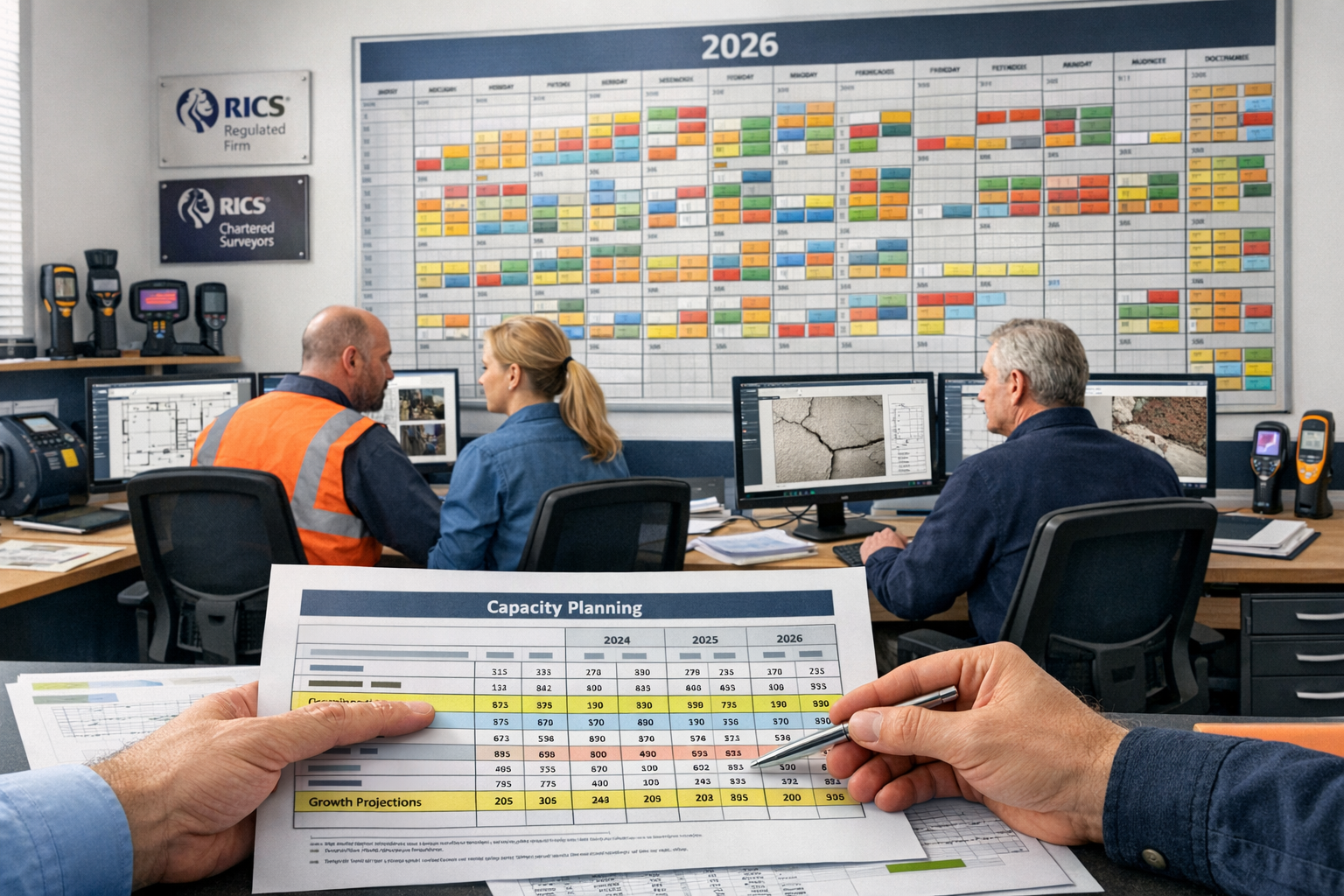
The most immediate challenge facing surveyors is scaling operations to meet increased demand without compromising quality. Firms that maintained lean operations during slower periods must now expand capacity strategically. This begins with honest assessment of current throughput capabilities and identification of bottlenecks.
Hiring decisions should precede demand spikes, not follow them. The construction industry will need to recruit at least 500,000 workers to meet demand in 2026 [6], and competition for qualified surveyors will intensify. Firms should:
- Establish recruitment pipelines now: Partner with universities offering surveying programs, create internship opportunities, and build relationships with recently qualified professionals
- Invest in training existing staff: Cross-training team members on different types of building surveys increases flexibility and reduces dependency on individual specialists
- Consider strategic partnerships: Collaborate with complementary firms to handle overflow work while maintaining quality standards
- Implement tiered service models: Develop clear service levels from basic inspections to comprehensive Level 3 full building surveys, allowing efficient resource allocation based on property complexity
Technology Adoption and Workflow Optimization
Technology represents the most significant opportunity for scaling without proportional cost increases. Modern surveying practices leverage digital tools to improve efficiency, accuracy, and client communication.
Digital inspection tools transform field work efficiency. Tablet-based reporting systems allow surveyors to input observations, capture photographs, and annotate floor plans on-site, eliminating double-handling of information. Cloud-based platforms enable real-time collaboration between field surveyors and office-based report writers.
Premium drone surveys provide particular advantages during high-demand periods. Drones safely inspect roofs, chimneys, and elevated structures without requiring scaffolding or access equipment, reducing inspection time and associated costs. Thermal imaging capabilities identify heat loss and moisture issues that might be missed during visual inspection.
Automated scheduling and client communication systems reduce administrative burden. Online booking platforms allow clients to select available time slots, while automated email sequences keep them informed throughout the survey process. This frees surveyors to focus on technical work rather than coordination tasks.
Template libraries and standardized reporting accelerate report production without sacrificing thoroughness. Well-designed templates ensure consistent coverage of essential elements while allowing customization for property-specific issues. However, surveyors must resist the temptation to over-automate—clients value personalized insights and professional judgment.
Quality Assurance During Growth Phases
Rapid expansion creates quality risks that can damage reputation and create liability exposure. Firms must implement robust quality assurance processes that scale with growth.
Peer review systems provide essential oversight. Having experienced surveyors review reports before release catches errors, ensures consistency, and provides mentoring opportunities for junior staff. While this adds time to the process, it prevents costly mistakes and maintains professional standards.
Continuing professional development becomes even more critical during busy periods. Surveyors must stay current with building regulations, construction techniques, and emerging defect patterns. Firms should maintain CPD commitments even when workload increases, as cutting corners on professional development ultimately undermines service quality.
Client feedback mechanisms identify issues before they escalate. Post-survey questionnaires, follow-up calls, and systematic complaint tracking reveal patterns that indicate training needs or process improvements. Firms that actively solicit and respond to feedback build stronger client relationships and improve service delivery.
Understanding which building survey clients need requires careful consultation. Surveyors should resist pressure to recommend minimal inspections when property characteristics warrant more comprehensive assessment. This consultative approach protects clients and reinforces professional credibility.

Capitalizing on Market Recovery: Strategic Positioning for Building Survey Demand Through 2026
Service Diversification and Market Positioning 💼
Strategic service expansion captures broader market opportunities while reducing dependence on single revenue streams. Surveyors should evaluate which complementary services align with their expertise and market demand.
New build inspections represent growing opportunities as community counts expand. Many buyers mistakenly assume new construction requires no inspection, but snagging surveys identify defects and incomplete work before completion. Marketing this service to new home buyers provides early-stage engagement and positions surveyors as trusted advisors.
Specialized valuations offer higher margins and differentiation. Services including capital gains valuations, matrimonial valuations, and insurance reinstatement cost assessments require additional expertise but command premium fees. Cross-selling these services to existing survey clients increases revenue per customer.
Energy performance and environmental assessments align with regulatory trends and buyer priorities. Understanding EPC and MEES requirements allows surveyors to advise on compliance issues and improvement opportunities. As environmental regulations tighten, this expertise becomes increasingly valuable.
Building defects surveys and construction condition assessments serve investors and developers evaluating renovation projects. With repair and remodel spending accelerating, surveyors who can accurately assess renovation costs and feasibility find strong demand from this segment.
Marketing and Client Acquisition Strategies
Market recovery creates opportunities for firms willing to invest in visibility. While referrals from estate agents and solicitors remain important, direct-to-consumer marketing builds sustainable client pipelines.
Content marketing establishes expertise and trust. Educational articles explaining survey types, common defects, and property assessment processes attract potential clients during their research phase. Firms should create resources addressing frequent questions: understanding statutory considerations, evaluating environmental issues, and budgeting for repairs and restoration.
Local market positioning captures geographically concentrated demand. Firms should optimize for location-specific searches and establish presence in target markets. Understanding local property characteristics, common defect patterns, and market conditions allows surveyors to provide more relevant advice and build community reputation.
Professional relationships with estate agents, mortgage brokers, and solicitors generate consistent referrals. However, these relationships require active cultivation—regular communication, reliable service delivery, and mutual value creation. Surveyors should position themselves as resources who help transactions proceed smoothly rather than obstacles who create problems.
Online reputation management influences client decisions significantly. Positive reviews on Google, Trustpilot, and industry platforms build credibility, while negative reviews require prompt, professional responses. Firms should systematically request reviews from satisfied clients and address concerns raised in negative feedback.
Pricing Strategy During Demand Surges
Market recovery creates pricing opportunities, but surveyors must balance revenue optimization with competitive positioning and perceived value.
Value-based pricing reflects the importance of the purchase decision rather than just the time invested. A comprehensive survey on a £500,000 property provides enormous value relative to its cost, as it may identify £50,000 in hidden defects or provide negotiating leverage worth tens of thousands. Pricing should reflect this value rather than simply hourly rates.
Tiered service offerings allow clients to self-select based on their needs and budget while maximizing revenue capture. Basic inspections serve price-sensitive buyers purchasing straightforward properties, while premium services including drone surveys, thermal imaging, and detailed specialist assessments command higher fees for complex properties.
Dynamic pricing adjusts for demand fluctuations and capacity constraints. During peak periods, modest price increases help manage demand while maximizing revenue. However, firms must avoid appearing opportunistic—price changes should be gradual and justified by market conditions.
Package pricing for multiple services encourages clients to purchase comprehensive assessments. Bundling building surveys with valuations, energy assessments, or specialized inspections at a modest discount increases total transaction value while providing better client outcomes.
Risk Management and Professional Liability
Increased volume creates increased exposure to professional liability claims. Surveyors must maintain rigorous risk management practices even during busy periods.
Professional indemnity insurance should be reviewed and potentially increased to reflect higher transaction volumes and property values. Firms should ensure coverage limits adequately protect against worst-case scenarios and that policy terms cover all services offered.
Documentation standards protect against future disputes. Comprehensive photographs, detailed notes, and clear explanations of limitations create defensible records of what was inspected and what was reported. Surveyors should document access limitations that prevented full inspection of certain areas.
Clear communication about survey scope and limitations manages client expectations. Clients should understand what surveys can and cannot identify, the difference between various survey types, and the inherent limitations of visual inspection. Written engagement letters should clearly define scope, exclusions, and assumptions.
Continuing education on emerging defect patterns and construction techniques reduces risk of missing significant issues. Surveyors should stay informed about common problems in different property types and ages, new construction methods, and evolving building regulations.
Regional Variations and Local Market Dynamics
Geographic Opportunities Across the UK
Market recovery manifests differently across regions, creating opportunities for surveyors who understand local dynamics. While national trends provide overall direction, local factors significantly influence demand patterns.
London and the South East typically lead recovery cycles due to higher transaction volumes and property values. Areas including West London, Richmond, and Kingston show strong demand for premium surveying services as high-value properties change hands.
Surrey markets including Guildford, Weybridge, Esher, and Godalming benefit from strong commuter appeal and affluent demographics. Properties in these areas often feature complex construction, period characteristics, and high values—factors that drive demand for comprehensive surveys.
Outer London boroughs like Bexley and Twickenham offer opportunities for surveyors serving first-time buyers and families seeking more affordable options while maintaining accessibility to central London. These markets often feature 1930s suburban development requiring specialized knowledge of interwar construction techniques.
Property Type Specialization
Different property types present distinct opportunities and require specialized knowledge. Surveyors who develop expertise in specific property categories can command premium fees and build strong reputations.
Period properties require understanding of traditional construction methods, common defect patterns, and appropriate repair techniques. Victorian and Edwardian homes, Georgian townhouses, and older rural properties each present characteristic issues that experienced surveyors recognize and assess accurately.
Modern construction including new builds and recent developments requires different expertise. Understanding current building regulations, modern materials, and common construction defects in recently built properties allows surveyors to provide valuable insights to buyers who might otherwise assume new means problem-free.
Commercial properties offer opportunities for surveyors with appropriate expertise. While the office sector faces challenges with 20.5% vacancy rates [3], this creates opportunities for conversion assessments and repurposing evaluations. Retail, industrial, and mixed-use properties each require specialized knowledge.
Leasehold properties introduce additional complexity requiring understanding of lease terms, service charge implications, and leasehold extension and enfranchisement valuations. Surveyors who can advise on these issues provide additional value to clients navigating leasehold purchases.
Future-Proofing Your Surveying Practice
Adapting to Industry Evolution 🚀
The surveying profession continues evolving in response to technological advances, regulatory changes, and market demands. Firms that anticipate and adapt to these changes position themselves for sustained success beyond the immediate recovery.
Artificial intelligence and machine learning are beginning to influence surveying practices. While AI cannot replace professional judgment and on-site inspection, it can assist with data analysis, defect pattern recognition, and report generation. Surveyors should explore how these technologies can enhance rather than replace their expertise.
Building information modeling (BIM) and digital twins create new opportunities for surveyors involved in commercial and complex residential projects. Understanding how to integrate survey data into BIM systems and provide ongoing condition monitoring services opens new revenue streams.
Sustainability and environmental assessment will grow in importance as net-zero targets approach and environmental regulations tighten. Surveyors who develop expertise in energy efficiency, renewable energy systems, and sustainable construction methods position themselves as essential advisors for environmentally conscious buyers and regulatory compliance.
Remote and hybrid service models emerged during pandemic restrictions and continue offering advantages. Virtual consultations, remote report delivery, and digital communication reduce friction and improve client experience. However, these must complement rather than replace on-site inspection, which remains the foundation of professional surveying.
Building Sustainable Growth
Market recovery provides growth opportunities, but sustainable success requires building practices that thrive across market cycles rather than just during boom periods.
Client relationship management transforms one-time transactions into ongoing relationships. Maintaining contact with past clients, providing periodic market updates, and offering follow-up services creates repeat business and referrals. Clients who received excellent service during their purchase become advocates who recommend surveyors to friends and family.
Team development and culture determine whether firms can attract and retain talented professionals. Creating environments where surveyors can develop their expertise, maintain work-life balance, and feel valued builds stable teams that deliver consistent quality.
Financial management during growth periods sets foundations for long-term stability. Firms should resist the temptation to increase fixed costs proportionally to revenue during boom periods. Maintaining financial reserves and conservative expense management provides buffers for inevitable market fluctuations.
Professional reputation remains the most valuable asset any surveying practice possesses. Short-term revenue opportunities that compromise quality or professional standards damage reputation in ways that take years to repair. Firms should make decisions that protect and enhance their professional standing even when this means turning away work or limiting growth.
Conclusion
The Building Survey Demand Surge: Capitalizing on Market Recovery as Transaction Volumes Accelerate Through 2026 represents a defining moment for surveying practices across the UK. With RICS data showing agreed sales at -9%—the least negative since mid-2025—and 12-month outlook at +35%, the trajectory is clear: transaction volumes are accelerating, and surveyors who position themselves strategically will capture significant growth opportunities.
However, success requires more than simply waiting for increased demand to arrive. Firms must implement capacity planning now, investing in recruitment, training, and technology before demand peaks. They must maintain quality standards even as volumes increase, recognizing that reputation built over years can be damaged by rushed, inadequate inspections. They must diversify service offerings to capture broader market opportunities while building resilience against sector-specific fluctuations.
The market recovery is not uniform—regional variations, property type differences, and sector-specific dynamics create pockets of stronger and weaker demand. Surveyors who understand these nuances and position themselves accordingly will outperform those taking undifferentiated approaches.
Actionable Next Steps ✅
For surveying practices preparing to capitalize on market recovery:
- Assess current capacity and identify bottlenecks that will constrain growth—then address them before demand surges
- Invest in technology that improves efficiency without compromising quality, including digital inspection tools, drone capabilities, and automated workflow systems
- Develop marketing strategies that build direct client relationships rather than relying solely on referral networks
- Expand service offerings strategically, adding complementary services that leverage existing expertise and capture additional revenue per client
- Implement quality assurance processes that scale with growth, ensuring consistent standards across all instructions
- Build professional networks and strategic partnerships that provide overflow capacity and specialized expertise when needed
- Monitor market indicators continuously, adjusting strategies as conditions evolve through 2026 and beyond
The building survey demand surge through 2026 offers exceptional opportunities for firms prepared to seize them. Those who combine operational excellence, strategic positioning, and unwavering commitment to professional standards will not only participate in the recovery—they will define it.
References
[1] 2026 Construction Industry Outlook – news.agc.org
[2] 2026 Housing Market Outlook Sales Starts Trends – bldr.com
[3] January 2026 – aia.org
[4] constructiondive – constructiondive.com
[5] Survey Reveals Demand Uncertainty Is Changing 2026 Homebuilding Strategy – housingwire.com
[6] Construction – hubinternational.com