

The property market stands at a critical inflection point in 2026. After months of uncertainty, house price net balance has improved from -19% in October 2025 to -10% in January 2026—a significant shift that signals stabilization rather than continued decline.[1] This transition from negative to positive sentiment creates unique challenges for chartered surveyors who must recalibrate their valuation methodologies to reflect market conditions accurately. Understanding Valuation Accuracy Under Price Stabilization: How Surveyors Assess Properties When National Sentiment Shifts from Negative to Positive has never been more critical for property professionals, lenders, and buyers navigating this transitional landscape.
The current environment represents what experts describe as an "economy recalibration phase" rather than market dysfunction.[3] With national home price growth slowing to just 1% year-over-year—a 14-year low—surveyors face the complex task of determining accurate property values when traditional appreciation models no longer apply. This article examines how professional valuers adapt their assessment techniques during sentiment shifts, ensuring accuracy when market psychology transitions from pessimism to cautious optimism.
Key Takeaways
- 📊 Market sentiment has improved significantly, with the house price net balance rising from -19% to -10% between October 2025 and January 2026, requiring surveyors to adjust valuation approaches accordingly
- 🏘️ Regional divergence remains pronounced, with Northeast and Midwest markets showing renewed growth while Florida and Texas continue experiencing corrections, demanding location-specific assessment strategies
- 🔧 Technology integration is transforming valuation accuracy, with 3D imaging, digital floor plans, and mobile workflows providing enhanced property data during market transitions
- 💼 Pre-listing appraisals are becoming standard practice, helping ground expectations and providing stronger valuation foundations before properties enter stabilizing markets
- ⏱️ Turnaround time has emerged as a competitive differentiator, with established firms delivering residential reports within 3-5 days to meet demand in purchase-driven markets
Understanding Market Stabilization and Its Impact on Valuation Accuracy Under Price Stabilization
Market stabilization represents a fundamental shift in property dynamics that directly affects how surveyors approach valuations. Unlike periods of rapid appreciation or sharp decline, stabilization creates a narrow pricing band where accuracy becomes paramount. Even small miscalculations can significantly impact mortgage approvals, investment decisions, and transaction outcomes.
The Current Stabilization Landscape
The 2026 property market exhibits several characteristics that define this stabilization phase:
Price Growth Indicators:
- National home price growth at 1% year-over-year (November 2025)[1]
- Forecast growth of 1.2-3% for 2026 depending on regional factors[2]
- Number of major markets experiencing annual price declines projected to fall from 24 to 12[2]
Transaction Volume Recovery:
- Existing home sales projected at 4.26 million in 2026, representing a 4.3% increase over 2025[2]
- Purchase-driven market activity replacing refinance-dominated periods
- Improved buyer demand as affordability conditions stabilize
This stabilization environment requires surveyors to distinguish between genuine market equilibrium and temporary pauses in longer-term trends. Professional valuers must assess whether current prices reflect sustainable market conditions or represent transitional pricing that may shift as sentiment continues evolving.
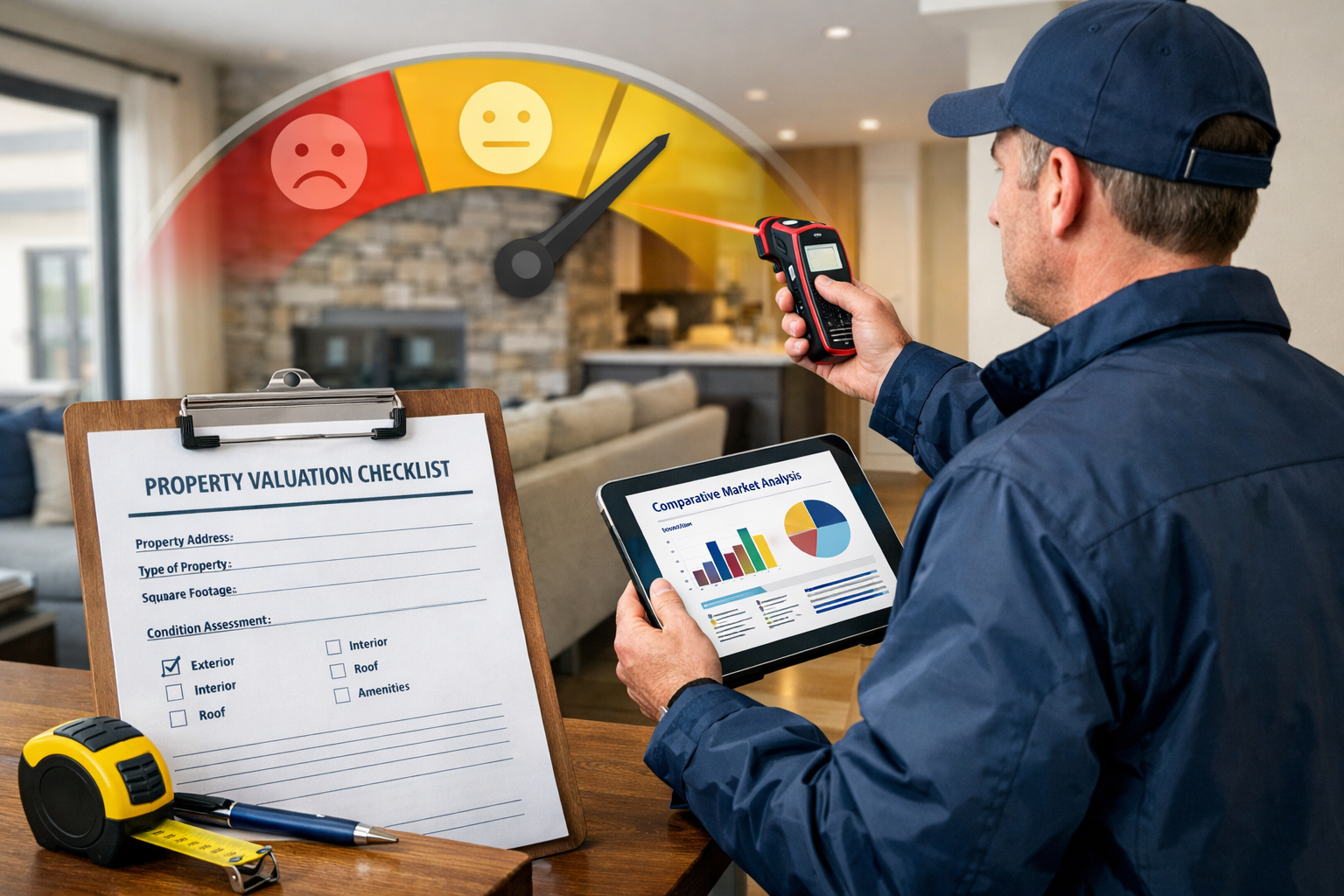
How Sentiment Shifts Affect Property Valuations
When national sentiment transitions from negative to positive, several valuation factors come into play:
Comparable Sales Analysis Challenges 📋
During sentiment shifts, recent comparable sales may reflect outdated market psychology. A property sold three months ago during peak negativity may not accurately represent current value when sentiment has improved. Surveyors must:
- Weight recent comparables more heavily than historical norms
- Adjust for sentiment-driven pricing in older sales data
- Consider pending sales and current listings as forward indicators
- Evaluate whether comparable properties sold during rising or falling sentiment periods
Buyer Motivation Assessment 🎯
Positive sentiment shifts typically correlate with:
- Increased buyer competition for well-presented properties
- Reduced negotiation leverage for buyers seeking significant reductions
- Faster transaction timelines reducing the need for extended price reductions
- Greater willingness to accept properties at asking price when condition meets expectations
Understanding average price reductions after survey becomes particularly important during these transitions, as buyer behavior shifts alongside market sentiment.
The Role of Rate Stabilization in Valuation Frameworks
A critical insight for 2026 is that the next housing expansion doesn't begin when rates return to 3%—it begins when rates stabilize.[3] This understanding fundamentally changes how surveyors approach valuations:
| Factor | Negative Sentiment Period | Stabilization Period | Positive Sentiment Period |
|---|---|---|---|
| Buyer Urgency | Low – waiting for better conditions | Moderate – cautious entry | High – fear of missing opportunity |
| Price Negotiation | Aggressive reductions expected | Modest adjustments common | Limited discounting |
| Comparable Weight | Older sales more reliable | Recent sales critical | Forward-looking indicators valued |
| Market Time | Extended listing periods | Normalizing timelines | Compressed selling periods |
Professional chartered surveyors valuations must account for these shifting dynamics when determining accurate property values during sentiment transitions.
Regional Divergence and Valuation Accuracy Under Price Stabilization: Geographic Considerations
One of the most significant challenges in maintaining Valuation Accuracy Under Price Stabilization: How Surveyors Assess Properties When National Sentiment Shifts from Negative to Positive lies in regional market divergence. While national sentiment may be improving, local market conditions vary dramatically across different geographic areas.
Markets Showing Renewed Growth Traction
The Northeast and Midwest regions are experiencing distinct recovery patterns that affect valuation approaches:
Northeast Market Characteristics:
- Newark, NJ showing renewed price growth momentum[1]
- Urban core properties benefiting from return-to-office trends
- Historic housing stock requiring specialized assessment expertise
- Transportation connectivity adding premium value
Midwest Market Dynamics:
- Chicago, IL and Milwaukee, WI leading regional recovery[1]
- Affordability advantage attracting relocating buyers
- Industrial and commercial property stabilization supporting residential values
- Seasonal factors requiring careful timing considerations in comparable analysis
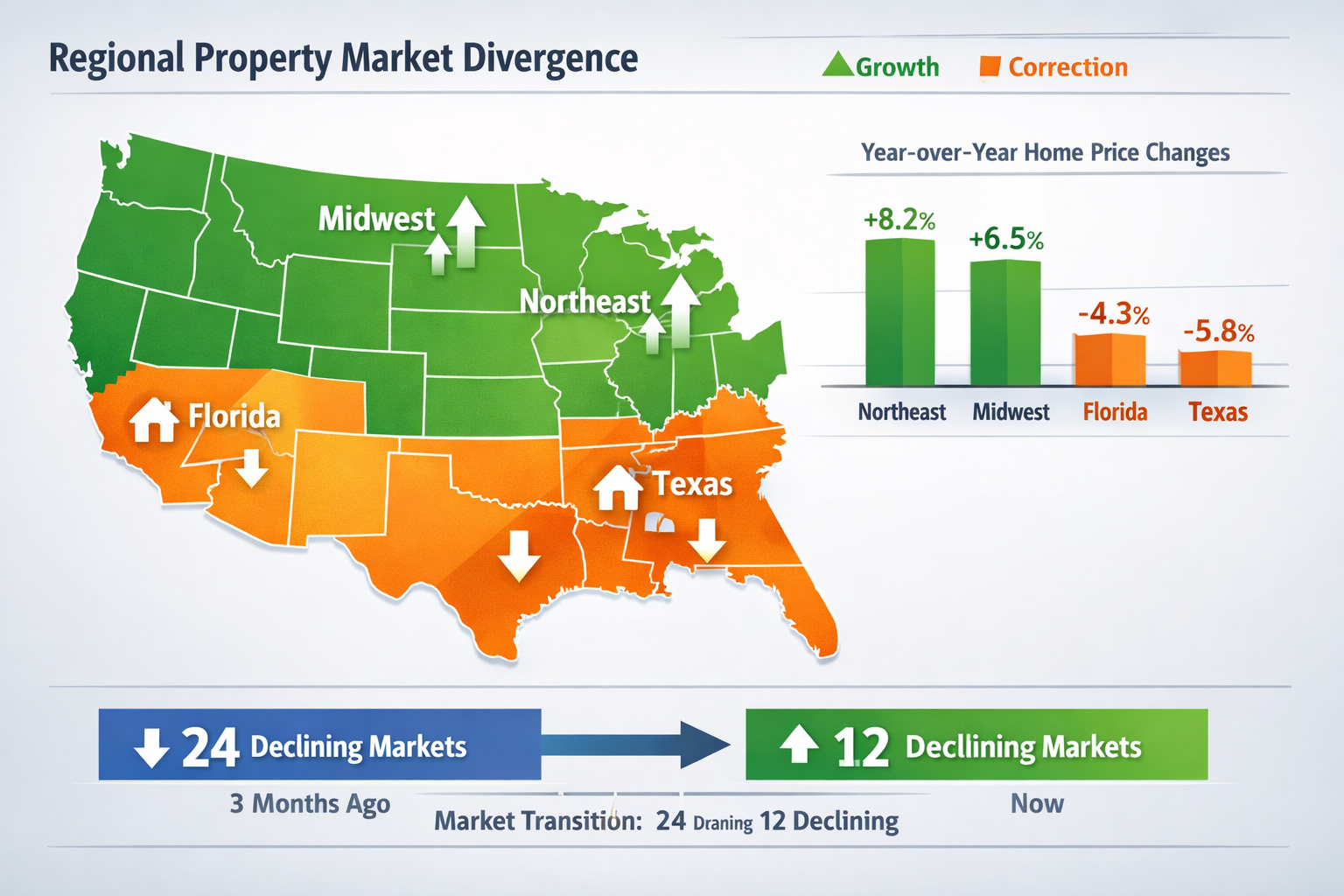
Surveyors operating in these growth-traction markets must recognize that local sentiment may be significantly more positive than national indicators suggest. This requires:
✅ Enhanced local market research beyond national data sources
✅ Increased weight on recent local transactions versus regional averages
✅ Recognition of neighborhood-specific appreciation trends
✅ Assessment of local economic drivers supporting sustained growth
Markets Continuing to Experience Corrections
Conversely, Florida and Texas metropolitan areas continue leading in market depreciation despite improving national sentiment.[1] These markets present unique valuation challenges:
Florida Market Pressures:
- Insurance cost increases affecting affordability and valuations
- Oversupply in certain submarkets from recent construction boom
- Climate risk considerations influencing long-term value assessments
- Seasonal demand fluctuations complicating comparable analysis
Texas Market Conditions:
- Rapid supply additions in major metros (Austin, Dallas, Houston)
- Property tax burden considerations in valuation models
- Energy sector volatility affecting regional economic stability
- Interstate migration patterns creating localized demand pockets
"The shift from negative to positive sentiment is contingent on rate stabilization rather than rate returns to historical lows. Professionals must understand that mortgage rates above 6% represent a new normal rather than temporary disruption."[3]
Adjusting Valuation Methodologies for Regional Variations
Professional surveyors employ several techniques to maintain accuracy across divergent regional markets:
1. Localized Comparable Selection Criteria 🏘️
Rather than relying on broader market area comparables, surveyors narrow their selection to:
- Properties within immediate neighborhood (0.5-1 mile radius)
- Similar property types and condition grades
- Sales completed within the last 90 days (versus traditional 6-month window)
- Adjustments for specific local amenities and detractors
2. Market Condition Adjustments 📈
When sentiment is shifting, time-based adjustments become critical:
- Monthly appreciation/depreciation rates calculated from recent local sales trends
- Adjustment factors applied to older comparables to reflect current conditions
- Recognition that market direction may differ from recent historical patterns
- Consideration of pending sales and active listings as forward indicators
3. Income Approach Validation 💰
For investment properties and certain residential valuations, the income approach provides valuable cross-validation:
- Rental rate trends indicating market strength or weakness
- Capitalization rate adjustments reflecting risk perception changes
- Comparison of gross rent multipliers across time periods
- Assessment of landlord-tenant dynamics in local market
Understanding what to do if your home valuation is less than an offer becomes particularly relevant when regional conditions diverge from expectations.
Advanced Methodologies for Valuation Accuracy Under Price Stabilization During Sentiment Transitions
As market sentiment shifts from negative to positive, surveyors must employ sophisticated methodologies that go beyond traditional valuation approaches. The integration of advanced technology, enhanced data analysis, and refined assessment techniques ensures accuracy during these transitional periods.
Technology-Enhanced Property Assessment
Property assessment technology has advanced significantly in 2026, providing surveyors with tools that improve both accuracy and consistency:[6]
3D Image Capture and Digital Floor Plans 📸
Modern valuation processes increasingly incorporate:
- High-resolution 3D imaging creating detailed property records
- Accurate floor plan generation for precise square footage calculations
- Virtual property tours allowing remote assessment capabilities
- Permanent digital records enabling future valuation comparisons
These technologies prove particularly valuable during sentiment shifts, as they provide objective property documentation independent of market psychology. When comparable sales reflect varying sentiment periods, accurate property measurements and condition documentation become critical differentiators.
Mobile Workflow Integration 📱
Professional surveyors now utilize integrated mobile platforms that:
- Capture inspection data in real-time during property visits
- Access comparable sales databases instantly for on-site analysis
- Generate preliminary valuation ranges before leaving the property
- Streamline communication with clients and lenders
This efficiency improvement has made turnaround time a competitive differentiator, with established firms delivering residential reports within 3-5 days of inspection in purchase-driven markets.[3]

Pre-Listing Appraisals as Sentiment Calibration Tools
The growing use of pre-listing appraisals represents a strategic response to sentiment-driven market volatility.[3] These assessments serve multiple purposes during stabilization periods:
For Sellers:
- Realistic pricing expectations grounded in current market conditions
- Understanding of property strengths and weaknesses before listing
- Identification of value-enhancing improvements with positive ROI
- Confidence in listing price decisions during uncertain market conditions
For Surveyors:
- Opportunity to assess properties without transaction pressure
- Ability to provide detailed condition analysis and valuation rationale
- Foundation for future listing and mortgage valuations
- Enhanced professional relationship development with estate agents
For the Market:
- More accurately priced listings reducing time on market
- Fewer failed transactions due to valuation shortfalls
- Improved market transparency and price discovery
- Reduced sentiment-driven pricing volatility
Professional independent property valuations provide this foundation for informed decision-making during market transitions.
Enhanced Comparable Sales Analysis Techniques
During sentiment shifts, traditional comparable sales analysis requires refinement:
Weighted Time-Series Analysis ⚖️
Rather than treating all recent comparables equally, surveyors apply:
- Exponential weighting favoring most recent transactions
- Sentiment adjustment factors for sales completed during negative periods
- Market direction indicators from pending sales and listings
- Statistical confidence intervals reflecting market uncertainty
Condition-Adjusted Valuation Models 🔧
Property condition becomes increasingly important during stabilization:
- Detailed condition grading beyond simple "good/average/poor" classifications
- Specific defect identification and cost-to-cure calculations
- Recognition that buyers in stabilizing markets prioritize move-in ready properties
- Enhanced value differentiation between well-maintained and deferred maintenance properties
Understanding top factors examined during property valuations helps both professionals and property owners recognize critical value drivers.
Policy Stability and Predictable Valuation Frameworks
A significant advantage for 2026 valuations is anticipated policy stability, which allows professionals to "anticipate what's ahead and make plans without constantly reacting to new policy shifts."[4] This stability enables:
More Reliable Long-Term Value Projections 🎯
- Reduced uncertainty in mortgage underwriting standards
- Consistent treatment of property types and loan products
- Predictable regulatory environment for property transactions
- Enhanced confidence in valuation conclusions
Standardized Assessment Protocols 📋
- Industry-wide adoption of enhanced property data standards
- Consistent application of valuation methodologies across lenders
- Improved quality control and review processes
- Greater transparency in valuation rationale and adjustments
Risk Assessment Refinement ⚠️
- Better understanding of which property types and locations carry elevated risk
- Enhanced ability to identify properties requiring additional scrutiny
- Improved communication of valuation uncertainty and confidence levels
- More accurate assessment of market exposure and marketability
Practical Applications: How Surveyors Implement Accuracy Measures
Understanding theoretical approaches to Valuation Accuracy Under Price Stabilization: How Surveyors Assess Properties When National Sentiment Shifts from Negative to Positive is valuable, but practical implementation determines real-world success. Professional surveyors employ specific techniques and workflows to ensure accuracy during these transitional periods.
The Pre-Inspection Research Phase
Before even visiting a property, thorough surveyors conduct extensive market research:
Market Sentiment Assessment 📊
- Review of recent local sales trends and pricing patterns
- Analysis of days-on-market statistics for similar properties
- Evaluation of listing price versus sold price ratios
- Assessment of buyer competition levels through agent consultations
Comparable Property Identification 🏠
- Initial selection of 6-10 potential comparable sales
- Verification of sales details through multiple data sources
- Identification of properties currently under contract (pending sales)
- Review of recently listed properties as market indicators
Economic Indicator Review 💼
- Local employment trends and major employer stability
- Infrastructure development and transportation improvements
- School district performance and demographic trends
- Retail and commercial activity levels in the area
The On-Site Assessment Process
During property inspections, surveyors focus on factors particularly relevant during sentiment transitions:
Detailed Condition Documentation 🔍
Professional assessments include:
- Structural integrity evaluation – foundation, framing, roof condition
- Systems assessment – heating, cooling, electrical, plumbing functionality
- Cosmetic condition grading – finishes, fixtures, overall presentation
- Deferred maintenance identification – items requiring near-term attention
This detailed approach proves critical because buyers in stabilizing markets demonstrate increased selectivity, preferring properties requiring minimal immediate investment.[5]
Marketability Factor Analysis 🎯
Beyond physical condition, surveyors evaluate:
- Property layout and functional utility
- Neighborhood characteristics and location desirability
- Unique features providing competitive advantages
- Potential obstacles to sale (busy roads, commercial proximity, etc.)
Photographic Documentation Standards 📷
Comprehensive photo documentation includes:
- Exterior views from multiple angles
- Interior room-by-room coverage
- Specific defects and condition concerns
- Neighborhood context and surrounding properties
The Valuation Reconciliation Process
After completing research and inspection, surveyors reconcile multiple valuation indicators:
Comparable Sales Adjustment Grid 📋
| Comparable | Sale Date | Sale Price | Location Adj. | Size Adj. | Condition Adj. | Final Adjusted Value |
|---|---|---|---|---|---|---|
| Comp 1 | Jan 2026 | £425,000 | 0% | -£15,000 | +£10,000 | £420,000 |
| Comp 2 | Dec 2025 | £410,000 | +£5,000 | -£8,000 | +£8,000 | £415,000 |
| Comp 3 | Nov 2025 | £405,000 | +£3,000 | -£12,000 | +£15,000 | £411,000 |
Value Range Determination 💷
Rather than single-point estimates, professional valuations during transitional periods often include:
- Most likely value (primary valuation conclusion)
- Value range reflecting market uncertainty (e.g., £410,000-£425,000)
- Confidence level assessment based on comparable quality and market stability
- Market exposure time estimate for achieving the concluded value
Narrative Explanation Development ✍️
Comprehensive valuation reports include detailed explanations of:
- Market conditions and sentiment trends affecting the valuation
- Rationale for comparable selection and adjustment decisions
- Property-specific factors influencing value conclusions
- Risk factors and uncertainty considerations
For specialized property types, such as Right to Buy valuations or SIPP pension valuations, additional regulatory and procedural considerations apply.
Quality Control and Review Processes
Maintaining accuracy during sentiment shifts requires robust quality control:
Internal Review Protocols ✅
- Peer review of valuations by senior surveyors
- Statistical analysis comparing individual valuations to market trends
- Verification of comparable sales data accuracy
- Consistency checks across similar property valuations
Ongoing Market Monitoring 📈
- Regular tracking of completed sales versus initial valuations
- Analysis of mortgage approval rates and lender feedback
- Monitoring of market time for valued properties
- Adjustment of methodologies based on outcome data
Professional Development 🎓
- Continuing education on market trends and valuation techniques
- Participation in professional organizations and peer groups
- Regular review of industry guidance and regulatory updates
- Technology training for new assessment tools and platforms
Challenges and Solutions in Maintaining Valuation Accuracy
Even with sophisticated methodologies and advanced technology, surveyors face ongoing challenges when assessing Valuation Accuracy Under Price Stabilization: How Surveyors Assess Properties When National Sentiment Shifts from Negative to Positive.
Challenge 1: Limited Comparable Sales Data
The Problem: In some markets, particularly during rapid sentiment shifts, recent comparable sales may be scarce, forcing reliance on older data that reflects outdated market conditions.
Solutions:
- Expand geographic search radius while applying appropriate location adjustments
- Utilize pending sales data (with appropriate caveats about unconfirmed prices)
- Incorporate active listing data as upper-bound market indicators
- Apply statistical modeling techniques to project values from limited data
- Consider alternative property types with appropriate adjustments
Challenge 2: Rapid Market Condition Changes
The Problem: Market conditions may shift significantly between inspection date and report completion, potentially rendering conclusions outdated.
Solutions:
- Minimize turnaround time through efficient workflows and technology
- Include market condition clauses specifying valuation date relevance period
- Establish monitoring protocols for significant market events post-valuation
- Communicate proactively with clients when material market changes occur
- Consider short-term validity periods for valuations during volatile periods
Challenge 3: Buyer Psychology Versus Market Fundamentals
The Problem: Improving sentiment may create buyer enthusiasm that temporarily inflates prices beyond what fundamentals support, or lingering negativity may suppress prices below intrinsic value.
Solutions:
- Distinguish between sustainable value and sentiment-driven pricing
- Analyze historical relationships between sentiment indicators and actual prices
- Consider multiple valuation scenarios (conservative, most likely, optimistic)
- Provide clear communication about sentiment-related uncertainty
- Monitor subsequent market performance to validate or adjust approaches
Challenge 4: Regional Divergence Complexity
The Problem: National sentiment improvement may not reflect local market conditions, creating disconnect between broader indicators and specific property valuations.
Solutions:
- Prioritize local market data over national trends in valuation decisions
- Develop location-specific market sentiment indicators
- Maintain detailed knowledge of micro-market conditions and drivers
- Establish relationships with local estate agents for real-time market intelligence
- Document regional variations clearly in valuation reports
Challenge 5: Technology Integration and Data Quality
The Problem: While technology enhances capabilities, data quality issues and system integration challenges can compromise accuracy.
Solutions:
- Implement robust data verification protocols before relying on automated sources
- Maintain manual review processes for technology-generated outputs
- Invest in training for proper technology utilization
- Establish backup procedures when technology systems fail
- Balance technology efficiency with professional judgment application
Understanding how long building surveys take helps set realistic expectations for thorough assessment processes that prioritize accuracy over speed.
Future Outlook: Valuation Practices in Evolving Markets
As 2026 progresses and market stabilization continues, valuation practices will continue evolving to meet emerging challenges and opportunities.
Anticipated Market Developments
Rent Affordability Improvements 🏘️
With multifamily rents forecast to rise only 0.3% in 2026,[2] improved rental affordability should support residential property valuations by:
- Reducing competition between rental and ownership markets
- Improving debt-to-income ratios for potential buyers
- Supporting investor property valuations through stable rental income
- Reducing financial stress on households considering homeownership
Transaction Volume Growth 📈
The projected 4.3% increase in existing home sales to 4.26 million transactions[2] will provide:
- Enhanced comparable sales data for more accurate valuations
- Improved market liquidity reducing valuation uncertainty
- Better price discovery across property types and locations
- Increased professional opportunities for surveyors and valuers
Technology Advancement Acceleration 💻
Continued development of assessment technology will deliver:
- Enhanced automation of routine valuation tasks
- Improved data analytics and predictive modeling capabilities
- Virtual and augmented reality assessment tools
- Blockchain-based property records and transaction verification
Emerging Best Practices
Integrated Valuation Approaches 🔄
Leading surveyors are adopting holistic methodologies that:
- Combine traditional sales comparison with income and cost approaches
- Incorporate sentiment indicators alongside fundamental market data
- Utilize both quantitative analytics and qualitative professional judgment
- Consider multiple time horizons (current value versus projected appreciation)
Enhanced Client Communication 💬
Professional valuation services increasingly emphasize:
- Clear explanation of valuation methodology and rationale
- Transparent discussion of uncertainty and confidence levels
- Proactive communication about market changes affecting valuations
- Educational content helping clients understand valuation factors
Continuous Professional Development 📚
Maintaining accuracy during market transitions requires:
- Regular participation in professional education programs
- Engagement with industry research and market analysis
- Networking with peers to share insights and experiences
- Adoption of emerging technologies and methodologies
Preparing for Continued Market Evolution
While 2026 represents a stabilization year, markets will continue evolving beyond this transitional period. Surveyors can prepare by:
✅ Building flexible valuation frameworks that adapt to changing conditions
✅ Investing in technology infrastructure supporting advanced assessment capabilities
✅ Developing specialized expertise in specific property types or geographic markets
✅ Establishing strong professional networks for market intelligence and peer consultation
✅ Maintaining rigorous quality control processes ensuring consistent accuracy
Conclusion
Valuation Accuracy Under Price Stabilization: How Surveyors Assess Properties When National Sentiment Shifts from Negative to Positive represents one of the most significant professional challenges facing chartered surveyors in 2026. The improvement in house price net balance from -19% to -10% signals genuine market stabilization, but this transitional period demands sophisticated assessment methodologies that go beyond traditional valuation approaches.
Key principles for maintaining accuracy during sentiment shifts include:
🎯 Prioritizing recent local market data over historical patterns and national trends
📊 Leveraging advanced technology including 3D imaging, digital floor plans, and mobile workflows
🏘️ Recognizing regional divergence with Northeast and Midwest growth contrasting with continued Florida and Texas corrections
⚖️ Implementing weighted comparable analysis that accounts for sentiment-driven pricing in older sales data
🔍 Conducting thorough condition assessments recognizing that buyers in stabilizing markets prioritize move-in ready properties
The shift from negative to positive sentiment doesn't occur uniformly or instantaneously. Professional surveyors must remain vigilant, continuously monitoring market indicators and adjusting methodologies as conditions evolve. The understanding that rate stabilization, not rate reduction, drives market recovery fundamentally changes how valuations should be approached in 2026 and beyond.[3]
Actionable Next Steps
For Property Owners:
- Consider obtaining a professional property valuation before listing to establish realistic pricing expectations
- Address deferred maintenance and condition issues that disproportionately affect value in stabilizing markets
- Research recent local sales rather than relying on outdated property portals or automated estimates
For Buyers:
- Recognize that improving sentiment may reduce negotiation leverage compared to 2025
- Obtain thorough property surveys to identify condition issues affecting value
- Work with experienced surveyors who understand local market dynamics
For Property Professionals:
- Invest in continuing education focused on valuation during market transitions
- Adopt technology platforms enhancing assessment accuracy and efficiency
- Develop specialized knowledge of specific geographic markets or property types
For Lenders:
- Engage qualified surveyors with demonstrated expertise in current market conditions
- Recognize that valuation uncertainty remains elevated during sentiment transitions
- Implement appropriate risk management protocols for properties in divergent regional markets
The property market's evolution from negative to positive sentiment creates both challenges and opportunities. Surveyors who embrace advanced methodologies, leverage technology effectively, and maintain rigorous professional standards will deliver the accurate valuations that clients, lenders, and the broader market require during this critical transitional period.
As 2026 progresses and stabilization continues, the valuation profession will play an increasingly important role in supporting healthy market function, facilitating transactions, and providing the reliable property intelligence that underpins sound financial decisions. By understanding and implementing the principles outlined in this guide, surveyors can ensure their assessments remain accurate, defensible, and valuable regardless of how market sentiment continues to evolve.
References
[1] U.S. Housing Market Expected to Stabilize in 2026 – https://www.businesswire.com/news/home/20260106859855/en/U.S.-Housing-Market-Expected-to-Stabilize-in-2026
[2] 2026 Housing Predictions 35800 – https://www.zillow.com/research/2026-housing-predictions-35800/
[3] Rates in 2026: Reset, Recalibration and What it Means for Real Estate Professionals – https://triangleappraisalgroup.com/2026/03/16/rates-in-2026-reset-recaliabration-and-what-it-means-for-real-estate-professionals/
[4] 2026 Real Estate Outlook: What Leading Housing Economists Are Watching – https://www.nar.realtor/magazine/real-estate-news/2026-real-estate-outlook-what-leading-housing-economists-are-watching
[5] 2026 Commercial Real Estate Outlook: Stabilization, Selectivity and a Market That Rewards Precision – https://bbgres.com/2026-commercial-real-estate-outlook-stabilization-selectivity-and-a-market-that-rewards-precision/
[6] Premier Member Editorial: The Pivot to Precision: How Appraisals Will Change in 2026 – https://newslink.mba.org/mba-newslinks/2026/march/premier-member-editorial-the-pivot-to-precision-how-appraisals-will-change-in-2026