

The UK property market has entered uncharted territory in 2026. While national headlines celebrate record average house prices, a dramatic story unfolds beneath the surface: Scotland, Northern Ireland, and Northern England are experiencing robust growth, while London and the South East face sustained price declines. For chartered surveyors, this north-south divergence presents unprecedented valuation challenges that demand sophisticated, region-specific methodologies.
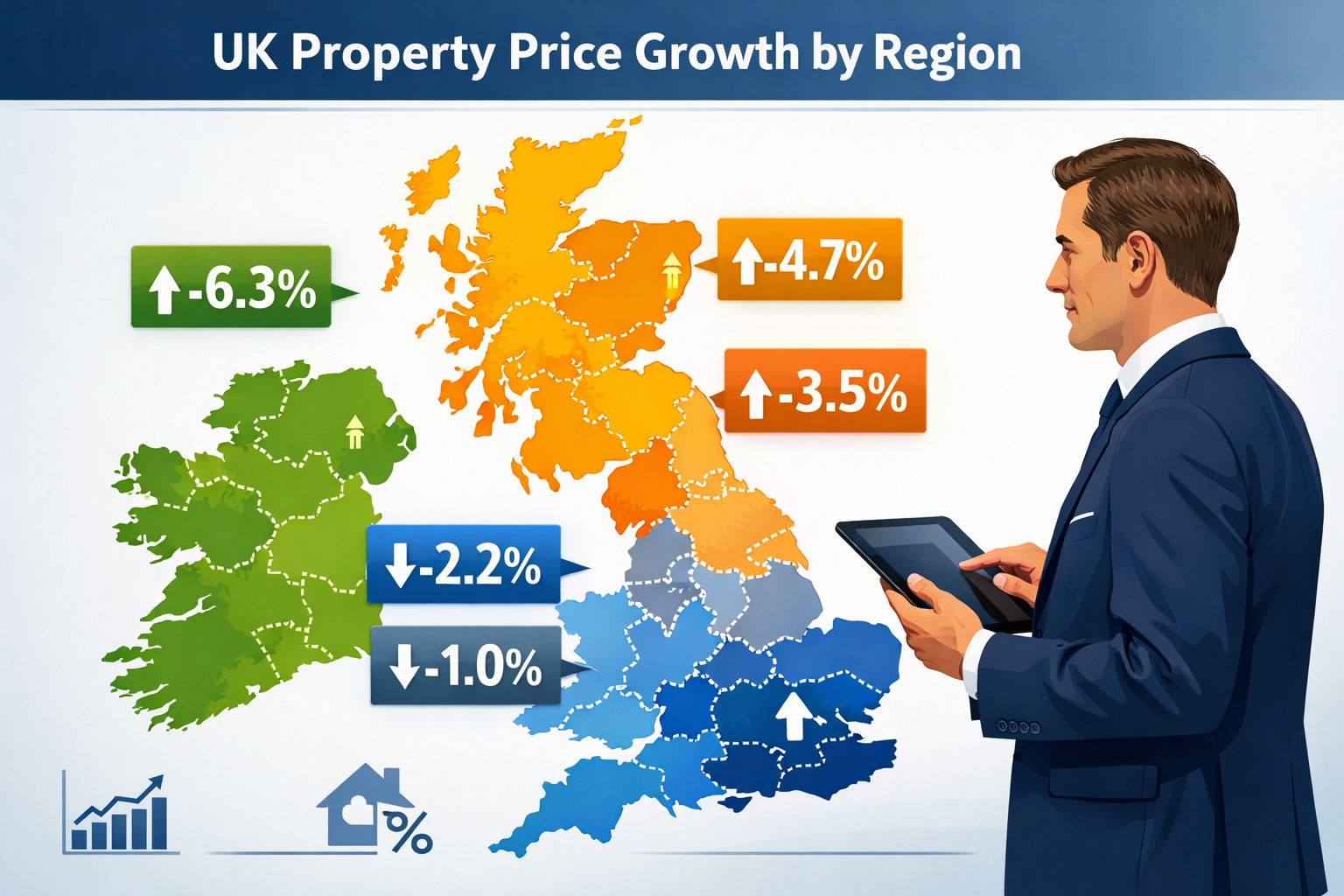
Recent RICS data reveals the stark reality: Northern Ireland recorded remarkable 6.3% year-on-year growth to an average of £218,608, Scotland climbed 4.7% to £222,286, while the South East declined 2.2% to £383,834 and London fell 1.0% to £538,200 [1]. This fragmented landscape fundamentally disrupts traditional valuation approaches, requiring chartered surveyors to master advanced techniques for Valuation Challenges in Diverging Regional Markets: Chartered Surveyor Techniques for North-South Price Disparities in 2026.
Key Takeaways
- 🏴 Northern regions dominate growth: Northern Ireland (+6.3%), Scotland (+4.7%), and North East England (+3.5%) significantly outpace southern markets, requiring region-specific valuation methodologies
- 📊 Individual property factors now override regional metrics: Leasehold structures, EPC ratings, building safety compliance, and local planning decisions create valuation variations of thousands of pounds within identical postcodes
- ⏱️ Transaction timescales vary dramatically: London properties now take 45 days to sell (20% slower year-on-year), fundamentally altering comparable evidence approaches compared to faster northern markets
- 💷 Affordability divergence accelerates: Five-year fixed mortgage rates below 4% for the first time since September 2022 impact expensive southern markets differently than affordable northern regions
- 🎯 Forward-looking indicators essential: With only three of nine UK regions showing price rises, surveyors must weight asking price trends and market sentiment more heavily than historical comparables
Understanding the North-South Divide in 2026 Property Valuations
The Valuation Challenges in Diverging Regional Markets: Chartered Surveyor Techniques for North-South Price Disparities in 2026 begin with understanding the fundamental drivers creating this unprecedented divergence. The regional split represents more than cyclical market fluctuations—it reflects structural economic shifts that chartered surveyors must incorporate into every valuation assignment.
Regional Performance Metrics
Within England alone, the North East led growth at 3.5% annually to an average of £181,838, while Yorkshire maintained strong performance at 3.2% year-on-year growth [1][2]. These northern regions benefit from:
- Superior affordability ratios compared to southern counterparts
- Strong rental demand supporting investor activity
- Regional economic development initiatives attracting employment
- First-time buyer accessibility maintaining transaction volumes
Conversely, southern markets face headwinds that chartered surveyors must quantify. The South East's 2.2% decline and London's 1.0% fall reflect multiple pressures [1]:
- Higher stamp duty costs implemented in April 2025
- Languishing premium market sector performance
- Extended transaction timescales reducing market liquidity
- Price-to-income ratios constraining buyer pools
For chartered surveyors in North London, these divergent trends require careful calibration when preparing valuations that may be compared against northern market benchmarks.
Surveyor Sentiment and Price Pressure Indicators
Professional surveyor sentiment provides leading indicators that complement transactional data. The divergence in price pressure expectations reveals the challenge:
| Region | Surveyor Price Pressure | Market Sentiment |
|---|---|---|
| London | -40% (downward) | Significantly negative |
| South East | -24% (downward) | Moderately negative |
| East Anglia | -26% (downward) | Moderately negative |
| Northern Ireland | Positive | Growth expectations |
| Scotland | Positive | Growth expectations |
| North West England | Positive | Growth expectations |
This sentiment data [3] demonstrates that chartered surveyors must apply region-specific valuation methodologies rather than national averages. A property in Sussex requires fundamentally different growth assumptions than an equivalent property in Scotland.
London's Micromarket Complexity
The London market presents additional complexity requiring granular analysis. While the broader London market softened 1.2% year-on-year, borough-level variations tell a different story [4]:
- Bromley: +6.0% (strongest London growth)
- Havering: +5.2%
- Waltham Forest: +4.0%
- Central London: Significant declines in premium segments
This variation means chartered surveyors in Bromley face entirely different valuation parameters than colleagues working in Central London, despite geographic proximity.
Advanced Chartered Surveyor Techniques for Regional Valuation Challenges

Addressing Valuation Challenges in Diverging Regional Markets: Chartered Surveyor Techniques for North-South Price Disparities in 2026 requires chartered surveyors to deploy sophisticated methodologies that account for regional divergence while maintaining RICS Red Book compliance.
Comparative Method Adjustments for Regional Markets
The traditional comparative method—identifying similar properties recently sold in the same area—faces fundamental challenges when regional markets diverge. Chartered surveyors must now:
1. Adjust Comparable Evidence Timescales
London's 45-day average selling time represents approximately 20% slower transaction speeds than the previous year, while northern England and Scotland experience faster sales [2]. This creates valuation implications:
- Recent comparables carry greater weight in fast-moving northern markets
- Older comparables require significant adjustment in declining southern markets
- Transaction certainty factors must be quantified in illiquid markets
When preparing professional valuations, surveyors should consider implementing a time-decay adjustment factor that varies by region, applying steeper adjustments in rapidly changing northern markets.
2. Incorporate Forward-Looking Market Indicators
With three of nine UK regions showing price rises, one flat, and four falling [2], historical comparables alone provide insufficient valuation evidence. Chartered surveyors should integrate:
- Asking price trends as leading indicators
- Days on market analysis showing demand strength
- Offer-to-asking price ratios revealing negotiation dynamics
- Mortgage approval rates indicating buyer confidence
This forward-looking approach proves particularly critical in areas like Hammersmith and West London, where premium market softness may not yet fully reflect in completed transactions.
3. Apply Regional Growth Forecasts Differentially
National forecasts predicting 1.5% growth for 2026 mask significant regional variations [3][5]. Chartered surveyors must apply differentiated assumptions:
High-Growth Regions (West Midlands, North West, Wales):
- Apply 2.5-3.5% annual growth assumptions
- Weight recent comparables more heavily
- Consider supply constraints supporting prices
Declining Regions (South East, London premium):
- Apply flat to negative growth assumptions
- Extend comparable search periods
- Incorporate downward price pressure evidence
Stable Regions (Midlands, East of England):
- Apply moderate 1-2% growth assumptions
- Balance recent and historical evidence
- Monitor transition indicators
Individual Property Factors Overriding Regional Metrics
The most critical evolution in Valuation Challenges in Diverging Regional Markets: Chartered Surveyor Techniques for North-South Price Disparities in 2026 involves recognizing that individual property characteristics now create valuation variations exceeding regional trends [2].
Leasehold Structure Analysis
Leasehold properties require detailed assessment of:
- Remaining lease term (sub-80 years triggering marriage value)
- Ground rent escalation clauses (particularly onerous terms)
- Service charge trajectories and reserve fund adequacy
- Lease extension costs as material valuation adjustments
A property in Bexley with 75 years remaining lease may require £20,000-40,000 adjustment compared to an identical freehold property, regardless of regional market trends.
Building Safety and EPC Compliance
Post-Grenfell building safety requirements and energy performance standards create significant valuation impacts:
- EWS1 certificates (or absence) affecting mortgageability
- Building Safety Act compliance costs for leaseholders
- EPC ratings below 'C' (future rental restrictions from 2025-2028)
- Retrofit costs for energy efficiency improvements
Properties requiring £15,000+ in building safety remediation or energy efficiency upgrades demand corresponding valuation adjustments, particularly in areas like Islington and East London with significant leasehold flat stock.
Local Planning and Development Factors
Hyperlocal planning decisions create micromarket variations:
- Permitted development conversions affecting local supply
- Transport infrastructure projects (Crossrail, HS2 impacts)
- Conservation area restrictions limiting development potential
- Article 4 directions removing permitted development rights
These factors mean properties in Weybridge or Guildford may experience entirely different valuation trajectories despite similar regional market conditions.
Supply-Demand Imbalance Techniques
The significant housing inventory shortage across various price brackets creates inconsistent comparable evidence [1]. Chartered surveyors must develop techniques for valuing properties in supply-constrained subsectors:
Rental Yield Capitalization Method
In markets with limited sales comparables but active rental sectors, the investment method provides alternative valuation evidence:
- Establish market rental value through lettings comparables
- Apply appropriate yield (varying by region: 4-6% typical)
- Adjust for property-specific factors (lease terms, condition)
- Cross-reference against sales comparables where available
This approach proves particularly valuable in Buckinghamshire and Berkshire commuter markets with strong rental demand.
New Build Premium/Discount Analysis
New build properties trade at premiums or discounts depending on regional market dynamics:
- Northern growth markets: New builds command 5-10% premiums
- Southern cooling markets: New builds may trade at par or slight discounts
- London premium areas: Significant new build discounts persist
Chartered surveyors must quantify these differentials when valuing new construction or using new build comparables for existing property valuations.
Practical Implementation: Regional Valuation Frameworks

Implementing solutions for Valuation Challenges in Diverging Regional Markets: Chartered Surveyor Techniques for North-South Price Disparities in 2026 requires structured frameworks that chartered surveyors can apply consistently across assignments.
The Regional Valuation Adjustment Matrix
Chartered surveyors should develop a systematic adjustment framework accounting for regional divergence:
Step 1: Establish Base Comparable Value
- Identify 3-5 comparable properties in target area
- Apply standard adjustments (size, condition, location)
- Calculate preliminary valuation range
Step 2: Apply Regional Market Adjustment
- Assess regional price trajectory (growth/decline)
- Quantify time-decay adjustment for comparables
- Incorporate surveyor sentiment indicators
- Apply regional growth forecast differential
Step 3: Individual Property Adjustment
- Leasehold structure analysis (£5,000-50,000+ impact)
- Building safety and EPC compliance (£10,000-40,000+ impact)
- Local planning factors (£5,000-30,000+ impact)
- Transaction certainty factors (2-5% adjustment)
Step 4: Cross-Validation
- Investment method cross-check (rental yield)
- Affordability analysis (price-to-income ratios)
- Market absorption rate assessment
- Comparable density and reliability scoring
This framework ensures comprehensive valuations that account for both macro regional trends and micro property-specific factors.
Affordability Analysis in Divergent Markets
The fall of five-year fixed mortgage rates to 3.95%—the first time below 4% since September 2022—creates differential affordability impacts across regions [4]. Chartered surveyors must incorporate affordability metrics:
Northern Market Affordability (Example: North East)
- Average property price: £181,838
- Typical household income: £32,000-35,000
- Price-to-income ratio: 5.2-5.7x
- Monthly payment (3.95%, 25-year): £850-900
- Affordability assessment: ✅ Strong (30-32% of gross income)
Southern Market Affordability (Example: South East)
- Average property price: £383,834
- Typical household income: £45,000-50,000
- Price-to-income ratio: 7.7-8.5x
- Monthly payment (3.95%, 25-year): £1,800-1,900
- Affordability assessment: ⚠️ Stretched (43-48% of gross income)
This analysis demonstrates why mortgage rate reductions disproportionately benefit northern markets, where affordability remains within sustainable ranges, while southern markets remain constrained despite rate improvements.
Transaction Certainty and Buyer Motivation Assessment
Factors such as buyer/seller confidence, transaction timescales, financial constraints, and motivation differ significantly between regions [2]. Chartered surveyors should assess:
High Transaction Certainty Indicators:
- ✅ Properties selling within 2-3 weeks
- ✅ Multiple offers above asking price
- ✅ High mortgage approval rates
- ✅ Low fall-through rates
Low Transaction Certainty Indicators:
- ⚠️ Properties remaining unsold 8+ weeks
- ⚠️ Significant offer-to-asking price discounts
- ⚠️ High percentage of cash buyers only
- ⚠️ Frequent price reductions
In areas like Twickenham, Clapham, and Battersea, transaction certainty factors may warrant 2-5% valuation adjustments compared to headline comparable prices.
Technology-Enhanced Valuation Approaches
Modern chartered surveyors can leverage technology to address regional divergence challenges:
Automated Valuation Model (AVM) Integration
While AVMs cannot replace professional judgment, they provide valuable data aggregation across divergent markets:
- Regional price index tracking showing real-time trends
- Comparable property density mapping identifying data gaps
- Transaction timeline analysis quantifying market liquidity
- Predictive analytics for forward-looking adjustments
Chartered surveyors should use AVMs as supporting evidence rather than primary valuation tools, particularly in complex markets like Esher or Leatherhead.
Drone Survey Integration
Premium drone surveys provide enhanced property assessment capabilities:
- Roof condition analysis without access equipment
- Boundary and land area verification improving accuracy
- Neighborhood context documentation supporting location adjustments
- Comparable property identification through aerial perspectives
This technology proves particularly valuable for properties in Harrow, Ealing, and Hounslow where large housing estates create complex comparable selection challenges.
Case Study: Comparative Valuation Across Regions
Consider two identical three-bedroom semi-detached properties built in 1930:
Property A: North East England
- Recent comparable sales: £180,000-185,000
- Regional growth: +3.5% annually
- Transaction speed: 3-4 weeks average
- Buyer demand: Strong first-time buyer market
- Valuation: £182,500 (mid-range, confidence: high)
Property B: South East England
- Recent comparable sales: £380,000-390,000
- Regional decline: -2.2% annually
- Transaction speed: 8-10 weeks average
- Buyer demand: Limited, price-sensitive
- Additional factors: Leasehold (95 years remaining), EPC rating 'D'
- Valuation: £365,000 (lower range, adjusted for market conditions, leasehold, EPC; confidence: moderate)
This comparison illustrates how Valuation Challenges in Diverging Regional Markets: Chartered Surveyor Techniques for North-South Price Disparities in 2026 require fundamentally different approaches despite property similarities.
Professional Standards and Reporting Requirements
Chartered surveyors addressing regional divergence must maintain rigorous professional standards while communicating complex valuation rationales.
RICS Red Book Compliance in Divergent Markets
The RICS Valuation – Global Standards (Red Book) requires valuers to:
- Clearly state assumptions about regional market conditions
- Disclose uncertainty where comparable evidence is limited
- Explain departures from standard methodologies
- Provide sensitivity analysis showing valuation ranges
In divergent markets, chartered surveyors should explicitly document:
- Regional market context (growth/decline trends)
- Comparable adjustment methodology (time-decay factors)
- Individual property factors (leasehold, EPC, building safety)
- Alternative valuation approaches (investment method cross-checks)
- Confidence levels (high/moderate/low based on evidence quality)
Communicating Regional Valuation Complexity
Valuation reports must communicate complex regional dynamics to non-specialist audiences:
Effective Communication Strategies:
📊 Visual aids: Regional price trend charts and maps
📈 Comparative tables: Side-by-side regional performance metrics
💡 Plain language explanations: Avoiding excessive technical jargon
🎯 Executive summaries: Key findings and valuation rationale
⚖️ Balanced perspective: Acknowledging uncertainty where appropriate
For clients in areas like Chiswick or Epsom, clear communication about regional market positioning relative to national trends proves essential for informed decision-making.
Continuing Professional Development
Addressing Valuation Challenges in Diverging Regional Markets: Chartered Surveyor Techniques for North-South Price Disparities in 2026 requires ongoing professional development:
- Regional market intelligence subscriptions and analysis
- RICS technical guidance on emerging valuation challenges
- Networking with regional specialists sharing market insights
- Technology training on AVM integration and data analytics
- Building safety and EPC regulatory compliance updates
Chartered surveyors should dedicate significant CPD hours to understanding regional market dynamics, particularly when operating across multiple geographic areas.
Future Outlook: Evolving Regional Dynamics
Looking ahead through 2026 and beyond, chartered surveyors must anticipate continued regional divergence driven by structural factors:
Projected Regional Performance
Forecasters expect growth concentrated in the West Midlands, North West, and Wales due to better affordability, while southern markets face continued headwinds [3][5]. Chartered surveyors should monitor:
- Employment migration patterns (remote work impacts)
- Infrastructure investment (regional connectivity improvements)
- Housing supply responses (planning reform effects)
- Demographic shifts (age, household formation trends)
Emerging Valuation Considerations
New factors will increasingly influence regional valuations:
Climate Risk Assessment:
- Flood risk mapping and insurance availability
- Coastal erosion and sea-level rise impacts
- Heat island effects in urban areas
- Energy efficiency and retrofit requirements
Digital Infrastructure:
- Broadband connectivity quality (remote work enabler)
- Smart home technology integration
- Electric vehicle charging infrastructure
- Digital planning and conveyancing impacts
Social Infrastructure:
- Healthcare facility access (aging population)
- Education quality and school places
- Green space and amenity provision
- Community resilience factors
These considerations will create additional valuation complexity requiring chartered surveyors to expand their analytical frameworks beyond traditional property characteristics.
Conclusion
The Valuation Challenges in Diverging Regional Markets: Chartered Surveyor Techniques for North-South Price Disparities in 2026 represent a fundamental shift in UK property valuation practice. With Northern Ireland, Scotland, and Northern England experiencing robust growth while London and the South East decline, chartered surveyors must abandon one-size-fits-all approaches in favor of sophisticated, region-specific methodologies.
Key implementation priorities for chartered surveyors include:
✅ Developing regional adjustment matrices that systematically account for divergent market conditions
✅ Weighting individual property factors (leasehold, EPC, building safety) more heavily than historical regional averages
✅ Incorporating forward-looking indicators (asking prices, market sentiment) alongside historical comparables
✅ Applying differential growth assumptions based on regional affordability and economic fundamentals
✅ Leveraging technology (AVMs, drone surveys) to enhance data quality in fragmented markets
✅ Communicating complexity clearly to clients navigating uncertain market conditions
The regional divergence evident in 2026 data—with Northern Ireland growing 6.3% while the South East declines 2.2%—demands that chartered surveyors continuously refine their techniques, maintain rigorous professional standards, and communicate valuation rationales with unprecedented clarity.
Next Steps for Property Professionals
For Chartered Surveyors:
- Conduct comprehensive regional market analysis for your operating areas
- Develop standardized adjustment frameworks for regional divergence
- Invest in technology and data analytics capabilities
- Enhance CPD focused on regional market intelligence
For Property Buyers and Sellers:
- Engage qualified chartered surveyors with regional expertise
- Request detailed valuation reports explaining regional context
- Consider independent property valuations before major transactions
- Understand how individual property factors may override regional trends
For Lenders and Investors:
- Require enhanced regional analysis in valuation instructions
- Apply differentiated lending criteria by regional market conditions
- Monitor regional performance metrics continuously
- Assess portfolio concentration risks across divergent markets
The fragmented UK property market of 2026 presents challenges, but also opportunities for chartered surveyors who master the advanced techniques necessary to navigate this complex landscape. By combining rigorous methodology, regional expertise, and clear communication, property professionals can deliver valuations that truly reflect the nuanced reality of today's divergent regional markets.
References
[1] Uk House Prices Hit New High As Market Gathers Pace In Early 2026 – propertysoup.co.uk
[2] Regional Property Prices Diverging – thenegotiator.co.uk
[3] House Prices – moneyweek.com
[4] Article – millersepping.co.uk
[5] Uk House Prices In 2026 Where The Market Is Headed What It Means For Buyers Sellers And Landlor – approvedbusinessfinance.co.uk