

{"cover":"Professional landscape format (1536×1024) hero image with bold text overlay 'Expert Witness Preparation for Awaab's Law Disputes: Surveying Damp and Mould in Rental Properties' in extra large 72pt white sans-serif font with dark shadow and semi-transparent navy overlay box, positioned in upper third center. Background shows split composition: left side displays a professional surveyor in PPE examining black mould on a rental property wall with moisture meter and thermal imaging camera, right side shows a courtroom setting with expert witness stand and legal documents. Color palette: deep navy blue, white, amber warning accents. High contrast, editorial magazine cover quality, professional legal-technical aesthetic with subtle justice scales watermark.","content":["Detailed landscape format (1536×1024) image showing a professional surveyor conducting comprehensive damp and mould investigation in a rental property bedroom. Scene includes surveyor wearing protective equipment using multiple diagnostic tools: thermal imaging camera displaying heat map on tablet screen, digital moisture meter pressed against wall showing elevated readings, clipboard with detailed inspection checklist, professional camera photographing black mould patches on ceiling corner. Wall shows visible condensation staining, window with poor ventilation evident. Foreground displays open investigation kit with calibrated instruments, evidence bags, measurement tools. Text overlay in corner: 'Awaab's Law Investigation Standards 2026'. Photorealistic style, natural lighting, professional documentation aesthetic, technical precision focus.","Detailed landscape format (1536×1024) image depicting organized evidence documentation system for expert witness testimony. Central focus shows large desk with multiple monitors displaying: thermal imaging analysis software with temperature gradients, moisture mapping diagrams with color-coded severity zones, photographic evidence gallery of mould growth progression, HHSRS risk assessment scoring matrix. Physical evidence includes printed site reports with annotated photographs, chain of custody documentation, calibration certificates for testing equipment, building pathology reference materials. Professional surveyor reviewing documents with highlighter, legal notepad with courtroom testimony preparation notes visible. Side table shows bound expert witness report with tabbed sections. Clean, organized, professional legal preparation aesthetic with excellent lighting and sharp detail.","Detailed landscape format (1536×1024) image showing courtroom testimony scenario with expert witness presentation setup. Professional surveyor in business attire standing at witness stand presenting technical evidence to court. Large presentation screen displays split view: left shows before/after property photographs with measurement annotations, right shows detailed building pathology diagram identifying moisture ingress sources with arrows and technical labels. Witness holds laser pointer indicating specific evidence. Foreground shows barrister's desk with open expert report, highlighted sections visible, legal briefs stacked neatly. Background suggests formal courtroom setting with judge's bench partially visible. Professional legal environment, authoritative presentation style, technical evidence clearly displayed, serious professional atmosphere, balanced lighting emphasizing credibility and expertise."]"}
The tragic death of two-year-old Awaab Ishak from prolonged exposure to black mould in his family's social housing has fundamentally changed how the UK addresses damp and mould in rental properties. As Awaab's Law extends to the private rental sector in 2026, surveyors face unprecedented demand to serve as expert witnesses in landlord-tenant disputes. Expert Witness Preparation for Awaab's Law Disputes: Surveying Damp and Mould in Rental Properties requires specialized knowledge, rigorous documentation standards, and the ability to translate technical findings into compelling courtroom testimony that protects tenant health and establishes landlord accountability.
Key Takeaways
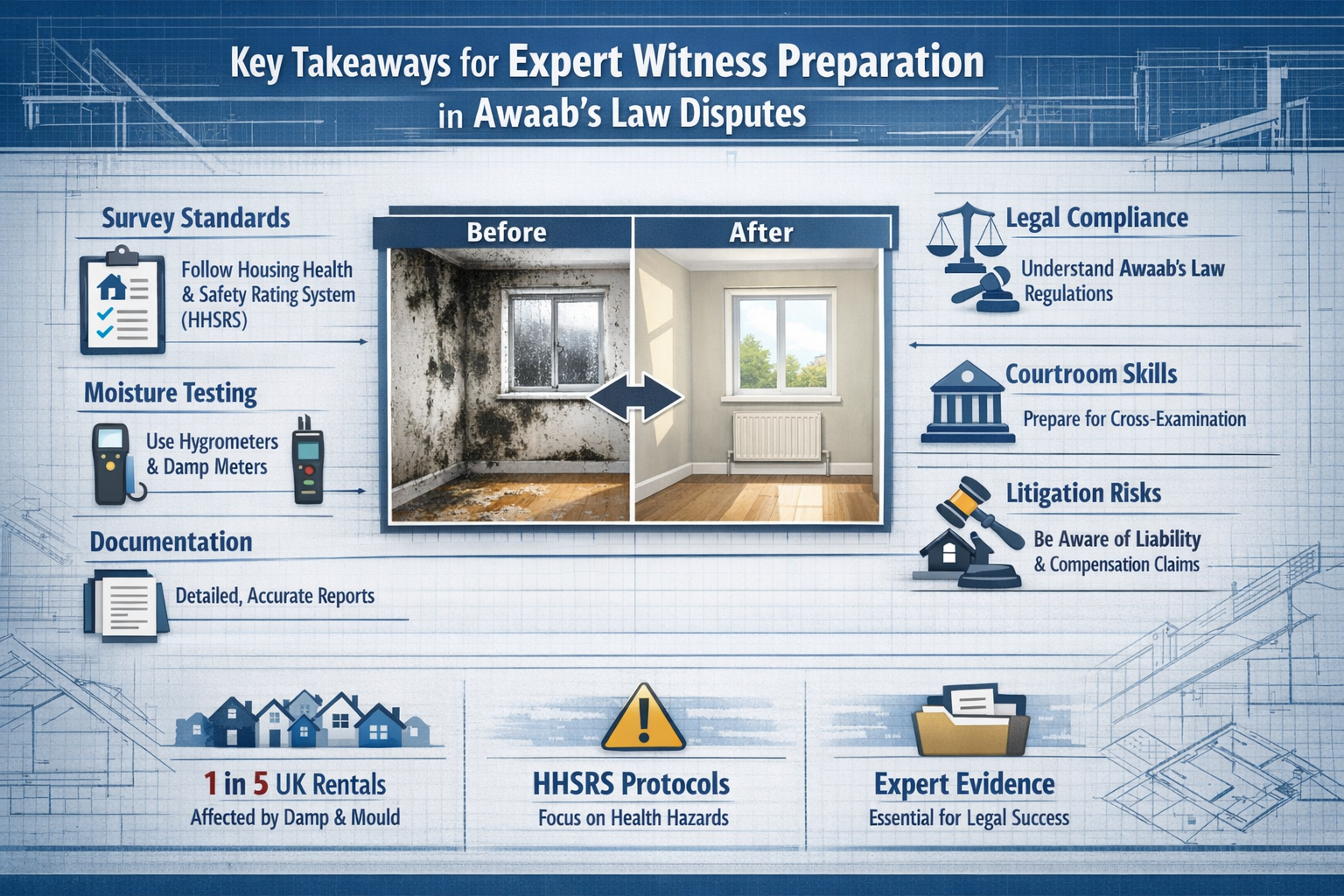
✅ Comprehensive competency requirements: Expert witnesses must demonstrate expertise in damp typology, mould species identification, building pathology, HHSRS standards, and vulnerability-based risk assessment[1]
📋 Rigorous documentation protocols: All investigations require timestamped records, investigator qualifications, detailed site reports with measurements and photographs, evidence-based analysis, and specific remediation recommendations[1]
⚖️ Courtroom-ready evidence standards: Reports must translate technical findings into plain language, provide honest risk assessments, and include actionable timelines that withstand legal scrutiny
🏠 Beyond visual inspection: Adequate investigations identify moisture sources, assess ventilation and insulation systems, understand building fabric interactions, and account for occupancy factors[2]
🎯 Rising litigation landscape: With private landlords now subject to strict investigation and remediation timelines, expert witness testimony will become critical in resolving disputes and establishing compliance
Understanding Awaab's Law and Its Implications for Expert Witnesses
Awaab's Law represents a watershed moment in UK housing legislation. Originally enacted for social housing providers, the law now extends to private landlords from 2026, creating strict obligations for investigating and remediating damp and mould hazards within defined timeframes.
The Legislative Framework
The law establishes mandatory investigation timelines that landlords must follow after receiving a hazard report. For social housing, investigations must begin within 14 days of notification. Private landlords face similar scrutiny, with enforcement mechanisms that include substantial penalties for non-compliance.
This legislative shift transforms surveyors from advisory consultants into potential key witnesses in legal proceedings. When landlords fail to meet investigation or remediation requirements, tenants increasingly pursue legal action. Expert witnesses who can demonstrate competent investigation methodology and provide credible testimony become invaluable to both prosecution and defense.
Why Standard Surveys Are Insufficient
Traditional property surveys focus on structural integrity and valuation. Awaab's Law demands something fundamentally different: health-focused hazard assessment that prioritizes occupant safety over property value. This requires understanding:
- Housing Health and Safety Rating System (HHSRS) scoring methodologies
- Vulnerability factors including age, pre-existing respiratory conditions, and immune system status
- Mould species identification and associated health risks
- Causation analysis distinguishing between building defects and occupant behavior
Expert witnesses must bridge the gap between building pathology expertise and legal evidence standards. A comprehensive understanding of both technical investigation and courtroom procedures separates qualified expert witnesses from general surveyors.
Essential Competencies for Expert Witness Preparation for Awaab's Law Disputes: Surveying Damp and Mould in Rental Properties
Serving as an expert witness in Awaab's Law disputes requires a specialized skill set that extends far beyond standard surveying qualifications. The competency framework established by the legislation provides clear guidance on minimum standards.[1]
Technical Knowledge Requirements
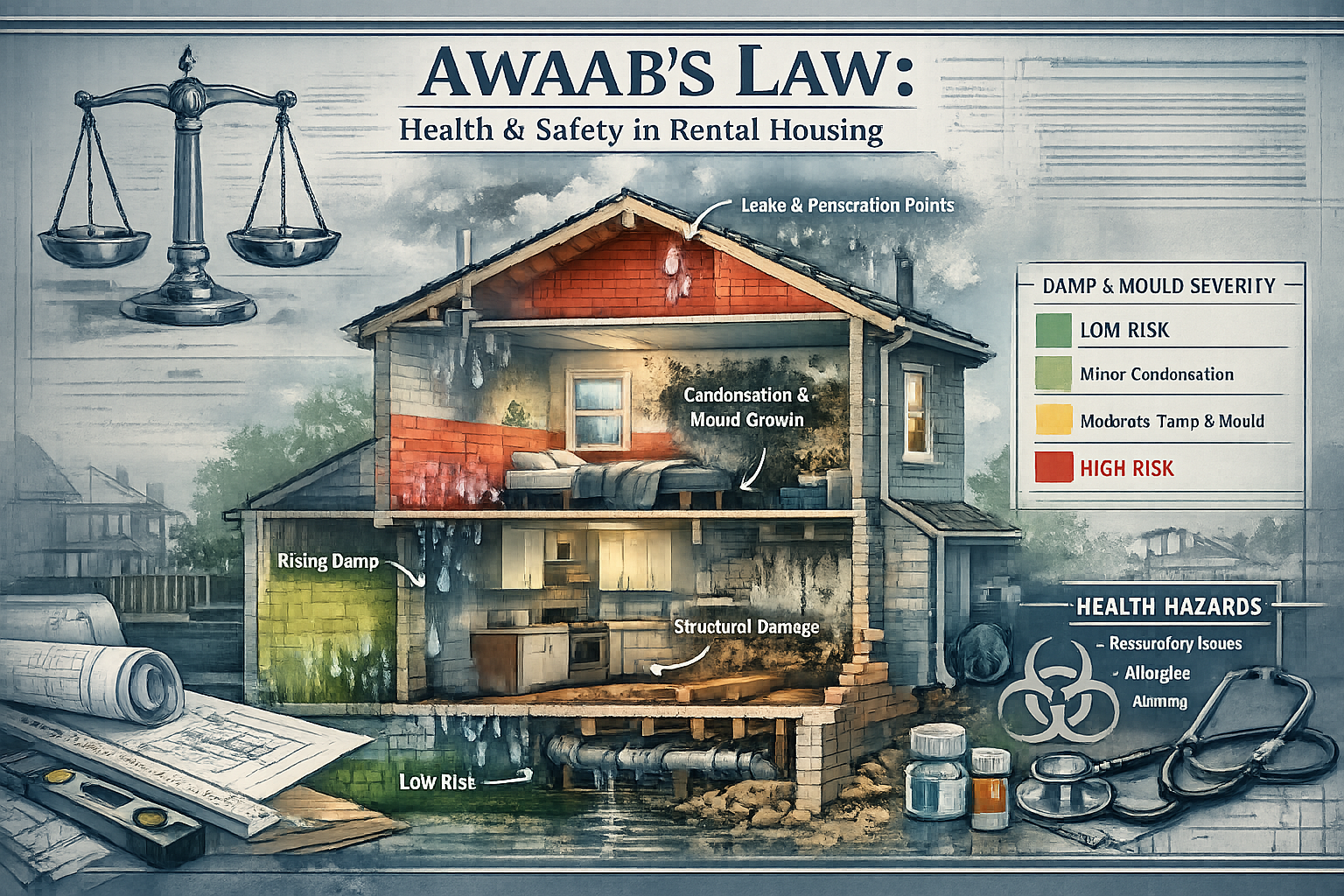
Damp Typology Expertise: Expert witnesses must confidently identify and differentiate between:
- Penetrating damp from external water ingress through defective building fabric
- Rising damp caused by failed or absent damp-proof courses
- Condensation damp resulting from inadequate ventilation and thermal bridging
- Hygroscopic moisture from salt-contaminated building materials
Each damp type requires different diagnostic approaches and remediation strategies. Misidentification undermines expert credibility and can lead to ineffective remediation that prolongs tenant exposure to hazardous conditions.
Mould Species Identification: While laboratory analysis provides definitive identification, expert witnesses should recognize common mould genera by visual characteristics:
- Stachybotrys chartarum (black mould) – the species implicated in Awaab Ishak's death
- Aspergillus species – common allergenic moulds
- Penicillium species – frequently found in water-damaged materials
- Cladosporium species – outdoor moulds that colonize damp indoor surfaces
Understanding the health implications of different mould species strengthens expert testimony regarding hazard severity and urgency of remediation.
Building Pathology and Investigation Methodology
Expert witnesses must demonstrate systematic investigation approaches that identify root causes rather than superficial symptoms. This requires:
Moisture Source Analysis: Using calibrated equipment including:
- Thermal imaging cameras to identify thermal bridging and insulation defects
- Moisture meters (both pin-type and non-invasive) for quantitative measurements
- Hygrometers for relative humidity assessment
- Borescopes for concealed cavity inspection
Ventilation Assessment: Evaluating both natural and mechanical ventilation systems, identifying inadequate air changes per hour, and assessing condensation risk based on occupancy patterns and internal moisture generation.
Building Fabric Evaluation: Understanding construction typology, identifying defects in:
- External envelope (walls, roofs, windows, doors)
- Internal finishes that trap moisture
- Drainage systems and ground conditions
- Heating system adequacy
For guidance on comprehensive property assessment methodologies, surveyors can reference Level 3 building survey protocols that establish thorough investigation standards.
HHSRS and Risk Assessment Expertise
The Housing Health and Safety Rating System provides the statutory framework for assessing housing hazards. Expert witnesses must:
- Calculate hazard scores based on likelihood and severity of harm
- Assess occupant vulnerability considering age, health status, and exposure duration
- Classify hazards as Category 1 (serious and immediate) or Category 2 (less serious)
- Understand enforcement powers available to local authorities
Risk assessment must account for the specific occupants at the property, not hypothetical average residents. A property posing minimal risk to healthy adults may present severe Category 1 hazards for infants, elderly persons, or individuals with respiratory conditions.
Documentation Standards for Expert Witness Preparation for Awaab's Law Disputes: Surveying Damp and Mould in Rental Properties
Robust documentation forms the foundation of credible expert witness testimony. Awaab's Law establishes specific requirements for investigation records that directly translate to courtroom evidence standards.[1]
Mandatory Investigation Records
Every investigation must include comprehensive documentation:
Basic Information Requirements:
- Date and time of inspection with weather conditions noted
- Method of report (tenant complaint, routine inspection, third-party referral)
- Tenant details including household composition and vulnerability factors
- Investigator qualifications demonstrating competency to conduct assessment
Site Investigation Records:
- Photographic evidence with consistent metadata (date, time, location)
- Quantitative measurements from calibrated instruments with equipment serial numbers
- Detailed descriptions of affected areas with dimensions and severity classifications
- Environmental readings including temperature, relative humidity, and air quality parameters
Analysis and Findings:
- Root cause identification with supporting evidence
- Hazard classification using HHSRS methodology
- Risk assessment specific to actual occupants
- Recommended remedial actions with prioritization and estimated timelines
This documentation framework ensures that expert witnesses can reconstruct their investigation methodology months or years later during legal proceedings. Missing or incomplete records severely compromise expert credibility.
Evidence Quality and Chain of Custody
Courts require demonstrable evidence integrity. Expert witnesses should implement:
Photographic Standards:
- High-resolution images with scale references
- Multiple angles showing context and detail
- Before, during, and after remediation documentation
- Metadata preservation proving authenticity
Measurement Protocols:
- Calibrated equipment with current certification
- Multiple readings to establish patterns
- Documented measurement locations on floor plans
- Comparison with baseline or external reference readings
Sample Collection (when required):
- Proper containment to prevent cross-contamination
- Clear labeling with location, date, and collector identification
- Chain of custody documentation
- Laboratory analysis by accredited facilities
For complex investigations requiring additional specialist input, understanding areas requiring further investigation helps expert witnesses identify when to recommend supplementary testing.
Written Summary Requirements
Awaab's Law mandates that investigation findings be communicated in plain language accessible to non-technical audiences.[1] Expert witness reports must balance technical precision with readability:
Clear Communication Standards:
- Avoid jargon or define technical terms when first used
- Use visual aids (annotated photographs, diagrams, charts)
- Organize findings logically with clear section headings
- Provide executive summary highlighting critical findings
Honest Risk Assessment:
- Clearly state hazard severity without exaggeration or minimization
- Acknowledge limitations of investigation methodology
- Distinguish between confirmed findings and professional opinions
- Provide confidence levels for conclusions
Actionable Recommendations:
- Specific remediation actions rather than vague suggestions
- Realistic timelines based on work complexity and availability
- Interim measures to reduce exposure during remediation
- Verification procedures to confirm successful remediation
These written summaries often become the primary evidence reviewed by judges, making clarity and completeness essential. Expert witnesses should anticipate that every statement may be challenged during cross-examination.
Conducting Adequate Investigations Under Awaab's Law Standards
The legislation specifically defines "adequate investigation" to prevent superficial assessments that miss underlying causes.[2] Expert witnesses must demonstrate investigation depth that satisfies both technical and legal scrutiny.
Comprehensive Assessment Methodology
Initial Site Assessment:
Begin with systematic visual inspection documenting:
- All visible mould growth with location mapping
- Damp staining patterns and extent
- Condensation on windows and cold surfaces
- Ventilation provision and functionality
- Heating system type and operation
- Occupancy patterns and internal moisture sources
Diagnostic Testing:
Deploy appropriate technology to identify hidden defects:
- Thermal imaging to locate thermal bridging, insulation gaps, and concealed moisture
- Moisture mapping to establish affected area extent and severity gradients
- Air quality sampling when respiratory symptoms are reported
- Invasive investigation of concealed cavities when non-invasive methods indicate problems
Building Performance Analysis:
Evaluate whether the property meets minimum performance standards:
- Adequate insulation to prevent surface condensation
- Sufficient ventilation for occupancy level and moisture generation
- Functional heating capable of maintaining healthy temperatures
- Weather-tight external envelope preventing water ingress
For properties with multiple defects, understanding common building problems and solutions helps expert witnesses provide comprehensive remediation strategies.
Identifying Causation: Building Defects vs. Occupant Behavior
One of the most contentious aspects of Awaab's Law disputes involves attributing responsibility for damp and mould conditions. Landlords frequently claim that tenant behavior (excessive moisture generation, inadequate ventilation, insufficient heating) causes the problem. Expert witnesses must objectively assess causation.
Building Defect Indicators:
- Mould growth in unoccupied properties or vacant rooms
- Damp patterns inconsistent with condensation (e.g., penetrating damp from external defects)
- Inadequate ventilation provision regardless of occupant behavior
- Heating systems insufficient to maintain minimum temperatures economically
- Structural thermal bridging creating cold spots prone to condensation
Occupancy Factor Indicators:
- Excessive moisture generation (e.g., drying laundry indoors without ventilation)
- Blocked or closed ventilation openings
- Heating systems not used despite adequate capacity
- Furniture placement blocking airflow to external walls
In most cases, causation is multifactorial. Expert witnesses serve the court best by identifying all contributing factors and their relative significance rather than attempting to assign binary blame. Even when occupant behavior contributes, landlords retain responsibility to provide properties that can accommodate normal residential use without creating health hazards.
Evidence-Based Remediation Planning
Adequate investigations must conclude with specific, actionable remediation plans[2] that address root causes rather than cosmetic treatments. Expert witnesses should specify:
Immediate Actions:
- Emergency measures to reduce exposure (e.g., dehumidifiers, temporary ventilation)
- Mould removal using appropriate biocides and containment procedures
- Interim monitoring protocols
Root Cause Remediation:
- Building fabric repairs (e.g., roof repairs, repointing, damp-proof course installation)
- Ventilation improvements (e.g., mechanical extract fans, passive vents)
- Insulation upgrades to eliminate thermal bridging
- Heating system repairs or upgrades
Verification and Monitoring:
- Post-remediation inspection timeline
- Success criteria (e.g., moisture readings below threshold, no mould recurrence)
- Ongoing monitoring frequency
- Tenant education on property use and maintenance
Remediation plans must be realistic and proportionate to the hazard severity. Expert witnesses who recommend excessive interventions beyond what's necessary to eliminate the hazard may have their objectivity questioned.
Preparing for Courtroom Testimony in Awaab's Law Disputes
Technical competence alone does not make an effective expert witness. Courtroom testimony requires additional preparation to communicate findings persuasively while withstanding cross-examination.
Understanding Your Role as Expert Witness
Expert witnesses have a duty to the court that supersedes any obligation to the party instructing them. This fundamental principle means:
- Providing objective, unbiased opinions based on evidence
- Acknowledging limitations and uncertainties in findings
- Revising opinions if new evidence emerges
- Refusing to advocate for either party's position
Courts grant expert witnesses special status to provide opinion evidence (unlike fact witnesses who can only testify about observations). This privilege comes with responsibility to maintain professional integrity and independence.
For surveyors new to expert witness work, understanding the expert witness report process provides essential context for the role's requirements and expectations.
Report Writing for Legal Proceedings
Expert witness reports follow specific formats that differ from standard survey reports:
Mandatory Report Components:
- Statement of truth confirming understanding of expert duties
- Qualifications and experience demonstrating competency
- Instructions received and scope of investigation
- Methodology explaining investigation approach and equipment used
- Findings presenting factual observations with supporting evidence
- Opinion providing professional interpretation of findings
- Conclusions answering specific questions posed by instructing party
- Declaration confirming compliance with expert witness duties
Writing Style Considerations:
- Use first person when expressing professional opinions ("In my opinion…")
- Distinguish clearly between facts and opinions
- Provide reasoning for all conclusions
- Acknowledge alternative explanations and why they were rejected
- Use conditional language appropriately ("likely," "probable," "possible")
Reports should anticipate cross-examination by addressing potential weaknesses or alternative interpretations preemptively. Transparency about limitations strengthens rather than undermines credibility.
Effective Courtroom Communication
Testifying in court requires different communication skills than client consultations:
Preparation Strategies:
- Review all investigation records thoroughly before testimony
- Prepare visual aids (annotated photographs, diagrams, charts)
- Anticipate challenging questions and prepare responses
- Practice explaining technical concepts in plain language
- Coordinate with instructing solicitor on likely examination topics
Testimony Best Practices:
- Address the judge rather than the questioning barrister
- Pause before answering to ensure understanding and formulate clear responses
- Request clarification if questions are ambiguous or compound
- Admit uncertainty rather than speculating beyond expertise
- Maintain composure during aggressive cross-examination
- Correct mistakes immediately if errors are identified
Common Cross-Examination Tactics:
- Challenging qualifications or experience
- Questioning investigation methodology or equipment accuracy
- Presenting alternative explanations for findings
- Highlighting inconsistencies in documentation
- Suggesting bias toward instructing party
Expert witnesses who remain calm, honest, and focused on evidence rather than advocacy typically maintain credibility even under vigorous cross-examination.
Continuing Professional Development
The evolving nature of Awaab's Law and emerging building pathology research requires ongoing learning:
Recommended CPD Areas:
- Updates to housing health and safety legislation
- Advances in diagnostic technology and methodologies
- Emerging mould species and health research
- Legal procedures and expert witness duties
- Communication and presentation skills
Professional organizations including RICS offer specialized training for expert witnesses. Regular engagement with current research and case law ensures that testimony reflects best current practice rather than outdated approaches.
Common Pitfalls in Expert Witness Preparation for Awaab's Law Disputes
Even experienced surveyors can compromise their effectiveness as expert witnesses through common mistakes:
Inadequate Documentation
The Problem: Relying on memory or incomplete notes months after an investigation when preparing for trial.
The Solution: Implement systematic documentation protocols during every site visit. Assume that every investigation may eventually require courtroom testimony and document accordingly. Use checklists to ensure completeness.
Exceeding Competency Boundaries
The Problem: Offering opinions on matters outside surveying expertise (e.g., medical causation, legal liability).
The Solution: Clearly define expertise boundaries. Recommend additional specialist input when questions exceed surveying competency. Courts value experts who acknowledge limitations over those who overreach.
Advocacy Rather Than Objectivity
The Problem: Becoming invested in the instructing party's success rather than providing impartial evidence.
The Solution: Remember that the duty to the court supersedes all other obligations. Present evidence honestly even when it may not support the instructing party's position. Credibility depends on demonstrated objectivity.
Insufficient Investigation Depth
The Problem: Conducting superficial visual inspections that miss underlying causes.
The Solution: Follow the adequate investigation standards established by Awaab's Law.[2] Use appropriate diagnostic technology. Investigate beyond immediately visible symptoms to identify root causes. For complex cases, understanding environmental issues in buildings provides additional context.
Poor Communication
The Problem: Using technical jargon that judges and juries cannot understand, or providing vague recommendations that cannot be implemented.
The Solution: Practice explaining technical concepts in plain language. Use visual aids extensively. Provide specific, actionable recommendations with clear timelines and success criteria.
The Business Case for Expert Witness Specialization
As Awaab's Law extends to the private rental sector in 2026, surveyors who develop expert witness capabilities position themselves for significant professional opportunities.
Growing Market Demand
Several factors drive increasing demand for qualified expert witnesses:
Legislative Expansion: Extending Awaab's Law to approximately 4.6 million private rental properties creates exponentially more potential disputes requiring expert testimony.
Enforcement Intensity: Local authorities face political pressure to demonstrate robust enforcement following high-profile cases, leading to more prosecutions requiring expert evidence.
Tenant Awareness: Increased publicity around tenant rights and health hazards encourages more complaints and legal actions when landlords fail to remediate problems promptly.
Insurance Claims: Property insurers increasingly require expert assessments to determine liability and appropriate remediation costs.
Fee Structures and Income Potential
Expert witness work typically commands premium rates compared to standard surveying services:
- Initial investigation and report: £1,500-£3,500 depending on complexity
- Report review and amendments: £150-£250 per hour
- Conference with instructing solicitor: £150-£250 per hour
- Court attendance: £200-£350 per hour plus preparation time
- Travel and expenses: Reimbursed at cost
A single expert witness instruction can generate £5,000-£15,000 in fees for complex cases requiring multiple reports and court appearances. Surveyors who establish reputations for credible, thorough work develop referral networks with solicitors handling housing litigation.
Professional Development Pathway
Building expert witness capability requires strategic investment:
- Foundational training: RICS Expert Witness certification or equivalent
- Technical specialization: Advanced training in building pathology, HHSRS, and mould investigation
- Initial instructions: Accept lower-profile cases to build experience and testimonials
- Reputation building: Publish articles, present at conferences, engage with legal community
- Network development: Build relationships with housing solicitors and local authorities
The investment typically pays dividends within 2-3 years as referrals increase and fee rates rise with demonstrated expertise.
Practical Steps to Begin Expert Witness Preparation
For surveyors seeking to develop expert witness capabilities in Awaab's Law disputes, the following pathway provides a structured approach:
Step 1: Assess Current Competency
Honestly evaluate existing knowledge against the competency framework:
- ✅ Can you confidently identify all damp types and their causes?
- ✅ Do you understand HHSRS scoring methodology?
- ✅ Can you operate thermal imaging and moisture detection equipment proficiently?
- ✅ Do you know how to conduct vulnerability-based risk assessments?
- ✅ Are you familiar with expert witness duties and report formats?
Identify gaps requiring additional training or mentorship.
Step 2: Obtain Specialized Training
Invest in formal qualifications:
- RICS Expert Witness certification covering legal duties and procedures
- Building pathology courses focusing on damp and mould investigation
- HHSRS training from accredited providers
- Equipment training for thermal imaging and diagnostic tools
Many training providers now offer Awaab's Law-specific modules addressing the legislation's unique requirements.
Step 3: Upgrade Equipment and Systems
Ensure access to professional-grade diagnostic equipment:
- Thermal imaging camera (FLIR or equivalent)
- Calibrated moisture meters (pin and non-invasive types)
- Digital hygrometers and thermometers
- Professional photography equipment
- Documentation templates and checklists
Equipment investment typically ranges from £3,000-£8,000 for a comprehensive diagnostic kit.
Step 4: Develop Documentation Protocols
Create systematic procedures ensuring consistent, thorough documentation:
- Pre-inspection checklists covering all required information
- Standardized photography protocols
- Measurement recording templates
- Report templates meeting legal requirements
- Quality assurance review processes
Robust systems prevent documentation gaps that could undermine expert credibility.
Step 5: Build Legal Network
Connect with potential instruction sources:
- Housing solicitors specializing in landlord-tenant disputes
- Local authority enforcement teams
- Tenant advocacy organizations
- Property insurance companies
- Other expert witnesses for reciprocal referrals
Attend legal conferences and housing forums to raise profile within the legal community.
Step 6: Start with Manageable Instructions
Accept initial instructions that build experience without overwhelming capacity:
- Simple cases with clear causation
- Instructions as shadow expert reviewing others' reports
- Pre-litigation assessments not requiring court attendance
- Joint expert instructions with experienced practitioners
Gradually increase complexity as confidence and competence grow.
For surveyors seeking comprehensive understanding of professional survey standards, reviewing what questions to ask during building surveys provides additional context for thorough property assessment.
Conclusion
Expert Witness Preparation for Awaab's Law Disputes: Surveying Damp and Mould in Rental Properties represents both a professional responsibility and significant business opportunity for qualified surveyors. As the legislation extends to the private rental sector in 2026, the demand for credible expert witnesses who can competently investigate damp and mould hazards, document findings rigorously, and communicate technical evidence persuasively in legal proceedings will grow substantially.
Success as an expert witness requires more than technical surveying competence. It demands deep understanding of damp typology and building pathology, mastery of HHSRS risk assessment methodology, rigorous documentation standards that withstand legal scrutiny, and the ability to maintain objectivity while presenting complex technical evidence in plain language accessible to judges and juries.
The stakes in these disputes extend beyond financial liability. Expert testimony directly impacts tenant health and safety, particularly for vulnerable populations including children, elderly persons, and those with respiratory conditions. The tragic death of Awaab Ishak reminds us that inadequate responses to damp and mould can have fatal consequences.
Actionable Next Steps
For Surveyors Developing Expert Witness Capabilities:
- Assess competency gaps against the Awaab's Law investigation framework
- Invest in specialized training covering building pathology, HHSRS, and expert witness duties
- Upgrade diagnostic equipment to professional standards with calibration certification
- Implement rigorous documentation protocols assuming every investigation may require courtroom testimony
- Build legal networks with housing solicitors and enforcement authorities
- Start with manageable instructions to develop experience and testimonials
- Commit to ongoing CPD tracking legislative updates and emerging research
For Property Professionals and Landlords:
- Engage qualified expert witnesses early when damp and mould issues are identified
- Ensure investigations meet adequate standards as defined by legislation
- Implement recommended remediation promptly to minimize health risks and legal exposure
- Maintain comprehensive records of all investigations and remedial actions
- Understand that expert witnesses serve the court, not the instructing party
The implementation of Awaab's Law marks a fundamental shift in how the UK addresses housing health hazards. Surveyors who develop the specialized competencies required to serve as credible expert witnesses position themselves as essential contributors to tenant protection while building rewarding professional practices. The combination of technical excellence, rigorous methodology, and unwavering objectivity defines the expert witnesses who will shape housing standards for years to come.
By embracing these standards and committing to continuous professional development, surveyors can ensure their expert testimony protects vulnerable tenants while advancing the profession's contribution to housing health and safety across the UK rental sector.
References
[1] Awaabs Law Requirements And Deadlines The Complete Breakdown – procurementforhousing.co.uk
[2] Awaabs Law Private Landlords 2026 – idealresponse.co.uk