

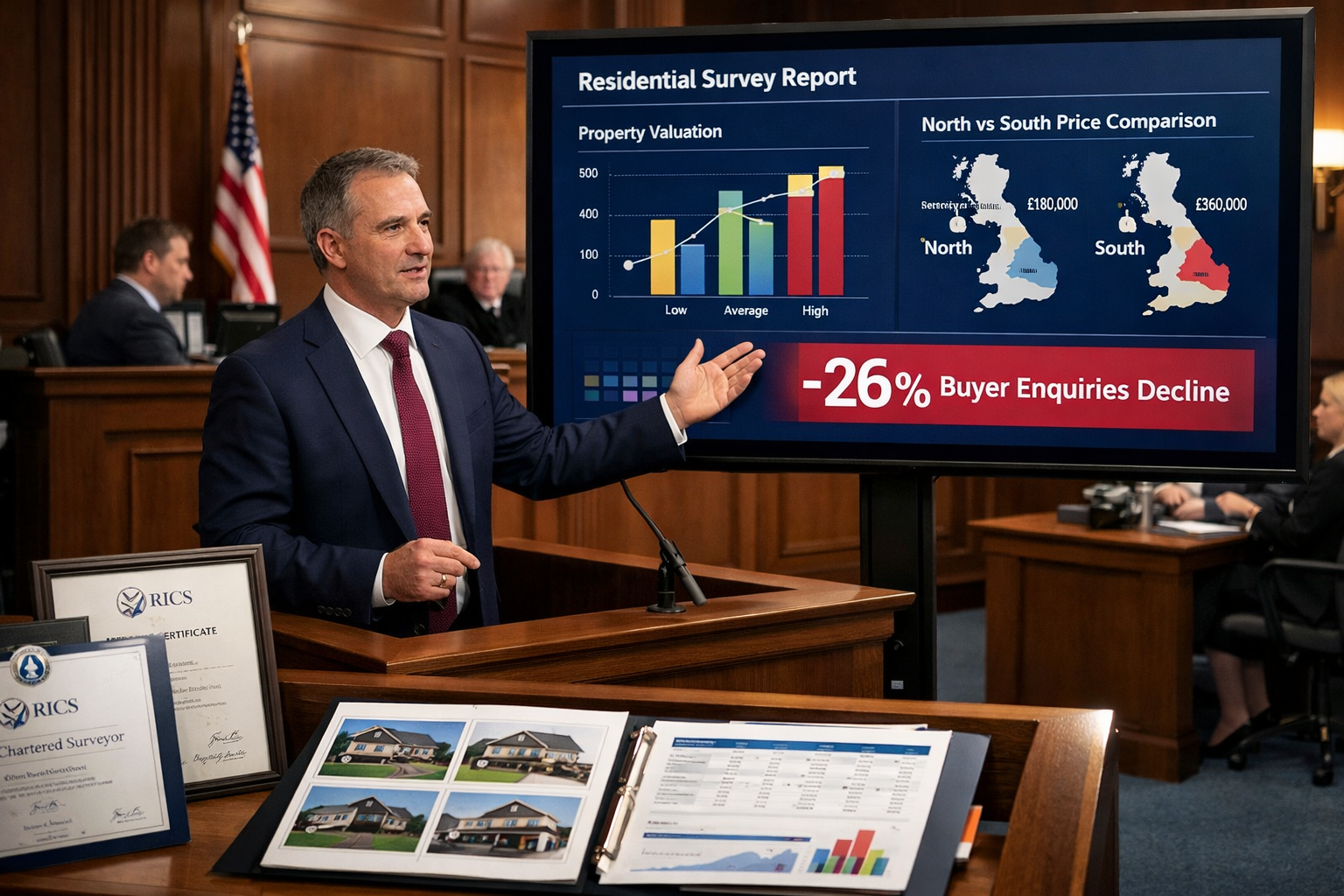
The UK property market is experiencing unprecedented turbulence in 2026, with buyer enquiries plummeting by 26% and stark regional divides creating a minefield for property valuations. As Southern markets soften while Northern regions show resilience, RICS Residential Survey 2026: Expert Witness Techniques for Regional Price Disputes in Buyer Enquiries Slump has become essential knowledge for chartered surveyors navigating increasingly contentious litigation. When buyers challenge valuations or sellers dispute survey findings amid market volatility, expert witnesses must possess both technical mastery and courtroom credibility to defend their assessments.
This comprehensive guide explores how RICS-accredited professionals can leverage specialized techniques to provide authoritative testimony in regional price disputes, ensuring their survey findings withstand legal scrutiny during this challenging market period. 📊
Key Takeaways
- Buyer enquiries have dropped 26% in 2026, creating heightened scrutiny of property valuations and increased litigation over survey findings
- Regional price disparities between resilient Northern markets and softening Southern regions require expert witnesses to demonstrate sophisticated understanding of local market dynamics
- RICS Expert Witness Certificate provides structured training and accreditation that enhances credibility in legal proceedings involving residential survey disputes
- Comprehensive documentation and defensible methodology are critical when survey valuations are challenged in the context of market uncertainty
- Cross-examination preparedness separates competent surveyors from effective expert witnesses in contentious property price disputes
Understanding the 2026 Market Context for Expert Witness Testimony
The Buyer Enquiries Slump and Its Impact on Disputes
The dramatic 26% decline in buyer enquiries throughout 2026 has fundamentally altered the landscape for residential property transactions. This slump has created a perfect storm for disputes: buyers are more cautious and questioning, sellers are defensive about valuations, and lenders are scrutinizing survey reports with unprecedented rigor.
When transactions do proceed, parties are far more likely to challenge survey findings, particularly when valuations suggest price reductions. Expert witnesses must now anticipate aggressive questioning about their methodology, comparable evidence, and regional market knowledge. The reduced transaction volume means each survey carries greater weight, and mistakes or ambiguities can quickly escalate to litigation.
For chartered surveyors providing expert witness reports, understanding this context is crucial. Courts expect witnesses to explain not just what they observed during a Level 3 full building survey, but how market conditions influenced their valuation conclusions.
The North-South Divide: Regional Price Dynamics
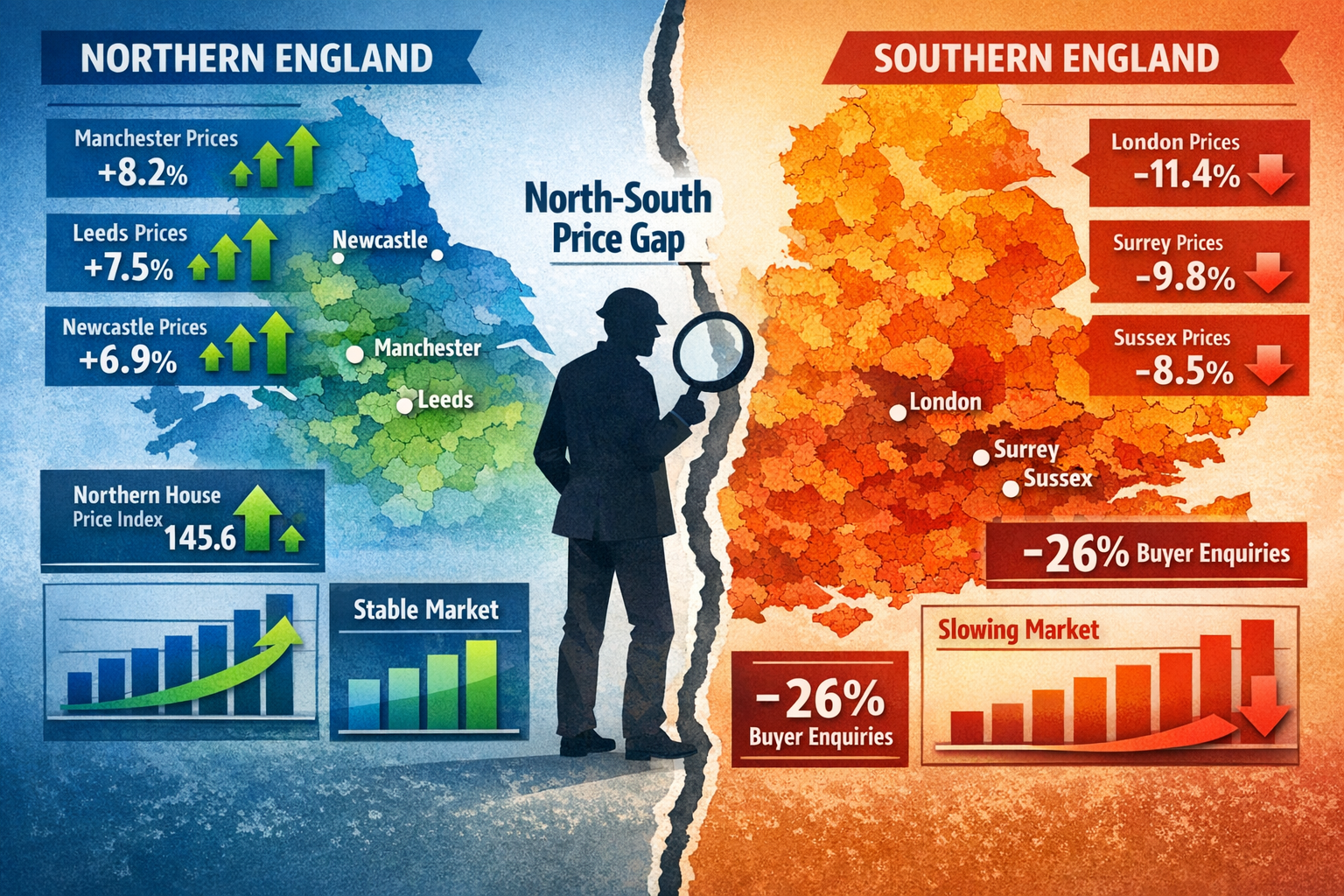
Perhaps the most significant challenge facing expert witnesses in 2026 is the stark regional divergence in property markets. Northern England has demonstrated remarkable resilience, with cities like Manchester, Leeds, and Newcastle maintaining stable prices and even modest growth. Meanwhile, Southern markets—particularly the Home Counties and outer London—have experienced softening, with asking prices declining and properties lingering on the market.
This divide creates complexity for expert testimony:
| Region | Market Condition | Key Factors | Expert Witness Considerations |
|---|---|---|---|
| Northern England | Resilient/Stable | Affordability, local employment growth, first-time buyer activity | Justify valuations against claims of overpricing; demonstrate sustainable demand |
| Southern England | Softening | High prices, mortgage affordability constraints, buyer hesitancy | Defend downward adjustments; explain market correction without undermining property fundamentally |
| London | Mixed/Variable | Micro-market variations, prime vs. secondary locations | Require granular comparable evidence; distinguish between submarkets |
| Scotland/Wales | Moderately Stable | Regional economic factors, different regulatory environment | Account for jurisdictional differences in survey standards |
Expert witnesses must demonstrate intimate knowledge of the specific regional dynamics affecting the property in question. Generic market commentary will not withstand cross-examination when opposing counsel presents contradictory local evidence.
RICS Residential Survey 2026: Expert Witness Techniques for Effective Testimony
Building Credibility Through RICS Accreditation
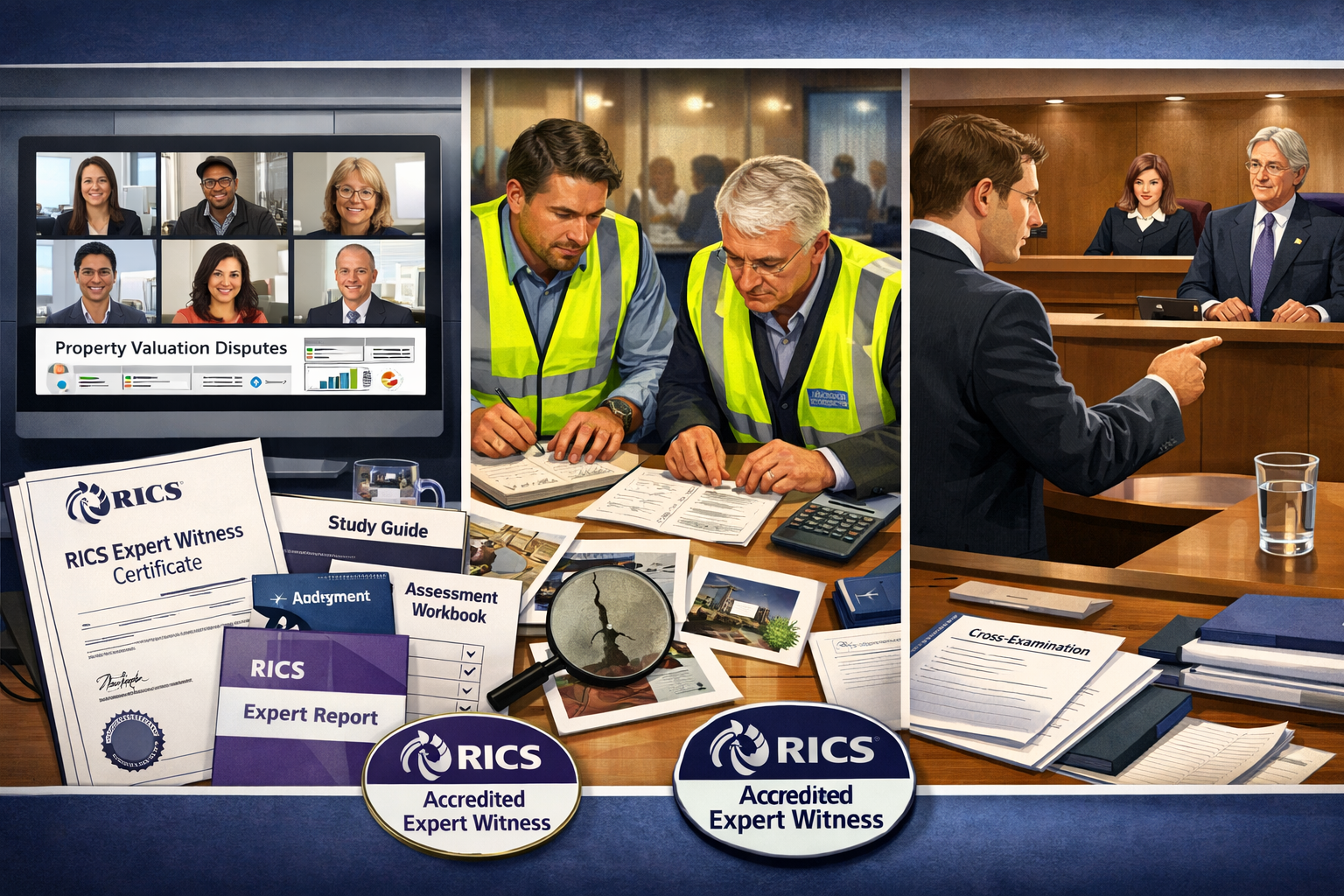
The foundation of effective expert witness work lies in establishing unimpeachable credibility. The RICS Expert Witness Certificate provides structured training specifically designed to equip professionals with the skills needed for litigation support.[1] This 12-week blended learning programme combines three interactive webinars with three online workshops, covering everything from report writing to cross-examination techniques.[1]
The programme costs £2,100 + VAT and culminates in a rigorous assessment process that includes:
- ✅ Five multiple-choice tests evaluating technical knowledge
- ✅ Expert report evaluation demonstrating written communication skills
- ✅ Cross-examination role-play simulating courtroom pressure
- ✅ Informal interview assessing overall competency[1]
Upon completion, participants can apply for RICS Accredited Expert Witness status, which serves as an industry-recognized benchmark.[1] This accreditation significantly enhances credibility when being qualified as an expert in court proceedings, particularly when opposing experts lack similar credentials.
For surveyors regularly involved in disputes over building survey findings or valuation disagreements, this investment provides substantial professional advantages.
Defensible Methodology in Regional Price Assessments
When providing expert testimony on property valuations amid the 2026 market volatility, methodology is everything. Courts require experts to demonstrate that their conclusions are based on sound, replicable processes rather than subjective judgment.
Key methodological elements include:
- Comprehensive comparable evidence: Document at least 5-7 comparable properties with detailed justification for selection criteria, adjustments for differences, and temporal considerations
- Market trend analysis: Present data showing price movements over 6-12 months in the specific locality, not just regional averages
- Adjustment transparency: Clearly explain every adjustment made to comparable evidence, with percentage or monetary values justified
- Multiple valuation approaches: Where appropriate, use both comparable method and investment method to triangulate value
- Condition assessment: Link physical defects identified in survey to specific valuation impacts with quantified repair costs
When regional markets are diverging, expert witnesses must avoid the temptation to rely on national statistics. A property in Bromley will have different market dynamics than one in Clapham or Leatherhead, even within the same broader region.
Documenting Survey Findings for Litigation Resilience
The quality of documentation during the initial survey phase directly impacts the strength of subsequent expert testimony. In 2026's contentious market, surveyors must assume that any residential survey report may eventually be scrutinized in legal proceedings.
Best practices for litigation-resilient documentation:
- 📸 Extensive photographic evidence: Capture multiple angles of all significant defects, with scale references and clear captions
- 📝 Detailed contemporaneous notes: Record observations, measurements, and reasoning during the inspection, not retrospectively
- 🔍 Explicit limitations: Clearly state any areas not inspected, reasons for limitations, and potential implications
- 💰 Quantified repair estimates: Provide specific cost ranges for identified defects, with basis for estimates documented
- 📊 Market context: Include brief market commentary relevant to the specific property and location at the time of survey
When disputes arise months after the original survey, this documentation becomes the foundation of expert testimony. Vague descriptions like "some dampness noted" will not withstand cross-examination when buyers claim undisclosed defects justify substantial price reductions.
For complex properties requiring areas of further investigation, experts must clearly document why additional specialist reports were recommended and what implications these recommendations carry for valuation.
Advanced Techniques for RICS Residential Survey 2026 Expert Witness Success
Cross-Examination Preparedness and Courtroom Demeanor
The most technically competent surveyor can fail as an expert witness without proper cross-examination skills. Legal counsel will aggressively challenge valuations, particularly when significant sums are at stake in price negotiation disputes.
Essential cross-examination techniques:
Maintain composure under pressure: Opposing counsel may attempt to provoke emotional responses or defensive behavior. Expert witnesses must remain calm, professional, and focused on facts regardless of questioning tone.
Answer only the question asked: Resist the temptation to over-explain or volunteer additional information. Concise, direct answers prevent creating new avenues for attack.
Acknowledge limitations appropriately: When uncertain about a specific detail, admit it honestly rather than speculating. Credibility is enhanced by intellectual honesty, not false omniscience.
Use visual aids effectively: Bring enlarged photographs, charts, and diagrams to court. Visual evidence is more persuasive than verbal descriptions alone.
Speak to the judge/jury, not counsel: While answering questions from lawyers, direct responses toward the decision-maker, maintaining appropriate eye contact and clear communication.
The RICS Expert Witness Certificate specifically includes cross-examination role-play to develop these skills in a controlled environment.[1] This practical experience is invaluable for surveyors transitioning from technical work to litigation support.
Addressing Regional Market Complexity in Testimony
Given the pronounced North-South divide in 2026, expert witnesses must demonstrate sophisticated understanding of micro-market dynamics. Generic statements about "the London market" or "Northern England property values" will not suffice when specific localities show divergent trends.
Strategies for addressing regional complexity:
🎯 Hyper-local comparable evidence: Focus on properties within 0.5-1 mile radius when possible, expanding only when necessary with explicit justification
🎯 Temporal precision: Distinguish between market conditions at contract date, survey date, and hearing date, explaining how each timeframe affects valuation
🎯 Submarket segmentation: Identify whether the property falls into first-time buyer, family home, luxury, or investment segments, as these have performed differently in 2026
🎯 Infrastructure and development impacts: Account for planned or completed transport links, regeneration projects, or planning changes affecting specific localities
🎯 Affordability metrics: Present mortgage affordability calculations showing how local income levels support (or constrain) pricing in the specific area
For properties in areas like Hammersmith, Fulham, or Richmond, expert witnesses should be prepared to explain how proximity to central London, local amenities, and school catchment areas create pricing premiums that may be eroding or holding firm in 2026's market conditions.
Integrating Survey Findings with Price Negotiation Disputes
Many expert witness engagements arise from disputes over negotiating house prices down after survey findings. Buyers may claim that identified defects justify substantial reductions, while sellers argue that issues are minor or already reflected in the asking price.
Expert witnesses must navigate this tension by:
Separating defect identification from valuation impact: Clearly distinguish between describing what was found during the survey and quantifying how those findings affect market value. A £10,000 repair does not automatically translate to a £10,000 price reduction.
Considering market absorption: In a buyer's market (like Southern England in 2026), defects may have amplified impact on value as buyers have alternatives. In resilient markets (Northern regions), the same defects may have minimal impact on achievable price.
Addressing buyer perception: Expert testimony should acknowledge that serious defects (structural issues, dampness, subsidence) affect not just repair costs but also buyer willingness to proceed, which influences market value beyond mere remediation expenses.
Contextualizing within transaction: Explain whether the original asking price appeared to already account for property condition, or whether the survey revealed previously unknown issues that genuinely affect value.
Providing range valuations: In uncertain markets, offering a defensible range (e.g., £475,000-£495,000) with clear explanation of factors supporting each end of the range demonstrates professional judgment rather than false precision.
This nuanced approach helps courts understand that property valuation involves professional judgment informed by market evidence, not mechanical calculation.
Specialized Considerations for RICS Residential Survey 2026 Expert Witnesses
Handling Valuation Disputes in Softening Southern Markets
Southern England's market softening presents unique challenges for expert witnesses. Properties that were valued at peak prices in 2024-2025 may now struggle to achieve those figures, creating disputes when sellers resist accepting market reality or when buyers claim excessive overvaluation.
Key considerations for Southern market disputes:
- Historical pricing context: Explain how the property's value trajectory relates to broader market movements, distinguishing between property-specific issues and market-wide corrections
- Comparable selection timing: Use only recent comparables (within 3-6 months) in rapidly changing markets, as older transactions may not reflect current conditions
- Days-on-market analysis: Present evidence of how long similar properties are taking to sell, indicating genuine market appetite at various price points
- Price reduction patterns: Document typical reduction patterns for comparable properties, showing whether asking prices are being achieved or negotiated down
- Buyer pool characteristics: Explain how mortgage affordability constraints are affecting the available buyer pool for properties in specific price brackets
For properties in areas like Chiswick, Putney, or Battersea, expert witnesses should be prepared to explain how these formerly hot markets are adjusting to new affordability realities in 2026.
Defending Valuations in Resilient Northern Markets
Conversely, Northern England's market resilience creates different expert witness challenges. Sellers may claim that expert valuations are too conservative given strong local demand, while buyers may argue that national market weakness should affect local pricing.
Strategies for Northern market testimony:
✔️ Local economic indicators: Present employment data, wage growth, and economic development specific to the locality supporting continued demand
✔️ Affordability advantage: Demonstrate how Northern property prices remain accessible to local buyers, sustaining transaction volumes despite national trends
✔️ First-time buyer activity: Show evidence of continued first-time buyer entry into the market, indicating fundamental demand rather than speculative pricing
✔️ Rental yield analysis: For investment properties, present rental yield comparisons showing Northern properties offer superior returns, supporting valuations
✔️ Supply constraints: Document limited housing supply in desirable Northern locations, explaining how this supports pricing despite broader market weakness
Expert witnesses working in areas like Romford, Ilford, or South East London should be prepared to explain how these markets bridge between London's softening and the regions' resilience, requiring particularly nuanced analysis.
Addressing Specific Dispute Scenarios
Scenario 1: Buyer Refuses to Complete After Survey
When buyers attempt to withdraw from contracts citing survey findings, expert witnesses may be engaged to assess whether identified defects genuinely justify withdrawal or whether buyers are using survey issues as pretext in a falling market.
Expert testimony should address:
- Whether defects were reasonably discoverable during initial viewing
- Whether defects are materially different from what a reasonable buyer should have anticipated
- Whether defects affect habitability, safety, or require immediate remediation
- How the defects compare to typical properties of similar age and type
Scenario 2: Seller Disputes Downward Valuation
Sellers may challenge survey valuations that come in below asking price, claiming the surveyor has undervalued the property. Expert witnesses must defend their methodology while acknowledging the inherent uncertainty in valuation.
Key defense strategies:
- Present multiple comparable transactions supporting the valuation
- Explain specific property characteristics that justify valuation relative to comparables
- Address any unique features or limitations affecting marketability
- Distinguish between seller's aspirational pricing and market evidence
Scenario 3: Lender Rejects Valuation for Mortgage Purposes
When mortgage lenders obtain different valuations than buyer's surveyors, disputes arise over which figure is correct. Expert witnesses must explain different valuation purposes and methodologies.
Critical points:
- Lender valuations prioritize security and worst-case scenarios
- Buyer survey valuations reflect market value under normal marketing conditions
- Both can be "correct" for their respective purposes
- Differences should be explained rather than one being declared "wrong"
Practical Implementation: Building an Expert Witness Practice
Developing Regional Market Intelligence Systems
To provide credible expert testimony on RICS Residential Survey 2026: Expert Witness Techniques for Regional Price Disputes in Buyer Enquiries Slump, surveyors must maintain sophisticated market intelligence systems tracking local trends in real-time.
Essential intelligence components:
📈 Transaction database: Maintain detailed records of completed sales in your operating areas, including achieved prices, days on market, and initial asking prices
📈 Market sentiment monitoring: Track local estate agent reports, mortgage approval rates, and buyer enquiry trends specific to your regions
📈 Comparable property files: Build comprehensive files for key property types in your areas, with photographs, specifications, and transaction details
📈 Economic indicators: Monitor local employment data, major employer announcements, infrastructure projects, and planning decisions
📈 Peer network: Maintain relationships with other surveyors, estate agents, and property professionals for informal market intelligence
This intelligence foundation enables confident, evidence-based testimony that withstands cross-examination scrutiny.
Continuous Professional Development for Expert Witnesses
The legal and regulatory environment for expert witnesses continues to evolve. Surveyors committed to this specialization must engage in ongoing professional development beyond the initial RICS Expert Witness Certificate.[1]
Recommended CPD activities:
- Attend court proceedings as an observer to understand judicial expectations and courtroom dynamics
- Review published judgments involving surveyor expert witnesses to learn from successful and unsuccessful testimony
- Participate in mock trial exercises and cross-examination workshops
- Study updates to Civil Procedure Rules Part 35 governing expert witness duties
- Engage with legal professionals to understand evolving standards for expert evidence
- Complete specialized training in areas like dilapidations or party wall disputes that may involve expert testimony
The investment in becoming an effective expert witness extends far beyond initial certification, requiring sustained commitment to excellence.
Ethical Considerations and Professional Duties
Expert witnesses owe their primary duty to the court, not to the party instructing them. This fundamental principle can create tension when clients pressure experts to support particular positions.
Key ethical obligations:
⚖️ Independence: Maintain complete independence from the instructing party's desired outcome
⚖️ Objectivity: Base all opinions on evidence and professional judgment, not advocacy
⚖️ Transparency: Disclose any limitations, uncertainties, or factors that might affect conclusions
⚖️ Competence: Only accept instructions within areas of genuine expertise and current knowledge
⚖️ Truthfulness: Never misrepresent facts, omit material information, or allow reports to be misleading
Violations of these duties can result in professional sanctions, exclusion of evidence, and reputational damage that ends an expert witness career.
The RICS Code of Conduct provides clear guidance on these obligations, and the Expert Witness Certificate programme specifically addresses ethical decision-making in challenging scenarios.[1]
Conclusion
The convergence of plummeting buyer enquiries, stark regional market disparities, and heightened transaction scrutiny has made 2026 a watershed year for property dispute litigation. RICS Residential Survey 2026: Expert Witness Techniques for Regional Price Disputes in Buyer Enquiries Slump represents not just a technical skillset but a critical professional competency for chartered surveyors navigating this challenging environment.
Success as an expert witness requires a multifaceted approach: impeccable credentials through RICS accreditation, sophisticated understanding of regional market dynamics, rigorous documentation practices, and polished courtroom skills. The 26% decline in buyer enquiries has intensified scrutiny of every valuation, while the North-South divide demands nuanced analysis that distinguishes between resilient and softening markets.
Surveyors who invest in developing expert witness capabilities—through formal training like the RICS Expert Witness Certificate, continuous market intelligence gathering, and practical courtroom experience—position themselves as invaluable resources during this period of market turbulence. As disputes over property valuations proliferate, the demand for credible, articulate expert witnesses will only intensify.
Actionable Next Steps
For chartered surveyors seeking to enhance their expert witness capabilities:
- Enroll in the RICS Expert Witness Certificate to gain structured training and pursue accredited status[1]
- Develop comprehensive market intelligence systems for your operating regions, tracking transaction data and local trends
- Review your current survey documentation practices to ensure litigation resilience
- Observe court proceedings involving property disputes to understand judicial expectations
- Build relationships with legal professionals who instruct expert witnesses in property matters
- Commit to ongoing CPD specifically focused on expert witness skills and legal developments
The property market may be experiencing unprecedented challenges in 2026, but for well-prepared expert witnesses, this environment presents significant professional opportunities. By mastering the techniques outlined in this guide and maintaining unwavering commitment to professional standards, RICS-accredited surveyors can provide the authoritative testimony that courts, clients, and the property market urgently need.
References
[1] Expert Witness Certificate – rics.org