

First impressions matter—especially in property transactions. In 2026, new research reveals that 58% of buyers have rejected properties based solely on exterior appearance, with 27% making that decision instantly before even stepping inside[1]. Understanding Building Survey Red Flags in Kerb Appeal: 2026 Protocols for Roofs, Paint, and Driveways That Tank Valuations has become essential for sellers, buyers, and surveyors navigating today's competitive property market.
The exterior condition of a property speaks volumes about its overall maintenance, structural integrity, and potential hidden costs. When damaged roofs trigger offer reductions from 66% of buyers, and peeling paint deters 37% of potential purchasers[1], these aren't merely cosmetic concerns—they're significant valuation factors that demand professional assessment through comprehensive Level 3 building surveys.

Key Takeaways
- Damaged roofs and gutters are the #1 valuation killer, with 66% of buyers reducing offers when these defects are present—making roof condition the most critical kerb appeal factor in 2026[1]
- Peeling paint impacts both valuations and buyer psychology, causing 45% of buyers to lower offers and deterring 37% from proceeding with viewings altogether[1]
- Neglected driveways reduce offers from 36% of buyers, yet only 30% of sellers prioritize driveway improvements, creating a significant gap in market expectations[1]
- Professional building surveys identify hidden costs behind visible exterior defects, providing essential data for budgeting repairs and restoration work
- 27% of buyers make instant rejection decisions based purely on external appearance before viewing interiors, emphasizing the critical importance of addressing kerb appeal red flags[1]
Understanding Building Survey Red Flags: The 2026 Kerb Appeal Crisis
The property market in 2026 has witnessed a fundamental shift in buyer behaviour. Kerb appeal—once considered a "nice-to-have" marketing advantage—has evolved into a critical valuation determinant that directly impacts transaction success rates and final sale prices.
The Psychology Behind Kerb Appeal Valuations
Buyers today approach properties with heightened scrutiny, particularly regarding exterior maintenance. Visible signs of disrepair deter 39% of potential buyers[1], triggering immediate concerns about hidden structural problems, deferred maintenance costs, and overall property management standards.
This psychological barrier operates on multiple levels:
- Risk perception: Exterior defects signal potential internal problems
- Cost anxiety: Buyers calculate immediate repair expenses
- Emotional response: Neglected properties fail to create the aspirational connection buyers seek
- Negotiation leverage: Visible defects provide concrete justification for offer reductions
The 2026 Valuation Impact Data
Recent comprehensive research into UK home kerb appeal trends has quantified exactly how specific exterior defects translate into financial consequences[1]:
| Exterior Defect | Buyers Reducing Offers | Buyer Deterrent Rate |
|---|---|---|
| Damaged roofs/gutters | 66% | Not separately measured |
| Peeling paint | 45% | 37% |
| Neglected driveways | 36% | Not separately measured |
| General disrepair signs | 39% (deterrent) | 39% |
| Poor neighbouring properties | 36% (deterrent) | 36% |
These statistics underscore why professional building inspections and surveys have become indispensable tools for both buyers and sellers navigating the 2026 property market.
The Seller Awareness Gap
Despite overwhelming evidence that kerb appeal directly impacts valuations, a concerning disconnect exists between buyer priorities and seller actions. Only 30% of sellers receive guidance from estate agents on improving kerb appeal[1], leaving the majority to navigate these critical decisions without professional input.
Furthermore, seller investment patterns don't always align with buyer priorities. While 50% of sellers prioritize external paintwork[1]—recognizing its importance—only 30% focus on driveway improvements[1], despite 36% of buyers reducing offers for neglected driveways.
This misalignment creates opportunities for informed buyers to negotiate substantial price reductions while highlighting the value of professional property valuations that account for these exterior condition factors.
Roof and Gutter Defects: The 66% Offer Reduction Trigger

When examining Building Survey Red Flags in Kerb Appeal: 2026 Protocols for Roofs, Paint, and Driveways That Tank Valuations, roof condition stands unequivocally as the most significant factor. 66% of buyers reduce their offers when confronted with damaged roofs or gutters[1]—a statistic that reflects both the visible nature of these defects and the substantial repair costs they represent.
Why Roof Damage Dominates Buyer Concerns
Roofs represent one of the most expensive components to repair or replace in any property. A complete roof replacement can cost £5,000-£15,000 for typical residential properties, with complex or large roofs exceeding £20,000. This financial reality immediately translates into offer reductions when defects become apparent during viewings or surveys.
Beyond immediate costs, roof damage signals:
- Water ingress risks: Potential for internal damage to ceilings, walls, and insulation
- Structural concerns: Long-term neglect may indicate broader maintenance issues
- Insurance complications: Some insurers refuse coverage or charge premiums for properties with known roof defects
- Energy efficiency problems: Damaged roofs compromise thermal performance and increase heating costs
Common Roof Red Flags in 2026 Building Surveys
Professional surveyors conducting Level 3 full building surveys identify several critical roof defects that trigger valuation concerns:
Structural Defects
- Sagging roof lines: Indicates potential rafter failure or inadequate support
- Missing or slipped tiles/slates: Creates immediate water ingress pathways
- Ridge tile deterioration: Compromises the roof's apex protection
- Valley gutter failures: High-risk areas for water penetration
Material Degradation
- Moss and algae growth: Signals moisture retention and accelerated deterioration
- Cracked or broken tiles: Particularly problematic in severe weather
- Felt underlayment failure: Often invisible from ground level but critical for waterproofing
- Flashing deterioration: Around chimneys, dormers, and roof penetrations
Gutter and Drainage Issues
- Blocked or overflowing gutters: Causes wall saturation and foundation problems
- Rusted or separated sections: Indicates deferred maintenance
- Missing downpipes: Directs water against building fabric
- Inadequate fall: Prevents proper drainage function
2026 Protocol for Roof Assessment
Modern building survey protocols for roof inspection have evolved to provide comprehensive risk assessment:
Visual Ground-Level Inspection
- Binocular examination of all visible roof surfaces
- Documentation of missing, damaged, or displaced materials
- Assessment of roof line geometry and structural integrity
- Evaluation of chimney stacks, flashings, and roof penetrations
Close-Range Inspection (where safe and accessible)
- Ladder access to gutter level for detailed examination
- Photography of defect areas for client documentation
- Material condition testing (tap tests for delamination)
- Assessment of roof void from internal access points
Specialist Equipment
- Drone surveys for comprehensive overhead documentation
- Thermal imaging to identify insulation deficiencies and moisture ingress
- Moisture meters for roof timber assessment
- Endoscopic cameras for concealed areas
For properties with significant roof concerns, surveyors often recommend sourcing extra advice from specialist roofing contractors or structural engineers to provide detailed repair specifications and costings.
Remediation Strategies and Cost Implications
When roof defects are identified, buyers and sellers face several remediation options:
Minor Repairs (£500-£2,000)
- Individual tile/slate replacement
- Gutter cleaning and minor repairs
- Repointing ridge tiles
- Flashing repairs
Moderate Interventions (£2,000-£8,000)
- Partial roof re-covering (one slope)
- Complete gutter replacement
- Valley gutter reconstruction
- Chimney stack repairs
Major Works (£8,000-£20,000+)
- Complete roof replacement
- Structural timber repairs
- Comprehensive re-roofing with insulation upgrades
- Complex chimney rebuilding
Understanding these cost implications enables informed negotiation. Buyers armed with detailed survey reports can justify offer reductions based on documented repair requirements, while sellers can address issues proactively to maintain asking prices.
Paint Condition Protocols: The 45% Valuation Factor
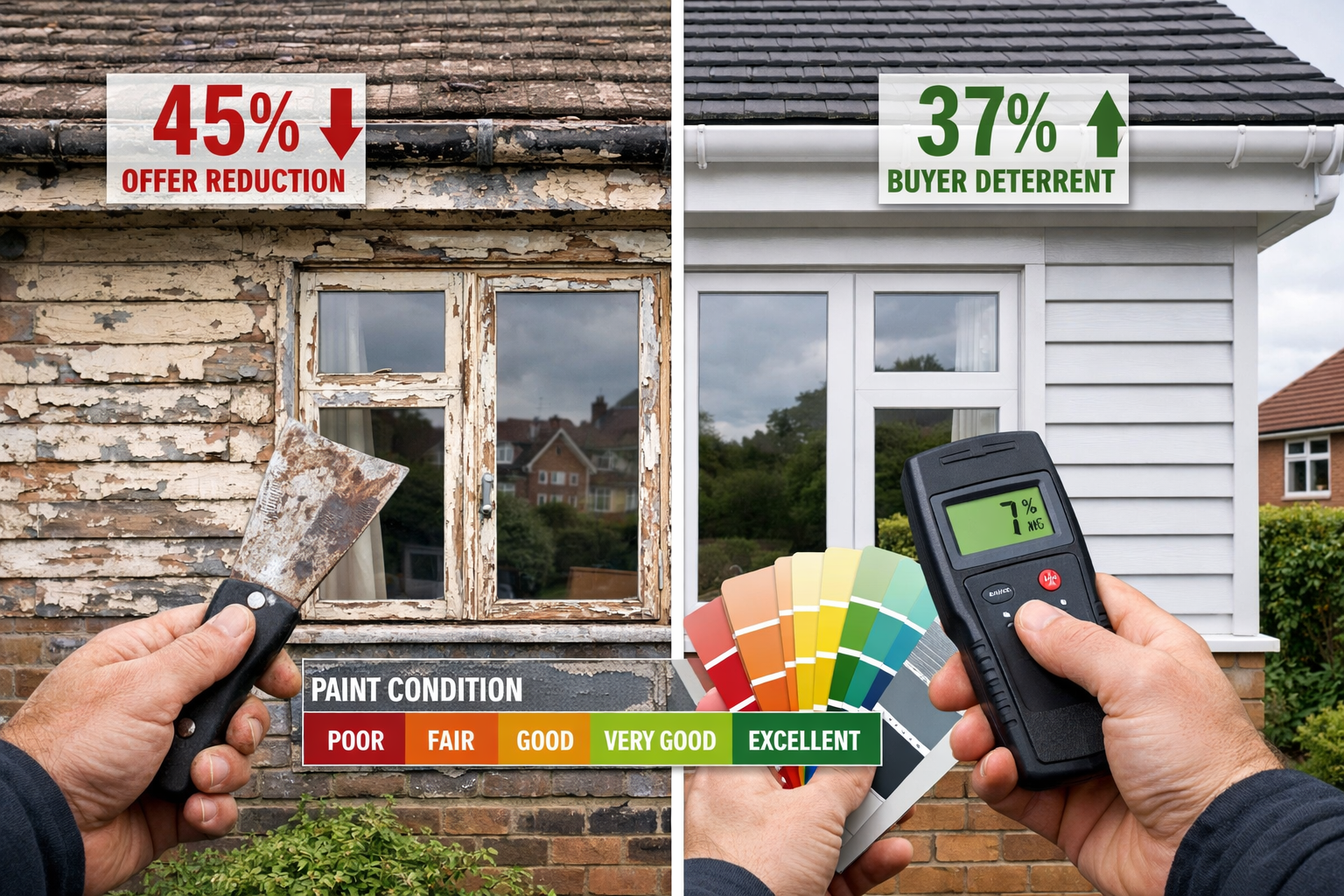
External paintwork occupies a unique position in Building Survey Red Flags in Kerb Appeal: 2026 Protocols for Roofs, Paint, and Driveways That Tank Valuations. While less structurally critical than roof integrity, paint condition creates immediate visual impact that influences both buyer psychology and property valuations. 45% of buyers reduce offers when confronted with peeling paint, and 37% report being deterred from purchasing altogether[1].
The Dual Function of External Paint
External paint serves two critical purposes that extend beyond aesthetics:
Protective Function 🛡️
- Weather protection for timber elements (fascias, soffits, window frames)
- Moisture barrier preventing wood rot and decay
- UV protection reducing material degradation
- Thermal performance contribution through reflective properties
Visual Communication 👁️
- Immediate indicator of property maintenance standards
- Psychological signal of owner care and attention
- Market positioning statement (premium vs. neglected)
- Neighbourhood context and comparative appearance
When paint fails, both functions deteriorate simultaneously—creating practical problems while broadcasting maintenance neglect to every potential buyer.
Critical Paint Assessment Areas
Professional building surveys examine external paintwork systematically across key property elements:
Timber Components
- Window frames and sills: High-exposure areas prone to moisture damage
- Fascia and soffit boards: Critical junction between roof and walls
- External doors and frames: High-traffic areas showing wear patterns
- Barge boards and gable ends: Often neglected in maintenance schedules
- Decorative timber features: Bay windows, porches, and architectural details
Rendered and Masonry Surfaces
- Painted render: Cracking, flaking, or moisture-related failures
- Brick paint: Particularly problematic when trapping moisture
- Decorative masonry features: Quoins, lintels, and architectural elements
- Boundary walls and gates: Contributing to overall kerb appeal impression
Paint Failure Indicators and Underlying Issues
Peeling paint rarely exists in isolation. Surveyors trained in building materials assessments recognize that paint failure often signals deeper problems:
Surface-Level Failures
- Flaking and peeling: Inadequate preparation or moisture-related adhesion loss
- Blistering: Moisture trapped beneath paint film
- Chalking: UV degradation of paint binders
- Discoloration: Algae growth, pollution, or substrate bleeding
Substrate Problems
- Wood rot: Wet or dry rot requiring timber replacement
- Render deterioration: Loss of adhesion, cracking, or spalling
- Moisture ingress: Systematic water penetration issues
- Structural movement: Cracks indicating settlement or subsidence
2026 Paint Condition Assessment Protocol
Modern survey protocols employ systematic evaluation criteria:
Visual Inspection Standards
- Close-range examination of all painted surfaces
- Documentation using standardized condition grading (1-5 scale)
- Photography of representative areas and specific defects
- Comparison with age-appropriate condition expectations
Physical Testing Methods
- Scrape tests: Assessing paint adhesion and layer build-up
- Moisture meter readings: Identifying hidden dampness beneath paint
- Tap tests: Detecting render delamination or timber decay
- Probe tests: Assessing timber soundness in suspect areas
Grading System Example
| Grade | Condition | Action Required |
|---|---|---|
| 1 | Excellent – Recently decorated | Routine maintenance only |
| 2 | Good – Minor wear, intact protection | Monitor, redecorate within 2-3 years |
| 3 | Fair – Visible wear, some failures | Redecoration recommended within 1 year |
| 4 | Poor – Significant failures, protection compromised | Immediate attention required |
| 5 | Failed – Extensive damage, substrate at risk | Urgent remedial work essential |
Remediation Approaches and Investment Returns
Addressing paint defects offers sellers one of the highest returns on investment for kerb appeal improvements. 50% of sellers prioritize external paintwork[1], recognizing its impact on buyer perceptions.
Cost-Effective Interventions
- Spot repairs and touch-ups (£200-£500): Addressing isolated failures
- Single-element repainting (£500-£1,500): Windows, doors, or fascias
- Comprehensive external redecoration (£2,000-£6,000): Complete property refresh
- Render repair and redecoration (£3,000-£10,000): Addressing substrate issues
Strategic Timing Considerations
- Spring/early summer optimal for paint adhesion and drying
- Avoid painting during wet or freezing conditions
- Allow adequate drying time between preparation and topcoats
- Consider weather-resistant modern paint technologies
For buyers, documented paint condition provides negotiation leverage. A comprehensive survey detailing paint failures, underlying timber rot, and remediation costs justifies offer reductions while providing a clear roadmap for post-purchase improvements.
Understanding what to look out for when buying an old house includes recognizing that paint condition often reveals broader maintenance patterns affecting the entire property.
Driveway Defects: The 36% Overlooked Valuation Risk
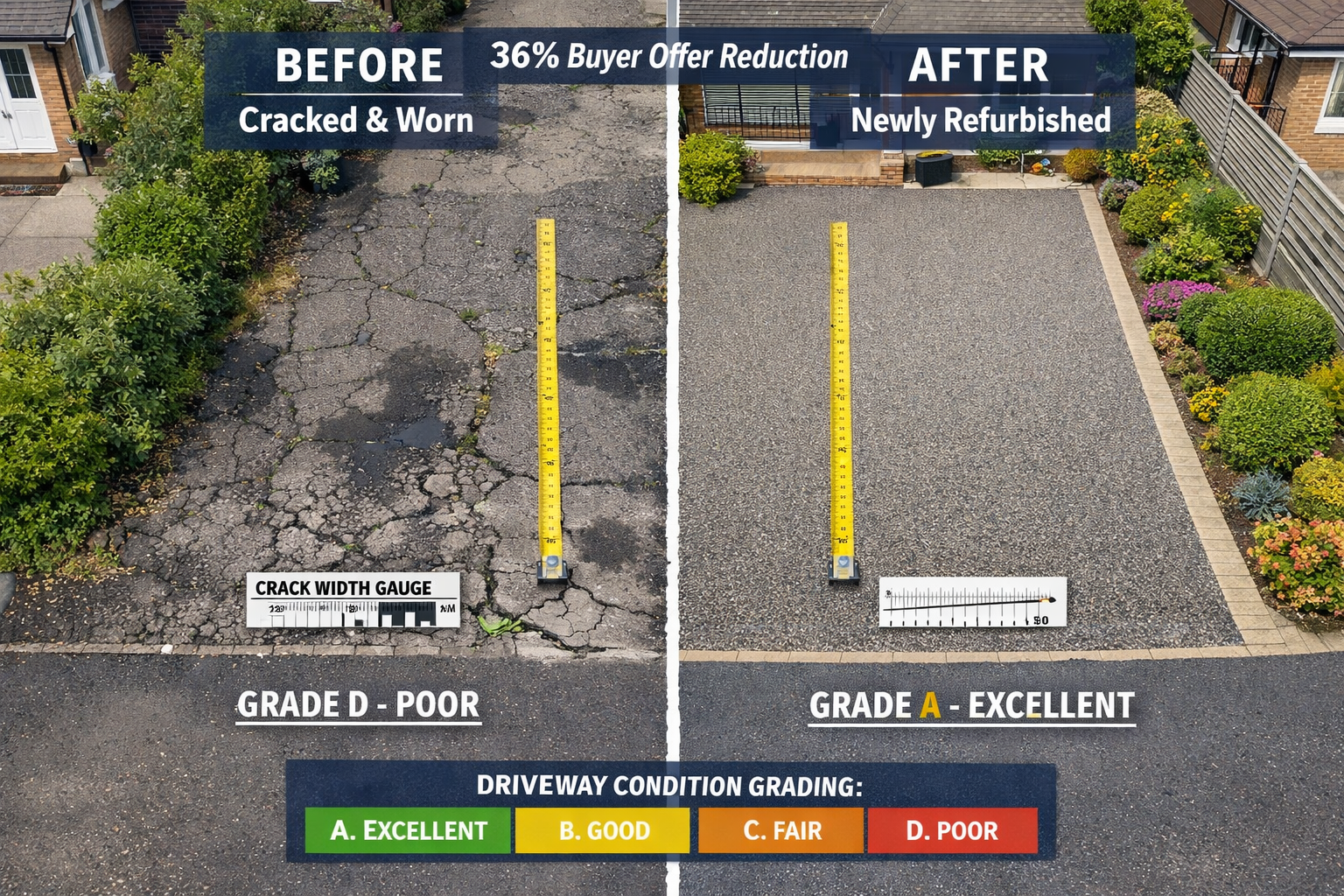
Driveways represent a fascinating paradox in Building Survey Red Flags in Kerb Appeal: 2026 Protocols for Roofs, Paint, and Driveways That Tank Valuations. Despite 36% of buyers reducing offers due to neglected driveways[1], only 30% of sellers prioritize driveway improvements[1]—creating a significant market disconnect that savvy buyers and sellers can exploit.
Why Driveways Matter More Than Sellers Realize
Driveways occupy a unique position in property assessment:
Functional Importance 🚗
- Primary access route for vehicles and pedestrians
- First physical interaction point with the property
- Drainage management for surface water
- Foundation protection through proper water direction
Visual Dominance 👀
- Often the largest single visual element in front gardens
- Frames the approach to the property entrance
- Sets expectations for interior condition
- Contributes significantly to neighbourhood aesthetic standards
Investment Signal 💰
- Expensive to replace (£2,000-£10,000+)
- Deferred maintenance indicator
- Reflects owner's financial priorities
- Suggests potential for other hidden neglect
Common Driveway Red Flags
Professional surveyors identify multiple driveway defects that trigger buyer concerns:
Surface Deterioration
- Cracking and crazing: Indicates age, poor installation, or substrate movement
- Pothole formation: Safety hazard and drainage failure indicator
- Surface spalling: Freeze-thaw damage or poor material quality
- Weed growth: Signals inadequate maintenance and accelerates deterioration
- Oil staining: Aesthetic concern and potential environmental issue
Structural Issues
- Settlement and subsidence: Uneven surfaces indicating foundation problems
- Edge deterioration: Loss of containment and progressive failure
- Drainage failures: Ponding water causing accelerated damage
- Tree root damage: Progressive heaving and cracking
Material-Specific Problems
- Tarmac: Rutting, cracking, and surface breakdown
- Block paving: Sinking blocks, weed growth, and pattern disruption
- Concrete: Cracking, spalling, and discoloration
- Gravel: Spreading, thinning, and weed infiltration
- Resin-bound: Cracking, discoloration, and loose aggregate
2026 Driveway Assessment Protocol
Modern building surveys employ comprehensive driveway evaluation methods:
Visual Survey Components
- Overall condition grading using standardized criteria
- Measurement and documentation of significant defects
- Assessment of drainage adequacy and water flow patterns
- Evaluation of boundary conditions and edge restraints
- Consideration of gradient and accessibility standards
Technical Evaluation
- Fall and drainage assessment: Ensuring water directs away from property
- Substrate condition: Identifying foundation and base layer issues
- Material lifespan estimation: Calculating remaining service life
- Replacement cost calculation: Providing accurate remediation budgets
Contextual Factors
- Comparison with neighbouring properties
- Assessment of street parking alternatives
- Evaluation of off-street parking capacity
- Consideration of planning and permitted development implications
Remediation Options and Cost Analysis
Driveway improvements range from minor repairs to complete replacement:
Minor Interventions (£200-£1,000)
- Crack filling and surface sealing
- Weed removal and preventative treatment
- Pressure washing and cleaning
- Minor patching and spot repairs
Moderate Improvements (£1,000-£3,000)
- Resurfacing existing tarmac
- Block paving releveling and sand replacement
- Partial area replacement
- Drainage improvement works
Major Replacement (£2,000-£10,000+)
- Complete driveway removal and replacement
- Substrate improvement and proper base installation
- Upgraded materials (resin-bound, quality block paving)
- Integrated drainage systems
Material Cost Comparison (typical 50m² driveway)
- Gravel: £1,000-£2,500
- Tarmac: £2,000-£4,000
- Concrete: £2,500-£5,000
- Block paving: £3,000-£6,000
- Resin-bound: £4,000-£8,000
- Natural stone: £6,000-£12,000+
The Strategic Advantage for Buyers and Sellers
Understanding driveway valuation impact creates opportunities:
For Buyers 📊
- Use documented driveway defects to justify offer reductions
- Obtain detailed remediation quotes before negotiation
- Recognize that driveway replacement offers design customization opportunities
- Consider whether driveway condition reflects broader property maintenance
For Sellers 📈
- Address driveway issues before marketing to avoid buyer deterrence
- Recognize that relatively modest investment yields disproportionate perception improvement
- Consider that fresh driveways create powerful first impressions
- Understand that 36% of potential buyers will reduce offers if neglect is visible[1]
The gap between buyer priorities (36% reducing offers) and seller investment (only 30% prioritizing improvements) suggests many sellers leave money on the table by neglecting this critical kerb appeal element.
Comprehensive Survey Strategies: Integrating Kerb Appeal into Professional Assessments
The 2026 property market demands that building surveys extend beyond traditional structural assessment to incorporate comprehensive kerb appeal evaluation. Understanding Building Survey Red Flags in Kerb Appeal: 2026 Protocols for Roofs, Paint, and Driveways That Tank Valuations requires integrated assessment methodologies that connect visible exterior defects with underlying structural, maintenance, and valuation implications.
The Evolution of Survey Protocols
Traditional building surveys focused primarily on structural integrity, damp, and major defects. However, with 58% of buyers rejecting properties based on exterior appearance[1], modern survey protocols must address kerb appeal systematically.
Contemporary Level 3 building surveys now incorporate:
- Comprehensive exterior condition assessment with photographic documentation
- Valuation impact analysis linking defects to likely buyer responses
- Prioritized remediation recommendations with cost estimates
- Comparative market context considering neighbourhood standards
Multi-Disciplinary Assessment Approach
Effective kerb appeal evaluation requires expertise across multiple domains:
Structural Engineering Perspective
- Identifying whether visible defects indicate underlying structural issues
- Assessing whether cosmetic problems mask serious structural failures
- Evaluating foundation, wall, and roof structural integrity
- Determining if repairs require structural intervention
Building Materials Expertise
- Understanding material lifecycles and expected performance
- Identifying appropriate repair and replacement materials
- Assessing compatibility of proposed remediation approaches
- Evaluating modern material alternatives and performance characteristics
Valuation Insight
- Quantifying the financial impact of identified defects
- Providing market-based evidence for offer adjustments
- Comparing property condition with local market standards
- Advising on cost-benefit analysis of remediation investments
Red Flag Prioritization Matrix
Not all kerb appeal defects carry equal weight. Professional surveyors employ prioritization frameworks:
Critical Priority (Immediate Valuation Impact)
- Damaged roofs with active water ingress
- Structural movement visible in external walls
- Significant timber decay in load-bearing elements
- Drainage failures causing foundation saturation
High Priority (Significant Buyer Deterrent)
- Extensive paint failure exposing timber to weather
- Driveway safety hazards (major potholes, trip hazards)
- Gutter failures causing wall saturation
- Visible signs of deferred maintenance across multiple elements
Medium Priority (Negotiation Leverage)
- Cosmetic paint deterioration without substrate damage
- Minor driveway surface wear
- Garden boundary deterioration
- Dated but functional external features
Low Priority (Minor Cosmetic Issues)
- Isolated minor paint touch-ups required
- Garden maintenance and landscaping
- Minor cosmetic improvements
- Personal preference updates
Integrating Environmental and Context Factors
Modern building surveys recognize that kerb appeal assessment extends beyond the property boundary. 36% of buyers are deterred by neighbouring properties in poor condition[1], making contextual evaluation essential.
Comprehensive surveys now consider:
- Neighbourhood maintenance standards: Comparative condition assessment
- Environmental factors: Exposure to pollution, coastal conditions, tree coverage
- Planning constraints: Conservation areas, listed building considerations
- Future risk factors: Climate change implications, flood risk, subsidence susceptibility
For properties in environmentally sensitive locations, environmental issues assessment becomes particularly important.
Actionable Survey Deliverables
Effective building surveys translate technical findings into actionable intelligence:
For Buyers 🏠
- Defect summary with valuation impact: Clear connection between identified issues and offer justification
- Prioritized remediation schedule: Immediate vs. deferred work identification
- Cost estimates with contingency: Realistic budgeting for repairs and restoration
- Negotiation strategy recommendations: Evidence-based approach to price discussions
For Sellers 💼
- Pre-sale condition assessment: Identifying issues likely to emerge in buyer surveys
- Investment prioritization: Highest-return improvements for market positioning
- Realistic pricing guidance: Accounting for condition factors
- Remediation specifications: Clear scope for contractor engagement
For Both Parties ⚖️
- Photographic evidence: Comprehensive documentation of all identified issues
- Specialist referral recommendations: When additional expertise is required
- Regulatory compliance assessment: Building control and planning considerations
- Long-term maintenance planning: Lifecycle cost projections
Understanding the Consequences of Inaction
The 2026 market demonstrates clear consequences for ignoring kerb appeal red flags. Understanding the consequences of failing to act on survey findings helps both buyers and sellers make informed decisions:
For Sellers Ignoring Issues
- Extended time on market as buyers are deterred
- Multiple offer reductions as each buyer's survey identifies problems
- Eventual forced price reductions exceeding remediation costs
- Reputational damage in local market
For Buyers Proceeding Without Surveys
- Unexpected repair costs exceeding purchase savings
- Potential safety hazards in occupied property
- Difficulty obtaining insurance or mortgages
- Reduced future resale value
Conclusion: Mastering 2026 Kerb Appeal Protocols for Valuation Protection
The 2026 property market has definitively established that kerb appeal transcends aesthetic preference—it represents a critical valuation determinant with quantifiable financial consequences. Understanding Building Survey Red Flags in Kerb Appeal: 2026 Protocols for Roofs, Paint, and Driveways That Tank Valuations equips buyers, sellers, and property professionals with the knowledge to navigate transactions strategically.
Key Insights for Market Success
The research is unequivocal: damaged roofs trigger offer reductions from 66% of buyers, peeling paint from 45%, and neglected driveways from 36%[1]. These aren't isolated concerns—they represent systematic buyer responses that directly impact property values and transaction success rates.
More significantly, 27% of buyers make instant rejection decisions based purely on external appearance[1], meaning that kerb appeal defects can eliminate potential buyers before negotiations even begin. This psychological barrier creates tangible financial consequences that far exceed the cost of addressing underlying issues.
Actionable Next Steps
For Property Buyers 🔍
- Commission comprehensive building surveys that explicitly address kerb appeal factors and valuation implications
- Document all exterior defects with photographic evidence and professional cost estimates
- Use survey findings strategically in negotiations, connecting visible defects to offer reductions
- Consider remediation timelines when planning post-purchase improvements
- Assess neighbourhood context to understand comparative property standards
For Property Sellers 🏡
- Obtain pre-sale surveys to identify issues before buyer surveys reveal them
- Prioritize high-impact improvements: roofs, external paint, and driveways deliver maximum return
- Address visible defects proactively to avoid buyer deterrence and offer reductions
- Obtain professional cost estimates for any issues you choose not to address, enabling transparent discussions
- Consider market positioning relative to neighbourhood standards and buyer expectations
For Property Professionals 🎯
- Integrate kerb appeal assessment into standard survey protocols and valuation methodologies
- Provide quantified valuation impact analysis connecting defects to market evidence
- Offer prioritized remediation recommendations with realistic cost estimates
- Educate clients about the financial implications of exterior condition factors
- Maintain current knowledge of market trends and buyer behaviour patterns
The Strategic Advantage of Professional Assessment
The gap between buyer priorities and seller awareness creates opportunities for informed market participants. With only 30% of sellers receiving professional guidance on kerb appeal improvements[1], those who engage qualified chartered surveyors gain significant competitive advantages.
Professional building surveys provide the evidence, analysis, and strategic guidance necessary to navigate the 2026 property market successfully—whether buying, selling, or simply maintaining property value.
Final Perspective
Kerb appeal red flags in roofs, paint, and driveways represent more than maintenance issues—they're market signals that inform buyer decisions, justify valuation adjustments, and ultimately determine transaction success. Understanding the 2026 protocols for identifying, assessing, and addressing these factors transforms property transactions from uncertain negotiations into evidence-based strategic decisions.
The properties that succeed in today's market aren't necessarily the newest or most expensive—they're the ones that demonstrate consistent maintenance, address visible defects proactively, and present confidently to discerning buyers armed with comprehensive survey information.
For expert guidance on building surveys, property valuations, and comprehensive property assessments, contact professional chartered surveyors who understand the critical connection between kerb appeal and property valuations in the 2026 market.
References
[1] Uk Home Kerb Appeal Trends Report 2026 – thebespokesignhouse.com