

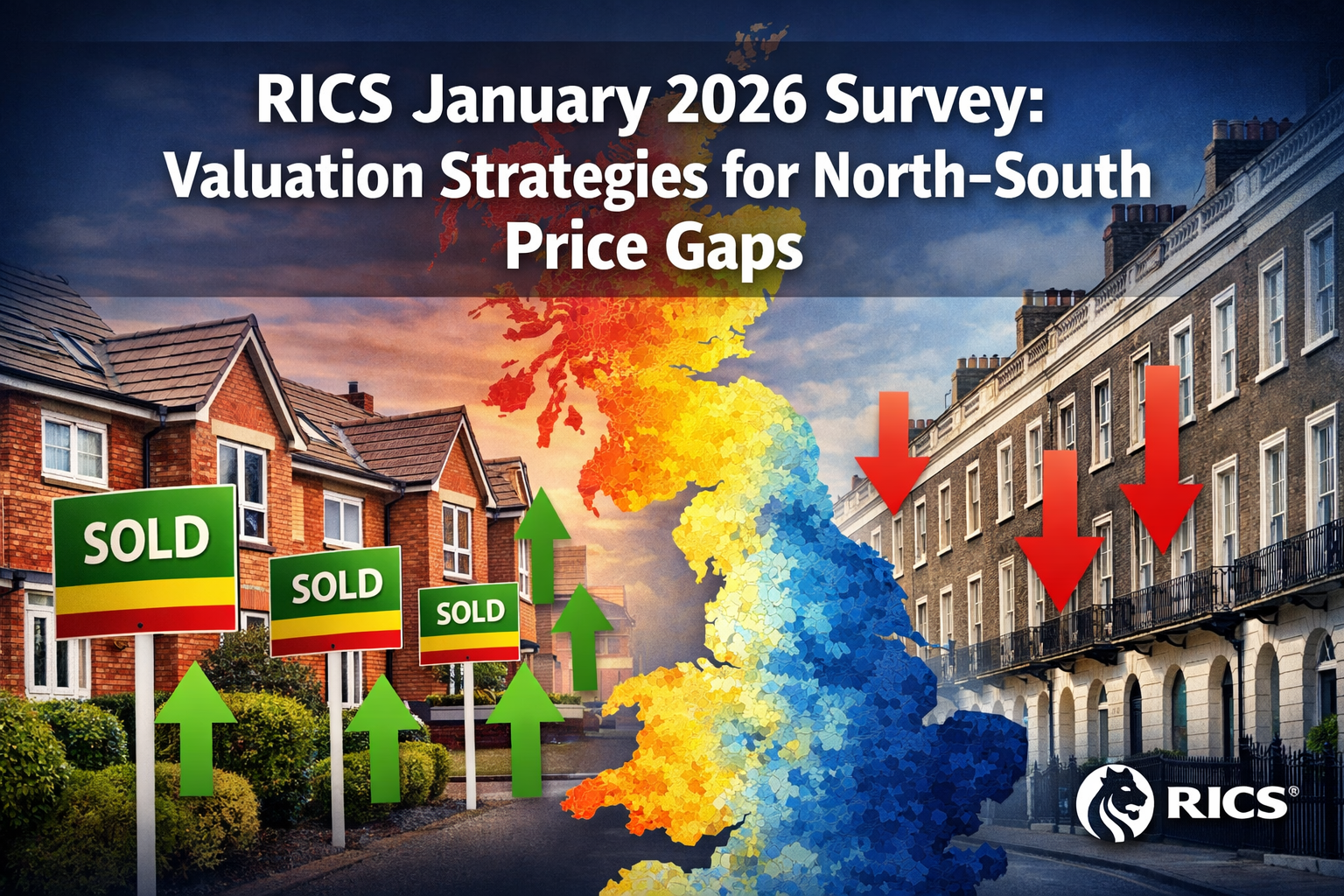
The UK residential property market stands at a pivotal crossroads in 2026. While national house prices show tentative signs of stabilization after months of decline, a striking geographic divide is reshaping the valuation landscape. The RICS January 2026 Residential Survey Insights: Valuation Strategies for Widening North-South Price Gaps reveal that Scotland, Northern Ireland, and northern English regions are experiencing robust growth, while London and the South East continue to struggle with affordability pressures and subdued demand.
For chartered surveyors and property professionals, these diverging regional trends demand sophisticated valuation approaches that account for local market dynamics, economic conditions, and future price trajectories. Understanding how to accurately assess property values during this recovery phase is essential for investors, lenders, and homeowners navigating an increasingly complex market.
Key Takeaways
- 📊 National house prices stabilizing with net balance improving from -19% in October 2025 to -10% in January 2026, signaling a turning point in market momentum
- 🗺️ Regional divergence intensifying as Scotland, Northern Ireland, and North West England lead price growth while London and South East lag significantly behind
- 🏠 Transaction activity strengthening with agreed sales at -9%, the least negative reading since June 2025, indicating genuine market recovery
- 💰 12-month price expectations surge to +43%, the most optimistic outlook since February 2025, suggesting sustained confidence in medium-term recovery
- 🔑 Valuation strategies must adapt to account for regional variations, supply constraints, and mortgage rate sensitivity in an uneven recovery environment
Understanding the RICS January 2026 Residential Survey Insights: National Market Stabilization

The January 2026 RICS UK Residential Market Survey marks a significant inflection point for the national housing market. After experiencing sustained downward pressure throughout late 2025, key indicators now point toward stabilization and early recovery.
National Price Trends Show Improvement
The net balance for house prices over the past three months stood at -10% in January 2026, representing a substantial improvement from the low of -19% recorded in October 2025 [1]. This steady progression indicates that the rate of price decline has slowed considerably, with some regions already experiencing positive price growth.
This stabilization reflects several converging factors:
- Easing inflation pressures allowing the Bank of England to maintain a more accommodative stance
- Improved consumer confidence as economic uncertainty gradually diminishes
- Pent-up demand from buyers who postponed decisions during the 2025 downturn
- Limited housing supply providing a floor for price corrections in many areas
Buyer Demand Accelerating Across the Market
New buyer enquiries improved significantly in January, with the net balance rising to -15% from -21% in December and -29% in November [1]. This three-month progression demonstrates that demand-side pressures are easing rapidly, bringing more prospective purchasers back into the market.
The acceleration in buyer interest has translated into tangible transaction activity. Agreed sales recorded a net balance of -9%, the least negative reading since June 2025 [1]. This represents the strongest sales momentum in over six months and suggests that the market is moving beyond mere enquiry activity toward completed transactions.
For chartered surveyors across London and other major markets, this improvement in transaction volumes creates increased demand for accurate property valuations that reflect current market conditions.
Forward-Looking Expectations Signal Confidence
Perhaps most significantly, the 12-month price expectations reached a net balance of +43% in January 2026, representing the most positive outlook since February 2025 [1]. This substantial shift in sentiment indicates that market participants anticipate sustained recovery over the coming year, despite short-term caution.
Similarly, expectations for sales over the next twelve months surged to +35%, the strongest reading since December 2024 [1]. This optimism contrasts with more measured three-month expectations of +4%, reflecting ongoing economic uncertainty but medium-term confidence in market fundamentals.
RICS January 2026 Residential Survey Insights: Regional Divergence and North-South Price Gaps

While national indicators suggest stabilization, the RICS January 2026 Residential Survey Insights: Valuation Strategies for Widening North-South Price Gaps highlight a striking geographic divide that is reshaping the UK property landscape.
Northern Regions Leading Price Growth
Scotland and Northern Ireland are experiencing the strongest price performance in the UK residential market, with sustained upward trends that contrast sharply with southern regions [1]. The North West and North of England are also reporting positive price momentum, benefiting from:
✅ Improved affordability ratios compared to southern markets
✅ Strong regional economies with growing employment opportunities
✅ Migration patterns as remote work enables relocation from expensive southern cities
✅ Infrastructure investment enhancing connectivity and desirability
✅ First-time buyer activity concentrated in more accessible price points
For professionals providing chartered surveyor services in North London and North West London, understanding these regional dynamics is essential when advising clients on investment decisions and valuation approaches.
Southern Markets Continue to Lag
In stark contrast, London, the South East, South West, and East Anglia continue to underperform relative to the national average [1]. These regions face persistent challenges:
- Affordability constraints limiting buyer pools, particularly for first-time purchasers
- Higher mortgage costs having disproportionate impact on expensive properties
- Economic uncertainty affecting high-value discretionary purchases
- Stamp duty implications creating transaction friction at higher price points
- Supply overhang in certain segments, particularly new-build apartments
Despite these headwinds, conditions in southern regions have shown modest improvement from their 2025 lows. Areas such as Fulham, Hampstead, and Richmond are experiencing pockets of resilience, particularly in prime residential segments with strong fundamentals.
The Widening Gap: Implications for Valuations
This geographic divergence creates significant challenges for property valuation. A one-size-fits-all approach no longer reflects market realities, requiring surveyors to:
- Apply location-specific adjustments based on regional market conditions
- Weight comparable evidence differently depending on transaction recency and regional trends
- Consider migration patterns and demographic shifts affecting local demand
- Assess infrastructure developments that may enhance or diminish location desirability
- Evaluate rental yields which vary significantly between regions
The widening north-south price gap also affects specialized valuation services, including matrimonial valuations where accurate regional context is essential for equitable settlements, and SIPP pension valuations where property location significantly impacts long-term investment returns.
Supply-Side Constraints Exacerbate Regional Differences
New property instructions continue showing flat month-on-month movement with a net balance of +1% [2], indicating that limited stock remains a fundamental market constraint. This supply shortage affects regions differently:
| Region | Supply Impact | Price Pressure |
|---|---|---|
| Scotland/Northern Ireland | Severe shortage | Strong upward pressure |
| North West England | Moderate shortage | Moderate upward pressure |
| London/South East | Balanced to slight surplus | Neutral to slight downward pressure |
| South West/East Anglia | Variable by sub-market | Mixed pressure |
In high-demand northern regions, supply constraints prevent price corrections even when affordability becomes stretched. Conversely, southern markets have sufficient stock in many segments to absorb demand without generating price growth.
Valuation Strategies for the RICS January 2026 Residential Survey Insights: Practical Approaches

The complex market dynamics revealed by the RICS January 2026 Residential Survey Insights: Valuation Strategies for Widening North-South Price Gaps require sophisticated valuation methodologies that account for regional divergence, market momentum, and forward-looking indicators.
Comparative Method: Adjusting for Regional Trends
The comparative method remains the primary valuation approach for residential properties, but requires careful calibration in the current environment:
Regional Adjustment Factors
Surveyors must apply location-specific adjustments when selecting and weighting comparable evidence:
- Northern regions: Apply positive time adjustments to older comparables (typically 1-3% per quarter) to reflect rising markets
- Southern regions: Apply neutral or slightly negative time adjustments depending on sub-market conditions
- Cross-regional comparables: Use with extreme caution, ensuring adjustments reflect true market differences
Transaction Recency Weighting
In rapidly changing markets, recent transactions carry significantly more weight than historical evidence:
- Prioritize sales agreed within the past 3 months
- Apply reduced weighting to sales from more than 6 months ago
- Consider withdrawn listings as negative indicators of pricing expectations
Quality and Location Micro-Adjustments
Within regions, micro-location factors have become increasingly important:
- Proximity to transport links (especially in commuter markets)
- School catchment areas (particularly in family-oriented suburbs)
- Local amenities and green spaces (enhanced importance post-pandemic)
- Neighborhood demographic trends and gentrification indicators
Income Approach: Rental Market Considerations
The rental market provides important valuation context, particularly given the emerging strength in tenant demand reported in the January 2026 survey [1].
Rental Yield Analysis
With rental prices expected to rise (net balance of +28%) [2], investment valuations must consider:
- Current gross and net rental yields by region
- Anticipated rental growth trajectories over hold periods
- Landlord cost pressures (maintenance, compliance, taxation)
- Tenant demand sustainability and demographic trends
Capitalization Rate Selection
Regional divergence affects appropriate capitalization rates:
| Market Segment | Cap Rate Range | Justification |
|---|---|---|
| Prime London | 3.0-4.5% | Low yields, capital appreciation focus |
| Regional Cities | 4.5-6.5% | Balanced yield/growth profile |
| Northern Markets | 5.5-7.5% | Higher yields, moderate growth |
| Student/HMO | 6.0-8.5% | Higher yields, management intensity |
For annual tax valuations and capital gains assessments, accurate rental income projections are essential for determining property investment returns and tax liabilities.
Cost Approach: Replacement Value Considerations
While less commonly used for standard residential valuations, the cost approach remains relevant for:
- Unique or specialized properties without comparable sales
- Insurance reinstatement cost valuations where replacement cost is primary concern
- New-build properties in emerging markets without transaction history
- Properties with significant redevelopment potential
Regional Construction Cost Variations
Building costs vary significantly across the UK:
- London and South East: £2,000-3,500+ per sqm for standard residential
- Regional cities: £1,500-2,500 per sqm
- Northern regions: £1,200-2,000 per sqm
These variations affect not only replacement cost calculations but also development viability assessments and residual land valuations.
Incorporating Forward-Looking Indicators
The strong 12-month expectations (+43% for prices, +35% for sales) [1] provide important context for valuations with future-dated effective dates or investment horizons:
Market Momentum Adjustments
When valuing for future transactions or investment analysis:
- Consider regional momentum indicators from RICS surveys
- Apply probability-weighted scenarios (optimistic, base, pessimistic)
- Adjust discount rates to reflect market uncertainty and volatility
- Document assumptions clearly for client understanding and professional liability
Mortgage Rate Sensitivity
RICS Chief Economist Simon Rubinsohn emphasized that "sustained momentum will depend heavily on the trajectory of mortgage rates" [1]. Valuations should consider:
- Current mortgage availability and pricing by loan-to-value band
- Interest rate sensitivity of target buyer demographics
- Affordability constraints at different price points
- Alternative financing options (family assistance, equity release)
Technology-Enhanced Valuation Approaches
Modern surveyors increasingly leverage technology to enhance valuation accuracy:
🔧 Automated Valuation Models (AVMs): Useful for initial estimates and validation checks, but require professional judgment overlay
🔧 Geographic Information Systems (GIS): Enhance location analysis and comparable selection
🔧 Market trend databases: Provide real-time transaction data and pricing indices
🔧 Digital inspection tools: Improve measurement accuracy and documentation quality
However, professional judgment remains irreplaceable, particularly in markets experiencing significant change or regional divergence.
Practical Considerations for Different Valuation Purposes
Different valuation contexts require tailored approaches based on the RICS January 2026 Residential Survey Insights: Valuation Strategies for Widening North-South Price Gaps:
Purchase and Sale Transactions
For buyers and sellers in 2026, accurate market valuations are essential:
- Buyers: Avoid overpaying in declining markets (southern regions) or missing opportunities in rising markets (northern regions)
- Sellers: Set realistic asking prices based on current market conditions, not historical peak values
- Estate agents: Provide evidence-based pricing advice reflecting regional trends and transaction momentum
Mortgage Lending Valuations
Lenders require conservative valuations that protect against downside risk:
- Apply prudent assumptions about future price movements, particularly in volatile southern markets
- Consider forced sale scenarios and typical marketing periods by region
- Assess borrower affordability in context of regional income levels and mortgage rates
- Document market uncertainty and potential risk factors clearly
Matrimonial and Family Settlements
Matrimonial valuations require particular care in diverging markets:
- Determine appropriate valuation date and whether retrospective or current values apply
- Consider marketing period assumptions based on regional transaction volumes
- Address potential price movement between valuation and actual sale if property must be sold
- Provide range valuations where significant market uncertainty exists
Tax and Probate Valuations
For capital gains and probate purposes, specific regulatory requirements apply:
- Use market value definition appropriate to tax context (typically open market value)
- Apply retrospective valuations carefully, considering historical market conditions
- Document comparable evidence thoroughly for potential HMRC scrutiny
- Consider regional market trends at the relevant historical valuation date
The Rental Market Context: Additional Valuation Considerations
The emerging strength in the rental market reported in the January 2026 RICS survey [1] provides important context for residential valuations, particularly for investment properties.
Tenant Demand Recovery
After two consecutive quarters of flat or negative readings, tenant demand edged higher in the three months to January 2026 [1]. This recovery reflects:
- Continued challenges in homeownership affordability pushing households toward renting
- Migration patterns with renters moving to more affordable regions
- Student and young professional demand returning to pre-pandemic patterns
- International tenants increasing as economic conditions stabilize
Rental Price Expectations
A net balance of +28% of respondents expect rental prices to rise in the near term, up substantially from +16% previously [2]. This expectation is driven by:
- Persistent landlord instruction constraints limiting rental supply
- Regulatory pressures causing some landlords to exit the market
- Increased landlord costs (mortgage rates, maintenance, compliance) passed to tenants
- Strong tenant demand in desirable locations and property types
Investment Valuation Implications
For investment property valuations, the rental market context affects:
Yield Compression in High-Demand Areas
Northern regions with strong rental demand may experience yield compression as capital values rise faster than rents, while southern markets may see yield expansion as prices stagnate but rents continue rising.
Hold Period Assumptions
Investors may extend hold periods in rising markets (northern regions) to capture capital appreciation, while shortening hold periods in stagnant markets (southern regions) to focus on income returns.
Portfolio Diversification
The regional divergence creates opportunities for geographic diversification, with investors balancing higher-yielding northern properties against lower-yielding but potentially more stable southern assets.
Risk Factors and Market Uncertainties
Despite improving indicators, the RICS January 2026 Residential Survey Insights: Valuation Strategies for Widening North-South Price Gaps highlight several risk factors that valuers must consider:
Mortgage Rate Trajectory
As RICS Chief Economist Simon Rubinsohn noted, mortgage rates remain the critical recovery determinant [1]. Potential scenarios include:
- Optimistic: Rates continue gradual decline, supporting sustained recovery
- Base case: Rates stabilize at current levels, allowing modest growth
- Pessimistic: Rates rise due to inflation concerns, stalling recovery
Economic Uncertainty
Broader economic factors affecting property markets include:
⚠️ Employment trends and regional job market strength
⚠️ Income growth relative to house price movements
⚠️ Consumer confidence and discretionary spending capacity
⚠️ Government policy changes affecting housing supply and demand
⚠️ International economic conditions influencing UK growth prospects
Regional Policy Divergence
With devolved administrations in Scotland, Wales, and Northern Ireland, regional policy differences affect property markets:
- Tax variations (Land and Buildings Transaction Tax in Scotland, Land Transaction Tax in Wales)
- Planning regulations and housing supply initiatives
- Tenant protection legislation affecting landlord behavior
- Infrastructure investment priorities and funding allocations
Supply-Side Constraints
The persistent supply shortage (new instructions net balance of +1%) [2] creates ongoing market friction:
- Limited stock prevents price corrections in high-demand areas
- Mismatched supply (property types, locations) fails to meet buyer preferences
- New-build delays due to construction sector challenges
- Landlord exits reducing rental supply despite strong tenant demand
Best Practices for Surveyors in 2026
Given the complex market dynamics revealed by the RICS January 2026 Residential Survey Insights: Valuation Strategies for Widening North-South Price Gaps, chartered surveyors should adopt these best practices:
1. Enhanced Regional Market Knowledge
Stay informed about local market conditions through:
- Regular review of RICS regional surveys and local market reports
- Engagement with local estate agents and property professionals
- Monitoring of local transaction data and pricing trends
- Understanding of regional economic indicators and employment patterns
Whether operating in Central London, Hertfordshire, or Surrey locations like Guildford, local expertise is essential.
2. Robust Comparable Evidence
Strengthen comparable analysis by:
- Expanding search parameters to capture sufficient recent transactions
- Applying appropriate time and location adjustments
- Documenting comparable selection rationale thoroughly
- Cross-referencing multiple data sources for validation
3. Scenario Analysis and Sensitivity Testing
Provide context for valuations through:
- Multiple valuation scenarios (optimistic, base, pessimistic)
- Sensitivity analysis for key assumptions (mortgage rates, market trends)
- Range valuations where significant uncertainty exists
- Clear documentation of assumptions and limitations
4. Clear Communication with Clients
Ensure client understanding by:
- Explaining regional market context and divergence
- Highlighting key risk factors and uncertainties
- Providing forward-looking market commentary where appropriate
- Setting realistic expectations about value stability and liquidity
5. Professional Development and Technical Skills
Maintain competence through:
- Continuing professional development in valuation methodology
- Technology adoption for enhanced analysis and efficiency
- Peer review and quality assurance processes
- Engagement with RICS guidance and professional standards
Looking Ahead: Market Outlook for 2026 and Beyond
The RICS January 2026 Residential Survey Insights: Valuation Strategies for Widening North-South Price Gaps paint a picture of a market in transition, with several key themes likely to shape the remainder of 2026:
Sustained Regional Divergence
The north-south divide is likely to persist or even widen throughout 2026, driven by:
- Structural affordability differences between regions
- Continued remote work flexibility enabling geographic arbitrage
- Infrastructure investment concentrated in northern regions
- First-time buyer concentration in more affordable markets
Gradual National Recovery
While regional variations remain significant, national indicators suggest gradual recovery:
- Transaction volumes increasing from 2025 lows
- Price stability replacing declines in most markets
- Consumer confidence gradually improving
- Mortgage market conditions stabilizing
Rental Market Strength
The rental sector appears positioned for continued strength:
- Supply constraints persisting despite strong demand
- Rental price growth outpacing wage growth in many areas
- Institutional investment increasing in build-to-rent sector
- Regulatory changes creating both challenges and opportunities
Technology and Innovation
Digital transformation continues reshaping property valuation:
- Enhanced data analytics and market intelligence
- Virtual inspection capabilities and remote assessment tools
- Blockchain and digital property records improving transparency
- Artificial intelligence augmenting (not replacing) professional judgment
Conclusion
The RICS January 2026 Residential Survey Insights: Valuation Strategies for Widening North-South Price Gaps reveal a UK residential property market characterized by stabilization, regional divergence, and cautious optimism. While national indicators point toward recovery after the challenges of 2025, the widening gap between northern and southern markets demands sophisticated, location-specific valuation approaches.
For chartered surveyors, property investors, lenders, and homeowners, understanding these regional dynamics is essential for accurate property assessment in 2026. The traditional one-size-fits-all valuation methodology no longer reflects market realities when Scotland and Northern Ireland experience robust price growth while London and the South East continue to struggle with affordability constraints.
Key success factors for accurate valuations in this environment include:
✅ Enhanced regional market knowledge and local expertise
✅ Robust comparable evidence analysis with appropriate adjustments
✅ Forward-looking indicators including rental market trends and expectations
✅ Scenario analysis addressing mortgage rate sensitivity and economic uncertainty
✅ Clear client communication about market context and risk factors
The survey's strong 12-month expectations (+43% for prices, +35% for sales) suggest that market participants anticipate sustained recovery over the coming year, despite short-term caution. However, as RICS Chief Economist Simon Rubinsohn emphasized, whether this improvement develops into sustained momentum will depend heavily on mortgage rate trajectories and broader macroeconomic confidence.
Next Steps for Property Professionals
For those seeking accurate property valuations in this complex market environment:
- Engage qualified chartered surveyors with specific regional expertise relevant to your property location
- Request detailed comparable analysis showing how regional trends affect your property's value
- Consider multiple valuation purposes (purchase, lending, tax) which may require different approaches
- Stay informed about local market conditions and regional economic trends
- Plan for uncertainty by understanding valuation ranges and sensitivity to key assumptions
Whether you're buying, selling, refinancing, or managing a property portfolio, the insights from the RICS January 2026 survey provide essential context for making informed decisions in a market characterized by both opportunity and complexity.
For professional valuation services that account for regional market dynamics and current conditions, consider consulting with experienced chartered surveyors who understand the nuances of the 2026 property landscape.
References
[1] Uk Resi Survey Jan 2026 Report Shows Early Signs Market Recovery Despite Caution – https://www.rics.org/news-insights/uk-resi-survey-jan-2026-report-shows-early-signs-market-recovery-despite-caution
[2] Uk Residential Market Survey January 2026 – https://www.rics.org/content/dam/ricsglobal/documents/market-surveys/uk-residential-market-survey/UK-Residential-Market-Survey_January-2026.pdf
[3] Uk Rics Residential Market Survey Jan 2026 – https://www.capitaleconomics.com/publications/uk-housing-market-update/uk-rics-residential-market-survey-jan-2026