

The 2026 construction landscape is witnessing an unprecedented surge in sustainable housing development, driven by the Future Homes Standard and ambitious zero-carbon targets. Yet beneath the gleaming solar panels and eco-friendly facades, a critical challenge emerges: detecting hidden defects in complex low-carbon systems that traditional inspection methods often miss. As surveyors navigate this new terrain, Level 3 Surveys for 2026 New Build Boom: Detecting Latent Defects in Sustainable Homes has become an essential service for protecting buyers investing in these technologically advanced properties.
The integration of heat pumps, mechanical ventilation systems, and advanced insulation materials creates unique inspection challenges that demand specialized knowledge and cutting-edge diagnostic tools. This comprehensive guide equips surveyors and property professionals with the advanced methodologies needed to uncover latent defects in sustainable new builds before they become costly problems.
Key Takeaways
✅ Future Homes Standard compliance requires specialized inspection protocols for zero-carbon technologies including heat pumps, MVHR systems, and advanced building fabrics
✅ Thermal imaging and air pressure testing are essential tools for detecting installation defects in sustainable homes that visual inspections alone cannot identify
✅ Common latent defects in 2026 new builds include airtightness failures, thermal bridging, improper ventilation system commissioning, and renewable energy system integration issues
✅ Building regulation compliance testing must verify both construction quality and energy performance to protect buyers from future remediation costs
✅ Early defect detection through comprehensive Level 3 surveys can save homeowners thousands in repair costs while ensuring promised energy efficiency is delivered
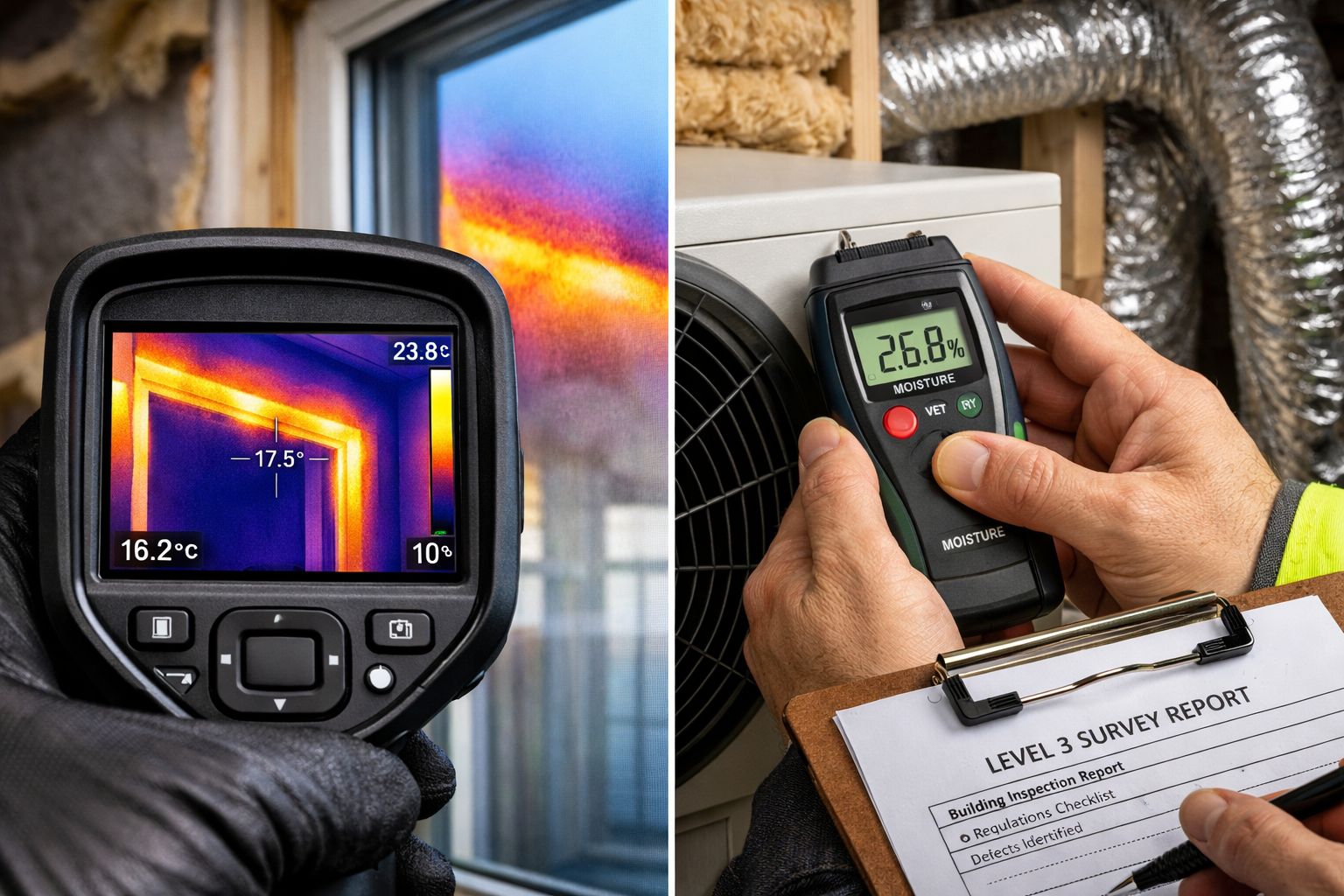
Understanding Level 3 Surveys for 2026 New Build Boom: Detecting Latent Defects in Sustainable Homes
What Makes 2026 New Builds Different
The 2026 new build market represents a fundamental shift in residential construction standards. The Future Homes Standard mandates that all new homes produce 75-80% less carbon emissions compared to current building regulations. This transformation means every new property now incorporates:
- Air source or ground source heat pumps replacing traditional gas boilers
- Mechanical Ventilation with Heat Recovery (MVHR) systems for controlled air quality
- Enhanced insulation standards with U-values significantly lower than previous requirements
- Triple-glazed windows with advanced thermal performance specifications
- Solar photovoltaic panels integrated into roof designs
- Smart home energy management systems controlling heating, lighting, and ventilation
These technologies deliver impressive environmental benefits, but they also introduce complex interdependencies where a single installation error can compromise the entire system's performance. Traditional visual inspections simply cannot detect many of these defects.
The Evolution of Building Survey Standards
A Level 3 Full Building Survey has always represented the most comprehensive property inspection available. However, the 2026 sustainable building boom demands enhanced protocols specifically designed for low-carbon construction.
Modern Level 3 surveys for new sustainable homes must incorporate:
| Traditional Survey Elements | Enhanced 2026 Sustainable Home Elements |
|---|---|
| Structural condition assessment | Thermal imaging for heat loss detection |
| Damp and moisture inspection | Airtightness pressure testing |
| Visual defect identification | MVHR system commissioning verification |
| Drainage and services review | Heat pump installation compliance checks |
| Roof and external fabric inspection | Solar panel integration and performance testing |
The shift from reactive defect detection to proactive performance verification represents the most significant change in surveying practice in decades.
Why Latent Defects Are More Common in Sustainable Builds
Latent defects are hidden flaws not immediately apparent during construction or initial occupation. In sustainable homes, these defects are particularly problematic because:
🔍 Complexity breeds errors: The integration of multiple advanced systems creates more opportunities for installation mistakes
🔍 Skills gap: Many construction workers are still learning sustainable building techniques, leading to improper installation
🔍 Performance dependencies: A small airtightness breach can dramatically reduce overall energy efficiency
🔍 Hidden failures: Many defects only become apparent when systems are tested under load or specific environmental conditions
🔍 Warranty limitations: Standard NHBC warranties may not cover performance shortfalls related to energy efficiency
Understanding building pathology in sustainable construction requires specialized knowledge that goes beyond traditional surveying expertise.
Common Latent Defects in Sustainable New Builds
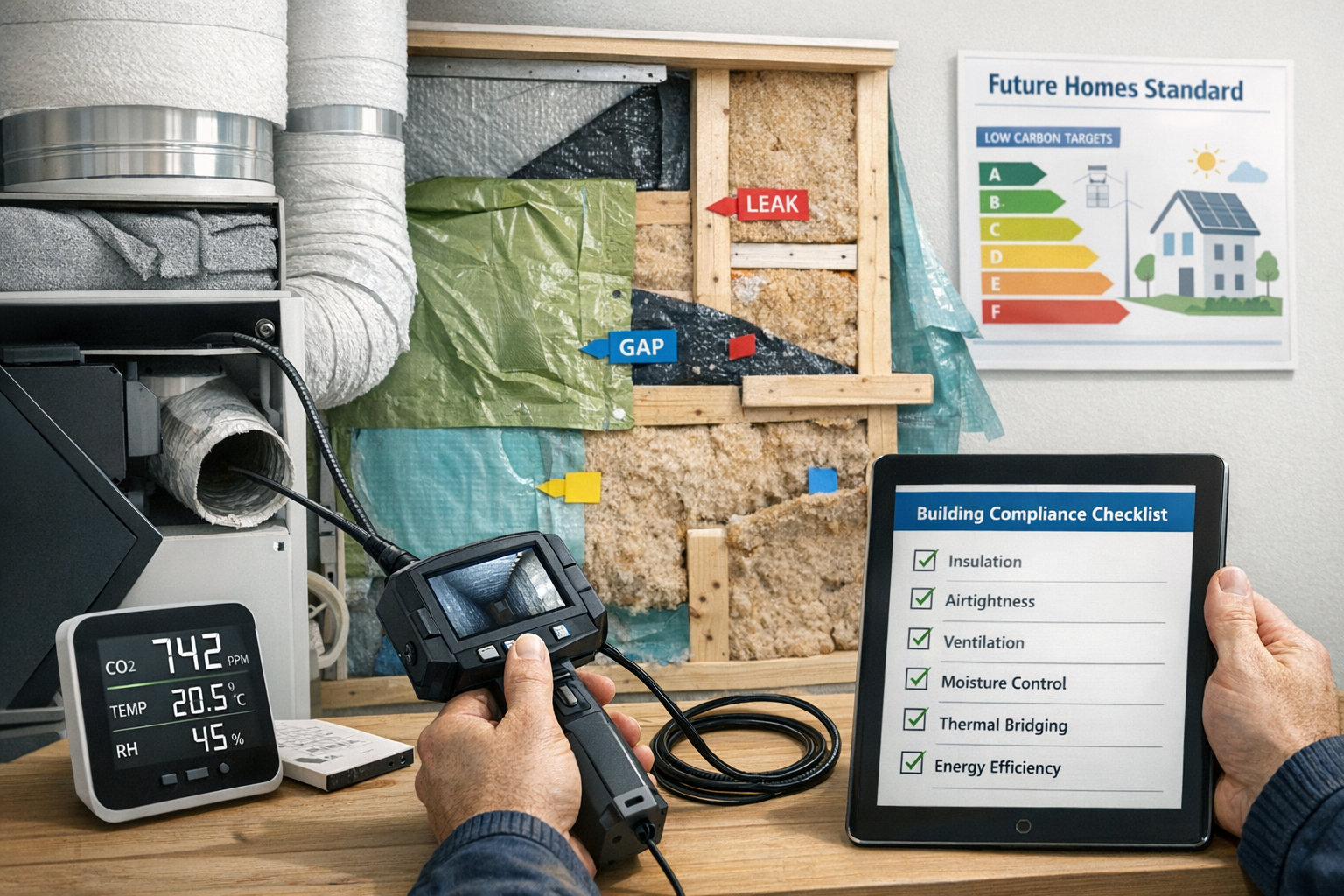
Airtightness and Thermal Envelope Failures
The building envelope in sustainable homes must achieve exceptional airtightness to meet energy performance standards. The target for 2026 new builds is typically 3 m³/(h·m²) at 50 Pa or better. However, common defects include:
Airtightness barrier breaches occur at:
- Service penetrations where pipes and cables pass through walls
- Junction points between walls, floors, and roofs
- Window and door frame installations
- Electrical socket back boxes in external walls
- Loft hatches and access points
These seemingly minor gaps can increase heating costs by 15-30% and create condensation risks within the building fabric. Professional building regulation compliance testing using blower door equipment is essential for verification.
Thermal bridging represents another critical defect where heat bypasses insulation through structural elements. Common locations include:
- Steel frame connections penetrating insulation layers
- Concrete balcony slabs extending through the thermal envelope
- Improperly detailed window reveals
- Cavity wall tie installations
"A single undetected thermal bridge can reduce a wall's effective R-value by 20-40%, undermining the entire sustainable design strategy." — Building Physics Research
Mechanical Ventilation System Defects
MVHR systems are now mandatory in most new sustainable homes to maintain air quality while recovering heat from exhaust air. However, installation defects are alarmingly common:
Commissioning failures include:
- Incorrect airflow balancing between supply and extract
- Inadequate duct sealing leading to air leakage
- Improper filter installation or specification
- Heat exchanger bypass settings incorrectly configured
Installation errors frequently found:
- Ductwork with excessive bends reducing efficiency
- Inadequate acoustic insulation causing noise complaints
- Condensate drainage improperly sloped
- External vents positioned incorrectly causing short-circuiting
Studies indicate that up to 60% of MVHR systems in new builds are not correctly commissioned, leading to poor indoor air quality, increased energy consumption, and occupant dissatisfaction. Understanding moisture in buildings becomes even more critical when ventilation systems underperform.
Heat Pump Installation Issues
Heat pumps are the cornerstone of zero-carbon heating strategies, but their performance is highly sensitive to installation quality. Common defects include:
System sizing errors:
- Oversized units that short-cycle and reduce efficiency
- Undersized systems unable to meet heating demand
- Incorrect buffer tank specifications
Installation defects:
- Refrigerant charge levels outside manufacturer specifications
- Inadequate clearance around outdoor units affecting airflow
- Poorly insulated pipework causing heat loss
- Electrical supply inadequate for peak demand
Integration failures:
- Hot water cylinder not properly matched to heat pump output
- Radiator sizing insufficient for lower flow temperatures
- Control systems not configured for weather compensation
- Backup heating elements activating unnecessarily
A properly conducted Level 3 survey should verify that the heat pump's Seasonal Coefficient of Performance (SCOP) matches design specifications through operational testing.
Building Fabric and Insulation Defects
Enhanced insulation standards in 2026 new builds create new opportunities for installation errors:
Insulation gaps and compression:
- Incomplete filling around window and door frames
- Compressed insulation reducing effective R-value
- Gaps at wall-to-ceiling junctions
- Missing insulation in difficult-to-access areas
Moisture-related issues:
- Vapor barriers installed on wrong side of insulation
- Interstitial condensation within wall assemblies
- Inadequate ventilation of roof spaces
- Water ingress through improperly sealed penetrations
Material specification errors:
- Incorrect insulation type for application
- Insufficient thickness to meet U-value targets
- Incompatible materials causing chemical reactions
Thermal imaging during a comprehensive survey can reveal these hidden defects before they cause long-term damage.
Renewable Energy System Integration Problems
Solar photovoltaic systems and other renewable technologies present their own inspection challenges:
Solar PV installation defects:
- Roof penetrations improperly sealed causing water ingress
- Inadequate cable management creating fire risks
- Inverter placement in unsuitable locations
- Shading issues not identified during design
- DC isolation switches not properly rated
System performance issues:
- Panel orientation not optimized for location
- String configuration reducing overall output
- Monitoring systems not commissioned
- Grid connection parameters incorrectly set
Integration with building systems:
- Battery storage systems improperly sized
- Electric vehicle charging points inadequately integrated
- Smart home energy management not configured
- Feed-in tariff metering not properly installed
Advanced Inspection Methodologies for Level 3 Surveys for 2026 New Build Boom
Thermal Imaging and Infrared Thermography
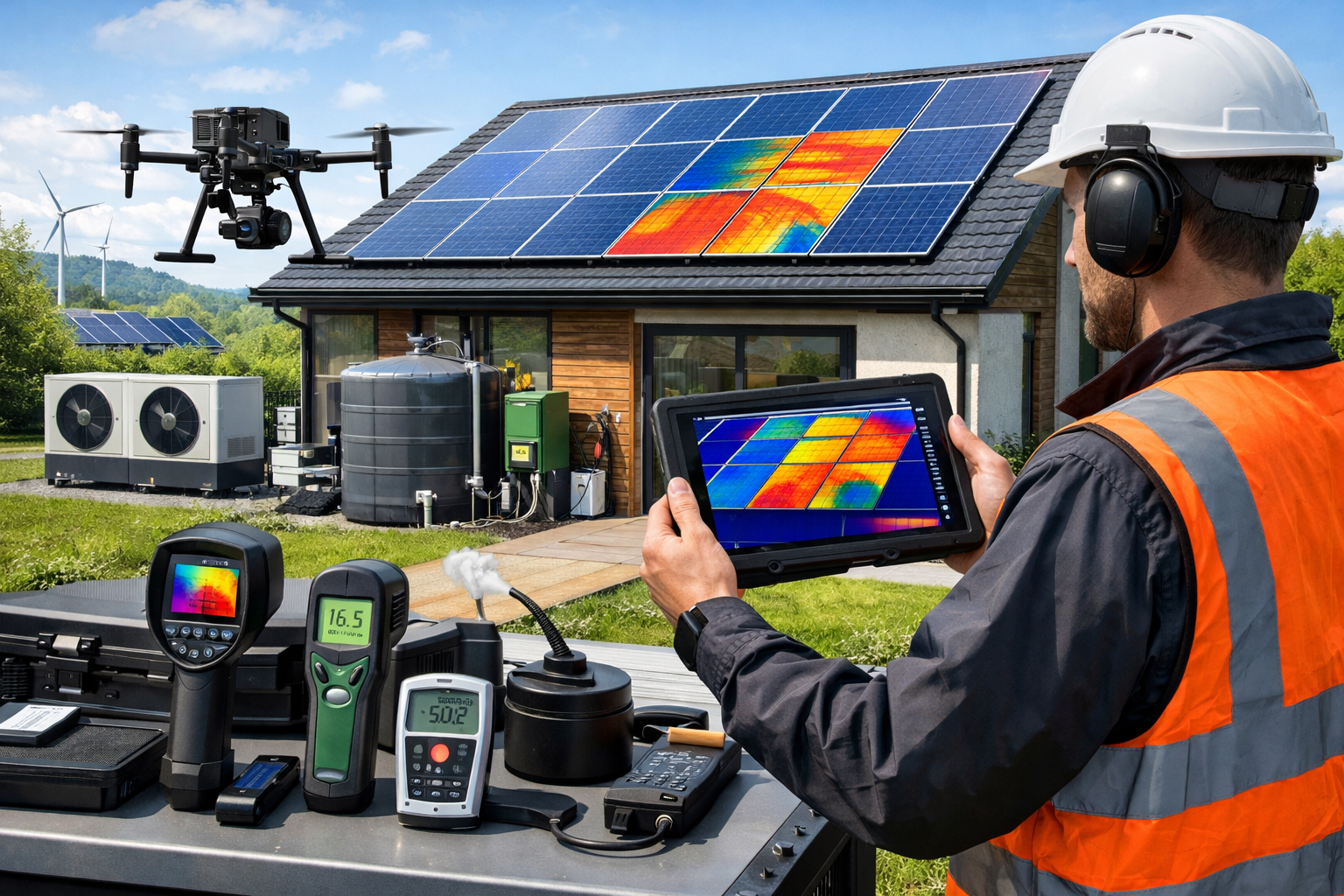
Thermal imaging cameras have become indispensable tools for detecting latent defects in sustainable homes. This non-invasive technology reveals:
✨ Heat loss patterns indicating insulation defects or gaps
✨ Thermal bridging through structural elements
✨ Air leakage paths around windows, doors, and penetrations
✨ HVAC system performance issues
✨ Moisture intrusion through temperature differentials
✨ Electrical hotspots indicating potential fire hazards
Best practices for thermal imaging surveys include:
- Conducting inspections during appropriate temperature differentials (minimum 10°C difference between inside and outside)
- Pressurizing or depressurizing the building to enhance air leakage detection
- Capturing images from multiple angles and distances
- Documenting ambient conditions affecting readings
Modern drone surveys equipped with thermal imaging capabilities can efficiently inspect roof installations and solar panel arrays that are difficult to access safely.
Airtightness Pressure Testing
Blower door testing provides quantitative measurement of building envelope performance. The process involves:
- Preparation: Sealing intentional openings (vents, flues) while leaving building fabric intact
- Pressurization: Using a calibrated fan to create pressure differential
- Measurement: Recording air flow required to maintain 50 Pa pressure
- Analysis: Calculating air changes per hour and identifying major leakage paths
Results are expressed as air permeability in m³/(h·m²) at 50 Pa. The 2026 Building Regulations typically require values below 5 m³/(h·m²), with best practice targeting 3 m³/(h·m²) or lower.
Combining pressure testing with thermal imaging creates a powerful diagnostic approach where:
- The building is pressurized using the blower door
- Thermal imaging reveals exact locations of air leakage
- Defects can be precisely documented and quantified
Ventilation System Performance Testing
Comprehensive MVHR system assessment requires specialized equipment and protocols:
Airflow measurement:
- Calibrated anemometers or flow hoods at each supply and extract point
- Verification against design specifications
- Balance testing between rooms
- Total system flow rate verification
Heat recovery efficiency testing:
- Temperature measurements at all four ports (supply, extract, intake, exhaust)
- Calculation of heat recovery efficiency percentage
- Comparison against manufacturer specifications
- Seasonal performance verification
Acoustic performance:
- Sound level measurements in habitable rooms
- Verification against Building Regulation requirements
- Identification of installation defects causing excessive noise
Filter and maintenance access:
- Verification of filter accessibility
- Assessment of maintenance documentation
- Review of homeowner handover information
Moisture and Humidity Monitoring
Sustainable homes with enhanced airtightness require careful moisture management. Advanced moisture detection includes:
Surface moisture meters:
- Pin-type meters for wood and porous materials
- Non-invasive capacitance meters for broader scanning
- Relative humidity measurements in wall cavities
Environmental monitoring:
- Indoor air quality sensors measuring CO₂, VOCs, and particulates
- Relative humidity levels in different zones
- Temperature stratification assessment
Condensation risk analysis:
- Dew point calculations for building assemblies
- Interstitial condensation modeling
- Surface temperature measurements at thermal bridges
Understanding environmental issues specific to high-performance buildings helps identify potential problems before they manifest as visible damage.
Renewable Energy System Testing
Solar PV and other renewable installations require specialized verification:
Electrical testing:
- Insulation resistance testing of DC circuits
- Continuity testing of protective bonding
- Polarity verification
- Earth loop impedance measurements
Performance verification:
- IV curve tracing to identify underperforming panels
- String voltage and current measurements
- Inverter efficiency testing
- Monitoring system data validation
Installation quality assessment:
- Roof penetration integrity inspection
- Cable routing and management review
- Fire safety compliance verification
- Manufacturer installation guidelines compliance
Documentation and Reporting for Sustainable Home Surveys
Comprehensive Defect Categorization
Professional Level 3 survey reports for sustainable new builds should categorize defects using a clear priority system:
Category 1 – Critical Defects 🔴
- Issues requiring immediate attention
- Defects affecting safety or structural integrity
- Major system failures compromising habitability
- Building regulation non-compliance requiring urgent remediation
Category 2 – Significant Defects 🟡
- Issues requiring repair within 12 months
- Defects affecting energy performance
- System inefficiencies causing increased operating costs
- Warranty-covered items requiring developer attention
Category 3 – Minor Defects 🟢
- Cosmetic issues requiring attention
- Minor finishing defects
- Maintenance recommendations
- Future monitoring requirements
Energy Performance Verification
Beyond defect identification, surveys should verify actual energy performance against design predictions:
EPC validation:
- Comparison of predicted vs. actual energy consumption
- Verification of renewable energy generation
- Assessment of heating system efficiency
- Review of EPC and MEES compliance
Performance gap analysis:
- Identification of discrepancies between design and reality
- Quantification of energy efficiency shortfalls
- Cost implications of performance gaps
- Recommendations for remediation
Developer Liability and Warranty Claims
Comprehensive documentation supports warranty claims and developer liability:
Photographic evidence:
- High-resolution images of all defects
- Thermal imaging documentation
- Before/after comparisons where applicable
- Annotated diagrams showing defect locations
Technical specifications:
- Manufacturer installation requirements
- Building regulation standards
- Design specifications from planning documents
- Industry best practice guidelines
Cost implications:
- Estimated repair costs for identified defects
- Long-term energy cost implications
- Potential property value impact
- Urgency ratings for remediation work
Understanding construction law advice helps surveyors provide clients with actionable information for pursuing remediation.
Protecting Buyers in the 2026 Sustainable Housing Market
The Business Case for Comprehensive Surveys
Investing in a thorough Level 3 Building Survey for a new sustainable home delivers substantial value:
Financial protection:
- Average defect remediation costs: £8,000-£25,000
- Survey cost: £800-£2,500
- Return on investment: 3:1 to 10:1
- Negotiating leverage with developers
Performance assurance:
- Verification of promised energy efficiency
- Confirmation of running cost predictions
- Identification of warranty-covered issues
- Peace of mind regarding complex systems
Long-term value protection:
- Maintaining property value through proper maintenance
- Avoiding expensive emergency repairs
- Ensuring systems operate as designed
- Protecting against future building regulation changes
Timing Considerations for New Build Surveys
Strategic timing maximizes survey effectiveness:
Pre-completion inspection (if possible):
- Opportunity to identify defects before legal completion
- Stronger negotiating position with developer
- Ability to require remediation before moving in
- Access to systems before final finishes applied
Post-completion survey:
- After practical completion but within warranty period
- Allows testing of systems under operational conditions
- Identifies snagging items requiring developer attention
- Establishes baseline for future condition monitoring
End-of-warranty inspection:
- Before NHBC or developer warranty expires (typically 2 years)
- Final opportunity for warranty-covered repairs
- Identification of latent defects before liability transfers
- Planning for long-term maintenance requirements
Working with Developers and Warranty Providers
Effective communication strategies include:
Documentation requirements:
- Detailed defect schedules with photographic evidence
- Reference to specific building regulation requirements
- Manufacturer installation guidelines
- Industry standards and best practices
Escalation procedures:
- Initial notification to site manager or customer care team
- Formal written defect notification within warranty terms
- NHBC or warranty provider involvement if necessary
- Professional mediation or legal action as last resort
Reasonable expectations:
- Understanding difference between defects and design features
- Realistic timelines for remediation work
- Appropriate access arrangements for repairs
- Professional conduct throughout the process
Future-Proofing Sustainable Home Investments
Maintenance Planning for Low-Carbon Systems
Sustainable homes require proactive maintenance strategies:
Heat pump maintenance schedule:
- Annual professional servicing
- Quarterly filter cleaning
- Refrigerant pressure checks
- Control system updates
MVHR system maintenance:
- Filter replacement every 6-12 months
- Duct cleaning every 5 years
- Heat exchanger cleaning annually
- System rebalancing after building modifications
Building fabric monitoring:
- Annual thermal imaging inspection
- Moisture level monitoring in critical areas
- Airtightness re-testing after major works
- Insulation condition assessment
Renewable energy systems:
- Solar panel cleaning and inspection
- Inverter performance monitoring
- Battery system health checks
- Electrical connection integrity testing
Technology Evolution and Retrofit Considerations
The rapid pace of sustainable technology development creates opportunities:
System upgrades:
- Smart control system enhancements
- Battery storage additions
- EV charging infrastructure
- Home energy management systems
Performance optimization:
- Heat pump control algorithm updates
- MVHR system fine-tuning
- Solar panel optimizer installation
- Building automation integration
Future-proofing investments:
- Electrical capacity for future electrification
- Structural provisions for additional solar panels
- Plumbing infrastructure for future heat pump upgrades
- Communication networks for smart home evolution
Regulatory Compliance and Market Value
Maintaining compliance protects property value:
Building regulation evolution:
- Monitoring changes to energy performance standards
- Ensuring continued compliance with updated regulations
- Planning for potential retrofit requirements
- Understanding planning considerations
Market positioning:
- Maintaining premium value through verified performance
- Documentation supporting energy efficiency claims
- Professional certification of system condition
- Competitive advantage in increasingly eco-conscious market
Conclusion
The 2026 new build boom represents an exciting transition toward sustainable, zero-carbon housing that will define residential construction for decades to come. However, the complexity of low-carbon technologies and advanced building fabrics demands a fundamental evolution in property inspection practices. Level 3 Surveys for 2026 New Build Boom: Detecting Latent Defects in Sustainable Homes has emerged as an essential service protecting buyers from hidden defects that traditional visual inspections simply cannot detect.
From airtightness failures and thermal bridging to improperly commissioned MVHR systems and heat pump installation errors, the range of potential latent defects in sustainable homes requires specialized knowledge, advanced diagnostic equipment, and comprehensive testing protocols. Thermal imaging, pressure testing, and performance verification have transitioned from optional enhancements to fundamental requirements for responsible property assessment.
For buyers investing in sustainable new builds, the business case for comprehensive Level 3 surveys is compelling: a relatively modest investment in professional inspection can identify defects worth tens of thousands of pounds in remediation costs while ensuring the promised energy efficiency and environmental performance is actually delivered. The peace of mind that comes from knowing your zero-carbon home operates as designed is invaluable.
Take Action Today
For homebuyers: Don't assume a new sustainable home is defect-free simply because it's recently constructed. Schedule a comprehensive Level 3 survey with surveyors experienced in low-carbon building technologies before completion or within your warranty period.
For property professionals: Invest in specialized training and diagnostic equipment to serve the growing sustainable housing market. Understanding Future Homes Standard requirements and advanced system commissioning is no longer optional—it's essential for professional practice.
For developers: Embrace comprehensive third-party surveys as quality assurance tools that protect your reputation and reduce warranty claims. Proactive defect identification and remediation builds customer confidence and market differentiation.
The sustainable housing revolution is here, and with it comes the responsibility to ensure these technologically advanced homes deliver on their environmental and economic promises. Through rigorous inspection, comprehensive documentation, and specialized expertise, Level 3 surveys provide the foundation for confidence in the 2026 new build boom.
Ready to protect your sustainable home investment? Contact us for expert surveying services and ensure your zero-carbon property performs as promised.