

London's commercial property landscape is experiencing a dramatic transformation in 2026. As market recovery accelerates and remote work patterns stabilize, underpriced office assets across the capital are being snapped up by developers eager to capitalize on the residential conversion boom. Yet beneath the surface of these seemingly attractive opportunities lie hidden defects and compliance challenges that can derail projects and devastate budgets. Building Survey Protocols for Office-to-Residential Conversions: Spotting Risks in 2026 Revivals have never been more critical for investors, developers, and surveyors navigating this complex retrofit landscape.
The stakes are particularly high for London's aging commercial stock. Buildings constructed during the post-war boom or 1980s office expansion now face intensive scrutiny as they transition from cubicles to condos. Without rigorous survey protocols aligned with RICS expectations, developers risk discovering catastrophic structural issues, asbestos contamination, or building regulation non-compliance only after purchase—when remediation costs can exceed the entire project budget.
Key Takeaways
- Structural defects in older office buildings can remain hidden until conversion work begins, making comprehensive Level 3 surveys essential for risk mitigation
- Building regulation compliance for residential use requires significantly more stringent standards than commercial spaces, particularly for fire safety, ventilation, and egress routes
- RICS-aligned survey protocols must address retrofit-specific challenges including floorplate depth, natural light penetration, and seismic compliance for 2026 conversions
- Financial viability depends on early defect identification, with hidden issues potentially adding 15-30% to projected conversion costs
- Policy incentives in 2026 are accelerating conversions, but streamlined planning processes don't eliminate the need for thorough building assessments
Understanding the 2026 Office Conversion Landscape 🏢
The office-to-residential conversion market has matured significantly since the pandemic-era rush. In 2026, developers are approaching these projects with greater sophistication, yet the fundamental challenges remain. London's commercial property vacancy rates have stabilized around 12-15%, creating a substantial pool of conversion candidates—but not all are suitable.
Market drivers in 2026 include:
- Persistent housing shortages across Greater London
- Favorable financing conditions for adaptive reuse projects
- Government incentives supporting urban regeneration
- Reduced stigma around converted residential spaces
- Technological advances in retrofit construction methods
However, the quality of available office stock varies dramatically. Buildings constructed between 1960-1990 often present the most significant survey challenges due to outdated building systems, hazardous materials, and structural designs incompatible with residential requirements.
Policy Framework Changes
Recent regulatory updates have streamlined conversion processes while simultaneously raising quality expectations. Washington DC's Office-to-Anything program offers up to 15 years of tax abatements, while Los Angeles implemented a new Citywide Adaptive Reuse Ordinance in February 2026[4]. Minneapolis amended its zoning code in September 2024 to facilitate streamlined review processes for building conversions[1].
These policy shifts create opportunities but also place greater responsibility on developers to ensure comprehensive due diligence. Streamlined planning approval doesn't eliminate building defects—it simply accelerates the timeline for discovering them.
Critical Defects in Office-to-Residential Conversions: What Surveys Must Identify
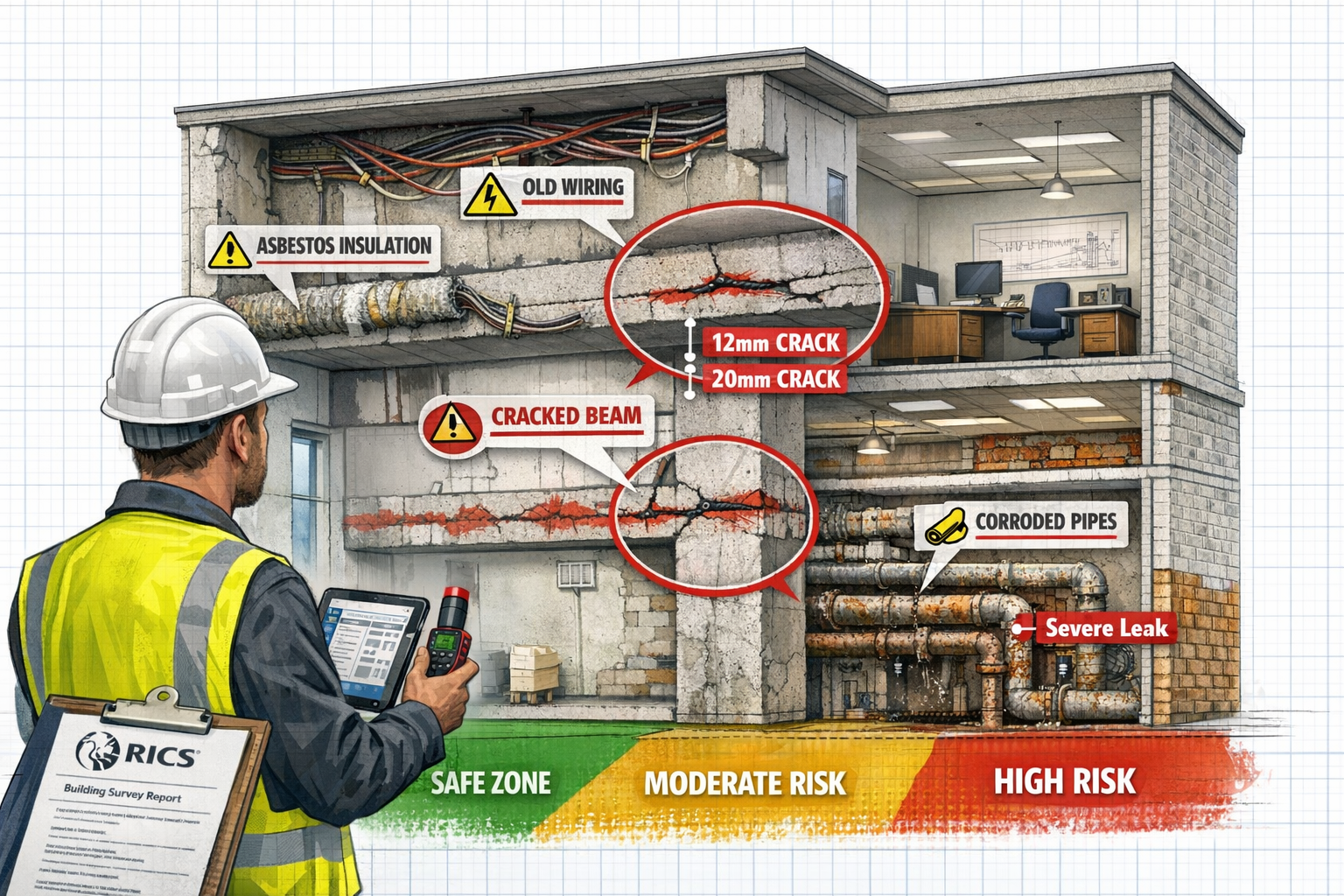
Identifying defects early separates successful conversions from financial disasters. Building Survey Protocols for Office-to-Residential Conversions: Spotting Risks in 2026 Revivals must prioritize specific defect categories that disproportionately affect retrofit projects.
Structural Integrity Issues
Office buildings were designed for different load distributions than residential properties. Survey protocols must assess:
Foundation and load-bearing capacity:
- Floor loading calculations for residential furniture and occupancy patterns
- Column spacing compatibility with residential unit layouts
- Beam deflection and concrete spalling in aging structures
- Settlement patterns indicating foundation movement
Concrete deterioration:
- Carbonation depth testing in reinforced concrete frames
- Chloride contamination in coastal or de-iced areas
- Alkali-silica reaction (ASR) in structures built 1950-1980
- Exposed rebar corrosion requiring remediation
A Level 3 full building survey provides the comprehensive assessment necessary for conversion projects, examining both visible and concealed defects.
Hazardous Materials Detection
Pre-2000 office buildings frequently contain materials now classified as hazardous. Survey protocols must include:
| Hazardous Material | Typical Locations | Survey Method | Remediation Cost Impact |
|---|---|---|---|
| Asbestos | Ceiling tiles, pipe insulation, floor tiles | Laboratory sampling | £15,000-£80,000 |
| Lead paint | Window frames, radiators, doors | XRF testing | £8,000-£25,000 |
| PCBs | Light ballasts, electrical equipment | Visual inspection + testing | £5,000-£20,000 |
| Radon | Basements, ground floors | Long-term monitoring | £3,000-£12,000 |
Asbestos building surveys are particularly critical for London office conversions, as many buildings constructed during the 1960s-1980s boom contain extensive asbestos-containing materials (ACMs).
Building Services Obsolescence
Commercial HVAC, plumbing, and electrical systems rarely meet residential standards without significant upgrades:
Electrical infrastructure:
- Insufficient capacity for individual residential units (typically 60-100A per unit required)
- Three-phase commercial systems incompatible with residential distribution
- Outdated wiring requiring complete replacement
- Inadequate consumer unit provision for modern residential loads
Plumbing and drainage:
- Insufficient vertical stacks for residential bathroom/kitchen density
- Inadequate hot water capacity for individual units
- Commercial waste systems incompatible with residential usage patterns
- Water pressure issues in upper floors
Heating and ventilation:
- Central commercial systems requiring replacement with individual unit controls
- Inadequate fresh air provision for residential occupancy standards
- Noise transmission from centralized plant rooms
- Energy efficiency below current residential EPC requirements
Understanding building materials assessments helps identify which building systems can be retrofitted versus completely replaced.
Envelope and Weatherproofing Defects
The building envelope often reveals the most expensive hidden defects:
- Curtain wall failures in 1980s-era office buildings
- Water ingress through deteriorated window seals and flashing
- Thermal bridging creating condensation and mold risks
- Inadequate insulation failing to meet Part L Building Regulations for residential use
"The difference between commercial and residential envelope performance standards catches many developers off-guard. What was acceptable for an office occupied 40 hours weekly becomes inadequate for a home occupied 168 hours weekly." — RICS Building Surveying Guidance
Building Regulation Compliance: Navigating the Residential Standard
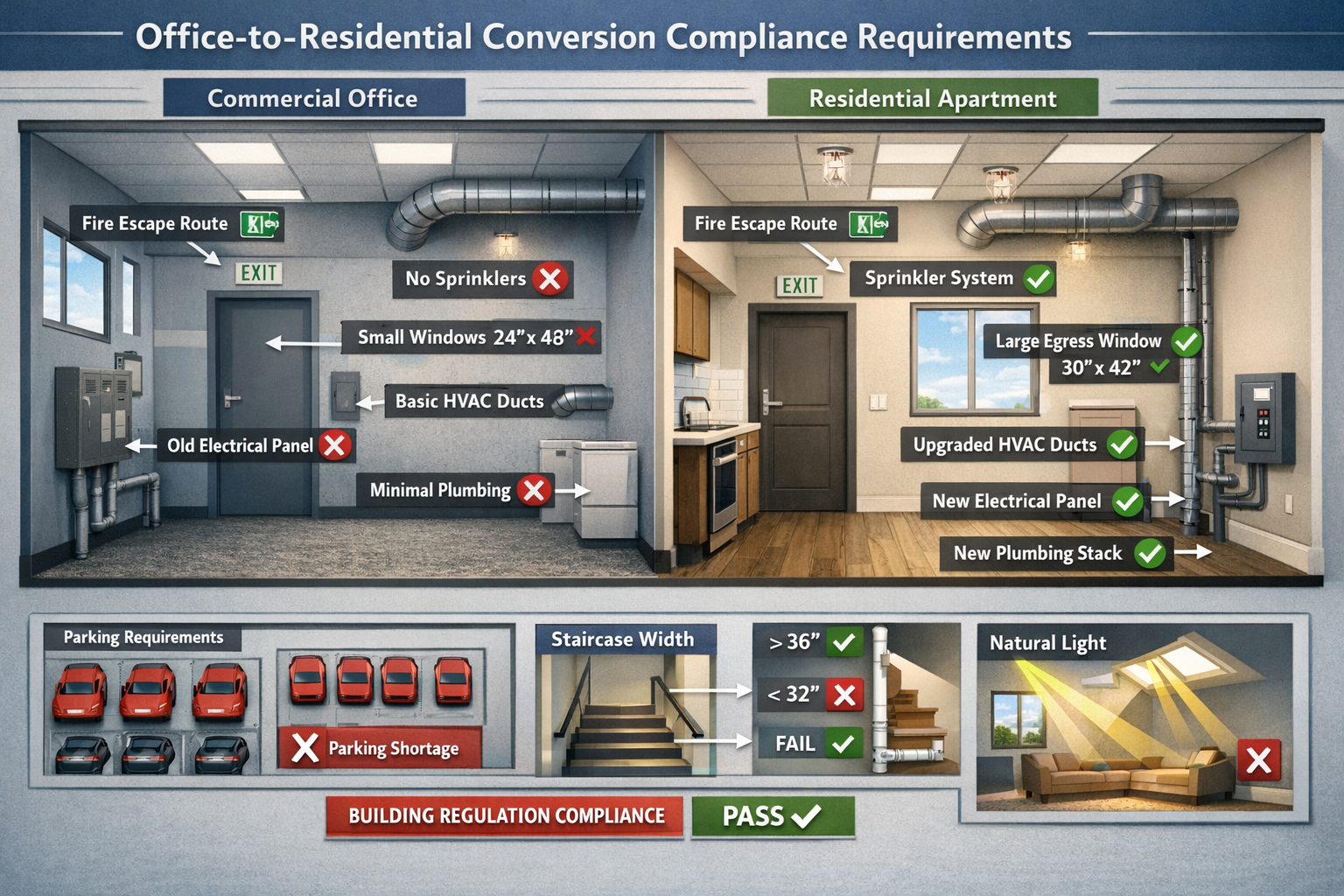
The transition from commercial to residential use triggers substantially more stringent building regulation requirements. Building Survey Protocols for Office-to-Residential Conversions: Spotting Risks in 2026 Revivals must evaluate compliance gaps early in the feasibility process.
Fire Safety and Means of Escape
Residential properties require more comprehensive fire protection than most office buildings[2]:
Critical fire safety requirements:
✅ Compartmentation: Fire-resistant separation between units (typically 60-minute rating)
✅ Escape routes: Multiple protected staircases meeting residential travel distance limits
✅ Fire detection: Interconnected smoke/heat detection in all units
✅ Sprinkler systems: Often required in buildings over 11 meters (mandatory in buildings over 18 meters post-Grenfell)
✅ External wall systems: Compliance with combustibility restrictions
Survey protocols must identify whether existing fire protection infrastructure can be adapted or requires complete replacement. The cost differential is substantial—adapting existing systems may cost £150-£300 per square meter, while complete fire safety retrofits can exceed £500 per square meter.
Building regulation compliance testing should be conducted before purchase commitments to avoid unexpected compliance costs.
Natural Light and Ventilation Standards
Office buildings often feature deep floorplates incompatible with residential habitability standards:
Floorplate depth analysis:
- Maximum 13-15 meters from external wall to unit core for adequate natural light
- Window-to-floor area ratios meeting Building Regulations Part F
- Daylight factor calculations for habitable rooms
- Right-to-light considerations for neighboring properties
Buildings with floorplates exceeding 18 meters typically require light wells, internal courtyards, or creative design solutions that significantly impact unit yield and project economics[3].
Sound Insulation and Acoustic Performance
Residential acoustic standards far exceed commercial requirements:
| Element | Office Standard | Residential Standard | Survey Focus |
|---|---|---|---|
| Floor impact | No requirement | ≤62 dB | Concrete thickness, floating floors |
| Airborne sound | Minimal | ≥45 dB reduction | Party wall construction |
| External noise | Variable | ≤35 dB internal | Glazing specification |
| Service noise | Minimal control | Strict limits | Plant room location |
Survey protocols must assess whether existing floor/wall construction achieves residential acoustic performance or requires enhancement through additional layers, floating floors, or acoustic underlays.
Accessibility and Part M Compliance
Residential conversions must meet accessibility standards:
- Wheelchair-accessible units (typically 10% of total units)
- Step-free access from entrance to all communal areas
- Accessible WC provision on entrance level
- Lift dimensions accommodating wheelchairs
- Corridor widths permitting wheelchair turning
Older office buildings often lack adequate lift provision or have entrance level changes incompatible with accessibility requirements, necessitating expensive structural modifications.
RICS-Aligned Survey Protocols for Conversion Projects
Developing comprehensive survey protocols aligned with RICS expectations ensures nothing falls through the cracks. Building Survey Protocols for Office-to-Residential Conversions: Spotting Risks in 2026 Revivals should follow a structured methodology.
Pre-Acquisition Survey Scope
Before committing to purchase, commission a comprehensive survey addressing:
Phase 1: Desktop Review
- Planning history and building control records
- Previous survey reports and structural assessments
- Asbestos registers and environmental reports
- Building regulation compliance certificates
- EPC ratings and energy performance data
Phase 2: Intrusive Investigation
- Opening-up works to examine concealed elements
- Concrete core sampling for strength testing
- Hazardous materials sampling (asbestos, lead, etc.)
- Drainage CCTV surveys
- Electrical installation condition reports
Phase 3: Specialist Assessments
- Structural engineer evaluation of conversion feasibility
- M&E consultant review of services capacity
- Acoustic consultant baseline testing
- Fire engineer assessment of compliance pathway
- Quantity surveyor cost estimation for identified defects
Understanding what is included in a Level 3 building survey helps establish appropriate scope expectations.
Survey Timing Considerations
Conversion project surveys face unique timing challenges. Building survey timeframes for occupied office buildings may require:
- Phased access coordinating with tenant occupation schedules
- Out-of-hours inspections minimizing business disruption
- Extended timelines for laboratory testing results (asbestos, concrete strength)
- Seasonal considerations for roof/envelope inspections during dry weather
Allow 4-6 weeks for comprehensive conversion feasibility surveys versus 2-3 weeks for standard residential surveys.
Risk Categorization Framework
Effective survey protocols categorize identified defects by urgency and financial impact:
Category 1: Project Viability Threats 🔴
- Structural inadequacy preventing conversion
- Hazardous material contamination exceeding remediation budgets
- Building regulation compliance gaps with no feasible solution
- Protected species or environmental constraints
Category 2: Significant Cost Implications 🟠
- Building services requiring complete replacement
- Fire safety upgrades beyond initial estimates
- Envelope failures requiring extensive remediation
- Foundation issues requiring underpinning
Category 3: Standard Conversion Requirements 🟡
- Expected building regulation upgrades
- Typical acoustic enhancement measures
- Standard accessibility modifications
- Routine maintenance items
This categorization enables informed decision-making about purchase price adjustments or project abandonment.
Documentation and Reporting Standards
RICS-compliant survey reports for conversions should include:
- Executive summary highlighting viability-threatening issues
- Photographic evidence of all significant defects
- Cost estimates for remediation (preliminary ranges)
- Compliance gap analysis against residential building regulations
- Recommendations for specialist follow-up investigations
- Risk register prioritizing defects by severity and probability
Reports should clearly distinguish between observed defects and areas requiring further investigation due to access limitations.
Spotting Hidden Risks: Advanced Survey Techniques for 2026
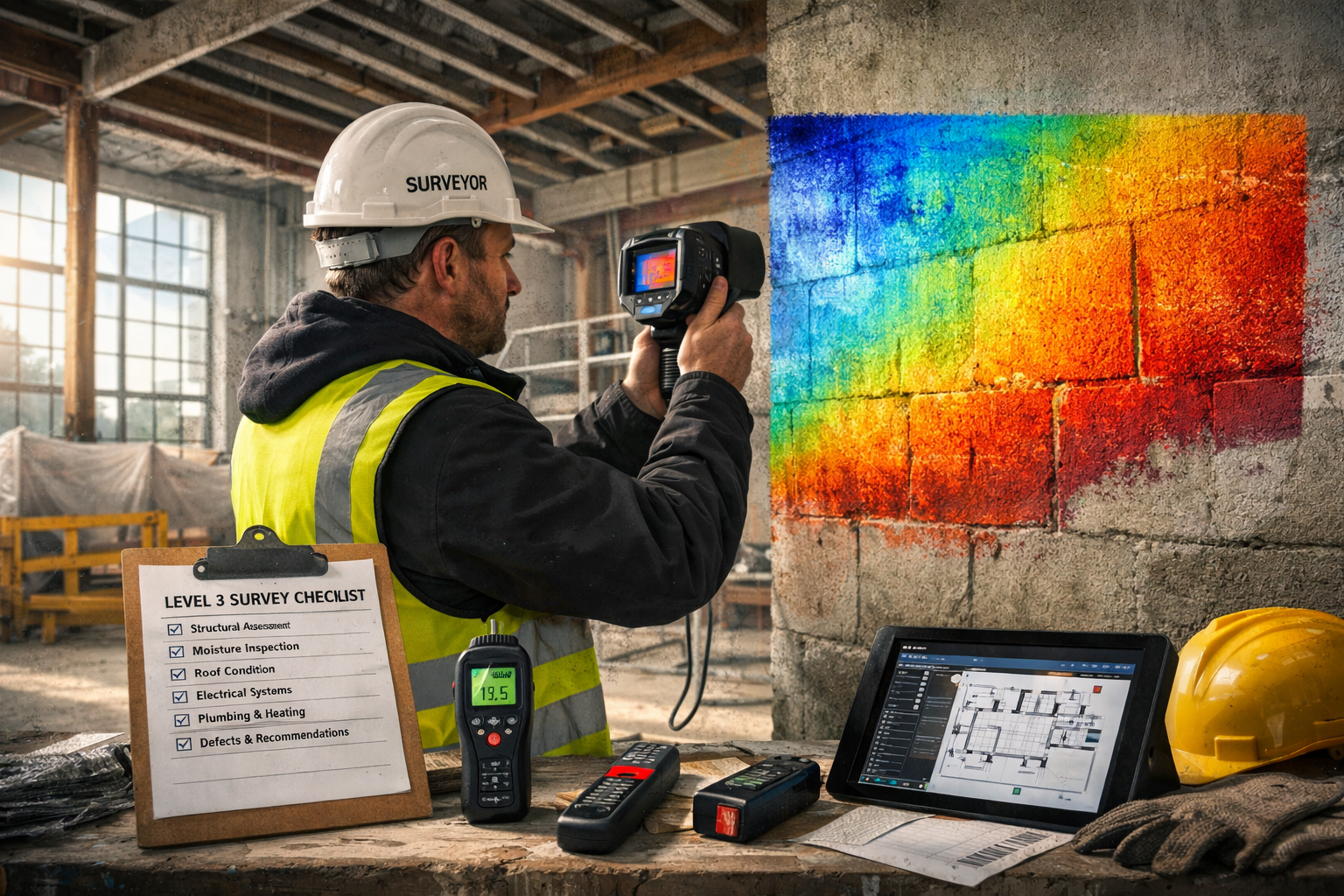
Modern survey technology enables defect detection impossible with visual inspection alone. Building Survey Protocols for Office-to-Residential Conversions: Spotting Risks in 2026 Revivals increasingly incorporate advanced diagnostic tools.
Non-Destructive Testing Methods
Thermal imaging:
- Detecting moisture ingress behind cladding systems
- Identifying insulation gaps and thermal bridging
- Locating concealed plumbing leaks
- Assessing heating system distribution
Ground-penetrating radar (GPR):
- Mapping concealed structural elements
- Identifying voids in concrete slabs
- Locating underground services and drainage
- Detecting foundation defects without excavation
Ultrasonic testing:
- Measuring concrete thickness and density
- Detecting delamination in composite materials
- Assessing structural timber condition
- Identifying voids behind rendered surfaces
Moisture meters and hygrometers:
- Quantifying dampness levels in walls and floors
- Distinguishing condensation from penetrating damp
- Establishing baseline conditions for monitoring
- Identifying areas requiring further investigation
Drone Survey Applications
Premium drone surveys offer significant advantages for tall office buildings:
- Roof condition assessment without scaffolding access
- Facade inspection identifying cladding defects at height
- Rainwater goods examination detecting blockages and damage
- Photographic documentation providing comprehensive visual records
Drone surveys reduce survey costs while improving safety and enabling inspection of otherwise inaccessible areas.
Sampling and Laboratory Testing
Certain defects require laboratory confirmation:
Asbestos identification:
- Bulk samples analyzed by UKAS-accredited laboratories
- Asbestos type and condition assessment
- Friability and exposure risk evaluation
- Remediation strategy development
Concrete analysis:
- Core sampling for compressive strength testing
- Carbonation depth measurement
- Chloride content analysis
- Petrographic examination for degradation mechanisms
Water quality testing:
- Legionella risk assessment in water systems
- Lead contamination in older plumbing
- Microbiological analysis for potability
Identifying Urgent or Dangerous Issues
Some defects pose immediate safety risks requiring emergency intervention. Urgent or dangerous building issues identified during surveys include:
- Structural instability requiring immediate temporary works
- Exposed asbestos presenting inhalation risks
- Electrical hazards including damaged wiring or inadequate earthing
- Gas leaks or defective gas installations
- Unsafe access including deteriorated staircases or balconies
Survey protocols must include clear procedures for communicating urgent findings to clients and relevant authorities.
Financial Implications: Budgeting for Survey Findings
Comprehensive surveys reveal the true cost of conversion projects. Budgeting for repairs and restoration based on survey findings prevents mid-project financial crises.
Cost Contingency Planning
Survey findings should inform contingency allocation:
| Project Risk Profile | Recommended Contingency | Basis |
|---|---|---|
| Well-surveyed, modern building | 10-15% | Standard conversion unknowns |
| Older building, comprehensive survey | 15-25% | Higher defect probability |
| Limited survey access | 25-35% | Significant unknowns remain |
| Known major defects | 35%+ | Complex remediation required |
Developers who skimp on survey scope often pay multiples more in unexpected costs during construction.
Negotiating Purchase Price Adjustments
Survey findings provide leverage for price negotiations:
Quantified defect costs enable:
- Direct price reductions reflecting remediation expenses
- Retention clauses releasing funds upon defect rectification
- Conditional contracts subject to satisfactory resolution
- Shared risk arrangements with vendors
Present survey findings with detailed cost estimates from quantity surveyors to support negotiation positions.
Insurance and Warranty Considerations
Survey reports influence insurance availability and cost:
- Professional indemnity insurance for surveyors increases with conversion project complexity
- Structural warranties may exclude pre-existing defects identified in surveys
- Latent defects insurance pricing reflects survey comprehensiveness
- Construction all-risks insurance premiums adjust based on identified hazards
Comprehensive surveys demonstrating thorough due diligence can actually reduce insurance costs by evidencing risk management.
Case Study: London Office Conversion Survey Success
A 1970s office block in East London illustrates the value of rigorous survey protocols. The eight-story building appeared structurally sound and was offered at an attractive price reflecting market conditions.
Initial visual inspection suggested:
- Generally good condition
- Suitable floorplate depth (14 meters)
- Adequate floor-to-ceiling heights
- Recent window replacement
Comprehensive Level 3 survey revealed:
- Extensive asbestos in ceiling voids and pipe insulation (£120,000 remediation)
- Concrete carbonation exceeding 40mm depth in columns (£85,000 repairs)
- Inadequate drainage capacity for residential use (£45,000 upgrade)
- Electrical system at end-of-life requiring complete replacement (£180,000)
- Fire compartmentation non-existent (£95,000 to install)
Total hidden defects: £525,000—representing 18% of the purchase price.
Armed with survey findings, the developer negotiated a £400,000 price reduction and allocated appropriate contingency for remaining risks. Without the survey, these defects would have emerged during construction, potentially rendering the project financially unviable.
Working with Specialist Consultants
Complex conversions require multidisciplinary expertise beyond general building surveyors. Sourcing extra advice from specialists ensures comprehensive risk assessment.
When to Engage Structural Engineers
Structural engineer involvement is essential when surveys identify:
- Proposed layout changes affecting load-bearing elements
- Evidence of structural movement or settlement
- Concrete deterioration requiring strength assessment
- Floor loading calculations for residential use
- Seismic compliance evaluation (particularly for tall buildings)
Fire Safety Consultants
Fire engineers provide crucial input for:
- Alternative compliance pathways for challenging conversions
- Sprinkler system design and specification
- Smoke control and ventilation strategies
- Means of escape analysis and optimization
- External wall system compliance assessment
M&E Consultants
Mechanical and electrical consultants evaluate:
- Existing services capacity and condition
- Residential services design and specification
- Energy efficiency and EPC compliance pathways
- Renewable energy integration opportunities
- Building management system requirements
Planning Consultants
While streamlined processes have simplified conversions, planning expertise remains valuable for:
- Permitted development rights assessment
- Change of use application strategy
- Section 106 obligations and affordable housing requirements
- Heritage and conservation area considerations
Maintenance Planning for Converted Buildings
Survey findings should inform long-term maintenance planning for converted properties. Older buildings transitioning to residential use face unique maintenance challenges:
Developing maintenance schedules:
- Prioritizing building envelope maintenance (roof, windows, cladding)
- Establishing service intervals for mechanical systems
- Planning cyclical decoration and repair programs
- Budgeting for major component replacement
Sinking fund calculations:
Residential conversions should establish sinking funds reflecting:
- Building age and condition
- Anticipated major works over 10-30 year horizons
- Specialist system maintenance requirements
- Regulatory compliance updates
Comprehensive survey reports provide the foundation for accurate long-term maintenance budgeting.
Regulatory Outlook: What's Changing in 2026 and Beyond
The regulatory landscape continues evolving, affecting conversion feasibility:
Energy Performance Standards
Minimum Energy Efficiency Standards (MEES) are tightening:
- EPC Band C minimum for new residential lettings by 2028
- Retrofit requirements for older building stock
- Embodied carbon considerations favoring conversion over demolition
- Heat pump and renewable energy integration requirements
Understanding EPC and MEES requirements helps assess conversion viability against future standards.
Building Safety Act Implications
Post-Grenfell reforms affect converted buildings:
- Enhanced fire safety requirements for buildings over 18 meters
- Building safety case requirements for higher-risk buildings
- Accountable person responsibilities for building owners
- Resident engagement and information requirements
Survey protocols must address Building Safety Act compliance pathways.
Future-Proofing Considerations
Forward-thinking surveys evaluate:
- Climate resilience (overheating risk, flood vulnerability)
- Adaptability for changing accessibility standards
- Electric vehicle charging infrastructure requirements
- Digital connectivity and smart building integration
- Circular economy principles for material selection
Conclusion
Building Survey Protocols for Office-to-Residential Conversions: Spotting Risks in 2026 Revivals represent the critical difference between profitable adaptive reuse projects and financial disasters. As London's commercial property market continues its transformation, the temptation to rush into seemingly attractive conversion opportunities remains strong. Yet the evidence is clear: comprehensive, RICS-aligned survey protocols identifying defects before purchase commitments consistently deliver superior project outcomes.
The most successful developers in 2026's conversion market share common characteristics: they invest in thorough due diligence, engage multidisciplinary specialist teams, and view survey costs as insurance rather than expense. A £15,000-£25,000 comprehensive survey investment routinely identifies £200,000-£500,000 in hidden defects, enabling informed negotiation and accurate project budgeting.
Actionable Next Steps
For developers and investors considering office-to-residential conversions:
- Commission comprehensive Level 3 surveys before making purchase commitments—visual inspections are insufficient for conversion projects
- Engage specialist consultants early including structural engineers, M&E consultants, and fire safety experts
- Allocate appropriate contingency based on survey findings and building age—minimum 15% for well-surveyed projects, 25%+ for older stock
- Develop detailed compliance roadmaps addressing building regulation gaps identified in surveys
- Establish long-term maintenance plans informed by survey findings to protect investment value
For building surveyors and construction professionals:
- Develop conversion-specific survey protocols addressing retrofit challenges beyond standard residential surveys
- Invest in advanced diagnostic equipment including thermal imaging, moisture meters, and drone technology
- Build multidisciplinary networks enabling rapid specialist consultation
- Stay current with regulatory changes affecting conversion feasibility and compliance pathways
- Document thoroughly with detailed photographic evidence and clear cost implications
The office-to-residential conversion opportunity in 2026 remains substantial, but success requires rigorous professional standards and comprehensive risk assessment. Those who prioritize thorough survey protocols will navigate this complex market successfully, while those who cut corners will discover that hidden defects always reveal themselves—usually at the worst possible time.
References
[1] Office To Residential – https://www.minneapolismn.gov/business-services/planning-zoning/amendments/proposed-adopted/office-to-residential/
[2] From Cubicles To Condos Considerations 3847300 – https://www.jdsupra.com/legalnews/from-cubicles-to-condos-considerations-3847300/
[3] Office To Residential Conversion What To Know – https://www.jpmorgan.com/insights/real-estate/community-development-banking/office-to-residential-conversion-what-to-know
[4] Commercial To Residential Conversions Law Faces Changes – https://wacities.org/advocacy/news/advocacy-news/2025/04/07/commercial-to-residential-conversions-law-faces-changes