

London's office market is experiencing a remarkable transformation in 2026. While many predicted the death of office spaces following the COVID-19 pandemic, a different story has emerged: underpriced office buildings are becoming some of the most attractive investment opportunities for developers and landlords willing to navigate the complex landscape of retrofitting. However, these opportunities come with significant hidden risks that only comprehensive building surveys can uncover.
Building Surveys for Office Revivals: Spotting Retrofit Risks in London's Underpriced Assets for 2026 requires a sophisticated understanding of both traditional structural assessment and modern sustainability compliance. With approximately 6,500 office buildings above 20,000 square feet in London urgently needing retrofit to meet existing Energy Performance Certificate (EPC) regulations [1], the race is on to identify which underpriced assets represent genuine value—and which are financial traps waiting to spring.
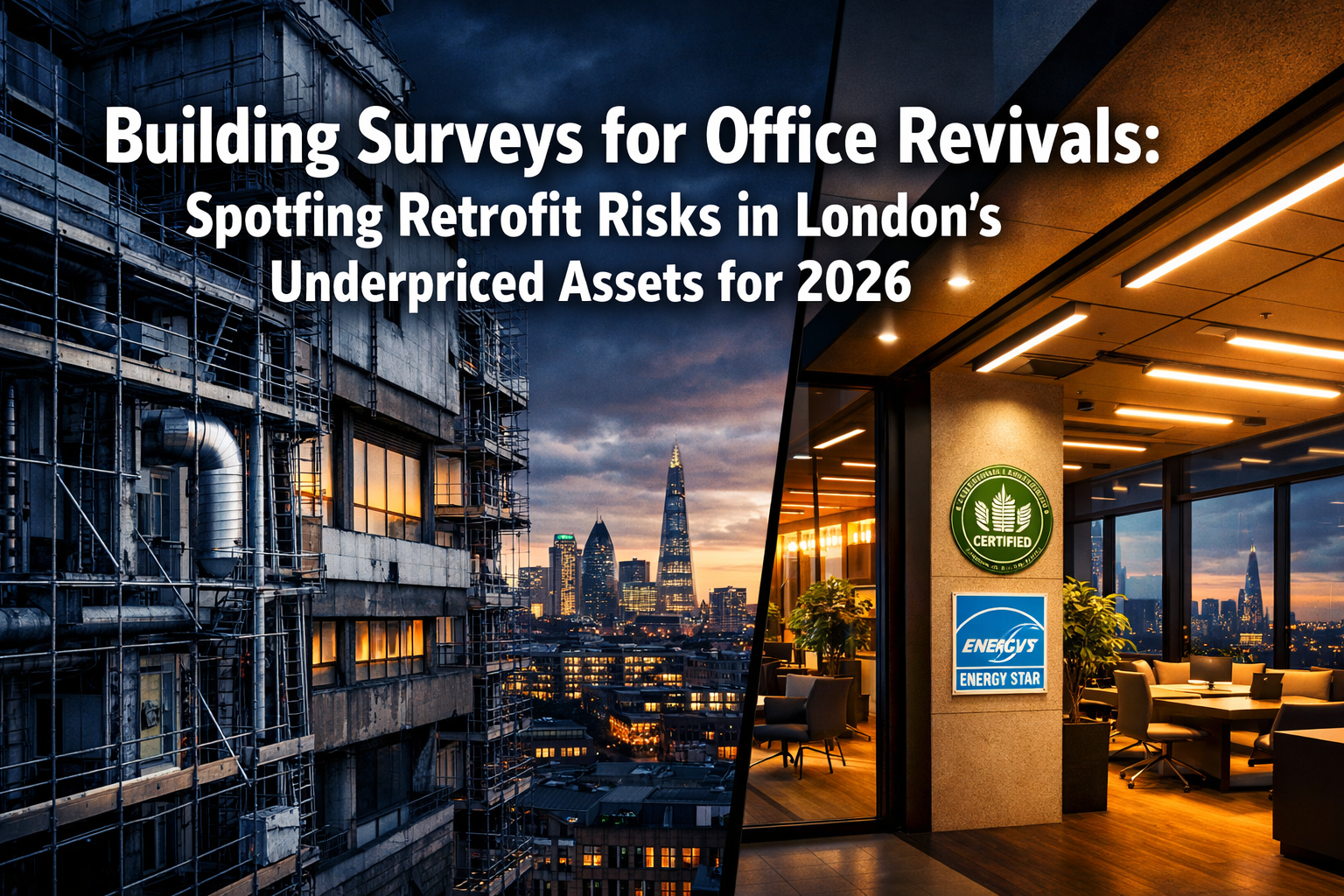
Key Takeaways
- Over 6,500 London office buildings urgently need retrofit to meet EPC regulations, creating a £1 billion opportunity in energy savings and rental premiums [1]
- MEES regulations tighten to EPC rating C by 2027 and B by 2030, making comprehensive building surveys essential for avoiding stranded assets [2]
- Average retrofit costs range from £113 to £268 per square foot depending on the scope, with unforeseen issues potentially doubling budgets [3]
- Outstanding BREEAM certification commands a 12.3% rental premium in London, while deep retrofits can more than double rental values [2]
- Level 3 building surveys must prioritize MEP systems, asbestos identification, and hybrid workspace adaptations to accurately assess retrofit viability
The Post-COVID Office Renaissance: Why Underpriced Assets Matter in 2026
The narrative around office spaces has shifted dramatically. Rather than witnessing the predicted collapse, London's commercial property market is experiencing a quality-driven renaissance. Tenants increasingly demand sustainable, flexible workspaces that support hybrid working models—and they're willing to pay premium rents for them.
This creates a unique opportunity: older office buildings trading at significant discounts can be transformed into high-value assets through strategic retrofitting. However, the difference between a profitable revival and a financial disaster lies in identifying retrofit risks before acquisition.
The Regulatory Pressure Cooker
The Minimum Energy Efficiency Standard (MEES) is creating immediate urgency. The threshold is rising from EPC rating E to C in 2027, then to B in 2030 [2]. Approximately half of London's office buildings will require action by 2027 to remain legally lettable [2].
This regulatory timeline means that underpriced office assets fall into two categories:
✅ Value opportunities – Buildings where retrofit is technically and financially viable
❌ Stranded assets – Properties where compliance costs exceed potential returns
A comprehensive building survey is the only reliable way to distinguish between these categories.
Critical Retrofit Risks That Building Surveys Must Identify
Building Surveys for Office Revivals: Spotting Retrofit Risks in London's Underpriced Assets for 2026 demands a specialized approach that goes far beyond traditional residential survey methodologies. Surveyors must assess both the physical condition of the building and its compliance pathway to future regulations.
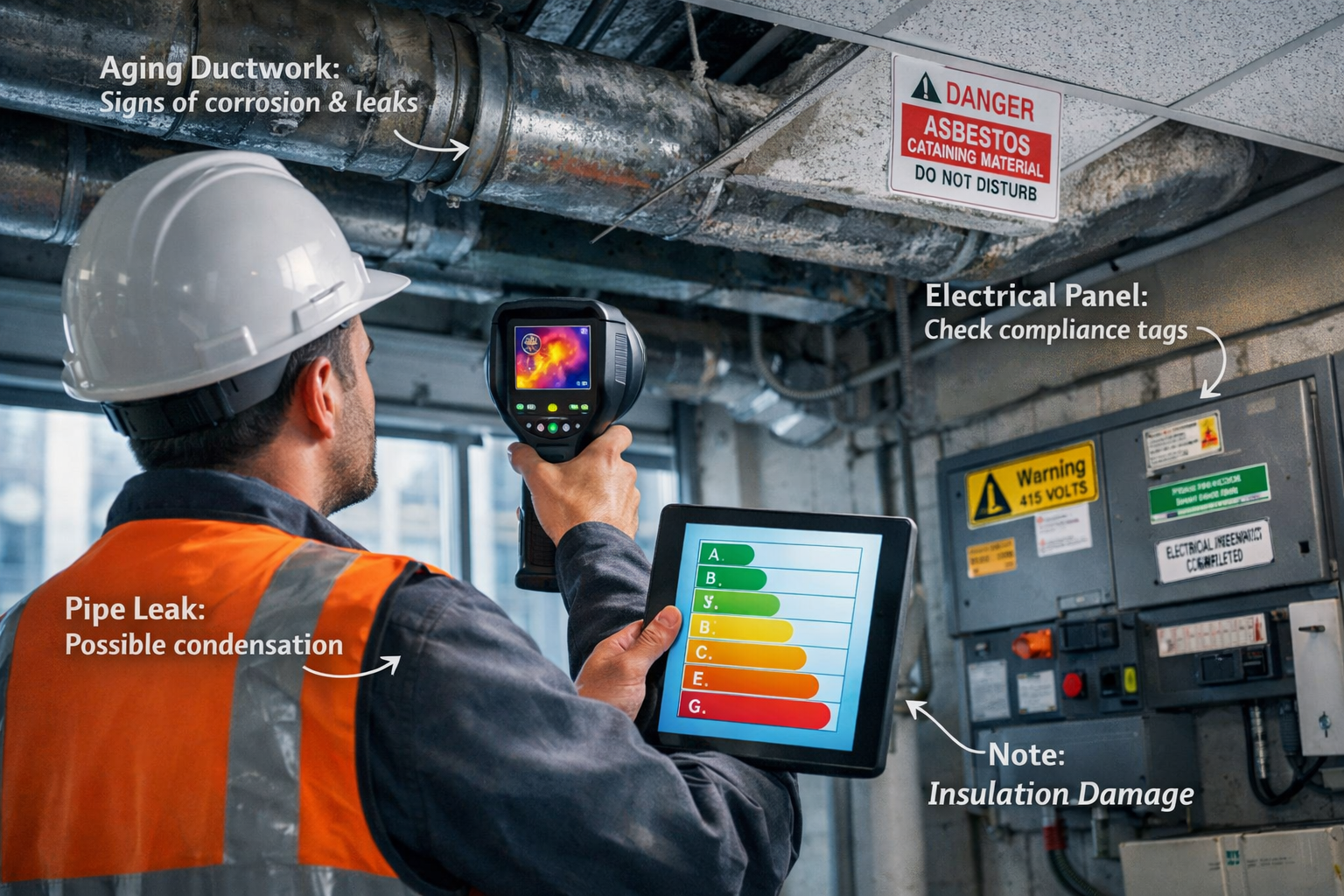
🔧 MEP Systems: The Retrofit Foundation
Mechanical, Electrical, and Plumbing (MEP) systems represent the largest component of most office retrofits, often accounting for 40-50% of total costs. A thorough building defects survey must evaluate:
Heating, Ventilation, and Air Conditioning (HVAC)
- Age and efficiency of existing systems
- Capacity for modern heat pump integration
- Ductwork condition and asbestos presence
- Compliance with current mechanical ventilation standards
- Zoning capabilities for hybrid workspace flexibility
Electrical Infrastructure
- Main panel capacity for increased loads (EV charging, enhanced IT)
- Wiring age and compliance with current regulations
- Lighting systems and LED conversion potential
- Smart building system integration readiness
- Emergency power and fire safety systems
Plumbing and Water Systems
- Pipe material and condition (particularly pre-1970s installations)
- Water efficiency compliance potential
- Drainage capacity for increased occupancy
- Legionella risk assessment for modified usage patterns
Expert Insight: "The estimated average cost of raising an EPC D-rated office building to a B rating is £113 per square foot, rising to £268 per square foot when combined with high-level amenity improvements." [3]
☠️ Asbestos: The Hidden Cost Multiplier
Asbestos-containing materials (ACMs) are present in the majority of London office buildings constructed before 2000. The location and type of asbestos dramatically impacts retrofit costs:
Low-Impact Scenarios:
- Encapsulated floor tiles in good condition
- Pipe lagging in non-disturbance zones
- Ceiling tiles that can remain undisturbed
High-Impact Scenarios:
- Sprayed asbestos in ceiling voids requiring removal
- Asbestos Insulating Board (AIB) in fire protection systems
- ACMs in areas requiring MEP upgrades
Asbestos removal can add £15-50 per square foot to retrofit costs, but more critically, it extends project timelines by 3-6 months due to licensing requirements and disposal protocols. A comprehensive building materials assessment is essential for accurate budgeting.
🏢 Structural and Envelope Considerations
The building envelope—walls, windows, roof, and foundation—determines both energy efficiency potential and structural retrofit capacity:
Thermal Performance
- Existing insulation levels and upgrade pathways
- Window replacement requirements (single vs. double glazing)
- Air tightness and infiltration rates
- Thermal bridging at structural connections
Structural Capacity
- Floor loading for increased occupancy and amenities
- Roof capacity for solar panels or green roof systems
- Foundation condition for additional floors or extensions
- Seismic and wind loading compliance
Moisture and Weatherproofing
- Moisture intrusion in walls and basements
- Roof membrane condition and remaining lifespan
- Facade deterioration and water penetration
- Condensation risk in improved envelope scenarios
🔥 Fire Safety and Building Regulations
Post-Grenfell fire safety legislation has significantly impacted office retrofit requirements [4]:
- Compartmentation integrity in existing floor and wall assemblies
- Means of escape compliance for modern occupancy levels
- Sprinkler system requirements for buildings over certain heights
- Fire door specifications and upgrade needs
- External cladding materials and replacement requirements
Fire safety upgrades can represent 10-20% of total retrofit costs but are non-negotiable for regulatory compliance and insurance.
🌿 Heritage and Conservation Constraints
Many of London's underpriced office assets are located in conservation areas or are listed buildings. While the UK government published proposals in 2024 to streamline retrofit processes for historic buildings [5], significant barriers remain:
- Planning approval delays extending project timelines by 6-12 months
- Material restrictions limiting insulation and window replacement options
- Aesthetic requirements increasing costs for sympathetic upgrades
- Risk of maladaptation if traditional building fabric is not properly understood [6]
Retrofitting listed properties could deliver approximately 30% of annual emissions reductions [5], making them valuable targets—but only with expert survey guidance.
Building Surveys for Office Revivals: Advanced Assessment Methodologies for 2026
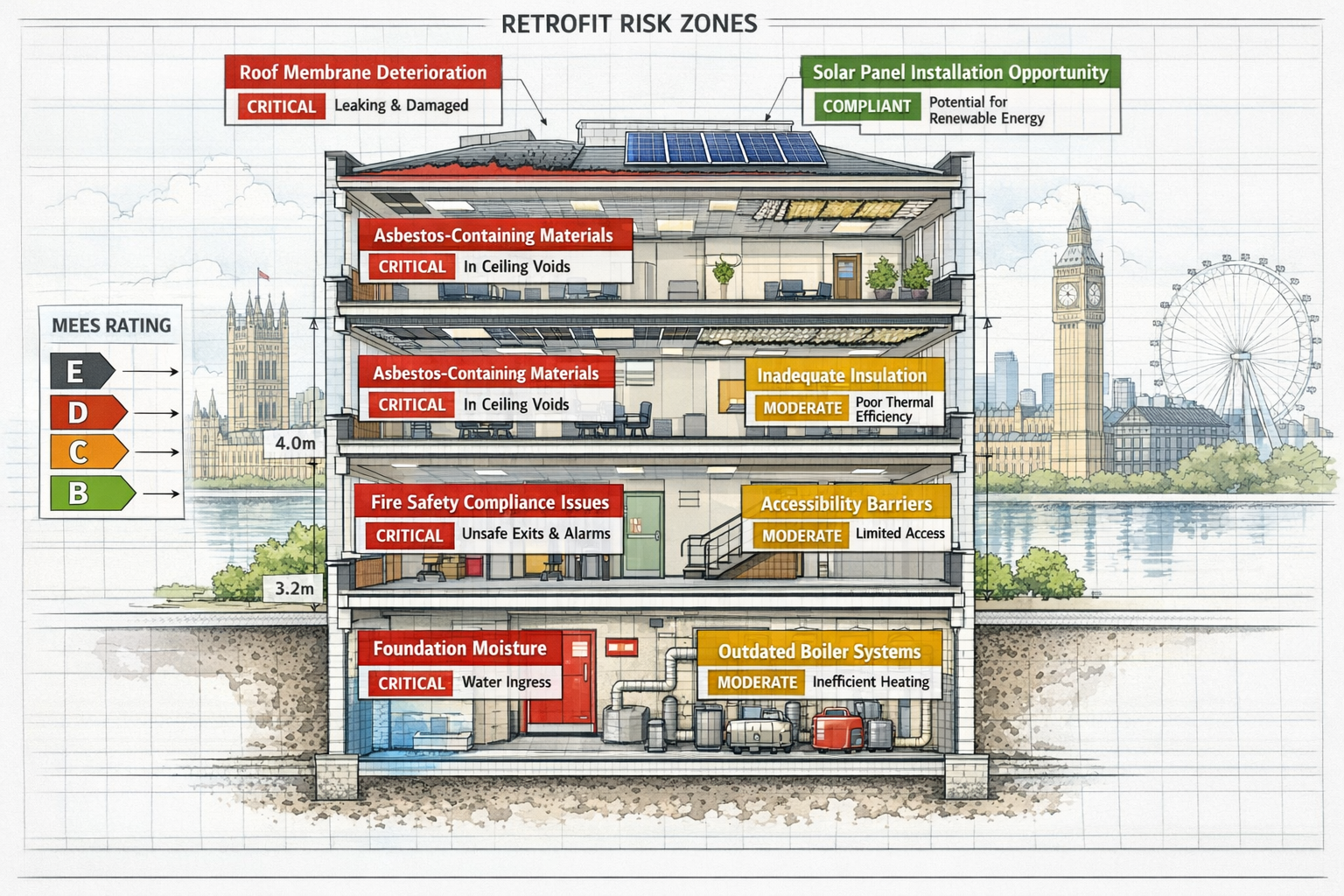
Traditional building survey approaches are insufficient for evaluating retrofit potential. Surveyors must employ advanced diagnostic techniques and compliance modeling to provide actionable investment intelligence.
Level 3 Survey Enhancements for Commercial Retrofits
While Level 3 building surveys provide the most comprehensive residential assessment, commercial office retrofits require additional specialized investigations:
Energy Performance Modeling
- Current EPC rating verification through on-site testing
- Pathway modeling to EPC B or A ratings
- Cost-benefit analysis of different upgrade scenarios
- Renewable energy integration feasibility
Occupancy and Usage Analysis
- Space utilization patterns for hybrid working
- Density calculations for modern workspace standards
- Amenity requirements (wellness rooms, collaboration spaces)
- Accessibility compliance for inclusive design
Technology Infrastructure Assessment
- Data cabling and connectivity capacity
- Smart building system integration potential
- Security and access control systems
- Building Management System (BMS) capabilities
Tenant Coordination Requirements
- Vacant possession needs and costs
- Phased retrofit feasibility with occupied spaces
- Tenant improvement allowance implications
- Lease restructuring opportunities
Digital Survey Tools and Risk Modeling
Modern building surveys leverage technology to improve accuracy and reduce uncertainty:
Thermal Imaging
- Heat loss identification and quantification
- Moisture intrusion detection
- Insulation gap identification
- HVAC system performance verification
3D Laser Scanning
- Precise as-built documentation
- Clash detection for MEP retrofits
- Volume calculations for materials estimation
- Virtual design and construction coordination
Drone Inspections
- Roof condition assessment without scaffolding
- Facade deterioration mapping
- Solar panel placement optimization
- Surrounding context analysis
Digital Risk Dashboards
Supply chain disruptions, fire safety legislation, and ESG-driven design changes are prominent risks for London office refurbishment in 2026 [4]. Digital risk management tools enable scenario planning and contingency budgeting.
The Financial Reality: Costs, Returns, and Market Dynamics
Understanding the financial implications of retrofit risks is essential for investment decision-making. Building Surveys for Office Revivals: Spotting Retrofit Risks in London's Underpriced Assets for 2026 must translate technical findings into clear financial projections.
Retrofit Cost Breakdown
Based on current London market data [3], typical retrofit costs include:
| Component | Cost per sq ft | % of Total |
|---|---|---|
| MEP Systems Upgrade | £45-120 | 40-45% |
| Envelope Improvements | £30-80 | 25-30% |
| Fire Safety & Compliance | £15-35 | 10-15% |
| Amenity Enhancements | £20-60 | 10-15% |
| Professional Fees | £10-25 | 8-10% |
| Contingency | £15-40 | 10-15% |
| Total Range | £135-360 | 100% |
Critical insight: Unforeseen issues discovered during construction can increase costs by 20-50% above initial estimates [3]. Comprehensive pre-acquisition surveys reduce this risk significantly.
The Rental Premium Opportunity
The financial case for retrofit is compelling when executed correctly:
📈 BREEAM Outstanding certification commands a 12.3% rental premium compared to uncertified offices in London [2]
📈 Deep retrofits can more than double rental values: One Manchester example saw rents increase from £12-15 to £35-37 per square foot [2]
📈 Reduced void periods: London offices renovated between 2020 and mid-2024 with BREEAM Outstanding or EPC A-rating achieved pre-let periods of nearly six months, while BREEAM Very Good or EPC B-rated offices averaged just over two months [3]
📈 Market shift toward Grade A sustainability: More than 40% of office leases in London are now for buildings with EPC ratings of A or B, nearly double the proportion in 2017 (21%) [2]
Capital Expenditure Viability Assessment
A comprehensive building survey must evaluate whether retrofit capital expenditure is justified:
Positive Indicators:
- Strong location with limited Grade A supply
- Building size above 20,000 sq ft (economies of scale)
- Structural capacity for amenity additions
- Favorable lease expiry profile or vacant possession
- Ceiling heights above 2.7m for modern workspace appeal
Warning Signs:
- Extensive asbestos requiring full removal
- Structural deficiencies requiring major reinforcement
- Heritage constraints limiting efficiency improvements
- Unfavorable site constraints (access, parking, transport)
- Competing new-build supply in immediate vicinity
Navigating Planning and Policy in 2026
The regulatory environment continues to evolve, creating both opportunities and challenges for office retrofits in London.
Westminster's "Retrofit-First" Policy
Westminster City Council announced a "retrofit-first" city policy in March 2024, prioritizing applications for projects that reuse at least 50% of existing buildings [2]. Similar policies are influencing planning approval timelines across London boroughs.
Survey implications:
- Document existing building fabric percentage
- Identify retention opportunities for planning advantages
- Assess embodied carbon savings versus new-build alternatives
- Evaluate circular economy material reuse potential
Working with Chartered Surveyors in Central London
Location-specific expertise is crucial. Different London boroughs have varying approaches to:
- Conservation area restrictions
- Permitted development rights for office conversions
- Section 106 and Community Infrastructure Levy requirements
- Sustainability policy requirements beyond national standards
Engaging chartered surveyors with local borough experience can significantly reduce planning risk and accelerate approval timelines.
Hybrid Workspace Adaptations: The 2026 Imperative
The post-pandemic office serves a fundamentally different purpose than its predecessor. Building surveys must assess retrofit potential for hybrid workspace functionality:
Space Configuration Flexibility
Modern offices require:
- Variety of work settings: focus zones, collaboration areas, social spaces
- Adaptable layouts: movable partitions, modular furniture systems
- Technology integration: video conferencing infrastructure, wireless charging
- Wellness amenities: natural light, air quality monitoring, biophilic design
Survey focus: Floor-to-floor heights, column spacing, structural loading for demountable partitions, natural light penetration.
Health and Wellbeing Standards
Post-COVID expectations include:
- Enhanced ventilation rates (10-15 liters/second/person minimum)
- Touchless fixtures and antimicrobial surfaces
- Air filtration and purification systems
- Outdoor space access or terrace potential
Survey focus: HVAC capacity for increased fresh air, roof terrace structural capacity, bathroom fixture replacement requirements.
Sustainability Visibility
Tenants increasingly demand visible sustainability features:
- Real-time energy monitoring displays
- Green certification plaques (BREEAM, WELL, LEED)
- Renewable energy generation on-site
- Sustainable material transparency
Survey focus: Smart metering infrastructure, renewable energy integration potential, material provenance documentation.
Actionable Survey Checklist for Office Revival Projects
When commissioning Building Surveys for Office Revivals: Spotting Retrofit Risks in London's Underpriced Assets for 2026, ensure the scope includes:
Pre-Acquisition Phase
- Current EPC rating verification and improvement pathway modeling
- Comprehensive asbestos survey (Type 2 or Type 3 as appropriate)
- MEP systems condition assessment with replacement cost estimates
- Structural capacity evaluation for additional loading
- Fire safety compliance gap analysis
- Heritage and conservation constraint identification
- Planning policy review and approval probability assessment
- Tenant lease review and vacant possession strategy
- Comparable rental analysis for retrofitted properties
- Total cost estimate with 15-20% contingency
Due Diligence Phase
- Detailed building problems and solutions documentation
- Specialist investigations (drainage, environmental, geotechnical)
- Utility capacity confirmation with providers
- Title and easement review for renewable energy installations
- Insurance implications of retrofit scope
- Supply chain availability for critical materials
- Contractor market testing for cost validation
Post-Acquisition Phase
- Detailed design development with survey findings integration
- Value engineering to optimize cost-benefit ratio
- Phasing strategy to minimize void periods
- Monitoring program for unforeseen conditions
- Regular cost tracking against survey estimates
Common Pitfalls and How to Avoid Them
Even experienced investors make costly mistakes when evaluating office retrofit opportunities:
❌ Pitfall 1: Underestimating MEP Complexity
Solution: Engage specialist MEP consultants alongside building surveyors. Request invasive investigations of critical systems rather than relying on visual inspection alone.
❌ Pitfall 2: Ignoring Tenant Coordination Costs
Solution: Model both vacant possession scenarios and occupied retrofit approaches. Factor in tenant compensation, temporary relocation, and rental income loss during works.
❌ Pitfall 3: Overlooking Planning Delays
Solution: Conduct pre-application consultation with local planning authority. Budget 6-12 months for planning approval in conservation areas or for listed buildings.
❌ Pitfall 4: Inadequate Contingency Budgets
Solution: Maintain 15-20% contingency for unforeseen conditions. Prioritize invasive investigations during survey phase to reduce uncertainty.
❌ Pitfall 5: Focusing Solely on EPC Compliance
Solution: Evaluate full market positioning including BREEAM certification, WELL standards, and amenity expectations. EPC B is minimum; market leaders achieve EPC A with Outstanding BREEAM.
The Future of London Office Retrofits Beyond 2026
Looking ahead, several trends will shape the retrofit landscape:
Circular Economy Integration
- Material reuse and recycling requirements
- Embodied carbon accounting in planning decisions
- Deconstruction-friendly design specifications
Climate Resilience
- Overheating risk mitigation in improved envelopes
- Flood resilience for basement and ground floor spaces
- Extreme weather event preparedness
Technology Evolution
- AI-driven building management systems
- Predictive maintenance reducing operational costs
- Digital twin integration for ongoing optimization
Regulatory Acceleration
- Potential tightening of MEES to EPC A by 2035
- Embodied carbon limits for major refurbishments
- Operational energy disclosure requirements
Investors who understand these trends and commission comprehensive building surveys will identify the most resilient opportunities.
Conclusion
Building Surveys for Office Revivals: Spotting Retrofit Risks in London's Underpriced Assets for 2026 represents both an art and a science. The opportunity is substantial: over 6,500 London office buildings need urgent retrofit [1], creating a market worth billions in value creation. However, the risks are equally significant, with unforeseen costs capable of transforming attractive acquisitions into financial disasters.
The key differentiator is comprehensive, specialized building survey work that goes far beyond traditional approaches. Successful office revival projects in 2026 require:
✅ Advanced MEP system assessment with replacement cost modeling
✅ Thorough asbestos identification and removal cost estimation
✅ Regulatory compliance pathway analysis for MEES 2027 and 2030 deadlines
✅ Hybrid workspace adaptation evaluation for modern tenant requirements
✅ Financial modeling linking technical findings to rental premiums and ROI
✅ Planning and heritage expertise for location-specific constraints
The market dynamics are clear: outstanding retrofits command 12.3% rental premiums [2], while poorly executed projects create stranded assets. The difference lies in the quality of pre-acquisition intelligence.
Next Steps for Investors and Developers
- Engage specialist surveyors early: Commission comprehensive building surveys during initial due diligence, not after contract exchange
- Budget adequately: Plan for £135-360 per square foot depending on existing condition and target certification level
- Model multiple scenarios: Evaluate both minimum compliance (EPC C/B) and market-leading (EPC A + BREEAM Outstanding) approaches
- Build the right team: Combine building surveyors, MEP specialists, planning consultants, and cost consultants from project inception
- Stay informed: Monitor regulatory developments and market rental trends to optimize timing and specification
London's office market in 2026 offers exceptional opportunities for those who can navigate the complexity. With proper survey work identifying retrofit risks before acquisition, underpriced assets can be transformed into premium, sustainable workspaces that meet the demands of the modern hybrid workforce while delivering superior investment returns.
The retrofit revolution is here—and comprehensive building surveys are the essential foundation for success.
References
[1] Retrofitting Office Buildings Building The Case For Net Zero – ukgbc.org
[2] The Rise Of Office Retrofits – oktra.co.uk
[3] Offices Repurpose Or Retrofit Where Are We Today – mayerbrown.com
[4] What Challenges Are Being Forecast For The Commercial Construction Industry In 2026 And Beyond – virtus-contracts.co.uk
[5] Barriers To Historic Building Retrofit – londonforum.org.uk
[6] Heritage Buildings Retrofit Toolkit – cityoflondon.gov.uk