

The rapid expansion of data centres across the UK is creating an unexpected battleground: shared property boundaries. As construction crews dig deeper foundations for massive server facilities, neighbouring property owners are experiencing vibrations, structural concerns, and disputes that demand expert intervention. Party Wall Surveying for Data Centre Expansions: Protocols Amid 2026 Infrastructure Surge has become a critical specialisation as the digital infrastructure boom transforms urban and suburban landscapes.
With investment in data centres reaching historic levels in 2026, the construction industry faces unprecedented challenges in managing neighbour relations and legal compliance. The Party Wall Act 1996 provides the framework, but applying it to deep excavations for hyperscale facilities requires updated protocols and strategic approaches that minimize downtime while protecting adjacent properties.
Key Takeaways
- 🏗️ Deep excavations for data centres trigger Section 6 Party Wall Act requirements when digging within three meters of neighbouring foundations
- 📋 Updated notice protocols are essential for 2026 data centre projects, with specific provisions for vibration monitoring and foundation protection
- ⚖️ Party Wall Awards can prevent costly disputes and construction delays through proactive surveyor engagement
- 🔍 Pre-construction condition surveys protect both building owners and neighbours by documenting existing property states
- ⏱️ Strategic scheduling in awards can minimize operational downtime for adjacent businesses during excavation work
Understanding the 2026 Data Centre Construction Boom
The global data centre industry is experiencing exceptional growth that directly impacts UK property owners and construction professionals. Nearly 100 Gigawatts of new capacity are expected to come online globally between 2026 and 2030, effectively doubling existing infrastructure[1]. This expansion is not limited to traditional technology hubs—development is spreading to new locations, bringing large-scale construction to areas previously unfamiliar with such projects.
Why Data Centres Require Deep Foundations
Modern data centres, particularly those designed for AI and hyperscale operations, demand substantial structural support:
- Heavy equipment loads: Server racks, cooling systems, and backup power infrastructure create concentrated floor loads
- Vibration isolation: Sensitive equipment requires stable foundations that minimize movement
- Underground utilities: Extensive cabling, cooling pipes, and power distribution systems need protected pathways
- Future expansion: Foundations must accommodate additional floors or equipment upgrades
These requirements frequently necessitate excavations extending 6 to 10 meters below ground level—significantly deeper than typical commercial buildings. When such excavations occur near existing structures, the Party Wall Act becomes immediately relevant.
The Infrastructure Surge Creates Neighbour Concerns
Property owners adjacent to proposed data centre sites are raising legitimate concerns:
- Foundation stability: Will deep excavations undermine existing building foundations?
- Construction vibrations: Can sensitive operations (medical facilities, laboratories, offices) continue during pile driving?
- Property damage: Who bears responsibility if cracks appear during construction?
- Long-term effects: Will ongoing data centre operations cause vibration or noise issues?
These concerns have led to increased disputes and, in some cases, construction delays costing developers millions. Understanding the consequences of ignoring the Party Wall Act has become essential for project managers and developers.
Party Wall Act Requirements for Data Centre Excavations
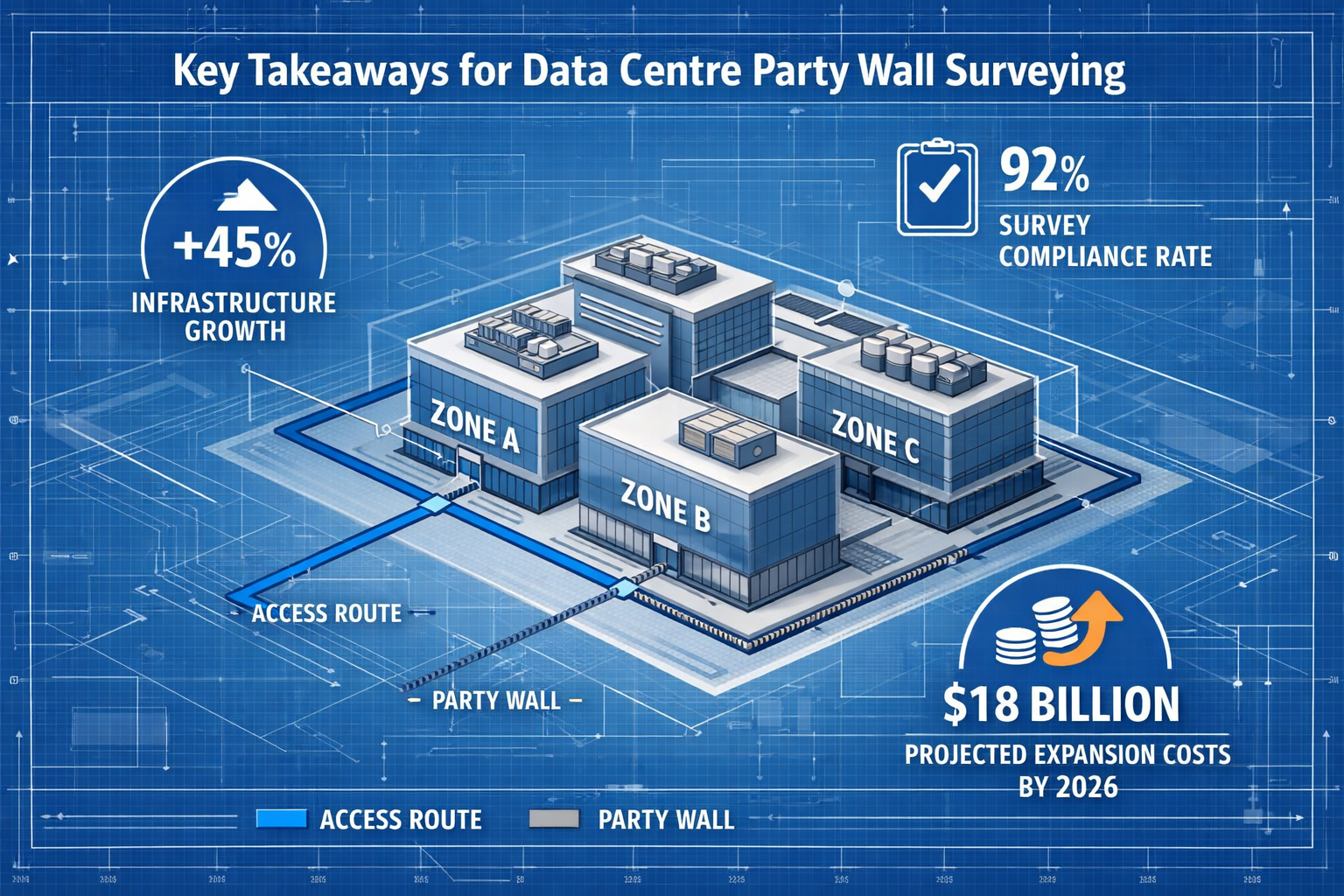
The Party Wall etc. Act 1996 provides the legal framework for managing construction work that affects shared boundaries or nearby structures. For data centre expansions, Section 6 is particularly relevant.
Section 6: Excavation Near Neighbouring Buildings
Section 6 applies when a building owner plans to excavate:
- Within 3 meters of a neighbouring structure, if the excavation will go deeper than the neighbour's foundation
- Within 6 meters of a neighbouring structure, if the excavation will cut a line drawn downward at 45 degrees from the bottom of the neighbour's foundation
Most data centre projects trigger these requirements due to their substantial foundation depths. The building owner must serve notice and, if necessary, provide support for the neighbouring structure through underpinning or other engineering solutions[2].
Updated Notice Protocols for 2026 Projects
Traditional party wall notices often lack the specific details required for modern data centre construction. Best practice protocols now include:
| Notice Element | Standard Approach | Enhanced 2026 Protocol |
|---|---|---|
| Excavation depth | General depth range | Precise depth with engineering drawings |
| Timeline | Approximate start date | Detailed phase schedule with critical periods |
| Vibration management | Not typically addressed | Specific monitoring plan with threshold limits |
| Support measures | Generic underpinning reference | Detailed engineering methodology |
| Access requirements | Standard access clause | Specific inspection schedule and access points |
These enhanced protocols help neighbouring owners understand the scope of work and make informed decisions about appointing their own surveyors.
The Role of Party Wall Surveyors
When notices are served, adjoining owners have three options:
- Consent to the proposed work
- Dissent and appoint their own surveyor
- Take no action (deemed dissent after 14 days)
In practice, most data centre projects involve dissent, leading to the appointment of surveyors. This is not necessarily adversarial—professional surveyors work to create Party Wall Awards that protect all parties' interests while allowing construction to proceed.
Understanding what your party wall rights are empowers property owners to make informed decisions during this process.
Surveyor Protocols for Data Centre Expansion Projects
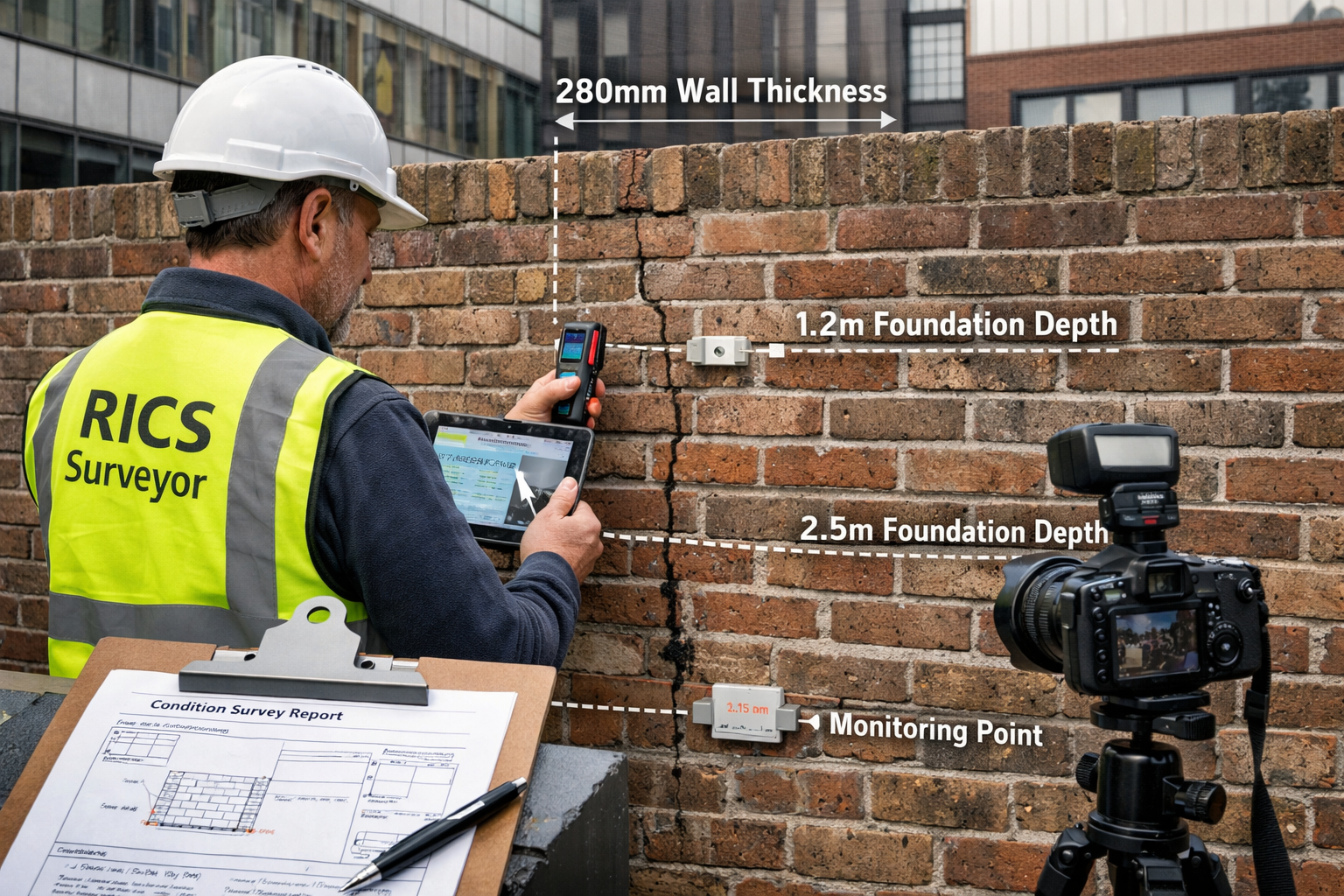
Professional surveyors following RICS (Royal Institution of Chartered Surveyors) guidance employ specific protocols when dealing with data centre expansions. These protocols have evolved significantly in 2026 to address the unique challenges of large-scale digital infrastructure projects.
Pre-Construction Condition Surveys
Before any excavation begins, surveyors conduct comprehensive condition surveys of neighbouring properties. For data centre projects, these surveys are more extensive than standard assessments:
- Structural photography: Detailed photographic records of all walls, floors, and ceilings
- Crack monitoring: Installation of tell-tales or electronic monitors on existing cracks
- Foundation investigation: Non-invasive testing to determine existing foundation depths and condition
- Vibration-sensitive equipment: Documentation of any sensitive equipment or operations in neighbouring buildings
- Baseline vibration readings: Establishing normal vibration levels before construction
These surveys create an indisputable record of pre-existing conditions, protecting both the building owner and the neighbour from false claims.
Vibration Monitoring and Thresholds
Data centre excavations often involve piling, excavation, and compaction work that generates significant vibrations. Modern party wall awards include specific vibration monitoring provisions:
Typical Vibration Thresholds:
- Cosmetic damage threshold: 15-20 mm/s peak particle velocity (PPV)
- Minor damage threshold: 50 mm/s PPV
- Operational disruption: Custom thresholds based on neighbouring use (e.g., 2-5 mm/s for laboratories)
Surveyors specify:
- Monitoring equipment locations
- Real-time alert systems
- Response protocols if thresholds are exceeded
- Work suspension triggers
This proactive approach prevents damage and maintains good neighbour relations throughout construction.
Engineering Solutions in Party Wall Awards
When excavations threaten neighbouring foundations, awards specify engineering solutions. For data centre projects, common approaches include:
- Underpinning: Extending neighbouring foundations to match or exceed the new excavation depth
- Temporary shoring: Steel or concrete support systems during excavation
- Secant piling: Interlocking concrete piles creating a retaining wall
- Ground anchors: Tensioned anchors preventing lateral soil movement
The award details the methodology, timeline, and quality standards for these works. It also addresses access requirements—data centre sites often need 24/7 construction access, which must be balanced against neighbours' reasonable use of their property.
Dispute Resolution Strategies
Despite careful planning, disputes can arise. Surveyors employ several strategies to minimize conflicts:
- Regular communication: Weekly updates to neighbouring owners during critical construction phases
- Third surveyor appointment: When building owner and adjoining owner surveyors disagree, a neutral third surveyor resolves disputes
- Phased awards: Breaking large projects into phases with separate awards for each stage
- Compensation provisions: Clear frameworks for compensating neighbours for temporary inconvenience or proven damage
When a neighbour refuses party wall works, these mechanisms provide legal pathways to resolution without halting construction.
Case Studies from 2026 UK Data Centre Projects
Real-world examples from 2026 demonstrate how effective party wall surveying protocols minimize downtime and prevent disputes during data centre expansions.
Case Study 1: London Hyperscale Facility
A major technology company planned a hyperscale data centre in East London, requiring excavations to 8 meters depth. The site was surrounded by operational warehouses and light industrial units.
Challenge: Neighbouring businesses could not tolerate construction vibrations during daytime operations due to precision manufacturing equipment.
Solution: Party wall surveyors developed an award with:
- Night-time piling work (10 PM – 6 AM) with noise mitigation
- Continuous vibration monitoring with 5 mm/s operational threshold
- Compensation framework for any production disruptions
- Accelerated construction schedule to minimize total duration
Outcome: Construction completed without neighbour complaints or damage claims. The proactive award strategy added £180,000 to project costs but avoided estimated £2.3 million in potential delay penalties.
Case Study 2: Manchester Edge Computing Facility
An edge computing facility required excavation adjacent to a Victorian-era office building with shallow brick foundations.
Challenge: The historic building's foundations extended only 1.2 meters, while the data centre required 5-meter excavation within 2 meters of the shared boundary.
Solution: Surveyors specified:
- Comprehensive underpinning of the Victorian building's party wall section
- Temporary propping during excavation
- Weekly structural monitoring by independent engineer
- Detailed photographic condition survey with 360-degree imaging
Outcome: The underpinning work added 6 weeks to the schedule but prevented potential collapse. Post-construction surveys showed zero new structural movement or damage.
Case Study 3: Birmingham Co-Location Expansion
A co-location provider expanded an existing data centre, requiring excavation for additional cooling infrastructure adjacent to an active office building.
Challenge: Office tenants included a financial services firm with regulatory requirements for operational continuity.
Solution: The party wall award included:
- Phased excavation schedule avoiding quarter-end periods
- Redundant vibration monitoring with real-time alerts to office management
- Pre-agreed work suspension protocol if thresholds exceeded
- Temporary structural support installed before excavation began
Outcome: All excavation work completed during agreed windows. One brief work suspension occurred when vibration exceeded 8 mm/s, demonstrating the monitoring system's effectiveness. No operational disruptions reported by office tenants.
These case studies highlight the importance of customized awards that address specific site conditions and neighbour requirements. Generic approaches rarely succeed with complex data centre projects.
Cost Considerations and Timeline Planning
Understanding the financial and temporal implications of party wall surveying helps developers budget appropriately for data centre expansions.
Surveyor Fees and Related Costs
The cost of party wall surveyors varies based on project complexity:
Typical Fee Ranges (2026):
- Building owner's surveyor: £2,500 – £8,000 for data centre projects
- Adjoining owner's surveyor: £2,000 – £6,000 per neighbouring property
- Third surveyor (if required): £3,000 – £10,000
- Condition surveys: £800 – £2,500 per property
- Vibration monitoring: £5,000 – £15,000 for project duration
For large data centre projects with multiple neighbours, total party wall costs can reach £50,000 – £150,000. However, this represents a small fraction of total project costs (typically 0.1% – 0.3%) and provides essential risk mitigation.
Additional Engineering Costs
When awards require structural support for neighbouring properties:
- Underpinning: £1,500 – £3,000 per linear meter
- Temporary shoring: £15,000 – £50,000 depending on depth and duration
- Secant piling: £800 – £1,200 per linear meter
- Structural monitoring: £8,000 – £20,000 for comprehensive programs
These costs are borne by the building owner (the party undertaking the works) under the Party Wall Act.
Timeline Implications
Party wall procedures add time to project schedules:
- Notice period: Minimum 2 months before work begins (1 month for notice, 14 days for response, time for surveyor appointment)
- Surveyor appointment and award preparation: 4-8 weeks
- Pre-construction surveys: 1-2 weeks
- Monitoring setup: 1 week
In total, developers should allow 3-4 months from initial notice to construction commencement. Attempting to shortcut this process risks injunctions, work stoppages, and costly legal disputes.
Pro tip: Engage party wall surveyors during the planning phase, not after planning permission is granted. Early engagement identifies potential issues and allows timeline adjustments before construction contracts are signed.
Best Practices for Building Owners and Developers
Developers undertaking data centre expansions can optimize party wall processes by following these proven practices:
Early Engagement and Communication
✅ Inform neighbours before formal notices: Informal discussions build goodwill and identify concerns early
✅ Provide project visualizations: Help neighbours understand the scope and scale of proposed work
✅ Appoint experienced surveyors: Data centre projects require surveyors familiar with deep excavations and commercial construction
✅ Budget adequately: Include party wall costs, potential underpinning, and contingency for unforeseen issues
Technical Documentation
Comprehensive technical packages support smooth party wall processes:
- Detailed excavation plans with precise depths and locations
- Foundation design drawings showing support methodologies
- Construction methodology statements addressing vibration, noise, and dust
- Proposed monitoring and mitigation measures
- Realistic construction timelines with critical phases identified
This documentation demonstrates professionalism and helps surveyors prepare thorough awards efficiently.
Contractor Management
Ensure construction teams understand party wall obligations:
- Include party wall award compliance in contractor agreements
- Require contractors to attend pre-construction meetings with surveyors
- Establish clear reporting lines for vibration monitoring alerts
- Implement immediate response protocols for neighbour concerns
Many party wall disputes arise from contractor actions, not design issues. Proper contractor briefing prevents problems.
Ongoing Monitoring and Reporting
Throughout construction:
- Maintain regular communication with neighbouring owners
- Provide monthly progress updates highlighting upcoming critical phases
- Respond promptly to concerns or complaints
- Document compliance with award conditions
- Conduct post-construction surveys to confirm no damage occurred
This transparent approach builds trust and prevents misunderstandings from escalating into formal disputes.
Future Trends in Party Wall Surveying for Digital Infrastructure
As data centre construction continues to accelerate through 2026 and beyond, several trends are emerging in party wall surveying practice:
Technology Integration
Modern surveying increasingly incorporates advanced technology:
- 3D laser scanning: Creates precise digital models of existing structures for condition surveys
- IoT vibration sensors: Real-time monitoring with automated alerts and cloud-based data storage
- Building Information Modeling (BIM): Integration of party wall data into project BIM models
- Drone surveys: Aerial documentation of site conditions and construction progress
These technologies improve accuracy, reduce survey time, and provide better documentation for all parties.
Standardized Protocols
Industry bodies are developing standardized protocols specifically for data centre projects:
- Template notices addressing common data centre construction scenarios
- Standard vibration threshold frameworks based on neighbouring use types
- Model award clauses for deep excavations and underpinning
- Best practice guides for hyperscale and edge computing facilities
These standards will streamline processes and reduce variation in surveyor approaches.
Sustainability Considerations
Party wall awards are beginning to address sustainability:
- Requirements for sustainable underpinning materials
- Noise and vibration limits that account for neighbour sustainability certifications
- Coordination with neighbouring properties' environmental management systems
- Provisions for shared infrastructure (drainage, utilities) that benefit both properties
As data centres pursue sustainability certifications, party wall processes will increasingly reflect environmental priorities.
Regulatory Evolution
The Party Wall Act 1996 may see updates to address modern construction challenges:
- Explicit provisions for vibration-sensitive neighbouring uses
- Enhanced rights for neighbours affected by large-scale infrastructure projects
- Clearer frameworks for compensation and temporary disruption
- Streamlined dispute resolution mechanisms
While legislative change moves slowly, industry practice is evolving rapidly to address gaps in the current framework.
Conclusion
Party Wall Surveying for Data Centre Expansions: Protocols Amid 2026 Infrastructure Surge represents a critical intersection of digital infrastructure growth and property law. As data centres proliferate across the UK, driven by AI demand and hyperscale expansion, the construction industry must navigate complex neighbour relationships and legal obligations.
The Party Wall Act 1996 provides the foundational framework, but successful data centre projects require enhanced protocols that address:
- Deep excavations triggering Section 6 requirements
- Vibration monitoring and protection for neighbouring properties
- Customized awards reflecting specific site conditions and neighbour needs
- Proactive communication and dispute prevention strategies
Professional surveyors following RICS guidance and employing updated 2026 protocols can minimize construction delays, prevent costly disputes, and protect all parties' interests. The case studies demonstrate that investment in proper party wall procedures—while adding cost and time—delivers substantial returns through risk mitigation and maintained neighbour relations.
Actionable Next Steps
For developers planning data centre expansions:
- Engage party wall surveyors early in the planning process, ideally before submitting planning applications
- Budget appropriately for surveyor fees, condition surveys, monitoring, and potential underpinning works
- Communicate proactively with neighbours before serving formal notices
- Ensure technical documentation is comprehensive and addresses party wall implications
- Select experienced contractors familiar with party wall compliance requirements
For property owners receiving party wall notices:
- Seek professional advice from an independent party wall surveyor
- Respond within the 14-day notice period to protect your rights
- Request comprehensive condition surveys before work begins
- Understand your rights regarding access, compensation, and dispute resolution
- Maintain open communication with the building owner and surveyors
The 2026 infrastructure surge presents both opportunities and challenges. With proper protocols, professional surveying, and collaborative approaches, data centre expansions can proceed smoothly while protecting neighbouring properties and maintaining community relationships.
For expert guidance on party wall matters related to data centre or other construction projects, professional party wall services provide essential support throughout the process.
References
[1] Party Wall Surveys For Data Centre Expansions Navigating Agreements In The 2026 Investment Surge – https://nottinghillsurveyors.com/blog/party-wall-surveys-for-data-centre-expansions-navigating-agreements-in-the-2026-investment-surge
[2] Party Wall Surveys For Data Centre Expansions In The Uk Ai Boom Rics Guidance And Case Studies From 2026 Projects – https://nottinghillsurveyors.com/blog/party-wall-surveys-for-data-centre-expansions-in-the-uk-ai-boom-rics-guidance-and-case-studies-from-2026-projects