

{"cover":"Professional landscape format (1536x1024) hero image featuring bold text overlay 'Expert Witness Challenges in 2026 Boundary Disputes: Rising Volumes from Increased Development Activity' in extra large 70pt white sans-serif font with dark shadow and semi-transparent navy overlay box, positioned in upper third. Background shows aerial view of urban development with construction cranes, residential extensions, and property boundary lines overlaid on satellite imagery. Split composition: left side shows modern housing development, right side displays courtroom with expert witness testifying. Color scheme: deep navy blue, white, gold accents. Magazine cover aesthetic, high contrast, editorial quality with professional surveying equipment subtly visible in foreground.","content":["Landscape format (1536x1024) detailed illustration showing the direct correlation between development activity and boundary disputes in 2026. Split-screen composition: left half displays bar graph with rising construction permits and housing extensions from 2023-2026 in ascending blue bars, right half shows corresponding increase in boundary dispute cases in red ascending bars. Center features property boundary fence with surveyor using theodolite equipment. Overlay text '40% Increase in Disputes' in bold typography. Background includes architectural blueprints, property deeds, and Party Wall notices. Clean infographic style with professional color palette of navy, burgundy, and cream. Data visualization with percentage markers and trend arrows pointing upward.","Landscape format (1536x1024) professional photograph of chartered surveyor expert witness in modern courtroom setting, examining detailed boundary survey report with judge and legal teams visible in background. Foreground shows open expert witness report with visible sections: Executive Summary, Site Investigation Findings, Technical Analysis, and Conclusions. Surveyor pointing to scaled site plan with boundary markers clearly indicated. Table displays surveying equipment: laser distance measurer, GPS unit, historical deed documents, and photographic evidence. Warm courtroom lighting with wooden paneling. Composition emphasizes professionalism and technical expertise. Color scheme: rich mahogany, cream, navy blue accents. Sharp focus on documentation and measurement tools.","Landscape format (1536x1024) detailed infographic illustrating court-ready boundary dispute evidence gathering process. Circular workflow diagram in center showing six stages: Initial Site Survey, Historical Research, Measurement Documentation, Photographic Evidence, Expert Analysis, and Court Report Preparation. Each stage features relevant icons and mini-illustrations: surveyor with equipment, archive documents, precision measurements, camera, analytical charts, and formal report binding. Background shows faded property boundary map with disputed area highlighted in yellow. Side panels display sample evidence: historical maps from 1950s-2026, measurement certificates, witness statements, and RICS compliance badges. Professional color scheme: forest green, gold, charcoal grey. Clean, organized layout with connecting arrows showing process flow."]}
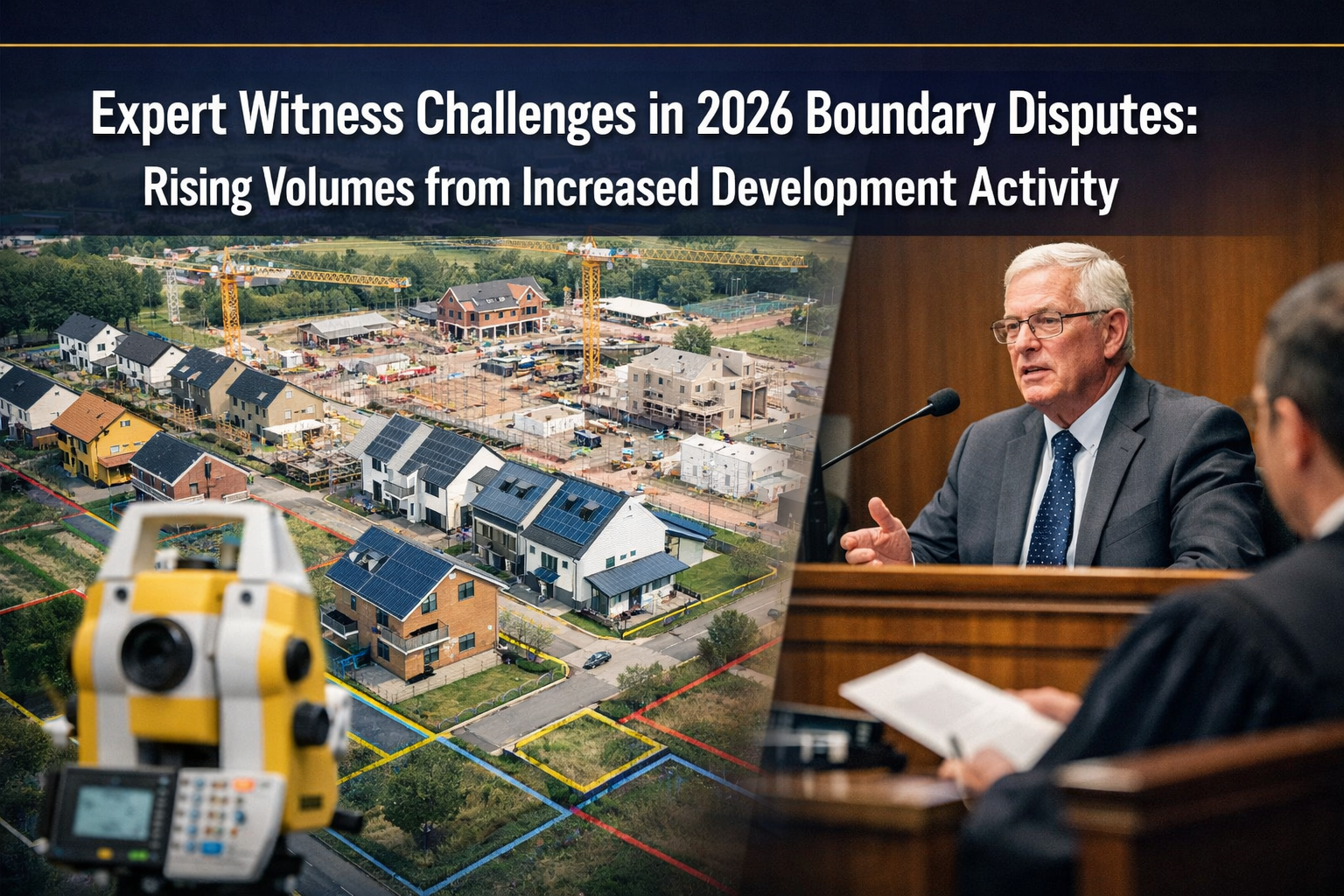
The property market recovery of 2026 has brought unexpected consequences for homeowners, developers, and legal professionals alike. As construction activity surges and homeowners invest in extensions, loft conversions, and rear additions, Expert Witness Challenges in 2026 Boundary Disputes: Rising Volumes from Increased Development Activity have emerged as a critical concern across the UK property sector. 🏗️
When neighbours disagree about property lines, fence placements, or Party Wall matters, chartered surveyors step into the courtroom as expert witnesses. However, the dramatic increase in development activity has created unprecedented demand for qualified experts, revealing significant challenges in qualification standards, evidence preparation, and court-ready reporting. This comprehensive guide examines how market recovery has intensified boundary conflicts and what property professionals need to know about expert witness requirements in 2026.
Key Takeaways
- Development boom drives disputes: The 2026 property market recovery has triggered substantial increases in residential extensions and developments, directly correlating with higher boundary dispute volumes requiring expert witness testimony
- Qualification matters critically: Not all licensed surveyors possess the specialized expertise to serve as expert witnesses in boundary disputes, with courts increasingly scrutinizing expert methodologies and credentials[1]
- Court-ready reports require structure: Effective expert witness reports must follow specific formats including executive summaries, site investigation findings, technical analysis, and clear conclusions supported by verifiable evidence
- Evidence gathering is comprehensive: Successful boundary dispute resolution demands historical research, precise measurements, photographic documentation, and adherence to professional standards like RICS guidelines
- Legal standards are tightening: Courts in 2026 apply rigorous admissibility standards for expert testimony, requiring witnesses to demonstrate both technical competence and litigation experience
Understanding Expert Witness Challenges in 2026 Boundary Disputes: Rising Volumes from Increased Development Activity
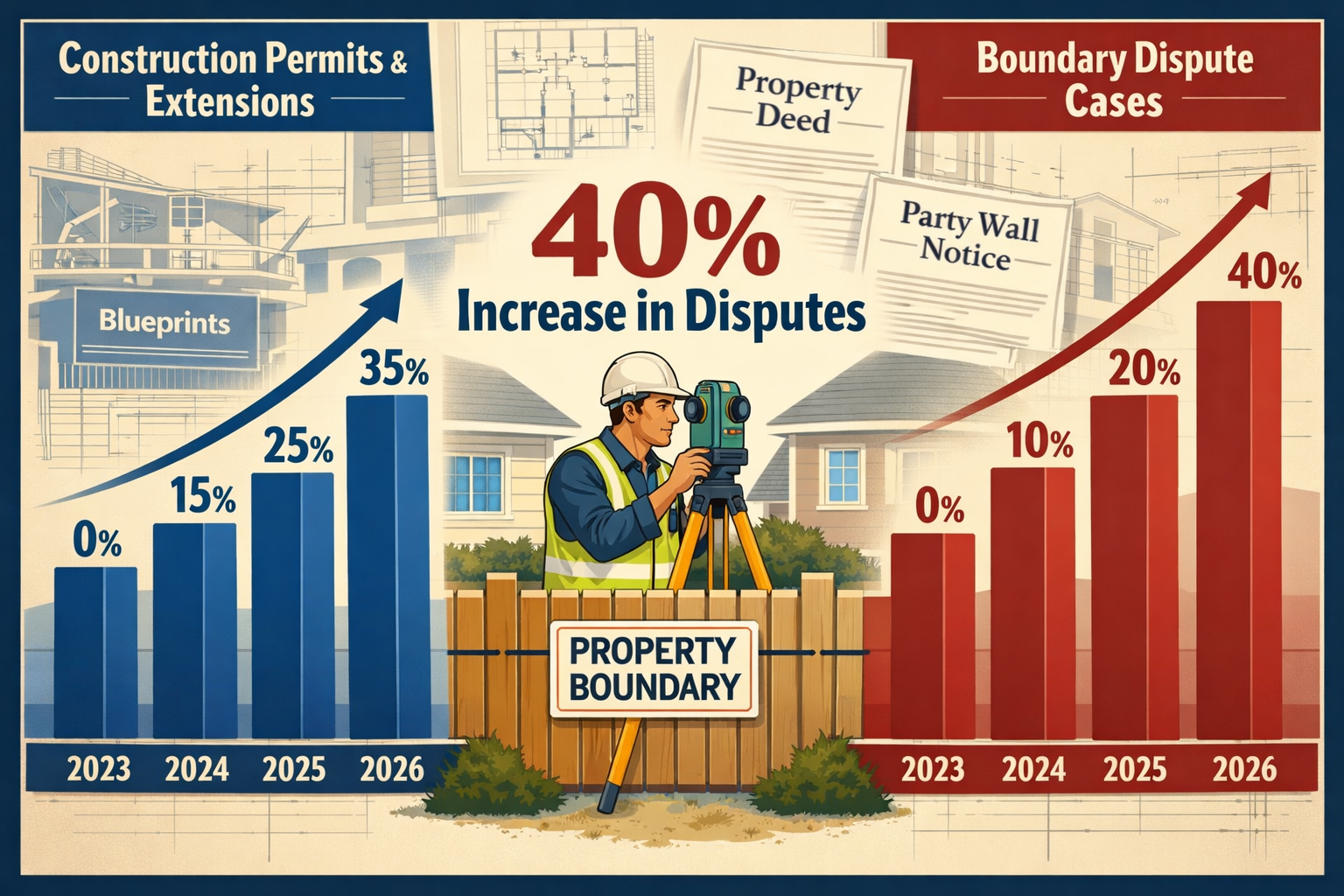
The Development Activity Surge
The UK property market has experienced remarkable recovery in 2026, with homeowners capitalizing on improved economic conditions to invest in property improvements. This development surge includes:
- Residential extensions: Single and double-storey rear extensions, side returns, and wraparound additions
- Loft conversions: Dormer installations and full loft transformations adding valuable living space
- Basement excavations: Underground extensions particularly popular in high-value urban areas
- Garden developments: Outbuildings, studios, and structures near property boundaries
- Commercial conversions: Residential properties converted to mixed-use or commercial spaces
Each of these projects carries potential for boundary disputes, particularly when work approaches or crosses property lines. The average cost of boundary disputes has risen accordingly, making expert witness selection increasingly important.
Why Development Activity Triggers Boundary Disputes
Several factors connect increased development to boundary conflicts:
Physical encroachment concerns: Extensions and excavations may inadvertently cross boundary lines, especially where historical property records lack precision or where natural boundaries have shifted over time.
Party Wall Act complications: The Party Wall etc. Act 1996 requires specific procedures when building on or near shared walls and boundaries. Many homeowners and contractors fail to follow proper notification procedures, creating disputes that require expert Party Wall surveyors to resolve.
Access disputes: Construction projects often require temporary access through neighbouring properties, leading to disagreements about rights of way and easements.
Foundation and excavation impacts: Deep excavations for basements or extensions can affect neighbouring properties' structural integrity, raising questions about liability and damage assessment.
Measurement discrepancies: Modern precise surveying equipment reveals inconsistencies in historical boundary descriptions, creating conflicts when development plans rely on accurate measurements.
The Expert Witness Qualification Crisis
A critical challenge emerging in 2026 involves expert witness qualification standards. As one industry case study revealed, not all licensed surveyors are qualified to serve as expert witnesses in boundary disputes.[1] This distinction has profound implications for property owners and legal teams.
The qualification gap includes:
| Licensed Surveyor | Qualified Expert Witness |
|---|---|
| Basic surveying credentials | Specialized boundary dispute experience |
| General property knowledge | Court testimony training |
| Standard measurement skills | Historical research expertise |
| Limited litigation exposure | Proven track record in legal proceedings |
| May lack report writing expertise | Produces court-compliant documentation |
Courts increasingly scrutinize expert qualifications, following standards established in cases like Barry v. DePuy Synthes, which emphasized that expert testimony must demonstrate reliable methodologies and align with established professional standards.[2] This heightened scrutiny means property owners cannot simply hire the cheapest available surveyor—they need genuinely qualified experts.
Court-Ready Report Structures for Boundary Dispute Expert Witnesses
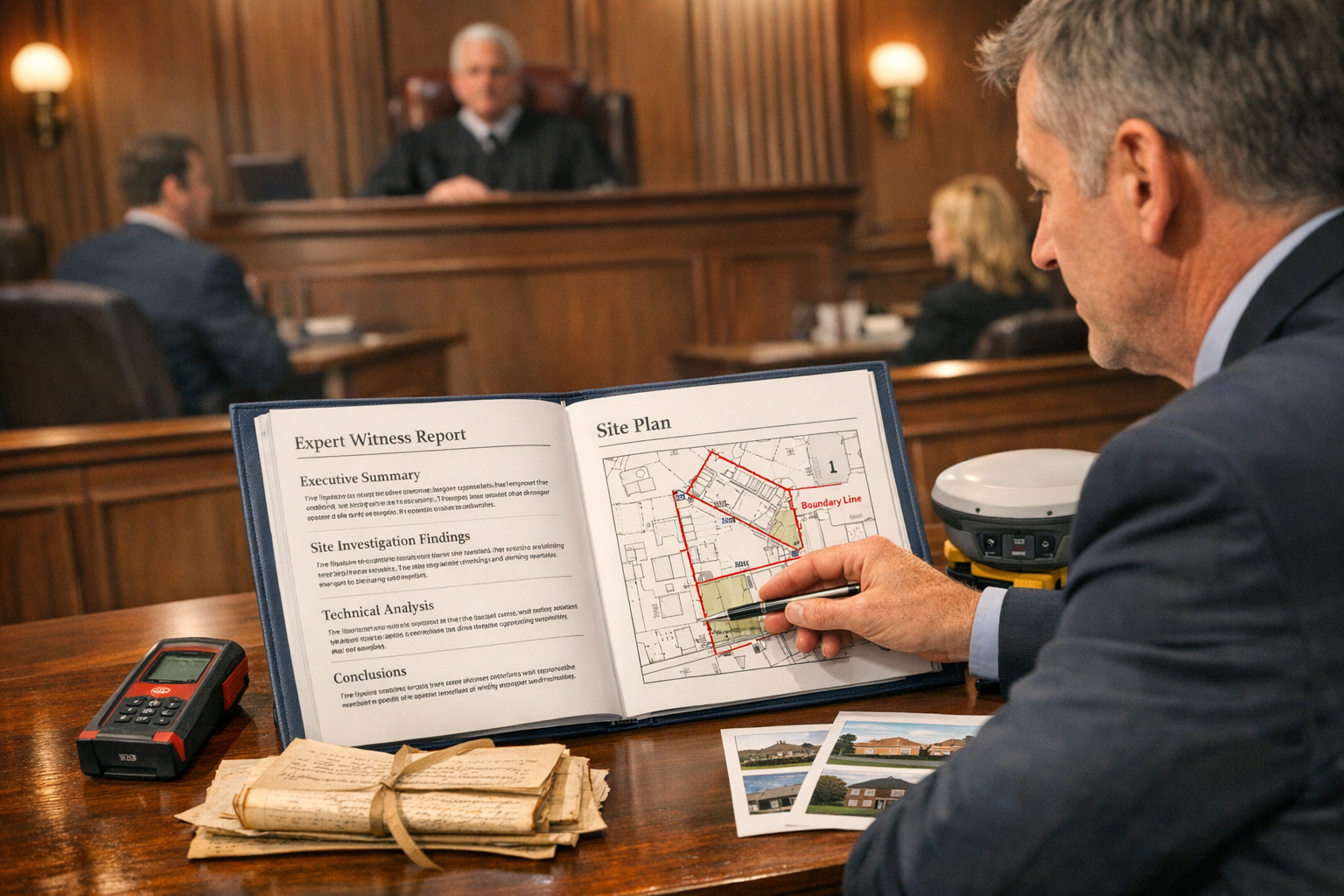
Essential Components of Expert Witness Reports
Effective expert witness reports in boundary disputes must follow structured formats that courts recognize and respect. The comprehensive report typically includes:
1. Executive Summary
A concise overview stating the expert's conclusions, the disputed boundary location, and key findings. This section should be understandable to non-technical readers including judges, solicitors, and property owners.
2. Expert Qualifications and Instructions
- Professional credentials (RICS membership, specialized training)
- Relevant experience in boundary dispute cases
- Confirmation of independence and duty to the court
- Clear statement of instructions received from instructing solicitors
- Confirmation of compliance with Civil Procedure Rules Part 35
3. Site Investigation Findings
Detailed documentation of physical site inspection including:
- Current boundary features: Fences, walls, hedges, and natural boundaries
- Physical evidence: Wear patterns, vegetation lines, historical markers
- Measurements: Precise dimensions using calibrated equipment
- Photographic evidence: Comprehensive images with annotations
- Neighbouring property observations: Relevant features on adjacent land
Understanding what building surveys include helps contextualize the thoroughness required for boundary investigations.
4. Historical Research and Documentary Evidence
Expert witnesses must investigate:
- Title deeds: Current and historical property descriptions
- Conveyance documents: Transfer records showing boundary descriptions
- Ordnance Survey maps: Historical and current editions
- Planning applications: Previous development approvals affecting boundaries
- Aerial photographs: Historical imagery showing boundary evolution
- Local authority records: Highway boundaries, adoption records
5. Technical Analysis
The analytical section demonstrates the expert's methodology:
- Comparison of documentary evidence with physical features
- Analysis of measurement discrepancies
- Assessment of boundary movement or encroachment
- Evaluation of competing boundary interpretations
- Application of legal principles (e.g., adverse possession considerations)
6. Conclusions and Opinions
Clear, unambiguous statements regarding:
- Most probable boundary location based on evidence
- Degree of certainty in conclusions
- Alternative interpretations if evidence permits
- Recommendations for dispute resolution
7. Appendices
Supporting documentation including:
- Scaled site plans showing disputed boundary
- Measurement records and survey data
- Photographic evidence with location references
- Copies of relevant historical documents
- Professional qualifications and CV
Meeting Legal Standards for Expert Testimony
The 2026 legal landscape demands rigorous adherence to admissibility standards. Following the principles established in Daubert and codified in Rule 702, courts evaluate expert testimony based on:
Reliability of methodology: Experts must demonstrate that their boundary determination methods are scientifically sound and professionally accepted. This includes using calibrated equipment, following RICS standards, and applying recognized surveying principles.[2]
Relevance to disputed issues: Expert opinions must directly address the specific boundary questions in dispute, avoiding speculation or opinions beyond the expert's expertise.
Qualifications and experience: Courts verify that experts possess genuine specialized knowledge in boundary determination, not just general surveying credentials.
Independence and objectivity: Expert witnesses serve the court, not the party instructing them. Reports must present balanced analysis, acknowledging weaknesses in their own position and strengths in opposing arguments.
Evidence Gathering Strategies for Boundary Dispute Expert Witnesses
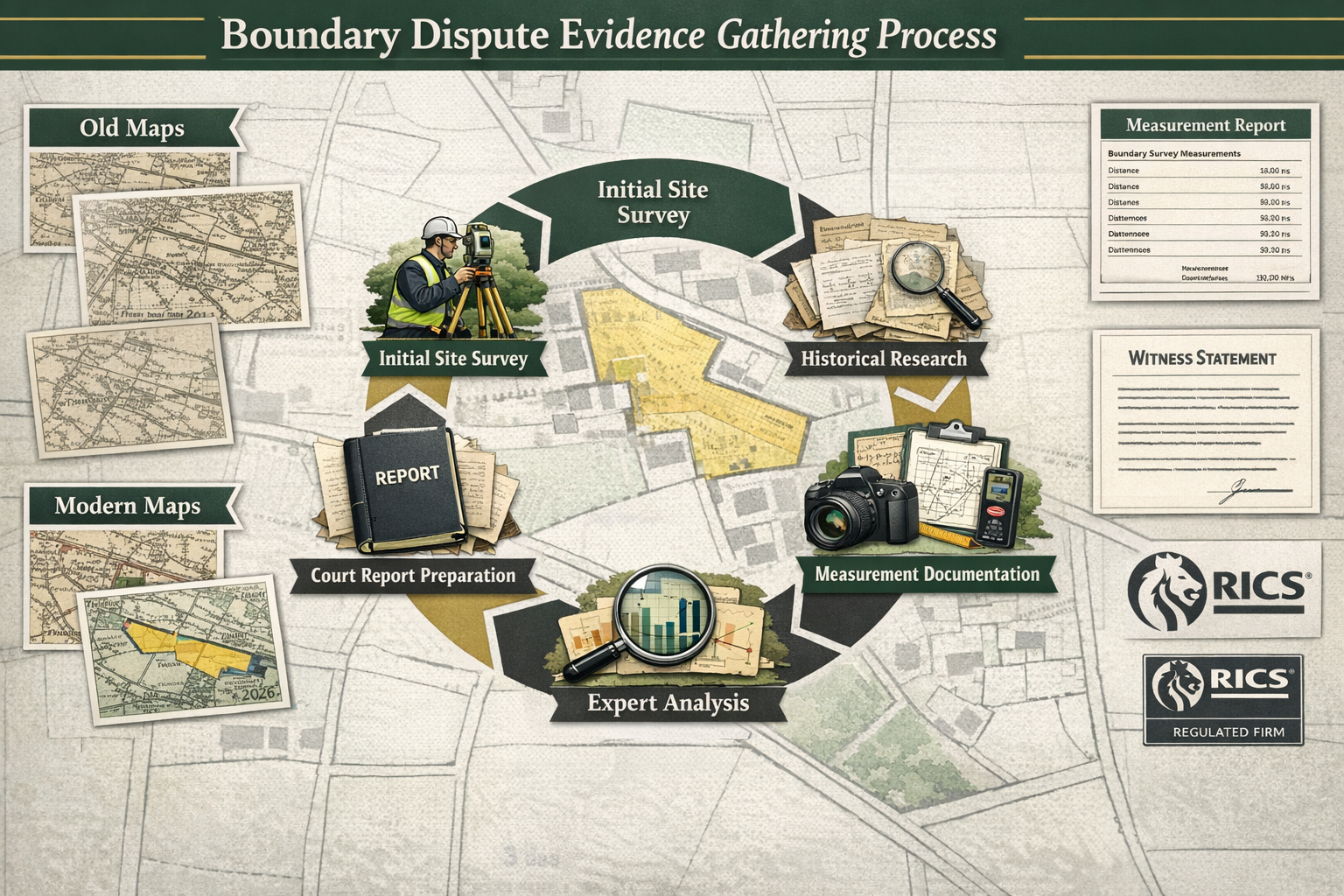
Comprehensive Site Investigation Protocols
Successful expert witnesses follow systematic site investigation procedures:
Pre-visit preparation: Review all available documentation including title deeds, historical maps, planning records, and previous survey reports before visiting the site. This preparation identifies specific features to investigate and potential evidence sources.
Equipment requirements: Professional boundary investigations require:
- Total station or theodolite for precise angular measurements
- GPS equipment for georeferencing
- Laser distance measurers for quick verification
- Metal detectors for locating buried boundary markers
- Cameras (standard and drone for aerial perspectives)
- Measuring tapes and ranging rods
Systematic documentation: Create comprehensive records including:
- Detailed field notes with sketches
- Photographic series showing context and detail
- Measurements from multiple reference points
- Observations of boundary feature conditions
- Weather and lighting conditions affecting visibility
Neighbouring property considerations: Where access permits, examine boundary features from both sides, noting differences in maintenance, use patterns, and physical evidence supporting competing boundary claims.
Historical Research Methodologies
Expert witnesses must conduct thorough historical investigations:
Land Registry searches: Obtain official copies of title registers and filed plans for both properties, noting any boundary determinations, restrictions, or easements affecting the disputed area.
Archive research: Visit local archives for:
- Historical Ordnance Survey editions (particularly 1:2500 and 1:1250 scales)
- Tithe maps and apportionments
- Enclosure awards
- Estate maps and sale particulars
- Historical aerial photographs
Chain of title analysis: Trace property ownership backwards, examining each conveyance for boundary descriptions, measurements, and references to physical features.
Planning history: Review planning applications affecting both properties, including:
- Original building plans showing boundary relationships
- Extension approvals and as-built drawings
- Building regulation approvals
- Enforcement notices or boundary-related planning disputes
Measurement and Survey Techniques
Precision in measurement distinguishes qualified expert witnesses:
Establishing control networks: Create reference points tied to Ordnance Survey grid coordinates, allowing independent verification and future re-measurement.
Multiple measurement methods: Employ redundant measurement techniques to verify accuracy:
- Direct linear measurements
- Angular observations from control points
- GPS positioning where precision permits
- Photogrammetric analysis from aerial imagery
Tolerance and uncertainty: Acknowledge measurement limitations, stating precision levels and potential error margins. Historical measurements from deeds may have tolerances of several feet, while modern surveys achieve centimeter-level accuracy.
Scaled plan production: Create accurate scaled drawings showing:
- Disputed boundary location according to each party's interpretation
- Expert's determined most probable boundary
- Measurement dimensions and bearings
- Relationship to fixed features and control points
- Area calculations for disputed land
Understanding measured building surveys provides context for the precision standards expected in boundary determinations.
Addressing Common Expert Witness Challenges in 2026
Challenge 1: Conflicting Historical Evidence
Boundary disputes frequently involve contradictory historical records. Expert witnesses must:
- Weight evidence appropriately: Physical features on the ground typically carry more weight than vague deed descriptions
- Explain discrepancies: Identify why conflicts exist (surveying errors, natural boundary movement, deliberate encroachment)
- Apply legal principles: Understand concepts like "general boundaries" versus "determined boundaries" in Land Registry practice
Challenge 2: Expert Witness Availability and Costs
The surge in boundary disputes has created capacity constraints:
Limited qualified experts: The pool of surveyors with genuine boundary dispute expertise and court experience remains relatively small, creating scheduling challenges and increased fees.
Cost pressures: Property owners facing party wall agreement costs and expert witness fees may seek cheaper alternatives, potentially hiring unqualified surveyors who produce inadequate reports.[1]
Timeline delays: High demand means qualified experts may have waiting periods of several months before accepting new instructions.
Challenge 3: Maintaining Independence
Expert witnesses face pressure to support their instructing party's position, but professional and legal obligations require independence:
- Clearly state when evidence doesn't support the instructing party's claimed boundary
- Acknowledge reasonable alternative interpretations
- Refuse instructions that compromise professional integrity
- Document all communications to demonstrate independence
Challenge 4: Technical Complexity vs. Accessibility
Expert reports must balance technical rigor with accessibility:
Technical requirements: Courts expect professional-standard surveying methodology, precise measurements, and proper technical terminology.
Accessibility needs: Judges, solicitors, and property owners without surveying backgrounds must understand the expert's reasoning and conclusions.
Solution approaches:
- Use clear language with technical terms explained
- Include visual aids (annotated photographs, scaled drawings)
- Provide step-by-step explanation of analytical process
- Separate technical appendices from main report narrative
Challenge 5: Cross-Examination Preparation
Qualified expert witnesses must withstand rigorous cross-examination:
Anticipate challenges: Identify weaknesses in evidence and prepare reasoned responses
Know the evidence thoroughly: Be able to reference specific documents, measurements, and observations without hesitation
Maintain composure: Respond professionally to aggressive questioning
Admit limitations: Acknowledge uncertainty where appropriate rather than overstating confidence
Working with experienced building surveyors in London who understand litigation requirements provides valuable preparation support.
Best Practices for Property Owners and Legal Teams
Selecting Qualified Expert Witnesses
Property owners and solicitors should:
✅ Verify credentials: Confirm RICS membership, specialist boundary dispute qualifications, and court experience
✅ Request case examples: Ask for examples of previous boundary dispute reports and testimony (with confidential information redacted)
✅ Check references: Contact solicitors who have previously instructed the expert
✅ Assess communication skills: Ensure the expert can explain technical matters clearly
✅ Confirm availability: Verify the expert can meet case timelines
✅ Understand fee structures: Obtain clear fee estimates including site visits, research, report preparation, and court attendance
❌ Avoid cost-cutting: Hiring unqualified surveyors to save money typically backfires when courts reject inadequate expert evidence[1]
Early Expert Involvement
Engage expert witnesses early in disputes:
- Pre-litigation assessment: Expert opinions help evaluate case strength before committing to litigation
- Evidence preservation: Early site visits document conditions before changes occur
- Settlement facilitation: Expert analysis may reveal clear boundary locations, enabling settlement without court proceedings
- Strategic planning: Expert input guides evidence gathering and case strategy
Understanding Party Wall Implications
Many boundary disputes involve Party Wall Act considerations. Property owners should understand whether Party Wall agreements are needed before commencing development work.
The Future of Expert Witness Practice in Boundary Disputes
Technology Integration
Expert witnesses in 2026 increasingly employ advanced technologies:
3D laser scanning: Creates detailed point clouds of properties and boundaries, providing comprehensive spatial data
Drone photogrammetry: Aerial imagery enables boundary analysis and provides compelling visual evidence for courts
Historical map overlays: GIS technology allows precise overlay of historical maps on current surveys, revealing boundary evolution
Virtual site presentations: Digital models enable judges to "visit" disputed boundaries virtually, understanding spatial relationships more effectively
Professional Development Requirements
The boundary dispute expert witness field is professionalizing:
- Specialized training programs in expert witness duties
- Mandatory CPD (Continuing Professional Development) in boundary law and practice
- Peer review processes for expert reports
- Professional indemnity insurance requirements specific to expert witness work
Regulatory Evolution
Expect continued development of expert witness standards:
- Clearer RICS guidance on boundary dispute expert qualifications
- Court protocols for expert evidence in boundary cases
- Potential accreditation schemes for boundary dispute specialists
- Enhanced scrutiny of expert methodologies following cases like Barry v. DePuy Synthes[2]
Conclusion
Expert Witness Challenges in 2026 Boundary Disputes: Rising Volumes from Increased Development Activity represent a significant issue for property owners, legal professionals, and surveyors alike. The property market recovery has triggered unprecedented development activity, creating corresponding increases in boundary conflicts that require qualified expert witnesses to resolve.
The key challenges—qualification gaps, evidence complexity, court-ready reporting requirements, and capacity constraints—demand professional responses from all stakeholders. Property owners must recognize that hiring genuinely qualified experts, rather than seeking the cheapest option, protects their interests and improves dispute resolution outcomes.[1] Legal teams need experts who can withstand rigorous cross-examination and produce reports meeting evolving admissibility standards.[2]
For chartered surveyors, the expanding boundary dispute market offers opportunities for those willing to develop specialized expertise, invest in proper training, and maintain the independence and professionalism that courts demand. The field requires more than basic surveying skills—it demands historical research capabilities, litigation experience, communication excellence, and unwavering professional integrity.
Actionable Next Steps
For property owners planning development:
- Commission professional boundary surveys before commencing work near property lines
- Follow proper Party Wall Act procedures for notifiable works
- Engage qualified expert witnesses early if disputes arise
- Maintain comprehensive documentation of all development activities
For legal professionals:
5. Verify expert witness qualifications thoroughly before instruction
6. Provide clear, comprehensive instructions to experts
7. Allow adequate time for proper site investigation and research
8. Understand the technical aspects of boundary determination to effectively use expert evidence
For surveyors seeking expert witness work:
9. Pursue specialized training in boundary disputes and expert witness duties
10. Develop historical research skills and access to archive resources
11. Build experience through mentorship with established boundary experts
12. Maintain professional indemnity insurance appropriate for expert witness work
The intersection of development activity and boundary disputes will continue shaping the property sector throughout 2026 and beyond. Those who approach these challenges with professionalism, proper qualifications, and commitment to evidence-based practice will successfully navigate this complex landscape.
For comprehensive support with boundary disputes, Party Wall matters, and property surveys, consider consulting with experienced chartered surveyors who understand both technical requirements and litigation standards. The investment in qualified expertise protects property rights and facilitates efficient dispute resolution.
References
[1] Watch – https://www.youtube.com/watch?v=oiLAZiAr5Vs
[2] Finding That Expert Testimony Aligns 2422154 – https://www.jdsupra.com/legalnews/finding-that-expert-testimony-aligns-2422154/
[3] How To Win A Boundary Dispute Case – https://www.xyht.com/surveying/how-to-win-a-boundary-dispute-case/