

{"cover":"Professional landscape format (1536x1024) editorial hero image featuring bold text overlay 'Renters Rights Act Impact on Buy-to-Let Building Surveys: Risk Assessments for Institutional Landlords in 2026' in extra large 72pt white sans-serif font with dark gradient shadow, positioned in upper third with perfect alignment. Background shows modern British apartment building facade with surveyor using digital tablet and drone hovering near roofline, split composition showing compliance checklist overlay on left side. Color palette: deep navy blue, professional grey, accent orange for regulatory warning elements. High contrast, magazine cover quality, professional property investment aesthetic with subtle Union Jack color accents, documentary photography style with sharp focus on building details and regulatory documentation visible on tablet screen.","content":["Detailed landscape format (1536x1024) image showing professional building surveyor in high-visibility vest conducting external property inspection of multi-unit residential building, using thermal imaging camera pointed at brick facade revealing heat loss patterns in vibrant red and blue thermal gradient overlay. Foreground shows clipboard with 'Renters Rights Act 2026 Compliance Checklist' visible with checkboxes, middle ground features scaffolding and detailed Victorian-era brickwork with visible defects circled in digital annotation, background shows portfolio of similar buy-to-let properties. Include digital interface overlay showing risk assessment matrix with red/amber/green zones, moisture meter readings, and regulatory compliance status indicators. Professional surveying equipment scattered including laser measure and damp meter, dramatic side lighting emphasizing building texture and professional documentation process.","Wide landscape format (1536x1024) infographic-style image displaying institutional landlord risk assessment framework as layered pyramid diagram with five distinct tiers labeled 'Structural Integrity', 'Safety Compliance', 'Energy Performance', 'Tenancy Standards', and 'Future-Proofing' from bottom to top. Each tier shows specific Renters Rights Act 2026 requirements with icon representations: foundation cracks, fire safety symbols, EPC rating certificates, tenancy agreement documents, and retrofit planning blueprints. Left side features portfolio manager reviewing large-format building survey reports spread across conference table with red flags and priority markers, right side shows financial impact calculator dashboard with projected compliance costs, vacancy rates, and ROI metrics. Color-coded risk zones with percentage statistics, timeline arrows indicating 2026 implementation deadlines, professional corporate aesthetic with clean typography and data visualization elements.","Detailed landscape format (1536x1024) split-screen composition showing contrast between compliant and non-compliant buy-to-let properties under 2026 regulations. Left half displays modern apartment building with green compliance badges overlay, surveyor giving thumbs up, visible improvements including new boiler installation, updated electrical panel, proper insulation, and digital smart home systems, surrounded by positive financial indicators showing tenant retention and stable yields. Right half shows older property with red warning flags, structural issues highlighted with danger markers, outdated systems, failed EPC rating certificate, eviction notice on door, and declining value graph. Center dividing line features large 'VS' with Renters Rights Act 2026 logo, bottom strip shows comparative cost analysis bar charts and timeline for remedial works. Documentary photography style with professional lighting, architectural detail focus, and clear regulatory documentation visible throughout both scenarios."]
}
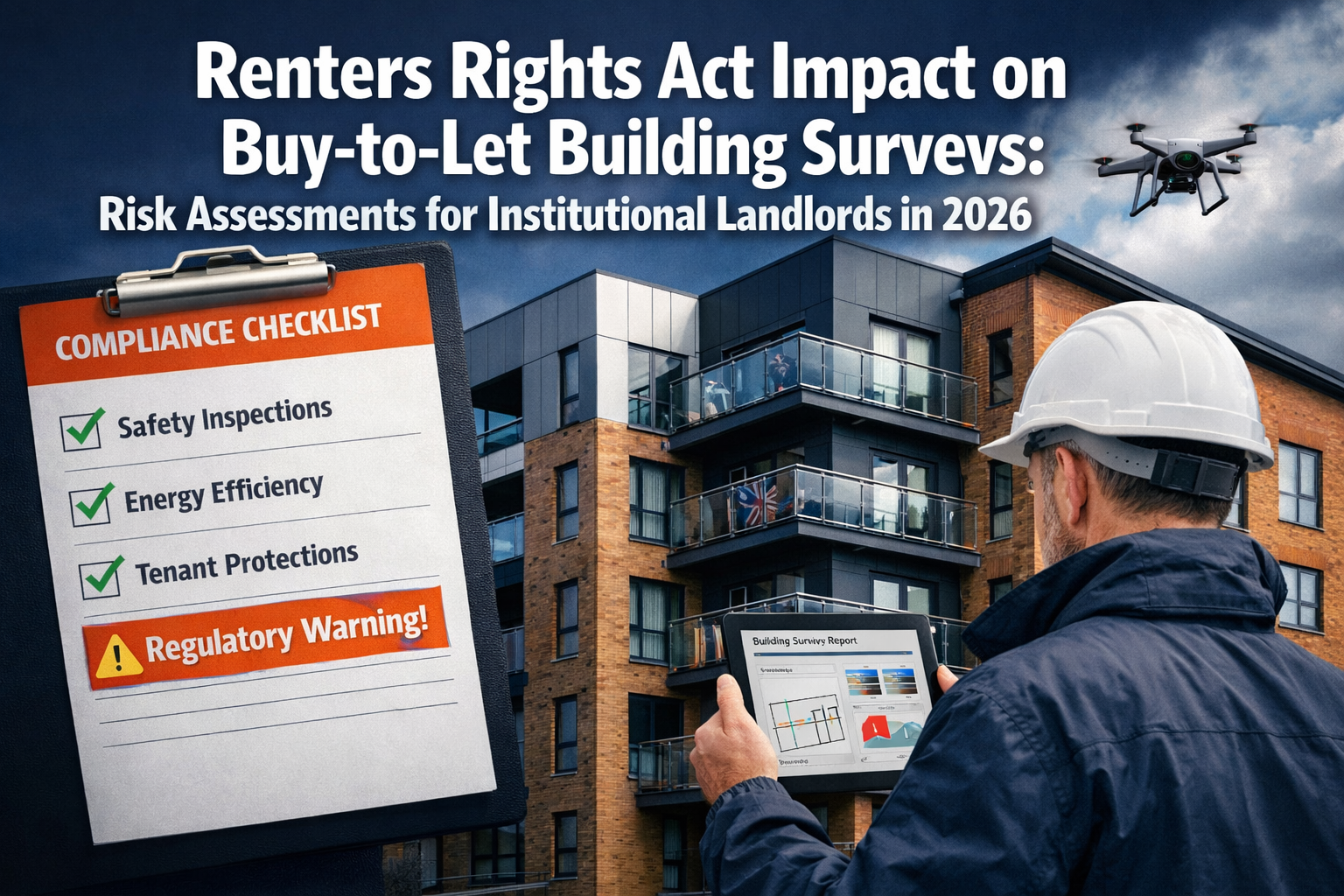
The UK rental market stands at a critical crossroads in 2026. As the Renters Rights Act reshapes landlord obligations and tenant protections, institutional investors face unprecedented scrutiny of their buy-to-let portfolios. The legislation's sweeping reforms—from abolishing Section 21 "no-fault" evictions to imposing stricter property standards—have transformed building surveys from routine due diligence into mission-critical risk assessment tools. Understanding the Renters Rights Act Impact on Buy-to-Let Building Surveys: Risk Assessments for Institutional Landlords in 2026 has become essential for protecting capital, ensuring compliance, and maintaining competitive yields in an increasingly regulated market.
Key Takeaways
✅ Enhanced survey protocols are now mandatory to identify compliance gaps with Renters Rights Act standards before acquisition or portfolio review
✅ Institutional landlords must integrate regulatory risk assessments into building surveys to avoid costly retrofits, legal challenges, and tenant disputes
✅ Property condition standards have elevated from basic habitability to comprehensive safety, energy performance, and future-proofing requirements
✅ Strategic survey investments can differentiate compliant portfolios from distressed assets as smaller landlords exit the market
✅ Proactive risk management through detailed building assessments protects institutional capital and sustains long-term rental yields
Understanding the Renters Rights Act 2026: Core Provisions Affecting Property Standards
The Renters Rights Act represents the most significant overhaul of private rental legislation in decades. For institutional landlords managing substantial buy-to-let portfolios, the Act's provisions directly impact property acquisition strategies, asset management protocols, and risk assessment frameworks.
Abolition of Section 21 and Eviction Reform 🏛️
The removal of Section 21 "no-fault" evictions fundamentally alters landlord-tenant dynamics. Institutional investors can no longer rely on straightforward possession processes to manage underperforming assets or problematic tenancies. Instead, landlords must demonstrate specific Section 8 grounds—such as rent arrears, property damage, or owner occupation needs—requiring robust documentation and potentially lengthy legal proceedings.
This shift elevates the importance of pre-acquisition building surveys. Properties with hidden defects, deferred maintenance, or compliance issues create legal vulnerabilities when tenants dispute possession claims. A comprehensive Level 3 full building survey becomes essential to identify potential tenant complaint triggers before committing capital.
Rent Control Mechanisms and Financial Implications 💰
The Act limits rent increases to once annually through formal Section 13 notices and prohibits rental bidding wars. For institutional portfolios, this constrains revenue optimization strategies and demands accurate property valuation tied to long-term maintenance costs.
Building surveys must now quantify:
- Immediate compliance costs for safety and habitability standards
- Projected maintenance expenditure over extended tenancy periods
- Energy efficiency upgrade requirements to justify premium rents
- Structural longevity affecting capital appreciation assumptions
Enhanced Property Standards and Decent Homes Criteria ⚡
While the Act doesn't explicitly mandate new construction standards, it strengthens enforcement of existing Decent Homes requirements and empowers tenants to challenge substandard conditions. Institutional landlords face reputational and financial risks from properties failing to meet:
- Adequate heating and thermal comfort standards
- Freedom from serious hazards under the Housing Health and Safety Rating System (HHSRS)
- Reasonable state of repair for building elements
- Modern facilities including kitchens and bathrooms
The regulatory environment now penalizes reactive maintenance. Building surveys identifying areas requiring further investigation enable proactive remediation before tenant complaints escalate to enforcement action or tribunal claims.
Renters Rights Act Impact on Buy-to-Let Building Surveys: Enhanced Due Diligence Protocols
Traditional building surveys focused primarily on structural integrity and immediate safety concerns. The Renters Rights Act demands expanded assessment criteria that align with institutional investors' compliance obligations and risk management frameworks.
Compliance-Focused Survey Enhancements 📋
Modern buy-to-let surveys for institutional portfolios must incorporate:
1. Regulatory Compliance Audits
Surveyors now evaluate properties against the full spectrum of landlord obligations, including statutory considerations such as:
- Fire safety regulations (smoke alarms, carbon monoxide detectors, emergency egress)
- Electrical safety certification (five-year inspection cycles)
- Gas safety annual inspections
- Energy Performance Certificate (EPC) minimum ratings
- Legionella risk assessments for water systems
2. Tenant Complaint Vulnerability Assessment
Surveys identify conditions likely to trigger tenant disputes or tribunal claims:
- Damp and mold issues affecting health
- Inadequate heating systems
- Structural defects impacting habitability
- Noise transmission between units
- Pest ingress points
3. Future-Proofing Analysis
Institutional investors require long-term asset strategies. Surveys now assess:
- Retrofit potential for net-zero compliance
- Adaptability to accessibility standards
- Capacity for smart home technology integration
- Resilience to climate change impacts (flooding, overheating)
Integration with Energy Performance and MEES Requirements ♻️
The intersection of the Renters Rights Act with Minimum Energy Efficiency Standards (MEES) creates compounded compliance obligations. Properties below EPC rating C face rental restrictions and potential enforcement action.
Building surveys must now include detailed EPC and MEES assessments evaluating:
- Current energy performance ratings
- Cost-effective improvement pathways
- Payback periods for efficiency upgrades
- Impact on rental yields and capital values
"Institutional landlords cannot afford to acquire properties requiring extensive energy retrofits without accurate cost modeling. A comprehensive building survey identifying insulation deficiencies, inefficient heating systems, and glazing upgrades is now fundamental to investment appraisal."
Advanced Survey Technologies for Portfolio Assessment 🚁
Large-scale institutional portfolios benefit from technology-enhanced survey methodologies:
- Drone surveys provide rapid roof and external envelope assessments across multiple properties—premium drone survey services enable efficient portfolio screening
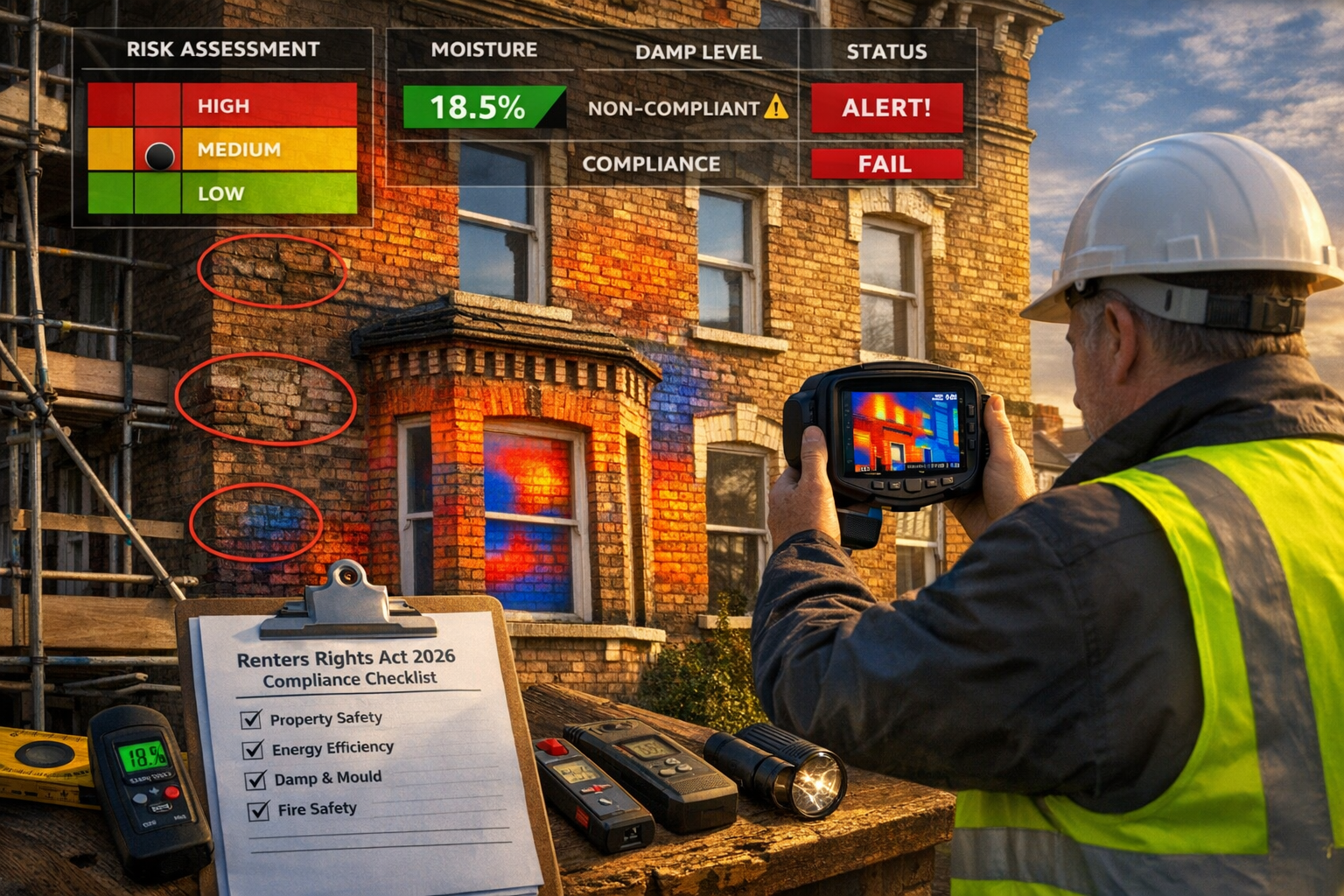
- Thermal imaging identifies insulation gaps and heat loss patterns affecting energy compliance
- Moisture mapping detects hidden damp issues before tenant occupation
- Digital reporting platforms aggregate compliance data across portfolios for strategic decision-making
Understanding what types of building surveys are available helps institutional investors select appropriate assessment levels for different property categories within their portfolios.
Risk Assessments for Institutional Landlords: Strategic Framework for 2026
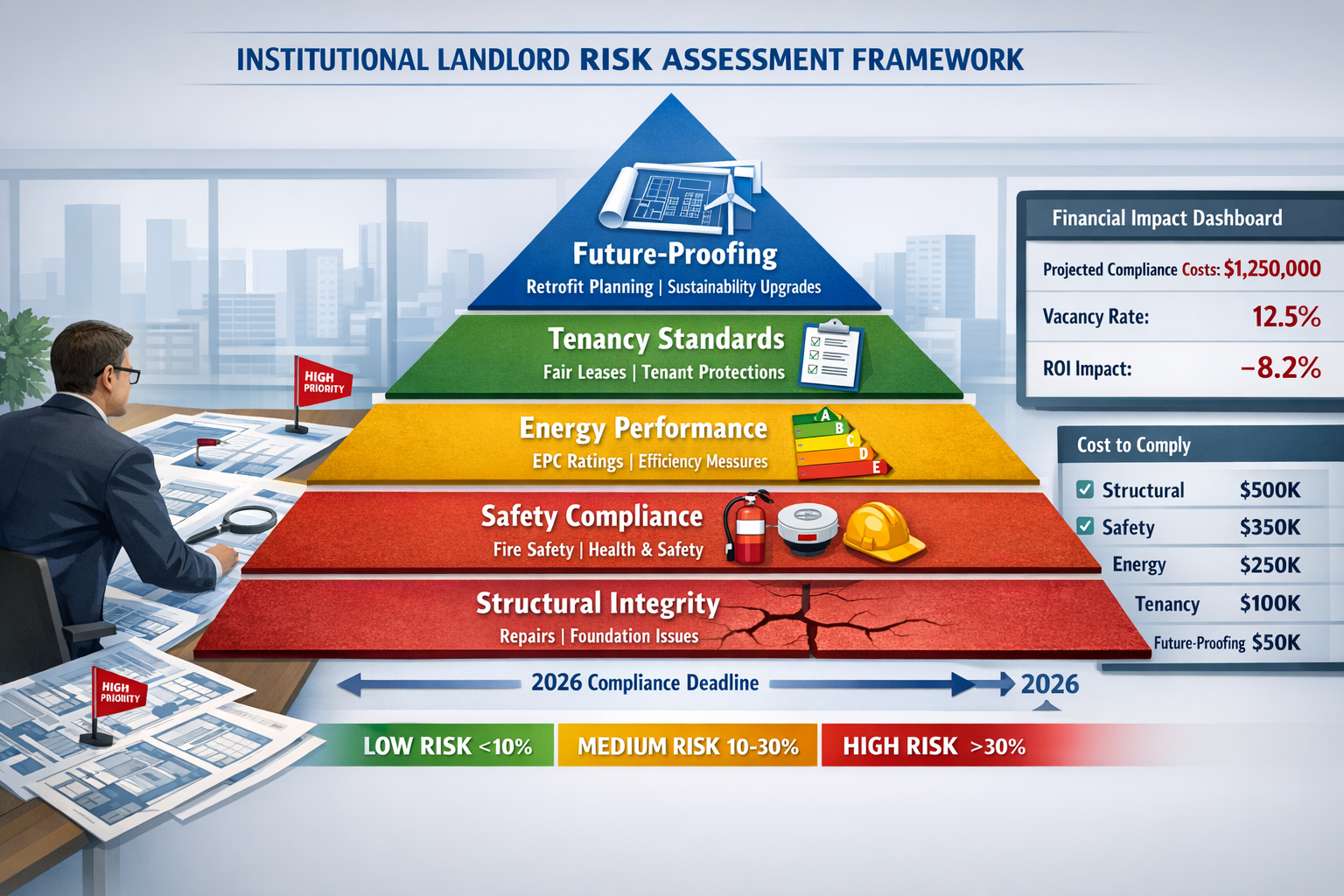
Institutional investors require systematic risk frameworks integrating building survey findings with broader portfolio management strategies. The Renters Rights Act elevates compliance risk to a primary concern alongside traditional financial and market risks.
Multi-Tier Risk Classification System 🎯
Effective institutional risk management categorizes properties based on survey findings:
| Risk Tier | Characteristics | Survey Findings | Strategic Response |
|---|---|---|---|
| Low Risk | Full compliance, modern construction, minimal defects | Recent EPC rating A-B, no HHSRS hazards, comprehensive maintenance records | Hold and optimize; minimal survey frequency |
| Medium Risk | Generally compliant, some upgrade needs | EPC rating C-D, minor defects, aging systems approaching replacement | Planned maintenance program; survey every 3-5 years |
| High Risk | Compliance gaps, significant defects | EPC rating E or below, HHSRS Category 1 hazards, structural concerns | Immediate remediation or divestment; annual surveys |
| Critical Risk | Non-compliant, uninhabitable elements | Multiple serious defects, enforcement notices, tenant complaints | Urgent action required; potential portfolio exit |
Acquisition Due Diligence: Pre-Purchase Survey Protocols 🔍
For institutional investors evaluating new acquisitions, building surveys serve as the foundation for investment decisions. The Renters Rights Act demands enhanced scrutiny of:
Immediate Compliance Costs
Surveys must quantify remediation expenses for:
- Safety certificate deficiencies
- HHSRS hazard elimination
- EPC rating improvements to minimum standards
- Accessibility modifications for diverse tenant needs
Hidden Liability Identification
Experienced surveyors identify consequences of failing to act on discovered defects, including:
- Tenant injury liability from unaddressed hazards
- Rent repayment orders for substandard conditions
- Local authority enforcement costs and penalties
- Reputational damage affecting portfolio valuations
Comparative Analysis: Survey Types for Different Scenarios
Institutional investors benefit from understanding when to deploy different survey levels. While a Level 2 RICS HomeBuyer Report may suffice for modern, well-maintained properties in low-risk categories, older buildings or those with visible defects warrant comprehensive Level 3 surveys.
The decision framework mirrors considerations outlined in full building survey vs homebuyer survey guidance, but with additional emphasis on regulatory compliance factors specific to rental properties.
Portfolio Monitoring and Cyclical Survey Strategies 📊
Institutional landlords managing hundreds or thousands of units require systematic survey scheduling:
Risk-Based Survey Frequency
- High-value flagship properties: Annual comprehensive surveys
- Standard portfolio assets: Surveys every 3-5 years
- Newer compliant properties: Surveys every 5-7 years
- Trigger-based surveys: Following tenant complaints, weather events, or regulatory changes
Aggregated Compliance Reporting
Modern institutional management demands portfolio-wide visibility:
- Percentage of properties meeting EPC standards
- Distribution of HHSRS risk ratings
- Capital expenditure forecasts for compliance upgrades
- Geographic compliance risk mapping
Predictive Maintenance Integration
Building survey data feeds predictive maintenance models identifying:
- Component replacement schedules (boilers, roofs, windows)
- Compliance deadline tracking
- Budget allocation optimization
- Divestment candidate identification
Legal and Reputational Risk Mitigation 🛡️
The Renters Rights Act empowers tenants with enhanced complaint mechanisms and tribunal access. Building surveys provide institutional landlords with defensive documentation:
Pre-Tenancy Condition Records
Detailed surveys establish baseline property conditions, protecting against:
- Exaggerated tenant damage claims
- Disputes over pre-existing defects
- Unfounded habitability complaints
Proactive Hazard Management
Regular surveys demonstrate institutional commitment to tenant safety:
- Systematic identification and remediation of HHSRS hazards
- Documentation of compliance efforts for tribunal defense
- Evidence of reasonable landlord conduct in possession proceedings
ESG and Stakeholder Reporting
Institutional investors face increasing environmental, social, and governance scrutiny. Building survey programs support:
- Transparent reporting of property condition standards
- Demonstration of tenant welfare prioritization
- Progress tracking toward net-zero portfolio targets
- Investor confidence through professional asset management
Market Dynamics and Strategic Opportunities: Navigating the 2026 Landscape
While the Renters Rights Act creates compliance challenges, it simultaneously generates strategic opportunities for well-capitalized institutional landlords with robust risk assessment frameworks.
The Landlord Exit Phenomenon and Supply Constraints 📉
Industry analysis suggests the Act's complexity is accelerating small landlord exits from the market. Individual investors with limited resources struggle to navigate enhanced compliance requirements, creating:
Acquisition Opportunities
Institutional investors with comprehensive building survey capabilities can identify:
- Distressed assets from exiting landlords at discounted prices
- Properties requiring known, quantifiable remediation work
- Portfolio consolidation opportunities in target markets
Competitive Advantage Through Professionalism
Tenants increasingly prefer institutional landlords offering:
- Professionally maintained, compliant properties
- Transparent complaint resolution processes
- Long-term tenancy stability
- Modern amenities and energy efficiency
Building surveys demonstrating superior property standards become marketing differentiators justifying premium rents within regulatory constraints.
Rental Yield Resilience and Value Preservation 💎
Despite regulatory pressures, rental demand fundamentals remain strong. Institutional portfolios with documented compliance through systematic building surveys demonstrate:
Reduced Void Periods
High-quality, compliant properties attract and retain tenants:
- Lower turnover costs
- Sustained rental income streams
- Reduced marketing expenses
Capital Value Protection
Properties with comprehensive survey documentation and compliance records:
- Command higher valuations in institutional transactions
- Attract lower-risk financing terms
- Demonstrate professional asset management to investors
Regulatory Arbitrage
As enforcement intensifies, compliant properties gain relative value:
- Reduced competition from non-compliant stock
- Tenant flight from substandard alternatives
- Premium positioning in constrained markets
Future-Proofing Strategies: Beyond 2026 Compliance 🔮
Forward-thinking institutional landlords use building surveys to anticipate future regulatory developments:
Net-Zero Pathway Planning
Surveys identifying cost-effective decarbonization routes:
- Insulation upgrade sequencing
- Heat pump installation feasibility
- Renewable energy integration potential
- Whole-life carbon assessments
Accessibility and Demographic Adaptation
Aging population trends and disability rights legislation suggest future requirements for:
- Step-free access provisions
- Bathroom and kitchen adaptability
- Smart home accessibility features
- Universal design principles
Climate Resilience Assessment
Building surveys incorporating climate risk analysis:
- Flood vulnerability and mitigation options
- Overheating risk in changing climate
- Storm damage resilience
- Water efficiency and drought adaptation
Technology Integration and Survey Innovation 🖥️
Institutional scale enables investment in advanced survey technologies:
Building Information Modeling (BIM)
Digital twins of portfolio properties enabling:
- Virtual compliance audits
- Scenario modeling for upgrade strategies
- Lifecycle cost analysis
- Tenant communication tools
IoT Sensor Networks
Continuous monitoring complementing periodic surveys:
- Real-time moisture and temperature tracking
- Energy consumption optimization
- Predictive maintenance alerts
- Tenant comfort verification
AI-Enhanced Risk Scoring
Machine learning algorithms analyzing survey data to:
- Predict compliance risk trajectories
- Optimize survey scheduling
- Identify portfolio-wide patterns
- Benchmark against market standards
Practical Implementation: Building Survey Best Practices for Institutional Portfolios
Translating regulatory requirements and risk frameworks into operational excellence requires structured survey programs aligned with institutional objectives.
Selecting Qualified Survey Professionals 👷
The Renters Rights Act's complexity demands surveyors with specialized expertise:
Essential Qualifications
- RICS chartered status with residential expertise
- Current knowledge of rental sector regulations
- Experience with institutional portfolio management
- Technology proficiency for digital reporting
Specialist Capabilities
Depending on portfolio characteristics, consider surveyors with:
- Listed building and conservation area expertise
- Energy assessment and retrofit design credentials
- HHSRS assessment certification
- Expert witness experience for tribunal proceedings
Survey Specification and Scope Definition 📝
Institutional surveys require tailored specifications beyond standard templates:
Core Survey Elements
Every buy-to-let survey should address:
- Full structural assessment of building envelope and load-bearing elements
- Services condition (electrical, plumbing, heating, ventilation)
- Safety compliance verification (fire, gas, electrical certificates)
- EPC rating confirmation and improvement recommendations
- HHSRS hazard identification and categorization
- Accessibility audit against current and anticipated standards
Enhanced Institutional Requirements
Additional elements for portfolio management:
- Standardized risk scoring aligned with internal frameworks
- Photographic documentation for condition tracking
- Cost estimates for identified remediation works
- Priority ranking for compliance actions
- Integration with asset management systems
Understanding building survey timeframes helps institutional investors plan acquisition schedules and portfolio review cycles efficiently.
Cost-Benefit Analysis: Survey Investment Returns 💵
Institutional investors must justify survey expenditure through demonstrated value:
Direct Cost Avoidance
Comprehensive surveys prevent:
- Overpayment for properties with hidden defects
- Unexpected remediation costs post-acquisition
- Legal fees from tenant disputes
- Enforcement penalties and rent repayment orders
Negotiation Leverage
Survey findings enable:
- Price reductions reflecting true property condition
- Seller-funded remediation as transaction conditions
- Warranty provisions for identified risks
- Walk-away decisions avoiding value-destroying acquisitions
Portfolio Optimization
Systematic surveys inform:
- Strategic divestment of high-risk assets
- Capital allocation to highest-return improvements
- Insurance premium negotiations
- Tenant retention strategies
Integration with Broader Asset Management Systems 🔗
Building surveys generate maximum value when integrated into comprehensive property management:
Data Centralization
Survey findings feed unified platforms tracking:
- Compliance status across entire portfolio
- Maintenance history and future requirements
- Financial performance correlated with property condition
- Risk exposure aggregation and reporting
Workflow Automation
Survey-triggered actions including:
- Automatic work order generation for identified defects
- Compliance deadline tracking and alerts
- Budget allocation recommendations
- Stakeholder notification protocols
Performance Measurement
Survey data enables KPI tracking:
- Percentage of portfolio meeting compliance standards
- Average property condition scores
- Remediation cost per unit
- Tenant satisfaction correlation with survey ratings
Conclusion: Strategic Imperatives for Institutional Landlords in 2026
The Renters Rights Act Impact on Buy-to-Let Building Surveys: Risk Assessments for Institutional Landlords in 2026 represents a fundamental shift in rental property investment and management. Compliance is no longer optional—it's a competitive necessity that separates sustainable institutional portfolios from distressed assets facing regulatory enforcement and market rejection.
Key strategic imperatives include:
🎯 Elevate building surveys from routine due diligence to strategic risk management tools that protect capital, ensure compliance, and identify value-creation opportunities
🎯 Implement systematic, risk-based survey programs tailored to portfolio characteristics, property age, and compliance status
🎯 Invest in qualified survey professionals and advanced technologies that deliver actionable insights aligned with institutional objectives
🎯 Integrate survey findings into comprehensive asset management systems enabling data-driven decision-making and portfolio optimization
🎯 View compliance as competitive advantage differentiating professional institutional landlords from exiting small investors
Actionable Next Steps
For Immediate Implementation:
- Audit current portfolio using compliance-focused building surveys to identify high-risk properties requiring urgent remediation
- Establish survey standards specifying institutional requirements beyond basic RICS protocols
- Develop risk classification framework categorizing properties and determining appropriate survey frequency
- Select qualified survey partners with rental sector expertise and institutional experience
- Create compliance roadmap prioritizing remediation works by regulatory deadline and financial impact
For Long-Term Strategic Positioning:
- Build predictive maintenance models using survey data to optimize capital expenditure and minimize reactive costs
- Develop acquisition criteria incorporating Renters Rights Act compliance as fundamental investment threshold
- Implement technology platforms centralizing survey data and automating compliance tracking
- Establish ESG reporting frameworks leveraging survey findings to demonstrate responsible property stewardship
- Monitor regulatory developments anticipating future requirements and positioning portfolios proactively
The institutional landlords who thrive in 2026 and beyond will be those who recognize building surveys not as compliance burdens, but as strategic intelligence enabling informed decision-making, risk mitigation, and value creation in an evolving regulatory landscape. The Renters Rights Act has raised the bar—comprehensive, professional building survey programs are now the foundation of successful buy-to-let investment.