

The UK aged care sector stands at a remarkable crossroads in 2026. As the population ages and market conditions stabilize following years of uncertainty, Expert Witness Valuations for Aged Care Facilities: Capitalising on 2026 Sector Resilience Amid UK Market Recovery has become a critical specialization for chartered surveyors and valuation professionals. With prime seniors housing assets in the South-East achieving yields around 5.25% and the sector demonstrating robust trading performance across thousands of units, the demand for expert testimony in disputes, litigation, and strategic transactions has never been higher.
The convergence of demographic pressures, regulatory changes, and market recovery creates unique valuation challenges. Whether navigating partnership disputes, inheritance tax matters, or commercial litigation, property professionals must understand both the technical methodologies and the expert witness framework that governs aged care facility valuations.
Key Takeaways
- Strong Market Performance: UK seniors housing schemes covering over 13,000 units demonstrate solid trading performance with prime South-East assets achieving approximately 5.25% yields in 2025[1]
- Expert Witness Demand: The specialized nature of aged care valuations requires qualified expert witnesses who understand both property valuation and healthcare sector dynamics
- Multiple Valuation Approaches: Aged care facilities require hybrid methodologies combining income capitalization, comparable sales, and specialized operational metrics
- Regulatory Complexity: Expert witnesses must navigate RICS standards, care quality regulations, and evolving tax legislation affecting the sector
- 2026 Growth Drivers: Demographic aging, market stabilization, and infrastructure investment position aged care as a resilient property sector
Understanding the Aged Care Facility Valuation Landscape in 2026
The Unique Nature of Seniors Housing Assets
Aged care facilities represent a specialized property class that combines real estate value with operational business value. Unlike traditional residential or commercial properties, these assets generate income through care services, accommodation fees, and ancillary revenue streams. This dual nature creates complexity that demands expert analysis.
The UK market encompasses several distinct categories:
- Independent Living Communities 🏘️ – Self-contained units with minimal care services
- Assisted Living Facilities 🏥 – Moderate support with daily living activities
- Nursing Homes 🩺 – Full-time medical care and supervision
- Continuing Care Retirement Communities 🌟 – Integrated facilities offering multiple care levels
Each category requires different valuation approaches. Recent market data reveals that 112 seniors housing schemes covering 13,489 units hold a combined market value of £6.8 billion[1], demonstrating the sector's substantial economic footprint.
Why Expert Witness Valuations Matter
Expert witness valuations serve distinct purposes beyond standard property valuation services. These specialized assessments provide independent, defensible opinions for:
- Litigation and Disputes – Partnership dissolutions, shareholder disagreements, contractual disputes
- Tax Matters – Inheritance tax valuations, capital gains tax assessments, stamp duty land tax disputes
- Matrimonial Proceedings – Asset division in divorce settlements
- Compulsory Purchase – Fair compensation determinations
- Professional Negligence Claims – Assessing damages from inadequate prior valuations
The expert witness must withstand cross-examination, produce reports that meet strict legal standards, and maintain absolute independence from the instructing party's interests.
Market Resilience Factors Driving 2026 Valuations
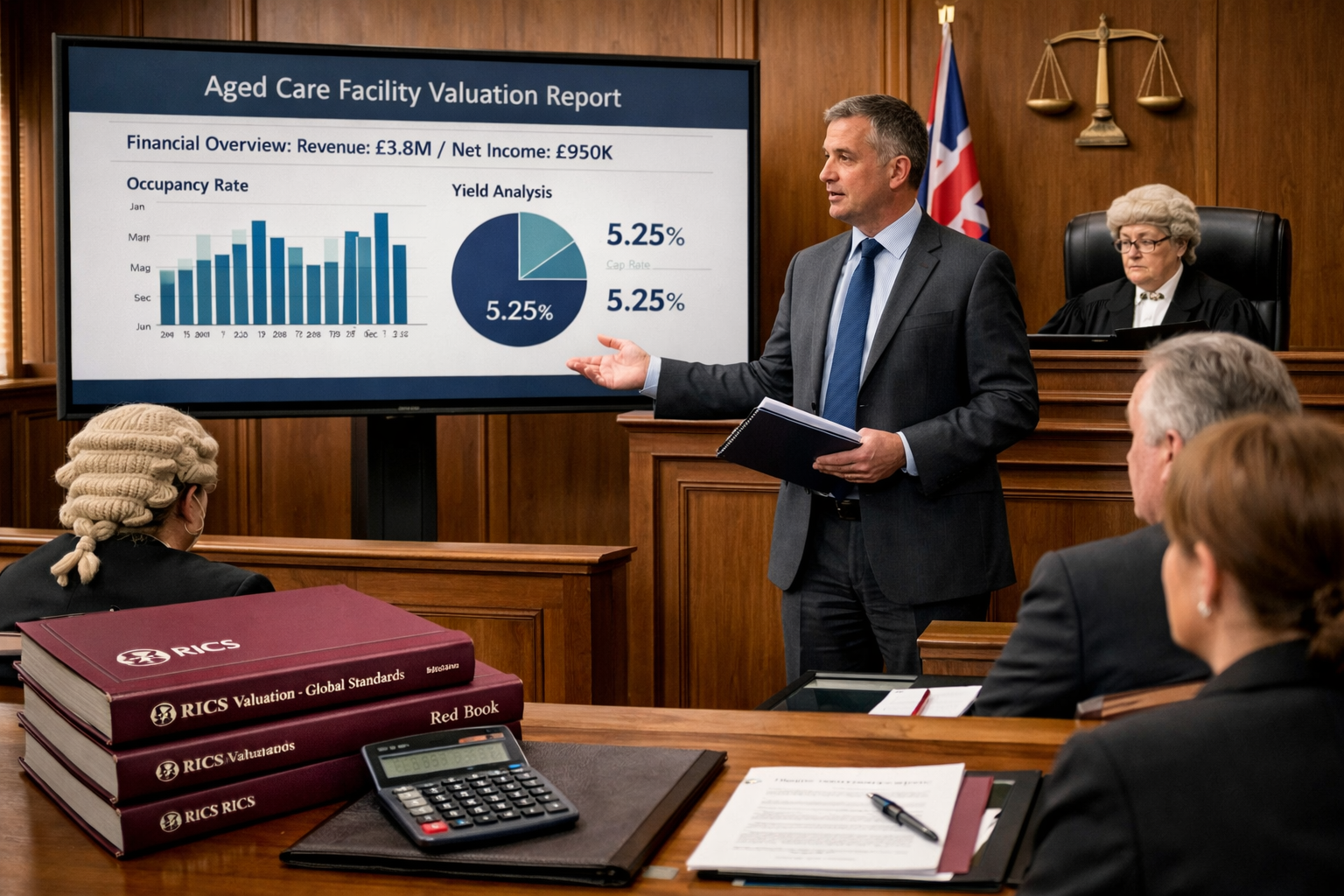
Several converging factors strengthen aged care facility valuations in 2026:
Demographic Imperatives 📊
The UK's aging population creates sustained demand. By 2026, over 12 million people are aged 65 or older, with the 85+ cohort experiencing the fastest growth. This demographic reality underpins long-term sector stability.
Operational Performance Recovery
Following pandemic-related challenges, occupancy rates have rebounded. Facilities demonstrating strong care quality ratings, modern amenities, and robust infection control measures command premium valuations.
Investment Appetite
Institutional investors increasingly view seniors housing as a defensive asset class with inflation-linked revenue potential. This capital inflow supports higher valuations and lower yield requirements for quality assets.
Regulatory Clarity
The Care Quality Commission's (CQC) refined standards provide greater certainty for operators and investors. Properties with "Good" or "Outstanding" ratings carry significant valuation premiums.
Understanding these property market legislation changes helps expert witnesses contextualize their valuations within broader market dynamics.
Expert Witness Valuations for Aged Care Facilities: Methodologies and Best Practices
Core Valuation Approaches for Aged Care Assets
Expert witnesses employ multiple methodologies, often triangulating between approaches to derive defensible conclusions:
1. Income Capitalization Approach
This method values the facility based on its income-generating capacity:
Formula: Value = Net Operating Income (NOI) / Capitalization Rate
For aged care facilities, calculating NOI requires careful analysis of:
- Gross Revenue: Accommodation fees, care charges, ancillary services
- Occupancy Rates: Historical trends and projected stabilization
- Operating Expenses: Staffing (typically 60-70% of revenue), utilities, maintenance, insurance, management fees
- Capital Reserves: Planned replacement of equipment and refurbishment
The capitalization rate reflects market expectations. Prime South-East facilities achieving 5.25% yields[1] provide benchmarks, though individual property characteristics warrant adjustments.
2. Comparable Sales Method
This approach analyzes recent transactions of similar aged care facilities:
| Adjustment Factor | Typical Impact on Value |
|---|---|
| Location (prime vs. secondary) | ±15-25% |
| CQC Rating (Outstanding vs. Requires Improvement) | ±10-20% |
| Bed Count and Mix | ±5-15% |
| Age and Condition | ±10-30% |
| Operator Reputation | ±5-10% |
Expert witnesses must carefully adjust for differences between comparable properties and the subject facility. The limited transaction volume in specialized sectors like aged care makes this approach challenging but valuable for cross-checking.
3. Depreciated Replacement Cost
For specialized facilities with limited comparable sales, this method estimates:
- Land Value: Based on comparable land sales
- Building Replacement Cost: Current construction costs for equivalent facility
- Depreciation: Physical deterioration, functional obsolescence, economic obsolescence
- Entrepreneurial Profit: Developer's margin
This approach proves particularly useful for purpose-built facilities in unique locations.
RICS Standards and Expert Witness Duties
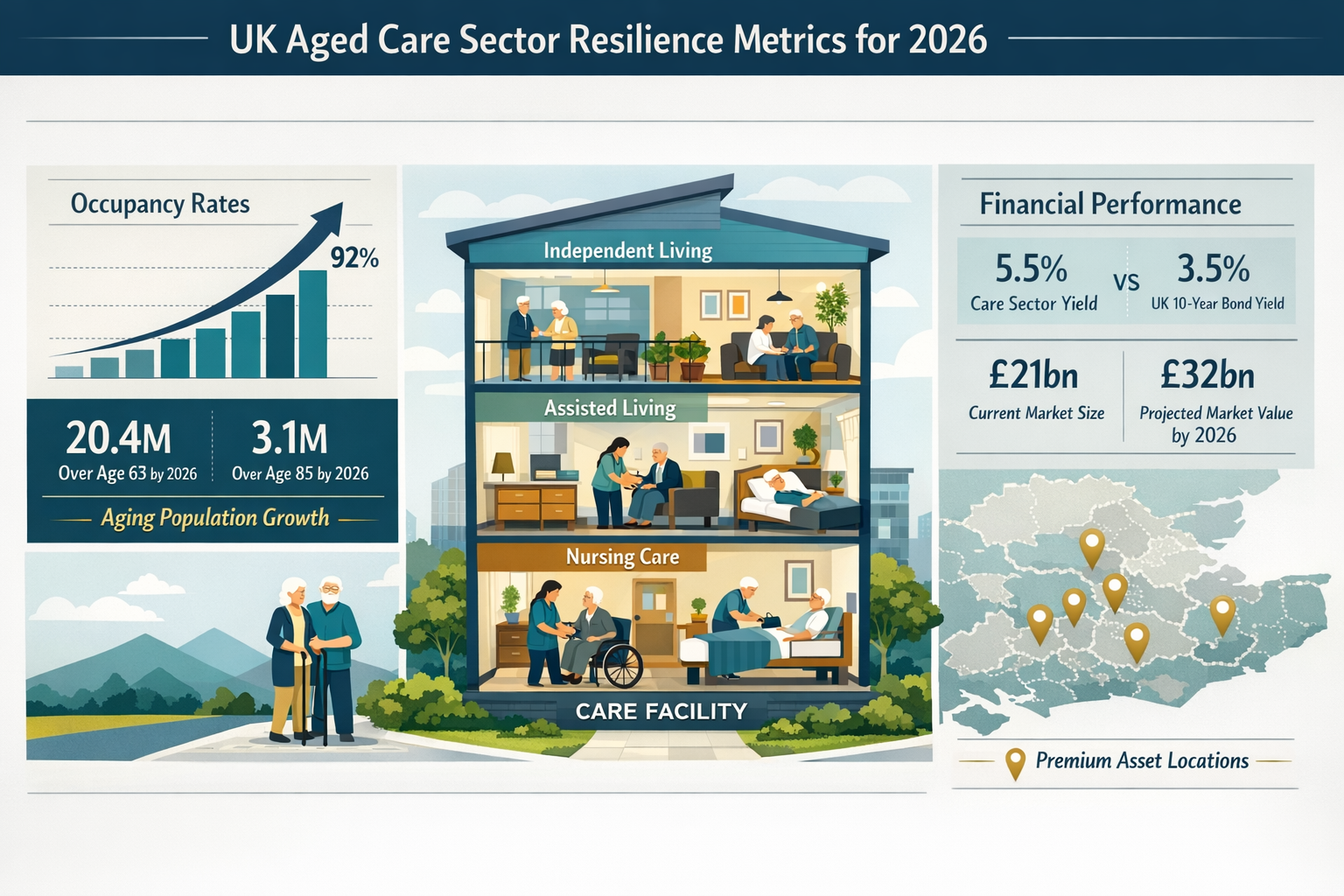
Expert witnesses must adhere to rigorous professional standards:
RICS Red Book Compliance
The RICS Valuation – Global Standards (Red Book) establishes mandatory requirements for valuations. Expert witnesses must:
- Define the basis of value (typically Market Value for litigation)
- Clearly state assumptions and special assumptions
- Disclose any departures from standards
- Maintain independence and objectivity
Civil Procedure Rules (CPR) Part 35
In England and Wales, expert witnesses owe their primary duty to the court, not the instructing party. This requires:
✅ Providing opinions within their area of expertise
✅ Stating the facts and assumptions underlying their opinion
✅ Identifying matters outside their competence
✅ Declaring any conflicts of interest
✅ Updating opinions if circumstances change
Practice Statement and Protocol
Expert witnesses should engage in pre-hearing discussions to narrow issues, prepare joint statements identifying areas of agreement and disagreement, and attend conferences with legal teams while maintaining independence.
Specialized Considerations for Aged Care Valuations
Operational Metrics Analysis
Beyond physical property assessment, expert witnesses must evaluate:
- Occupancy Trends: Seasonal variations, admission rates, discharge patterns
- Fee Structures: Private pay vs. local authority funded residents
- Staff Retention: Impact on care quality and operational costs
- Regulatory Compliance History: CQC inspection reports, enforcement actions
- Reputation and Waitlists: Market positioning indicators
Care Quality Impact on Value
CQC ratings directly influence value. An "Outstanding" facility commands premium pricing for both fees and sale multiples. Conversely, facilities rated "Requires Improvement" or "Inadequate" face:
- Reduced occupancy as families seek alternatives
- Increased insurance and legal costs
- Potential regulatory restrictions on admissions
- Difficulty attracting quality staff
Expert witnesses should quantify these impacts through adjustments to income projections and capitalization rates.
Tax Considerations in Valuations
Aged care facility valuations for tax purposes require specific expertise:
Inheritance Tax (IHT)
When facilities form part of estates, expert witnesses must value at Market Value as of the date of death. Understanding inheritance tax valuation requirements ensures compliance with HMRC expectations.
Capital Gains Tax (CGT)
Disposals trigger CGT on gains since acquisition. Expert witnesses may need to provide retrospective valuations to establish base costs or rebasing values.
Business Property Relief
Operating aged care facilities may qualify for Business Property Relief, reducing IHT liability. Expert witnesses should distinguish between investment property (no relief) and trading businesses (potential 100% relief).
Capitalising on 2026 Sector Resilience: Strategic Insights for Expert Witnesses
Emerging Trends Affecting Valuations
Demographic-Driven Demand
The UK's 85+ population continues expanding, creating sustained demand for nursing and dementia care beds. Expert witnesses should incorporate demographic projections into long-term income forecasts, particularly for facilities with specialized dementia units.
Technology Integration
Modern facilities incorporating:
- Digital care management systems 💻
- Telehealth capabilities 📱
- Environmental monitoring 🌡️
- Smart building controls 🏢
These features command valuation premiums through operational efficiency and enhanced resident safety. Expert witnesses must assess whether technology investments represent value-adding improvements or merely keep pace with market expectations.
Sustainability and ESG Factors
Environmental, Social, and Governance (ESG) considerations increasingly influence investor decisions. Facilities with:
- Superior energy efficiency ratings
- Renewable energy installations
- Accessible design exceeding minimum standards
- Strong community integration
These characteristics attract premium valuations from institutional buyers prioritizing ESG metrics.
Regional Market Variations
The £6.8 billion market value across 13,489 units[1] demonstrates significant regional variation:
South-East England 🏆
Prime locations near London achieve the lowest yields (highest values) due to:
- Higher private pay ratios
- Wealthier demographic catchments
- Land scarcity driving replacement cost values
- Strong institutional investment demand
Regional Markets 🌍
Secondary locations may show:
- Higher yields (lower values) reflecting perceived risk
- Greater reliance on local authority funding
- More volatile occupancy patterns
- Limited transaction comparables
Expert witnesses must adjust their approaches based on regional market dynamics, avoiding blanket application of national averages.
Common Valuation Disputes and Resolution
Partnership Dissolution Cases
When care home partnerships dissolve, disputes often arise over:
- Goodwill valuation: Is operational reputation separately valuable?
- Forced sale discounts: Should valuations reflect restricted marketing periods?
- Deferred maintenance: Who bears responsibility for capital expenditure backlogs?
Expert witnesses provide independent assessments, often participating in joint expert meetings to narrow disagreements before trial.
Professional Negligence Claims
Claims against prior valuers require expert witnesses to:
- Assess whether the original valuation fell within acceptable professional range
- Quantify financial losses resulting from negligent advice
- Consider whether the instructing party relied reasonably on the valuation
These cases demand thorough understanding of valuation standards applicable at the time of the alleged negligence.
Tax Tribunal Disputes
HMRC may challenge valuations for tax purposes, particularly:
- Aggressive discounts for lack of marketability or minority interests
- Optimistic income projections unsupported by historical performance
- Inappropriate valuation bases (e.g., using investment value rather than market value)
Expert witnesses must present robust, evidence-based opinions that withstand scrutiny from opposing experts and tribunal judges.
Building a Defensible Valuation Report
Successful expert witness reports share common characteristics:
1. Clear Scope and Instructions 📋
Define precisely what is being valued, the valuation date, the purpose, and the basis of value.
2. Comprehensive Property Description
Include:
- Location and accessibility analysis
- Physical description (buildings, grounds, facilities)
- Accommodation schedule (bed count, room types, communal areas)
- Planning and regulatory status
- Tenure and title considerations
3. Market Context
Demonstrate understanding of:
- Local and national aged care market conditions
- Supply and demand dynamics
- Regulatory environment
- Economic factors influencing the sector
Referencing resources like top considerations during property valuation helps establish credibility.
4. Detailed Methodology Explanation
Explain each valuation approach:
- Why it was selected or rejected
- Data sources and verification
- Calculations and assumptions
- Adjustments and their justification
5. Sensitivity Analysis
Demonstrate how value changes with variations in key assumptions:
- ±5% occupancy rate changes
- ±0.25% yield adjustments
- Alternative growth rate scenarios
This transparency helps tribunals and courts understand valuation uncertainty.
6. Professional Presentation
Expert reports should be:
- Well-organized with clear section headings
- Free from advocacy or bias
- Supported by appendices with detailed data
- Professionally formatted and proofread
Leveraging Market Data and Industry Intelligence
Expert witnesses strengthen their opinions through:
Proprietary Databases
Subscription services providing transaction data, yield surveys, and operational benchmarks for the seniors housing sector.
Industry Reports
Publications from organizations like Knight Frank, JLL, and Savills offer market intelligence on trading performance, investment trends, and yield movements[1].
Regulatory Data
CQC inspection reports, local authority fee rate schedules, and occupancy statistics provide crucial operational context.
Professional Networks
Engagement with specialist organizations and expert witness directories[2] facilitates knowledge sharing and professional development.
Practical Applications: Case Studies and Scenarios
Scenario 1: Partnership Dispute Valuation
Background: Two partners operate a 60-bed nursing home in Surrey. Following irreconcilable differences, one partner seeks to buy out the other.
Valuation Challenge: The facility shows strong occupancy (92%) but deferred maintenance estimated at £400,000. One partner argues for value reduction; the other claims buyers would factor maintenance into their offers without reducing core value.
Expert Witness Approach:
- Value the facility in current condition using income approach
- Separately value assuming completion of deferred maintenance
- Analyze comparable sales to determine whether buyers typically adjust prices for deferred maintenance
- Provide opinion on appropriate treatment (direct deduction vs. capitalized income impact)
Outcome: Expert testimony clarified that institutional buyers typically demand price reductions exceeding actual maintenance costs due to operational disruption and execution risk, supporting a £600,000 adjustment (1.5x actual costs).
Scenario 2: Inheritance Tax Dispute
Background: A deceased estate includes a 45-bed assisted living facility valued by the executor at £3.2 million. HMRC challenges this as understated, proposing £4.1 million.
Valuation Challenge: The facility achieved only 78% occupancy in the year before death due to management transitions. Disagreement centers on whether "special purchaser" value should apply.
Expert Witness Approach:
- Establish Market Value definition per RICS Red Book
- Analyze whether the hypothetical buyer pool includes special purchasers
- Compare occupancy recovery timelines for similar facilities post-acquisition
- Apply appropriate capitalization rates reflecting stabilized vs. current performance
Similar principles apply to SIPP pension valuations where market value must be established independently.
Outcome: Expert report supported £3.5 million valuation, acknowledging that while special purchasers exist, Market Value assumes a typical buyer who would discount for occupancy recovery risk.
Scenario 3: Professional Negligence Claim
Background: A buyer purchased a care home for £5.2 million based on a valuation. Within 18 months, significant structural defects emerged, requiring £800,000 in repairs. The buyer claims the valuer was negligent in failing to identify or recommend specialist inspections.
Valuation Challenge: Determine whether the original valuation was negligent and quantify losses.
Expert Witness Approach:
- Review original valuation report and inspection scope
- Assess whether defects were reasonably discoverable during standard inspection
- Determine whether competent valuer would have recommended specialist surveys
- Calculate diminution in value attributable to defects
- Consider buyer's contributory negligence in not commissioning building surveys
Understanding why property owners hire surveyors helps establish reasonable expectations.
Outcome: Expert concluded that while some defects were latent, others showed warning signs that should have triggered recommendations for structural engineering input, supporting partial liability.
Future-Proofing Expert Witness Practice in Aged Care Valuations
Continuing Professional Development
The aged care sector evolves rapidly. Expert witnesses must maintain expertise through:
- RICS CPD Requirements: Minimum 20 hours annually, including ethics and professional standards
- Sector-Specific Training: Care quality regulations, healthcare finance, dementia care trends
- Legal Updates: Changes to expert witness protocols and admissibility standards
- Market Intelligence: Regular review of transaction data and industry reports
Technology and Data Analytics
Advanced tools enhance expert witness capabilities:
Geographic Information Systems (GIS) 🗺️
Mapping competitor locations, demographic catchments, and accessibility factors provides visual evidence supporting location-based valuation adjustments.
Financial Modeling Software 📊
Sophisticated cash flow models demonstrate sensitivity to key variables, helping courts understand valuation uncertainty ranges.
Database Management 💾
Maintaining proprietary databases of transactions, yields, and operational metrics strengthens comparable analysis and cross-examination resilience.
Building Expert Witness Credentials
Successful aged care valuation experts typically possess:
✅ RICS Chartered Surveyor status (MRICS or FRICS)
✅ Registered Valuer designation
✅ Expert Witness Training through Bond Solon or similar programs
✅ Sector Experience with demonstrable aged care valuation track record
✅ Court Testimony Experience across multiple jurisdictions
✅ Professional Indemnity Insurance with adequate limits for expert witness work
Listing in recognized expert witness directories[2] enhances visibility to instructing solicitors and barristers.
Ethical Considerations and Independence
The expert witness role demands unwavering integrity:
Avoiding Conflicts of Interest ⚖️
Disclose any relationships with parties, prior involvement with the property, or financial interests that could compromise independence.
Resisting Advocacy Pressure 🛡️
Instructing parties may pressure experts to support their positions. Professional experts maintain objectivity, even when opinions disadvantage their instructing party.
Transparent Methodology 🔍
Clearly explain approaches, assumptions, and limitations. Acknowledge alternative methodologies and why they were or weren't adopted.
Timely Communication ⏰
Update instructing parties and courts promptly if circumstances change opinions or new information emerges.
Integrating Broader Valuation Services
Expert witness work complements broader surveying practices. Firms offering comprehensive services create synergies:
- Insurance reinstatement cost valuations for aged care facilities
- Routine market valuations for refinancing or portfolio management
- Dilapidations assessments for leasehold care facilities
- Development appraisals for care home expansions or conversions
This diversification strengthens expertise while providing stable revenue alongside episodic expert witness instructions.
Conclusion
Expert Witness Valuations for Aged Care Facilities: Capitalising on 2026 Sector Resilience Amid UK Market Recovery represents a specialized but increasingly vital area of surveying practice. The sector's strong fundamentals—demonstrated by prime assets achieving 5.25% yields and a £6.8 billion market across thousands of units[1]—create both valuation opportunities and potential disputes requiring expert resolution.
Successful expert witnesses in this field combine technical valuation competence with deep understanding of aged care operations, regulatory frameworks, and legal procedures. They maintain independence, communicate complex analyses clearly, and provide defensible opinions that withstand rigorous cross-examination.
Actionable Next Steps
For surveyors seeking to develop expert witness capabilities in aged care valuations:
- Enhance Sector Knowledge 📚 – Study care quality regulations, operational metrics, and demographic trends driving demand
- Obtain Specialist Training 🎓 – Complete expert witness courses covering CPR Part 35 duties and report writing
- Build Transaction Database 💼 – Systematically collect and analyze aged care facility sales data
- Develop Template Reports 📝 – Create standardized structures ensuring comprehensive coverage of required elements
- Seek Mentorship 🤝 – Shadow experienced expert witnesses through cases to understand courtroom dynamics
- Market Expertise 📢 – Register with expert witness directories and develop relationships with specialist solicitors
- Maintain CPD 🔄 – Stay current with valuation standards, market conditions, and legal developments
The convergence of demographic aging, market stabilization, and regulatory clarity positions aged care as a resilient property sector throughout 2026 and beyond. Expert witnesses who master this specialized field will find sustained demand for their services across litigation, tax disputes, and commercial transactions.
By combining rigorous methodology, sector expertise, and unwavering professional integrity, chartered surveyors can provide invaluable guidance to courts, tribunals, and parties navigating the complex valuation landscape of aged care facilities. The sector's resilience creates opportunities—but only for those prepared to meet the exacting standards that expert witness work demands.
References
[1] Seniors Housing Trading Performance Review 202526 12554 – https://content.knightfrank.com/research/1854/documents/en/seniors-housing-trading-performance-review-202526-12554.pdf
[2] Residential Care Homes – https://www.jspubs.com/expert-witness/si/r/residential-care-homes/