

{"cover":"Professional landscape format (1536x1024) hero image featuring bold text overlay 'Chartered Surveyor Guide to Buy-to-Let Surveys in 2026: Assessing Risks Amid Institutional Investor Shifts' in extra large 70pt white sans-serif font with dark shadow and semi-transparent navy overlay box, positioned in upper third. Background shows modern British residential property portfolio with mix of Victorian terraces and contemporary apartment blocks, overlaid with transparent building survey documents, institutional investor charts showing upward trends, and RICS certification symbols. Foreground includes professional chartered surveyor with tablet conducting property inspection. Color scheme: deep navy blue, white, gold accents. High contrast, magazine cover quality, editorial style with professional authority conveying institutional investment sophistication and technical expertise.","content":["Landscape format (1536x1024) detailed infographic showing comprehensive buy-to-let survey types comparison chart with three columns: Level 2 HomeBuyer Report, Level 3 Building Survey, and Specialist Valuation Survey. Each column features property type icons (Victorian terraces, modern flats, HMOs), inspection depth indicators with magnifying glass symbols, cost ranges in British pounds with upward arrows, and timeline bars showing 10-day inspection periods. Center displays institutional investor portfolio icon with multiple property thumbnails. Color-coded risk assessment meters (green, amber, red) for each survey type. Professional blue and gold color scheme with clean typography, data visualization elements, and RICS accreditation badges. Includes visual representations of structural defects, damp issues, and building regulation compliance checkmarks.","Landscape format (1536x1024) detailed financial analysis dashboard showing buy-to-let investment calculations for 2026. Central focus on yield calculation formula (7% benchmark highlighted in gold) with visual breakdown: property purchase price £200,000, annual rental income £14,000, minus survey costs £1,500, solicitor fees £2,000, and 5% SDRT stamp duty £8,000 for limited company structure. Side-by-side comparison charts showing freehold versus leasehold investment structures with pros/cons lists. Bottom section displays regional yield heatmap of England with southern regions in red (lower yields) and northern regions in green (higher yields). Includes calculator icons, percentage symbols, British pound sterling signs, and institutional investor briefcase imagery. Professional financial aesthetic with navy, white, and gold accents.","Landscape format (1536x1024) comprehensive risk assessment matrix for institutional buy-to-let portfolios in 2026. Central grid showing four quadrants: Structural Risks (foundation issues, roof defects, damp), Legal Risks (leasehold complications, planning permissions, building regulations), Financial Risks (yield compression, stamp duty impacts, maintenance costs), and Market Risks (tenant demand, price sensitivity, institutional competition). Each quadrant contains specific icons and checkboxes with red warning flags for high-risk items and green checkmarks for mitigated risks. Top banner shows timeline with inspection protocol stages: initial remote assessment, 10-day physical walkthrough, specialist reports, and final due diligence. Includes images of survey equipment, legal documents, financial spreadsheets, and property portfolio thumbnails. Professional color scheme with risk-appropriate red, amber, green traffic light system overlaying sophisticated navy and white corporate design."]
}

The buy-to-let landscape in 2026 has transformed dramatically, with institutional investors reshaping market dynamics and driving unprecedented demand for professional property assessments. As large-scale landlords consolidate portfolios and individual investors compete for viable opportunities, the role of comprehensive building surveys has never been more critical. This Chartered Surveyor Guide to Buy-to-Let Surveys in 2026: Assessing Risks Amid Institutional Investor Shifts provides essential insights into navigating this evolving market with confidence and precision.
The stakes are higher than ever. With survey costs, solicitor fees, and stamp duty charges potentially exceeding £15,000 on typical transactions[3], investors cannot afford to overlook due diligence. Whether purchasing through limited companies or as individual landlords, understanding the nuances of professional property assessments has become fundamental to portfolio success and yield protection.
Key Takeaways
- Comprehensive surveys are non-negotiable for buy-to-let investments in 2026, particularly for cash purchases where mortgage lender requirements don't mandate inspections[1]
- Institutional investor activity has elevated professional standards, requiring detailed building assessments, yield calculations, and risk mitigation strategies
- The 7% yield benchmark remains a critical screening threshold, especially challenging in southern England markets where property prices continue to outpace rental growth[3]
- Limited company purchases incur additional costs including 5% SDRT stamp duty charges, making thorough pre-purchase surveys essential for protecting capital[3]
- 10-day inspection protocols combining physical walkthroughs with remote assessments represent best practice for institutional-grade due diligence[2]
Understanding the 2026 Buy-to-Let Survey Landscape
The Institutional Investor Impact on Survey Standards
The buy-to-let market in 2026 has witnessed a fundamental shift as institutional investors bring corporate-level due diligence standards to residential property acquisition. These professional landlords have raised the bar for property assessments, transforming what was once an optional extra into an essential component of every transaction.
Key characteristics of institutional survey approaches:
- 📋 Multi-layered inspection protocols including remote assessments followed by comprehensive physical walkthroughs
- 💼 Portfolio-wide consistency in assessment criteria and risk evaluation
- 🔍 Enhanced scrutiny of structural integrity, regulatory compliance, and long-term maintenance projections
- 📊 Integrated financial modelling that incorporates survey findings into yield calculations
This professionalization has created a ripple effect throughout the market. Individual investors who fail to match these standards risk overpaying for properties with hidden defects or underestimating renovation costs that erode rental yields.
Why Cash Purchases Require Enhanced Survey Due Diligence
One of the most significant changes in 2026 relates to cash purchases. Without mortgage lender requirements mandating basic valuations, cash buyers face a critical decision point. Many assume that bypassing mortgage surveys saves money, but this approach exposes investors to substantial risks[1].
Critical considerations for cash buy-to-let purchases:
| Factor | With Survey | Without Survey |
|---|---|---|
| Structural defect discovery | Pre-purchase identification | Post-purchase surprise costs |
| Negotiation leverage | Evidence-based price reductions | No bargaining power |
| Renovation budgeting | Accurate cost projections | Unexpected expenditure |
| Insurance implications | Full disclosure to insurers | Potential claim rejections |
| Resale value protection | Documented condition baseline | Uncertain property history |
Professional chartered surveyors recommend treating cash purchases as requiring more rigorous assessment, not less. The absence of lender oversight means investors bear full responsibility for identifying issues that could devastate returns.
Essential Survey Types for Buy-to-Let Properties in 2026
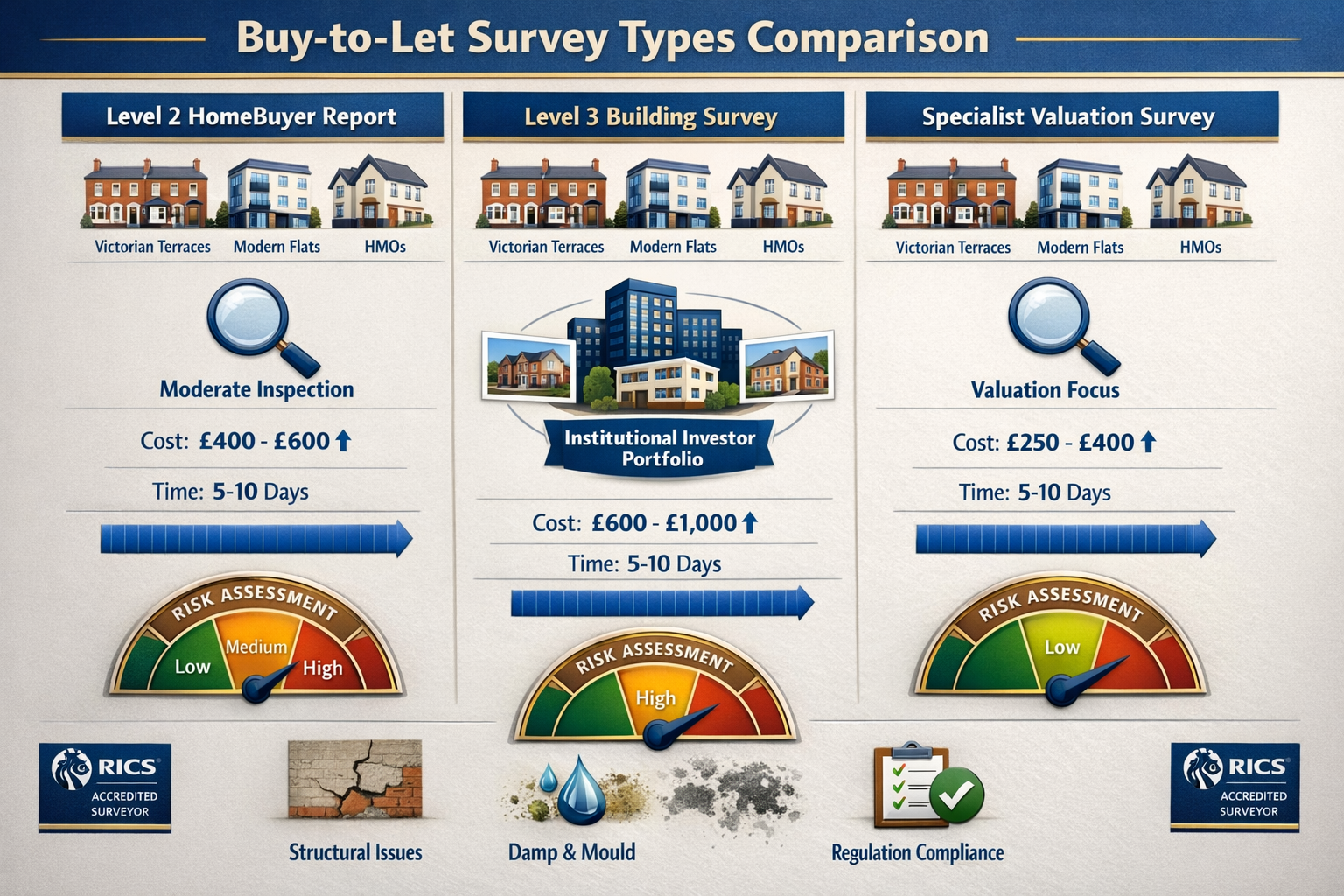
Level 2 HomeBuyer Reports vs Level 3 Building Surveys
Choosing the appropriate survey type represents a critical decision in the buy-to-let acquisition process. The two primary options—Level 2 HomeBuyer Reports and Level 3 Building Surveys—serve different purposes and suit different property types.
Level 2 HomeBuyer Report characteristics:
✅ Suitable for conventional properties in reasonable condition
✅ Visual inspection of accessible areas
✅ Traffic light rating system for defects
✅ Lower cost (typically £400-800)
✅ Faster turnaround (5-7 days)
❌ Limited scope for older or unusual properties
❌ No detailed structural analysis
Level 3 Building Survey characteristics:
✅ Comprehensive assessment of all accessible areas
✅ Detailed analysis of construction and condition
✅ Extensive reporting on defects and remediation
✅ Essential for older, altered, or unusual properties
✅ Supports complex renovation planning
❌ Higher cost (typically £800-1,500+)
❌ Longer completion time (10-14 days)
For buy-to-let investors, the choice often depends on property age and condition. Victorian terraces, properties with visible defects, or buildings requiring conversion work typically warrant Level 3 Building Surveys to ensure accurate cost projections.
"In the current market, institutional investors consistently opt for Level 3 surveys on pre-1950s properties, recognizing that comprehensive assessment protects yield projections and prevents capital erosion through unexpected repairs."
Understanding the difference between Level 2 and Level 3 surveys helps investors match assessment depth to property characteristics and investment strategy.
Specialist Valuations for Portfolio Investors
Beyond standard building surveys, institutional investors and growing portfolio landlords require specialist valuation services that integrate property condition with investment performance metrics. These assessments go beyond physical defects to evaluate rental potential, tenant appeal, and market positioning.
Components of specialist buy-to-let valuations:
- Rental yield analysis incorporating realistic market rents and void periods
- Comparable property assessment within the local rental market
- Tenant demographic profiling matching property features to demand
- Regulatory compliance review including HMO licensing and EPC requirements
- Capital growth projections based on area development plans
Professional valuation services provide the financial foundation for portfolio decisions, particularly when acquiring multiple properties or seeking investment funding.
The 10-Day Inspection Protocol
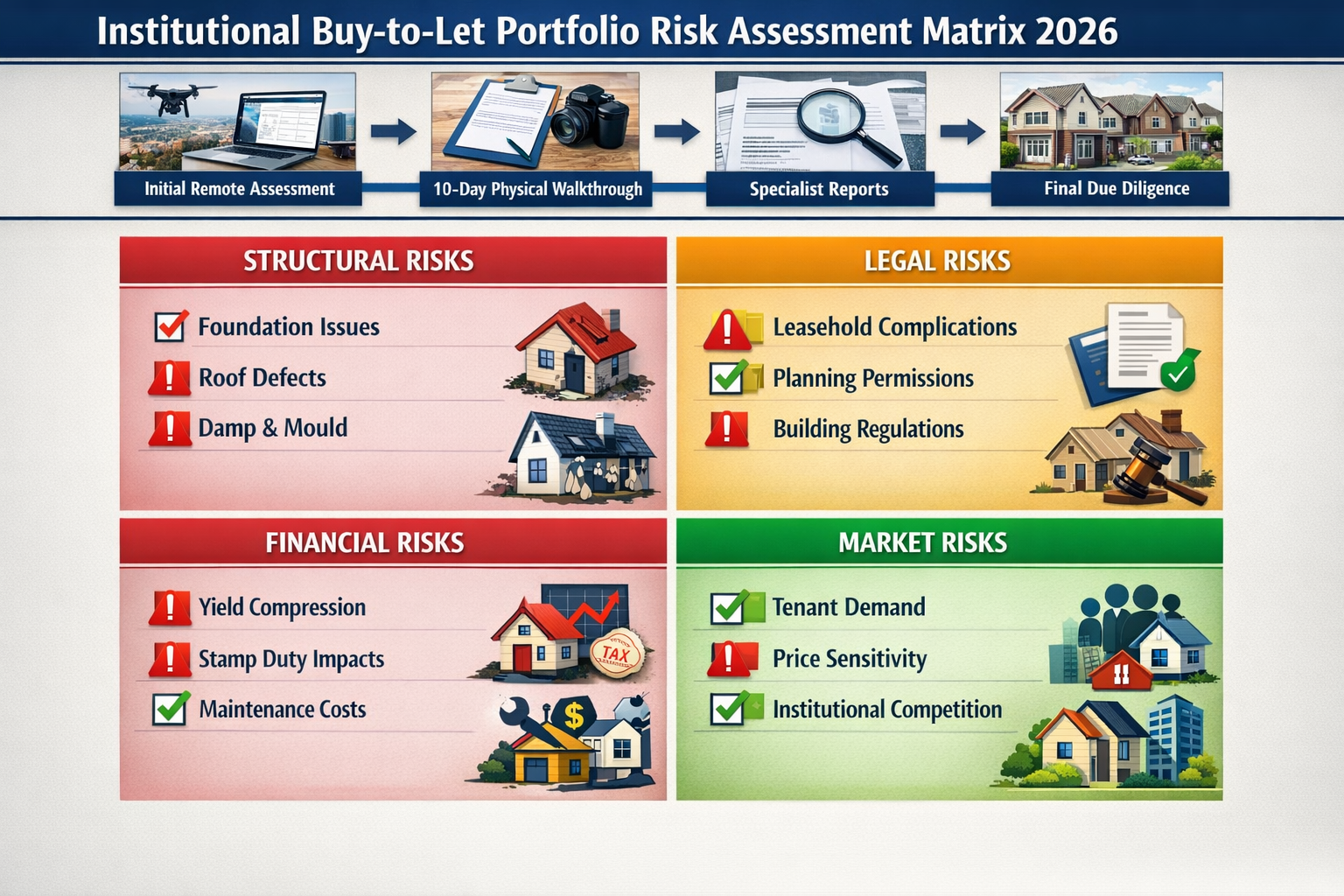
Best practice in 2026 involves a structured inspection timeline that balances thoroughness with transaction speed. The recommended 10-day inspection period allows for both remote preliminary assessment and comprehensive physical walkthrough[2].
Optimal inspection timeline:
Days 1-2: Desktop research and remote assessment
Days 3-4: Coordinated access arrangements
Days 5-7: Physical property inspection
Days 8-9: Specialist reports (damp, electrical, structural)
Day 10: Consolidated findings and recommendations
This protocol ensures investors don't rush critical decisions while maintaining transaction momentum. Properties showing significant defects during initial assessment may require extended investigation periods before proceeding.
Financial Impact: Survey Costs Within Total Acquisition Budgets
Breaking Down Transaction Costs in 2026
Understanding where survey expenses fit within total acquisition costs helps investors budget accurately and avoid capital shortfalls. A typical buy-to-let purchase involves multiple professional fees that collectively impact investment returns.
Typical cost breakdown for £200,000 property purchase:
- Stamp Duty (Limited Company): £8,000 (5% SDRT)[3]
- Solicitor Fees: £2,000-3,000
- Building Survey: £1,000-1,500
- Specialist Reports: £500-1,000
- Valuation (if required): £300-600
- Total Professional Fees: £11,800-14,100
These figures demonstrate that survey costs represent approximately 10-12% of total transaction expenses[3]. Attempting to economize by skipping surveys risks far greater losses through unidentified defects or overpayment.
The 7% Yield Benchmark and Survey Implications
Conservative investment analysis in 2026 uses the 7% gross yield threshold as a minimum screening criterion for buy-to-let viability[3]. This benchmark proves particularly challenging in southern England markets where property prices remain elevated relative to achievable rents.
Yield calculation incorporating survey findings:
Standard Calculation:
Annual Rent ÷ Purchase Price × 100 = Gross Yield
Survey-Adjusted Calculation:
Annual Rent ÷ (Purchase Price + Survey-Identified Repairs) × 100 = Realistic Yield
Properties initially appearing to meet the 7% threshold may fall short once survey-identified repairs are factored into total capital requirements. A £200,000 property generating £14,000 annual rent achieves exactly 7% yield—but if surveys reveal £20,000 in essential repairs, the realistic yield drops to 6.36%.
Regional yield variations in 2026:
🟢 Northern England: 7%+ yields achievable
🟡 Midlands: 6-7% yields typical
🔴 Southern England: 5-6% yields common
🔴 London: 4-5% yields standard
These regional disparities make thorough surveys even more critical in lower-yield markets where margin for error is minimal. Investors cannot afford unexpected repair costs that eliminate already-thin returns.
Freehold vs Leasehold: Survey Considerations
Property tenure significantly impacts both survey requirements and long-term investment viability. Institutional investors demonstrate clear preference for freehold properties due to simplified legal structures and complete property control[1].
Freehold advantages for buy-to-let:
✅ No ground rent or service charge obligations
✅ Complete control over property improvements
✅ No lease extension costs
✅ Simpler sale process
✅ Better mortgage availability
Leasehold complications requiring additional survey scrutiny:
⚠️ Building condition responsibility shared with freeholder
⚠️ Service charge history and projected increases
⚠️ Remaining lease term impact on value
⚠️ Ground rent escalation clauses
⚠️ Freeholder consent requirements for alterations
When surveying leasehold buy-to-let properties, investors must request additional documentation including service charge accounts, building insurance policies, and major works schedules. These factors directly impact net yields and should inform purchase decisions.
For guidance on choosing the right property survey, investors should consult qualified chartered surveyors who understand buy-to-let specific requirements.
Risk Assessment Strategies for Institutional-Grade Due Diligence

Structural Risk Identification
Professional buy-to-let surveys in 2026 prioritize structural integrity assessment as the foundation of risk management. Unlike cosmetic issues that affect tenant appeal, structural defects threaten property value and generate substantial repair costs.
Critical structural elements requiring detailed assessment:
🏗️ Foundation integrity – subsidence, settlement, ground movement
🏗️ Load-bearing walls – cracks, bulging, structural alterations
🏗️ Roof structure – sagging, timber decay, inadequate support
🏗️ Damp penetration – rising damp, penetrating damp, condensation
🏗️ Timber condition – rot, beetle infestation, structural compromise
Chartered surveyors employ specialized equipment including moisture meters, thermal imaging cameras, and endoscopes to identify hidden defects. Properties built before 1950 require particularly thorough structural assessment due to construction methods and material degradation.
Investors should review common defects in older homes to understand typical issues affecting period properties popular in the buy-to-let market.
Legal and Regulatory Compliance Review
Beyond physical condition, institutional-grade surveys incorporate regulatory compliance assessment that protects investors from enforcement action and ensures properties meet rental standards.
Essential compliance areas for buy-to-let properties:
- Energy Performance Certificates (EPC) – Minimum rating requirements
- Electrical safety certification – Five-year inspection cycles
- Gas safety certificates – Annual landlord obligations
- Fire safety compliance – Smoke alarms, fire doors, escape routes
- HMO licensing – Local authority registration where applicable
- Planning permission – Verification of legal use and alterations
Properties failing to meet current regulatory standards require remediation before letting, directly impacting investment returns. Survey reports should explicitly identify compliance gaps and estimate rectification costs.
Understanding statutory considerations helps investors avoid properties with complex regulatory issues that erode profitability.
Market Risk Analysis in Price-Sensitive Conditions
The 2026 property market remains characterized by price sensitivity, with buyers maintaining negotiating power and sellers unable to command significant premiums[4]. This environment creates opportunities for investors armed with comprehensive survey evidence.
Leveraging survey findings for price negotiation:
📉 Structural defects: 5-15% price reduction potential
📉 Regulatory non-compliance: 3-8% reduction for remediation costs
📉 Deferred maintenance: 2-5% reduction based on repair schedules
📉 Market positioning: Additional leverage in slow-moving markets
Professional surveyors provide detailed cost estimates for identified defects, creating objective evidence for renegotiation. In the current market, sellers recognize that subsequent buyers will conduct similar assessments, reducing resistance to justified price adjustments.
"Survey-informed negotiation in 2026 represents standard practice among institutional investors. Properties with significant defects either achieve price reductions reflecting repair costs or fail to complete, protecting investor capital from value-destroying acquisitions."
Limited Company Purchase Considerations
Enhanced Legal Requirements and Survey Integration
Purchasing buy-to-let properties through limited company structures involves additional legal complexity requiring SRA-regulated solicitor involvement and personal guarantees[1]. This corporate approach demands enhanced survey documentation that satisfies both company directors and potential lenders.
Additional survey requirements for limited company purchases:
- 📄 Formal valuation reports suitable for company accounts
- 📄 Director-level executive summaries highlighting material risks
- 📄 Long-term maintenance projections for capital planning
- 📄 Regulatory compliance certification for corporate governance
- 📄 Professional indemnity insurance verification
Limited companies typically maintain higher documentation standards than individual landlords, making comprehensive surveys essential rather than optional. Company directors owe fiduciary duties to shareholders that mandate thorough due diligence on all property acquisitions.
SDRT Stamp Duty Impact on Survey Cost-Benefit Analysis
The 5% Stamp Duty Reserve Tax (SDRT) applicable to limited company property purchases significantly impacts transaction economics[3]. On a typical £200,000 acquisition, SDRT adds approximately £8,000 to costs—far exceeding survey expenses.
Cost-benefit analysis framework:
Survey Investment: £1,500
Potential Defect Discovery: £20,000+ in hidden repairs
SDRT Charge: £8,000 (unavoidable)
Risk Mitigation Value: 13:1 return on survey investment
This analysis demonstrates that survey costs represent exceptional value relative to both unavoidable stamp duty charges and potential defect exposure. Institutional investors recognize that comprehensive surveys protect far larger capital commitments.
Portfolio Expansion Strategy and Standardized Assessment
Investors building multi-property portfolios benefit from standardized survey protocols that enable consistent risk assessment across acquisitions. This systematic approach mirrors institutional investor practices and supports scalable growth.
Portfolio survey standardization benefits:
✅ Comparable property condition baselines
✅ Consistent yield calculation methodologies
✅ Streamlined decision-making processes
✅ Improved lender relationships through professional documentation
✅ Enhanced exit planning with comprehensive property records
Working with the same chartered surveyor practice for multiple acquisitions builds valuable relationships and ensures assessment consistency. Regional specialists such as chartered surveyors in Central London, North London, or Berkshire develop deep local market knowledge that enhances valuation accuracy.
Specialized Survey Considerations for Different Property Types
Victorian and Edwardian Terraces
Period properties dominate many buy-to-let markets but present unique survey challenges requiring specialist expertise. Victorian and Edwardian terraces built between 1840-1914 exhibit characteristic defects that standard surveys must thoroughly investigate.
Common issues in period terraces:
- 🏚️ Solid wall construction – No cavity, higher damp risk
- 🏚️ Lime mortar deterioration – Requires specialist repointing
- 🏚️ Suspended timber floors – Ventilation and rot concerns
- 🏚️ Original sash windows – Draught and maintenance issues
- 🏚️ Chimney stack condition – Structural and weather-tightness problems
These properties typically require Level 3 Building Surveys providing detailed analysis of construction methods and appropriate repair specifications. Understanding what to look out for when buying an old house helps investors assess whether period properties suit their investment strategy.
Modern Apartments and New Builds
Contrary to common assumptions, modern properties and new builds also require professional survey assessment. While structural issues prove less common, other defects can significantly impact buy-to-let viability.
New build survey priorities:
🔍 Snagging defects – Cosmetic and functional completion issues
🔍 Building regulation compliance – Verification of certification
🔍 Fire safety systems – Post-Grenfell scrutiny requirements
🔍 Sound insulation – Critical for tenant satisfaction
🔍 Warranty documentation – NHBC or equivalent coverage
Professional snagging surveys identify defects before completion, enabling investors to require developer rectification. This proves particularly valuable for buy-to-let purchases where tenant complaints about unresolved issues damage landlord reputation and income.
Investors should understand whether surveys are necessary for new builds to make informed decisions about assessment requirements.
Houses in Multiple Occupation (HMOs)
HMO properties present the most complex survey requirements due to intensive use, regulatory obligations, and higher maintenance demands. Professional assessment must address both building condition and licensing compliance.
HMO-specific survey elements:
- 🏢 Fire safety infrastructure – Compartmentation, detection, escape routes
- 🏢 Kitchen and bathroom facilities – Adequacy for occupant numbers
- 🏢 Room size compliance – Minimum space standards
- 🏢 Amenity provision – Shared space requirements
- 🏢 Structural capacity – Additional loading from multiple occupants
HMO surveys should explicitly confirm licensing compliance and identify any works required to meet local authority standards. Failure to address these issues pre-purchase can result in enforcement action preventing property letting.
Actionable Survey Implementation Framework
Pre-Purchase Survey Checklist
Successful buy-to-let investors follow systematic processes ensuring comprehensive assessment before commitment. This checklist provides a practical framework for survey implementation.
Essential pre-purchase survey steps:
☑️ Determine appropriate survey level based on property age and condition
☑️ Engage RICS-qualified chartered surveyor with buy-to-let experience
☑️ Schedule inspection allowing 10-day assessment period[2]
☑️ Request specialist reports for identified concerns (damp, electrical, structural)
☑️ Review findings with surveyor to understand implications
☑️ Obtain repair cost estimates from qualified contractors
☑️ Recalculate investment returns incorporating survey-identified costs
☑️ Negotiate price adjustments based on objective evidence
☑️ Proceed or withdraw according to revised financial analysis
This systematic approach prevents emotional decision-making and ensures investment discipline regardless of market conditions.
Integrating Survey Findings Into Investment Decisions
Survey reports provide raw data requiring interpretation within broader investment strategy. Professional investors develop frameworks for translating survey findings into actionable decisions.
Survey finding categorization:
Category A – Deal Breakers:
Major structural defects exceeding 15% of property value, regulatory non-compliance preventing letting, undisclosed legal restrictions
Category B – Price Adjusters:
Significant repairs requiring 5-15% of property value, deferred maintenance affecting tenant appeal, compliance upgrades with clear costs
Category C – Maintenance Planning:
Minor defects under 5% of property value, predictable lifecycle replacements, cosmetic improvements enhancing rental potential
This classification enables rapid decision-making while maintaining investment discipline. Category A findings typically trigger withdrawal or substantial renegotiation, while Category C issues inform ongoing property management rather than purchase decisions.
Building Surveyor Relationships for Portfolio Growth
Investors planning multiple acquisitions benefit enormously from developing ongoing relationships with qualified chartered surveyors. These professional partnerships deliver advantages beyond individual transaction support.
Long-term surveyor relationship benefits:
💼 Priority scheduling during competitive acquisition periods
💼 Portfolio-level insights identifying patterns across holdings
💼 Preferential pricing for multiple instructions
💼 Streamlined communication through established processes
💼 Expert witness support for disputes or insurance claims
Regional specialists develop deep local knowledge invaluable for comparative analysis. Investors operating in specific areas benefit from engaging local chartered surveyors who understand regional construction methods, common defects, and market dynamics.
Conclusion
The Chartered Surveyor Guide to Buy-to-Let Surveys in 2026: Assessing Risks Amid Institutional Investor Shifts demonstrates that professional property assessment has evolved from optional extra to essential investment protection. As institutional investors raise industry standards and market conditions remain price-sensitive, comprehensive surveys provide the foundation for successful buy-to-let acquisition.
The financial case proves compelling: survey investments of £1,000-1,500 protect against defect exposure potentially exceeding £20,000 while providing negotiating leverage in buyer-favorable markets. With total transaction costs including stamp duty, solicitor fees, and surveys approaching £15,000 on typical purchases[3], the survey component represents exceptional value relative to overall capital commitment.
Investors who embrace institutional-grade due diligence—including 10-day inspection protocols, specialist assessments, and comprehensive risk evaluation—position themselves for sustainable portfolio growth and yield protection. The 7% benchmark remains challenging but achievable for disciplined investors who thoroughly assess properties before commitment[3].
Next Steps for Buy-to-Let Investors
- Assess current portfolio holdings against institutional survey standards
- Engage RICS-qualified chartered surveyors for upcoming acquisitions
- Implement standardized assessment protocols across all property purchases
- Review limited company structures considering SDRT implications[3]
- Develop regional specialist relationships for target investment areas
- Integrate survey findings into yield calculations and negotiation strategies
The buy-to-let market in 2026 rewards investors who match institutional professionalism while maintaining individual investor agility. Comprehensive surveys provide the intelligence foundation for this competitive advantage, protecting capital and maximizing returns in an increasingly sophisticated market.
For investors seeking to understand which building survey they need or requiring professional assessment services, engaging qualified chartered surveyors represents the essential first step toward informed, profitable buy-to-let investment.
References
[1] Watch – youtube.com
[2] Watch – youtube.com
[3] Watch – youtube.com
[4] Forecasting The Future What To Expect From House Prices In 2026 – surveyingcorp.com