

The property market in England and Wales has long been plagued by uncertainty, delays, and frustrating transaction failures. Meanwhile, just across the border, Scotland's housing market has demonstrated remarkable stability and efficiency throughout 2025 and into 2026. What makes the Scottish system different? The answer lies in a fundamentally different approach to property transactions—one that prioritizes upfront information disclosure through comprehensive building and valuation reports provided at the very start of the sales process.
As England and Wales grapple with market volatility and extended transaction timelines, the question arises: could adopting Scottish survey models for England 2026 offer a practical pathway to faster, more certain property transactions? This article examines the proven advantages of Scotland's approach and explores how RICS-aligned chartered surveyors can implement elements of this model to deliver greater certainty in residential property deals.
Key Takeaways
- 🏴 Scotland's market demonstrated superior stability in 2025 with consistent year-on-year increases across listings, sales, and completions compared to England's volatility
- 📊 42% of Scottish surveyors reported rising house prices in January 2026—the strongest reading in nearly a year—while 62% expect further increases within 12 months
- ⚡ Upfront information disclosure is the key differentiator, with Scottish Home Reports providing building surveys and valuations before marketing begins
- 🔄 Practical adoption opportunities exist for England and Wales without legislative changes, particularly regarding early information surfacing
- ✅ Transaction efficiency improvements are measurable, with the Scottish model outperforming English processes across most key metrics
Understanding the Scottish Survey Model: A Proven Framework
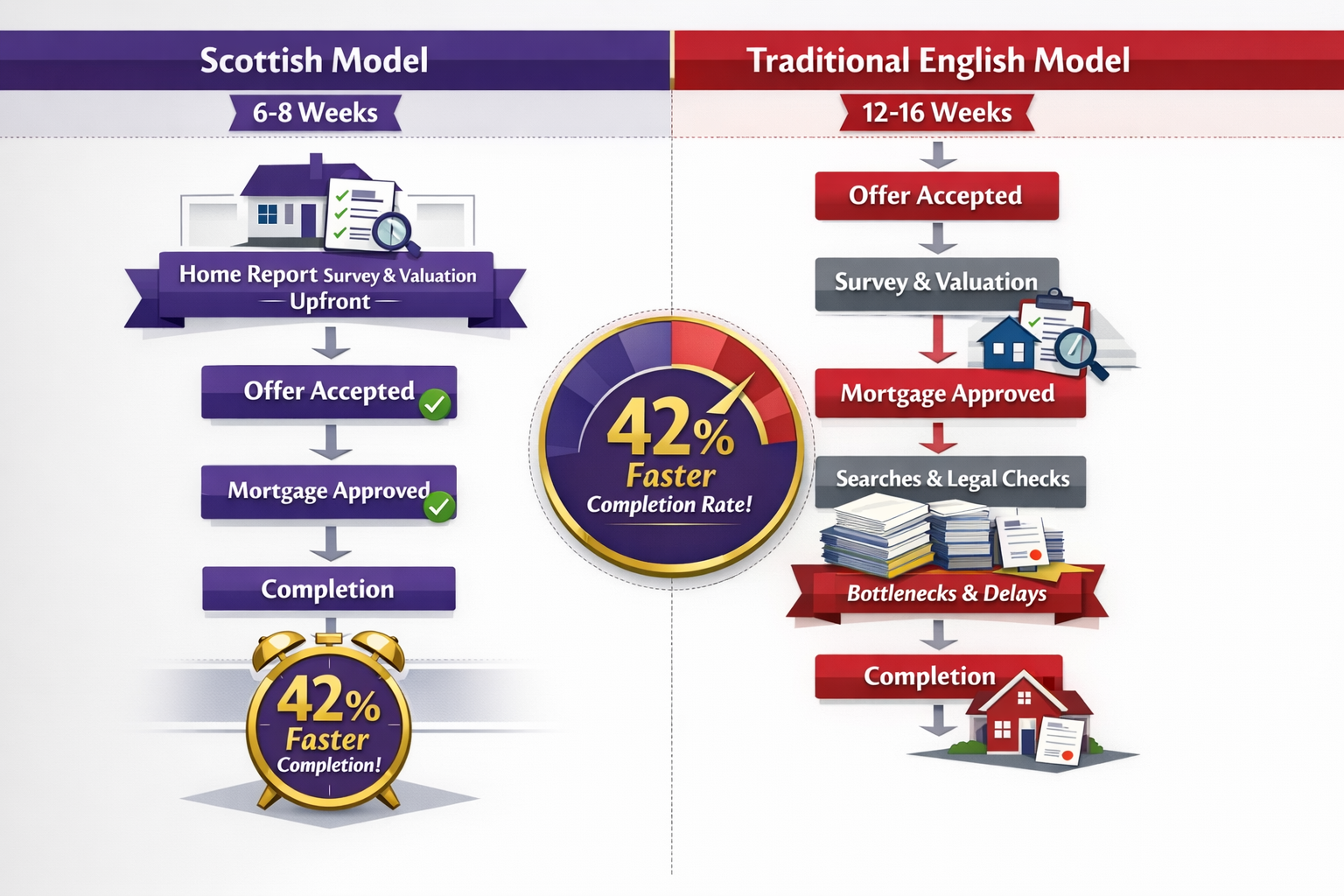
The Home Report System Explained
Scotland's property transaction system centers on the Home Report, a comprehensive document package that sellers must commission before marketing their property. This mandatory report includes three essential components:
- Single Survey – A detailed inspection conducted by a qualified surveyor
- Energy Performance Certificate (EPC) – Standard energy efficiency rating
- Property Questionnaire – Seller-provided information about the property's history
The Single Survey element represents the most significant departure from English practice. This Level 3 building survey equivalent provides prospective buyers with detailed information about the property's condition, structural integrity, and any defects before they make an offer.
Key Advantages of Upfront Surveys
The Scottish approach delivers several compelling benefits:
- Reduced fall-through rates – Buyers enter transactions with full knowledge of property condition
- Faster completion timelines – Survey delays are eliminated from the post-offer period
- Greater price certainty – Valuations are transparent from the outset
- Enhanced buyer confidence – Informed decision-making reduces post-offer surprises
- Market stability – Consistent processes create predictable outcomes
According to recent industry analysis, the Scottish transactional process is more efficient than English and Welsh models across most key metrics, offering a proven comparative framework for potential adoption [1].
Scotland's 2026 Market Performance
The effectiveness of Scotland's system is evident in its recent market performance. Throughout 2025, Scotland's property market delivered greater consistency with modest year-on-year increases across listings, Sold Subject to Missives (SSTMs), and completions—creating a more predictable operational environment compared to the volatility experienced in England and Wales [1].
Entering 2026, this momentum has continued:
| Metric | Net Balance | Significance |
|---|---|---|
| Buyer enquiries (Jan 2026) | +21% | Rising demand signal [2] |
| Instructions to sell (Jan 2026) | +27% | Meaningful supply uplift [2] |
| Price growth (past 3 months) | +42% | Strongest reading in nearly a year [2] |
| 12-month price expectations | +62% | Strong forward-looking confidence [2] |
| Q1 2026 sales forecast | +46% | Anticipated volume growth [3] |
| Year-end 2026 sales forecast | +59% | Robust annual outlook [3] |
These figures demonstrate that Scotland's structured, transparent approach to property transactions correlates with market confidence and stability—outcomes that England and Wales could benefit from replicating.
Adopting Scottish Survey Models for England 2026: Practical Implementation Strategies
Elements Ready for Immediate Adoption
The encouraging news for English and Welsh property professionals is that several practical elements of the Scottish model can be adopted without waiting for legislative intervention. Industry experts have identified surfacing trusted upfront information earlier in the transaction process as a key element for potential adoption [1].
1. Voluntary Upfront Survey Programs
Estate agents and sellers can voluntarily commission comprehensive building surveys before marketing properties. This proactive approach offers:
- Competitive advantage – Properties with pre-existing surveys stand out in crowded markets
- Faster sales – Buyers can proceed with confidence, reducing negotiation delays
- Premium positioning – Transparency signals quality and seller confidence
- Reduced renegotiation – Condition issues are disclosed upfront rather than discovered later
Chartered surveyors can partner with forward-thinking estate agents to develop pilot programs that demonstrate the value proposition to sellers.
2. Integrated Valuation and Survey Reports
Following the Scottish model, surveyors can offer combined packages that include both detailed building inspection and market valuation within a single report. This integrated approach:
- Reduces costs compared to commissioning separate reports
- Provides buyers with comprehensive information in one document
- Streamlines the mortgage application process
- Aligns surveyor incentives with transaction efficiency
Professional firms offering valuation services can develop standardized templates that mirror the Scottish Single Survey format while remaining compliant with RICS standards.
3. Digital Information Packs
Technology enables the creation of comprehensive digital property information packs that sellers can prepare before listing. These packs should include:
- Professional building survey report
- Market valuation assessment
- Energy Performance Certificate
- Property searches and title documentation
- Seller's property information form
- Planning permissions and building control certificates
By making this information available through secure online portals, all parties gain simultaneous access to critical data, eliminating information asymmetry and reducing transaction friction.
Overcoming Barriers to Adoption
Despite the clear benefits, several challenges must be addressed for widespread adoption of Scottish survey models in England:
Cost Concerns: Sellers may resist paying upfront survey costs. Solution: Demonstrate that upfront investment reduces overall transaction costs by preventing fall-throughs and renegotiations.
Market Education: Both sellers and buyers need education about the benefits. Solution: Industry bodies, estate agents, and surveyors should collaborate on awareness campaigns highlighting efficiency gains.
Quality Standardization: Ensuring consistent survey quality across providers is essential. Solution: RICS should develop standardized templates and quality benchmarks for upfront survey reports.
Valuation Timing: Property values can change between survey commissioning and offer acceptance. Solution: Include validity periods and update mechanisms within reports, similar to mortgage valuation practices.
The Role of Chartered Surveyors in Delivering Transaction Certainty
Expanding Service Offerings
Chartered surveyors are uniquely positioned to lead the adoption of Scottish-style upfront information models. By expanding service offerings to include pre-marketing survey packages, surveyors can:
- Capture additional revenue streams from seller-commissioned work
- Build relationships with estate agents seeking competitive advantages
- Demonstrate professional value beyond traditional buyer-commissioned surveys
- Contribute to market efficiency and consumer protection
Firms offering specialized services such as premium drone surveys and building pathology assessments can differentiate their upfront survey products with enhanced technology and expertise.
Quality Assurance and Professional Standards
For upfront survey models to gain market confidence, quality assurance is paramount. Chartered surveyors should:
- Adhere to RICS standards – Ensure all upfront surveys meet or exceed existing professional guidelines
- Provide comprehensive coverage – Address all material defects and condition issues that could affect value or safety
- Use clear, accessible language – Reports must be understandable to non-technical buyers while maintaining professional rigor
- Include photographic evidence – Visual documentation enhances credibility and understanding
- Offer follow-up consultations – Make surveyors available to answer buyer questions about report findings
Understanding what types of building surveys are available helps surveyors recommend appropriate inspection levels for different property types and transaction contexts.
Timeline Considerations
One common question is how long a building survey takes. For upfront survey models to work effectively, surveyors must balance thoroughness with efficiency:
- Standard properties: 2-4 hours on-site, 2-3 days for report completion
- Complex properties: 4-6 hours on-site, 3-5 days for report completion
- Rush services: Premium options for sellers with urgent marketing timelines
By establishing clear service level agreements, surveyors can help sellers plan marketing schedules around survey completion.
Valuation Integration
Combining building surveys with market valuations requires surveyors to wear multiple professional hats. Key considerations include:
- Independence: Maintaining objectivity when providing both condition assessment and value opinion
- Market knowledge: Staying current with local market conditions and comparable sales data
- Adjustment transparency: Clearly documenting how condition issues affect valuation conclusions
- Lender acceptance: Ensuring integrated reports meet mortgage lender requirements
Surveyors experienced in various valuation contexts—from insurance reinstatement to SIPP pension valuations—bring valuable expertise to integrated report preparation.
Regional Implementation: Adapting Scottish Models to Local Markets
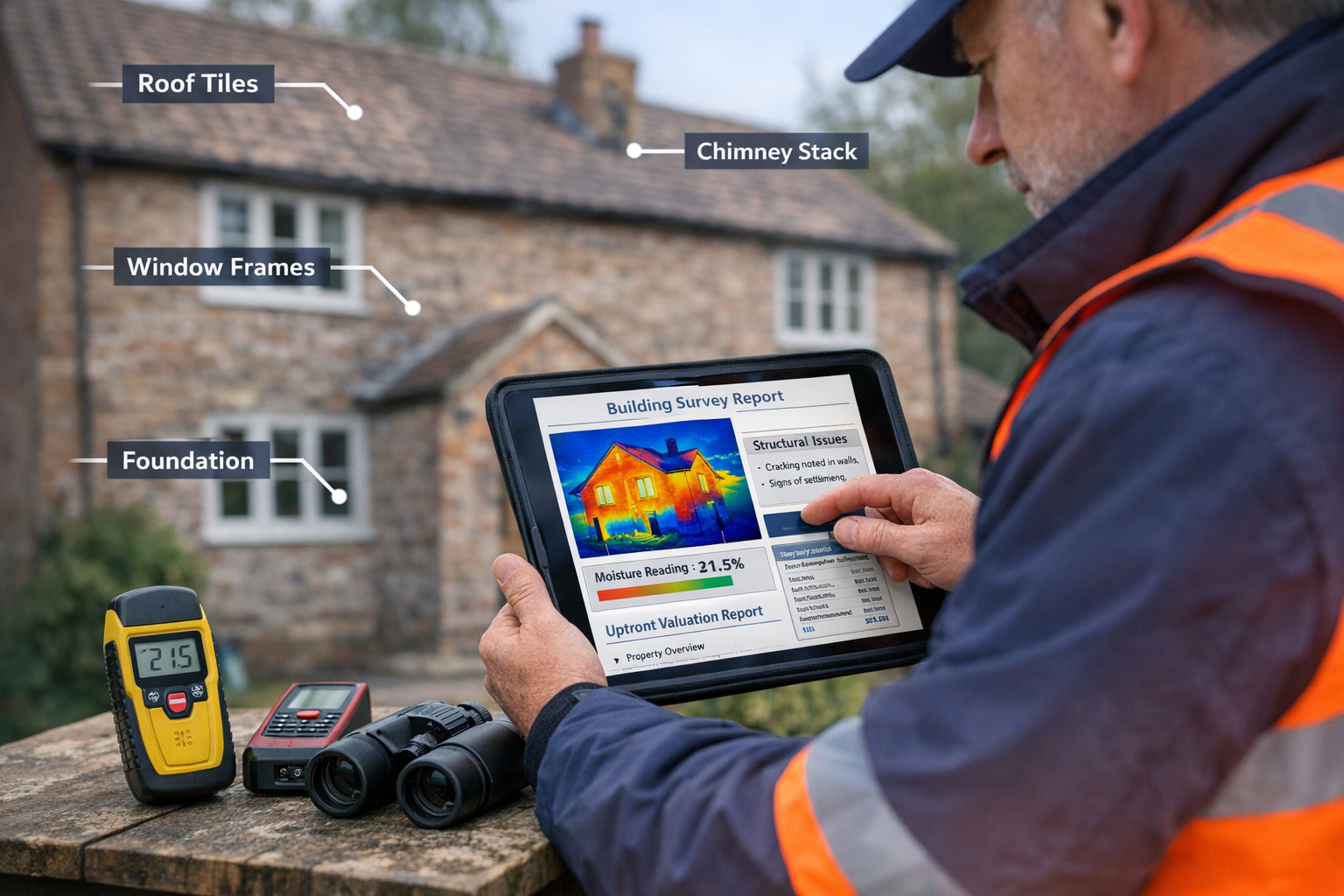
Geographic Considerations
England and Wales encompass diverse property markets with varying characteristics. Successful adoption of Scottish survey models requires regional adaptation:
Urban Markets (London, Manchester, Birmingham): High transaction volumes and competitive markets make efficiency gains particularly valuable. Fast-paced markets benefit from reduced uncertainty and quicker decision-making.
Rural Markets: Lower transaction volumes but often involving older, more complex properties where detailed upfront surveys provide significant value by revealing condition issues early.
Regional Variations: Different areas have varying property types, price points, and buyer demographics requiring tailored approaches.
Chartered surveyor firms operating across multiple regions—from Hampshire to Hertfordshire, from North London to Surrey—can develop market-specific implementation strategies while maintaining consistent quality standards.
Property Type Considerations
Different property categories benefit from upfront surveys in varying ways:
Period Properties: Older homes with potential structural issues, damp problems, or outdated systems benefit enormously from upfront disclosure. Buyers of Victorian, Edwardian, or Georgian properties expect condition issues and appreciate transparency.
New Build and Modern Properties: While typically having fewer defects, comprehensive snagging reports and quality assessments still provide value by documenting builder responsibilities.
Flats and Apartments: Leasehold properties involve additional complexities around building management, service charges, and shared responsibilities that upfront reports should address.
High-Value Properties: Premium properties in areas like Chelsea, Richmond, and Esher warrant comprehensive upfront due diligence given the financial stakes involved.
Industry Collaboration and Future Outlook
Stakeholder Alignment
Successful adoption of Scottish survey models requires collaboration across the property industry:
Estate Agents: Must recognize upfront surveys as competitive advantages rather than obstacles. Forward-thinking agents can differentiate their services by offering comprehensive information packages.
Mortgage Lenders: Need to accept seller-commissioned surveys and valuations as valid for lending purposes, potentially with verification mechanisms.
Solicitors: Should integrate upfront survey information into conveyancing processes, using disclosed condition issues to inform contract negotiations and legal protections.
Industry Bodies: RICS, National Association of Estate Agents (NAEA), and other professional organizations should develop best practice guidelines and promote adoption.
Government: While legislative change isn't required for voluntary adoption, supportive policy frameworks could accelerate implementation.
Technology Enablers
Digital transformation supports upfront information models through:
- Online portals for secure document sharing and access
- Digital survey tools including drone technology and thermal imaging
- Automated valuation models to supplement professional judgment
- Blockchain for immutable property information records
- AI-assisted report generation to improve efficiency while maintaining quality
2026 and Beyond: Market Evolution
As we progress through 2026, several trends support the adoption of Scottish survey models in England:
- Continued market volatility creates demand for greater transaction certainty
- Consumer expectations increasingly favor transparency and upfront information
- Technology advancement makes comprehensive information packages more feasible
- Professional innovation as surveyors seek new service offerings and revenue streams
- Regulatory momentum toward consumer protection and market efficiency
Scotland's strong market performance entering 2026—with 62% of surveyors expecting higher prices within 12 months and 59% anticipating increased sales volumes by year-end [3]—demonstrates the correlation between transparent, efficient transaction processes and market confidence.
Conclusion: Building a More Efficient Property Market
Adopting Scottish survey models for England 2026 represents a practical, achievable pathway to faster property transactions via upfront building and valuation reports. Scotland's proven track record of market stability, efficiency advantages, and strong 2026 performance indicators demonstrate that prioritizing early information disclosure delivers tangible benefits for all stakeholders.
The key insight is that legislative change isn't required for meaningful progress. Chartered surveyors, estate agents, and sellers can voluntarily implement upfront survey programs today, creating competitive advantages while contributing to broader market improvement.
Actionable Next Steps
For Chartered Surveyors:
- Develop standardized upfront survey and valuation packages
- Partner with estate agents to pilot voluntary programs
- Invest in technology to improve efficiency and report quality
- Educate clients about the benefits of pre-marketing surveys
For Estate Agents:
- Identify properties where upfront surveys provide maximum value
- Incorporate survey availability into marketing strategies
- Train staff to explain benefits to sellers and buyers
- Track performance metrics comparing properties with and without upfront surveys
For Sellers:
- Consider commissioning comprehensive surveys before marketing
- View upfront survey costs as investments in faster, more certain sales
- Use survey findings to address issues proactively or price appropriately
- Leverage transparency as a competitive differentiator
For Buyers:
- Prioritize properties with available upfront surveys
- Use survey information to make informed offers
- Reduce post-offer survey contingencies when comprehensive information exists
- Appreciate sellers who provide transparency
The Scottish model proves that transparency accelerates transactions rather than hindering them. As England and Wales face ongoing market challenges, the time has come to embrace proven solutions that deliver greater certainty, reduced fall-through rates, and improved outcomes for everyone involved in property transactions.
By learning from Scotland's success and adapting best practices to local contexts, the English and Welsh property markets can evolve toward greater efficiency in 2026 and beyond. The journey begins with professional leadership from chartered surveyors committed to delivering value through comprehensive, upfront building and valuation reports.
References

[1] Property Trends 2026 Why The Industry Is Increasingly Focused On Gaining Greater Certainty – landmark.co.uk
[2] Scottish Housing Market 2026 Rics Survey – simpsonmarwick.com
[3] Surveyors Expect Busy First Quarter For Scottish Housing Market After Quieter December – scottishfinancialnews.com