

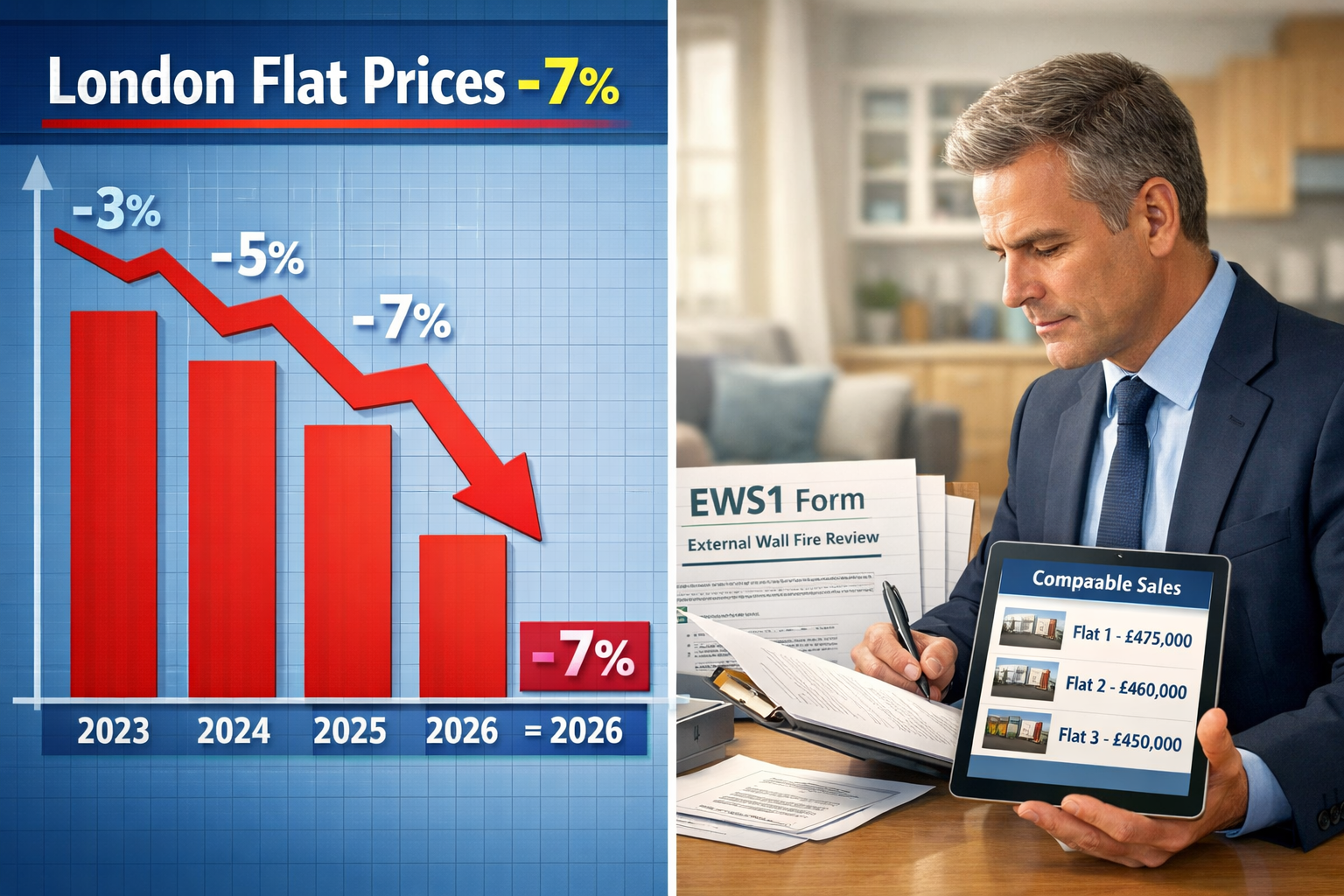
London's flat market faces unprecedented complexity in 2026. While property experts forecast modest stabilisation after years of decline, chartered surveyors now navigate a minefield of valuation challenges that extend far beyond traditional comparable sales analysis. With flat prices having fallen 7% since early 2023 and two in five new build flat owners selling at a loss over the past two decades [1], the Valuation Challenges in London's 2026 Flat Market Stabilisation: Chartered Surveyor Techniques Post-Budget demand sophisticated approaches that account for cladding crises, leasehold complications, and dramatically shifted lending criteria.
The divergence between houses and flats has created a two-tier London property market. While semi-detached and terraced houses appreciated between 1.4% and 3% over the past year, London flats dropped 5.1% in value [2]. This structural shift, combined with post-budget tax implications and tightened mortgage availability, requires chartered surveyors to deploy enhanced valuation methodologies that traditional approaches simply cannot address.
Key Takeaways
- 📉 London flats have declined 5.1% in value over the past year while houses appreciated, creating significant valuation complexity for chartered surveyors
- 🏢 EWS1 certification and cladding issues can reduce mortgage valuations to near-zero until remediation is completed, requiring specialist assessment techniques
- 💷 Service charges of £200-400 monthly directly impact flat valuations and must be incorporated into comparable sales adjustments
- 🏦 Major lenders have tightened criteria for flats, creating liquidity challenges that surveyors must factor into market value assessments
- 📊 Real-terms losses can reach 25-30% when inflation is considered, making inflation-adjusted valuation analysis essential for accurate reporting
Understanding the 2026 London Flat Market Landscape
The Scale of Market Divergence
The Valuation Challenges in London's 2026 Flat Market Stabilisation: Chartered Surveyor Techniques Post-Budget begin with understanding the fundamental market shift. Flats constitute approximately 60% of London sales, significantly weighing down overall average property prices [4]. This dominance means that flat market performance directly influences broader London property indices, yet the segment faces unique headwinds.
Central London has experienced even steeper declines than outer boroughs, with some prime areas seeing double-digit percentage drops from peak values. The divergence creates geographical complexity for chartered surveyors conducting comparable sales analysis, as location premiums have compressed differently across postal codes.
Key Market Indicators for 2026
| Indicator | Current Status | Impact on Valuation |
|---|---|---|
| Flat price change (YoY) | -5.1% [2] | Requires recent comparable weighting |
| House price change (YoY) | +1.4% to +3% [2] | Creates cross-segment comparison challenges |
| Mortgage costs vs 2021 | +40% monthly payments [2] | Reduces buyer affordability calculations |
| Service charge range | £200-400/month [2] | Direct deduction from capital value |
| New build loss rate | 40% sold at loss [1] | Premium erosion in valuation models |
Property experts expect London to underperform the national average in 2026, with growth likely remaining in low single digits and flats particularly lagging behind houses [5]. This forecast environment requires chartered surveyors to apply conservative growth assumptions when conducting valuations for mortgage, tax, or investment purposes.
Post-Budget Tax Implications
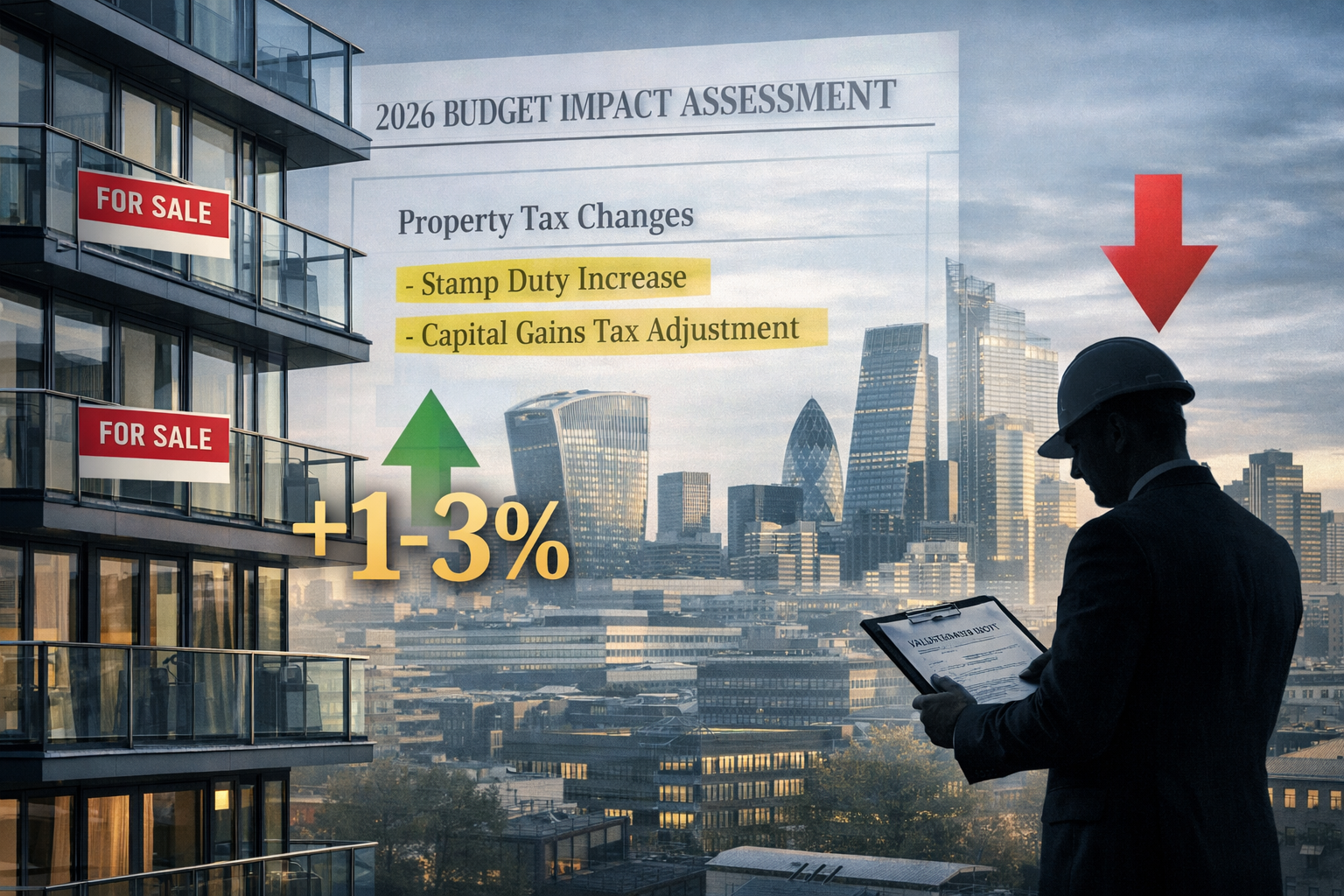
The 2026 budget has introduced additional considerations for flat valuations, particularly affecting:
- Capital Gains Tax calculations for flat disposals, where real-terms losses may not align with nominal gains
- Inheritance tax valuations requiring current market evidence rather than historical peak values
- Stamp Duty Land Tax thresholds that influence buyer behavior and comparable transaction volumes
Chartered surveyors must now incorporate these fiscal factors when advising clients on inheritance tax valuations and other tax-related property assessments.
Core Valuation Challenges in London's 2026 Flat Market Stabilisation
The Cladding Crisis and EWS1 Certification
Perhaps the most significant challenge facing chartered surveyors in 2026 is the ongoing cladding remediation crisis. EWS1 certification and cladding remediation costs are creating liquidity problems, with some survey valuations falling well below agreed sale prices and mortgage valuations approaching zero until remediation is completed [3].
This creates a fundamental valuation dilemma:
Before remediation: A flat may be technically unmortgageable, with lenders refusing to provide financing regardless of the property's physical condition or location merits.
During remediation: Values remain suppressed as buyers face uncertainty about completion timelines and potential additional costs.
After remediation: Values may recover, but the market has typically moved, and comparable evidence becomes outdated.
Major lenders including Halifax, Santander UK, Barclays, and NatWest have tightened lending criteria for flats [3], creating an "unmortgageable problem" for certain properties. Chartered surveyors must now conduct dual valuations in many cases:
- Market value assuming mortgage availability (for properties with EWS1 certification)
- Market value reflecting actual liquidity constraints (for properties without certification)
Leasehold Complications and Extension Costs
Leasehold complications and lease extension costs are creating additional buyer reluctance and valuation headwinds beyond traditional affordability factors [2]. The Valuation Challenges in London's 2026 Flat Market Stabilisation: Chartered Surveyor Techniques Post-Budget include sophisticated lease adjustment calculations that account for:
- Remaining lease term and its impact on mortgageability (typically sub-80 years triggers concerns)
- Marriage value calculations for leases below 80 years
- Ground rent capitalization and its effect on capital value
- Freeholder cooperation risk in lease extension negotiations
Chartered surveyors specializing in leasehold extension and enfranchisement valuations must now factor these elements into standard residential valuations, as they directly impact both buyer willingness to pay and lender willingness to advance funds.
Service Charge Escalation Impact
Service charges have increased significantly to £200-400 per month for mid-range properties [2], directly impacting flat valuations and buyer affordability. This represents a fundamental shift in the income-to-cost ratio for flat ownership.
Chartered surveyors must now:
- Capitalize service charges into value deductions using appropriate yield assumptions
- Compare service charge efficiency across comparable properties
- Assess reserve fund adequacy and potential for special assessments
- Evaluate management company quality and its impact on future cost trajectory
A flat with £300 monthly service charges represents £3,600 annually. Capitalized at a 5% yield, this equates to a £72,000 deduction from comparable value—a material adjustment that many traditional valuation approaches underestimate.
Real-Terms vs Nominal Value Considerations
Real-terms losses for flat owners can reach 25-30% over the past five years when accounting for inflation, despite modest nominal price movements [1]. This creates a psychological pricing challenge where sellers resist accepting current market values that represent significant real-terms losses.
Chartered surveyors must navigate:
- Vendor expectations based on purchase prices that haven't kept pace with inflation
- Comparable sales evidence that may reflect distressed or motivated transactions
- Inflation-adjusted analysis for long-term holding period assessments
- Investment performance reporting for SIPP pension valuations and portfolio reviews
Advanced Chartered Surveyor Techniques for Accurate Flat Valuations
Enhanced Comparable Sales Analysis
Traditional comparable sales analysis requires significant enhancement to address the Valuation Challenges in London's 2026 Flat Market Stabilisation: Chartered Surveyor Techniques Post-Budget. Modern best practices include:
🎯 Time-Weighted Comparable Selection
With rapidly changing market conditions, chartered surveyors now apply exponential weighting to comparable evidence:
- 0-3 months old: Full weight (100%)
- 3-6 months old: Moderate weight (75%)
- 6-12 months old: Reduced weight (50%)
- 12+ months old: Contextual reference only (25%)
This approach ensures valuations reflect current market sentiment rather than outdated transaction evidence.
📊 Multi-Factor Adjustment Matrix
Chartered surveyors deploy comprehensive adjustment matrices that account for:
| Factor | Typical Adjustment Range | Evidence Source |
|---|---|---|
| EWS1 certification status | -15% to -30% | Lender criteria analysis |
| Lease length (sub-80 years) | -5% to -20% | Lease extension cost modeling |
| Service charge premium | -£20 per £1/month variance | Capitalization yield analysis |
| Building remediation status | -10% to -25% | Transaction evidence comparison |
| Management company quality | -3% to +5% | Buyer preference surveys |
Residual Valuation for Remediation Properties
For properties requiring cladding remediation or other major works, chartered surveyors employ residual valuation methodology:
Market Value = Post-Remediation Value – Remediation Costs – Holding Costs – Developer Profit
This approach provides realistic valuations that reflect the economic position of buyers who must undertake remediation work. It's particularly relevant for commercial valuations where mixed-use buildings face similar challenges.
Affordability-Adjusted Valuation Models
With monthly mortgage payments on London flats remaining approximately 40% higher than 2021 levels [2], chartered surveyors now incorporate affordability stress testing into valuation analysis:
- Calculate monthly ownership costs: Mortgage payment + service charge + ground rent + insurance
- Assess buyer income requirements: Apply 4.5x income multiple (typical lending limit)
- Compare to area income demographics: Determine buyer pool size
- Adjust value accordingly: Reduce value if affordability constrains demand
This technique provides more realistic market value assessments than pure comparable analysis in affordability-constrained markets.
Scenario-Based Valuation Reporting
Modern chartered surveyor practice increasingly employs scenario-based reporting that provides clients with value ranges under different assumptions:
Base Case: Current market conditions with existing constraints
Optimistic Case: Post-remediation or post-lease extension value
Pessimistic Case: Forced sale or continued market decline scenario
This approach proves particularly valuable for annual tax valuations where clients need to understand valuation sensitivity to changing market conditions.
Regional Variations and Location-Specific Considerations

Central vs Outer London Dynamics
The Valuation Challenges in London's 2026 Flat Market Stabilisation: Chartered Surveyor Techniques Post-Budget vary significantly by location. Chartered surveyors working across different London boroughs must adapt their approaches:
Central London (Chelsea, Camden, Hampstead):
- Steeper price declines from peak values
- Higher proportion of investment buyers (less affordability-sensitive)
- Greater exposure to international buyer sentiment
- Premium service charges but better building quality
Outer London (East London, Enfield, Romford):
- More stable pricing but lower absolute values
- Higher proportion of owner-occupiers (more affordability-sensitive)
- Greater exposure to mortgage availability changes
- Lower service charges but variable building quality
Commuter Belt (Watford, Hemel Hempstead):
- Hybrid dynamics between London and regional markets
- Transport link quality heavily influences value
- Less cladding exposure but more new build stock
- Service charge expectations lower than central London
New Build vs Established Stock
Two in five new build flat owners have sold at a loss over the past 20 years [1], creating a new build premium erosion that chartered surveyors must carefully assess. Valuation approaches differ significantly:
New Build Flats:
- Apply premium discount (typically 10-20% below developer asking prices)
- Assess Help to Buy scheme impact on comparable evidence
- Evaluate defects liability period and NHBC warranty coverage
- Consider building warranty transferability
Established Stock:
- Assess building condition and maintenance history
- Evaluate modernization requirements
- Consider historical service charge trajectory
- Review management company track record
Practical Implementation for Property Professionals
Documentation Requirements
Chartered surveyors addressing the Valuation Challenges in London's 2026 Flat Market Stabilisation: Chartered Surveyor Techniques Post-Budget require comprehensive documentation:
✅ Essential Documents:
- Current lease (full copy, not summary)
- Last three years of service charge accounts
- EWS1 form or evidence of building assessment
- Management company details and contact information
- Ground rent payment schedule
- Reserve fund status and major works planning
- Recent comparable sales evidence (ideally 6+ examples)
- Lender criteria documentation for mortgageability assessment
Client Communication Strategies
Given the complexity of current market conditions, chartered surveyors must employ enhanced client communication:
"In the current London flat market, valuation is not simply a matter of comparing recent sales. We must account for cladding status, lease terms, service charge trajectories, and lender appetite—all of which can materially impact both market value and achievable sale price."
Clear explanation of valuation limitations and assumptions proves essential, particularly when values fall below client expectations or previous valuations.
Professional Standards and RICS Compliance
The Royal Institution of Chartered Surveyors (RICS) Red Book provides the framework for professional valuation practice, but chartered surveyors must now apply enhanced judgment in:
- Assumption transparency: Clearly stating assumptions about remediation, lease extensions, or market stabilization
- Comparable evidence quality: Ensuring comparable sales reflect similar constraints (EWS1 status, lease length, etc.)
- Market conditions commentary: Providing context about market trends and valuation uncertainty
- Departure justification: Documenting reasons for departing from standard methodologies when appropriate
Future Outlook and Strategic Considerations
Market Stabilization Indicators
While property experts expect London to underperform the national average in 2026 [5], several indicators suggest potential stabilization:
📈 Positive Factors:
- Cladding remediation programs advancing (though slowly)
- Leasehold reform legislation providing greater certainty
- Service charge transparency improving buyer confidence
- Mortgage rates stabilizing after recent volatility
📉 Headwind Factors:
- Continued affordability constraints limiting buyer pool
- Build-to-rent sector competing with traditional sales market
- Remote work trends reducing central London premium
- Economic uncertainty affecting buyer confidence
Strategic Valuation Approaches for Different Purposes
Chartered surveyors must tailor their approach based on valuation purpose:
Mortgage Valuations: Conservative approach emphasizing lender criteria and liquidity
Tax Valuations: Market value basis with clear assumption documentation
Investment Valuations: Income approach incorporating rental yield analysis
Matrimonial Valuations: Balanced approach considering both forced sale and optimal marketing scenarios
Conclusion
The Valuation Challenges in London's 2026 Flat Market Stabilisation: Chartered Surveyor Techniques Post-Budget represent a fundamental shift in property valuation practice. With flat prices down 5.1% annually while houses appreciate, cladding issues creating unmortgageable properties, service charges rising dramatically, and real-terms losses reaching 25-30%, traditional comparable sales analysis alone proves insufficient.
Chartered surveyors must now deploy enhanced methodologies including time-weighted comparable selection, multi-factor adjustment matrices, residual valuation for remediation properties, affordability-adjusted models, and scenario-based reporting. Regional variations between central, outer, and commuter belt locations require tailored approaches, while the divergence between new build and established stock demands careful premium assessment.
Actionable Next Steps
For property owners, buyers, and investors navigating London's complex flat market:
- Engage RICS-qualified chartered surveyors with specific London flat market experience and up-to-date knowledge of cladding, leasehold, and lending criteria challenges
- Request comprehensive documentation including EWS1 certification, service charge histories, and lease details before commissioning valuations
- Expect scenario-based valuations that reflect market uncertainty rather than single-point estimates
- Consider timing strategically as market stabilization may provide better valuation outcomes in 12-18 months
- Seek specialist advice for properties with specific challenges such as short leases, remediation requirements, or high service charges
The London flat market of 2026 demands sophisticated valuation expertise that extends far beyond traditional approaches. By understanding these challenges and employing advanced chartered surveyor techniques, property professionals can navigate this complex environment with confidence and provide clients with accurate, defensible valuations that reflect true market conditions.
References
[1] House Price Crash – hoa.org.uk
[2] Why London Houses Outperform Flats In 2026 Market – featheringtoninteriors.com
[3] Watch – youtube.com
[4] London House Prices – moneyweek.com
[5] London Property Market Outlook 2026 House Price Forecasts And Buyer Opportunities – chbl.uk