

Northern England's property market is rewriting the rules in 2026. While London and the South East struggle with stagnant prices and declining values, cities across the North West, North East, and Yorkshire are experiencing remarkable growth that's catching investors, homeowners, and chartered surveyors off guard. This dramatic regional shift demands a fresh approach to property valuations—one that accurately captures the unprecedented uplift transforming northern markets while southern regions lag behind.
The phenomenon of Chartered Valuations in Northern England's 2026 Surge: Adjusting for Price Growth Outpacing Southern Markets represents more than just a temporary fluctuation. It signals a fundamental restructuring of UK property dynamics, where affordability, regeneration investment, and economic migration are creating opportunities that professional valuers must carefully assess using RICS-approved methodologies.
Key Takeaways
✅ Northern regions lead 2026 growth: The North East achieved 7.0% monthly growth in January 2026, while London experienced -1.2% annual decline
✅ Valuation adjustments are critical: Chartered surveyors must apply sophisticated comparable analysis and growth rate adjustments to capture rapid northern appreciation
✅ Investment strategies are shifting: Northern properties offer superior ROI potential with lower entry costs and stronger growth trajectories compared to southern markets
✅ RICS standards ensure accuracy: Professional valuations using Red Book methodology protect buyers, sellers, and lenders during periods of rapid regional divergence
✅ Mortgage affordability drives demand: Stabilized rates around 4% make northern properties accessible to first-time buyers priced out of southern markets
Understanding Northern England's 2026 Property Price Surge
The Numbers Behind the Northern Boom 📊
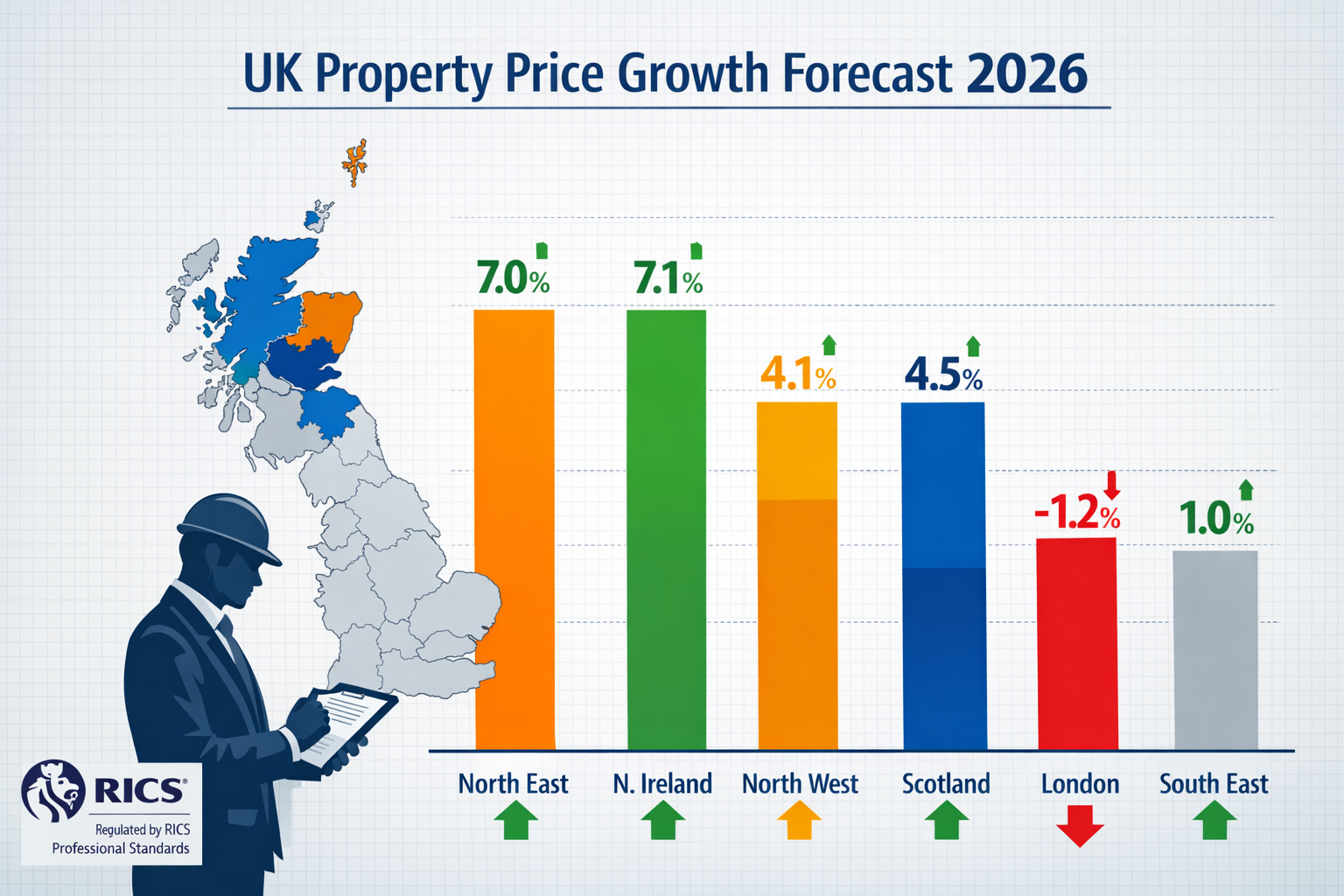
The statistics tell a compelling story. As of early 2026, the North East leads the nation with 6.8% annual growth, with January 2026 delivering an extraordinary 7.0% monthly increase. This performance dwarfs the national forecast of 0-2% annual growth and creates significant challenges for property valuations.
Meanwhile, the North West achieved 4.1% annual growth, supported by substantial regeneration investment in cities like Lancaster, Preston, and Morecambe. Yorkshire & Humber recorded 3.7% annual growth through 2025-2026, while Scotland posted 4.5% and Northern Ireland achieved the strongest regional performance at 7.1% annual growth.
| Region | Annual Growth (2026) | Monthly Growth (Jan 2026) |
|---|---|---|
| North East | 6.8% | 7.0% |
| Northern Ireland | 7.1% | – |
| Scotland | 4.5% | – |
| North West | 4.1% | – |
| Yorkshire & Humber | 3.7% | – |
| South East | 1.0% | – |
| London | -1.2% | – |
Southern Markets Face Headwinds
The contrast couldn't be starker. London experienced price declines of -1.2% annually, with Greater London's growth expectations moderating from 3% to just 2%. Prime Central London prices are holding steady rather than appreciating—a significant shift from historical patterns.
The South East saw only 1.0% annual growth, described by market analysts as "modest" compared to northern regions. Eight of the top ten areas with the biggest price growth through October 2025 were in northern or central England and Scotland, demonstrating consistent outperformance that continues into 2026.
What's Driving the Northern Surge?
Several factors converge to create this remarkable growth:
🏗️ Regeneration investment: Billions in infrastructure spending across northern cities create jobs and improve quality of life
💰 Affordability advantage: Average property prices remain 40-60% lower than London equivalents, attracting buyers and investors
📍 Economic migration: Remote work flexibility enables professionals to relocate from expensive southern markets
🏦 Mortgage accessibility: Stabilized rates around 3.75-4.75% make northern properties achievable for first-time buyers
🎓 University cities: Strong student populations in Manchester, Leeds, Liverpool, and Newcastle support rental demand
Chartered Valuations in Northern England's 2026 Surge: RICS Methodology and Adjustments
The Critical Role of Professional Valuations
When markets experience rapid appreciation, accurate property valuations become essential for multiple stakeholders. Buyers need confidence they're paying fair market value. Sellers want assurance they're capturing full appreciation. Lenders require reliable security assessments for mortgage approvals. Independent property valuations provide the objective analysis necessary for informed decisions.
Chartered surveyors following RICS Red Book standards apply rigorous methodologies to ensure valuations reflect current market conditions rather than outdated assumptions based on southern-dominated historical data.
Key Valuation Adjustments for Northern Markets
Professional valuers addressing Chartered Valuations in Northern England's 2026 Surge: Adjusting for Price Growth Outpacing Southern Markets must implement several critical adjustments:
1. Time-Adjusted Comparables ⏰
Traditional comparable sales analysis typically uses transactions from the previous 3-6 months. In rapidly appreciating markets, this approach undervalues properties. Chartered surveyors now apply monthly growth rate adjustments to older comparables, ensuring valuations reflect current market velocity.
For example, a comparable sale from three months ago in the North East requires approximately 21% upward adjustment (7% monthly × 3 months) to reflect January 2026 market conditions.
2. Regional Growth Rate Differentiation 📈
National valuation models fail to capture regional divergence. Professional valuers must apply region-specific growth rates rather than national averages. Understanding what's looked at during a property valuation helps property owners appreciate this nuanced approach.
A property in Manchester requires different growth assumptions than an equivalent property in Guildford, despite similar characteristics.
3. Micro-Market Analysis 🔍
Even within northern regions, growth varies significantly by neighborhood. Regeneration zones near new transport links or employment centers appreciate faster than peripheral areas. Chartered surveyors conduct granular analysis of:
- Recent planning permissions and development activity
- Transport infrastructure improvements
- Employment center proximity
- School catchment quality
- Retail and amenity accessibility
4. Forward-Looking Adjustments
RICS standards require valuations to reflect market conditions at the valuation date, but chartered surveyors also consider momentum indicators:
- Sales volumes and time-on-market trends
- Mortgage approval rates
- New listing inventory levels
- Local economic indicators
Valuation Methods for Different Property Types
Different property categories require tailored approaches:
Residential Properties: Comparative method with time adjustments remains primary, supplemented by rental yield analysis for investment properties
Commercial Properties: Income capitalization approach with regional yield adjustments reflecting northern market confidence
Development Sites: Residual valuation method incorporating northern market growth projections and construction cost variations
SIPP Pension Valuations: Require particular care during rapid appreciation to ensure pension fund accuracy
Common Valuation Challenges
Chartered surveyors face several obstacles when assessing northern properties:
⚠️ Limited comparable inventory: Rapid appreciation creates gaps between available comparables and current values
⚠️ Lender conservatism: Some mortgage lenders apply outdated regional risk assumptions, undervaluing northern properties
⚠️ Mixed signals: National forecasts of 0-2% growth conflict with 6-8% regional performance, creating confusion
⚠️ Buyer skepticism: Southern buyers unfamiliar with northern markets question valuations that seem "too high"
Investment Strategies: Capitalizing on Regional Price Divergence

The Northern Investment Opportunity
The dramatic gap between northern and southern performance creates compelling investment opportunities for those who understand the dynamics. While chartered surveyors in South East London assess properties in declining markets, their northern counterparts evaluate assets with strong appreciation potential.
"The 2026 northern surge represents the most significant regional rebalancing in UK property markets since the 1980s. Investors who recognize this shift early will benefit from both capital appreciation and superior rental yields." – Market Analysis
Calculating Northern vs. Southern ROI
Consider two hypothetical investment scenarios:
Northern England Investment (Manchester, 2-bed apartment):
- Purchase price: £200,000
- Annual growth: 6.5%
- Rental yield: 5.5%
- Total annual return: 12%
- 5-year projected value: £273,000
Southern England Investment (similar property in outer London):
- Purchase price: £450,000
- Annual growth: 0.5%
- Rental yield: 3.5%
- Total annual return: 4%
- 5-year projected value: £461,000
The northern property delivers triple the percentage return with less than half the capital requirement, demonstrating why understanding how to negotiate house price down after survey matters less in appreciating markets than securing properties quickly.
Strategic Considerations for Investors
Entry Timing ⏱️
Rapid appreciation creates urgency, but investors must balance speed with due diligence. Professional valuations prevent overpaying during market excitement.
Mortgage Affordability 💳
Stabilized mortgage rates around 4% make northern properties accessible. A £200,000 northern property requires approximately £40,000 deposit and £960 monthly payment at 4% over 25 years—achievable for many first-time buyers and investors.
Portfolio Diversification 🎯
Sophisticated investors spread risk across multiple northern cities rather than concentrating in single markets. Manchester, Leeds, Liverpool, Newcastle, and Sheffield each offer distinct advantages.
Property Selection Criteria 📋
Successful northern investments typically share characteristics:
- Proximity to universities or major employers
- Good transport links (rail, motorway access)
- Recent or planned regeneration activity
- Strong local rental demand indicators
- Properties requiring minimal immediate investment
What Happens When Valuations Fall Short?
In rapidly appreciating markets, buyers occasionally face situations where home valuation is less than an offer. This scenario, common in competitive northern markets, requires careful navigation.
Options include:
- Request revaluation with updated comparables reflecting recent market movement
- Provide additional evidence of comparable sales the surveyor may have missed
- Increase deposit to bridge the gap between valuation and offer
- Renegotiate purchase price if valuation reveals genuine overpricing
Tax Implications and Considerations
Northern property investments carry the same tax obligations as southern equivalents:
- Stamp Duty Land Tax: Lower property prices mean reduced SDLT burden
- Capital Gains Tax: Applies to investment properties upon sale
- Income Tax: Rental income taxed at marginal rates
- Corporation Tax: For properties held in limited companies
The lower entry costs in northern markets mean investors can acquire multiple properties within the same capital budget as a single southern property, potentially optimizing tax efficiency through strategic structuring.
Long-Term Outlook and Risk Factors
While 2026 data shows strong northern performance, prudent investors consider potential risks:
🔴 Interest rate volatility: Further rate increases could dampen affordability advantages
🔴 Economic recession: Northern economies may prove more vulnerable to downturns
🔴 Oversupply risk: Rapid new construction could exceed demand in some areas
🔴 Government policy changes: Tax or regulatory shifts could impact investment returns
However, fundamental drivers—affordability, regeneration investment, and economic rebalancing—suggest northern outperformance will persist beyond 2026's surge.
Professional Valuation Services: Choosing the Right Chartered Surveyor
RICS Accreditation and Standards
When engaging chartered surveyors for northern property valuations, RICS accreditation provides essential quality assurance. RICS Red Book standards ensure:
✓ Independence: Valuers free from conflicts of interest
✓ Competence: Appropriate qualifications and local market knowledge
✓ Transparency: Clear methodology and assumptions documentation
✓ Consistency: Standardized approaches enabling comparison
Questions to Ask Your Surveyor
Before commissioning a valuation, property owners should verify:
- Local market expertise: Does the surveyor regularly value properties in the specific northern region?
- Recent comparable knowledge: Can they cite recent sales supporting their valuation approach?
- Growth rate assumptions: What regional and local growth rates are they applying?
- Turnaround time: Can they deliver valuations quickly enough for competitive markets?
- Lender acceptance: Will their valuations satisfy mortgage lender requirements?
Valuation Report Components
Professional valuation reports for northern properties should include:
📄 Executive summary with clear market value statement
📄 Property description including condition, specifications, and location analysis
📄 Market analysis covering regional trends, local comparables, and growth rate justification
📄 Methodology explanation detailing valuation approach and adjustments applied
📄 Assumptions and limitations clarifying report scope and conditions
📄 Supporting evidence including comparable sales data and market statistics
Cost Considerations
Valuation fees vary based on property value, complexity, and urgency:
- Standard residential valuation: £300-£600
- Complex or high-value properties: £600-£1,500+
- Commercial properties: Typically 0.1-0.3% of property value
- Portfolio valuations: Negotiated rates for multiple properties
While costs may seem significant, professional valuations prevent far costlier mistakes in rapidly changing markets.
When to Commission a Valuation
Several scenarios warrant professional chartered valuations:
🏠 Purchase decisions: Before making offers in competitive northern markets
🏠 Remortgaging: To access equity from recent appreciation
🏠 Estate planning: For inheritance tax and probate purposes
🏠 Divorce settlements: To establish fair property division
🏠 Portfolio reviews: Annual assessments for investment property portfolios
🏠 Dispute resolution: Independent valuations for disagreements between parties
Conclusion: Navigating Northern England's Transformative Property Market

The Chartered Valuations in Northern England's 2026 Surge: Adjusting for Price Growth Outpacing Southern Markets phenomenon represents a historic shift in UK property dynamics. With the North East achieving 7.0% monthly growth while London declines 1.2% annually, regional divergence has never been more pronounced.
For property buyers, sellers, and investors, this creates both opportunities and challenges. Northern markets offer compelling value propositions—lower entry costs, stronger growth trajectories, and superior rental yields compared to southern equivalents. However, capitalizing on these advantages requires accurate property valuations that reflect rapid appreciation rather than outdated assumptions.
Chartered surveyors applying RICS Red Book methodology provide the professional expertise necessary to navigate these dynamic markets. Through time-adjusted comparables, regional growth rate differentiation, and micro-market analysis, they ensure valuations capture current market realities.
Actionable Next Steps
For those looking to engage with northern England's property surge:
- Commission professional valuations from RICS-accredited chartered surveyors with local northern market expertise
- Research specific cities and neighborhoods to identify areas with strongest regeneration investment and growth potential
- Secure mortgage pre-approval to act quickly in competitive markets where properties sell rapidly
- Diversify across multiple northern regions rather than concentrating investments in single cities
- Monitor market indicators including sales volumes, time-on-market, and regional economic data
- Engage local property professionals who understand nuances of northern markets
- Plan for long-term holds to maximize appreciation potential beyond 2026's surge
The regional rebalancing underway in 2026 favors those who recognize the shift early and act decisively. Whether purchasing a first home, relocating from southern markets, or building investment portfolios, northern England's property surge offers opportunities unavailable in stagnant southern regions.
Professional chartered valuations provide the foundation for confident decision-making, ensuring transactions reflect true market value in regions experiencing unprecedented growth. As mortgage rates stabilize and affordability advantages persist, northern markets are positioned to continue outperforming southern equivalents well beyond 2026.
The question isn't whether northern England's surge will continue—fundamental drivers suggest sustained outperformance. The question is whether buyers and investors will recognize the opportunity and engage qualified professionals to navigate it successfully.